Un i t e d St a t e S
Amanda Hilliard
Spoken Grammar and Its Role in
the English Language Classroom
I
f you have never heard of
spo-ken grammar, this article could
change the way you think about
teaching speaking skills and even how
you evaluate students’ speaking
abili-ties. To see an example of spoken
grammar, consider the two excerpts
below and decide which one is from
an English textbook and which one is
from a real-life conversation.
Excerpt 1:
A: My little brother is a really
good student.
B: Why do you say that?
A: Well, he is really smart, so he
always gets good grades.
B: Maybe he gets good grades
because he studies hard.
Excerpt 2:
A: Didn’t know you used boiling
water.
B: Pardon?
A: Didn’t know you used boiling
water.
B: Don’t have to but it’s um …
they reckon it’s um, quicker.
As you probably guessed, the first
excerpt is from an English textbook,
while the second excerpt is from a
real-life conversation. But can you
say why? Traditional, formal
descrip-tions of English grammar are
typi-cally based on standards of written
English; recently, though, particularly
as a result of analysis of large corpora
of spoken data and an emphasis on
spoken communication, researchers
and linguists have begun to focus on
describing features of spoken grammar
and to question the appropriateness of
applying writing-based standards and
grammatical descriptions to spoken
English. Because of current trends
emphasizing communicative language
teaching and authenticity, recognizing
the classroom role of spoken grammar
is more important than ever before.
Learning about characteristics of
spo-ken grammar and ways to teach them
empowers you to improve your
stu-dents’ overall fluency and face-to-face
conversation, increases the
authen-ticity of your speaking lessons, and
prevents your students from speaking
English like a textbook.
activities into their own teaching and also focuses on six common features of spoken grammar, with practical activities and sug-gestions for teaching them in the language classroom. It is hoped that this discussion of spoken grammar and its place in foreign language instruction, along with the activities, will encourage English-language teachers and textbook writers to incorporate more elements of spoken grammar into their own curricula.
Features of spoken English
Although many grammatical features of everyday, unplanned conversation are judged incorrect by standards of written English (Carter and McCarthy 1995; McCarthy and Carter 1995), these features of natural con-versation should not be considered incorrect deviations from standard English (Cullen and Kuo 2007). Unlike written English, spoken English is usually spontaneous and unplanned and produced in real time with no opportu-nity for editing (Cullen and Kuo 2007). This spontaneity produces some distinct features, as speakers deal with and adapt to the pres-sures of “real time processing,” resulting in a “step-by-step assembly” of speech (Cullen and Kuo 2007, 363). In addition, speech usually occurs face-to-face, resulting in highly interac-tive situations with a “shared context” (Cullen and Kuo 2007, 363). Thus, the nature and characteristics of conversational English itself lead to several distinct grammatical features of spoken English as speakers try to fulfill the interpersonal and interactive functions of spoken language in real time.
Not learning features of spoken grammar can impede students’ ability to speak English fluently and appropriately (Mumford 2009). The following six features of spoken grammar will help language instructors to understand what spoken grammar is and to provide class-room instruction and activities that advance their students’ development of spoken gram-mar knowledge and overall English speaking skills.
Six features of spoken grammar
Feature 1: Ellipsis
Ellipsis is the omission of elements nor-mally part of a certain structure and is found in both spoken and written English. For example:
“Do you have any questions?” (No ellipsis) “Any questions?” (Ellipsis—subject and verb omitted)
As Cullen and Kuo (2007) note, while ellipsis is found in both spoken and written English,
situ-ational ellipsis—omitting items that are
appar-ent, given the immediate situation—is much more common in spoken English. This is in contrast to textual ellipsis, in which the omitted information is retrievable from the text itself (Carter and McCarthy 1995). Unlike textual ellipsis, situational ellipsis often results in the omission of subjects and verbs, a phenomenon not common in written English (Carter and McCarthy 1995; McCarthy and Carter 1995). McCarthy and Carter (1995) cite an abun-dance of ellipsis in corpora data, highlighting fixed phrases and routines such as “sounds good” and “absolutely right” as examples of situational ellipsis of subjects and verbs. Situ-ational ellipsis arises from a “combination of informality and shared context” (Cullen and Kuo 2007, 368) and allows speakers to reduce the length and complexity of their comments (Leech 2000). Thus, the face-to-face nature of spoken language allows speakers to leave out information that is easily retrievable from the situation, which in turn helps them cope with the real-time pressures of conversation by speaking in shorter phrases.
Feature 2: Heads
Heads, also known as left-dislocation, are a way to introduce and orient listeners to a topic before giving information on the topic (Cul-len and Kuo 2007, 366). For example:
“The soccer game last night, it was really exciting.” (With head)
“The soccer game last night was really exciting.” (No head)
As Hughes and McCarthy (1998, 273) note, heads are both “an act of sensitivity to the listener” and “a reflection of the exigencies of face-to-face interaction and real-time nature of talk.” Heads allow speakers to highlight the topic they want to talk about before com-menting on it, giving both the speaker and the listener more processing time in real-time communication (Cullen and Kuo 2007).
Feature 3: Tails
“My teacher is really nice, the one from America.” (With tail)
“My teacher from America is really nice.” (No tail)
Tails can be a whole phrase, as in the example, “It’s very nice, that road up through Skipton to the Dales” (McCarthy and Carter 1995, 211), or they can consist of just one word, as in the example, “It’s a serious picture, that” (Timmis 2010, 333).
Tails have a range of functions, including clarifying a comment, expressing a personal attitude or judgment of an item, or serving an interpersonal function (Timmis 2010). Tails enable speakers to deal with the real-time processing and interactiveness of speech by allowing speakers to both edit their comments and give evaluative statements of topics (Rüh-lemann 2006).
Features 4 and 5: Fillers and backchannels Fillers are words and utterances like “er,” “well,” “hmm,” and “um” that do not have a specific meaning but rather fill time and allow the speaker to gather his or her thoughts (Willis 2003). Backchannels, on the other hand, are words and utterances like “uh-huh,” “oh,” “yeah,” and “I see” that are used to acknowledge what the speaker is saying and encourage him or her to continue (Stenström 2004).
Both fillers and backchannels are common in English conversation because they serve important communicative and interpersonal functions, and it would be both difficult and awkward to have a conversation without them (Willis 2003).
Feature 6: Phrasal chunks
Chunks are fixed words or phrases that can combine with other elements but act as ready-made lexical units of language, just as words do (Cullen and Kuo 2007). Because of the pressures of real-time processing, speak-ers rely on a relatively small number of fixed words and phrases to fill particular grammar functions (Leech 2000). Cullen and Kuo (2007, 370) cite different functions for dif-ferent phrasal chunks, including terms to (1) create vagueness (e.g., “sort of,” “kind of,” and “stuff like that”), (2) modify and show politeness (e.g., “a bit” and “a little bit”), and (3) mark discourse structures (e.g., “you know” and “I mean”). Cullen and Kuo (2007)
also note that these phrases can act as con-versation fillers, allowing the speaker time to pause and think about what to say under the constraints of real-time conversation.
Pedagogical issues
Even among researchers who advocate teaching specific characteristics of spoken English to English as a foreign language (EFL) students, there is no consensus on the approach teachers should adopt or the extent to which they should teach features of spoken grammar. This section focuses on three peda-gogical issues for teaching spoken grammar: (1) the need for authentic materials, (2) the necessity of teaching spoken grammar for developing students’ spoken communication skills in all contexts, and (3) the question of whether to teach production or to focus on the recognition of spoken grammar charac-teristics. Teachers who want to incorporate spoken grammar activities into their own classes must consider these issues in light of their own specific teaching contexts.
1. Using authentic spoken texts
2. Identifying when to teach spoken grammar Because of spoken grammar’s function in conversation and frequency in corpus data, a number of researchers recommend teaching it in all language classes (Cullen and Kuo 2007; McCarthy 2006; Goh 2009; Timmis 2002; Mumford 2009; Rühlemann 2008). Indeed, McCarthy (2006) emphasizes the importance of teaching spoken grammar:
Language pedagogy that claims to sup-port the teaching and learning of speak-ing skills does itself a disservice if it ignores what we know about the spoken language. Whatever else may be the result of imaginative methodologies for eliciting spoken language in the second-language classroom, there can be little hope for a natural spoken output on the part of language learners if the input is stubbornly rooted in models that owe their origin and shape to the written language. … Therefore, we believe it is timely to consider some of the insights a spoken corpus can offer, and to attempt to relate them more globally to the over-all problem of designing a pedagogical spoken grammar. (29)
In other words, it does not make sense to emphasize spoken communication and com-municative language teaching while refusing to acknowledge or teach important differences between spoken and written language. This implies that spoken grammar should be taught in all contexts—including EFL contexts—in which understanding and producing spoken language is a goal of second language teaching.
Similarly, Mumford (2009) argues that all students, regardless of likely interaction with native speakers, can benefit from learning some spoken grammar features. He identifies forms related to fluency, such as fillers, heads, tails, ellipsis, and phrasal chunks, which allow stu-dents to adapt to the pressures of real-time communication and speak more fluently and efficiently (Mumford 2009). Furthermore, surveys show that teachers generally support instruction of characteristics of spoken gram-mar, although this support can vary depending on the specific feature. For example, a survey by Timmis (2002) shows that teachers feel students need to at least be exposed to features of spoken grammar, and Goh’s (2009) survey of teachers from China and Singapore shows that
teachers feel spoken grammar knowledge is use-ful for raising students’ awareness of spoken and written language. If the ability for students to understand spoken English is a goal of language teaching, spoken grammar should be taught in the language classroom, even to EFL students. 3. Noticing versus producing spoken grammar
Another consideration when teaching spo-ken grammar is whether students should be required only to notice spoken grammar char-acteristics or whether they should be encour-aged to incorporate features of spoken grammar in their language production. McCarthy and Carter (1995) advocate a “three I’s” method-ology when teaching spoken grammar. The “three I’s” stand for illustration, interaction, and induction, where spoken data is first pre-sented, spoken grammar is highlighted, and learners are then encouraged to draw their own conclusions about and develop their capacity to notice features of spoken English (McCarthy and Carter 1995, 217). Timmis (2005) recom-mends using four types of tasks when teach-ing characteristics of spoken English: cultural access tasks, global understanding tasks, notic-ing tasks, and language discussion tasks. Both of these approaches to teaching spoken Eng-lish emphasize noticing and awareness-raising activities rather than production activities.
On the other hand, Cullen and Kuo (2007) and Mumford (2009) emphasize the need for learners to not only notice and analyze features of spoken grammar, but also to produce these features in their own speech. As Cullen and Kuo (2007, 382) note, because features of spoken grammar serve important communi-cative functions “relating to the unplanned, interactive, and interpersonal nature of con-versation,” they “cannot simply be covered by more conventional structures.” It would seem that the most useful approach would be to select specific features of spoken grammar for students to notice or produce depending on the students’ specific situation and needs.
Activities for teaching spoken grammar
class-rooms. However, as most EFL textbooks con-tain inauthentic texts lacking many features of spoken grammar and usually do not explicitly address numerous features of spoken gram-mar (Cullen and Kuo 2007), many language teachers struggle with teaching them. Follow-ing are specific activities teachers can utilize to instruct students on ellipsis, heads and tails, fillers and backchannels, and phrasal chunks. These activities focus on raising awareness of spoken grammar, practicing spoken grammar features, utilizing authentic materials (such as videos), and using explicit instruction and dis-cussion to sensitize students to varying degrees of appropriateness in different social contexts.
Spoken English activities for ellipsis
A number of activities and games can be utilized to introduce and practice situational ellipsis.
Activity 1: Ellipsis in videos
First, the teacher selects a short, authentic video where two or more people are
talk-ing. The teacher gives students a script that includes all the omitted subjects and verbs and asks them to cross out words that they do not hear in the video clip. Once students have listened and crossed out the words, the class discusses which words were omitted and why. Students also discuss which words can and cannot be omitted. It is sometimes difficult to find an appropriate, short clip with clear examples of ellipsis, so look for informal and authentic conversations in TV sitcoms, talk shows, and interviews, or on popular websites like YouTube. Table 1 shows an example from an English podcast (video and transcript can be found at Luke’s English Podcast, http:// teacherluke.co.uk/2010/03/26/116).
Activity 2: Long and short versions of conversations
In this activity teachers can either start with a short conversation that includes ellipsis and ask students to write a long version of the conversation by filling in the missing words, or give students a long conversation and ask
Instructions: Watch the video and cross out any words in the script that you do NOT hear.
Interviewer: So, uh, how long have you been in London? Interviewee: I have been in London two weeks.
Interviewer: Is that really true? So what do you do?
Interviewee: I study graphic design at Camberwell School of the Arts. Interviewer: So, this is your first two weeks?
Interviewee: Yes, this is my first two weeks. It’s quite a big impact. London is very big, there are lots of people, and it’s quite expensive as well.
Discussion questions:
1. What types of words have been omitted?
2. Why do you think these words have been omitted?
Answer key: (words not heard are in parentheses)
Interviewer: So, uh, how long have you been in London? Interviewee: (I have been in London) two weeks.
Interviewer: (Is that) really (true)? So what do you do?
Interviewee: (I study) graphic design (at) Camberwell School of the Arts. Interviewer: So, (this is) your first two weeks?
Interviewee: (Yes, this is my) first two weeks. It’s quite a big impact. (London is) very big, (there are) lots of people, and it’s quite expensive as well.
Discussion questions (possible answers):
1. Subjects (nouns) and main verbs have been omitted.
2. The meaning is clear from the context. The people are speaking casually.
them to omit words to make it shorter. The activity illustrated in Table 2 will lead to a discussion about which words can be omitted and why.
Teachers can also ask students to write out two “identical” conversations with a partner: a long version and a short version. Students then perform both versions for the class, followed by a discussion. This activity helps students incor-porate ellipsis into their spoken production. Activity 3: Ellipsis game
Ellipsis can also be incorporated into short games. After dividing students into groups, the teacher writes a long question or sentence on the board. The teacher then goes around the room, giving each team a point for every new, shorter question or sentence they create that has the same meaning as the original. For example:
The teacher asks the long question: Do you want to dance?
Team 1: “You want to dance?” = 1 point Team 2: “Wanna dance?” = 1 point When no group can come up with a new, shorter question or sentence, the teacher writes a new question or sentence on the board, and the game starts over.
Similarly, in groups of four, students can challenge each other. For example, Pair A cre-ates a long question and answer, and Pair B makes a short version of it. If Pair B creates an acceptable short question and answer, the pair gets a point; if Pair B does not, Pair A gets the point. The students decide for themselves whether the shorter version is acceptable, and if they are not sure, the teacher acts as a judge. After a few rounds back and forth, the game changes so that Pair A creates a shorter version of a sentence or question and Pair B must give a longer version.
Spoken English activities for heads and tails
A number of activities can be used to introduce the concept of heads and tails, dis-cuss their roles in spoken English, and help students practice using heads and tails in their own conversations.
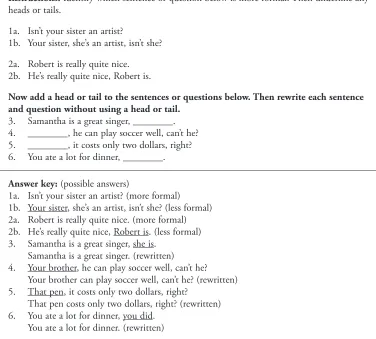
Activity 1: Heads and tails worksheet
A basic worksheet to teach students about heads and tails includes questions and statements written with and without heads and tails. For example, after discussing and
Long-version instructions: Make the following conversation longer by filling in missing words.
A: ________ ________ Wanna go to the party on Sunday? B: Sure, ________ sounds good.
Answer key:
A: Do you wanna go to the party on Sunday? B: Sure, that sounds good.
Short-version instructions: Make the following conversation shorter by omitting appropriate words.
A: Shall we go get lunch now? B: Yeah, that is a good idea.
Answer key: (omitted words are in parentheses) A: (Shall we) go get lunch now?
B: Yeah, (that is a) good idea.
Discussion question: Which words can be omitted from conversations with friends? Why?
Discussion question (possible answer): You can omit subjects and verbs because they are clear from the context, you can speak more quickly, and it is an informal conversation with friends.
explaining the use of heads and tails in spoken English, the teacher asks students to indicate or create heads or tails in each of the questions and sentences in Table 3. In another possible activity in Table 3, the teacher gives students some sentences or questions that already contain heads and tails, then asks students to rewrite them without the heads or tails. Then, the teacher gives students sentences that do not contain heads or tails and asks them to rewrite the sentences with heads or tails. These activities raise students’ awareness of the function and use of heads and tails in spoken English.
Activity 2: Heads and tails with partners Because heads and tails create two-part sentences and questions, the class can be divided into pairs and create their own heads and tails together. If the first student starts with a head, the second student finishes with
the rest of the question or sentence; if the first student starts with a statement or question, the second student finishes with an appro-priate tail. This activity can be turned into a game in which students receive points for correctly completing their partner’s sentence or question. Having students discuss, identify, and write their own heads and tails will both raise their awareness of these characteristics of spoken grammar and give students practice producing them. For example:
Student A (head): Our teacher … Student B: she’s really beautiful.
Student A (statement): Our teacher is really beautiful.
Student B (tail): she is.
Spoken English activities for fillers and backchannels
While common in everyday speech, fill-ers and backchannels are often missing in
Instructions: Identify which sentence or question below is more formal. Then underline any heads or tails.
1a. Isn’t your sister an artist?
1b. Your sister, she’s an artist, isn’t she? 2a. Robert is really quite nice. 2b. He’s really quite nice, Robert is.
Now add a head or tail to the sentences or questions below. Then rewrite each sentence and question without using a head or tail.
3. Samantha is a great singer, ________. 4. ________, he can play soccer well, can’t he? 5. ________, it costs only two dollars, right? 6. You ate a lot for dinner, ________.
Answer key: (possible answers)
1a. Isn’t your sister an artist? (more formal) 1b. Your sister, she’s an artist, isn’t she? (less formal) 2a. Robert is really quite nice. (more formal) 2b. He’s really quite nice, Robert is. (less formal) 3. Samantha is a great singer, she is.
Samantha is a great singer. (rewritten) 4. Your brother, he can play soccer well, can’t he?
Your brother can play soccer well, can’t he? (rewritten) 5. That pen, it costs only two dollars, right?
That pen costs only two dollars, right? (rewritten) 6. You ate a lot for dinner, you did.
You ate a lot for dinner. (rewritten)
students’ conversations and in textbook dia-logues. A variety of classroom activities with discussion, authentic materials, and dia-logues can highlight the ubiquity and useful-ness of these features and encourage students to add fillers and backchannels to their own conversations.
Activity 1: Add fillers and backchannels to student dialogues
To raise students’ awareness of fillers and backchannels, the teacher first has students work with a partner to write a short dialogue or conversation. Next, the teacher intro-duces the concept of fillers and backchannels, explains their function, and then asks students to categorize a group of words as either fillers or backchannels, as in Table 4.
After discussing the results, the teacher asks students to revise their original written conversation by adding in appropriate fillers and backchannels. Students then act out both conversations for the class, highlighting the difference between a more artificial dialogue versus a natural one containing fillers and backchannels. Alternatively, students can have
two conversations with a partner on a given topic: one using fillers and backchannels, and one without using fillers and backchannels. After the conversations are over, students dis-cuss how including fillers and backchannels in their conversations affected their conversation skills, their relationship with their partner, and their feelings while speaking.
Activity 2: Fillers and backchannels in video clips
To highlight the pervasiveness of fillers and backchannels in everyday English, the teacher can play a short video clip and ask students to count the number of fillers and backchannels they hear in the clip, using the worksheet in Table 5.
Alternatively, the teacher could give stu-dents a script in which the fillers and back-channels have been omitted and ask them to fill in the missing words as they watch the video. These video activities show students how common these words are in conversa-tional English. However, as with the ellip-sis video activity, it is important to choose authentic video clips so that students are
Instructions: Work with a partner to put the following 10 words and utterances in the correct column below. Then add at least two new words or utterances to each column. 1. oh 2. hmm 3. ah 4. um 5. I see 6. uh 7. uh-huh 8. er 9. really 10. eh
Fillers: words that give you time to think, create a pause, or indicate you’re not finished talking
Backchannels: words that show you are listening and understand what someone else is saying
Answers: hmm, um, er, eh, uh
Possible additional words: well, and Answers:Possible additional words: oh, ah, I see, uh-huh, really wow, yeah, yes
Table 4. Classifying fillers and backchannels
Directions: Watch the video and every time you hear one of the words or utterances, check that box.
Oh Hmm Ah/Uh Um Well I see Uh-huh Er Really Yeah/Yes
exposed to natural conversations containing fillers and backchannels.
Activity 3: Add fillers and backchannels to textbook dialogues
In this activity, teachers select an artificial dialogue from the textbook—or write one themselves—and ask students to add fillers and backchannels. Table 6 shows the results after students have added fillers and back-channels. This activity will prompt discussion on the most appropriate places to use fillers and backchannels, their functions in conver-sation, and perhaps the artificiality of some ELT textbook dialogues.
Spoken English activities for phrasal chunks
ELT textbooks tend to emphasize phrasal chunks of spoken English over syntactic conversational structures, perhaps because of their accessibility and relative ease of being learned (Cullen and Kuo 2007). Even though phrasal chunks are featured in many textbooks, a variety of classroom activities can supplement textbook materials; high-light the function, usefulness, and ubiquity of phrasal chunks; and give students more practice incorporating lexical units into their own conversations.
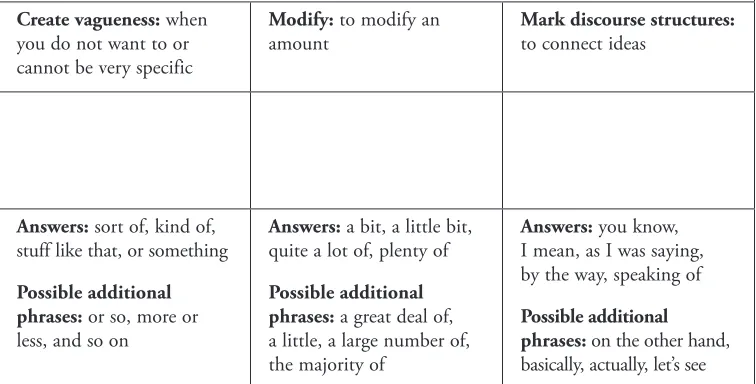
Activity 1: Categorizing phrasal chunks Phrasal chunks serve a variety of interper-sonal and communicative functions. After
introducing new phrasal chunks or reviewing those from the textbook, teachers ask students to categorize them by function or situation, as shown in Table 7. This activity encourages students to categorize the new phrases they have learned, enabling them to memorize the new words more easily and use them in appro-priate situations.
Activity 2: Phrasal chunks in video clips In this activity, students watch a video and count the new phrasal chunks they hear to raise their awareness of the overall frequency of chunks. Alternatively, the teacher prepares a script with the phrasal chunks omitted and asks students to write them in while watching the video. Afterwards, the teacher discusses the role of the phrasal chunks in the conversation and asks students to act out the new script, includ-ing the phrasal chunks studied, for practice.
Activity 3: Add phrasal chunks to conversations
In this activity, students add phrasal chunks into pre-existing conversations, either from their textbooks or dialogues written by the students themselves. Acting out these new dia-logues for the class leads to a comparison of dif-ferent groups’ dialogues and a discussion about the appropriateness of the different choices and placement of the phrasal chunks. Finally, for a more open-ended, communicative activity, students have a conversation with a partner and use at least five of the new terms. This range of
Dialogue from textbook (students have added the fillers and backchannels in italics)
Teacher: The question for Unit 1 is “Do you like your name?” How about you, Yuna?
Um … Were you named after someone in your family?
Yuna: Yes, er … my aunt.
Teacher: Oh, I see. Is your name common in Korea? Yuna: Yes, it is.
Teacher: Really? What about you, Sophy? Um … Where did your name come from? Sophy: Ah, It’s not really a family name. (teacher: Oh) My parents just liked it. Teacher: Uh-huh, Do you like it?
Sophy: Yes, I do. But, um … people spell it wrong a lot. (teacher: Uh-huh) Or they think it’s short for Sofia, but it’s not.
Teacher: I see. Do you like your name, Marcus?
Marcus: Sure. It’s a great name. Ah … It was my father’s and my grandfather’s and my great-grandfather’s.
activities introduces new phrasal chunks to the students, raises their awareness, and helps them incorporate the new words and phrases into their speech through practice.
Multiple spoken grammar features
The previous activities and suggestions isolate specific characteristics of spoken gram-mar in order to introduce the features, raise students’ awareness, and provide controlled practice. However, the fact is that natural, authentic conversation usually includes mul-tiple features of spoken grammar. Accord-ingly, many of the activities can be adapted to include a focus on multiple characteristics of spoken grammar at the same time. For example, students could add multiple char-acteristics of spoken grammar to written conversations over the course of the semester, giving continuity to the instruction and allow-ing them to clearly see how their conversation changes with each new addition. At the end of the course, students could act out both the original and the final conversation for the class, followed by a discussion of the role of spoken grammar in face-to-face conversation. Similarly, after introducing a number of fea-tures of spoken grammar, teachers could ask
students to watch a video and count several features of spoken grammar at once or fill in blanks in a script for multiple characteristics of spoken grammar. Focusing on multiple fea-tures highlights how these characteristics work together to create smooth, natural speech and help speakers cope with the pressures of real-time conversation.
Interview project
Another way to raise students’ awareness of the role of spoken grammar in authentic speech is to ask them to complete a project where they interview and record an advanced or native speaker of English and then tran-scribe the conversation. After identifying the elements of spoken grammar that were taught in class, students give a presentation in which they play the recording, highlight the charac-teristics of spoken grammar in their transcript, and discuss with the class. Again, this type of project helps students apply what they learned in class to real, authentic speech and highlights the role of spoken grammar in everyday conversation. As an example of this project, Table 8 contains a short excerpt from an English podcast (video and transcript can be found at Luke’s English Podcast, http://
Instructions: Put the following phrases into the appropriate column of the chart below. Then add two more phrases for each category.
1. by the way 2. sort of 3. a bit 4. speaking of 5. a little bit 6. you know 7. stuff like that 8. kind of 9. I mean 10. as I was saying 11. or something 12. quite a lot of 13. plenty of
Create vagueness: when you do not want to or cannot be very specific
Modify: to modify an
amount Mark discourse structures:to connect ideas
Answers: sort of, kind of, stuff like that, or something
Possible additional phrases: or so, more or less, and so on
Answers: a bit, a little bit, quite a lot of, plenty of
Possible additional phrases: a great deal of, a little, a large number of, the majority of
Answers: you know, I mean, as I was saying, by the way, speaking of
Possible additional phrases: on the other hand, basically, actually, let’s see
teacherluke.co.uk/2011/03/29/london-video-interviews-pt-3).
To transcribe their interview, students must listen carefully to their recording many times and analyze the authentic data, increas-ing their understandincreas-ing of spoken grammar, its function in conversation, and its frequency in authentic speech. To prepare students for this project, the teacher could have students first transcribe and analyze texts in class before attempting the project on their own. Luke’s English Podcast (http://teacherluke.co.uk) is a useful resource for this activity, as it contains interviews of native speakers with transcripts already prepared. After watching the videos and analyzing the transcripts, students will feel empowered and motivated to make and share their own videos with their own inter-view questions.
Conclusion
A major goal of communicative language teaching is to develop students’ abilities to communicate in meaningful contexts. This article has outlined specific features of spoken English grammar and shown their usefulness in meeting the demands of interactive, real-time conversation. As Basturkmen (2001, 5) points out, recent communication methodol-ogies often focus on “activities to get students to speak, rather than on providing them with the means to interact.” It only makes sense, then, that in order for our students to com-municate effectively in spoken English, they need to both recognize and use these features of spoken grammar, even in an EFL context. For teachers who find that ELT materials lack activities for teaching spoken grammar, this
article outlines a variety of activities for teach-ing features that contribute to the develop-ment of fluency by allowing students to adapt to the pressures of real-time communication (Mumford 2009).
With English increasingly being used to communicate in international contexts, it is more important than ever that students be taught conventions and features of spoken English that will allow them to become effective communicators. Any teacher who advocates a communicative language teach-ing approach should also support specific instruction and practice of select features of spoken English, which allow students to cope with the pressures and interactive nature of English conversation. By incorporating a few of the suggested activities into English classes, teachers can both help students interact in English and prevent them from sounding like an inauthentic English textbook.
References
Basturkmen, H. 2001. Descriptions of spoken lan-guage for higher level learners: The example of questioning. ELT Journal 55 (1): 4–13. Carter, R., and M. McCarthy. 1995. Grammar and
the spoken language. Applied Linguistics 16 (2): 141–158.
Cullen, R., and I. Kuo. 2007. Spoken grammar and ELT course materials: A missing link? TESOL
Quarterly 41 (2): 361–386.
Goh, C. 2009. Perspectives on spoken grammar.
ELT Journal 63 (4): 303–312.
Hughes, R., and M. McCarthy. 1998. From sen-tence to discourse: Discourse grammar and English language teaching. TESOL Quarterly 32 (2): 263–287.
Leech, G. 2000. Grammars of spoken English: New outcomes of corpus-oriented research. Language
Learning 50 (4): 675–724.
Example: Interview project (spoken grammar features in bold, with categories in parentheses after each speaker’s turn)
Interviewer: So, are you from London? Interviewee: Yep, I sure am.
Interviewer: How long have you lived here? Interviewee: 21 years. (ellipsis)
Interviewer: Right, okay. So, uh, what’s the best thing about it? (backchannel, filler) Interviewee: Best thing, there’s always something to do, places to go. There’s lots of
tour-ist attractions around here. Um, things, that’s the main thing, it’s things to do. You can never be bored in London. (Interviewer: Yeah). Always places,
things to see. (head, filler, head, backchannel, ellipsis)
McCarthy, M. 2006. Explorations in corpus
linguis-tics. Cambridge: Cambridge University Press.
McCarthy, M., and R. Carter. 1995. Spoken gram-mar: What is it and how can we teach it? ELT
Journal 49 (3): 207–218.
Mumford, S. 2009. An analysis of spoken gram-mar: The case for production. ELT Journal 63 (2): 137–144.
Rühlemann, C. 2006. Coming to terms with con-versational grammar: ‘Dislocation’ and ‘dysflu-ency.’ International Journal of Corpus Linguistics 11 (4): 385–409.
——. 2008. A register approach to teaching con-versation: Farewell to standard English? Applied
Linguistics 29 (4): 672–693.
Stenström, A. 2004. An introduction to spoken
inter-action. London: Longman.
Timmis, I. 2002. Native-speaker norms and inter-national English: A classroom view. ELT Journal 56 (3): 240–249.
——. 2005. Towards a framework for teaching spoken grammar. ELT Journal 59 (2): 117–125. ——. 2010. ‘Tails’ of linguistic survival. Applied
Linguistics 31 (3): 325–345.
Willis, D. 2003. Rules, patterns and words: Grammar
and lexis in English language teaching.
Cam-bridge: Cambridge University Press.