Nonlinear Uncertain HIV-1 Model Controller by Using
Control Lyapunov Function
Fatma A. Alazabi, Mohamed A. Zohdy
Department of Electrical and Computer Engineering, Oakland University, Rochester, USA Email: [email protected]
Received May 4,2012; revised May 15 2012; accepted May 25,2012
ABSTRACT
In this paper, we introduce a new Control Lyapunov Function (CLF) approach for controlling the behavior of nonlinear uncertain HIV-1 models. The uncertainty is in decay parameters and also external control setting. CLF is then applied to different strategies. One such strategy considers input into infected cells population stage and the other considers input into a virus population stage. Furthermore, by adding noise to the HIV-1 model a realistic comparison between control strategies is presented to evaluate the system’s dynamics. It has been demonstrated that nonlinear control has effective-ness and robusteffective-ness, in reducing virus loading to an undetectable level.
Keywords: HIV-1 Infection Model; Control Lyapunov Function (CLF); Control Strategy; Uncertain Parameters; Noise Effect
1. Introduction
Modeling physical or biological phenomena for any dy-namic system needs to take into account the nature of connection between the parameters of the dynamic sys-tem and the observed solution [1]. The function of these parameters is reflecting the characteristics of studied phe- nomena such that death rate of productive infected CD4+T cells for the HIV model. Therefore, it is valuable to know about how perturbations in these parameters present them- selves in the solution. There are many papers for HIV modeling that consider the importance of parameters into a system’s dynamic [2-4]. For example, in [5], a new mathematical model is presented to analyze many details on HIV-1 viral load data collected from five infected pa- tients that were administrated using protease inhibitor. Based on data provided in [5], many viral dynamics that can not only give the kinetics dynamic of HIV-1 disease but also give guidelines to develop new treatment strat-egy are investigated. Controlling HIV infection disease has been an interesting problem for many researchers [6-11]. It is well known [12,13] that a control Lyapunov function, if available, will be a convenient tool to analyze stability, evaluate the system's robustness to perturba-tions, or even to modify the design to enhance robustness or performance [14]. In this paper, a CLF approach for nonlinear uncertain HIV-1 model is introduced. The un-certainty is applied into system’s decay parameters and external control. Also, two different strategies based on CLF are investigated. It has been shown that the first
strategy is effective and has an ability to reduce virus concentration to an undetectable level even under uncer-tainty and noise effect.
2. Theory of Control Lyapunov Function
(CLF)
A function V x
is said to be a Lyapunov function for a given system of vector state equations:
xF x with F
0 0, xRn (1) If it is class C1 and there exists a neighborhood Q of the origin such that [15]:
0 0V and V x
0 for xQ, x0 (2)
0V x V x F x for xQ, x0 (3)
where:
1 2 3
, , , ..
n
V x V x V x V x
V x
x x x x
.
The classical Lyapunov stability theorem states that if Equation (1) has a suitable Lyapunov function, then the origin is globally asymptotically stable. Conversely, for any globally asymptotically stable system (1) with a con-tinuous right hand side a Lyapunov function class C
can be constructed.
If we consider the control system:
,
x f x u (4)
n
vector and is assumed continuously be stabilized. Ac-cording to the above definition, a positive definite C
function exists such that:
inf V x f x u,
0 (5) for each x0 in some neighborhood Q of the origin.As a result, if the function V x
of class C satis-fies Equations (2) and (5), then it’s called a CLF [15].3. Selection of Suitable CLF
It was shown in [16] that a first integral for the drift vec-tor field, plus some controllability conditions can derive smooth asymptotically stabilizing control laws. This me- thod has been introduced generally in [15,17], and is usually called Jurdjevic-Quinn method [14]. The control strategy based on this requires selection of CLF such that
V(x) is semi-positive definite. Stability is guaranteed if the derivative of is semi-negative definite. Con-sidering the following system (linear in control and non- linear in state):
V x
1
m o i i i
x f x
u f x (6) where fo
x is a stable unforced system, i is thedesignated control,
u
ithi
f x is a smooth vector field in .
n
R
We say that Equation (6) satisfies a Lyapunov condi-tion of Jurdjevic-Quinn type if there are a neighborhood
of the origin and a function such that [15]:
Q C V x
0V x for xQ, x0 and V
0 0 (7)
o 0 V x f x for xQ (8) Now, the derivative of V x
with respect to the closed loop system is given by [15]:
21 0
m
o i i
V x V x f x
V x f x (9) According to the Lyapunov control, a control function is selected as following:
i i
u x V x f x , i1, 2,,m (10)
4. Basic HIV-1 Infection Model
Parameters of HIV-1 infection models were estimated based on data provided by the Veterans Affairs hospital in West Haven, Connecticut, for a cohort of 338 people monitored for up to 2484 days [18]. This basic HIV-1 infection model is bilinear and has three states, namely uninfected cells
x , infected cells
y , and virus
v :1 2 3
3 4
5 6
x k k x k xv y k xv k y v k y k v
(11)
Let
1, 2, 3
, ,T
Tx x x x x y v and let
d
dt, where
T denotes transpose, Then:
1 1 1 2 1 3 1 2 2 3 1 3 4 2 3 3 5 2 6 3
x f k k x k x 3
x f k x x k x
x f k x k x
[image:2.595.312.539.83.158.2] [image:2.595.315.537.359.577.2] x (12)
Figure 1 shows the dynamic response of HIV-1 infec-tion model.
From Equation (12), 1 is the supply rate of
unin-fected cells by the thymus, 2 is the death rate of
unin-fected cells. 3 is the rate of infection, 4 is the death
rate of infected cells, 5 is the rate of virus production
by infected cells, 6 is the clearance rate of the virus. 1 k k k k k k
x and x2 are measured in (cells/mm 3
) and x3 is meas-
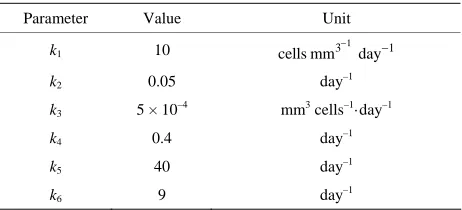
ured in (particles/mm3). Also, from [18] we got Table 1.
5. Robust CLF Controller Design
Many control techniques have been applied for HIV treatment [19,20], but here we are interested to develop a new control design based CLF. A stabilizing state feed-back law can be found via a suitable semi-definite posi-tive function V x
in two assumed cases as:
1 3 1 32 1 43 1 32
1
5 2 6 3
m
o i i i i
i
k k x k x x
x f x u f x k x x k x u f x
k x k x
(13)Figure 1. HIV-1 model without CLF, x1(0) = 350, x2(0) =5,
x3(0) =25.
Table 1. Parameter values used in HIV-1 infection model.
Parameter Value Unit
k1 10
1
3 1
cells mm day
k2 0.05 day–1
k3 5 × 10⁻⁴ mm3 cells–1·day–1
k4 0.4 day–1
k5 40 day–1
[image:2.595.308.539.631.736.2]The state feedback law with uncertainty is:
1, 2, 3
1, 2, 3
,i i
u x x x V x x x f x
(14)
V x from [21] is:
* * * * * 4 * * * 5, , ln ln
ln
*
x x y
V x y v x y y
x x y
k v v
v
k v v
y
(15)Now, we can express V x y v
, , as:
* 1 1 * 2 21 2 3 1 * * 2 *
1 1 2 2
* 3 3
4
3 * *
5 3 3
, , ln ln
ln
*
x x x x
V x x x x x
x x x x
x x
k x
k x x
(16)From V x x x
1, 2, 3 we can find V x x x
1, 2, 3
:
1* *2 4 3*1 2 3
1 2 5
, , 1 x 1 x k 1 x
V x x x
x x k x
3
(17)
where 1 3 5 0
2 4 6 k k k R
k k k
, * 1
1 2 0 k x k R ,
* 2 6
2 0 3 5 1 k k x R k k
, * 2
3 0 3 1 k x R k
From Table 1 we can find and the equilibrium states: 0 R 0 10 9
R , x1* 180, ,
* 2 2.5
x *3 100
9
x
5.1. Applying Control Strategy into Infected Cells with Uncertainty
In this section, we can apply the control input to infected cells for HIV-1 infection model with uncertainty as:
1
1 2 1 3 1 3
3 1 3 4 2 1 6 2
5 2 6 3
, ,
0
0
m
o i i
i
x f x u f x
k k x k x x
k x x k x u k x
k x k x
(18)In this case, u x x x1
1, 2, 3
will be:
1 1 2 3
*
* *
4 3
1 2
6 2
1 2 5 3
, ,
0
1 1 1
0 u x x x
k x
x x
k x
x x k x
(19)
*21 1 2 3 6 2
2
, , 1 x
u x x x k x
x
5.2. Applying Control Strategy into Virus with Uncertainty
We can also apply the control input to virus for the HIV- 1 infection model with uncertainty as:
1
1 2 1 3 1 3
3 1 3 4 2 1
5 2 6 3 3
, ,
0 0
m
o i i
i
x f x u f x
k k x k x x
k x x k x u
k x k x x
(21)In this case, u x x x1
1, 2, 3
will be:
1 1 2 3
*
* *
4 3
1 2
1 2 5 3
3
, ,
0
1 1 1
u x x x
k x
x x
x x k x 0
x (22)
4
*3 1 1 2 3 35 3
, , k 1 x
u x x x x
k x
(23)
6. Noise Effect on HIV-1 Dynamic System
In this section, noise effect on HIV-1 dynamic system with external control input is investigated into two strate- gies as:
1 2 1 3 1 3 3 1 3 4 2 1
5 2 6 3 ,
m o i i
i
i i
k k x k x x
x f x u f x d k x x k x
k x k x
u f x d
(24)where d represents noise effect.
7. Simulation and Results
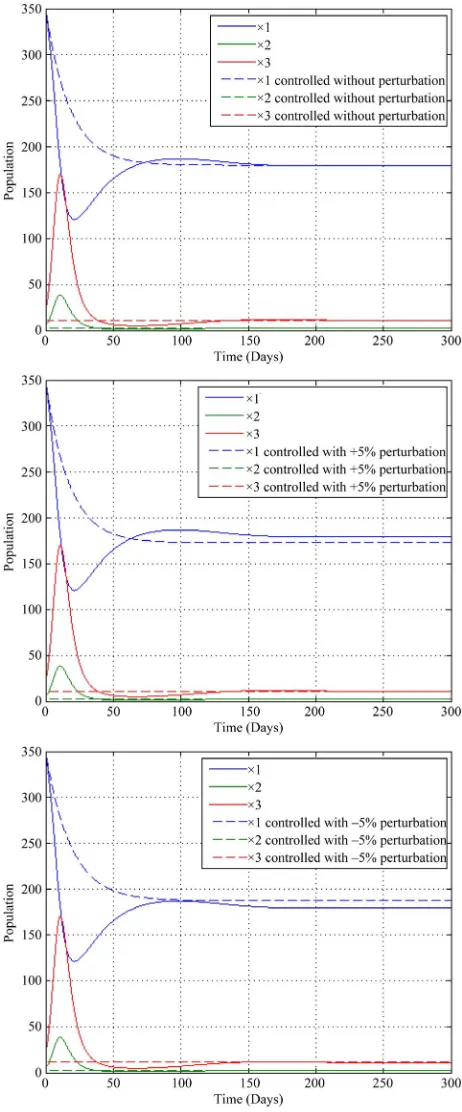
In Figure 2, it is assumed a (±5%) deterministic uncer-tainty in decay parameters of HIV-1 model are related to the first strategy. It’s noted that uncertainty doesn’t affect the control role on reducing viral load to an undetectable level, however the number of healthy cells with (+5%) uncertainty is reduced and with (–5%) uncertainty is in-creased and this can be referred to detrimental and bene-ficial perturbation respectively.
In Figure 3, it is assumed a high deterministic uncer-tainty (±20%) in decay parameters of HIV-1 model are related to the first strategy. It is noted that even for high uncertainty, the control is still effective on reducing viral load to an undetectable level, however the number of healthy cells with (+20%) and (–20%) uncertainty is re- duced (detrimental perturbation) and increased (benefi-cial perturbation) respectively.
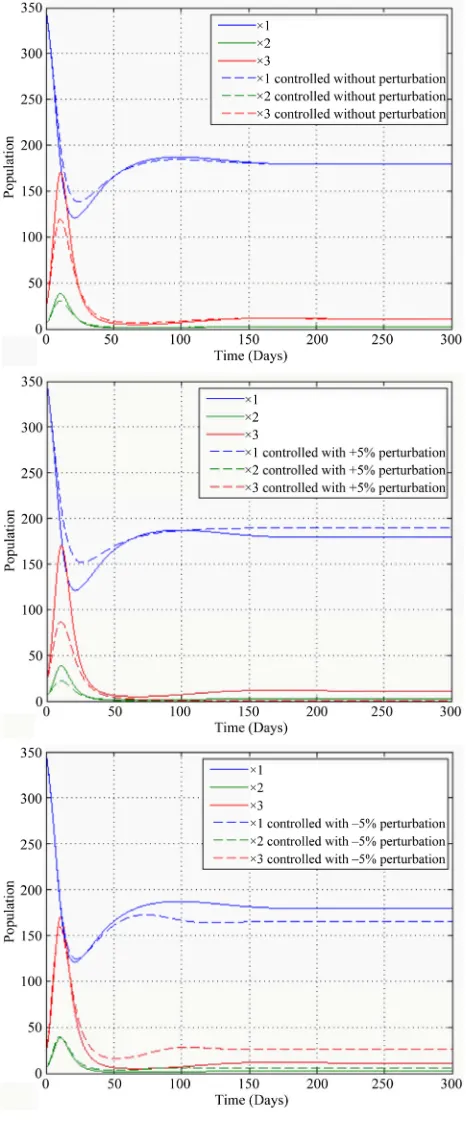
In Figure 4, it is assumed a (±5%) deterministic un-certainty in decay parameters of HIV-1 model are related
Figure 2. Control performance for nonlinear HIV-1 model under ±5% deterministic parameters uncertainty for first strategy.
[image:4.595.56.287.84.640.2]to the second strategy. It's noted that uncertainty affect the control role on reducing viral concentration to an undetectable level which means that the first strategy is more efficient than second strategy.
Figure 3. Control performance for nonlinear HIV-1 model under ±20% deterministic parameters uncertainty for first strategy.
Figure 4. Control performance for nonlinear HIV-1 model under ±5% deterministic parameters uncertainty for sec-ond strategy.
centration.
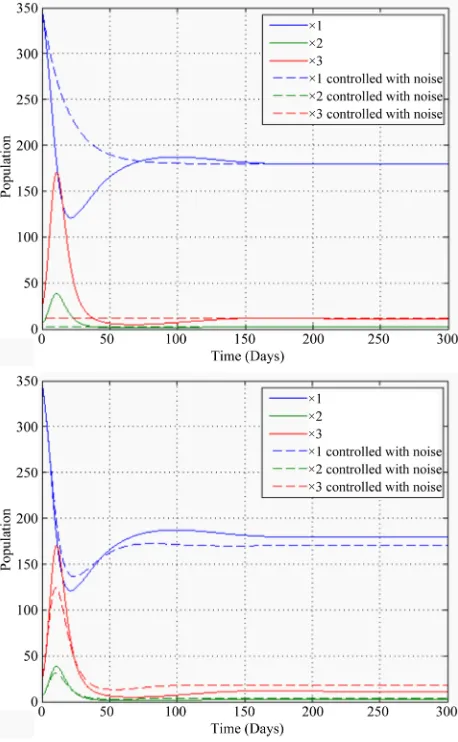
[image:5.595.56.289.85.646.2]In Figure 6, we add a constant noise (+10) in HIV-1 model related to first and second strategy. It’s shown that
Figure 5. Control performance for nonlinear HIV-1 mode
and that is also depends on how much noise is added.
d a new robust CLF control de-
l under ±20% deterministic parameters uncertainty for sec-ond strategy.
8. Conclusion
Figure 6. Noise effect on nonlinear HIV-1 model for firs
sign for uncertain and nonlinear HIV-1 infection models.
REFERENCES
[1] D. M. Bortz a tivity Analysis of
1
t and second strategies respectively.
We have found suitable nonlinear controller strategy to cause reduction of virus concentration to an undetectable level. Different strategies were considered to evaluate the control effectiveness. Additional noise into the HIV-1 system’s dynamics was simulated to further test the nonlinear control strategies stochastic behavior.
nd P. W. Nelson, “Sensi a Nonlinear Lumped Parameter Model of HIV Infection Dynamics,” Bulletin of Mathematical Biology, Vol. 66, No. 5, 2004, pp. 1009-1026.
doi:10.1016/j.bulm.2003.10.01
chenzle “Analysis of a [2] N. I. Stilianakis, K. Dietz and D. S
Model for the Pathogenesis of AIDS,” Mathematical Bio- sciences, Vol. 145, No. 1, 1997, pp. 27-46.
doi:10.1016/S0025-5564(97)00018-7
[3] A. S. Perelson and P. W. Nelson, “Mathematical Analysis of HIV-1 Dynamics in Vivo,” Society for Industrial and
Applied Mathematics Review, Vol. 41, No. 1, 1999, pp. 3- 44. doi:10.1137/S0036144598335107
[4] M. A. Stafford, L. Corey, Y. Cao, E. S. Daar, D. D. Ho and A. S. Perelson, “Modeling Plasma Virus Concentra-tion during Primary HIV InfecConcentra-tion,” Journal of Theoreti-cal Biology, Vol. 203, No. 3, 2000, pp. 285-301. doi:10.1006/jtbi.2000.1076
[5] A. S. Perelson, A. U. Neumann, M. Markowitz, M. Mar- kowitz, J. M. Leonard and D. D. Ho, “HIV-1 Dynamics in Vivo: Virion Clearance Rate, Infected Cell Lifespan, and Viral Generation Time,” Science, Vol. 271, No. 5255, 1996, pp. 1582-1586. doi:10.1126/science.271.5255.1582 [6] V. Gajic, “Optimal Control of HIV-Virus Dynamics,” An-
nals of Biomedical Engineering, Vol. 37, No. 6, 2009, pp. 1251-1261. doi:10.1007/s10439-009-9672-7
[7] S. Ge, Z. Tian and T. Lee, “Nonlinear Control of Dy-namic Model of HIV-1,” IEEE Transaction on Biomedi-cal Engineering, Vol. 52, No. 6, 2005, pp. 353-361. doi:10.1109/TBME.2004.840463
[8] M. Brandt and G. Chen, “Feedback Control of a Biody-namical Model of HIV-1,” IEEE Transaction on Biomedi- cal Engineering, Vol. 48, No. 7, 2001, pp. 754-759. doi:10.1109/10.930900
[9] I. Craig and X. Xia, “Can HIV/AIDS Be Controlled,” IEEE Control Systems Magazine, Vol. 25, No. 1, 2005, pp. 80- 83. doi:10.1109/MCS.2005.1388805
[10] E. Sontag, “Some New Directions in Control Theory In- spired by Systems Biology,” Systems Biology, Vol. 1, No. 1, 2004, pp. 9-18. doi:10.1049/sb:20045006
[11] H. Chang and A. Astolfi, “Immune Response’s Enhance- ment via Controlled Drug Scheduling,” IEEE Conference on Decision and Control, New Orleans, 12-14 December 2007, pp. 3919-3924. doi:10.1109/CDC.2007.4434462
[12] L. Praly and Y. Wang, “Stabilization in Spite of Matched Un-Modeled Dynamics and an Equivalent Definition of Input-to-State Stability,” Mathematics of Control, Signals and Systems, Vol. 9, No. 1, 1996, pp. 1-33.
doi:10.1007/BF01211516
[13] R. Sepulchre, M. Jankovic and P. Kokotovic, “Construc-
v tive Nonlinear Control,” Springer-Verlag, Berlin, 1997.
[14] L. Faubourg and J. Pomet, “Design of Control Lyapno Functions for ‘Jurdjevic-Quinn’ Systems,” Satbility and Stabilization of Nonlinear Systems, Vol. 246, 1999, pp. 137-150. doi:10.1007/1-84628-577-1_7
[15] A. Bacciotti, “Local Stabilizability of Nonlinear Control
stability,” Systems,” World Scientific, Singapore, 1992.
[16] V. Jurjevic and J. Quinn, “Controllability and
Journal of Differential Equations, Vol. 28, No. 3, 1978, pp. 381-389. doi:10.1016/0022-0396(78)90135-3
[17] R. Outbib and G. Sallet, “Stabilizability of the Angular Velocity of a Rigid Body Revisited,” Systems and Con-trol Letters, Vol. 18, No. 2, 1992, pp. 93-98.
doi: 10.1016/0167-6911(92)90013-I
Optimal Impulse Con- [19] V. Yadav and S. N. Balakrishnan, “
trol of Systems with Control Constraints and Application to HIV Treatment,” Proceedings of the 2006 American Control Conference, Minneapolis, 14-16 June 2006, pp. 4824-4829. doi.org/10.1109/ACC.2006.1657484
[20] R. Zurakowski and A. R. Teel, “Enhancing Immune Re- sponse to HIV Infection Using MPC-Based Treatment
Scheduling,” Proceedings of the 2003 American Control Conference, Denver, 4-6 June 2003, pp. 1182-1187. doi:10.1109/ACC.2003.1239748
[21] A. Korobeinikov, “Global Properties of Basic Virus Dy- namics Models,” Bulletin of Mathematical Biology, Vol. 66, No. 4, 2004, pp. 879-883.