Deve
1Muğla Sıtkı K 2Kastamonu U
Corresponden
Received: Oct doi:10.11114/j
Abstract
The purpose o was used in st pre-service te were used to p was used and data to princ exploratory fa from the value Drama expert consisted of coefficient. Th
Keywords: dr
1. Introductio
With the curr students to stu passing, the im methods that determined co learning with discovering, e part in many school to univ 1.1 Drama in Drama is an transforming regarding to w human except Toye, 2007). S actions about explain their r privately. With the pass students are a Schneider, 20 according to s
eloping A
Koçman Unive University, Tur nce: Gökhan U
tober 12, 2016 jets.v4i12.191
of this study is tudy. The samp eachers” was d
provide eviden Kaiser Meyer cipal compone actor analysis w
es of chi-squar ts’ opinions w 31 items was his calculated v rama, pre-serv
on
rent developm udent-centered mportance of m
provide activ ontent. Drama h action, activ
emotional learn levels of edu versity.
Education art form in to someone o world and hum
t their roles (M Students are b
the roles that reactions abou
sing of time, s allowed to cre 02). In drama someone; on th
Attitude S
Teach
Özkan ersity, Turkey rkey Uyanık, Kastam6 Accep 9 U
s to develop a mple of study co
developed and nce for constru Olkin test (KM ent analysis.
was checked o re (χ2), Degree were taken in o s obtained an value was dete vice teachers, s
ments, there is d education env
methods that p ve participatio a is an efficie
e learning, le ning, learning ucation environ
which people or something mans by playing
McNaughton, 2 oth participant t was created ut students’ cla
students’ react eate context th processes, be he other hand
Scale, Rel
hers towa
Çelik1, Hafife
monu Universit
pted: Novembe URL: http://dx
an attitude scal onsisted of 25 d used as data uct validity of s MO) and Bartl In confirmato out. Lisrel 8.7 es of Freedom order to ensure nd Cronbach a ermined as .96 scale developm
a passing fro vironment that provides active
on is drama. ent method th earning via int by establishin nments metho
e perform acti (Taylor, 2000 g role in drama
2004). Teache ts and observe unrealistically ss status throu
tions and thou hat they play t side learning a drama empha
166
liability a
ards Dram
e Bozdemir2, Gty, Turkey.
er 2, 2016 x.doi.org/10.11
le for pre-serv 8 pre-service t a collection to scale. For facto lett Sphericity ory factor ana package softw (df), and Root e content valid alpha (Crα) v 65.
ment, attitude
m teacher-cen t students are a e participation
Drama meth hat contains le teraction, soci ng cooperation odically from p
ions such as 0). Students an
a. Moreover, th er and all class ers. So they int y (Andersen, ugh writing and
ughts expand a their reactions and socializati sizes social su
Jo I
and Valid
ma Lesso
Gökhan Uyanık Online Pub 1114/jets.v4i12vice teachers to teachers. “Atti ool. Explorator or analysis, SP test methods w alysis, suitabi ware was used t-Mean-Square dity. In conclu value was cal
ntered educatio active and resp in learning pro hods might in
earning types ial learning, l n and concept l pre-school to
reflecting the nd teachers ac hey deepen an s learn from e teract each oth 2004). Drama d dialogue and
and are shared s in cooperativ ion, in one han uppressive pow
ournal of Educa Vol. 4, N SSN 2324-805X
Published URL
dity for Pr
on
k2
lished: Novem 2.1919
owards drama itude scale tow ry and confirm PSS 19.0 statis
were used to d lity of model d in this proces e Error of App usion, the fina culated to ge
on environmen ponsible for th ocess increases nclude other m
such as expe learning by di learning (Önde elementary sc
e human cond ctively regene nd expand their each other by s her and config a processes pr d allow them to
d with other s ve learning en nd drama enha wer that comes
ation and Trainin No. 12; Decem X E-ISSN 2 by Redfame P L: http://jets.redf
re-Servic
mber 21, 2016
a lesson. Surve wards drama le matory factor stical package determine suita
l which came ss and it was b proximation (R
al form of scal et internal con
nt that teache heir learning. W
s gradually. On methods acco erience-based l
iscussing, lear er, 2003). Dram chool, from se
dition, playing erate their per r understandin sharing (Prend gure their react
ovide opportu o focus these r
students. Teach nvironment (C
ances trust and s with being a
ng Studies mber 2016 324-8068 Publishing fame.com
e
ey model esson for analyses software ability of e out in benefited RMSEA). le which nsistencyr guided With this ne of the rding to learning, rning by ma takes econdary
g a role, rceptions ngs about diville & tions and unities to reactions
of a group according to someone and develops communication and problem-solving skills for others. Other qualities that were gained with drama are being participant instead of passivity, forehandedness and being independent instead of being independent, maturation and democratization (San, 1990). Interactive learning and teaching environments can be created by using drama by oneself or in lessons to make the program more creative and interesting in school (Baldwin, 2009).
Creative drama in education prepares opportunities for students and paves the way for various interactions. It aims to be conscious of students to their bodies, feelings, thoughts and goings-on. When creative drama is used as a method in lessons, students can both learn the lessons’ subjects effectively and also become skillful at compliance, trust, collaboration, critical thinking, creativity and communicating with others which are general purpose of education by participating in creative drama's background study (Aykaç & Adıgüzel, 2011). Participants, who take part in creative drama activities must be ready to work within a group firstly, feel comfortable and safe and be ready to explore new and different ways to themselves. The group leader who will direct this type of activity must take education even a little on acting and dramatics (Can & Cantürk-Günhan, 2009).
In literature regarding effectiveness of drama, there are a number of studies in different issues and different sample groups (Akınoğlu & Akbaş, 2010; Altıkulaç & Akhan, 2010; Arslan, Şahin, Şahin & Akçay, 2011; Avcıoğlu, 2012; Aykaç & Adıgüzel, 2011; Çam, Özkan & Avinç, 2009; Çelen, Akar-Vural, 2009; Dorion, 2009; Gomez, 2010; Karadağ, Korkmaz & Çalışkan, 2007; Kırmızı, 2007; Köseoğlu & Ünlü, 2006; Nicholls & Philip, 2012; Oğur & Bağcı-Kılıç, 2005; Özbek & Baturay, 2009; Şimşek, Topal, Maden & Şahin, 2010; Wright, Diener & Kemp, 2013; Yavuzer, 2012). Considering these studies, drama is a highly effective teaching and discipline method in education especially at preschool and primary school ages. Effectiveness of the methods that used in educational environments might be vary depending upon many different reasons. One of these variables is attitudes and interests of teachers towards lesson and method.
1.2 Measuring Pre-ServiceTeachers’ Attitude Towards Drama Lesson
Beliefs of teachers about learning and teaching play an important role in increasing students’ interests to lessons in all fields (Levitt, 2002). Positive attitudes of teachers who will achieve the goals in learning environments towards a lesson have an impact on students’ learning opportunities and performances (Kim, 2011). In this regard, it is important to know pre-service teachers’ attitudes towards drama lesson. Thus, it is possible to say that attitude is a psychological tendency and this tendency is expressed by evaluating a particular entity with positive or negative degree (Eagly & Chaiken, 1993).
1.3 Rationale and Purpose for This Study
Teachers who are in leading position in drama process should direct, form and affect students’ learning (Prendivill & Toye, 2007). Therefore, being competent is so important that teachers are able to use drama actively in education. Accordingly, drama is a compulsory lesson in many departments of the university faculties. Attitudes of pre-service teachers towards drama lesson might give an idea about using drama in their careers effectively and efficiently. In this sense, there are many researches regarding attitudes towards drama lesson (Başçı & Gündoğdu, 2011; Ceylan & Ömeroğlu, 2011; Fenli, 2010; Ünal, 2004). Many researches aim at developing attitude scale towards drama lesson. These are attitude scale towards drama lesson (Adıgüzel, 2006), attitude assessment scale towards drama in pre-school education (Ceylan & Ömeroğlu, 2011), creative drama attitude scale (Okvuran, 2000) and drama lesson attitude scale in primary education (Ünal, 2004). Attitudes towards drama in different education levels were discussed in researches that were carried out (Akınoğlu & Akbaş, 2010; Altıkulaç & Akhan, 2010; Avcıoğlu, 2012; Aykaç & Adıgüzel, 2011; Dorion, 2009; Gomez, 2010; Nicholls & Philip, 2012; Wright, Diener & Kemp, 2013; Yavuzer, 2012). It was not found out any scale which was aimed to determine pre-service teachers’ attitudes towards drama lesson. Hence, the purpose of this study is to develop a scale to determine attitudes of pre-service teachers towards drama lesson.
2. Method
2.1 Participant Characteristics
This research was conducted in spring term of 2013-2014 academic years. Research population consisted of the students who were studied at Gazi University Faculty of Education, Kastamonu University Faculty of Education and department of pre-school teacher and classroom teacher education. Sample was determined with purposive sampling method and consists of 258 pre-service teachers who studied at 3rd and 4th grade level in these undergraduate programs.
2.2 Sampling Procedures
Journal of Education and Training Studies Vol. 4, No. 12; December 2016
168
Table 1. Descriptive statistics of pre-service teachers in the participant group
University Gender
Department
Classroom Teacher Education Pre-School Teacher Education
f % f %
Gazi University Female Male 10627 41.0910,47 355 13.57 1.94 Kastamonu University Female Male 4523 17.448.91 134 5.04 1.55
Total 201 77.9 57 22.1
According to Table 1, working group consisted of 258 students, while 77.9% of them studied at undergraduate program of primary school teaching, 22.1% of these students studied at undergraduate program of preschool teaching.
2.3 Research Design
This section of the research consisted of survey model, population and sample, data collection device, implementation process and analysis of data.
In this study, survey model was used. According to Cohen & Manion (2007), survey studies, like attitude studies, are the ideal research method that can be used for studies required broad participation sampling. “An attitude scale towards drama lesson for pre-service teachers” was developed and used as data collection tool.
Studies in scale development phase, to determine attitude levels of pre-service teachers towards drama lesson are stated below.
2.4 Scale Development Phase
Researchers did literature research regarding attitude and measuring with attitude scale and then they prepared a draft questionnaire consisted of 45 items as a result of examining of theoretical structure on this issue. Besides, scales whose validity and reliability studies were done and which are in literature related attitudes towards drama were examined by researchers and benefited from this scale forming the draft questionnaire and writing scale items. Prepared items were examined by drama experts, assessment and evaluation experts and language experts, 5 items were crossed out by achieving a consensus in accordance with expert recommendations and 40-questioned final draft was completed. While 20 items contain positive statement, 20 items contain negative statement. Items are rated in quinary Likert-type as Strongly Disagree (1), Disagree (2), Neutral (3), Agree (4) and Strongly Agree (5).
2.5 Materials and Procedure
In data analysis phase of attitude scale’s development process towards drama lesson for pre-service teachers it was conducted to 271 pre-service teachers, after 13 scales which were filled inappropriately or uncompleted were removed and data analysis were carried out on 258 scales. Various analyses were carried out to provide evidence for reliability and validity of the scale. Exploratory and confirmatory factor analyses were used to provide evidence for construct validity. SPSS 19.0 statistical software package was used for factor analysis and Kaiser Meyer Olkin test (KMO) and Bartlett Sphericity test methods were used to determine the suitability of data to principal component analysis for factor analysis. Obtained factors were named by researchers by considering common characteristics of materials. In confirmatory factor analysis, sustainability of model which revealed in exploratory factor analysis was controlled. Within this period, LISREL 8.7 software package, Chi-square (χ2), Degrees of Freedom (DF), and Root-Mean-Square Error of Approximation (RMSEA) vales were used.
Opinions of drama expert were taken in order to ensure content validity of developed scale. In conclusion, final form of scale which consists of 31 items was completed and Cronbach alpha (Crα) value was calculated to get internal consistency coefficient.
3. Results
This section includes the findings of research. 3.1 Findings Regarding Validity
Factor analyse was taken as . Table 2. Expl pre-service tea
Items
24. I believe dra 22. I think my s 31. I think I wil 9. I believe dram 28. I believe dra 7. I think drama 27. I believe dra 6. I believe I kn 2. I think drama 16. I can contro 8. I think drama 23. I find drama 26. I feel comfo 17. Drama lesso 12. I do not thin 21. I think dram 40. I think dram 3. I see drama l 36. I see having 11. I do not beli 19. Drama lesso 33. Increasing d 4. I do my dram 13. I want dram 35. I want to be 18. I try to prov 10. I participate 39. I worry abo 38. I do not thin 30. I feel mysel 25. Taking part
es were made 45. Explorator loratory factor achers” items.
ama lessons dev self-confidence ll improve my ab ma lesson affect ama lesson impr a lesson will cha ama lesson will now myself bette
a lesson affects m ol my emotions b
a lesson contribu a lessons enterta orted after dram on do not contrib nk drama lesson ma lesson is not ma lesson does n esson as timewa g much informat ieve drama lesso on is one of the drama lessons nu ma lesson homew ma activities take
e a drama teache vide active partic e in drama activi out having troubl nk I fulfill dram lf desperate in d in drama lesson
F by using varim ry factor analy r analysis valu
velop my imagin increases thanks bility of making ts my comprehe rove my sense o ange my perspec improve my cre er thanks to dram my communicat better thanks to utes to my profe aining.
a lessons. bute to my educ ns will improve m
suitable for adul not contribute to
asting. tion about dram on contribute to
least important umerically mak work in pleasure e much longer. er in the future.
cipation in dram ities voluntarily le in drama lesso a lesson’s neces drama lessons.
n activities make
Figure 1. Eige max method o ysis results belo ues regarding
nation.
s to drama lesso g quick decision nsion skill posit of responsibility. ctive on events. eative ability. ma lesson. tion skill positiv
drama lesson. essional ability.
cation. my empathy abi
lt groups. my moral deve a lesson as unne
my social sensi lessons for me. es me happy. e.
ma activities. .
on. ssities.
e me annoy.
envalues for sc of vertical rota onging to rema
factors belong
ons.
n thanks to dram tively.
.
vely.
ility. elopment.
ecessary. itivity.
ale items ation methods
aining 31 item ging to “Attitu
ma lesson.
and factor loa ms can be seen
ude scale tow
F1 F2
.735 .724 .717 .706 .705 .691 .690 .686 .645 .634 600 .592 .507
.653 .643 .638 .606 .599 .576 .563 .562
ads lower cut-o in Table 2. wards drama le
Factors
2 F3
.729 .683 .678 .619 .587 .554
off point
esson for
F4
Journal of Education and Training Studies Vol. 4, No. 12; December 2016
170
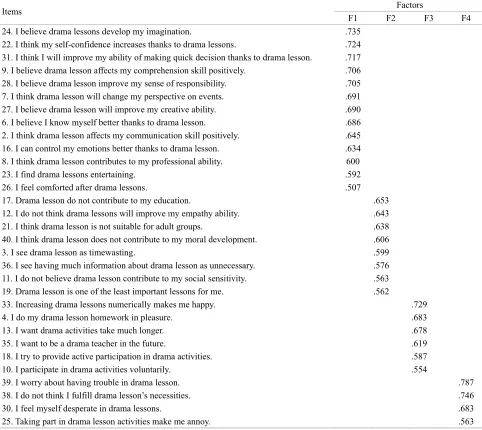
According to Table 2, it is seen that 31 items of scale were gathered in four factors. Item numbers which is involved in factors were determined as 13 in the first factor, as 8 in the second factor, as 6 in the third factor and as 4 in the fourth factor. When aforementioned factors are examined, the first factor was named as “Positive Attitude of Drama Lesson for Improving Personal and Professional Skills”, the second factor was named as “Negative Attitude of Drama Lesson for Improving Personal and Professional Skills”, the third factor was named as “Positive Attitude for Drama Lesson Activities” and the forth factor was named as “Negative Attitude for Drama Lesson Activities”.
According to exploratory factor analysis in Table 2, items’ load values in first factor show a change between .735 and .537, items’ load values in second factor show a change between .653 and .562, items’ load values in third factor show a change between .729 and .554, items’ load values in fourth factor show a change between .787 and .563. In addition to this, when examined factors’ variance percentages, it is seen that first factor explains 23,688% of variance by itself, second factor explains 15,023% of variance by itself, third factor explains 14,957% of variance by itself, fourth factor explains 10,165% of variance by itself. And it is seen that four factors explain 63,833% of total variance. Moreover, when examined eigenvalues that can give an idea about predicting importance level, it is seen that first factor’s value is 7,343, second factor’s value is 4,657, third factor’s value is 4,637, and fourth factor’s value is 3,151. Load values regarding factors in scale can be seen in Table 3.
Table 3. Load values regarding factors in scale
Factors Eigenvalues Stated Variance Percentage (%)
F1 7,343 23,68
F2 4,657 15,02
F3 4,637 14,95
F4 3,151 10,16
Total 63,81 F1: Load values of first factor
F2: Load values of second factor F3: Load values of third factor F4: Load values of fourth factor
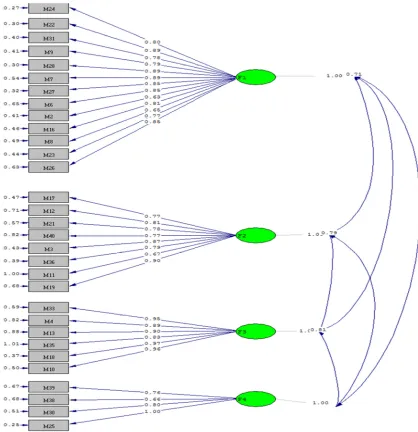
Results obtained by exploratory factor analysis were tried to verify the structure by testing with confirmatory factor analysis. It can be seen data regarding confirmatory factor analysis in Figure 2.
3.2 Findings R Cronbach Alp process. As a Cronbach Alp Skills” was fo Lesson for Imp coefficient of Cronbach Alp accordance wi
4. Discussion
As a result of suitable for sc remaining 31 chi-square sta df=465, p=0.0 lower cut-off involved in fa the fourth fact
Regarding Reli pha (Crα) inter
result of analy pha (Crα) coe ound as .950; mproving Perso f “Positive At pha (Crα) coe ith these obtain
f implemented cale’s structure items. As a re atistic test valu 000). Factor an
point was take actors were det
tor.
Figure 2 iability rnal consistenc ysis, all Cronba efficient of “P for the secon onal and Profe ttitude toward efficient of “N
ned values, it c
d factor analys e and loaded m esult of analysi ues, which was
nalyses were m en as .45. It is termined as 13
2. Data regardin
cy coefficient w ach Alpha (Crα Positive Attitud nd factor, Cron essional Skills ds Drama Les Negative Attitu can be said tha
sis on scale ite more than one is, KMO value s obtained as a made by using seen that 31 s 3 in the first fa
ng confirmator
was calculated α) values of sc de of Drama L nbach Alpha ( ” was found a sson Activities ude towards D at the scale is r
ems, 9 items ( dimension we e was calculate a result of Bar g varimax met scale items wer actor, as 8 in th
ry factor analy
d so as to provi cale were foun
Lesson for Im (Crα) coefficie as .888; for the s” was found Drama Lesson reliable suffici
(1, 5, 14, 15, ere removed fr ed as .963. Mo rtlett Sphericity
thod of vertica re gathered in he second facto
ysis
ide reliability i d as .965. For mproving Perso
ent of “Negat e third factor, C
as .880 and n Activities” w
ently.
20, 29, 32, 34 from scale and
oreover, it was y test, were si al rotation me four factors. I or, as 6 in the t
in scale’s deve the first factor onal and Prof tive Attitude of Cronbach Alp
for the fourth was found as
4, 37) which w d it was continu
s reached a find ignificant (χ2=
thods and fact Item numbers third factor an
elopment r of scale, fessional f Drama ha (Crα) h factor, .836. In
Journal of Education and Training Studies Vol. 4, No. 12; December 2016
172
Results obtained by exploratory factor analyses were tried to verify the structure by testing with confirmatory factor analysis. Correlation values of factor relations of items vary between .63 and 1.00. Moreover, correlation values of inter-factor relations vary between .71 and .83. As a result of confirmatory factor analysis of model, Chi-square (χ2) value was found as 942.14, degree of freedom (df) was 428, p=.000 and Root-Mean-Square Error of Approximation (RMSEA) was 0.068. So as to provide reliability in scale’s development process, Cronbach Alpha (Crα) internal consistency coefficient was calculated. As results of analyses, all Cronbach Alpha (Crα) values of scale were found as .965.
5. Conclusions and Suggestions
Drama was often discussed as a method in studies and effectiveness of this method on students’ achievements, attitudes and interests was examined. In addition to that, pre-service teachers’ attitudes towards drama and self-sufficiency for using drama method were studied. When looked to studies for pre-service teachers’ attitudes towards drama lesson, Şahin (2010) examined pre-service class teachers’ attitudes towards drama lesson and used “Attitude Scale for Creative Drama Lesson”, which was developed by Adıgüzel (2006), as data collection tool in his study. Likewise, Ünal (2004) examined pre-service class teachers’ attitudes towards drama lesson in primary education and used “Attitude Scale for Drama Lesson in Primary Education”, which was developed by himself as data collection tool in his study.
Ceylan & Ömeroğlu (2011) developed “Assessment Scale towards Drama in Preschool Education” within the scope of scale development studies to assess pre-service preschool teachers’ attitudes about drama training. Başçı & Gündoğdu (2011) found out pre-service teachers’ attitudes and opinions towards drama lesson and used “Attitude Scale for Creative Drama Lesson”, which was developed by Adıgüzel (2006), as data collection tool in his study. When looked to these studies, Ceylan & Ömeroğlu (2011) and Ünal (2004) developed respectively “Attitude Scale for Pre-service Preschool Teacher and Class Teachers”. These developed scales do not include all pre-service teachers. It was discussed only drama in “Attitude Scale for Creative Drama Lesson”, which was developed by Adıgüzel (2006) for all pre-service teachers.
In this study, drama lesson was examined with a general approach and it includes not only creative drama but also educational drama as well. If pre-service teacher have positive attitude towards this lesson, they will probably use drama method in class in their teaching life. In this study, pre-service teachers’ attitudes towards drama lesson can be found out with developed scale and in accordance with the results, it can be made arrangements about drama lessons in faculty of education in universities.
References
Adıgüzel, H. Ö. (2006). The concept, components and stages of creative drama. Journal of Creative Drama, 1, 17-27. Akınoğlu, O., & Akbaş, H. Ş. (2010). The impact of drama practices as a problem-solving strategies in science
education on conceptual understanding. International Conference on New Trends in Education and Their Implications. 11-13 November, Antalya.
Altıkulaç, A., & Akhan, N. E. (2010). The effect of using the creative drama method and the six thinking that technique on student success and attitudes in eighth-grade revolution History and Kemalism lesson. Ahi Evran University Journal of Kırşehir Education Faculty, 11(3), 225-247.
Andersen, C. (2004). Learning in “as-if” worlds: Cognition in drama in education. Theory into Practice, 43(4), 281-286. https://doi.org/10.1207/s15430421tip4304_6
Arslan, A., Şahin, A., Şahin, E., & Akçay, A. (2011). Effect of creative drama method on 6th grade students' attitude towards Turkish course. Journal of National Education, 190, 234-247.
Avcıoğlu, H. (2012). The effectiveness of the instructional programs based on cooperative learning and drama techniques in acquisition of social skills by the children with intellectual disabilities. Education and Science, 37(163), 110-125.
Aykaç, M., & Adıgüzel, Ö. (2011). The effect of using creative drama as a method in social studies class on students’ achievement. Kastamonu Education Journal, 19(1), 297-314.
Baldwin, P. (2009). School improvement through drama: A creative whole class, whole school approach. London: Network Continum.
Başcı, Z., & Gündoğdu, K. (2011). The attitudes and opinions of prospective teachers related to drama course: The case of Atatürk University. Elementary Education Online, 10(2), 454-467.
Journal of Gazi Educational Faculty, 29(2), 459-483.
Can, B., & Cantürk-Günhan, B. (2009). The self-efficacy beliefs scale towards the using of creative drama method. e-Journal of New World Sciences Academy, 4(1), 34-43.
Çelen, İ., & Akar-Vural, R. (2009). Drama in education and teaching English: A research on the fourth grade elementary students. Elementary Education Online, 8(2), 425-438.
Ceylan, Ş., & Ömeroğlu, E. (2011). Developing the scale about drama education for attitudes evaluation of pre-school teacher candidate. Pamukkale University Journal of Education, 29, 15-26.
Cohen, L., Manion, L., & Morrison, K. (2007). Research Methods in Education. New York: Routledge.
Crumpler, T., & Schneider, J. J. (2002). Writing with their whole being: A cross study analysis of children’s writing from classrooms using process drama. Research in Drama Education, 7(1), 61-79. https://doi.org/10.1080/13569780120113148
Dorion, K. R. (2009). Science through drama: A multiple case exploration of the characteristics of drama activities used in secondary science lessons. International Journal of Science Education, 31(16), 2247–2270. https://doi.org/10.1080/09500690802712699
Eagly, A. H., & Chaiken, S. (1993). The psychology of attitudes. Fort Worth, Texas: Harcourt Brace Jovanovich College Publishers.
Fenli, A. (2010). The attitude of candidates of classroom teaching oriented to creative drama lesson (Sample of MAKU). Unpublished Master's Thesis. Mehmet Akif Ersoy University Institute of Social Sciences, Burdur. Gomez, D. I. (2010). Using drama to improve oral skills in the ESL classroom. International Schools Journal, 30(1),
29-37.
Karadağ, E., Korkmaz, T. & Çalışkan, N. (2007). The evaluation of the effectiveness of drama method in teaching of social science according to cognitive domain. Ahi Evran University Journal of Kırşehir Education Faculty, 8(1), 179-195.
Kim, J. R. (2011). Influence of teacher preparation programs on pre-service teachers’ attitudes towards discussions. International Journal of Inclusive Education, 15(3), 355-377. https://doi.org/10.1080/13603110903030097
Kırmızı, F. S. (2007). The effect of creative drama technique on reading comprehension and students' opinions about the technique. Eurasian Journal of Educational Research (EJER), 29, 59-71.
Köseoğlu, İ., & Ünlü, M. (2006). The implementation of the drama technique as teaching method in Geography lessons. Journal of Marmara Geographic, 13, 125-132.
Levitt, K. E. (2002). An analysis of elementary teachers’ beliefs regarding the teaching and learning of science. Science Education, 86(1), 1-22. https://doi.org/10.1002/sce.1042
McNaughton, M. J. (2004). Educational dramas in the teaching of education for sustain ability. Environmental Education Research, 10(2), 139-155. https://doi.org/10.1080/13504620242000198140
Nicholls, J., & Philip, R. (2012). Solo life to second life: The design of physical and virtual learning spaces inspired by the drama classroom. RIDE: The Journal of Applied Theatre and Performance, 17(4), 583-602. https://doi.org/10.1080/13569783.2012.727628
Oğur, B., & Bağcı-Kılıç, G. (2005). The effect of drama integration into elementary science instruction on the students' success. Eurasian Journal of Educational Research (EJER), 20, 178-188.
Önder, A. (2001). Educational drama for learning by experience: Implementation techniques and examples of the theoretical basis. Istanbul: Epsilon.
Özbek, G., & Baturay, M. H. (2009). Educating primary school students on computer usage ethics and health by the drama method. e-Journal of New World Sciences Academy, 4(3), 707-714.
Prendiville, F., & Toye, N. (2007). Speaking and listening through drama 7-11. London: Paul Chapman Publishing. San, İ. (1990). Creative drama in education. Ankara University Journal of Faculty of Educational Sciences, 23(2),
573-582.
Şimşek, T., Topal, Y., Maden, S., & Şahin, A. (2010). Teaching of the topic determinant using dramatization method in Turkish lesson of primary second stage. Journal of National Education, 186, 106-120.
Journal of Educ
Ünal, E. (2004 5(2), 1-1 Wright, C., D childhoo https://do Yavuzer, Y. (
Eurasian
Appendix A
Attitude Scale There are som statement. Ple suitable optio Agree (5). Ple Thank you for
No
Ite
1 I th 2 I se 3 I d 4 I b 5 I th 6 I d 7 I w 8 I p 9 I d 10 I d 11 I w 12 I c 13 Dr 15 Dr 16 I th 17 I th 18 I fi 19 I b 20 Tak 21 I fe 22 I b 23 I b 24 I fe 25 I th 26 Inc 27 I w 28 I se 29 I d 30 I b 31 I th
This work is l
cation and Train
4). A study on 5.
Diener, M. L., d classroom. E oi.org/10.1007 (2012). Effect n Journal of Ed
e towards Dram me statements ease mark onl n with (X). It ease do not leav
r sparing time.
ems
hink drama lesso ee drama lesson do my drama les believe I know m
hink drama lesso do not think dram worry about havi participate in dra do not believe dr do not think dram want drama activ
an control my e rama lesson do n rama lesson is on hink drama lesso hink my self-con find drama lesson believe drama les king part in dram feel comforted af believe drama les believe drama les feel myself despe hink I will impro creasing drama l want to be a dram
ee having much do not think I ful believe drama les
hink drama lesso
icensed under
ning Studies
the students’ a
& Kemp, J. L Early Childhoo /s10643-012-0 of creative d ducational Res
ma Lesson for s about drama ly one checkb tems are rated ve any blank i
on affects my co n as timewasting son homework i myself better tha on will change m ma lesson contri
ing trouble in dr ama activities vo rama lesson cont ma lessons will i vities take much emotions better t not contribute to ne of the least im on is not suitabl nfidence increas ns entertaining. ssons develop m ma lesson activi fter drama lesso sson will improv sson improve m erate in drama le ove my ability o lessons numeric ma teacher in the h information ab
lfill drama lesso sson affects my on does not cont
a Creative Co
attitudes towar
L. (2013). Sto od Education J 0544-7 drama based g
search (EJER),
Pre-service Te a lesson below box for each s
as Strongly D item.
ommunication sk g.
in pleasure. anks to drama les
my perspective o ibutes to my pro rama lesson. oluntarily.
tribute to my so improve my emp h longer.
thanks to drama o my education.
mportant lessons le for adult grou ses thanks to dra my imagination.
ities make me an ons.
ve my creative a my sense of respo
essons. of making quick cally makes me h
e future. out drama lesso on’s necessities.
comprehension tribute to my mo
ommons Attrib
174 rd the lesson d
ry telling dram Journal, 41, 19
group guidanc , 47, 113-130.
eachers w. You are as
statement. Aft Disagree (1), D
kill positively. sson. on events. ofessional ability ocial sensitivity. mpathy ability. lesson. s for me. ups.
ama lessons.
nnoy. ability. onsibility. k decision thanks
happy. on as unnecessar n skill positively oral developmen
ution 3.0 Licen
drama. Trakya
mas as a comm 97-210.
ce on male-ad
ked to indicat ter reading the Disagree (2), N
y.
s to drama lesso
ry. y. nt. nse. Vol. 4, University Jou
munity buildin
dolescents’ con
te your contri e statements, Neutral (3), A
(1) Str ongly Disagr ee (2) Disagr ee on.
No. 12; Decem
urnal of Social
ng activity in
nflict resolutio
ibutory level please mark t Agree (4) and
(3) Neutral (4)
Agr ee (5) St l A mber 2016 l Science,
an early
on skills.