S T U D Y P R O T O C O L
Open Access
Protocol for promoting recovery
optimization of walking activity in stroke
(PROWALKS): a randomized controlled trial
Henry Wright
1, Tamara Wright
1, Ryan T. Pohlig
2, Scott E. Kasner
3, Jonathan Raser-Schramm
4and Darcy Reisman
1*Abstract
Background:Stroke survivors are more physically inactive than even the most sedentary older adults, and low activity is associated with increased risk of recurrent stroke, medical complications, and mortality. We hypothesize that the combination of a fast walking intervention that improves walking capacity, with a step activity monitoring program that facilitates translation of gains from the clinic to the“real-world”, would generate greater
improvements in real world walking activity than with either intervention alone.
Methods:Using a single-blind randomized controlled experimental design, 225 chronic (> 6 months) stroke survivors complete 12 weeks of fast walking training, a step activity monitoring program or a fast walking training + step activity monitoring program. Main eligibility criteria include: chronic ischemic or hemorrhagic stroke (> 6 months post), no evidence of cerebellar stroke, baseline walking speed between 0.3 m/s and 1.0 m/s, and baseline average steps / day < 8000. The primary (steps per day), secondary (self-selected and fastest walking speed, walking endurance, oxygen consumption) and exploratory (vascular events, blood lipids, glucose, blood pressure) outcomes are assessed prior to initiating treatment, after the last treatment and at a 6 and 12-month follow-up. Moderation of the changes in outcomes by baseline characteristics are evaluated to determinefor whomthe interventions are effective.
Discussion:Following completion of this study, we will not only understand the efficacy of the interventions and the individuals for which they are effective, we will have the necessary information to design a study investigating the secondary prevention benefits of improved physical activity post-stroke. This study is, therefore, an important step in the development of both rehabilitative and secondary prevention guidelines for persons with stroke.
Trial registration:ClinicalTrials.gov Identifier:NCT02835313. First Posted: July 18, 2016.
Keywords:Stroke, Rehabilitation, Physical activity, Walking
Background
Approximately 6.8 million adult Americans are living with stroke [1], which is a leading cause of serious, long-term disability in the US [1]. As a group, stroke survivors are even more physically inactive than the most sedentary older adults [2–4]. Lack of physical activity after stroke has ser-ious consequences, including increased risk of a second stroke [5], developing other diseases and mortality [2,3,6].
Despite the severe consequences of inactivity, little at-tention has been paid to whether activity is influenced by rehabilitation interventions for chronic stroke survivors [7–11]. The few intervention studies that have examined walking activity generally found no improvement in activ-ity [7,9,11], despite significant improvements in measures of walking capacity (e.g.-speed and endurance). This sug-gests that simply improving walking capacity is not suffi-cient for improving daily physical activity after stroke. One intervention, fast treadmill training, stands out for its ability to improve daily walking activity and capacity in chronic stroke survivors [8,12,13]. Our extensive study of fast walking training in chronic stroke suggests that * Correspondence:[email protected]
1Department of Physical Therapy, University of Delaware, Newark, DE 19713,
USA
Full list of author information is available at the end of the article
improvements may occur through improved biomechan-ics and energy cost that impact walking speed and endur-ance [12, 14–17]. However, even with the gains with fast walking training, total daily walking activity (~ 4500 steps/ day) [8] was far below recommended levels [18].
A recent meta-analysis found that step activity monitor-ing is an extremely effective stimulus for increasmonitor-ing daily walking activity in many patient populations [19]. The key ingredients of these programs are: 1) monitoring step ac-tivity with a pedometer or similar device, 2) setting a daily step activity goal and 3) identifying barriers to activity and strategies to overcome them [20–23]. Recent evidence suggests that a step activity monitoring program also im-proves walking activity in persons with chronic stroke [24]. Even with the gains, however, subject’s activity was still well below recommended amounts [24].
Together, these results led us to hypothesize that the combination of a fast walking intervention that improves walking capacity, with a step activity monitoring program that facilitates translation of gains from the clinic to the
“real-world”, would generate greater improvements in real world walking activity than either intervention alone. Data provides support for this hypothesis; however, it suggests that the greater efficacy of combining the 2 interventions depends on a subject’s initial walking activity [25]. This is similar to previous rehabilitation trials in persons post-stroke that have also demonstrated variable effects of in-terventions, with some individuals showing improvements and others none [14,26,27]. Thus,we do not expect that one intervention will be superior to the others for all sub-jects, but rather that the combined intervention will be su-perior for those with low levels of baseline walking activity, speed and endurance. This type of specific hy-potheses acknowledges that it is unlikely that one inter-vention is best for all after stroke.
The specific objective of this research study is to test
whether and for whom combining fast walking training with a step activity monitoring program (FAST+SAM) is superior in improving real-world walking activity com-pared to fast walking training alone (FAST) or a step ac-tivity monitoring alone (SAM) in those with chronic stroke. Further, we aimed to explore the effect of these interventions on cerebrovascular and cardiovascular events, and risk factors in chronic stroke survivors.
Methods/design
Type of design
This is a single blind randomized controlled trial in which subjects are randomly assigned to one of three groups to test whether and for whom combining fast walking training with a step activity monitoring program (FAST+SAM) is superior in improving real-world walk-ing activity compared to fast walkwalk-ing trainwalk-ing alone (FAST) or a step activity monitoring and feedback
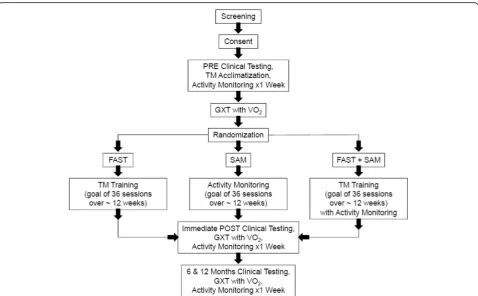
program alone (SAM) in those with chronic stroke. Sub-jects undergo PRE testing prior to randomization and then complete the intervention. Subjects then undergo testing at ~ 12 weeks POST baseline and then return for FOLLOW-UP testing at 6 and 12 months post-baseline. The evaluator is blinded to group assignment at each time point. The primary outcome measure is steps per day and the secondary outcome measures include self-selected and fastest walking speed, walking endurance, and oxygen consumption. Exploratory outcomes include vascular events, blood lipids, glucose, and blood pres-sure. The sequence from screening, enrollment to randomization is represented in Fig.1.
Study enrollment
We plan to enroll a total of 258 individuals with chronic stroke during the proposed 5-year project. Eighty-six subjects will be recruited at each of our 3 sites: Univer-sity of Delaware (UD), UniverUniver-sity of Pennsylvania (UPenn) and Christiana Care Health System (CCHS). Subjects are recruited from a variety of sources including existing clinical databases, local support groups, local physical therapy clinics, and advertisements.
Informed consent
Subjects who are interested in participating sign in-formed consent prior to any study interventions.
Screening process
Regardless of recruitment method, a member of the re-search team describes the purpose and general procedures of the study via an initial phone call or email. A Study Co-ordinator describes what to expect and the potential risks and benefits of participation. Potential subjects are also in-formed that joining the study is completely voluntary and that he/she is free to reconsider or stop participation at any time. If the potential subject expresses interest in agreeing to join, a series of screening questions to deter-mine if the person might be eligible takes place.
Inclusion & exclusion criteria
Inclusion criteria for participation in this study in-clude: 1) Age 21–85, 2) Chronic stroke (> 6 months post stroke), 3) Able to walk at self-selected speed without assistance from another person (assistive de-vices are allowed), 4) Self-selected walking speed greater than 0.3 m/s and less than 1.0 m/s, 5) Aver-age steps/day < 8000, 6) Resting heart rate between 40 and 100 beats per minute, 5) Resting blood pres-sure between 90/60 to 170/90.
4 months earlier, 4) Current participation in physical therapy, 5) Inability to walk outside the home prior to the stroke, 5) Coronary artery bypass graft, stent place-ment or myocardial infarction within past 3 months, 6) Musculoskeletal pain that limits activity, 7) Inability to communicate with investigators, 8) score > 1 on question 1b and > 0 on question 1c on the NIH Stroke Scale.
Assessments
Evaluation phases
Subjects participate in 4 evaluation phases during the course of the study as follows: PRE intervention evalu-ation phase, POST ~ 12-week intervention phase, 6 month UP (FU6), and 12 month FOLLOW-UP (FU12). The POST and FU evaluation phases follow the same procedures as the PRE Intervention Evaluation phase for clinical testing, activity monitoring and GXT/ V02 testing. At FU6 and FU12, subjects are also asked specifically if they had: recurrent stroke, myocardial in-farction, unstable angina requiring hospitalization or peripheral artery event and the date of that event.
Clinical evaluation measures
At the start of the clinical evaluation the following mea-sures/information are collected: a) Resting Blood Pressure (BP) taken according to American Heart Association
guidelines [28], b) Resting Heart Rate (RHR) heart rate is averaged over 1 min as determined using a Polar Heart Rate Monitor, c) Body Mass Index (BMI) is calculated as mass divided by height squared. Height and weight are measured on the same medical scale at each evaluation, d) Medications List - Subjects are asked to provide the re-searcher with all the names of prescribed medications and any over the counter medications. Updates are made to the medication list at POST and FU testing if any changes have occurred, e) the Charlson Index [29] is a comorbidity scoring system that includes weighting factors on the basis of disease severity. Using the subject’s past medical his-tory, the clinician assigns scores to each section and calcu-lates the total score. Other past medical history, beyond that listed in the Charlson Index, is also noted during the clinical evaluation.
For the following measures, subjects utilize their pre-ferred assistive device that they typically use at home or in the community and a gait belt or harness is used by a Research Physical Therapist for safety.
over 3 trials and measured in meters/s. This assessment has been used as a measure of short-distance walking speed in people post-stroke [30].
Six Minute Walk Test (6MWT): This is a test of endurance in which subjects are asked to walk continuously as fast as they can for six minutes so that when they are finished they walked as far as they could. Subjects walk around a rectangular path (4 turns required & approximately 42 m in total distance) until the 6 min time has elapsed. Subjects can stop and rest or sit and rest at any time. As talking can affect performance, talking only occurs if they have any questions or they want to tell the researcher how they are feeling. If subject has requested a rest break, the researcher lets them know they can take as much time as necessary. The researcher continues to provide subjects with a time elapsed statement at 1 min intervals. Total distance walked is recorded. This test has been used as an estimate of endurance in people post-stroke [31].
Questionnaires
Prior to the physical clinical testing, questionnaires are completed with subjects in a designated quiet area. Sub-jects complete the following:
Activities Balance Confidence Scale (ABC): is a 16-item questionnaire that is a measure of balance self-efficacy. Item scores are averaged to determine an over-all balance confidence score ranging from 0% to 100%. The ABC Scale has demonstrated high test-retest reli-ability, excellent internal consistency, and concurrent validity in individuals more than 1 year post stroke [32].
Patient Health Questionnaire: is 9-item self-administered depression screening and diagnostic tool increasingly used in primary care and other medical populations and has been shown to have high diagnostic accuracy for both major depression and any depression in persons post-stroke [33].
Montreal Cognitive Assessment: is an 11-item cognitive screening tool covering orientation and at-tention, memory, language, visuospatial skills, execu-tive function, verbal fluency and abstract thought. Instructions for each item are provided to subjects. Maximum score is 30 [34].
Treadmill acclimatization
Following completion of the baseline PRE clinical tests only, subjects are acclimatized to treadmill walking at their comfortable speed and fast speeds. This portion of the session is to familiarize the subject with treadmill walking prior to the GXT and to determine speeds that are used during that test. During the Acclimatization, subjects wear an overhead safety harness and heart rate
is monitored throughout. The subjects are allowed to hold onto the handrails. The treadmill is ramped up to 0.2 mph below the overground SSWS and increased by 0.1 mph every 10–15 s until subject begins to struggle as evidenced by: toe catching or significant deleterious change in biomechanics, and/or drifting backward on treadmill and has difficulty correcting forward, and/or significant increase in use of handrail support, and/or heart rate exceeds 80% of max HR via Karvonen for-mula(35) or score of > 17 on the RPE scale [35].
Activity monitoring
At each evaluation phase, The Fitbit™is used to measure daily step activity. A testing Fitibit is placed in an ankle strap and put on the uninvolved ankle of the subject. Testing Fitbits are set up with a facility email account that is not known to the subject to prevent them from checking data and receiving feedback on their computer or smartphone. The display of the Fitbit is covered over so the subject cannot receive feedback from the device. The subject is instructed to wear the monitor during waking hours, except when bathing. Step activity data is collected for at least 7 days. Subjects are asked to per-form only their regular walking activity. Subjects are ed-ucated on the wear and care of the unit as well as donning/doffing techniques through demonstration and a handout to take home. Subjects are contacted daily to remind them to wear the Fitbit. For those who are given a Fitbit device as part of the intervention, this is NOT the device that will be worn for testing at POST and FU phases. This is critical to prevent subjects from tracking their steps/day during the testing periods.
Graded exercise test with peak VO2
Prior to beginning the intervention, all subjects undergo a symptom limited GXT on a motorized treadmill. Dur-ing the GXT, a 12-lead electrocardiogram (ECG) and breath by breath analysis of VO2 with a metabolic cart
Blood testing
A fasting blood draw takes place at each evaluation phase to measure blood lipids, triglycerides and blood glucose.
Standardization of assessments
Standardization of data collection methods is achieved through a systematic training and competency assess-ment program for all physical therapists (PTs) blinded to the intervention. Performance of all outcome measures is reviewed and approved by the Primary Testing Re-search PT to ensure standardization. Continual training and feedback is provided to ensure sustained quality of outcome measures. Communication with the team re-garding protocol modifications occurs through a group forum as well as in regular phone calls.
Randomization methods
Simple random sampling is used to randomize subjects into 1 of the 3 groups; FAST+SAM, FAST, or SAM. For allocation of the subjects, a computer-generated list of random numbers is used. The random allocation se-quence is generated using https://www.randomizer.org. Three sets of numbers are generated, 1 set for each site, with 200 numbers per set. The number range used is 1– 3 (1 = FAST+SAM, 2 = FAST, 3 = SAM). Three sets of sequentially numbered, opaque, sealed envelopes are generated (1 set for each site). Set #1 is for UD, set #2 is for CCHS and set #3 is for UPenn. Once a subject has successfully completed the GXT, the sealed envelope with their subject number is opened by the Study Co-ordinator who communicates the group assignment to the Research PT who will be completing the interven-tion porinterven-tion of the study at the corresponding site. The researchers who are completing any of the evaluations are blinded to the subject’s group assignment.
Intervention
Subjects are randomly assigned to one of 3 groups: fast walking training (FAST), a step activity monitoring pro-gram (SAM) or a fast walking training + step activity monitoring program (FAST+SAM). The attendance goal for each group is 36 sessions at approximately 3× / week for 12 weeks.
Fast walking training
All subjects in the FAST and FAST+SAM groups complete a fast walking treadmill training program for 30 min, followed by approximately 10 min of overground walking activities each session. All treadmill walking is completed while subjects wear an overhead chest-harness system for safety; no body weight support is provided. Subjects walk for 30 min with the goal of walking at the fast training speed, one at which Target Heart Rate (THR) (calculated using the Karvonen formula) [36] is achieved:
(THR) = (((max HR found on GXT) - Resting heart rate) × 70-80%) + Resting heart rate [36]. The fast training speed interval is reduced if: 1) the subject requests to walk slower, 2) the fast speed is no longer safe (e.g. increased toe scuffing or tripping), 3) the subject reports a rate of perceived exertion of≥17 on the 6–20 Borg Rate of Per-ceived Exertion Scale [35], or 4) THR is exceeded. The treadmill speed is lowered to allow the heart rate to return to, (((max HR found on GXT)–Resting heart rate) × 50– 60%) + Resting heart rate [36], or to a rate of perceived ex-ertion≤13. If the HR is not steadily decreasing and the re-covery criteria are not achieved within approximately 1 min by walking slower, the treadmill is stopped and the subject takes a standing or seated rest break to achieve re-covery. Once recovery is reached, the subject is transi-tioned to the fast training speed again.
Following treadmill walking, 10 min of over-ground walking activities are performed with the same THR and perceived exertion criteria as on the treadmill. Subjects are guarded and activities are progressed by the Re-search PT. The purpose of this portion of the session is for the subject to practice walking activities experienced during everyday activities (e.g. turning, backward step-ping, walking while carrying objects) to gain both skill and confidence with these routine walking activities that are important in real-world walking.
During training, the RPE [35] is assessed every 2 min and heart rate is continuously monitored. Blood pressure is tested prior to the initiation of any activity. It is also checked at the Research PT’s discretion any time walk-ing is stopped, includwalk-ing rest breaks, at the end of tread-mill walking (prior to the start of over ground walking) and following over ground walking. For all sessions, the guidelines set forth by the ACSM for individuals in phase III or IV of cardiac rehabilitation are followed1. Based on these guidelines, we have developed session termination criteria. A session is terminated if any of the following occur: 1) Drop in Systolic blood pressure of≥ 10 mmHg from baseline (resting for that day) despite increase in workload, 2) Hypertensive response with a systolic blood pressure > 240 mmHg and diastolic blood pressure > 110, 3) Presence of nervous system symptoms: ataxia, dizziness, or near syncope, 4) Any chest pain or angina symptoms, 5) Signs of poor perfusion cyanosis or pallor, or 6) Excessive fatigue, excessive shortness of breath, leg cramps, claudication. If any of the above occurs, the subject’s physician is contacted and informed of the subject’s response to the activity. Subjects can also terminate any session or training bout by stating their desire to stop.
Step activity monitoring
with a Fitbit. If the device is lost or damaged, it is re-placed to allow continued participation in the step activ-ity monitoring program. Baseline step activactiv-ity data for subjects in the FAST+SAM and SAM groups is used to categorize and assign step activity goals. It is important to note that goals are set not based on an absolute num-ber for all subjects, but rather individually, based on their own baseline walking. Goals are advanced based on subject achievement of previous goals. Step activity data in the interim days between sessions is reviewed and used to assist subjects in understanding how much walk-ing activity they performed durwalk-ing certain daily activities, like walking to the mailbox or walking laps around their home, and how that added to their total steps per day. Subjects are also advised of how their steps per day re-lated to goal achievement; a discussion of individualized ideas to increase activity and of any barriers and how to overcome those barriers occurred. These discussions have been shown to be critical for the success of a step activity monitoring program.
Subjects in the FAST group are instructed not to begin the use of a step monitor during the study.
Standardization of intervention
The walking training and activity monitoring interven-tions are standardized so that implementation is consist-ent across clinical sites. Standardization assures that a common intervention is applied. Research PT’s demon-strate: 1) knowledge of the protocol; 2) decision making and progression of both the walking training and activity goal setting; 3) subject safety and monitoring; and 4) equipment use. Documentation is standardized across sites through the completion of walking training and ac-tivity monitoring session information in the REDCap PROWALKS Training Database.
A competency-based training program is used to train the Research PT’s at the 3 sites. First Research PT’s at each site are provided with the manual of operating pro-cedures and instructed to review pertinent sections. The Primary Training Research PT provides training at each site, followed by a several-week period of hands on prac-tice and problem-solving with weekly group (via phone) question and answer sessions. The Primary Training Re-search PT returns to each site to complete competency testing through observation of 2 pilot training sessions at each site. Competency is required in each of the 4 do-mains listed above. After individual Research PT’s achieve competency status, they are approved to admit subjects to the RCT. At least, bimonthly meetings of all clinical study personnel (in person and via phone or video-conferencing) address subject-specific issues re-lated to intervention adherence.
Treatment fidelity is also maintained throughout the study through systematic review of treatment delivery.
For the first subject at each site, treatment fidelity is assessed by the Primary Training Research PT after 2, 4, 8, and 10 weeks. For subsequent subjects, treatment fi-delity is evaluated by the Study Coordinator and the Pri-mary Training Research PT on a quarterly basis by assessing at least 1 subject from each group at each site with the goal of assessing treatment fidelity of each trainer within each group. Any intervention related is-sues are communicated to the site PI. Sessions may be video-taped to use for training and/or to further assess standardization compliance. A Treatment Fidelity web-form is completed to track intervention standardization compliance. Turnover in Research PT’s across sites is anticipated and the Primary Training Research PT is re-sponsible for training new staff and competency must be achieved as outlined above.
Statistical analysis
Sample size determination
Our data from previous work suggests an improvement of ~ 1700 steps/day in those with low steps/day at base-line. Given this and other recent work [37], we would consider an average improvement of ≥1700 steps/day in the FAST+SAM group worthy of further study in future clinical trials. Power calculations indicate that a total of 225 participants are needed (75 in each of the 3 groups) in order to detect this differential increase based on baseline steps/day and intervention received with power greater than 0.90. These calculations assume equal group sizes, a moderate correlation among repeated measures of r= 0.50, and a standard deviation for steps/ day of 2500 [8,24].
General data management & analysis
A database containing subject numbers, demographic information and collected data is stored on a password-protected server only accessible to members of the re-search team. The Biostatistician running analyses is blinded to group assignment. In general, both an“intent to treat” and a“per protocol analysis”will be performed, if results between the two analyses differ the “intent to treat” results will be used for primary publication. To ensure that the randomization worked, potential covari-ates (e.g. age, time since stroke, cognition) will be com-pared between groups using t-tests and χ2 tests. If a covariate is significantly different between groups, this will be an indication that the groups are not balanced and the covariate will be included in the models. The alpha is set at 0.05 for primary analyses and .01 for sec-ondary analyses.
Linear Mixed Models (GLMM) and moderated multiple regression models will be developed. All model assump-tions will be tested (including linearity, normality, homo-scedasticity, and multicollinearity as well as checking for outliers to be removed). Violations of the assumptions will be remedied using transformations or a Generalized Linear Model. Post-hoc tests in the GLMMS will use Bonferroni adjustment and for the regression models post-hoc probing of interactions will be done using sim-ple slopes method. In addition to the moderating effects identified a priori (baseline steps/day, walking speed and endurance), other factors (balance self-efficacy, depres-sion and co-morbidity burden) that might moderate the intervention will be tested as secondary analyses.
To determine the effect of the FAST+SAM, FAST and SAM interventions on cerebrovascular and cardiovascu-lar events, and risk factors in chronic stroke survivors we will use a Cox Proportional Hazards Model for time to first cardiac event and a Generalized Estimating Equa-tion, for the total number of cardiac events at the one year follow-up.
Adverse event monitoring & reporting
Study approval is in effect via the Institutional Review Boards (IRB) of the University of Delaware, the Univer-sity of Pennsylvania and the Christiana Care Health Sys-tem. All reporting guidelines from each institution are followed. No provisions are provided for ancillary or post-trial care.
Serious adverse events include death, life threatening event (stroke, myocardial infarction, fracture), inpatient hospitalization, a significant disability or incapacity that lasts 48 h and limits activities of daily living. Minor ad-verse events include fall without fracture, dyspnea, open sore, blister, cut, muscle soreness or pain that lasts more than 48 h, dizziness/fainting, diaphoresis. Serious ad-verse events are reviewed to determine whether they are unexpected.
Expected risks for this study are defined as: Risks due to physical activity including pain, fainting, dizziness, fa-tigue, nausea, shortness of breath, chest pain or angina, myocardial infarction, swelling, bruising, muscle/bone/ joint soreness, joint damage, bone fracture, ligament/ tendon/connective tissue damage, hospitalization, and death. Psychological risks include possible discomfort, frustration, and/or anxiety related to difficulty with the physical testing or completion of questionnaires. The risks of taking blood include pain and/or bruising where the blood is taken, redness and swelling of the vein and infection, and a rare risk of fainting.
We also consider whether an event is likely related to the study. This would be an event that reflects a realistic chance of a causal relationship between study interven-tion and the adverse event, as suggested when the event
occurs within a short time frame after the intervention (24 h), follows a pattern consistent with study interven-tion, and improves when the study has stopped or reap-pears when the study is resumed.
Reporting
Monitoring and reporting adverse events, whether antic-ipated or unanticantic-ipated, is the responsibility of the Prin-cipal Investigator (PI). The reporting requirements of the UD, UPenn and CCHS Institutional Review Boards for serious and unexpected adverse events are followed. Adverse events are tracked by the Primary Training Re-search PT through a webform platform that directly populates an electronic spreadsheet. Should an adverse event occur, a webform is completed by the respective overseeing training Research PT. Once submitted, events are adjudicated by the study PI and if necessary the Data Safety Monitoring Board and / or the on-site Institu-tional Review Board is notified.
Data management & quality
Secure electronic database(s) using the REDCap plat-form have been developed for the study. The number of potential subjects screened, enrolled and disqualified is collected by the Study Coordinator through a webform platform that directly populates an electronic spread-sheet. Adherence and retention are tracked through the PROWALKS REDCap Training database and the PRO-WALKS REDCap Clinical database. Adverse events are tracked by the Primary Training Research PT through a webform platform that directly populates an electronic spreadsheet.
Data from each testing session is entered directly into the PROWALKS REDCap Clinical database. This data-base is designed with built in quality control checks (e.g. , range checks, checking for missing data for required data points). In addition, each month the Primary Train-ing Research PT examines frequency distributions of outcome variables to identify questionable data points.
Data from each training session is entered directly into the PROWALKS REDCap Training database. This data-base is designed with built in quality control checks (e.g. , range checks, checking for missing data for required data points). In addition, each month the Study Coord-inator reviews a random sampling of data from 6 ses-sions at each site according to the Treatment Fidelity checklist webform. Intervention adherence (e.g.-number of sessions completed out of a total possible 36) is tracked via the data in the PROWALKS REDCap Train-ing database yearly by the Study Coordinator.
Study organization & management
the University of Delaware to monitor subject safety, data quality and evaluate the progress of the study. In addition, the study undergoes regular internal audits and is subjected to external auditing through the UD IRB.
The DSMB for this study reviewed the research proto-col, informed consent documents and plans for data safety and monitoring, will evaluate the progress of the trial, including periodic assessments of data quality and timeliness, recruitment, accrual and retention, subject risk versus benefit, performance of the trial sites, and other factors that can affect study safety and outcome, will make recommendations to the primary site Institu-tional Review Board and the Principal Investigator con-cerning continuation, termination or other modifications of the trial based on the observed progress and effects of the intervention under study, report to the funding agency on the safety and progress of the trial and assist the Institutional Review Board by commenting on any problems with study conduct, enrollment, sample size and/or data collection.
Meetings of the DSMB are held at least annually at the call of the Chairperson or other members of the DSMB. The first meeting of the DSMB occurred prior to the en-rollment of the first subject to familiarize members with the research protocol, ensure the appropriateness of the informed consent documentation, and understand the proposed plan for safety and data monitoring of the study.
Discussion
Post-stroke disability is strongly linked to inactivity. Stroke is the leading cause of disability in the United States [38]. Approximately 80% of the 5.5 million people living with stroke have some level of disability [39]. This disability is a consequence of, and a risk factor for, phys-ical inactivity [40, 41]. The onset of disability makes it difficult for stroke survivors to engage in physical activ-ity, causing them to remain sedentary and extremely in-active [40–42]. This inactivity can further functional loss and disability and thus, the vicious cycle continues [41]. In the chronic phase of stroke (> 6 months post-stroke), daily walking activity (generally 3500 steps/day or less) [2,3,43] is well below the activity level of even the most sedentary adults (< 5000 steps/day) [18]. The FAST +SAM intervention in this proposal is designed to inter-rupt this cycle through direct and indirect effects on physical inactivity after stroke.
Lack of physical activity has serious health conse-quences for chronic stroke survivors. Inactivity leads to an increased risk of a second stroke [5], an increased risk of developing other diseases such as diabetes and an increased risk of mortality [2, 3,6]. The risk of myocar-dial infarction or vascular death in the first 5 years after stroke is 17.4% or just over 3% per year [44]. This means that those with stroke have equal long-term risk for a
vascular event or MI as those with known coronary dis-ease [3, 45]. In chronic stroke survivors, inactivity exac-erbates the normal decline in aerobic fitness, putting most stroke survivor’s cardiovascular capacity below the level needed for activities of daily living [3, 46]. The po-tential consequences of inactivity are even more alarm-ing consideralarm-ing that inactivity gets worse over the first year after stroke [5]. If the vicious cycle of disability ↔ inactivity can be interrupted through improvements in activity after stroke [41], then many negative sequela of stroke may also be avoided.
Traditional rehabilitation interventions have little effect on the physical activity of chronic stroke survivors. To our knowledge, only a handful of rehabilitation intervention studies have examined changes in physical activity as an outcome of the intervention [7–10, 47]. When activity is measured, the results indicate that current rehabilitation interventions have limited impact on the daily walking ac-tivity of chronic stroke survivors [7–10,47]. These studies found either no improvement [7, 9, 47] or when an im-provement was observed, the subjects still remained rela-tively sedentary, walking fewer steps per day than sedentary older adults and well below the recommended levels of walking activity [8,10]. It is therefore critical that interventions are developed that can increase the physical activity of stroke survivors. It is likely that this may be ef-fectively done by incorporating interventions known to improve physical activity in other populations into the re-habilitation of chronic stroke survivors. Step activity mon-itoring programs, which aim to increase real-world activity, increase walking in a variety of patient popula-tions [19,48]. Such programs are also effective for increas-ing real-world walkincreas-ing after stroke [24] and may be particularly effective in combination with walking rehabili-tation interventions (such as FAST+SAM) after stroke be-cause they promote translation of gains from the clinic to the“real-world”. Indeed studies suggest that adherence at both one and two years following the start of exercise is better with programs that can be completed in the home [49,50].
Focus on an understanding of for whom the interven-tions are effective. Recent rehabilitation clinical trials in chronic stroke have demonstrated significant, but vari-able, effects of interventions with some individuals showing significant improvements and others no im-provement [11, 26, 27]. Moreover, studies have demon-strated equivalent results between various, equally dosed therapies [51, 52]. Together, these results suggest that
acknowledging that one intervention is not likely best for all. The analyses in this study will therefore examine the interaction between potentially moderating baseline characteristics and the individual interventions. This will avoid erroneous conclusions that one intervention is not superior to another, when in fact; the intervention is su-perior for a sub-group of subjects. Data suggests that the greater efficacy of combining the 2 interventions de-pends on a subject’s initial walking activity; in particular, the combined intervention may be superior for those with low levels of baseline walking activity, speed and endur-ance [25]. Importantly, then, the results of this study will tell us not only whether one intervention is superior, but for whom that intervention is most effective.
Physical inactivity, disability and health are intimately related after stroke. Improvements in activity should therefore improve not only post-stroke disability, but also lead to a reduced risk of secondary health conditions. The expected positive results of this study will determine for whom particular interventions are most effective for im-proving real world walking activity after stroke. The next step in this research is to implement those interventions and examine the secondary prevention benefits.
Abbreviations
6MWT:6 Minute walk test; ABC: Activities balance confidence; ACSM: American College of Sports Medicine; BMI: Body mass index; BP: Blood pressure; CCHS: Christiana Care Health System; DSMB: Data and safety monitoring board; ECG: Electrocardiogram; FAST: Fast walking training; FAST+SAM: Fast walking training & step activity monitoring; FU12: 12 Month follow-up; FU6: 6 Month follow-up; GLMM: General linear mixed model; GXT: Graded eXercise Test; MACCE: Major Adverse Cardiac / Cerebrovascular Event; PI: Principal investigator; PT: Physical therapist; RHR: Resting heart rate; RPE: Rate of perceived exertion; SAM: Step activity monitoring; THR: Target heart rate; TM: Treadmill; UPenn: University of Pennsylvania; VO2: Oxygen consumption
Acknowledgements
The authors would like to acknowledge the contributions of Kelly Danks toward the development of this protocol.
Funding
This study is funded through a grant from the National Institutes of Health: NIHR01HD086362.
Availability of data and materials
Data sharing is not applicable to this article as the datasets are currently being generated and have not yet been analyzed. De-identified data will be deposited in the National Institute of Child Health and Human Development (NICHD) Data and Specimen Hub (DASH) repository.
Authors’contributions
HW primary author, Primary Training Research PT. TW secondary author, Primary Testing Research PT. RP tertiary author, Statistician. SK tertiary author, site Principal Investigator. JRS- tertiary author, site Principal Investigator. DR senior author, Principal Investigator. All authors read and approved the final manuscript.
Ethics approval and consent to participate
This research has been approved by the University of Delaware, Christiana Care Health System and University of Pennsylvania Institutional Review Boards.
Consent for publication
Not applicable–this manuscript does not contain an individual person’s data.
Competing interests
The authors declare that they have no competing interests.
Publisher’s Note
Springer Nature remains neutral with regard to jurisdictional claims in published maps and institutional affiliations.
Author details
1Department of Physical Therapy, University of Delaware, Newark, DE 19713,
USA.2Biostatistics Core Facility, University of Delaware, Newark, DE 19713,
USA.3Department of Neurology, University of Pennsylvania, Philadelphia, PA
19104, USA.4Christiana Care Health System, Newark, DE 19713, USA.
Received: 15 January 2018 Accepted: 4 April 2018
References
1. Go AS, Mozaffarian D, Roger VL, Benjamin EJ, Berry JD, Borden WB, et al. Heart disease and stroke statistics–2013 update: a report from the American Heart Association. Circulation. 2013;127(1):e245.
2. Michael K, Macko RF. Ambulatory activity intensity profiles, fitness, and fatigue in chronic stroke. Top Stroke Rehabil. 2007;14(2):5–12.
3. Michael KM, Allen JK, Macko RF. Reduced ambulatory activity after stroke: the role of balance, gait, and cardiovascular fitness. Arch Phys Med Rehabil. 2005; 86(8):1552–6.
4. Rand D, Eng JJ, Tang P, Hung C, Jeng J. Daily physical activity and its contribution to the health-related quality of life of ambulatory individuals with chronic stroke. Health Qual Life Outcomes. 2010;8(1):80.
5. Hornnes N, Larsen K, Boysen G. Little change of modifiable risk factors 1 year after stroke: a pilot study. Int J Stroke. 2010;5(3):157–62.
6. Lloyd-Jones D, Adams RJ, Brown TM, Carnethon M, Dai S, De Simone G, et al. Heart disease and stroke statistics–2010 update: a report from the American Heart Association. Circulation. 2010;121(7):e215. 7. Michael K, Goldberg AP, Treuth MS, Beans J, Normandt P, Macko RF.
Progressive adaptive physical activity in stroke improves balance, gait, and fitness: preliminary results. Top Stroke Rehabil. 2009;16(2):133–9. 8. Moore JL, Roth EJ, Killian C, Hornby TG. Locomotor training improves daily
stepping activity and gait efficiency in individuals Poststroke who have reached a“plateau”in recovery. Stroke. 2010;41(1):129–35.
9. Mudge S, Barber PA, Stott NS. Circuit-based rehabilitation improves gait endurance but not usual walking activity in chronic stroke: a randomized controlled trial. Arch Phys Med Rehabil. 2009;90(12):1989–96.
10. Mirelman A, Bonato P, Deutsch JE. Effects of training with a robot-virtual reality system compared with a robot alone on the gait of individuals after stroke. Stroke. 2009;40(1):169–74.
11. Bowden MG, Behrman AL, Neptune RR, Gregory CM, Kautz SA. Locomotor rehabilitation of individuals with chronic stroke: difference between responders and nonresponders. Arch Phys Med Rehabil. 2013;94(5):856. 12. Reisman DS, Binder-MacLeod S, Farquhar WB. Changes in metabolic cost of
transport following locomotor training poststroke. Top Stroke Rehabil. 2013; 20(2):161–70.
13. Awad LN, Reisman DS, Pohlig RT, Binder-Macleod SA. Reducing the cost of transport and increasing walking distance after stroke. Neurorehabil Neural Repair. 2016;30(7):661–70.
14. Reisman D, Kesar T, Perumal R, Roos M, Rudolph K, Higginson J, et al. Time course of functional and biomechanical improvements during a gait training intervention in persons with chronic stroke. J Neurol Phys Ther. 2013;37(4):159–65.
15. Kesar TM, Reisman DS, Perumal R, Jancosko AM, Higginson JS, Rudolph KS, et al. Combined effects of fast treadmill walking and functional electrical stimulation on post-stroke gait. Gait & Posture. 2011;33(2):309–13. 16. Reisman DS, Rudolph KS, Farquhar WB. Influence of speed on walking
economy Poststroke. Neurorehabil Neural Repair. 2009;23(6):529–34. 17. Tyrell CM, Roos MA, Rudolph KS, Reisman DS. Influence of systematic
increases in treadmill walking speed on gait kinematics after stroke. Phys Ther. 2011;91(3):392–403.
18. Tudor-Locke C, Bassett Jr DR. How many steps/day are enough?: preliminary pedometer indices for public health. Sports Med. 2004;34(1):1–8.
20. Sidman CL, Corbin CB, Le Masurier G. Promoting physical activity among sedentary women using pedometers. Res Q Exerc Sport. 2004;75(2):122–9. 21. Tudor-Locke C, Lutes L. Why do pedometers work?: a reflection upon the factors related to successfully increasing physical activity. Sports Med. 2009;39(12):981–93. 22. Morris JH, Macgillivray S, McFarlane S. Interventions to promote long-term
participation in physical activity after stroke: a systematic review of the literature. Arch Phys Med Rehabil. 2014;95(5):956–67.
23. Butler L, Furber S, Phongsavan P, Mark A, Bauman A. Effects of a pedometer-based intervention on physical activity levels after cardiac rehabilitation: a RANDOMIZED CONTROLLED TRIAL. J Cardiopulm Rehabil Prev. 2009;29(2):105–14.
24. Danks KA, Roos MA, McCoy D, Reisman DS. A step activity monitoring program improves real world walking activity post stroke. Disabil Rehabil. 2014;36(26):2233–6.
25. Danks KA, Pohlig R, Reisman DS. Combining fast-walking training and a step activity monitoring program to improve daily walking activity after stroke: a preliminary study. Arch Phys Med Rehabil. 2016;97(9 Suppl):S193. 26. Lam JM, Globas C, Cerny J, Hertler B, Uludag K, Forrester LW, et al.
Predictors of response to treadmill exercise in stroke survivors. Neurorehabil Neural Repair. 2010;24(6):567–74.
27. Sullivan KJ, Brown DA, Klassen T, Mulroy S, Ge T, Azen SP, et al. Effects of task-specific locomotor and strength training in adults who were ambulatory after stroke: results of the STEPS randomized clinical trial. Phys Ther. 2007;87(12):1580–602.
28. Pickering TG, Hall JE, Appel LJ, Falkner BE, Graves J, Hill MN, et al. Recommendations for blood pressure measurement in humans and experimental animals: part 1: blood pressure measurement in humans: a statement for professionals from the Subcommittee of Professional and Public Education of the American Heart Association Council on high blood pressure research. Hypertension. 2005;45(1):142–61.
29. Berlowitz DR, Hoenig H, Cowper DC, Duncan PW, Vogel WB. Impact of comorbidities on stroke rehabilitation outcomes: does the method matter? Arch Phys Med Rehabil. 2008;89(10):1903–6.
30. Plummer P, Behrman AL, Duncan PW, Spigel P, Saracino D, Martin J, et al. Effects of stroke severity and training duration on locomotor recovery after stroke: a pilot study. Neurorehabil Neural Repair. 2007;21(2):137–51. 31. Pohl PS, Duncan PW, Perera S, Liu W, Lai SM, Studenski S, et al. Influence of
stroke-related impairments on performance in 6-minute walk test. J Rehabil Res Dev. 2002;39(4):439.
32. Botner EM, Miller WC, Eng JJ. Measurement properties of the activities-specific balance confidence scale among individuals with stroke. Disabil Rehabil. 2005;27(4):156–63.
33. Williams LS, Brizendine EJ, Plue L, Bakas T, Tu W, Hendrie H, et al. Performance of the PHQ-9 as a screening tool for depression after stroke. Stroke. 2005;36(3):635–8.
34. Burton L, Tyson SF. Screening for cognitive impairment after stroke: a systematic review of psychometric properties and clinical utility. J Rehabil Med. 2015;47(3):193.
35. Borg G. Perceived exertion as an indicator of somatic stress. Scand J Rehabil Med. 1970;2(2):92.
36. Whaley MH, Armstrong L. ACSM’s guidelines for exercise testing and prescription. 7th ed. Philadelphia: Lippincott Williams & Wilkins; 2006. 37. Yates T, Haffner SM, Schulte PJ, Thomas L, Huffman KM, Bales CW, et al.
Association between change in daily ambulatory activity and cardiovascular events in people with impaired glucose tolerance (NAVIGATOR trial): a cohort analysis. Lancet. 2014;383(9922):1059–66.
38. WRITING GROUP MEMBERS, Lloyd-Jones D, Adams R, Carnethon M, De Simone G, Ferguson TB, et al. Heart Disease and Stroke Statistics–2009 update: a report from the American Heart Association Statistics Committee and Stroke Statistics Subcommittee. Circulation. 2009;119(3):480–6. 39. Lees KR, Zivin JA, Ashwood T, Davalos A, Davis SM, Diener H, et al. NXY-059
for acute ischemic stroke. N Engl J Med. 2006;354(6):588–600. 40. Mayo NE, Wood-Dauphinee S, Côté R, Durcan L, Carlton J. Activity,
participation, and quality of life 6 months poststroke. Arch Phys Med Rehabil. 2002;83(8):1035–42.
41. Rimmer JH, Wang E. Aerobic exercise training in stroke survivors. Top Stroke Rehabil. 2005;12(1):17–30.
42. Resnick B, Michael K, Shaughnessy M, Nahm ES, Kobunek S, Sorkin J, et al. Inflated perceptions of physical activity after stroke: pairing self-report with physiologic measures. J Phys Act Health. 2008;5(2):308.
43. Bowden MG, Balasubramanian CK, Behrman AL, Kautz SA. Validation of a speed-based classification system using quantitative measures of walking performance Poststroke. Neurorehabil Neural Repair. 2008;22(6):672–5. 44. Dhamoon MS, Tai W, Boden-Albala B, Rundek T, Paik MC, Sacco RL, et al.
Risk of myocardial infarction or vascular death after first ischemic stroke: the northern Manhattan study. Stroke. 2007;38(6):1752–8.
45. Grundy SM, Pasternak R, Greenland P, Smith S Jr, Fuster V. Assessment of cardiovascular risk by use of multiple-risk-factor assessment equations : a statement for healthcare professionals from the American Heart Association and the American College of Cardiology. Circulation. 1999;100(13):1481–92. 46. Macko RF, Ivey FM, Forrester LW, Hanley D, Sorkin JD, Katzel LI, et al.
Treadmill exercise rehabilitation improves ambulatory function and cardiovascular fitness in patients with chronic stroke: a randomized, controlled trial. Stroke. 2005;36(10):2206–11.
47. Pang MYC, Eng JJ, Dawson AS, McKay HA, Harris JE. A community-based fitness and mobility exercise program for older adults with chronic stroke: a randomized, controlled trial. J Am Geriatr Soc. 2005;53(10):1667.
48. Tudor-Locke C. Promoting lifestyle physical activity: experiences with the first step program. Am J Lifestyle Med. 2009;3(1_suppl):54S.
49. King AC, Haskell WL, Young DR, Oka RK, Stefanick ML. Long-term effects of varying intensities and formats of physical activity on participation rates, fitness, and lipoproteins in men and women aged 50 to 65 years. Circulation. 1995;91(10):2596–604.
50. King AC, Haskell WL, Taylor CB, Kraemer HC, DeBusk RF. Group- vs home-based exercise training in healthy older men and women: a community-based clinical trial. JAMA. 1991;266(11):1535–42.
51. Duncan PW, Sullivan KJ, Behrman AL, Azen SP, Wu SS, Nadeau SE, et al. Body-weight–supported treadmill rehabilitation after stroke. N Engl J Med. 2011;364(21):2026–36.
52. Lo AC, Guarino PD, Richards LG, Haselkorn JK, Wittenberg GF, Federman DG, et al. Robot-assisted therapy for long-term upper-limb impairment after stroke. N Engl J Med. 2010;362(19):1772–83.