Fast and Efficient Inter Mode Decision Algorithm for
H.264/AVC Encoding Optimization
Md. Salah Uddin Yusuf*, Monira Islam, Mohiuddin Ahmad
Department of Electrical and Electronic EngineeringKhulna University of Engineering & Technology, Bangladesh *Email: [email protected]
Abstract – In this paper, an efficient inter mode decision algorithm based on Compensated sum of Absolute Transform Difference (CSATD) is proposed for H.264/AVC video standard. The main idea is to determine the best inter mode based on CSATD cost function instead of the rate-distortion (R-D) cost. This approach can avoid most of the computationally intensive processes in the H.264/AVC mode decision, such as integer transform, quantization, variable length coding and pixel-reconstruction. Besides, it can solve the problem of SAD, SATD-based cost function for H.264/AVC mode decision in biasing to the smaller block size modes, as they are normally achieving higher prediction accuracy. It is demonstrated by experimental results that the proposed CSATD algorithm can reduce 62% to 72% of the H.264/AVC total encoding time with negligible degradation in R-D performance.
Keywords – CSATD, H.264/AVC, Inter Prediction, Mode Decision, Rate Distortion Optimization (RD).
I.
I
NTRODUCTIONThe latest video coding standard is known as H.264/AVC [1], [2], which greatly outperforms the previous MPEG-1/2/4 and H.261/263 [3]-[5] standards in terms of both picture quality and compression efficiency. To achieve this superior coding performance, H.264/AVC adopts many advanced techniques, such as directional spatial prediction for intra frame coding, variable and hierarchical block transform, arithmetic entropy coding, multiple reference frame motion compensation, etc. It also uses seven different block sizes (16×16, 16×8, 8×16, 8×8, 8×4, 4×8 and 4×4) for motion compensation in inter mode coding, and two different block sizes with various spatial directional prediction modes in intra modes. The purpose to employ variable block size coding is that large block modes (such as 16×16, 16×8 and 8×16) can be used for stationary image block prediction with high coding efficiency while small block modes can be used for high or complex image blocks with better prediction accuracy.
Although the variable block size technique can significantly improve the prediction accuracy, it also introduces heavy computation loading. In order to select the best macro block (MB) coding mode, H.264/AVC encoder needs to compute the rate-distortion costs of all possible modes [6] - [8], which involves computation of integer transform, quantization, variable length coding and pixel-reconstructions processes. All of these processes explain the high computational complexity of R-D cost calculation. The intensive computation greatly limits the application of H.264/AVC in real-time and portable device; therefore, many fast mode decision algorithms,
which can reduce the computational complexity without compromising coding efficiency, have been proposed for real-time implementation of H.264/AVC encoders.
In literature, a number of fast mode decision algorithms [9]-[18]have been proposed to reduce the computational complexity of H.264/AVC. In [9], Jing et al. uses the mean absolute frame difference of the current frame and mean absolute difference of the current MB to determine whether the current MB belongs to homogeneous regions or not and thus only check 16x16, 16×8 and 8×16 modes. Similarly, in [10], Wu et al. uses the spatial homogeneity and the temporal stationarity characteristics of video objects to select only a small number of inter modes in the rate-distortion optimization process. The MB’s edge intensity is applied to detect the spatial homogeneity and collocated MB difference is used to decide the stationarity. By doing this some unnecessary modes are not checked and computation loading is reduced. Kim et al. proposes an adaptive mode decision algorithm [11] by using the property of an all-zero coefficients block to effectively skip unnecessary modes. In [12], Kuo proposes a mode decision algorithm that determines the best mode according to the motion field distribution and correlation within a MB. In [15], Gao and Lu propose a mode selection algorithm to skip some unlikely modes using the rate-distortion cost gaps between different modes. In [17], Wei et al. proposes a mode prediction algorithm that can predict the possible modes of current MB using the modes of adjacent MBs. Then a mode checking technique is used to early terminate the mode decision process with an adaptive threshold.
Some of the aforementioned fast mode decision algorithms try to classify the MB into large partition or small partition and skip checking some unnecessary modes. However, they still need to compute the rate-distortion costs of some possible modes for the ultimate mode decision, which involve computationally intensive processes of image transformation, quantization, entropy coding, and pixel reconstruction. In H.264/AVC video coding standard, SAD-based and SATD-based cost functions are developed as fast mode decision techniques for avoiding these computationally intensive processes [20]. However, the major drawback is that the rate-distortion performance of the encoded video is quite degraded, which affects their practical implementation.
Copyright © 2015 IJECCE, All right reserved The rest of the paper is organized with section II
introducing the rate-distortion cost functions for H.264/AVC standard. The SKIP mode early termination algorithm is reviewed in section III. The proposed CSATD based fast mode decision algorithm is described in section IV. Simulation results are presented in section V and the conclusion is given in section VI.
II.
R
ATED
ISTORSIONC
OSTF
UNCTIONS FORH.264/AVC
In H.264/AVC encoding process, the best MB coding mode is selected by computing the rate-distortion cost of all possible modes. The best mode is the one with minimum rate-distortion cost and this cost is defined as [1, 2].
�� , , � | = , , � |
+� . , , � | (1) Where, is the quantization parameter, �is the Lagrangian multiplier. A strong connection between the local Lagrangian multiplier and QP was found experimentally as � = .8 × − . The R in (1) can be written as = ℎ � + � + � �, where, ℎ � , � and � � present the numberof bits need to encode the header information, motionvectors and quantized residual block, respectively. In equation (1), � is chosen from the set of potential prediction modes as below: For Intra frame :� ∈ { ���� × , ���� × and for Inter frame: � ∈ , �� � × , �� � ×
8, �� � 8 × , �� � 8 × 8, ���� × , ���� × .
SKIP mode means that no motion or residual bits will be encoded (only the mode indicator is transmitted). Inter P8x8 mode actually contains four sub-modes. A similar rate-distortion cost function is employed to determine the optimal sub-mode that achieves minimal rate-distortion cost. Once the best sub-mode is found, the minimal cost for the MB is evaluated by searching all the possible modes as �� � 8 × 8 ∈ �� � 8 × 8, �� � 8 × ,
�� � × 8, �� � × ).SSD(S, C) is the sum of the squared difference (SSD) between the original blocks S and the reconstructed block C, and it can be expressed as:
1 1 2 2 0 0 ( , ) ( ) N N
ij ij F
i j
SSD S C s c S C
Where, sij and cij are the (i, j)th elements of the current
original block S and the reconstructed block C, respectively. Moreover, N is the image block size (N =4 in H.264 standard) and‖ ‖� is Frobenius norm. It is also found that the computation of spatial-domain SSD is very time-consuming, since we have to obtain the reconstructed block after Transformation→ Quantization → Inverse Quantization → Inverse Transformation → Pixel
Reconstruction for each possible prediction mode [20]. Besides, encoding bits R is also difficult to calculate since it needs entropy coding, such as CAVLC or CABAC to obtain, which is also quite a time-consuming process. To accelerate the coding process, the JVT reference software provides a fast SAD-based cost function [20]:
( , ) . 4 , int 4 4 mod 1
( , ),
SAD S P K for ra e
J
SAD SAD S P otherwise
(2)
Where, SAD (S, P) is sum of absolute difference between the original block S and the predicted block P. The λ1 is
also approximate exponential function of the quantization parameter (QP) which is almost the square of λ, and the K equal to 0 for the probable mode and 1 for the other modes. This SAD-based cost function could save a lot of computations as the distortion part is based on the differences between the original block and the predicted block instead of the reconstructed block.Thus, the processes of image block transformation, quantization, inverse quantization, inverse transformation and reconstruction of image block can all be saved. In addition, the number of bits is estimated by constants either equal 4 or 0. Thus, the variable length coding using CAVLC or CABAC can also be skipped.
To achieve further better rate-distortion performance, JM6.1d also suggests an alternative SATD-based cost function [9]:
1
( , ) ( ) 4 int 4 4 mod
( , )
p SATD
SATD S P Q K if ra e
J
SATD S P otherwise
(3)Where, SATD(S,P) is sum of absolute Hadamard-transformed differences [10] between the original block S and the predicted block P, which is given by
SATD(S,P) h
ij j0
N1
i0
N1
Where, hij are the
(i,j)th element of the Hadamard transformed image block H which is the difference between the original block S and the predicted block P. The Hadamard transformed block H is defined as
� = H − � HT (4)
With
1
1
1
1
1
1
1
1
1
1
1
1
1
1
1
1
HT
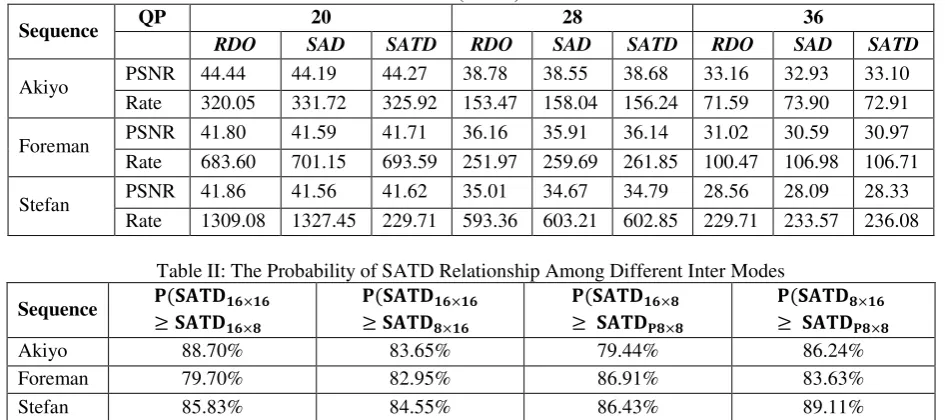
Table I: H.264 R-D Performance Comparison Using RDO and SATD- Based Cost Functions In PSNR(db) and Rate(KBPS)
Sequence QP 20 28 36
RDO SAD SATD RDO SAD SATD RDO SAD SATD
Akiyo PSNR 44.44 44.19 44.27 38.78 38.55 38.68 33.16 32.93 33.10 Rate 320.05 331.72 325.92 153.47 158.04 156.24 71.59 73.90 72.91 Foreman PSNR 41.80 41.59 41.71 36.16 35.91 36.14 31.02 30.59 30.97 Rate 683.60 701.15 693.59 251.97 259.69 261.85 100.47 106.98 106.71 Stefan PSNR 41.86 41.56 41.62 35.01 34.67 34.79 28.56 28.09 28.33
Rate 1309.08 1327.45 229.71 593.36 603.21 602.85 229.71 233.57 236.08 Table II: The Probability of SATD Relationship Among Different Inter Modes
Sequence � � �����
≥ � ���×�
� � �����
≥ � ��×��
� � ����
≥ � ���×�
� � ����
≥ � ���×�
Akiyo 88.70% 83.65% 79.44% 86.24%
Foreman 79.70% 82.95% 86.91% 83.63%
Stefan 85.83% 84.55% 86.43% 89.11%
SATD-based cost functions for different QPs is shown in Table I. Compared with RDO-based encoder, the performance degradation of SATD-based cost functions are not-ignorable. Thus, SATD is not an appropriate criterion to determine the best mode. Actually, the SATD values of different inter modes usually have the following relation:SATDinter16x16
SATDinter16x8
(SATDinter8x16)
SATDinter8x8, which is shown in Table II. The reason behind is that the small partition motion estimation can always provide better prediction accuracy than the large mode motion estimation. According to this relationship, the SATD based cost functions are inclined to choose smaller block mode as the best mode since their SATD values are smaller. Thus, it can explain why JSATD cost functions are not appropriate for the best mode decision.III.
I
NTRODUCTIONCSATD
B
ASEDM
ODED
ECISIONA
LGORITHMA. Definition of CSATD based cost function
The reason why H.264/AVC employs variable block-size modes is that sometimes the current MB cannot be well predicted by large partitions, which means the difference between the current MB and predicted MB is quite large. Thus, the MB should be divided into smaller partitions for better motion compensation. On the other hand, if the current block can be well predicted by the large block mode, it is unnecessary to encode the block with smaller partitions which require more encoding complexity and more bits to represent the motion vectors and side information. Thus, we need to use an appropriate criterion to tell whether the current MB achieves adequate prediction accuracy or not. SATD value presents the difference between the current MB and predicted MB, so it can reflect the prediction accuracy of different modes. As mentioned earlier, however, JSATD cost functions are not appropriate for mode decision as smaller modes usually lead to smaller SATD values so that smaller block
this paper we propose to use Compensated SATD (CSATD) to solve the problem of SATD-based mode selection on biasing to the smaller partition modes. Thus, CSATD based fast mode selection scheme for large and small partition modes are defined as:
� � � _ = � � � _ (5)
� � �� = � � �� + . � � � _ (6) where F is a compensation factor for the SATD of the small partition related to the � of the large partition. According to the definition, if F = 0.1, then 10% of
� � � _ is added to the � � _ .
B. CSATD-based cost implementation for H.264/AVC
inter mode decision
H.264/AVC video standard supports seven inter modes of different block size and shapes, including mode ×
, × 8, 8 × and 8 × 8 8 × 8, 8 × , × 8 �� × . According to the definition, CSATD-based fast mode decision algorithm for H.264/AVC can be implemented for inter modes × , × 8,8 × and
8 × 8 selection as follows:
Step I: Initialize 16×8, 8×16, 8×8based on the QP. Step II: Calculate the CSATD costs of these four inter modes:
CSATD16x16, CSATD16x8, CSATD8x16and CSATDP8x8as CSATD16x16 = SATD16x16
CSATD16x8 = SATD16x8+ 16×8• SATD16x16 CSATD8x16 = SATD8x16+ 8×16•SATD16x16 CSATDP8x8 = SATDP8x8+ 8×8•SATD16x16
Step III: Select the best mode as the minimum of CSATD16×16, CSATD16×8, CSATD8×16, CSATDP8×8
Copyright © 2015 IJECCE, All right reserved Actually, in regard to the Inter P8×8 mode, it contains
four sub-modes: Inter 8×8, Inter 8×4, Inter 4×8 and Inter 4×4 modes.In H.264/AVC standard, for each 8×8 block in a MB, rate-distortion cost function isemployed to determine the best sub-mode. Similarly, we can implement the proposed algorithm to choose the best sub-mode among all possible sub-modes with another set of compensation factors. The CSATD-based sub-mode decision process can be summarized as:
Step I: Initialize 8×4, 4×8, 4×4,based on the QP. Step II: Calculate the CSATD costs of these four sub- modes:
CSATD8x8, CSATD8x4, CSATDS4x8and CSATD4x4as CSATD8x8 = SATDS8x8
CSATD8x4 = SATD8x4+ 8×4• SATD8x8 CSATD4x8 = SATD4x8+ 4×8• SATD8x8 CSATD4x4 = SATD4x4+ 4×4• SATD8x8
Step III: Select the best mode as the minimum of CSATD8x8, CSATD8x4, CSATD4x8, CSATD4x4
Based on this algorithm, we can determine the best inter mode by comparing the CSATD cost instead of calculating the rate-distortion cost for each inter mode.
IV.
P
ARAMETERSS
ELECTIONThe selection of the compensation factors is vital for the proposed algorithm. So, we have to select those such that they are not sensitive to different video contents. In order to evaluate the appropriate values for the proposed algorithm, at first we do not consider the sub-mode related parameters. Here, we use the iterative searching method to obtain the optimal values by the following algorithm: Step 1: Initialize the factor 16×8 and 8×8 for a specific QP value;
Step 2: Adjust the factor 16×8 and 8×8in order to achieve local minimum RD cost. Denote the updated value asfactor 16×8 � and 8×8 � ;
Step 3: Repeat Step 2 until the RD cost cannot be further reduced. Record the optimal values.
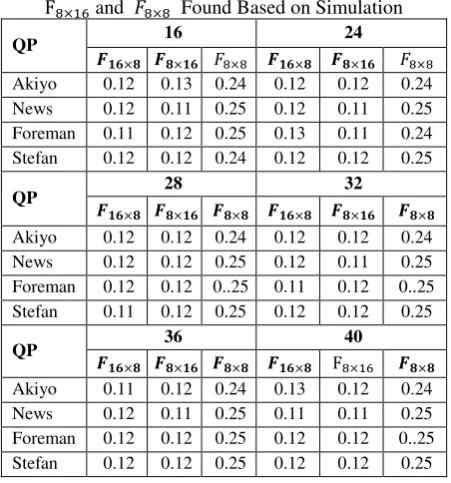
Based on the extensive simulation upon various types of video contents (low motion, medium motion and high motion), we find that the selection of 16×8, 8×16, 8×8 is nearly not varied with the video contents as shown in Table III and the relationship is also very robust. In addition, the optimal values of 8×4, 4×4 for sub-mode selection can also be obtained via the iterative searching method. These results are shown in Table IV.
According to the block size of different partition we can assume some relationships of the compensation factors for simplifying the parameters selection asF16x8 = F8x16 and F8x4 = F4x8. It is because they have the size block sizes only with different shapes andF8×8 = 2 • F16×8=2 = 2 • F8×16 and F4×4 = 2 • F8×4 =2 • F4×8. It is because their size is half of the other. Similar assumption can be made for other partition also and we can make the best use of them for the proposed algorithm.
Table III: The Optimal Compensation Factor F16×8, F8×16 and 8×8 Found Based on Simulation
QP 16 24
���×� ��×�� 8×8 ���×� ��×�� 8×8
Akiyo 0.12 0.13 0.24 0.12 0.12 0.24 News 0.12 0.11 0.25 0.12 0.11 0.25 Foreman 0.11 0.12 0.25 0.13 0.11 0.24 Stefan 0.12 0.12 0.24 0.12 0.12 0.25
QP 28 32
���� ���� ��� ���� ���� ���
Akiyo 0.12 0.12 0.24 0.12 0.12 0.24 News 0.12 0.12 0.25 0.12 0.11 0.25 Foreman 0.12 0.12 0..25 0.11 0.12 0..25 Stefan 0.11 0.12 0.25 0.12 0.12 0.25
QP 36 40
���×� ��×�� ��×� ���×� F8×16 ��×�
Akiyo 0.11 0.12 0.24 0.13 0.12 0.24 News 0.12 0.11 0.25 0.11 0.11 0.25 Foreman 0.12 0.12 0.25 0.12 0.12 0..25 Stefan 0.12 0.12 0.25 0.12 0.12 0.25
Table IV: The Optimal Compensation Factor F8×4, F4×8 and 4×4Found Based on Simulation.
QP 20 24
��×� ��×� 4×4 ��×� ��×� 4×4
Akiyo 0.35 0.35 0.70 0.35 0.35 0.70 News 0.35 0.35 0.71 0.35 0.35 0.70 Foreman 0.35 0.35 0.70 0.35 0.35 0.72 Stefan 0.35 0.35 0.70 0.35 0.35 0.70
QP
28 32
��� ��� ��� ��� ��� ���
Akiyo 0.35 0.35 0.70 0.35 0.35 0.70 News 0.36 0.35 0.70 0.36 0.35 0.70 Foreman 0.36 0.35 0.68 0.35 0.35 0.70 Stefan 0.35 0.35 0.70 0.35 0.38 0.70
QP
36 40
��� ��� ��� ��� ��� ���
Akiyo 0.34 0.35 0.70 0.35 0.35 0.70 News 0.35 0.35 0.70 0.35 0.35 0.71 Foreman 0.35 0.33 0.68 0.35 0.35 0.70 Stefan 0.35 0.35 0.70 0.35 0.35 0.70
Table V: The Optimal Compensation Factor For The Proposed Algorithm
���� ���� ��� ��� ��� ���
0.12 0.12 0.25 0.35 0.35 0.70
V.
R
ESULTS ANDD
ISCUSSIONcontains panning motion and has distinct fast motion changes. “Mobile” has slow panning, zooming and a complex horizontal and vertical motion. The experiment was carried out in the JVT JM12.0 encoder and the test parameters are listed as below:
CABAC is enabled;
GOP structure is IPPP;
Max search range for motion estimation is 32;
QP values are 20, 24, 28, 32, 36 and 40;
These optimal values of compensation factor based on experimental results are also nearly not varied with the video contents. Such phenomenon is also found in other video sequences and QP factors but due to the limited length of the paper, we cannot list all of them here. Fortunately, we can select a group of optimal thresholds for ( 16×8 and 8×8) and ( 8×4, 4×4) for practical implementation of the proposed algorithm, which are shown in Table V. In practical implementation, we can use a table to store all the optimal values with QP and use table-lookup method to decide those thresholds for a specified QP value.
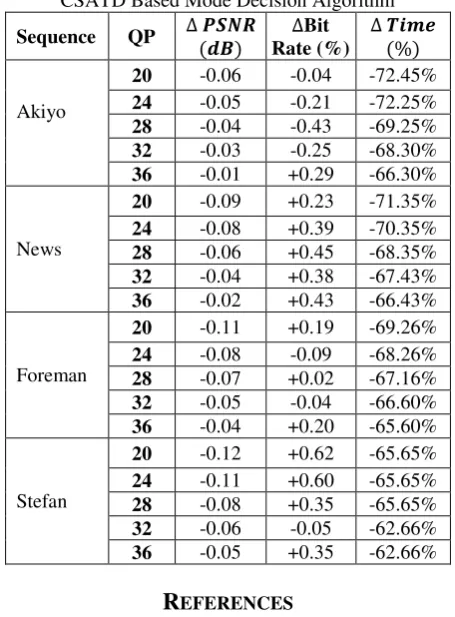
Compared with the original H.264/AVC encoder in terms of the rate-distortion optimization and computation time, the proposed algorithm achieves a considerable computation time reduction shown in Table VI with a little R-D performance degradation. From the simulation results, we can conclude that the proposed CSATD algorithm can reduce the encoding time by around 62% to 72% in different QP values. The comparison of rate-distortion performances among H.264 standard, SATD, and proposed CSATD based mode decision algorithms is shown in Fig.1. The result indicates that our proposed algorithm indeed outperforms some other fast algorithm in terms of video quality and compression ratio.
The encoding time is not the only criterion to evaluate an algorithm’s efficiency. In the hardware implementation we mainly focus on the number of rate-distortion operations on different modes because the computation of rate-distortion cost is quite heavy in the coding process. From this aspect, our proposed algorithm is quite efficient since it determines the best mode only based on the CSATD cost function.
Fig.1. R-D Performance of ‘Akiyo’ for proposed Inter Mode Decision Algorithm.
Table VI: Performance Comparison For the Proposed CSATD Based Mode Decision Algorithm
Sequence QP ∆ � �
� ∆
Bit Rate (%)
∆ �� %
Akiyo
20 -0.06 -0.04 -72.45% 24 -0.05 -0.21 -72.25% 28 -0.04 -0.43 -69.25% 32 -0.03 -0.25 -68.30% 36 -0.01 +0.29 -66.30%
News
20 -0.09 +0.23 -71.35% 24 -0.08 +0.39 -70.35% 28 -0.06 +0.45 -68.35% 32 -0.04 +0.38 -67.43% 36 -0.02 +0.43 -66.43%
Foreman
20 -0.11 +0.19 -69.26% 24 -0.08 -0.09 -68.26% 28 -0.07 +0.02 -67.16% 32 -0.05 -0.04 -66.60% 36 -0.04 +0.20 -65.60%
Stefan
20 -0.12 +0.62 -65.65% 24 -0.11 +0.60 -65.65% 28 -0.08 +0.35 -65.65% 32 -0.06 -0.05 -62.66% 36 -0.05 +0.35 -62.66%
R
EFERENCES[1] I. E. G. Richardson, “H.264 and MPEG-4 video compression:
video coding for next-generation multimedia”, Chichester: John Wiley and Sons, c2003.
[2] T. Wiegand, G. J. Sullivan, G..Bjontegaard, and A. Luthra,
“Overview of the H.264/AVC video coding standard,”IEEE Trans. Circuits Syst. Video Technol., vol. 13, pp. 560-576, July 2003.
[3] J. Watkinson, “MPEG-2”, Oxford, Boston: Focal Press, 1999.
[4] Pereira, C. N. Fernando, “The MPEG-4 book”, Upper Saddle River, N.J.: Prentice Hall PTR, c2002.
[5] V.Roden, “H.261 and MPEG1-a comparison”,in Proc. 1996
IEEE Int. Phoenix Conf., pp. 65-71, March 1996.
[6] L. M. Po, Y. M. S. Uddin, K. Guo, and L. Wang, Compensated Sum of Absolute Difference for Fast H.264 Inter Mode Selection¡¨ in Proc. Int. Conf. Audio, Language and Image Processing, 2008, pp. 1486 - 1491.
[7] K. Y. Liao, J. F. Yang, and M. T. Sun, Rate-Distortion Cost Estimation for H.264/AVC¨, IEEE Trans. on Circuits and Systems for Video Technology, vol. 20, no.1, Jan. 2010, pp. 38-49.
[8] Y. M. Lee, Y. T. Sun, and Y. Lin, SATD-Based Intra Mode Decision for H.264/AVC Video Coding¨, IEEE Trans. on Circuits and Systems for Video Technology, vol. 20, no. 3, Mar. 2010, pp. 463-469.
[9] X. Jing and L. P. Chau, “Fast approach for H.264 inter mode
decision,”Electron. Lett., vol. 40, no. 17, pp. 1051-1052, Aug. 2004.
[10] D. Wu, F. Pan, K. P. Lim and S. Wu et al., “Fast intermode decision in H.264/AVC video coding,”IEEE Trans. Circuits Syst. Video Technol., vol. 15, no. 7, pp.953-958, Jul. 2005.
[11] Y. H. Kim, J. W. Yoo, S. W. Lee et al.,“Adaptive mode decision
for H.264 encoder”, Electron. Lett.,vol. 40, no. 19, pp. 1172 - 1173, Sept. 2004.
[12] T. Y. Kuo and C. H. Chan, “Fast variable block size motion
Copyright © 2015 IJECCE, All right reserved
[13] C. Grecos, M. Yang, “Fast Mode Prediction for the Baseline and
Main Profiles in the H.264 Video Coding Standard”, IEEE
Trans. Multimedia, vol. 8, pp. 1125-1134, Dec. 2006
[14] J. L. Fan, Y. Chen, X. D. Zhang, “A Novel Fast Inter Mode
Decision for H.264”, Proc. IEEE Signal Processing 2006, vol. 2,
2006
[15] S. Gao, T. J. Lu, “An improved fast mode decision algorithm in
H.264 for video communications”, Proc. IEEE ISSCAA 2006,
Jan. 2006.
[16] Z. P. Lin, H. T. Yu, F. Pan, “A scalable fast mode decision
algorithm for H.264”, Proc. IEEE ISCAS 2006, May 2006
[17] Z. Y. Wei, K. N. Ngan, “A Fast Macroblock Mode Decision
Algorithm for H.264”, Proc. IEEE APCCAS 2006, pp. 772-775,
Dec. 2006
[18] C. Chen, L. J. Mo, J. J. Bu, “A novel fast predictive mode
decision algorithm for H.264”, Proc. IEEE Signal Processing
2005, vol. 1, pp. 243-246, Aug. 2005
[19] A.Hallapuro,M. Karczewicz, “Low Complexity Transformand
Quantization – PartI: Basic implement tation” ,ITU-T Q.6/SG16DocumentJVT-B038, Jan. 2002.
[20] Joint Video Team (JVT) Reference Software: http://iphome.hhi.de/suehring/~
A
UTHOR’
SP
ROFILEMd. Salah Uddin Yusuf
received his B.Sc. and M. Sc. Engineering degree in Electrical and Electronic Engineering from Khulna University of Engineering & Technology (KUET), Bangladesh in 1999 and 2005, respectively. He is currently pursuing his PhD in the same department also serving as Associate Professor. His research interest includes signal and image processing, video compression and multimedia communication.
Monira Islam
received her B.Sc. Engineering degree in Electrical and Electronic Engineering from Khulna University of Engineering & Technology (KUET), Khulna-9203, Bangladesh in 2013. She is currently pursuing her M.Sc. engineering in the same department and also serving as Lecturer in the same department. Her research interest includes signal processing and multimedia communication.
Mohiuddin Ahmad
received his BS degree with Honors Grade in Electrical and Electronic Engineering (EEE) from Chittagong University of Engineering and Technology (CUET), Bangladesh and his MS degree in Electronics and Information Science (EIS) from Kyoto Institute of Technology of Japan in 1994 and 2001, respectively. He received his PhD degree in Computer Science and Engineering (CSE) from Korea University, Republic of Korea, in 2008. From November 1994 to August 1995, he served as a part-time Lecturer in the Department of Electrical and Electronic Engineering at CUET, Bangladesh. From August 1995 to October 1998, he served as a Lecturer in the Department of Electrical and Electronic Engineering at Khulna University of Engineering & Technology (KUET), Bangladesh. In June 2001, he joined the same Department as an Assistant Professor. In May 2009, he joined the same Department as an Associate Professor and now he is a full Professor. Moreover, Dr. Ahmad had been serving as the Head of the Department of Biomedical Engineering from October 2009 to September 2012. Prof. Ahmad served as the Head of the Department of Electrical and Electronic Engineering from September 2012 to August 2014. His research interests include Biomedical Signal and Image Processing, Computer Vision and Pattern Recognition, Human Motion Analysis, and Energy Conversion. Technology (KUET), Bangladesh. In June 2001, he joined the same Department as an Assistant Professor. In May 2009, he joined the same Department as an Associate Professor and now he is a full Professor. Moreover, Dr. Ahmad had been serving as the Head of the Department of Biomedical Engineering from October 2009