Commun
ficaft
fion
On
fthe
Behav
fiour
,
abundance
,
hab
fiftaft
use
and
poftenft
fial
fthreafts
off
fthe
Gangeft
fic
Dolph
fin
Plaftan
fisfta
gangeft
fica
fin
soufthern
Wesft
Bengal
,
Ind
fia
Mahua Roy Chowdhury, Sangfifta Mfiftra & Saswafi Sen
26 Augusft 2016 | Vol. 8 | No. 9 | Pp. 9131–9137 10.11609/joft.1752.8.9.9131-9137
Threaftened Taxa All arficles publfishedfinftheJournal off Threaftened Taxa are regfisftered under Creafive Commons Aftrfibufion 4.0 Infterna-fional Lficense unless oftherwfise menfioned. JoTT allows unresftrficfted use off arficlesfin any medfium, reproducfion and dfisftrfibufion by provfidfing adequafte credfift fto fthe aufthors and fthe source off publficafion.
OPEN
ACCESS
Parftner
www
.
fthrea
ftenedftaxa
.org
ISSN 0974-7907(Onlfine) |ISSN 0974-7893(Prfinft)
Thefinfternafionaljournal off conservafion and ftaxonomy
Journa
l
o
ff
Threaftened
Taxa
Pub
l
fisher/Hosft
For Focus, Scope, Afims, Polficfies and Gufidelfines vfisfift hftp://fthreaftenedftaxa.org/Abouft_JoTT.asp For Arficle Submfissfion Gufidelfines vfisfift hftp://fthreaftenedftaxa.org/Submfissfion_Gufidelfines.asp
9131
Co
m
mu
nfi
ca
ftfi
on
LOGOs
Journal off Threaftened Taxa | www.fthreaftenedftaxa.org | 26 Augusft 2016 | 8(9): 9131–9137
DOI:hftp://dx.dofi.org/10.11609/joft.1752.8.9.9131-9137
Edfiftor: L.A.K. Sfingh, Bhubaneswar, Odfisha,Indfia. Dafte off publficafion: 26 Augusft 2016(onlfine & prfinft)
Manuscrfipft deftafils: Ms # 1752 | Recefived 20 May 2016 | Ffinal recefived 25July 2016 | Ffinally accepfted 04 Augusft 2016
Cfiftafion: Chowdhury, M.R., S. Mfiftra & S. Sen (2016).Onfthe Behavfiour, abundance, habfiftaft use and poftenfialfthreafts offfthe Gangefic Dolphfin Plaftanfisfta gangefica fin soufthern Wesft Bengal,Indfia.Journal off Threaftened Taxa 8(9):9131–9137;hftp://dx.dofi.org/10.11609/joft.1752.8.9.9131-9137
Copyrfighft: ©Chowdhury eft al. 2016. Creafive Commons Aftrfibufion 4.0Infternafional Lficense.JoTT allows unresftrficfted use offfthfis arficlefin any medfium,reproduc -fion and dfisftrfibufion by provfidfing adequafte credfift fto fthe aufthors and fthe source off publficafion.
Fundfing: The sftudy wasffunded by HSBC Bank.
Conlficft offInfteresft: The aufthors declare no compefingfinfteresfts.
Aufthor Deftafils: Mahua Roy Chowdhury fis a Marfine Bfiologfisft,fformerJunfior Research Fellow off Unfiversfifty Calcufta andfinfteresftedfin marfine ecology and wfildlfiffe bfiology relafted work, workfing as a projecft assocfiaftefin WWF-Indfia, Wesft Bengal Sftafte Ofice. Sangfifta Mfiftra fis presenftly workfing as senfior consulftanft wfifth Nafional Bfiodfiversfifty Aufthorfifty(GOI), Zoologfisft, specfialfizafionfin wfildlfiffe ecology. Former Coordfinaftor off WWF-Indfia, Wesft Bengal Sftafte Ofice. Saswafi Sen, Sftafte Dfirecftor off WWF-Indfia, WBSO.
Aufthor Conftrfibufion: All aufthors conftrfibufted equallyfin field work. MRC & SM desfigned and wrofte fthe paper.
Acknowledgemenfts: WWF-Indfia, WBSOfis sfincerely fthankfful fto HSBC ffor fthefir generous supporft fto fthfis projecft and all ofther sftakeholders whoever exftended fthefir cooperafionfin conducfingfthfis sftudy soffar. The aufthors arefindebftedfto WWF-Indfia secreftarfiaft and Mrs. Saswafi Sen, Dfirecftor WWF-Indfia, WBSOffor fimely supporft and assfisftance.
On
fthe
Behav
fiour
,
abundance
,
hab
fiftaft
use
and
poftenft
fial
fthreafts
off
fthe
Gangeft
fic
Dolph
fin
Plaftan
fisfta
gangeft
fica
fin
soufthern
Wesft
Bengal
,
Ind
fia
Mahua Roy Chowdhury 1, Sangfifta Mfiftra 2& Saswafi Sen 3
1,3WWF-Indfia, Wesft Bengal Sftafte Ofice, Tafta cenftre, 1sft Floor 43Jawaharlal Nehru Road, Kolkafta, Wesft Bengal
700071,Indfia
2“Ananda Nfilayam”, 2/21 6fth Mafin Road, Kasfturfibafi Nagar, Adyar, Chennafi, Tamfil Nadu 600020,Indfia
2Presenft address: Nafional Bfiodfiversfifty Aufthorfifty, TICEL Bfio park, 5fth loor, CSIR Road, Taramanfi, Chennafi, Tamfil Nadu
600113,Indfia
1mahua.rfishra@gmafil.com (correspondfing aufthor),2mfiftras095@gmafil.com,3ssen@wwfindfia.neft
ISSN 0974-7907(Onlfine) ISSN 0974-7893(Prfinft)
OPEN ACCESS
Absftracft: The Ganga Rfiver Dolphfin Plaftanfisfta gangefica Roxburgh, 1801fis a globally endangeredceftaceanffoundfinfthe Rfiversysftem off Ganga, Brahmapuftra and Meghnafin Bangladesh and Indfia. A survey and research were conducfted ffrom 2012–2014 fto explore fthe behavfiour, abundance, habfiftaft use and poftenfialfthreafts offfthe Dolphfinfin fthelower, mfiddle and upper sftreftches offfthe rfiver Ganga andfifts ftrfibuftarfiesfin soufthern Wesft Bengal. The sftudy recorded dfifferenft ftypes off surffacfing pafterns wfifth respecft fto fthefir age class as well as on dfiurnal acfivfifty paftern off fthefindfivfidual. The adulfts and sub-adulfts wereffound fto have dfifferenft ftypes off surffacfing durfing dfifferenft hours off fthe day. The mornfing and afternoon were observed fto be ffeedfing hours off fthe Dolphfin. Mulfiple poftenfial fthreafts were encounftered durfing fthe presenft sftudy such as desftrucfive fishfing gears, dumpfing off solfid and munficfipal wasfte,findusftrfial eluenfts, agrficulftural run-off, consftrucfion off wafter sftrucftures, wafter exftracfion and reducfion off rfiver depfth aftrfibufted fto sfilftafion. These ffacftors conftrfibufted fto fthe presenft sftudy off fthe rfiver dolphfinsfin fthe Ganga, whfich arelocalfised aft cerftafin pockeftsfin good number.
Journal of Threatened Taxa | www.threatenedtaxa.org | 26 August 2016 | 8(9): 9131–9137 9132
Gangetic Dolphin in southern West Bengal, India Chowdhury et al.
INTRODUCTION
River dolphins occurring in Asia and southern America are amongst the world’s most threatened mammal species (Kreb & Budiono 2005). The Ganga River Dolphin Platanista gangetica Roxburgh, 1801 is a river dolphin out of about 36 species of dolphins found in the world. The Ganga River Dolphin (Dolphin) was historically distributed throughout the Ganga, Meghna, Brahmputra and Karnaphuli River systems of India, Nepal and Bangladesh (Anderson 1879; Kasuya & Haque 1972; Jones 1982; Reeves et al. 1989; Shrestha 1993; Mohan et al. 1997; Wakid 2005). It is presently categorised as ‘Endangered’ (Smith & Braulik 2012). Its global population is declining. The current global population of the species is between 1,200 and 1,800 individuals (Smith & Braulik 2012). The study on the dolphin in southern West Bengal was the first such attempt to find out the present status of the species and its occurrence in the river system of the Ganga and its tributaries. The study further looked into the potential threats to the habitat of the Dolphin and its population.
STUDY AREA
The Dolphins were observed in the Ganga River and its tributaries of southern West Bengal lying between 24048’ –22010’N & 87055’–88011’E from Murshidabad to
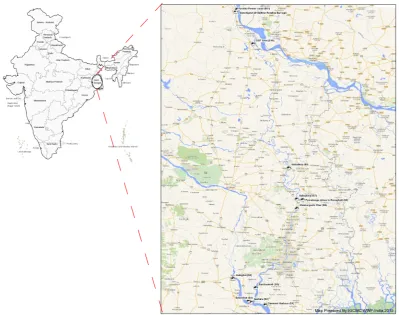
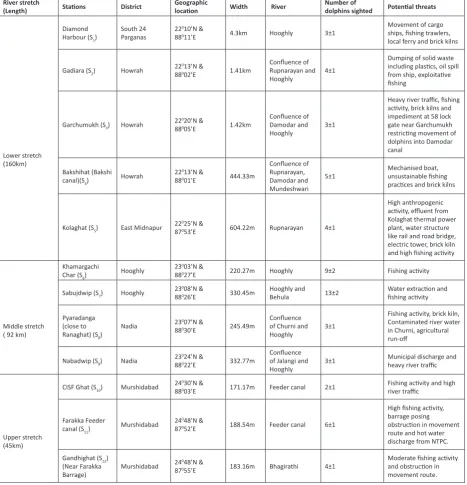
South 24 parganas. The lower and middle half of this riverine stretch up to 280km (at Nabadwip, S9 in Table 1) from the mouth of the Bay of Bengal is influenced by tidal variations (Chugh 1961; Chatterjee et al. 2013). A barrage was commissioned at Farakka in 1975 to divert water into river Bhagirathi and to reduce the silting problem at Kolkata and Haldia port (Rudra 2008). Located 254km upstream from Nabadwip, this barrage diverts water from the Ganga to the Bhagirathi River through a 40km long feeder canal. It runs parallel to the flow direction of the Ganges for 38.3km. Two of its well known tributaries are the Damodar and the Rupnarayan which join downstream Kolkata. The sampling stations in Dolphin habitat on the river Ganga and its tributaries in southern West Bengal are described in Table 1 and Fig. 1. The study area all along the river course of the Ganga has been broadly catagorised as:
1. Lower stretch: From the mouth of the Bay of Bengal to 160km upstream (including Diamond Harbour, Bakshihat, Gadiara and Garchumukh). The adjacent point of Kolaghat on river Rupnarayan is also included due to regular occurrence of Dolphin in recent times.
2. Middle stretch: A length of 92km on the river Ganga from the upper limit of the lower stretch up to Katwa (including Khamargachi, Sabujdwip, Pyaradanga and Nabadwip).
3. Upper stretch: A stretch of 45km adjoining Farakka Barrage (including CISF Ghat, Farakka feeder canal and Gandhighat near Farakka Barrage).
MATERIALS AND METHODS
A total river survey effort of 297km was invested out of 534km (24048’ –22010’N & 87055’–88011’E from
Farakka Barrage to Diamond Harbour) of the River Ganga flowing in southern West Bengal from 2012–2014. The study area was selected on the basis of information collected from the literature, community interaction and by observing riverine character (emphasizing the confluence, meanderings, deep channels and area of high fishing activity and good assemblage of water birds) of the respective stations. Point observations were made during the day-light hours (0700 to 1600 hr) at 12 stations and their adjacent river stretches from the boat and along river banks during the study period. Global positioning system (GPS) was used during navigation for recording the locations of sightings around every station and adjacent water channels. The location of the boat was in proximity with individual dolphins and groups (5–40 m) while observations were made without using any optical device. Dolphins were identified as calves, sub-adults and adults based on their colour, size and diving pattern. At each point, observations on dolphins and potential anthropogenic threats were recorded. Hydrological parameters (temperature, pH, salinity, conductivity and dissolved oxygen) were measured from all the stations especially in the areas of regular occurrence of dolphins. The field team consisting of 2–4 observers was involved in the regular collection of field data on a pre-designed data sheet. The dolphins were considered to be of the same group if visibility of them was within a radius of 100m. The present study did not involve census survey to count dolphins because this was the first such attempt to record baseline data on the Dolphin in southern West Bengal in selected stretches where their occurrence has been monitored for two consecutive years.
Journal of Threatened Taxa | www.threatenedtaxa.org | 26 August 2016 | 8(9): 9131–9137 9133
Gangetic Dolphin in southern West Bengal, India Chowdhury et al.
RESULTS & DISCUSSION
A comprehensive Dolphin survey conducted from 2012–2014 confirmed the continued occurrence of Platanista gangetica in seven districts (East Midnapur, Hooghly, Howrah, Murshidabad, Nadia, North 24 Parganas, South 24 Parganas) of southern West Bengal where the Ganga and the other tributaries flow. They were usually seen in groups of 4-6 near the confluence of rivers and channels. Dolphins were sighted at the confluence of major tributaries, Rupnarayan, Behula, Damodar, Mundeshwari, Jalangi and Churni (Table 1; Images 1 & 2). This study confirmed that river confluences which are generally considered as high fish assemblage areas due to favourable hydro-biological conditions and proper depth (Smith et al. 1998; Bashir 2010; Choudhury 2013) were also identified as favourable dolphin microhabitats (Sinha 1997; Biswas et al. 2000; Wakid 2006). All the congregation points of Dolphin, however, have their specific characteristics with respect to channel width (88.39–4300 m), depth (5–37 m), nature of land use (crop lands, brick kiln and human settlement), fishing activity and frequency of river traffic (10–12 boats/hour). Among the observed dolphins most
were solitary or in small groups but as many as two to 12 individuals were spotted in the main channel of the river Hooghly like Khamargachi Char and at Sabujdwip in the confluence of rivers Hooghly and Behula.
Habitat use
In the present study a congregation of more number of dolphins was noticed at locations with deep pools like Khamargachi Char (9±2) and Sabujdwip (13±2) with a depth between 20–25 m. Dolphins are known to prefer deeper pools, meandering channels and confluences that offer hydraulic refuge (Reeves & Leatherwood 1994; Smith et al. 2009, 2010; Kelkar et al. 2010). A similar observation was earlier supported by Smith et al. (1998) that in deeper pools with counter-currents, dolphins often aggregate for feeding in side-channels near deep pools, to maximize foraging efficiency. In the present study narrow channels like Bakshi Canal (Bakshihat) with lower water depth (4.8–5.1 m in dry season) houses a good number of dolphins during the monsoon. These narrow channels become water deficient in the lean period when dolphins are unable to access these waterways. In a study by Choudhary et al. (2012) the minimum mid-channel depth requirements were
Journal of Threatened Taxa | www.threatenedtaxa.org | 26 August 2016 | 8(9): 9131–9137 9134
Gangetic Dolphin in southern West Bengal, India Chowdhury et al.
estimated at 5.2m for dolphin adults and between 2.2m and 2.4m for mother-calf pairs.
Surfacing behaviour and abundance
Different surfacing patterns were observed with respect to their age class as well as on diurnal activity pattern. The adults and sub-adults were found to have different types of surfacing during different hours of the day. Exposure of the head and dorsal fin was dominant among adults throughout the day, while exposure of the
Table 1. The sampling stations in dolphin habitat on the river Ganga and its tributaries in southern West Bengal
River stretch
(Length) Stations District Geographic location Width River Number of dolphins sighted Potential threats
Lower stretch (160km)
Diamond
Harbour (S1) South 24 Parganas 22
010’N &
88011’E 4.3km Hooghly 3±1
Movement of cargo ships, fishing trawlers, local ferry and brick kilns
Gadiara (S2) Howrah 22880013’N & 02’E 1.41km
Confluence of Rupnarayan and Hooghly 4±1
Dumping of solid waste including plastics, oil spill from ship, exploitative fishing
Garchumukh (S3) Howrah
22020’N &
88005’E 1.42km
Confluence of Damodar and Hooghly 3±1
Heavy river traffic, fishing activity, brick kilns and impediment at 58 lock gate near Garchumukh restricting movement of dolphins into Damodar canal
Bakshihat (Bakshi
canal)(S4) Howrah 22
013’N &
88001’E 444.33m
Confluence of Rupnarayan, Damodar and Mundeshwari
5±1 Mechanised boat, unsustainable fishing practices and brick kilns
Kolaghat (S5) East Midnapur 22870025’N & 53’E 604.22m Rupnarayan 4±1
High anthropogenic activity, effluent from Kolaghat thermal power plant, water structure like rail and road bridge, electric tower, brick kiln and high fishing activity
Middle stretch ( 92 km)
Khamargachi
Char (S6) Hooghly 23
003’N &
88027’E 220.27m Hooghly 9±2 Fishing activity
Sabujdwip (S7) Hooghly 23880008’N & 26’E 330.45m Hooghly and Behula 13±2 Water extraction and fishing activity
Pyaradanga (close to
Ranaghat) (S8) Nadia
23007’N &
88030’E 245.49m
Confluence of Churni and Hooghly 3±1
Fishing activity, brick kiln, Contaminated river water in Churni, agricultural run-off
Nabadwip (S9) Nadia
23024’N &
88022’E 332.77m
Confluence of Jalangi and Hooghly 3±1
Municipal discharge and heavy river traffic
Upper stretch (45km)
CISF Ghat (S10) Murshidabad 24880030’N & 03’E 171.17m Feeder canal 2±1 Fishing activity and high river traffic
Farakka Feeder
canal (S11) Murshidabad 24
048’N &
87052’E 188.54m Feeder canal 6±1
High fishing activity, barrage posing obstruction in movement route and hot water discharge from NTPC.
Gandhighat (S12)
(Near Farakka
Barrage) Murshidabad
24048’N &
87055’E 183.16m Bhagirathi 4±1
Moderate fishing activity and obstruction in movement route.
Journal of Threatened Taxa | www.threatenedtaxa.org | 26 August 2016 | 8(9): 9131–9137 9135
Gangetic Dolphin in southern West Bengal, India Chowdhury et al.
highest during the morning hours. Wakid & Braulik (2009) reported an average dive-time of 107sec in the Dolphin. The highest congregation of dolphins was recorded in Sabujdwip during the monsoon period followed by Khamargachi Char, Bakshihat, Feeder canal, Nabadwip, Gandhighat (Near Farakka Barrage), CISF Ghat, Kolaghat, Gadiara, Pyaradanga, Garchumukh and Diamond Harbour (Table 1). Stations like Sabujdwip and Khamargachi Char are important points of the river Ganga in terms of Dolphin congregation, particularly the abundance of calves (3±1) and sub-adults (5±1) observed were highest at Sabujdwip and Khamargachi
Stations River Temperature (˚C) pH Salinity(ppm) Conductivity (μs/cm) Dissolve oxygen
(mg/l)
Diamond Harbour (S1) Hooghly 30.5 8.0 0 0186 7.8
Gadiara (S2) Confluence of Rupnarayan and Hooghly 29 8.2 0 0232 7.5
Garchumukh (S3) Confluence of Damodar and Hooghly 30 8.0 0 0371 7.7
Bakshihat (S4) Confluence of Rupnarayan, Damodar and Mundeshwari 32.5 8.0 0 0257 7.6
Kolaghat (S5) Rupnarayan 30 7.7 0 0159 7.8
Khamargachi Char (S6) Hooghly 30 8.4 0 0198 7.8
Sabujdwip (S7) Hooghly and Behula 31˚C 7.9 0 0177 7.3
Pyaradanga (S8) Confluence of Churni and Hooghly 32˚C 7.1 0 0186 7.5
Nabadwip (S9) Confluence of Jalangi and Hooghly 29.5˚C 8.2 0 0224 8.0
CISF Ghat (S10) Feeder canal 30.1 7.7 0 0164 7.8
Farakka Feeder canal
(S11) Feeder canal 30 7.8 0 0172 7.8
Gandhighat (S12) Bhagirathi 30 7.8 0 0205 7.9
Table 2. Optimum range of hydrological parameters in the dolphin habitat of river Ganga and its tributaries
Char indicating calving areas. The adults appeared partially out of water during every leap whereas the calves frequently jumped out of the river making a complete U-turn in the air.
Hydrological parameters
Water parameters were recorded from all the stations where sighting of Dolphin was frequent throughout the seasons. The average surface water temperature recorded from the sites of point observations was 30.38±0.99 0C, pH 7.90±0.33, salinity
0 ppt, conductivity 210.92±58.28 μs/cm and dissolved
Journal of Threatened Taxa | www.threatenedtaxa.org | 26 August 2016 | 8(9): 9131–9137 9136
Gangetic Dolphin in southern West Bengal, India Chowdhury et al.
oxygen was 7.70±0.19 mg/l (Table 2). Dolphins are not generally known to occur in salinities greater than 10ppt, although they have been recorded in waters as saline as 23ppt (Smith & Braulik 2012). Hydrological parameters in stations like Sabujdwip, Khamargachi Char and Bakshihat were favourable compared to Nabadwip, Farakka, Kolaghat, Diamond Harbour, and Pyaradanga in terms of habitat preference of dolphins with respect to suitable depth (7–25 m) and non-occurrence of river traffic. Thus the above hydrological parameters of river Ganga and its tributaries were found to be optimum for the existence of dolphins.
Anthropogenic disturbances and potential threats
It was noticed during this study that potential threats in the Dolphin habitat have an adverse impact either directly on their prey species or confine the habitat into isolated pockets. It was confirmed by the observations and appraisal among the community members that the waterways, which were full of resources, are now showing signs of decline. Around 94–95 % of the Hilsa, an iconic fish (Tenualosa ilisha) in this subregion are captured by drift gill nets in the lower stretch of the study area at Hooghly estuarine system (De 2014). These nets have a direct or indirect impact on the availability of fish in the river. Unsustainable use of fishing gear in the Ganga and its tributaries contributes to the loss of many fish varieties, especially their breeding grounds and fish seeds (Choudhury & Mitra 2014). Entanglement of dolphins in fishing nets causes direct damage to the local population. This was observed in Diamond Harbour, Garchumukh and near Farakka Barrage. Accidental killing is another concern for Dolphins throughout most of their range. The primary cause is believed to be entanglement in fishing gear such as nylon gill nets because their preferred habitat is often in the same location as primary fishing grounds. The practice of oil extraction from the specimen of such incidental killing is not rare in Nadia District. Such traditional habits have been recorded since ages by many observers (Anderson 1879; Sinha 2002). On a few occasions accidental killing due to collisions with river crafts has also been recorded in Kolkata. The present study had similar observations in all three stretches of the study area. Around 76% of the respondents in community appraisal comprised fishermen and boatmen depending on the river for their livelihood. Even 50–60 % of the fishing boats in lower and middle stretches are engaged in illegal sand mining on account of decline in fish catch.
The presence of dams and barrages in Ganga River is another potential threat to the Dolphin habitat which
prevents their migration and leads to the segregation of populations. Farakka Barrage on the Ganga is one major impediment in the movement of dolphins since its commissioning in 1975. Presently, there are five connecting bridges over river Rupnarayan at Kolaghat and a series of sluice gates over river Damodar near Garchumukh obstructing the movement of the dolphins. The mortality of dolphins has been recorded in the recent past (November 2014) near the Farakka Barrage gate. Migration of economically important species like the Hilsa and Macrobrachium prawns is severely affected by these impediments. The effects of dams and barrages on the Dolphins and their prey in the entire distribution range in India was studied by Smith et al. (2000).
Water quality is directly affected by the discharge of industrial effluents, hot water discharge from thermal power plants (like Kolaghat and Farakka), municipal waste, agricultural run-off, frequent river traffic and spillage of oil. Abundance of fish near Farakka and Kolaghat is affected by the discharge of hot water from thermal power plants and consequent impact on dolphin’s prey.
Extraction of water for agriculture and industry leaves a major impact on the rivulets and tributaries especially in the lean seasons of summer and winter. This deprives the Dolphin and many other associated freshwater species of their home and confinement of resources in separate pockets. Brick kilns directly utilize soil from river banks in many locations (with 7–10 kilns/ km on both banks of river) of the study area destabilizing the river front and making it vulnerable to erosion.
A predominantly fish eating community like that in West Bengal depends on large scale fishing activity in all the freshwater sources by direct wild harvesting. This is the major deterrent to replenish the fish variety. Fishing gear used by the local fisherman do not adhere to the regulatory guidelines of the government and unsustainable practices leads to loss of fish or prey species in the habitat (Braulik 2006). The above factors confine this species to isolated pockets and restrict their range in southern West Bengal.
CONCLUSIONS
Journal of Threatened Taxa | www.threatenedtaxa.org | 26 August 2016 | 8(9): 9131–9137 9137
Gangetic Dolphin in southern West Bengal, India Chowdhury et al.
and the impact of many possible potential threats on their distribution need to be further studied.
In general the aim is to increase awareness of the Dolphin and river ecosystem conservation among the general riverside communities and enhance the dolphin prey-base by awareness raising and monitoring of illegal fishing in association with local communities and management authorities.
REFERENCES
Anderson, J. (1879). Anatomical and Zoological researches comprising
an account of zoological results of the two expeditions to western Yunnan in 1868 and 1875; and a monograph of the two cetacean genera, Platanista and Orcella, B. Quatrich, London.
Bashir, T. (2010). Ganges River Dolphin (Platanista gangetica) seeks
help. Current Science 98 (3): 287–288; http://dx.doi.org/10.11609/ jott.o2333.1087-91
Biswas, S.P. & S. Baruah (2000). Ecology of river dolphin (Platanista
gangetica) in the Upper Brahmaputra. Hydrobiologia 430: 97–111;
http://dx.doi.org/10.1023/A: 1004077215276
Braulik, G.T. (2006). Status assessment of the Indus River dolphin,
Platanista gangetica minor, March–April 2001. Biological Conservation 129: 579–590; http://dx.doi.org/10.1016/j. biocon.2005.11.026
Chatterjee, M., D. Shankar, G.K. Sen, P. Sanyal, D. Sundar, G.S. Michael, A. Chatterjee, P. Amol, D. Mukherjee, K. Suprit, A. Mukherjee, V. Vijith, S. Chatterjee, A. Basu, M. Das, S. Chakraborti, A. Kalla, S.K. Mishra, S. Mukhopadhyay, G. Mandal & K. Sarkar (2013). Tidal
variation in the Sundarbans estuarine system, India. Journal of Earth
System Science 122(4): 899–933.
Choudhary, S., S. Dey, S. Dey, V. Sagar, T. Naird & N. Kelkar (2012).
River dolphin distribution in regulated river systems: implications for dry-season flow regimes in the Gangetic basin. Aquatic
Conservation: Marine and Freshwater Ecosystems 22: 11–25; http:// dx.doi.org/10.1002/aqc.1240
Choudhury, A.U. (2013). The Mammals of North East India. Gibbon
Books (Guwahati) and the Rhino Foundation for Nature in North East India (Guwahati), 221–222.
Choudhury, A. & S. Mitra (2014). Assessing sustainable livelihood
strategies for fisheries communities during Hilsa fishing ban period in West Bengal, India. IUCN, 52pp.
Chugh, R.S. (1961). Tides in Hooghly River. Hydrological Science
Journal 6(2): 10–26.
De, D.K. (2014). The Shad Hilsha, Tenualosa ilisha (Hamilton) - Its
biology and fisheries. CIFRI, 166: 6–7.
IUCN (2010). IUCN Red List of Threatened Species. Version 2010.4.
<www.iucnredlist.org>. Downloaded on 12 November 2010.
Jones, S. (1982). The present status of the Gangetic Susu, Platanista
gangetica (Roxburgh) with comments on the Indus Susu P. minor
(Owen). FAO Fisheries Series 5: 97–115.
Kasuya, T. & A.K.M.A. Haque (1972). Some information on the
distribution and seasonal movement of the Ganges dolphin. The
Scientific Report of the Whales Research Institute (Tokyo) 24: 109–
115.
Kelkar, N., J. Krishnaswamy, S. Choudhary & D. Samaria (2010).
Coexistence of fisheries with river dolphin conservation.
Conservation Biology 24: 1130–1140; http://dx.doi.org/10.1111/ j.1523-1739.2010.01467.x
Kreb, D. & Budiono (2005). Conservation management of small
core areas: key to survival of a critical endangered population of Irrawaddy river dolphins Orcaella brevirostris in Indonesia.
Oryx 39(2): 1–11.
Mohan, R.S.L., S.C. Dey, S.P. Bairagi & S. Roy (1997). On a survey of
Ganges River dolphin Platanista gangetica of Brahmaputra River, Assam. Journal of the Bombay Natural History Society 94: 483–495.
Reeves R.R. & S. Leatherwood (1994). Dams and river dolphins: can
they coexist? Ambio 23: 172–175.
Reeves, R.R. & J.R.L. Brownell (1989). Susu Platanista gangetica
(Roxburgh, 1801) and Platanista minor (Owen, 1853), pp. 69–99. In: Ridgway, S.H. & R. Harrison (eds.). Handbook of Marine Mammals. Academic Press, London.
Rudra, K. (2008). The encroaching Ganga and social conflicts, The case
of West Bengal. Publisher? Total number of pages?
Shrestha, T.K. (1993). Ecology, status appraisal, conservation and
management of Gangetic
Dolphin Platanista gangetica in the Koshi River of Nepal. Journal of
Freshwater Biology 5(1): 93–105.
Sinha, R.K. (1997). Status and conservation of Ganges River dolphin in
Bhagirathi-Hooghly River systems in India. International Journal of
Ecology and Environmental Sciences 23: 343–355.
Sinha, R.K. (2002). An alternative to dolphin oil as a fish attractant
in the Ganges River system: conservation of the Gangetic River Dolphin. Biological Conservation 107: 253–257.
Sinha, R.K., S.K. Sinha, G. Sharma & D.K. Kedia (2010b). Surfacing and
diving behaviour of free-ranging Ganges River Dolphin, Platanista
gangetica gangetica. Current Science 98(2): 230–236.
Smith, B.D., M.A.A. Diyan, R.M. Mansur, E.F. Mansur & B. Ahmed (2010). Identification and channel characteristics of cetacean
hotspots in waterways of the eastern Sundarbans mangrove forest, Bangladesh. Oryx 44: 241–247.
Smith, B.D. & G.T. Braulik (2012). Platanista gangetica. In: IUCN
2013. IUCN Red List of Threatened Species. Version 2013.2. www.
iucnredlist.org. Downloaded on 02 April 2014.
Smith, B.D., A.K.M. Haque, M.S. Hussain & A. Khan (1998). River
dolphins in Bangladesh: conservation and the effects of water development. Environmental Management 22: 323–335.
Smith, B.D., G. Braulik, S. Strindberg, R. Mansur, M. Diyan & B. Ahmed (2009). Habitat selection of freshwater-dependent cetaceans and
the potential effects of declining freshwater flows and sea-level rise in waterways of the Sundarbans mangrove forest, Bangladesh.
Aquatic Conservation: Marine and Freshwater Ecosystems 19: 209–
225; http://dx.doi.org/10.1002/aqc.987
Smith, B.D., R.K. Sinha & K. Zhou (2000). Register of water
development projects affecting Asian river cetaceans, pp. 22–39. In: Reeves, R.R., B.D. Smith & T. Kasuya (eds.). Biology and Conservation
of Freshwater Cetaceans in Asia. Occasional Papers of the IUCN
Species Survival Commission. IUCN, Gland, Switzerland.
Wakid, A. (2005). Conservation of Gangetic Dolphin in Brahmaputra
River System, India. Final Technical Report submitted to the BP Conservation Programme and Rufford Small Grant, 80pp.
Wakid, A. (2006). Status and distribution of a newly documented
residential Gangetic Dolphin (Platanista gangetica Roxburgh 1801) population in eastern Assam. Journal of the Bombay Natural History
Society 102: 158–161.
Wakid, K. & G. Braulik (2009). Protection of endangered Gangetic
Dolphin in Brahmaputra River, Assam, India. Final report to IUCN-Sir Peter Scott Fund, 44pp.
Bengali abstract:
All articles published in the Journal of Threatened Taxa are registered under Cre-ative Commons Attribution 4.0 International License unless otherwise mentioned. JoTT allows unrestricted use of articles in any medium, reproduction and distribution by providing adequate credit to the authors and the source of publication.
August 2016 | Vol. 8 | No. 9 | Pages: 9125–9220
Date of Publication: 26 August 2016 (Online & Print)
DOI: 10.11609/jott.2016.8.9.9125-9220
www.threatenedtaxa.org
ISSN 0974-7907 (Online); ISSN 0974-7893 (Print)
OPEN ACCESS
Threatened Taxa
Communications
People’s attitudes toward Striped Hyaena (Hyaena hyaena Linnaeus, 1758) (Mammalia: Carnivora: Hyaenidae) conservation in lowland Nepal
-- Shivish Bhandari & Mukesh Kumar Chalise, Pp. 9125–9130
On the Behaviour, abundance, habitat use and potential threats of the Gangetic Dolphin Platanista gangetica in southern West Bengal, India
-- Mahua Roy Chowdhury, Sangita Mitra & Saswati Sen, Pp. 9131–9137
Habitat preference and roosting behaviour of the Red
Junglefowl Gallus gallus (Aves: Galliformes: Phasianidae) in
Deva Vatala National Park, Azad Jammu & Kashmir, Pakistan
-- Faraz Akrim, Tariq Mahmood, Muhammad Siddique Awan, Siddiqa Qasim Butt, Durr-e-Shawar, Muhammad Arslan Asadi & Imad-ul-din Zangi, Pp. 9138–9143
Indigenous ornamental freshwater ichthyofauna of the Sundarban Biosphere Reserve, India: status and prospects
-- Sandipan Gupta, Sourabh Kumar Dubey, Raman Kumar Trivedi, Bimal Kinkar Chand & Samir Banerjee, Pp. 9144–9154
Pollination ecology and fruiting behavior of Pavetta indica L. (Rubiaceae), a keystone shrub species in the southern Eastern Ghats forest, Andhra Pradesh, India
-- A.J. Solomon Raju, M. Mallikarjuna Rao, K. Venkata Ramana, C. Prasada Rao & M. Sulakshana, Pp. 9155–9170
Short Communications
On the status of the Long-tailed Marmot Marmota caudata (Mammalia: Rodentia: Sciuridae) in Kargil, Ladakh (Indian Trans-Himalaya)
-- Tanveer Ahmed, Mohammad Shoeb, Pankaj Chandan & Afifullah Khan, Pp. 9171–9176
The decline of the interspecific agonistic displays in an adult female Indian Eagle Owl Bubo bengalensis (Aves: Strigiformes: Strigidae): a case of habituation to human approach
-- M. Eric Ramanujam, Pp. 9177–9181
Effect of vehicular traffic on wild animals in Sigur Plateau, Tamil Nadu, India
-- A. Samson, B. Ramakrishnan, A. Veeramani, P. Santhoshkumar, S. Karthick, G. Sivasubramanian, M. Ilakkia, A. Chitheena, J. Leona Princy & P. Ravi, Pp. 9182–9189
Range extension of Heliogomphus lyratus Fraser, 1933
(Anisoptera: Gomphidae) with notes on its identification, habits and habitat
-- Amila P. Sumanapala & Himesh D. Jayasinghe, Pp. 9190–9194
A second record of Knipowitschia byblisia Ahnelt, 2011
(Teleostei: Perciformes: Gobiidae) from southwestern Anatolia, Turkey
-- H. Ahnelt, Pp. 9195–9197
New records of polypores (Basidiomycota: Aphyllophorales) from the southern Western Ghats with an identification key for polypores in Peechi-Vazhani Wildlife Sanctuary, Kerala, India
-- A. Muhammed Iqbal, Kattany Vidyasagaran & P. Narayan Ganesh, Pp. 9198–9207
Notes
Notes on three species of Palaearctic satyrinae (Lepidoptera: Nymphalidae) from northwestern Himalaya, India
-- Arun P. Singh, Pp. 9208–9215
Two additions to the flora of the Palni Hills, southern India