S T U D Y P R O T O C O L
Open Access
A cluster randomised controlled trial and
process evaluation of a training programme for
mental health professionals to enhance user
involvement in care planning in service users
with severe mental health issues (EQUIP): study
protocol for a randomised controlled trial
Peter Bower
1*, Chris Roberts
3, Neil O
’
Leary
3, Patrick Callaghan
4, Penny Bee
2, Claire Fraser
2, Chris Gibbons
2,
Nicola Olleveant
2, Anne Rogers
5, Linda Davies
6, Richard Drake
2,7, Caroline Sanders
1, Oonagh Meade
4,
Andrew Grundy
4, Lauren Walker
2, Lindsey Cree
2, Kathryn Berzins
2, Helen Brooks
2, Susan Beatty
2, Patrick Cahoon
7,
Anita Rolfe
7and Karina Lovell
2Abstract
Background:Involving service users in planning their care is at the centre of policy initiatives to improve mental health care quality in England. Whilst users value care planning and want to be more involved in their own care, there is substantial empirical evidence that the majority of users are not fully involved in the care planning process. Our aim is to evaluate the effectiveness and cost-effectiveness of training for mental health professionals in improving user involvement with the care planning processes.
Methods/Design:This is a cluster randomised controlled trial of community mental health teams in NHS Trusts in England allocated either to a training intervention to improve user and carer involvement in care planning or control (no training and care planning as usual).
We will evaluate the effectiveness of the training intervention using a mixed design, including a‘cluster cohort’ sample, a‘cluster cross-sectional’sample and process evaluation. Service users will be recruited from the caseloads of care co-ordinators.
The primary outcome will be change in self-reported involvement in care planning as measured by the validated Health Care Climate Questionnaire. Secondary outcomes include involvement in care planning, satisfaction with services, medication side-effects, recovery and hope, mental health symptoms, alliance/engagement, well-being and quality of life. Cost- effectiveness will also be measured. A process evaluation informed by implementation theory will be undertaken to assess the extent to which the training was implemented and to gauge sustainability beyond the time-frame of the trial.
(Continued on next page)
* Correspondence:[email protected]
1NIHR School for Primary Care Research, Manchester Academic Health
Science Centre, University of Manchester, Williamson Building, Oxford Road, Manchester M13 9PL, England
Full list of author information is available at the end of the article
(Continued from previous page)
Discussion:It is hoped that the trial will generate data to inform mental health care policy and practice on care planning.
Trial Registration Number:ISRCTN16488358 (14 May 2014)
Keywords:Care planning, Severe mental illness, Service user involvement
Background
Involving service users in their own care and allowing choice is at the centre of policy initiatives aimed at im-proving quality of care and enhancing recovery. This principle is enshrined and prioritised in health care [1, 2], particularly mental health care policy and guidelines [3, 4]. Current guidance states that the outcome of any assess-ment will be a care plan developed with the service user, the professional/member of the care team and other ap-propriate parties, such as families and carers [5, 6]. Mental health nurses, psychiatrists and allied health and social care workers provide the majority of care for service users regardless of setting. They have a pivotal role in the devel-opment of care planning, particularly as care co-ordinators under the Care Programme Approach (CPA) [5, 6]. Despite the consensus among policy-makers, pro-fessionals, service users and carers about the importance of involvement there is substantial empirical evidence that the majority of users and carers are marginalised in the care planning process. This lack of involvement occurs in both in-patient and community settings [7, 8] and there is evidence that current models of involving users and carers in their care are less effective than first envisaged.
One of the key findings of the Care Quality Commis-sion’s national survey, which included 7500 users of men-tal health services, was that service users were often not involved in their care as much as they wanted to be, with only 34 % agreeing that they were ‘definitely’ involved as much as they wanted to be in decisions about their care and treatment [7, 8]. A significant number of studies of user and carer experience echo the need and desire to be involved in their care [9], but despite this evidence there has been little change in practice. There is also evidence that carers feel excluded, unsupported and distanced by mental health services and want to be more involved in the care planning process [10–13]. A systematic review of user and carer views and expectations of mental health nurses, including 132 papers over a 20-year period [14], found that users and carers expressed a need for openness and adequate information, more choice and increased in-volvement in the assessment and planning of their care. Perhaps most importantly it found that the literature re-mains strikingly consistent over time, indicating a sus-tained lack of impact on practice.
This research aims to develop a standardised training intervention (EQUIP training) to improve user and carer
involvement with the care planning process, and to test the effectiveness and cost-effectiveness of this package. The study is a pragmatic effectiveness and cost-effectiveness trial and, thus, the optimal comparator is a no training control representing usual practice.
If proven effective and cost-effective, it will provide a model for wider implementation to improve the quality of mental health care across community mental health services.
Objectives
To conduct a cluster randomised controlled trial (RCT) of effectiveness and cost-effectiveness of the EQUIP training for improving involvement of service users and carers compared with controls in UK National Health Service (NHS) community mental health services.
Methods/Design
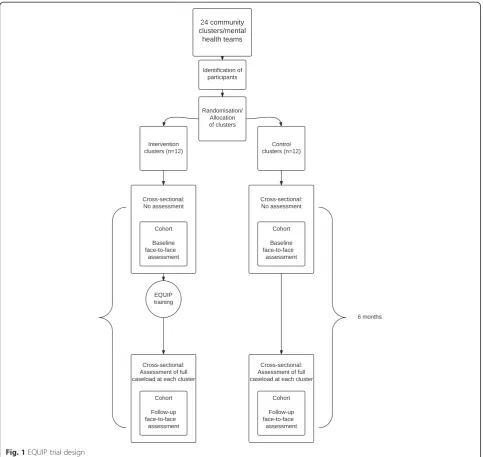
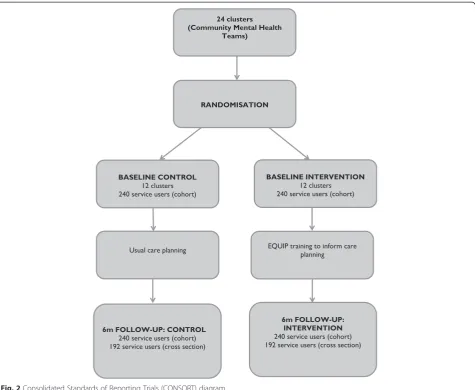
As the trial involves a health professional training inter-vention, a cluster randomised design is required to avoid contamination. A mixed design, including a ‘cluster co-hort’ design, a‘cluster cross-sectional’design and process evaluation will be adopted (see Fig. 1 for an outline of the trial design, and Fig. 2 for the Consolidated Standards of Reporting Trials (CONSORT) flow diagram). Adoption of the combined design provides protection against problems in either of the individual approaches.
In the ‘cluster cohort’ design, service users cared for by each Community Mental Health Team (CMHT) will be recruited, and a detailed face-to-face assessment will be conducted at baseline. Carers will be recruited from consenting service users. Each CMHT will then be ran-domised to either intervention (training in care plan-ning) or control (usual care planplan-ning). The CMHTs randomised to intervention will then receive the EQUIP training. Six-month follow-up face-to-face assessments will then be conducted with the same service users and carers (intervention and control groups) 6 months after the baseline assessment.
The design will, therefore, also include a‘cluster cross-sectional’ element to help ameliorate problems of re-cruitment and attrition within the cluster cohort. Six months after randomisation, a smaller number of ques-tionnaires (see Table 1) will be posted to all service users who are not part of the ‘cluster cohort’ but who are under the care of all participating teams.
Service users in the cross-sectional sample only have to agree to assessment once, and the assessment is de-signed to be less burdensome as it includes fewer mea-sures. This means that a higher proportion of service users may agree to take part in the study, potentially giv-ing a larger sample size.
However, the‘cluster cohort’design allows adjustment for a wider range of baseline characteristics at an indi-vidual level because of the greater range of measures included, giving potentially greater statistical power compared to analysis of the‘cluster cross-sectional’data [15]. Comparative analyses of data from the two designs will allow the possibility of pooling results from the two designs to be investigated.
A potential threat to the validity of a cluster rando-mised trial is recruitment bias, where professionals allo-cated to different trial arms recruit differently depending on their allocation, leading to selection bias and baseline incomparability [16]. Whilst it is preferable to recruit
[image:3.595.57.541.88.545.2]service users prior to allocation, the logistics of the trial means that clusters will need advanced notice of their training date, which will require us to inform them of their allocation. Therefore, initial patient selection in the EQUIP trial is not by those being trained in the trial, but will use existing registers of service users. This will be undertaken by NIHR Clinical Research Network Clinical Studies Officers (CSO) and Trust staff. This will limit the opportunity for biased recruitment. Carers will be recruited by providing service users with a recruitment pack to give to their carer (if a carer is identified and wishes to consider taking part).
A longitudinal process evaluation of the training programme is being undertaken which incorporates mul-tiple interviews over time, observations and diary methods of data collection. This will run alongside the trial and is being conducted because successful implementation of user and carer-led care planning implicates a range of fac-tors including the integrity of the intervention and the
acceptability of the intervention to both clinicians and ser-vice users [17].
Study setting and inclusion criteria
Community Mental Health Teams (CMHTs)
The study is being conducted in NHS Trusts in the UK. All CMHTs within the participating NHS Trusts will be eligible for inclusion. Service users aged 18 and over with a severe mental illness (e.g., psychosis, bipolar dis-order, schizophrenia) under the care of participating CMHTs will be eligible for inclusion. We will seek con-sent from service users to access health records to col-lect data on diagnosis, service use and treatment history.
Intervention design–User/carer-led training package to inform care planning
All consenting CMHTs allocated to the intervention arm will receive the EQUIP training intervention developed in our earlier work. The EQUIP training intervention
[image:4.595.62.538.88.478.2]consists of 2 days face-to-face training, an 8-hour op-tional self-directed learning package and 6 hours super-vision per team in the 6 months following the training. In recruitment of teams, we ask that at least 80 % of staff designated as‘care co-ordinators’(i.e., those with a case-load) commit to attend the training. We will document attendance at training by all professionals.
Comparator–Usual care
This will consist of‘usual practice’in care planning, with-out access to the specialist training described above. We will have considerable detail about what ‘usual practice’
consists of and how it varies from unit to unit from the embedded process evaluation.
Intervention components
We describe the intervention according to the Template for Intervention Description and Replication (TIDieR) guidelines [18]:
[image:5.595.59.542.96.534.2]a) Why: our aim was to co-develop, co-produce and co-deliver (with service users/carers) a best evidence, acceptable and feasible training programme for men-tal health professionals to enhance user and carer in-volvement in care planning. Two reviews were Table 1Outcome measures used with the 3 sample groups at baseline and 6-month follow-up
Sample Baseline Six months
Service user cohort (face-to-face collection) Demographic data
Primary outcome: Primary outcome:
HCCQ-10 HCCQ-10
Secondary outcomes: Secondary outcomes:
VSSS-EU-54 VSSS-EU-54
GASS GASS
WEMWBS WEMWBS
DREEM DREEM
HADS HADS
CALPAS-12 CALPAS-12
WHOQOL-BREF WHOQOL-BREF
PROM PROM
Economic outcome: Economic outcome:
EQ-5D-5L EQ-5D-5L
Service use questionnaire Service use questionnaire
Carer cohort (postal collection) Demographic data
Secondary outcomes: Secondary outcomes:
PROM PROM
CUES-C CUES-C
WHOQOL-BREF WHOQOL-BREF
Economic outcome: Economic outcome:
EQ-5D-5L EQ-5D-5L
Cross-sectional sample: service users (postal collection) Demographic data
Primary outcome:
HCCQ-10
Secondary outcome:
PROM (14-item SF version)
Economic outcome:
EQ-5D-5L
conducted including: a narrative synthesis (Bee et al., in press) which examined how user-involved care planning is operationalised within mental health ser-vices and to establish where, how and why chal-lenges to user involvement occur; and a scoping review of training reviews and interventions that change clinician behaviour. In addition, focus groups and individual interviews with service users, carers and health professionals were conducted to ascertain training content and delivery requirements and to determine the priorities and components of ad-equate user and carer involvement in care planning. The evidence from the reviews and qualitative data was synthesised to develop and design the training. b) What: a range of training materials have been
developed for the training including PowerPoint slides, case scenarios, audio-recordings from health professionals, service users and carers and a trainer’s manual.
c) Who: the synthesis identified that the training should be multi-disciplinary, including all health professionals and psychiatrists. Team training was seen as optimal and, as far as possible, teams will be trained together. The training will be delivered by 2 of the co-applicants (both academics with teaching experience) and 3/4 service users and
carers who have attended a 4-day‘train the
trainers’course.
d) How: the synthesis indicated that training should include a range of formats: face-to-face, self-directed learning and follow-up supervision. The consensus exercise indicated a minimum of 15 hours and max-imum of 30. The course will run for 2 days (12 hours) plus 6 hours follow-up supervision and 8 hours self-directed learning (optional). Hence, each health professional will receive 18 hours of facilitated training and an additional optional 8 hours self-directed learning.
e) Where: consensus was reached that the training venue should be outside the clinical area, geographically convenient, provide good catering and in a venue with appropriate training resources. f ) When and how: the training will be delivered to
each cluster randomised to the training intervention over 2 days. In recruiting teams, we ask that 80 % of the care co-ordinators within each team attend the training. The training will be delivered within 6 weeks of service users being recruited into the trial. g) Tailoring: the intervention has been tailored for
health professionals.
h) Modifications: only minor modifications will be made in light of feedback during the trial. If the trial is successful and we implement the training across other NHS Trusts, modifications will be made in
light of feedback collected from the process evaluation.
i) How well: fidelity of the training has been ensured by the careful development and synthesis work described earlier, the‘train the trainers’course, the development of a detailed manual and the delivery of training by the same groups of trainers.
Outcome assessment
Primary outcome
The Health Care Climate Questionnaire (HCCQ-10) [19] is the primary outcome measure for the service users in the trial.
The HCCQ-10 was developed to assess patient experi-ence of health care and the degree to which their care offers support for autonomy. The scale has ten items, which are scored on a seven-point scale ranging from
‘strongly disagree’to ‘strongly agree’. An overall score is calculated as the mean of the items (expressed out of 100), where a higher score indicates greater support for autonomy.
Secondary outcomes
Secondary outcome measures were determined using ex-perts and a consensus discussion exercise with the ser-vice user/carer advisory group. Key domains to measure were recommended by the service user/carer advisory group in our earlier Programme Development Grant (RP-DG-1209-10020). The domains identified were: quality of life; alliance/engagement; service satisfaction; well-being; mental health symptoms; hope and recovery; and medica-tion side-effects. Six of these domains have one quesmedica-tion- question-naire selected for completion, whilst the domain
‘satisfaction’ has separate questionnaires for both service users and carers.
acceptability, validity and sensitivity to change of this measure for this population.
Satisfaction (service users)
Verona Service Satisfaction Scale (VSSS-EU-54) [21, 22], is a validated, multi-dimensional, self-administered scale for measuring service users’ satisfaction with mental health services. There are seven dimensions: overall sat-isfaction, professional skill and behaviour, access, effi-cacy, types of intervention and relatives’ involvement. Participants are asked to express their overall feeling about their experience of the mental health service they have been attending in the last year. Satisfaction ratings are on a five-point Likert scale, with higher scores repre-senting greater satisfaction. Global and subscale scores can be obtained. Reliability testing has shown that the VSSS-EU-54 has good internal consistency and stability.
Satisfaction (carers)
Carers and Users’ Expectations of Services - carer ver-sion (CUES-C) [23] will be used to measure carers’ views of services. There are three parts to the question-naire; part A measures the impact of caring, part B mea-sures the quality of support provided by carers and part C is a free text response for advice and help. The self-rating scales consist of 13 items each in parts A and B, totalling 26 questions. All questions are answered using a three-point scale. Scores for each part range from 0 to 26, with higher scores representing more dissatisfaction and the need for more support. The scale has been found to be suitable to use to assess carers’experiences.
Medication side-effects
The Glasgow Antipsychotic Side-effect Scale (GASS) [24] is a self-rating scale to detect the side-effects of antipsychotic medication. The scale consists of 22 ques-tions and scores range from 0 to 66. Higher scores re-flect more frequent experience of side-effects, with total scores providing three categories of severity (ab-sent/mild side-effects, moderate side-effects and severe side-effects).
Well-being
The Warwick-Edinburgh Mental Well-being Scale (WEMWBS) [25] is a short, psychometrically robust scale, which is easy to complete. It has 14 items scored on a 5-point Likert scale ranging from‘none of the time’to‘all of the time’ based on experience over the past 2 weeks. Scores range from 14–70 and a higher score indicates a higher level of mental well-being.
Recovery and hope
Developing Recovery Enhancing Environments Measure (DREEM) [26] is a self-report measure used to assess
mental health recovery of people who receive mental health services. It is a 166-item questionnaire which is organised into 24 subscales (such as ‘stage of recovery’ and‘elements of recovery’), including a final section con-sisting of open-ended questions. Responses are scored on a five-point Likert scale ranging from‘strongly agree’ to ‘strongly disagree’, with low scores representing more positive experience.
Symptoms
Hospital Anxiety and Depression Scale (HADS) [27] is a 14-item scale using a 4-point Likert scale. Items are added to give two scores, one for anxiety and one for depression, with higher scores representing more severe symptoms. Scores range from 0 to 21 for both anxiety and depression. This is a well-used and validated measure.
Alliance/engagement
California Psychotherapy Alliance Scale (CALPAS) [28] is a 12-item, self-report questionnaire, which provides a total score. It has four subscales:‘service user capacity to work purposefully in therapy’, ‘the affective bond with the therapist’, ‘therapist’s empathic understanding’ and
‘involvement and the agreement between the patient and therapist on the goals and tasks of treatment’. Each item is rated on a 6-point Likert scale, with scores ranging from 12 to 84, with higher scores representing better al-liance. It has good reliability and validity.
Quality of life
World Health Organisation Quality of Life (WHOQOL-BREF) [29] is a 26-item questionnaire consisting of 4 do-mains (physical, psychological, social relationships and environment). Each question uses a 5-point Likert scale, ranging from a score of 1 to 5, with higher scores repre-senting more positive ratings. Total scores are computed within each domain. It has been shown to demonstrate good reliability and validity.
Economic outcome
Health Status
VAS, where the end points are labelled,‘best imaginable health state’and‘worst imaginable health state’.
Service use questionnaire
A Service Use Questionnaire will be used at baseline and follow-up to identify the range of services used by each trial participant and how much they have used each ser-vice. The measure will be used to estimate the costs of health and social care service use.
Use of outcome measures and methods of data collection
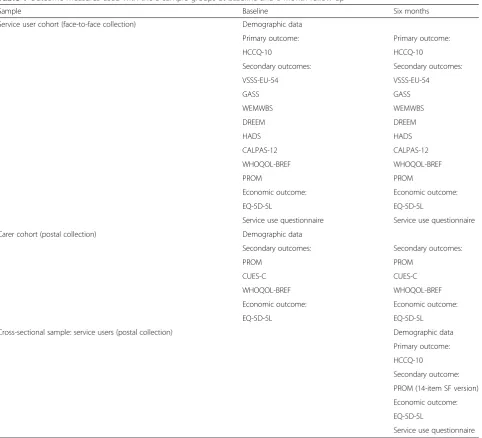
Use of outcome measures with the three sample groups (service user cohort, carer cohort, cross-sectional co-hort) is further detailed in Table 1.
Service user cohort sample
Demographic data, primary, secondary and economic outcome measures will be collected via a face-to-face as-sessment. As the‘cluster cohort’assessment is more bur-densome, service users will receive a £10 voucher for their time after completion of the follow-up interview at 6 months.
Carer cohort sample
Demographic data, primary, secondary and economic outcome measures will be collected via a postal method. Carers will receive a £5 voucher following receipt of the follow-up questionnaires at the 6-month time point.
Cross-sectional sample (service users)
Demographic data, primary, secondary and economic outcome measures will be collected via a postal method at the 6-month time point. There will be no collection of carer information in the cross-sectional part of the study. Respondents can choose to receive a £5 voucher on receipt of the questionnaire by providing postal con-tact details.
Table 1 indicates the measures to be used, with which respondents, and at what time points.
Sample size
The primary outcome is the Health Care Climate Ques-tionnaire (HCCQ-10), identified by our user consultation group as their preferred outcome measure. However, data on the use of this scale with service users with se-vere mental illness is limited and so we have used a stan-dardised effect to calculate sample size and power. A trial with 12 clusters per arm and a mean of 20 service users per cluster (total sample size of 480) will provide power greater than 80 % to detect a standardised effect size of 0.4. This assumes an intra-cluster correlation co-efficient of 0.05 and an 80 % follow-up rate, giving 384 participants with complete data in the analysis. Power
will be increased by inclusion of baseline covariates (see Statistical analysis below).
For the cross-sectional component, the primary out-come remains the HCCQ-10. We aim to recruit at least the same number of participants in each cluster; given that the same clusters will be assessed as the cohort component. As with the cohort component a sample size of 384 in the cross-sectional component will ensure power greater than 80 % in the corresponding analysis. Any additional data gathered should increase power.
Recruitment
Trust managers have agreed that we can recruit CMHTs. To recruit professionals we will use our applicants to champion the study. Teams will be introduced to the trial via a letter of support from the chief executive, and/ or via meetings with senior managers. Meetings will also be held with area team managers (and if requested, staff ) across both sites to facilitate engagement with and un-derstanding of the trial.
Recruitment and training will be undertaken in se-quence, to maximise efficiency in delivery of training to community teams, but also to ensure there is sufficient time to permit the relevant baseline assessments to be undertaken with service users (see below). CMHTs will be randomly allocated to receive the EQUIP training or control.
Recruitment of service users and carers - Cluster cohort Service users will be excluded if their participation is judged as inappropriate by the CMHTs: for example, if a patient is not deemed to have capacity to provide fully informed consent or is too unwell at the time of recruit-ment. We will seek to document all exclusions and re-port them as part of the trial CONSORT diagram.
Any carer (aged 18 years or older) of the service user will be eligible for inclusion in the ‘cluster cohort’study if they agree to take part. Consent will be implied by re-sponse via completion and return of the baseline ques-tionnaires (and return of the consent to contact form if they wish to be contacted at 6-month follow-up).
service users to opt in over the telephone. The research team will then follow-up the consent to contact forms, to answer any further questions, and when a participant is recruited, the researcher will continue with a face-to-face informed consent process. Following signed con-sent, service users will be invited to complete all baseline measures.
Service users will be asked at the informed consent meeting to nominate a carer to be included in the study and, if they choose to do so, will be provided with a questionnaire pack (including introductory letter, infor-mation sheet, questionnaire, pre-paid envelope and con-sent to contact at 6-month follow-up form).
Service users who consent to take part in the trial will be offered the opportunity to take part in the process evaluation based on a purposive sampling framework to ensure variation in gender, age and randomised group. Potential participants will be provided with an invitation letter, information sheet and consent to contact form during the baseline meeting.
Recruitment of service users–Cluster cross-sectional To recruit service users in the ‘cluster cross-sectional’ study, we will conduct a postal survey of all service users under the care of each community mental health team 6 months after randomisation, excluding those already re-cruited to the‘cluster cohort’.
Sequence generation and allocation concealment
Once service users and carers have been sent a trial invi-tation pack (following caseload review), the clusters will be allocated randomly to either intervention or control. To eliminate selection bias, allocation will be determined through an external telephone randomisation service at the Clinical Trials Unit of the Manchester Academic Health Science Centre.
Clusters will be submitted to the randomisation ser-vice in pairs. Each pair will be from the same site and similarly matched in other characteristics where possible, to reduce imbalance between intervention and control arms. One member of the pair will be allocated to inter-vention by random selection, the other allocated to control.
Blinding
To reduce detection bias, we will seek to blind re-searchers undertaking assessments of the quality of care planning to the allocation. We will report the success or otherwise of our attempts at blinding.
Data management
All data will be stored securely in line with local data management arrangements. All questionnaires and other paper records will be stored in secure storage facilities at
the University of Manchester and the University of Nottingham. Personal identifiable paper records will be stored separate from anonymised paper records. All electronic records will be pseudo-anonymised using a reference number for each participant and stored on a password protected server at the University of Manchester.
Statistical analysis
Analysis of outcomes will follow intention-to-treat prin-ciples: outcome data will be sought and included in the analysis for all service users irrespective of receipt of the intervention or completion of care planning during the time scale of the EQUIP trial.
Standard data checking procedures will be used as part of the data cleaning procedure prior to locking the data-base and linkage to group allocation. We will then model the pattern of missing data in terms of baseline characteristics of service users and treatment allocation to check for differential non-response. Depending on the patterns of missing data we may at this point choose to use multiple-imputation. Multiple-imputation may also be used in sensitivity analyses for non-ignorable missing data assumptions [31].
For the cluster cohort study the intervention effects for the primary outcome (HCCQ-10) and secondary out-come measures will be estimated using a linear mixed model with a random intercept for CMHTs. The base-line value of the outcome will be used as a covariate to-gether with other covariates pre-specified in the statistical analysis plan. The same statistical modelling procedure will be used for estimation of the intervention effect in the cluster cross-sectional study using a re-stricted set of covariates. Full detail of covariates for each model will be confirmed in the statistical analysis plan. We will then test for heterogeneity of the treat-ment effect using the combined cohort and cross-sectional data. If there is no evidence of heterogeneity, we will estimate a pooled treatment effect.
A draft statistical analysis plan for primary and sec-ondary outcomes, including sub-group analyses will be presented to and agreed with the Programme Steering Group prior to the commencement of the data analysis.
Economic analysis
control for key covariates that are associated with either costs or QALYs. Bootstrap techniques will be used to estimate the cost-effectiveness acceptability curve, like-lihood that the intervention could be cost-effective and net benefit statistic.
The objective of the economic study will be to assess the relative cost-effectiveness of the training intervention to improve patient outcomes and/or reduce the costs of health and social care.
Process evaluation
A process evaluation of the training programme delivered as part of the trial is deemed appropriate because success-ful implementation of the user/carer-led care planning training implicates a range of factors including the integ-rity of the intervention and the acceptability of the inter-vention to both clinicians and service users [17].
The process evaluation is designed to explore by how far the user/carer-led care planning has been taken up and implemented in the daily work of the health profes-sionals who attended the training and what the conse-quences of this uptake have been. It will complement and supplement the evidence provided by the main ran-domised trial, as recommended by the Medical Research Council (MRC) framework for evaluation of complex intervention [32]. The design and execution of the process evaluation will draw on Normalisation Process Theory (NPT) [33] from the outset as well as other the-ories of implementation science. NPT comprises four components: coherence (sense making work), cognitive participation (relational work), collective action (oper-ational work), reflexive monitoring (appraisal work). NPT has been developed from empirical studies of the implementation of complex interventions in health care contexts and in relation to mental health contexts in particular. We will focus on: (a) implementation of user/ carer-involved care planning–the way this is developed and translated into practices (of mental health profes-sionals, users, carers and others); (b) embedding – the manner in which care planning becomes, (or does not become), routinely incorporated in everyday work of ser-vice users and professionals; (c) integration – how care planning is sustained as part of the everyday lives of in-dividuals at work and at home; and d) networking – how it generates access to new networks and resources.
Informed consent
The key ethical concerns for the programme include confidentiality, participant anonymity and informed con-sent to participate. The study includes both mental health service users and carers as participants and, as such, there are specific ethical issues to be considered. Research governance principles and ethical committee approvals bind all applicants and institutions. We will
ensure we adopt the highest standards of research con-duct including involvement of service user representa-tion in the management and delivery of the research.
The study will be conducted in compliance with the study protocol, Good Clinical Practice (GCP) and both University and NHS regulatory and monitoring require-ments. The Work stream teams will meet every 3 months and the chief investigator (CI) will be respon-sible for the overall leadership, management and outputs of the programme. The principal investigator (PI) from each site will maintain a log of the key milestones to be achieved against the timetable. The programme man-agers and Work stream leads will be responsible for the day to day running and co-ordination of the studies and will be accountable to the PI. All research associates will be supervised by the Work stream leads.
All potential participants will be provided with an in-formation sheet written to current NRES guidelines and favourably reviewed by the relevant ethics committee, prior to the study commencing. Service users and carers have been involved in developing the participant mation sheets to ensure they are accessible. The infor-mation sheet will be provided to potential participants at the point of them expressing an interest in participating. It will provide potential participants with information about the study, including the potential benefits and risks of taking part, confidentiality and the right to with-draw. Researcher contact details will be provided so par-ticipants can contact them with any queries prior to the participant deciding whether or not to take part. Re-searchers will further discuss risks and benefits immedi-ately prior to the data collection taking place.
Participants in randomised trials usually provide writ-ten informed consent for a range of research procedures, including participation in the trial, randomisation and data collection. However, conventional informed consent procedures are not always appropriate in the context of a cluster, randomised trial [34]. In the EQUIP trial, com-munity mental health services are making the decision to take part in the EQUIP trial and agree to randomised allocation. This is described as a‘cluster cluster’ design, and is distinguished from an ‘individual cluster’ design [35]. In the latter, randomisation is at the level of the cluster, but specific services are delivered to individuals, and service users can consent to receive or not receive that intervention. The recent CADET trial was an ex-ample of an individual cluster design [36]. In ‘cluster cluster’ designs such as the EQUIP trial, service users cannot opt out of a cluster in the same way, as the com-munity teams will have been trained in the new methods. The recent WISE study was an example of this design [37].
as these processes are not under control of the service users. The following consent procedures will be adopted.
If the service, and the CMHTs consent to take part in the trial, then individual service users will not be asked for specific consent to be randomised as part of the EQUIP trial. Service users cannot, therefore,‘opt out’of their cluster allocation. The Clinical Research Network CSOs (or Trust staff ) will be responsible for accessing patient details and determining who is eligible to take part in the study and be contacted. They will be respon-sible for sending out information about the study to the identified service users, along with an invitation to par-ticipate. The research team will not have access to ser-vice user details until they have returned the consent to contact form.
Service users in the ‘cluster cohort’ will undertake a detailed face-to-face assessment at 2 points in time (baseline and 6 months). For these, a formal written consent procedure will be adopted. It will be explained to service users that their CMHT is involved in a study to test the effectiveness of a new training package on service user/carer involvement in care planning com-pared to the usual care planning experience. Participants will be told that we will do this by delivering the training to some mental health teams and not to other teams to see if receiving the training has an impact on the extent of service user/carer involvement in care planning.
Carers in the ‘cluster cohort’ will undertake a postal survey at baseline and at 6 months. Carers will be asked to participate via nomination by a service user. Response to the questionnaires will be treated as consent. Carers will also be asked to complete a consent to contact form to allow invitation to complete the follow-up question-naire at 6 months, which is returnable to the research team in the prepaid envelope provided.
Service users in the‘cross-sectional sample’will under-take a short postal survey at 6 months only. For these, we will treat this part of the study as a survey. Service users will receive a postal invitation to the survey, seek-ing their views on the quality of the care plannseek-ing process that they have received. Response to the survey will be treated as consent, as is usual in survey work. Participants may change their mind and withdraw from the study at any point and this will not affect the care they receive.
Ethics
The study received a favourable ethical opinion from the National Research Ethics Service (NRES) on 8 August 2014 (NRES Committee North West Lancaster, REC Reference 14/NW/0297; IRAS Project ID 125899). It will be conducted in accordance with the UK Department of Health Research Governance Framework in Health and Social Care (2005) and adhere to the ethical principles of
the Helsinki Declaration (2013). All research staff in-volved in the conduct of the trial will meet the standards laid out in the ICH Tripartite Guideline for Good Clin-ical Practice (1996).
All data will be anonymised and secured off site fol-lowing data input for a period of at least 5 years in ac-cordance with the Data Protection Act (1995).
The design of this trial will not disadvantage service users in either the care planning training groups or con-trol groups. No treatment is being withheld from service users in the control group.
Ancillary studies
Data from an embedded sub-study will contribute to a programme of research (www.population-health.man-chester.ac.uk/mrcstart/) funded by the MRC to expand the relatively small evidence base on an important issue concerning the recruitment of participants to trials [38].
It is recognised that patient and public involvement (PPI) is an important part of designing studies that are sensitive to the needs and preferences of patients, and the EQUIP study has invested significant time and re-sources into ensuring that PPI on the project receives sufficient focus. The embedded sub-study (‘START in EQUIP’, funded through an NIHR Doctoral Research Fellowship – award number DRF-2012-05-128) aims to evaluate whether telling eligible patients directly about the PPI in EQUIP increases patient recruitment into the study.
Service users will be randomised to receive a flyer de-tailing the extensive PPI in EQUIP alongside the stand-ard participant information sheet, or the standstand-ard participant information sheet alone. This will be imple-mented by using cluster randomisation, in a crossed-factorial design with the main EQUIP allocation. We will test whether receiving the flyer is associated with higher levels of recruitment into EQUIP.
Discussion
Involving service users in planning their care is at the centre of policy initiatives in the United Kingdom to im-prove quality of mental health care. Users value care planning and involvement in care, but achieving this in practice is far from straightforward.
Conducting trials such as this in the context of routine care raises significant logistical challenges. Recruiting ad-equate numbers of patients in the limited recruitment window prior to training is proving challenging, and busy services can struggle to provide time for staff to at-tend the relevant training sessions when faced with sig-nificant clinical pressures.
The planned process evaluation will allow us to ex-plore the impact of these pressures on delivery and im-plementation of the training. If successful in improving outcomes, we will be active in disseminating and imple-menting the results of the trial.
Trial status
CMHTs in the first 18 clusters have been randomised and training of staff in the experimental arm of these clusters completed. Randomisation and training of the remaining clusters will continue until December 2015. Recruitment and data collection of primary and second-ary outcomes with service users and carers began in July 2014 and will continue until June 2016.
Abbreviations
CALPAS:California Psychotherapy Alliance Scales; CI: chief investigator; CMHT: Community Mental Health Team; CONSORT: Consolidated Standards of Reporting Trials; CPA: Care Programme Approach; CSO: Clinical Studies Officers; CUES-C: Carers’and Users’Expectations of Services - carer version; DREEM: Developing Recovery Enhancing Environments Measure; EQUIP: Enhancing the Quality of User Involved Care Planning in Mental Health Services; GASS: Glasgow Antipsychotic Side-effect Scale; GCP: Good Clinical Practice; HADS: Hospital Anxiety and Depression Scale; HCCQ-10: Health Care Climate Questionnaire; ICH: International Conference on Harmonisation; ISRCTN: International Standard Randomised Controlled Trial Number; MMHSCT: Manchester Mental Health and Social Care Trust; MRC: Medical Research Council; NHS: National Health Service; NIHR: National Institute for Health Research; NPT: Normalisation Process Theory;
NRES: National Research Ethics Service; PI: principal investigator;
PMG: Programme Management Group; PPI: Patient and Public Involvement; PROM: Patient Reported Outcome Measure; PSG: Programme Steering Group; QALYs: Quality-Adjusted Life Years; RCT: randomised controlled trial; REC: Research Ethics Committee; TIDieR: Template for Intervention Description and Replication; VAS: visual analogue scale; UK: United Kingdom; VSSS: Verona Service Satisfaction Scale; WEMWBS: Warwick-Edinburgh Mental Well-being Scale; WHOQOL: World Health Organisation Quality of Life.
Competing interests
The authors declare that they have no competing interests.
Authors’contributions
PB is applicant and lead of Work stream 2, designed the study and co-wrote the first draft of the protocol, and revised and edited subsequent versions for publication. CR is trial statistician and co-applicant, contributed to the study design, performed the sample size calculation and will oversee analyses. NOL contributed to the study design and statistical analysis plan for the study. PCal is PI (University of Nottingham) and co-applicant and contributed to the study design. PBe is Work stream 1 lead and co-applicant and contributed to the study design. CF is programme manager and revised and edited the manu-script. CG is research fellow, assisted with trial design, selection of outcome measures and co-wrote the first draft of the protocol. NO is research associate and assisted with the first draft of the protocol. AR is Work stream 3 lead and co-applicant and contributed to study design. LD is co-applicant and designed the health economic evaluation. RD is co-applicant, psychiatrist and Trust cham-pion. CS is co-applicant and contributed to the study design. OM is research fel-low and Nottingham recruitment lead. AG is co-applicant and service user researcher. LW is co-applicant and service user researcher. LC is co-applicant
and carer researcher. KB is programme manager and governance lead and con-tributed to study planning. HB is study research associate. SB is study research associate. PC is co-applicant, co-lead for patient and public involvement and Trust champion. AR is Executive Nurse at MMHSCT and Trust champion for the study. KL is CI of the Programme Grant and lead of Work stream 2, co-designed the study and co-designed the training programme. All authors read and approved the final manuscript.
Acknowledgments
The EQUIP project is funded by the National Institute for Health Research’s Programme Grants for Applied Research (RP-PG-1210-12007). The views expressed are those of the authors and not necessarily those of the NHS, the NIHR or the Department of Health.
The trial team wishes to acknowledge the support of the NIHR Clinical Research Networks.
Roles and responsibilities
Trial sponsor
Manchester Mental Health and Social Care Trust (contact: Dr Andy Mee)
Programme Management Group (PMG)
Karina Lovell, CI Patrick Callaghan, PI
Kathryn Berzins, Programme Manager Claire Fraser, Programme Manager
Work stream Leads: Penny Bee, Peter Bower, Anne Rogers
Study co-applicants: Patrick Cahoon, Lindsey Cree, Linda Davies, Richard Drake, Andrew Grundy, Chris Roberts, Caroline Sanders, Lauren Walker Researchers: Susan Beatty, Helen Brooks, Chris Gibbons, Matthew Hamilton, Oonagh Meade, Nicola Olleveant, Neil O’Leary
The PMG will meet every 3 months to review the progress of a study and recommend any changes necessary to the protocol to facilitate smooth running of the study.
Programme Steering Group (PSG)
Independent chair:
Alan Simpson, City University London Independent members:
Michael Coffey, University of Swansea Dean McMillan, University of York Bethan Edwards, Service user representative Trial team:
Karina Lovell, Chief Investigator Kathryn Berzins, Programme Manager Claire Fraser, Programme Manager
The PSG will meet every 6 months and undertake other business via Email. The PSG will have responsibility for monitoring progress of the trial, adherence to the protocol, patient safety and adverse events, and
consideration of new information. Membership of the PSG will include the CI along with an independent chair, and at least two other independent members. The trial manager and the trial statistician will attend when appropriate. The nature of the trial is such that a data monitoring committee is not required. The PSG will oversee the quality of the data being collected from the study, assisted by the trial manager and statistician.
Author details
1NIHR School for Primary Care Research, Manchester Academic Health
Science Centre, University of Manchester, Williamson Building, Oxford Road, Manchester M13 9PL, England.2School of Nursing, Midwifery and Social Work, University of Manchester, Jean McFarlane Building, Oxford Road, Manchester M13 9PL, England.3Centre for Biostatistics, Institute of Population Health, University of Manchester, Jean McFarlane Building, Oxford Road, Manchester M13 9PL, England.4School of Health Sciences, University of Nottingham, Queen’s Medical Centre, Nottingham NG7 2HA, England. 5Faculty of Health Sciences, University of Southampton, Highfield,
Southampton SO17 1BJ, England.6Centre for Health Economics, Institute of Population Health, University of Manchester, Jean McFarlane Building, Oxford Road, Manchester M13 9PL, England.7Manchester Mental Health and Social Care Trust, Chorlton House, 70 Manchester Road, Chorlton-cum-Hardy, Manchester M21 9UN, England.
References
1. Department of Health. The NHS Plan: a plan for investment, a plan for reform. London: 2000.
2. Royal College of Physicians. Advance care planning (National Guidelines, Number 12): Concise guidance to good practice. London: 2009. 3. Care Services Improvement Partnership and National Institute for Mental
Health in England. Our choices in mental health: a framework for improving choice for people who use mental health services and their carers. London: 2005.
4. Healthcare Commission. The pathway to recovery: a review of NHS acute inpatient mental health services. London: 2008
5. Department of Health. Effective care co-ordination in mental health services: modernising the care programme approach - A policy booklet. London: 1999. 6. Department of Health. Refocusing the care programme approach. Policy
and Positive Practice Guidance. London: 2008.
7. Care Quality Commission. Survey of mental health inpatient services. London: 2009.
8. Healthcare Commission. Community mental health service users’survey. London: 2008
9. Crawford MJ, Rutter D, Manley C, Weaver T, Bhui K, Fulop N. Systematic review of involving patients in the planning and development of health care. Br Med J. 2002;325:1263–7.
10. Wilkinson C, McAndrew S.‘I'm not an outsider, I'm his mother!’A phenomenological enquiry into carer experiences of exclusion from acute psychiatric settings. Int J Ment Health Nurs. 2008;17(6):392–401. 11. Rethink. Involving carers in out of area treatments: a good practice guide.
London: 2007.
12. Rethink. You care, you count: a carer’s guide to getting support. London: 2009. 13. Rethink. Caring and coping: the guide for people caring for someone with
mental illness. London: 2009.
14. Bee PE, Playle JF, Lovell K, Barnes P, Gray R, Keeley P. Service user views and expectations of UK-registered mental health nurses: a systematic review of empirical research. Int J Nurs Stud. 2008;45:442–57.
15. Murray DM. Design and analysis of group-randomized trials. Oxford: Oxford University Press; 1998.
16. Torgerson DJ. Contamination in trials: is cluster randomisation the answer? Br Med J. 2001;322(7282):355.
17. Greenhalgh T, Robert G, Bate P, MacFarlane F, Kyriakidou O. Diffusion of innovations in health service organisations. Oxford: Blackwell; 2005. 18. Hoffmann TC, Glasziou PP, Boutron I, Milne R, Perera R, Moher D, et al.
Better reporting of interventions: template for intervention description and replication (TIDieR) checklist and guide. Br Med J. 2014;348:g1687. 19. Ludman EJ, Simon GE, Rutter CM, Bauer MS, Unutzer J. A measure for
assessing patient perception of provider support for self-management of bipolar disorder. Bipolar Disord. 2002;4:249–53.
20. Rasch G. Probabilistic models for some intelligence and attainment tests. Chicago: University of Chicago Press; 1980.
21. Ruggeri M, Lasalvia A, Dall’agnola R, van Wijngaarden B, Knudsen HC, Leese M, et al. Development, internal consistency and reliability of the Verona Service Satisfaction Scale–European Version–EPSILON Study 7. Br J Psychiatry Supp. 2000;177:S41–8.
22. Ruggeri M, Dall’agnola R. The development and use of the Verona expectations for care scale (VECS) and the Verona service satisfaction scale (VSSS) for measuring expectations and satisfaction with community-based psychiatric-services in service users, relatives and professionals. Psychol Med. 1993;23(2):511–23.
23. Lelliott P, Beevor A, Hogman G, Hyslop J, Lathlean J, Ward M. Carers’and users’expectations of services–carer version (CUES-C): a new instrument to support the assessment of carers of people with a severe mental illness. J Ment Health. 2003;12(2):143–52.
24. Waddell L, Taylor M. A new self-rating scale for detecting atypical or second-generation antipsychotic side effects. J Psychopharmacol. 2008;22(3):238–43.
25. Tennant R, Hiller L, Fishwick R, Platt S, Joseph S, Weich S, et al. The Warwick-Edinburgh Mental Well-being Scale (WEMWBS): development and UK validation. Health Qual Life Outcomes. 2007;5:63.
26. Ridgway PA, Press A. Assessing the recovery commitment of your mental health services: a user’s guide for the Developing Recovery Enhancing Environments Measure (DREEM). Recovery Devon; 2004
27. Zigmond AS, Snaith RP. The Hospital Anxiety and Depression Scale. Acta Psychiatrica Scandinavica. 1983;67(6):361–70.
28. Gaston L. Reliability and criterion-related validity of the California Psychotherapy Alliance Scales–patient version. Psychological Assess. 1991;3(1):68.
29. Skevington SM, Lotfy M, O'Connell KA. The World Health Organization's WHOQOL-BREF quality of life assessment: psychometric properties and results of the international field trial - A report from the WHOQOL group. Qual Life Res. 2004;13(2):299–310.
30. Janssen MF, Pickard AS, Golicki D, Gudex C, Niewada M, Scalone L, et al. Measurement properties of the EQ-5D-5L compared to the EQ-5D-3L across eight patient groups: a multi-country study. Qual Life Res. 2013;22(7):1717–27. 31. Sterne JAC, White IR, Carlin JB, Spratt M, Royston P, Kenward MG, et al.
Multiple imputation for missing data in epidemiological and clinical research: potential and pitfalls. Br Med J. 2009;338:b2393. 32. Campbell M, Fitzpatrick R, Haines A, Kinmonth AL, Sandercock P,
Spiegelhalter D, et al. Framework for design and evaluation of complex interventions to improve health. Br Med J. 2000;321(7262):694–6. 33. May C, Finch T, Mair FS, Ballini L, Dowrick C, Eccles E, et al. Understanding
the implementation of complex interventions in health care: the Normalization Process Model. BMC Health Serv Res. 2007;7:148.
34. Hutton JL. Are distinctive ethical principles required for cluster randomized controlled trials? Stat Med. 2001;20(3):473–88.
35. Edwards SJL, Braunholtz DA, Lilford RJ, Stevens AJ. Ethical issues in the design and conduct of cluster randomised controlled trials. Br Med J. 1999;318(7195):1407–9.
36. Richards DA, Hill JJ, Gask L, Lovell K, Chew-Graham C, Bower P, et al. Clinical effectiveness of collaborative care for depression in UK primary care (CADET): cluster randomised controlled trial. Br Med J. 2013;347:4913. 37. Kennedy A, Bower P, Reeves D, Blakeman T, Bowen R, Chew-Graham C,
et al. Implementation of self-management support for long term conditions in routine primary care settings: cluster randomised controlled trial. Br Med J. 2013;346:f2882.
38. Rick J, Graffy J, Knapp P, Small N, Collier DJ, Eldridge S, et al. Systematic techniques for assisting recruitment to trials (START): study protocol for embedded, randomized controlled trials. Trials. 2014;15:407.
Submit your next manuscript to BioMed Central and take full advantage of:
• Convenient online submission
• Thorough peer review
• No space constraints or color figure charges
• Immediate publication on acceptance
• Inclusion in PubMed, CAS, Scopus and Google Scholar
• Research which is freely available for redistribution