129 Information Technology and Control 2019/1/48
An Authentication Framework for
Roaming Service in Global Mobility
Networks
ITC 1/48
Journal of Information Technology and Control
Vol. 48 / No. 1 / 2019 pp. 129-145
DOI 10.5755/j01.itc.48.1.17270
An Authentication Framework for Roaming Service in Global Mobility Networks
Received 2016/12/15 Accepted after revision 2018/10/09
http://dx.doi.org/10.5755/j01.itc.48.1.17270
Corresponding author: [email protected]
Jangirala Srinivas
Jindal Global Business School, O. P. Jindal Global University, Haryana 131 001, India
Dheerendra Mishra
Department of Mathematics, The LNM Institute of Information Technology, Jaipur, India; e-mail: [email protected]
Sourav Mukhopadhyay
Department of Mathematics, Indian Institute of Technology, Kharagpur 721 302, India
Saru Kumari
Department of Mathematics, Ch. Charan Singh University, Meerut, India
Vandana Guleria
Department of Mathematics, Birla Institute of Technology, Mesra, Ranchi, India
In global mobility networks (GLOMONET), to provide secure and privacy-preserving communication among authorized mobile users in roaming services is not an easy task. To achieve authorized communication, mutual authentication is performed among legal users in GLOMONET. Therefore, security as well as privacy should be addressed in designing the security protocols for GLOMONET. In recent years, most of the research work is focused on one-way authentication and does not have desirable security attributes. In this paper, we discuss the development of authentication protocol for GLOMONET. To address security and privacy issues in autho-rized communication, we proposed a provably secure authentication protocol for GLOMONET. To identify the resistance against known attacks, we have analyzed the scheme against all known attacks. The comparative study on the security and performance with the related results manifests that the proposed scheme addresses the security and privacy challenges and avails comparable performance.
Information Technology and Control 2019/1/48 130
1. Introduction
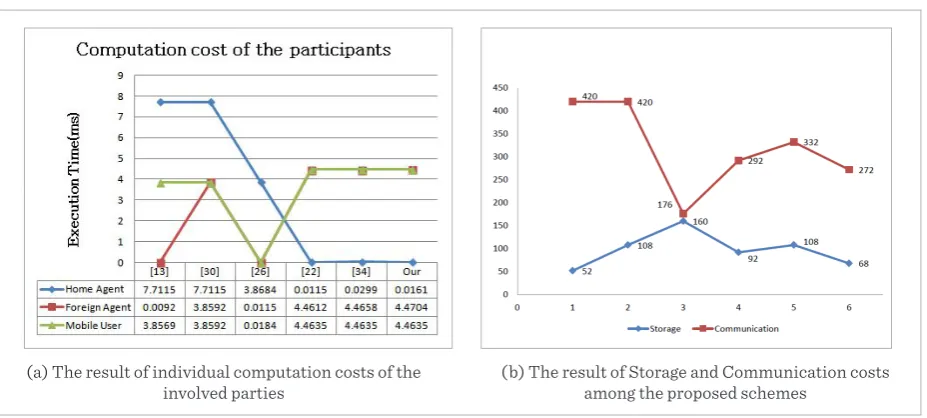
Global Mobility Networks (GLOMONET) provide the roaming services for the mobile users, which en-able them to use the extended services in their home agent whenever they enter into a foreign agent zone irrespective of their locations [2]. When a mobile user (MU) enters a foreign agent zone, there should be some mechanism of communication between a mo-bile user, home agent (HA), and foreign agent (FA). A conventional frame for roaming service is shown in Figure 1. To communicate with FA, firstly, a session is developed with the home agent by MU. Then, MU
communicates with FA with the help of HA. A regis-tered MU gets the services only when he/she is suc-cessfully authenticated by FA. Meanwhile, in prac-tice, two major concerns (privacy and security) are identified in roaming services. Thus, in attaining the roaming services, the mutual authentication mecha-nism is designed to address the issues of authorized communication. The secure communication is being achieved using key agreement [1, 21, 27]. As the com-munication technologies are developing rapidly, the entire world is reciprocally more connected. Due to this privacy risks are at stake. Privacy concerns have increasingly got attention from governments, cor-porations, and individuals. It is desirable to control sensitive information. However, in the environment of Internet where information sharing is very easy, this problem (controlling sensitive information) does not have an easy solution. Thus, a balanced approach is required between information sharing and privacy. For roaming services in GLOMONET, the first au-thentication scheme was introduced by Zhu and Ma
[36]. Since then, there were many proposals for a secure design with low computation cost [6, 10-11, 18-19, 29, 31]. It is observed that most of the existing similar schemes failed to provide the user anonymity along with untraceability.
In 2011, two new authentication schemes were pro-posed by Chen et al. [4-5]. However, Xie et al. [33] enlightened the security shortcomings of both the schemes. For roaming services, Mun et al. [22] gave an anonymous authentication scheme in 2012. However, Mun et al.’s scheme is shown failure by Kim and Kwak [15] due to the design flaws in their scheme.
Based on quadratic residue, Jiang et al. [13] gave an au-thentication scheme. But, Wen et al. [30] and He et al.
[12] both pointed out that service attack, replay attack and impersonation attack are not addressed in Jiang
et al.’s scheme. To overcome the security flaws, Wen
et al. [30] and He et al. [12] independently presented improved schemes. Using the modular exponentiation operations, Shin et al. [26] gave an efficient authenti-cation scheme. Unfortunately, Farash et al. [9] pointed out that both [30] and [26] failed to resist user trace-ability, impersonation attack and session key disclo-sure attack. Due to these failures, a lightweight authen-tication scheme has been presented by them.
Recently (2015), Zhang et al. [34] designed an authenti-cation scheme by adopting symmetric key and rational points multiplication in elliptic curve to preserve the privacy in GLOMONET. As a part of our case study, we figured out that their scheme fails to ensure the securi-ty goals. We came across some securisecuri-ty shortcomings
Figure 1
131 Information Technology and Control 2019/1/48
in Zhang et al.’s scheme, such as (a) password guessing attack; (b) user anonymity and traceability; (c) replay attack; and (d) user impersonation attack. In a thor-ough study, we observed that Zhang et al.’s scheme can be enhanced such that improved design can collective-ly address all the security attributes.
1.1. Security Goals
In providing secure roaming services, an efficient and anonymous authentication scheme should possess the following attributes:
Mobile user’s privacy: Roaming authentication has issues with two types of privacy: (i) MU’s real identity; and (ii) MU’s roaming line. Both types should be re-quired to provide privacy when running the roaming services.
Untraceability: No tracking of MU by looking at the connections, i.e., the third party must not be able to iden-tify MU by looking at his interactions with different FAs. User’s validation checking: The registration of MU
with HA should be correctly identified by the foreign agent.
Prohibit impersonation attack: Only the legitimate mobile user and the network agent (home or foreign) should be able to authenticate.
Ensure a private session key: The parties should agree upon a fresh session key. The session key can be established among the authorized participants. Prohibit replaying attack: Interception of the mes-sages by attacker should not reveal any sensitive in-formation of the participants even by replaying the previous messages.
1.2. Our Contributions
The contributions are as follows:
_ In a thorough study of the recently proposed Zhang et al.’s [34] scheme, we concluded that their scheme suffers from several attacks such as (a) password guessing attack; (b) user anonymity and traceability; (c) replay attack; and (d) user impersonation attack.
_ To overcome the shortcomings of Zhang et al.’s scheme, we present an improved scheme which inherits Zhang et al.’s scheme and successfully withstands the possible known attacks.
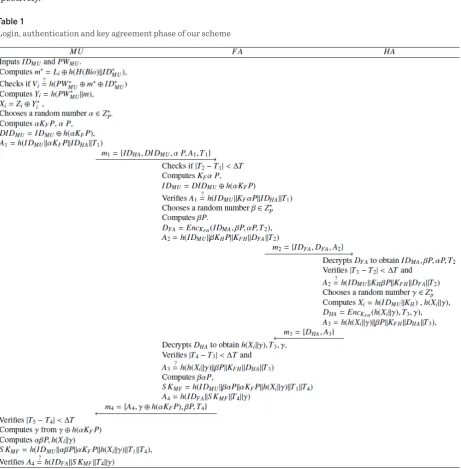
_ Moreover, the proposed scheme is proved secure assuming the hardness of ECDH assumption.
The scheme is presented with a valid proof which preserves all the security attributes.
_ Furthermore, the proposed scheme is
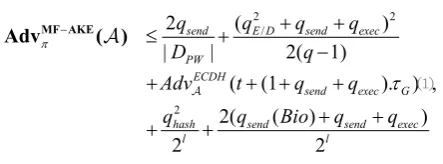
computa-tionally efficient in comparison to Zhang et al.’s scheme and performs better in comparison to oth-er existing similar schemes.
1.3. Cryptographic Preliminaries
1.3.1. Elliptic Curve
An elliptic curve E over a finite field FP consists of
points satisfying the equation y2= x3 + ax + b mod p
along with the point at infinity, where a, b∈ Fpand
4a3 + 27b2 mod p≠ 0. We omit mod p and draw out the
following assumptions [17]. Assumption1:
Ellipticcurvediscretelogarithmproblem(ECDLP): Suppose P, Q∈G with Q = αP, it is computationally hard to compute the integer α, where G is the group of rational points on the elliptic curve E(Fp).
Assumption2:
EllipticcurveDiffie–Hellmanproblem(ECDHP): If αP, βP ∈ G and α, β are positive integers, it is hard to compute αβP.
1.3.2. Biohashing
Biometric systems are applicable for human au-thentication in validating the security task to enable the authorized access, however, these systems face specific security challenges such as noisy data input which causes denial of service attack. It has impact on the usability of the system by failing to identify authorized consumers [23]. To overcome these prob-lems, BioHashing technique is introduced [28]. It has substantial functional advantages such as clean sep-aration of the genuine, zero error rate and imposter populations [14]. It has the following functions:
_ Extraction of biometric parameter represented in
a vector form Γ ∈n, where n is the feature length.
_ Input token is used to generate m pseudo-random
vector { M | = 1,2, }
i
r∈ i m .
_ The Gram-Schmidt process is employed for
{ M | = 1,2, }
i
r∈ i m and orthonormal
pseudorandam vectors are obtained
{r i⊥ ∈n| = 1,2,i m}, n m≥ .
_ Calculate { |〈Γ r i i⊥ 〉| = 1,2,m}, where 〈 〉.|.
Information Technology and Control 2019/1/48 132
_ Compute m –bit BioHash template, b =
= { | = = 1,2,i }
b b i i m using a threshold
κ
obtainedfrom
enable the authorized access, however, these systems face specific security challenges such as noisy data
input which causes denial of service attack. It has impact on the usability of the system by failing to
identify authorized consumers [23]. To overcome these problems, BioHashing technique is introduced
[28]. It has substantial functional advantages such as clean separation of the genuine, zero error rate and
imposter populations [14]. It has the following functions:
• Extraction of biometric parameter represented in a vector form
Γ ∈
n, where
n
is the
feature length.
• Input token is used to generate
m
pseudo-random vector
{
M| = 1,2,
}
i
r
∈
i
m
.
• The Gram-Schmidt process is employed for
{
M| = 1,2,
}
i
r
∈
i
m
and orthonormal
pseudorandam vectors are obtained
{
r i
⊥ ∈
n| = 1,2,
i
m
}
,
n m
≥
.
• Calculate
{ |
〈Γ
r i i
⊥ 〉
| = 1,2,
m
}
, where
〈 〉
.|.
indicates inner product.
• Compute
m
−
bit BioHash template,
b
= { | = = 1,2,
b i i
i
m
}
using a threshold
κ
obtained from
1, if |
,
=
0, if |
> .
ir i
b
r i
κ
κ
〈Γ
⊥ 〉 ≤
〈Γ
⊥ 〉
(1)
1.4 Road Map of the Paper
The details are as follows. In Section 2, we present the review of Zhang
et al.
’s scheme. Security
weaknesses of Zhang
et al.
’s scheme are shown in Section 3. The proposed authentication scheme is
provided in Section 4. Further, in Section 5, we present our provably secure scheme in formal model.
The informal security analysis and discussion of the proposed scheme is done in Section 6. In
Section 7, the performance of our scheme with the other existing similar schemes is compared. Finally,
the paper is concluded in Section 8.
2 Review of Zhang
et al.
’s Scheme
2.1 Registration Phase
MU
registers with the home agent
HA
if he/she wishes to get services from Global Mobility
Network [34]. In this phase, the communication with the participants is done through secure
communication channel.
R1.
MU
selects his/her identity
ID
MUand password
PW
MU. After computing
= (
MU)
V h PW
m
,
MU
sends the message
{
ID V
MU, }
to home agent
HA
where
m Z
∈
*pis a random
number.
R2.
HA
receives the message {
ID V
MU, }
and a random number
n
is generated to undergo
computations using
HA
’s master key
K
,
MID Enc ID
=
K(
MU, )
n
,
C V h ID
=
⊕
(
MU
K
)
. Further
HA
sends
{
MID C ID
, ,
HA}
to
MU
.
R3.
MU
stores
{
ID
MU,
ID C MID m
HA, ,
, }
into
SC
.
2.2 Authentication and Key Establishment Phase
(1)
1.4. Road Map of the Paper
The details are as follows. In Section 2, we present the review of Zhang et al.’s scheme. Security weaknesses of Zhang et al.’s scheme are shown in Section 3. The proposed authentication scheme is provided in Sec-tion 4. Further, in SecSec-tion 5, we present our provably secure scheme in formal model.
The informal security analysis and discussion of the proposed scheme is done in Section 6. In Section 7, the performance of our scheme with the other exist-ing similar schemes is compared. Finally, the paper is concluded in Section 8.
2. Review of Zhang et al.’s Scheme
2.1. Registration Phase
MU registers with the home agent HA if he/she wishes to get services from Global Mobility Network [34]. In this phase, the communication with the participants is done through secure communication channel. R1.MU selects his/her identity ID IDMU and pass-word PWMU. After computing
enable the authorized access, however, these systems face specific security challenges such as noisy data input which causes denial of service attack. It has impact on the usability of the system by failing to identify authorized consumers [23]. To overcome these problems, BioHashing technique is introduced [28]. It has substantial functional advantages such as clean separation of the genuine, zero error rate and imposter populations [14]. It has the following functions:
• Extraction of biometric parameter represented in a vector form Γ ∈n, where n is the feature length.
• Input token is used to generate m pseudo-random vector { M | = 1,2, }
i
r∈ i m . • The Gram-Schmidt process is employed for { M| = 1,2, }
i
r∈ i m and orthonormal pseudorandam vectors are obtained {r i⊥ ∈n| = 1,2,i m}, n m≥ .
• Calculate { |〈Γ r i i⊥ 〉| = 1,2,m}, where .|.〈 〉 indicates inner product.
• Compute m−bit BioHash template, b= { | = = 1,2,b i ii m} using a threshold κ obtained from
1, if | , =
0, if | > . i r i b r i κ κ 〈Γ ⊥ 〉 ≤ 〈Γ ⊥ 〉 (1)
1.4 Road Map of the Paper
The details are as follows. In Section 2, we present the review of Zhang et al.’s scheme. Security weaknesses of Zhang et al.’s scheme are shown in Section 3. The proposed authentication scheme is provided in Section 4. Further, in Section 5, we present our provably secure scheme in formal model.
The informal security analysis and discussion of the proposed scheme is done in Section 6. In Section 7, the performance of our scheme with the other existing similar schemes is compared. Finally, the paper is concluded in Section 8.
2 Review of Zhang
et al.’s Scheme
2.1 Registration Phase
MU registers with the home agent HA if he/she wishes to get services from Global Mobility Network [34]. In this phase, the communication with the participants is done through secure communication channel.
R1. MU selects his/her identity IDMU and password PWMU . After computing = ( MU )
V h PW m , MU sends the message {ID VMU, } to home agent HA where m Z∈ *p is a random number.
R2. HA receives the message {ID VMU, } and a random number n is generated to undergo computations using HA’s master key K, MID Enc ID= K( MU, )n , C V h ID= ⊕ ( MUK). Further HA sends {MID C ID, , HA} to MU.
R3. MU stores {IDMU,ID C MID mHA, , , } into SC.
2.2 Authentication and Key Establishment Phase
, MUsends the message {ID VMU, } to home agent HA where *
p
m Z∈ is a random number.
R2.HA receives the message {ID VMU, } and a ran-dom number n is generated to undergo computa-tions using HA’s master key K, MID Enc ID= K( MU, )n , enable the authorized access, however, these systems face specific security challenges such as noisy data
input which causes denial of service attack. It has impact on the usability of the system by failing to identify authorized consumers [23]. To overcome these problems, BioHashing technique is introduced [28]. It has substantial functional advantages such as clean separation of the genuine, zero error rate and imposter populations [14]. It has the following functions:
• Extraction of biometric parameter represented in a vector form Γ ∈n, where n is the
feature length.
• Input token is used to generate m pseudo-random vector { M| = 1,2, }
i
r∈ i m .
• The Gram-Schmidt process is employed for { M| = 1,2, } i
r∈ i m and orthonormal pseudorandam vectors are obtained {r i⊥ ∈n| = 1,2,i m}, n m≥ .
• Calculate { |〈Γ r i i⊥ 〉| = 1,2,m}, where .|.〈 〉 indicates inner product.
• Compute m−bit BioHash template, b= { | = = 1,2,b i ii m} using a threshold κ obtained from
1, if | , =
0, if | > .
i r i b r i κ κ 〈Γ ⊥ 〉 ≤ 〈Γ ⊥ 〉 (1)
1.4 Road Map of the Paper
The details are as follows. In Section 2, we present the review of Zhang et al.’s scheme. Security weaknesses of Zhang et al.’s scheme are shown in Section 3. The proposed authentication scheme is provided in Section 4. Further, in Section 5, we present our provably secure scheme in formal model.
The informal security analysis and discussion of the proposed scheme is done in Section 6. In Section 7, the performance of our scheme with the other existing similar schemes is compared. Finally, the paper is concluded in Section 8.
2 Review of Zhang
et al.’s Scheme
2.1 Registration Phase
MU registers with the home agent HA if he/she wishes to get services from Global Mobility Network [34]. In this phase, the communication with the participants is done through secure communication channel.
R1. MU selects his/her identity IDMU and password PWMU . After computing
= ( MU )
V h PW m , MU sends the message {ID VMU, } to home agent HA where m Z∈ *p is a random
number.
R2. HA receives the message {ID VMU, } and a random number n is generated to undergo computations using HA’s master key K, MID Enc ID= K( MU, )n , C V h ID= ⊕ ( MUK) HA
sends {MID C ID, , HA} to MU.
R3. MU stores {IDMU,ID C MID mHA, , , } into SC.
2.2 Authentication and Key Establishment Phase
. Further HA sends {MID C ID, , HA} to MU.
R3.MU stores {IDMU,ID C MID mHA, , , } into SC.
2.2. Authentication and Key Establishment Phase
The registered MU opts services from FA. Before this, both the parties agree upon a common session key. Moreover, the communication between FA and HA
is done through the secure channel. The details are shown as follows:
A1.MU inputs his/her login credentials into the smart-card to compute
The registered MU opts services from FA. Before this, both the parties agree upon a common session key. Moreover, the communication between FA and HA is done through the secure channel. The details are shown as follows:
A1. MU inputs his/her login credentials into the smartcard to compute V h PW= ( MUm) and
= .
V′ C V⊕ Further, MU chooses a random number *
p
a Z∈ and computes aP and
= ( , )
MU V MU
Auth Enc ID′ aP . MU sends the message m1= {ID MID AuthHA, , MU} to the foreign agent FA.
A2. FA receives the message m1, and selects a random number *
p
b Z∈ , computes bP and
= ( , , )
FA KFH FA FA
D Enc ID bP T , where TFA is FA’s chosen timestamp, and KFH is a pre-shared secret
known to FA and HA. The message m2= {ID MID Auth T DFA, , MU, ,FA FA} is sent to HA.
A3. HA receives the message m2, decrypts MID and DFA to obtain IDMU, TFA. HA verifies
the correctness of IDMU and TFA. If the verification doesn’t hold, HA rejects the process. Else, HA
calculates V′= (h IDMUK) using HA’s master key and decrypts AuthMU to fetch aP. A random
number n′ is generated by HA to compute MID Enc ID′= K( MU, ),n′
= ( , , , )
HA KFH HA MU
D Enc ID ID aP bP and AuthHA=Enc MID aP bPV′( ′, , ), where THA is a timestamp of
HA. Finally, the message m3= {DHA, AuthHA} is sent to FA.
A4. FA receives the message m3 and decrypts DHA and looks for the correctness of bP and
.
HA
T If the correctness holds, FA computes AuthFA= (h abP ID MUIDFA),
= ( )
MF MU FA
SK h aP bP abP ID ID . The message m4= {Auth AuthFA, HA} is sent to MU.
A5. To obtain aP, bP and MID′, MU decrypts AuthHA. MU verifies whether the decrypted
aP is same as that of the value in step A1. If the verification holds with the chosen secret value a, then
MU needs to verify the correctness of AuthFA to compute the session key
= ( )
MF MU FA
SK h aP bP abP ID ID . The smartcard updates MID with MID′ in its memory.
2.3 Update Session Key
Interested readers can refer to [34].3 Security Pitfalls of Zhang
et al.
’s Scheme
3.1 Adversary Model
The security of Zhang et al.’s scheme is analyzed under the following security model [7-8, 16, 20]:
1. Over the public channel, Adversary/Attacker () has the ability to eavesdrop all the communications between the parties.
2. attains the potential to delete, modify, resend or to redirect the eavesdropped transmitted messages.
3. By analyzing the method of power analysis and consumption or from the leaked
and V′=C V⊕ . Further, MU chooses a random number *
p
a Z∈ and computes aP and AuthMU =Enc IDV′( MU, )aP . MU sends the message m1= {ID MID AuthHA, , MU} to the foreign agent FA.
A2. FA receives the message m1, and selects
a random number * p
b Z∈ , computes bP and
= ( , , )
FA KFH FA FA
D Enc ID bP T , where TFA is FA’s
chosen timestamp, and KFH is a pre-shared secret known to FA and HA. The message
2 = { FA, , MU, FA, FA}
m ID MID Auth T D is sent to HA.
A3. HA receives the message
m
2, decrypts MIDand DFA to obtain IDMU, TFA. HA verifies the cor-rectness of IDMU and TFA. If the verification doesn’t hold, HA rejects the process. Else, HA calculates
The registered MU opts services from FA. Before this, both the parties agree upon a common session key. Moreover, the communication between FA and HA is done through the secure channel. The details are shown as follows:
A1. MU inputs his/her login credentials into the smartcard to compute V h PW= ( MUm) and
= .
V′ C V⊕ Further, MU chooses a random number *
p
a Z∈ and computes aP and
= ( , )
MU V MU
Auth Enc ID′ aP . MU sends the message m1= {ID MID AuthHA, , MU} to the foreign agent FA.
A2. FA receives the message m1, and selects a random number b Z∈ *p, computes bP and
= ( , , )
FA KFH FA FA
D Enc ID bP T , where TFA is FA’s chosen timestamp, and KFH is a pre-shared secret
known to FA and HA. The message m2= {ID MID Auth T DFA, , MU, ,FA FA} is sent to HA.
A3. HA receives the message m2, decrypts MID and DFA to obtain IDMU, TFA. HA verifies
the correctness of IDMU and TFA. If the verification doesn’t hold, HA rejects the process. Else, HA
calculates V′= (h IDMUK) using HA’s master key and decrypts AuthMU to fetch aP. A random
number n′ is generated by HA to compute MID Enc ID′= K( MU, ),n′
= ( , , , )
HA KFH HA MU
D Enc ID ID aP bP and AuthHA=Enc MID aP bPV′( ′, , ), where THA is a timestamp of
HA. Finally, the message m3= {DHA, AuthHA} is sent to FA.
A4. FA receives the message m3 and decrypts DHA and looks for the correctness of bP and
.
HA
T If the correctness holds, FA computes AuthFA= (h abP ID MUIDFA),
= ( )
MF MU FA
SK h aP bP abP ID ID . The message m4= {Auth AuthFA, HA} is sent to MU.
A5. To obtain aP, bP and MID′, MU decrypts AuthHA. MU verifies whether the decrypted
aP is same as that of the value in step A1. If the verification holds with the chosen secret value a, then
MU needs to verify the correctness of AuthFA to compute the session key
= ( )
MF MU FA
SK h aP bP abP ID ID . The smartcard updates MID with MID′ in its memory.
2.3 Update Session Key
Interested readers can refer to [34].3 Security Pitfalls of Zhang et al.’s Scheme
3.1 Adversary Model
The security of Zhang et al.’s scheme is analyzed under the following security model [7-8, 16, 20]:
1. Over the public channel, Adversary/Attacker () has the ability to eavesdrop all the communications between the parties.
2. attains the potential to delete, modify, resend or to redirect the eavesdropped transmitted messages.
3. By analyzing the method of power analysis and consumption or from the leaked using HA’s master key and
de-crypts AuthMU to fetch aP. A random number
n
′
is generated by HA to compute MID Enc ID′= K( MU, ),n′= ( , , , )
HA KFH HA MU
D Enc ID ID aP bP and AuthHA=Enc MID aP bPV′( ′, , )
= ( , , )
HA V
Auth Enc MID aP bP′ ′ , where THA is a timestamp of HA.
Finally, the message m3= {DHA, AuthHA} is sent to FA.
A4. FA receives the message m3 and decrypts DHA and looks for the correctness of bP and THA. If the correct-ness holds, FA computes Auth h abP IDFA= ( MUIDFA)
{ , }
m Auth Auth
The registered MU opts services from FA. Before this, both the parties agree upon a common session key. Moreover, the communication between FA and HA is done through the secure channel. The details are shown as follows:
A1. MU inputs his/her login credentials into the smartcard to compute V h PW= ( MUm) and
= .
V′ C V⊕ Further, MU chooses a random number *
p
a Z∈ and computes aP and
= ( , )
MU V MU
Auth Enc ID′ aP . MU sends the message m1= {ID MID AuthHA, , MU} to the foreign agent FA.
A2. FA receives the message m1, and selects a random number *
p
b Z∈ , computes bP and
= ( , , )
FA KFH FA FA
D Enc ID bP T , where TFA is FA’s chosen timestamp, and KFH is a pre-shared secret
known to FA and HA. The message m2= {ID MID Auth T DFA, , MU, ,FA FA} is sent to HA.
A3. HA receives the message m2, decrypts MID and DFA to obtain IDMU, TFA. HA verifies
the correctness of IDMU and TFA. If the verification doesn’t hold, HA rejects the process. Else, HA
calculates V′= (h IDMUK) using HA’s master key and decrypts AuthMU to fetch aP. A random
number n′ is generated by HA to compute MID Enc ID′= K( MU, ),n′
= ( , , , )
HA KFH HA MU
D Enc ID ID aP bP and AuthHA=Enc MID aP bPV′( ′, , ), where THA is a timestamp of
HA. Finally, the message m3= {DHA, AuthHA} is sent to FA.
A4. FA receives the message m3 and decrypts DHA and looks for the correctness of bP and
.
HA
T If the correctness holds, FA computes AuthFA= (h abP ID MUIDFA),
= ( )
MF MU FA
SK h aP bP abP ID ID . The message m4= {Auth AuthFA, HA} is sent to MU.
A5. To obtain aP, bP and MID′, MU decrypts AuthHA. MU verifies whether the decrypted
aP is same as that of the value in step A1. If the verification holds with the chosen secret value a, then
MU needs to verify the correctness of AuthFA to compute the session key
= ( )
MF MU FA
SK h aP bP abP ID ID . The smartcard updates MID with MID′ in its memory.
2.3 Update Session Key
Interested readers can refer to [34].3 Security Pitfalls of Zhang et al.’s Scheme
3.1 Adversary Model
The security of Zhang et al.’s scheme is analyzed under the following security model [7-8, 16, 20]:
1. Over the public channel, Adversary/Attacker () has the ability to eavesdrop all the communications between the parties.
2. attains the potential to delete, modify, resend or to redirect the eavesdropped transmitted messages.
3. By analyzing the method of power analysis and consumption or from the leaked . The message
4 = { FA, HA}
m Auth Auth is sent to MU.
A5. To obtain aP, bP and MID′, MU decrypts AuthHA.
MU verifies whether the decrypted aP is same as that of the value in step A1. If the verification holds with the chosen secret value a, then MU needs to verify the correctness of AuthFA to compute the session key
The registered MU opts services from FA. Before this, both the parties agree upon a common session key. Moreover, the communication between FA and HA is done through the secure channel. The details are shown as follows:
A1. MU inputs his/her login credentials into the smartcard to compute V h PW= ( MUm) and
= .
V′ C V⊕ Further, MU chooses a random number *
p
a Z∈ and computes aP and
= ( , )
MU V MU
Auth Enc ID′ aP . MU sends the message m1= {ID MID AuthHA, , MU} to the foreign agent FA.
A2. FA receives the message m1, and selects a random number *
p
b Z∈ , computes bP and
= ( , , )
FA KFH FA FA
D Enc ID bP T , where TFA is FA’s chosen timestamp, and KFH is a pre-shared secret
known to FA and HA. The message m2= {ID MID Auth T DFA, , MU, ,FA FA} is sent to HA.
A3. HA receives the message m2, decrypts MID and DFA to obtain IDMU, TFA. HA verifies
the correctness of IDMU and TFA. If the verification doesn’t hold, HA rejects the process. Else, HA
calculates V′= (h IDMUK) using HA’s master key and decrypts AuthMU to fetch aP. A random
number n′ is generated by HA to compute MID Enc ID′= K( MU, ),n′
= ( , , , )
HA KFH HA MU
D Enc ID ID aP bP and AuthHA =Enc MID aP bPV′( ′, , ), where THA is a timestamp of
HA. Finally, the message m3= {DHA, AuthHA} is sent to FA.
A4. FA receives the message m3 and decrypts DHA and looks for the correctness of bP and
.
HA
T If the correctness holds, FA computes AuthFA= (h abP ID MUIDFA),
= ( )
MF MU FA
SK h aP bP abP ID ID . The message m4= {Auth AuthFA, HA} is sent to MU.
A5. To obtain aP, bP and MID′, MU decrypts AuthHA. MU verifies whether the decrypted
aP is same as that of the value in step A1. If the verification holds with the chosen secret value a, then
MU needs to verify the correctness of AuthFA to compute the session key
= ( )
MF MU FA
SK h aP bP abP ID ID . The smartcard updates MID with MID′ in its memory.
2.3 Update Session Key
Interested readers can refer to [34].3 Security Pitfalls of Zhang et al.’s Scheme
3.1 Adversary Model
The security of Zhang et al.’s scheme is analyzed under the following security model [7-8, 16, 20]:
1. Over the public channel, Adversary/Attacker () has the ability to eavesdrop all the communications between the parties.
2. attains the potential to delete, modify, resend or to redirect the eavesdropped transmitted messages.
3. By analyzing the method of power analysis and consumption or from the leaked . The
smart-card updates MID with
MID
′
in its memory.2.3. Update Session Key
Interested readers can refer to [34].
3. Security Pitfalls of Zhang et al.’s
Scheme
3.1. Adversary Model
The security of Zhang et al.’s scheme is analyzed un-der the following security model [7-8, 16, 20]:
communica-133 Information Technology and Control 2019/1/48
tions between the parties.
2 attains the potential to delete, modify, resend or
to redirect the eavesdropped transmitted messages.
3 By analyzing the method of power analysis and
consumption or from the leaked information, the information from the smart card can be extracted by .
4 can be an insider of the system.
3.2. Disadvantages:
1 No verification mechanism for user’s login
creden-tials to check the legitimacy of the user.
2 The communication message m1 is transmitted to
FA even if illegal credentials (Wrong credentials) are being used by a user/adversary.
3 Incorrect login credentials induce huge
communi-cation and computational wastage.
3.3. Stolen Smartcard Attack
Suppose that the smartcard of MU is lost or stolen for a deliberate amount of time and replaced. The ad-versary can get control over the smartcard as dis-cussed in Section 3.1. Using this captured smartcard parameters and the transmitted messages on the in-secure channel, can perform the following attacks: 3.3.1. Password Guessing Attack
1 Initially, guesses the PWMU and computes
information, the information from the smart card can be extracted by . 4. can be an insider of the system.
3.2 Disadvantages:
1. No verification mechanism for user’s login credentials to check the legitimacy of the user. 2. The communication message m1 is transmitted to FA even if illegal credentials (Wrong credentials) are being used by a user/adversary.
3. Incorrect login credentials induce huge communication and computational wastage.
3.3 Stolen Smartcard Attack
Suppose that the smartcard of MU is lost or stolen for a deliberate amount of time and replaced. The adversary can get control over the smartcard as discussed in Section 3.1. Using this captured smartcard parameters and the transmitted messages on the insecure channel, can perform the following attacks:
3.3.1 Password Guessing Attack
1. Initially, guesses the PWMU and computes V = (h PWMU m), V V′= ⊕C. 2. decrypts AuthMU and AuthHA using the computed V′.
3. verifies the parametric value of aP in both AuthMU and AuthHA from the above
decryption. If the value is the same in both the decryption computations, guesses the password of the
MU successfully.
4. Otherwise, repeats the above steps until the password PWMU is guessed correctly.
Therefore, will be able to guess the MU’s password.
3.3.2 User Anonymity and Traceability
According to Subsection 3.3.1, adversary guesses the password of MU and computes V′. Further decrypts AuthMU using V′. It is evident that the decryption of AuthMU discloses the
identity IDMU of the MU. Thus, IDMU allows to differentiate the users in every different login
sessions which may breach the privacy of the user. Therefore, we claim that privacy of the user was not taken proper care as refered in [34].
3.4 User Impersonation Attack
We have seen that is able to compute V′ (i.e., V′= (h IDMUK) ) successfully. Using the adversary capabilities described in Section 3.1 and V′, modifies AuthMU using his selected random
number (say * P
Z
α∈ ). The details are as follows:
1. computes aP and Auth =Enc IDV′( MU,αP) and transmits the message 1= { HA, ,
m ID MID Auth} to FA.
, V V′= ⊕C.
2 decrypts AuthMU and AuthHA using the computed V′.
3 verifies the parametric value of aP in both AuthMU
and AuthHA from the above decryption. If the value is the same in both the decryption computations,
guesses the password of the MU successfully.
4 Otherwise, repeats the above steps until the password PWMU is guessed correctly.
Therefore, will be able to guess the MU’s password. 3.3.2. User Anonymity and Traceability
According to Subsection 3.3.1, adversary guesses the password of MU and computes V′. Further de-crypts AuthMU using V′. It is evident that the decryp-tion of AuthMU discloses the identity IDMU of the MU. Thus, IDMU allows to differentiate the users in ev-ery different login sessions which may breach the pri-vacy of the user. Therefore, we claim that pripri-vacy of the user was not taken proper care as refered in [34].
3.4. User Impersonation Attack
We have seen that is able to compute V′ (i.e., information, the information from the smart card can be extracted by .
4. can be an insider of the system.
3.2 Disadvantages:
1. No verification mechanism for user’s login credentials to check the legitimacy of the user. 2. The communication message m1 is transmitted to FA even if illegal credentials (Wrong credentials) are being used by a user/adversary.
3. Incorrect login credentials induce huge communication and computational wastage.
3.3 Stolen Smartcard Attack
Suppose that the smartcard of MU is lost or stolen for a deliberate amount of time and replaced. The adversary can get control over the smartcard as discussed in Section 3.1. Using this captured smartcard parameters and the transmitted messages on the insecure channel, can perform the following attacks:
3.3.1 Password Guessing Attack
1. Initially, guesses the PWMU and computes = ( )
MU
V h PW m , V V′= ⊕C. 2. decrypts AuthMU and AuthHA using the computed V′.
3. verifies the parametric value of aP in both AuthMU and AuthHA from the above
decryption. If the value is the same in both the decryption computations, guesses the password of the
MU successfully.
4. Otherwise, repeats the above steps until the password PWMU is guessed correctly.
Therefore, will be able to guess the MU’s password.
3.3.2 User Anonymity and Traceability
According to Subsection 3.3.1, adversary guesses the password of MU and computes V′. Further decrypts AuthMU using V′. It is evident that the decryption of AuthMU discloses the
identity IDMU of the MU. Thus, IDMU allows to differentiate the users in every different login
sessions which may breach the privacy of the user. Therefore, we claim that privacy of the user was not taken proper care as refered in [34].
3.4 User Impersonation Attack
We have seen that is able to compute V′ (i.e., V′= (h IDMUK) ) successfully. Using the
adversary capabilities described in Section 3.1 and V′, modifies AuthMU using his selected random
number (say *
P
Z
α∈ ). The details are as follows:
1. computes aP and Auth =Enc IDV′( MU,αP) and transmits the message
1= { HA, ,
m ID MID Auth} to FA.
) successfully. Using the adversary capabilities described in Section 3.1 and V′, modi-fies
Auth
MU using his selected random number (say* P
Z
α ∈ ). The details are as follows:
1 computes aP and Auth =Enc IDV′( MU,αP) and
transmits the message m1= {ID MIDHA, , Auth} to FA.
2 FA receives the message m1 and selects a ran-dom number *
p
b Z∈ computes bP and DFA=EncKFH(ID bP TFA, , FA)
= ( , , )
FA KFH FA FA
D Enc ID bP T . The message m2 = {ID MID Auth T DFA, , , FA, FA} 2= { FA, , , FA, FA}
m ID MID Auth T D is sent to HA.
3 On receiving m2, HA decrypts MID and DFA to obtain IDMU and TFA. HA verifies the correct-ness of IDMU and TFA. If verification fails, HA re-jects the process. Else, makes use of HA’s master key K, computes
2. FA receives the message m1 and selects a random number *
p
b Z∈ computes bP and
= ( , , )
FA KFH FA FA
D Enc ID bP T . The message m2= {ID MID Auth T DFA, , , ,FA FA} is sent to HA.
3. On receiving m2, HA decrypts MID and DFA to obtain IDMU and TFA. HA verifies the
correctness of IDMU and TFA. If verification fails, HA rejects the process. Else, makes use of HA’s
master key K, computes V′= (h IDMUK) and decrypts Auth to fetch αP T, 1. Then a random number n′ is chosen from *
p
Z to compute DHA=EncKFH(ID IDHA, MU,αP bP T T, , ,1 HA) and
1
= ( , , , )
HA V
Auth Enc MID P T bP′ ′α . Finally, the message m3= {DHA, AuthHA} is sent to FA.
4. FA receives the message m3 and decrypts DHA and looks for the correctness of bP and
.
HA
T If the correctness holds, FA computes AuthFA= (h bP IDα MUIDFA),
= ( )
MF MU FA
SK h P bPα αbP ID ID . The message m4= {Auth AuthFA, HA} is sent to MU.
5. captures the message m4.
The above procedure indicates that the adversary can successfully impersonate MU by making both FA and HA believe that they are communicating with MU.
3.5 Replay Attack
The adversary can capture the previously communicated messages as described in Section 3.1. uses the communicated messages and replays the same message (say m1) to FA and the same is transmitted to HA via FA as there is no fresh verification of the messages sent by MU at HA. Therefore, Zhang et al.’s scheme does not prevent from sending the replay messages.
3.6 Absence of Unauthorized Login Detection
A user may sometime fail to correctly map different password to his/ her different accounts. Thus, login credential verification should be supported at initial stage. However, Zhang et al.’s scheme lacks user credential verification mechanism in login phase. Lack of efficient login phase makes the scheme inefficient.
4 The Proposed Scheme
In proposed scheme, *
H p
K ∈Z is the secret key of HA and *
F p
K ∈Z is the secret key of FA. FA
and HA also share a common secret key KFH. Furthermore, FA and HA also compute their public keys
H
K P and K PF , respectively.
4.1 Registration Phase
This phase utilizes the secure channel to communicate with the participants. MU registers with
HA, if he/she wishes to get services from Global Mobility Network.
1. MU selects his/her identity IDMU, password PWMU, computes Y h PWi= ( MUm) and
and decrypts Auth to fetch αP T, 1. Then a ran-dom number n′ is chosen from *
p
Z to compute 1
= ( , , , , , )
HA KFH HA MU HA
D Enc ID ID αP bP T T and
1
= ( , , , )
HA V
Auth Enc MID P T bP′ ′α . Finally, the
mes-sage m3= {DHA, AuthHA} is sent to FA.
4 FA receives the message m3 and decrypts
DHA and looks for the correctness of bP
and THA. If the correctness holds, FA com-
putes
2. FA receives the message m1 and selects a random number b Z∈ *p computes bP and
= ( , , )
FA KFH FA FA
D Enc ID bP T . The message m2= {ID MID Auth T DFA, , , ,FA FA} is sent to HA.
3. On receiving m2, HA decrypts MID and DFA to obtain IDMU and TFA. HA verifies the
correctness of IDMU and TFA. If verification fails, HA rejects the process. Else, makes use of HA’s
master key K, computes V′= (h IDMUK) and decrypts Auth to fetch
α
P T, 1. Then a randomnumber n′ is chosen from *
p
Z to compute DHA=EncKFH(ID IDHA, MU,
α
P bP T T, , ,1 HA) and1
= ( , , , )
HA V
Auth Enc MID P T bP′ ′
α
. Finally, the message m3= {DHA, AuthHA} is sent to FA.4. FA receives the message m3 and decrypts DHA and looks for the correctness of bP and
.
HA
T If the correctness holds, FA computes AuthFA= (h bP ID
α
MUIDFA),= ( )
MF MU FA
SK h P bP
α
α
bP ID ID . The message m4= {Auth AuthFA, HA} is sent to MU.5. captures the message m4.
The above procedure indicates that the adversary can successfully impersonate MU by making both FA and HA believe that they are communicating with MU.
3.5 Replay Attack
The adversary can capture the previously communicated messages as described in Section
3.1. uses the communicated messages and replays the same message (say m1) to FA and the same
is transmitted to HA via FA as there is no fresh verification of the messages sent by MU at HA.
Therefore, Zhang et al.’s scheme does not prevent from sending the replay messages.
3.6 Absence of Unauthorized Login Detection
A user may sometime fail to correctly map different password to his/ her different accounts. Thus, login credential verification should be supported at initial stage. However, Zhang et al.’s scheme lacks user credential verification mechanism in login phase. Lack of efficient login phase makes the scheme inefficient.
4 The Proposed Scheme
In proposed scheme, *
H p
K ∈Z is the secret key of HA and *
F p
K ∈Z is the secret key of FA. FA
and HA also share a common secret key KFH. Furthermore, FA and HA also compute their public keys
H
K P and K PF , respectively.
4.1 Registration Phase
This phase utilizes the secure channel to communicate with the participants. MU registers with HA, if he/she wishes to get services from Global Mobility Network.
1. MU selects his/her identity IDMU, password PWMU , computes Y h PWi= ( MUm) and
,
2. FA receives the message m1 and selects a random number b Z∈ *p computes bP and
= ( , , )
FA KFH FA FA
D Enc ID bP T . The message m2= {ID MID Auth T DFA, , , ,FA FA} is sent to HA.
3. On receiving m2, HA decrypts MID and DFA to obtain IDMU and TFA. HA verifies the
correctness of IDMU and TFA. If verification fails, HA rejects the process. Else, makes use of HA’s
master key K, computes V′= (h IDMUK) and decrypts Auth to fetch αP T, 1. Then a random number n′ is chosen from *
p
Z to compute DHA=EncKFH(ID IDHA, MU,αP bP T T, , ,1 HA) and
1
= ( , , , )
HA V
Auth Enc MID P T bP′ ′α . Finally, the message m3= {DHA, AuthHA} is sent to FA.
4. FA receives the message m3 and decrypts DHA and looks for the correctness of bP and
.
HA
T If the correctness holds, FA computes AuthFA= (h bP IDα MUIDFA),
= ( )
MF MU FA
SK h P bPα αbP ID ID . The message m4= {Auth AuthFA, HA} is sent to MU.
5. captures the message m4.
The above procedure indicates that the adversary can successfully impersonate MU by making both FA and HA believe that they are communicating with MU.
3.5 Replay Attack
The adversary can capture the previously communicated messages as described in Section 3.1. uses the communicated messages and replays the same message (say m1) to FA and the same is transmitted to HA via FA as there is no fresh verification of the messages sent by MU at HA. Therefore, Zhang et al.’s scheme does not prevent from sending the replay messages.
3.6 Absence of Unauthorized Login Detection
A user may sometime fail to correctly map different password to his/ her different accounts. Thus, login credential verification should be supported at initial stage. However, Zhang et al.’s scheme lacks user credential verification mechanism in login phase. Lack of efficient login phase makes the scheme inefficient.
4 The Proposed Scheme
In proposed scheme, *H p
K ∈Z is the secret key of HA and *
F p
K ∈Z is the secret key of FA. FA
and HA also share a common secret key KFH. Furthermore, FA and HA also compute their public keys
H
K P and K PF , respectively.
4.1 Registration Phase
This phase utilizes the secure channel to communicate with the participants. MU registers with
HA, if he/she wishes to get services from Global Mobility Network.
1. MU selects his/her identity IDMU, password PWMU, computes Y h PWi= ( MUm) and
2. FA receives the message m1 and selects a random number b Z∈ *p computes bP and
= ( , , )
FA KFH FA FA
D Enc ID bP T . The message m2 = {ID MID Auth T DFA, , , ,FA FA} is sent to HA.
3. On receiving m2, HA decrypts MID and DFA to obtain IDMU and TFA. HA verifies the
correctness of IDMU and TFA. If verification fails, HA rejects the process. Else, makes use of HA’s
master key K, computes V′= (h IDMUK) and decrypts Auth to fetch αP T, 1. Then a random number n′ is chosen from *
p
Z to compute DHA=EncKFH(ID IDHA, MU,αP bP T T, , ,1 HA) and
1
= ( , , , )
HA V
Auth Enc MID P T bP′ ′α . Finally, the message m3 = {DHA, AuthHA} is sent to FA.
4. FA receives the message m3 and decrypts DHA and looks for the correctness of bP and
.
HA
T If the correctness holds, FA computes AuthFA= (h bP IDα MUIDFA),
= ( )
MF MU FA
SK h P bPα αbP ID ID . The message m4 = {Auth AuthFA, HA} is sent to MU.
5. captures the message m4.
The above procedure indicates that the adversary can successfully impersonate MU by making both FA and HA believe that they are communicating with MU.
3.5 Replay Attack
The adversary can capture the previously communicated messages as described in Section 3.1. uses the communicated messages and replays the same message (say m1) to FA and the same is transmitted to HA via FA as there is no fresh verification of the messages sent by MU at HA. Therefore, Zhang et al.’s scheme does not prevent from sending the replay messages.
3.6 Absence of Unauthorized Login Detection
A user may sometime fail to correctly map different password to his/ her different accounts. Thus, login credential verification should be supported at initial stage. However, Zhang et al.’s scheme lacks user credential verification mechanism in login phase. Lack of efficient login phase makes the scheme inefficient.
4 The Proposed Scheme
In proposed scheme, *H p
K ∈Z is the secret key of HA and *
F p
K ∈Z is the secret key of FA. FA
and HA also share a common secret key KFH. Furthermore, FA and HA also compute their public keys
H
K P and K PF , respectively.
4.1 Registration Phase
This phase utilizes the secure channel to communicate with the participants. MU registers with
HA, if he/she wishes to get services from Global Mobility Network.
1. MU selects his/her identity IDMU, password PWMU, computes Y h PWi = ( MUm) and
. The message 4 = { FA, HA}
m Auth Auth is sent to MU.
5 captures the message m4.
The above procedure indicates that the adversary can successfully impersonate MU by making both FA and
HA believe that they are communicating with MU.
3.5. Replay Attack
The adversary can capture the previously communi-cated messages as described in Section 3.1. uses the communicated messages and replays the same mes-sage (say m1) to FA and the same is transmitted to HA
via FA as there is no fresh verification of the messag-es sent by MU at HA. Therefore, Zhang et al.’s scheme does not prevent from sending the replay messages.
3.6. Absence of Unauthorized Login Detection
Information Technology and Control 2019/1/48 134
stage. However, Zhang et al.’s scheme lacks user cre-dential verification mechanism in login phase. Lack of efficient login phase makes the scheme inefficient.
4. The Proposed Scheme
In proposed scheme, *H p
K ∈Z is the secret key of HA
and * F p
K ∈Z is the secret key of FA. FA and HA also share a common secret key KFH. Furthermore, FA and
HA also compute their public keys K PH and K PF , re-spectively.
4.1. Registration Phase
This phase utilizes the secure channel to communi-cate with the participants. MU registers with HA, if he/she wishes to get services from Global Mobility Network.
1 MU selects his/her identity IDMU, password PWMU,
computes
2. FA receives the message m1 and selects a random number b Z∈ *p computes bP and
= ( , , )
FA KFH FA FA
D Enc ID bP T . The message m2= {ID MID Auth T DFA, , , ,FA FA} is sent to HA.
3. On receiving m2, HA decrypts MID and DFA to obtain IDMU and TFA. HA verifies the
correctness of IDMU and TFA. If verification fails, HA rejects the process. Else, makes use of HA’s
master key K, computes V′= (h IDMUK) and decrypts Auth to fetch αP T, 1. Then a random number n′ is chosen from *
p
Z to compute DHA=EncKFH(ID IDHA, MU,αP bP T T, , ,1 HA) and
1
= ( , , , )
HA V
Auth Enc MID P T bP′ ′α . Finally, the message m3= {DHA, AuthHA} is sent to FA.
4. FA receives the message m3 and decrypts DHA and looks for the correctness of bP and
.
HA
T If the correctness holds, FA computes AuthFA= (h bP IDα MUIDFA),
= ( )
MF MU FA
SK h P bPα αbP ID ID . The message m4= {Auth AuthFA, HA} is sent to MU.
5. captures the message m4.
The above procedure indicates that the adversary can successfully impersonate MU by making both FA and HA believe that they are communicating with MU.
3.5 Replay Attack
The adversary can capture the previously communicated messages as described in Section 3.1. uses the communicated messages and replays the same message (say m1) to FA and the same is transmitted to HA via FA as there is no fresh verification of the messages sent by MU at HA. Therefore, Zhang et al.’s scheme does not prevent from sending the replay messages.
3.6 Absence of Unauthorized Login Detection
A user may sometime fail to correctly map different password to his/ her different accounts. Thus, login credential verification should be supported at initial stage. However, Zhang et al.’s scheme lacks user credential verification mechanism in login phase. Lack of efficient login phase makes the scheme inefficient.
4 The Proposed Scheme
In proposed scheme, *H p
K ∈Z is the secret key of HA and *
F p
K ∈Z is the secret key of FA. FA
and HA also share a common secret key KFH. Furthermore, FA and HA also compute their public keys
H
K P and K PF , respectively.
4.1 Registration Phase
This phase utilizes the secure channel to communicate with the participants. MU registers with
HA, if he/she wishes to get services from Global Mobility Network.
1. MU selects his/her identity IDMU, password PWMU, computes Y h PWi= ( MUm) and transmits the and
message {IDMU, }Yi to home agent, where m Z∈ *p is a random number.
2 HA receives the message {IDMU, }Yi and
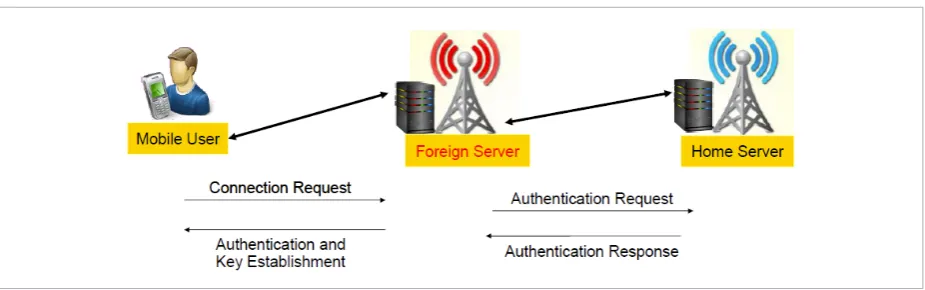
Table 1
Login, authentication and key agreement phase of our scheme
transmits the message
{
ID
MU, }
Y
ito home agent, where
m Z
∈
*pis a random number.
2.
HA
receives the message
{
ID
MU, }
Y
iand generates a random number
n
.
HA
performs
computations using its master key
K
.
HA
computes
X
i= (
h ID
MU
K
H)
,
Z Y
i=
i⊕
X
i. Further,
HA
stores
{ ,
Z ID
i HA}
into the smartcard
SC
and sends to
MU
.
3.
MU
imprints his/her biometric
Bio
and computes
V h PW
i= (
MU⊕ ⊕
m ID
MU),
= ( (
)
)
i MU
![Table 3 Computation cost analysis [24-25, 35]](https://thumb-us.123doks.com/thumbv2/123dok_us/8763865.1753409/14.595.63.532.582.679/table-computation-cost-analysis.webp)