Using the Technology Acceptance Model to Understand the Use
of Bring Your Own Device (BYOD) to Classroom
In today’s world, the technology has been embedded in all aspects of human life. The education sector has been at the forefront of tech-nology adoption. Techtech-nology-enhanced learning (TEL) is a system of education that promotes the application of information and com-munication technology for teaching and learning and the concept of “bring your own device” (BYOD) supports this. BYOD is particularly beneficial for the education sector due to cost saving and comfort of using personal devices. Researchers believe that inclusion of technol-ogy must be supported by the user acceptance and the most popular framework to predict user acceptance of technology is the Technolo-gy Acceptance Model (TAM) proposed by Davis. The paper describes the study conducted for the purpose of predicting the acceptance and utilization of BYOD by the college students based on TAM variables of perceived ease of use, perceived usefulness, attitude towards using, and behavioral intention to use. Additional external variables of teach-ers’ influence, facilitating conditions and peer influence are adopted to study the user acceptance of BYOD. A questionnaire based on the TAM variables was developed and used to gather information from students of a post graduate course in information technology of an Indian university. The results of analysis suggest that the considered variables have an impact on the overall behavioral intention to use BYOD and thus support the original findings of TAM.
Deepshikha Aggarwal
Jagan Institute of Management Studies, Delhi, India
Email: [email protected]
1. Introduction
The education system around the world is becoming more and more dependent on information and communication technology (ICT). In the application of ICT in education, one
Journal on Today’s Ideas - Tomorrow’s
Technologies
Journal homepage: https://jotitt.chitkara.edu.in/
Keywords: BYOD; Digital Education; Technology Acceptance Model (TAM); Technology enhanced Learning
ARTICLE INFORMATION ABSTRACT
The Author(s) 2018. This article is published with open access at www.chitkara.edu.in/publications. https://doi.org//10.15415/ DOI: 10.15415/jotitt.2018.62007
of the popular ways of integrating technology with learning is the students using their personal devices for their studies.
and use their own devices instead of depend-ing on the devices provided by the school/ college. The adoption of bring your own device in the education sector can be moti-vated by two factors i.e. (a) cost cutting and (b) adaptation of technology. The cost saving due to students bringing their own devices is a big factor to motivate the educational institutes to promote BYOD. Though most of the students these days own personal elec-tronic devices but financial constraints may exist for some of them. The educational in-stitutes may implement certain policies for support such as enabling subsidized purchase of devices for economically weaker students. The second factor of technology adoption is equally important. It is easier to keep a track of studies if using the same device in school and home. The concept of BYOD is already very popular in the business sector and its advantages have been well understood. Now, a number of educational institutions are considering BYOD due to the benefits it can offer to classroom learning [1]. Bring your own Device is a relatively new trend and its advantages and disadvantages are being ex-plored to understand its implementation in both the business and education sectors. On one hand, BYOD brings many benefits to the effective classroom learning, but there are many concerns associated with its im-plementation that leave many educational in-stitutions pondering whether or not BYOD should actually be promoted.
There have been continuous attempts to include technology in education by educationists [2]. There has been a tremendous increase in technology supported education. But there remains a great challenge in integrating technology in education as there is a lack of proper methods for prediction of utilization and acceptance of technology. Integrating technology with education does not only
mean that the students use electronic devices for learning but it is only possible if the teaching methodology is modified to embrace technology enabled learning.
2.
Technology acceptance model
(TAM)
TAM was introduced by Davis in 1986 [3]. It is a model that has been used by various researchers for the prediction of the possi-ble acceptance of developments in informa-tion technology by prospective users. TAM is used to explain the factors that influence the computer acceptance of end-user regarding the usage of the new computing technolo-gies. The traditional TAM model includes two basic factors of Perceived Usefulness (PU) and Perceived Ease of Use (PEOU). Perceived Usefulness is indicated as the pro-spective user’s perception that the use of a particular information system will be useful for their tasks. It is the degree to which a per-son believes that using a certain technology would enhance his or her job performance. Perceived Ease of Use indicates the level to which the prospective user expects the spe-cific information system to be effortless [4]. PEOU is defined as the degree to which a person believes that learning and adapting the use of a new technology would be easy. The users may also be affected by various other factors such as the peer group influence during their decision to choose computer systems which are considered as the external variables of TAM.
when it is useful in performing their tasks. When we consider adoption of technology in teaching and learning then for a teacher, the use of technology in the classroom is perceived as useful when a teacher believes that using the particular technology will
help to improve their teaching [5]. Some people are highly motivated towards adopting new technologies may sometimes underestimate the difficulties that may be accompanied [6].
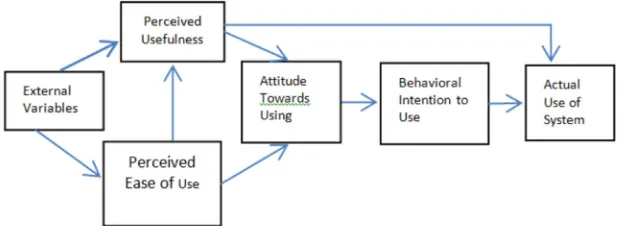
Figure 1: Technology acceptance model (TAM)
3. Studies on educational
technology using TAM
The TAM as shown in Fig. 1 is an effective theoretical model that has been used in researches to study the acceptance of technology in the education sector. The main idea of TAM is to determine the factors responsible for acceptance of technology by the users. These are determined by their intention to use a new system which is taken as a variable called Behavioural Intention to Use (BIU). The BIU is determined by the PU and PEOU [2]. In BYOD, the BIU signifies the extent to which the students and teachers plan to use or not to use their own personal devices for learning related activities. The attitude towards using a technology also plays a significant role in determining the user acceptance for technology. TAM considers that the users develop a positive attitude towards accepting technology when they consider it to be useful for them (PU) and easy to
study as we need to predict the acceptance of BYOD in the learning process in the Indian higher education scenario as this model of technology enhanced learning is still not popular.
4. Application of TAM in BYOD
Lot of developments have happened in education sector in recent years. The educational institutions have realised the importance of Information and Communication Technologies (ICT). The ICT enables them to perform their operations in a much better way [11]. There have been numerous technological advancements in the education sector that makes teaching and learning more effective. To take the complete advantage of this technology integration with education, the students need an uninterrupted access to computing devices. Bring Your Own Device (BYOD) in the classroom means that the students will carry their own devices like laptops, tablets and smartphones to the class and use their own devices instead of depending on the devices provided by the school/ college. This enables the students to have access to technology at all times. The implementation of BYOD in the educational sector cannot be generalized as there are specific issues related to regulations by the governments and university systems which vary across different countries and regions. There are infrastructural requirements that have to be identified and implemented for an effective implementation of BYOD. There are financial constraints and internal rules and regulations of the educational institutions that need to be addressed. Today, the computing devices are quite affordable and the development of mobile technologies makes the usage of devices possible anywhere anytime. This acts as a motivation for students to buy and bring their own devices to college.
Technology enhanced learning is an area of interest for the researchers in educational technology. They are keen to determine if BYOD would provide an added advantage for the education sector in adoption of technology. TAM has been used in various sectors for prediction of user acceptance of technology and through this study we are trying to establish if TAM can also be applied in the context of BYOD.
The following TAM variables are used for predicting the acceptance of BYOD: 1) Perceived usefulness
Perceived usefulness of BYOD indicates the ease of access to learning resources to students if they use their personal devices in college. The computing devices are the sources that enable the students to access the learning content anytime and anywhere, thus giving them the facility for personalised learning. Studies (Valk, Ahmed & Laurent 2010) have suggested that the mobile devices are not only useful for increased access to learning resources, but also have positive impacts on overall educational outcomes of the institutions. Personal devices are also useful for teachers and students as they allow them to utilize their free time in the campus more effectively.
2) Perceived ease of Use
also receive and share content with other students and teachers. An important consideration to avail all these facilities is a proper computing infrastructure set up in the campus. We have therefore considered this as an external variable to the TAM as the Facilitating Conditions (FC) which indicate the supporting facilities such as Wi-Fi and LAN because without a proper network support, the personal devices cannot be effectively used on the campus.
3) Attitude towards use (ATU)
A user will actually start using technology if he/ she has the attitude towards usage of that particular technology. Therefore, it is important to predict the attitude of users while using TAM for prediction of technology acceptance. The attitude influences the Behavioral Intention to Use (BIU) the technology and ultimately predicts the actual use.
5. Research model and hypothesis
TAM is used to predict the users’ perception and intention towards acceptance of a new technology [5]. The Technology Acceptance Model (TAM) has been designed to demonstrate the factors that affect the acceptance and use of a technology. TAM can be applied before adoption of a new technology so that the utilization of the technology can be done in a better way. The theoretical model of TAM is built on the assumption that when the users are presented with a new technology the major factors that influence their decision to accept it are Perceived Usefulness, Perceived ease of use and attitude towards using the technology. A Bring Your Own Device (BYOD) policy means that students and staff are allowed to bring their own devices such as tablets, laptops, and smartphones for use within the classroom
for learning activities and facilitating the faculty in preparing their lessons. There are some external factors also that influence the acceptance of the BYOD model of education. Hypothesis was formulated after considering the following external variables:
(a) Peer Influence (b) Facilitating conditions (c) Teacher influence
The Perceived Ease of use (PEOU), Perceived Usefulness (PU), Attitude Towards Using (ATU) and Behavioral Intention to Use (BTU) for the BYOD model of education are hypothesized as following:
H1: Perceived Ease of use (PEOU) positively affects the Perceived Usefulness (PU) of BYOD.
H2: Perceived Ease of use (PEOU) positively affects the Attitude Towards Using (ATU) BYOD.
H3: Perceived Usefulness (PU) positively affects the Behavioral Intention to Use (BTU) BYOD.
H4: Perceived Usefulness (PU) positively affects the Attitude Towards Using (ATU) BYOD.
H5: Teachers (TI) positively affect the Perceived Usefulness (PU) of BYOD. H6: Peer Group (PI) positively affects the
Behavioral Intention to Use (BTU) BYOD.
H7: Facilitating Conditions (FC) positively affect the Perceived Ease of use (PEOU) of BYOD.
6. Research method
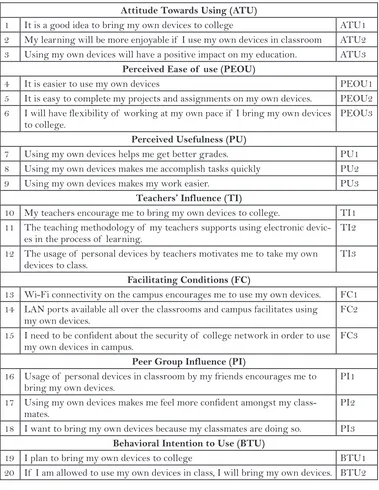
contained 20 items related to TAM variables.
It incorporated a five-point Likert response scale ranging from “strongly disagree (1)” to “strongly agree (5)”. Table 1: Questionnaire
Attitude Towards Using (ATU)
1 It is a good idea to bring my own devices to college ATU1
2 My learning will be more enjoyable if I use my own devices in classroom ATU2 3 Using my own devices will have a positive impact on my education. ATU3
Perceived Ease of use (PEOU)
4 It is easier to use my own devices PEOU1
5 It is easy to complete my projects and assignments on my own devices. PEOU2 6 I will have flexibility of working at my own pace if I bring my own devices
to college. PEOU3
Perceived Usefulness (PU)
7 Using my own devices helps me get better grades. PU1
8 Using my own devices makes me accomplish tasks quickly PU2
9 Using my own devices makes my work easier. PU3
Teachers’ Influence (TI)
10 My teachers encourage me to bring my own devices to college. TI1 11 The teaching methodology of my teachers supports using electronic
devic-es in the procdevic-ess of learning. TI2
12 The usage of personal devices by teachers motivates me to take my own
devices to class. TI3
Facilitating Conditions (FC)
13 Wi-Fi connectivity on the campus encourages me to use my own devices. FC1 14 LAN ports available all over the classrooms and campus facilitates using
my own devices. FC2
15 I need to be confident about the security of college network in order to use
my own devices in campus. FC3
Peer Group Influence (PI)
16 Usage of personal devices in classroom by my friends encourages me to
bring my own devices. PI1
17 Using my own devices makes me feel more confident amongst my
class-mates. PI2
18 I want to bring my own devices because my classmates are doing so. PI3
Behavioral Intention to Use (BTU)
19 I plan to bring my own devices to college BTU1
6.1. Data collection
The data used for the study is collected by means of the questionnaires filled by the students of MCA (Masters in Computer
Application), a 3 year post graduate course in information technology. The questionnaires were distributed to 130 students out of which 117 returned the filled questionnaires Table 2 shows the data demographics..
Table 2: Data demographics
Total number of students 117
Number of students in first year 59
Number of students in second year 58
Number of male students 63
Number of female students 54
6.2. Hypothesis testing
In order to test the hypothesis, the correlation analysis was conducted in R to examine the relationship between the TAM variables and on
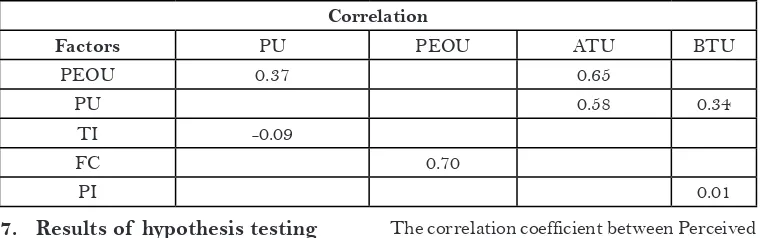
the basis of the analysis it was decided whether to accept or reject the hypotheses Table 3 shows the correlation between TAM variables..
Table 3: Correlation between TAM variables
Correlation
Factors PU PEOU ATU BTU
PEOU 0.37 0.65
PU 0.58 0.34
TI -0.09
FC 0.70
PI 0.01
7. Results of hypothesis testing The correlation analysis results are shown in Table 3. The results are interpreted as follows: H1: Perceived Ease of use (PEOU) positively
affects the Perceived Usefulness (PU) of BYOD.
The correlation coefficient between Perceived Ease of use (PEOU) and Perceived Usefulness (PU) is 0.37. This indicates a positive correlation between the two variables.
Hence, hypothesis H1 is supported.
H2: Perceived Ease of use (PEOU) positively affects the Attitude Towards Using (ATU) BYOD.
The correlation coefficient between Perceived Ease of use (PEOU) and Attitude Towards Using (ATU) is 0.65 which indicates that there is a positive correlation between two variables.
Hence, hypothesis H2 is supported.
H3: Perceived Usefulness (PU) positively affects the Behavioral Intention to Use (BTU) BYOD.
The correlation coefficient between Perceived Usefulness (PU) and the Behavioral Intention to Use (BTU) is 0.34. It indicates a positive correlation between the two variables.
H4: Perceived Usefulness (PU) positively affects the Attitude Towards Using (ATU) BYOD.
The correlation coefficient between Perceived Usefulness (PU) and the Attitude Towards Using (ATU) is 0.58. It can be observed that there is a positive correlation between two variables.
Hence, hypothesis H4 is supported.
H5: Teachers (TI) positively affect the Perceived Usefulness (PU) of BYOD. The correlation coefficient between Teachers Influence (TI) and Perceived Usefulness (PU) is -0.9. It can be observed that there is a negative correlation between two variables. It indicates that teachers are not having any positive influence on students regarding BYOD.
Hence, hypothesis H5 is not supported and is rejected.
H6: Peer Group (PI) positively affects the Behavioral Intention to Use (BTU) BYOD.
The correlation coefficient between Peer Group Influence (PI) and the Behavioural Intention to Use (BTU) is 0.01. It can be observed that there is no correlation between two variables.
Hence, hypothesis H6 is not supported. H7: Facilitating Conditions (FC) positively affect
the Perceived Ease of use (PEOU) of BYOD. The correlation coefficient between Facilitating Conditions (FC) and the Perceived Ease of use (PEOU) is 0.70. It can be observed that there is a positive correlation between two variables.
Hence, hypothesis H7 is supported.
8. Conclusion
The integration of personal computing devices like laptops, tablets and smartphones
into our daily lives has brought a revolution in the process of how we communicate with the world and access information. The education sector has infused these devices into the teaching and learning processes. The inception of these devices along with the mobile communication technologies like Wi-Fi and 4G makes the information revolution even more powerful and omnipresent in the lives of students and teachers alike. The education sector is currently experiencing a digital wave that supports technology based classroom learning. Bring your own device (BYOD) is a policy that brings the students closer to technology and makes them understand that the digital revolution is not just about social networking and entertainment but it has a major role in enhancing the learning and knowledge sharing processes. This study has used the TAM to predict the acceptance of BYOD among the college students in Delhi, India. The statistical analysis conducted using correlation indicates that the results of the current study are consistent with the original TAM model. The study indicates that when the Perceived ease of use increases, the perceived usefulness increases accordingly which develops a positive attitude towards utilizing the technology.
TAM to predict the impact of various factors on the acceptance of BYOD in the classroom.
References
[1] M. K. O. Lee, C. M. K. Cheung and Z. Chen, “Acceptance of internet-based learning medium: The role of extrinsic and intrinsic motivation”, Information & Management, vol. 42, no. 8, pp. 1095– 1104, 2005.
[2] H. T. K. Yee, W. S. Luan, A. F. Ayub and R. Mahmud, “A review of the literature: Determinants of online learning among students”, European Journal of Social Sciences, vol. 8, no. 2, 2009.
[3] F. D. Davis, R. P. Bagozzi and P. R. Warshaw, “User acceptance of computer technology: A comparison of two theoretical models”, Management Science, vol. 35, no. 8, pp. 982-1003, 1989.
[4] F. D. Davis, “Perceived usefulness, perceived ease of use, and user acceptance of information technology”,
MIS Quarterly, vol. 13, no. 3, pp. 319-340, 1989.
[5] M.A. Hassan, B. A. Samah, H. A. M. Shaffril and J. Dsilva, “Perceived usefulness of ict usage among JKKK members in peninsular malaysia”, Asian Social Science, vol. 7, no.10, pp. 255-266, 2011.
[6] M. H. Fagan, S. Neill and B. R. Wooldridge, “Exploring the intention to use computers: an empirical investigation of the role of intrinsic motivation, extrinsic motivation, and perceived ease of use”, Journal of Computer Information Systems, vol. 48, no. 3, pp. 31-37, 2008. [7] J. S. Lee, H. Cho, G. Gay, B. Davidson
and A. Ingraffea, “Technology acceptance and social networking in distance learning”, Educational Technology & Society, vol. 6, no. 2, pp. 50-61, 2003.
[8] S. Y. Park, “An analysis of the technology acceptance model in understanding university students’ behavioral intention to use e-learning”,
Educational Technology & Society, vol. 12, no. 3, pp. 150–162, 2009.
[9] P. S. Shum, L. Land and G. Dick, “Online lecturing: Suitable for all courses, in Proceedings of the Southern Association for Information Systems Conference, Atlanta, GA, USA March 26th-27th, 2010, pp. 19-26.
[10] S. W. H. Wong, “Using the technology acceptance model in understanding staff acceptance and attitudes to use lecture capture system”, International Journal of Management and Applied Science (IJMAS), vol. 3, no. 8, pp. 69-74, 2017.
[11] K. J. Mugo, “Effective implementation of technology innovations in higher education institutions: A survey of selected projects in universities in Africa. PhD diss.”, Kenyatta University; 2014.
[12] V. J. Harmen, A, T. Rashid , L. Elder, “Using mobile phones to improve educational outcomes: An analysis of evidence from Asia”,