The Journal of Threatened Taxa (JoTT) is dedicated to building evidence for conservation globally by publishing peer-reviewed articles online every month at a reasonably rapid rate at www.threatenedtaxa.org. All articles published in JoTT are registered under Creative Commons Attribution 4.0 International License unless otherwise mentioned. JoTT allows allows unrestricted use, reproduction, and distribution of articles in any medium by providing adequate credit to the author(s) and the source of publication.
www.threatenedtaxa.org
ISSN 0974-7907 (Online) | ISSN 0974-7893 (Print) Building evidence for conservation globally
Journal of Threatened Taxa
For Focus, Scope, Aims, Policies, and Guidelines visit https://threatenedtaxa.org/index.php/JoTT/about/editorialPolicies#custom-0
For Article Submission Guidelines, visit https://threatenedtaxa.org/index.php/JoTT/about/submissions#onlineSubmissions
For Policies against Scientific Misconduct, visit https://threatenedtaxa.org/index.php/JoTT/about/editorialPolicies#custom-2
For reprints, contact <[email protected]>
Short Communication
Efficacy of oxyclozanide and levamisole treatment on the
gastrointestinal parasites in captive Lions Panthera leo
Dhareppa Ganager, Gotakanapura Sanjeevamurthy Mamatha, Asoor Muralidhara, Nagappa Lakkundi Jaya & Beechagondahalli Papanna Shivashankar
26 December 2019 | Vol. 11 | No. 15 | Pages: 15043–15046 DOI: 10.11609/jott.4859.11.15.15043-15046
Partner
Member
Threatened Taxa
Publisher & Host
PLATINUMOPEN ACCESS
15043
Shor
t C
ommunica
tion
DOI:https://doi.org/10.11609/jott.4859.11.15.15043-15046
Editor: Rajeshkumar G. Jani, Anand Agricultural University, Anand,India Date of publication: 26 December 2019 (online & print)
Manuscript details: #4859 | Received 29 January 2019 | Final received 30 November 2019 | Finally accepted 06 December 2019
Citation: Ganager, D., G.S. Mamatha, A. Muralidhara, N.L. Jaya & B.P. Shivashankar (2019). Efficacy of oxyclozanide and levamisole treatment on the gastrointestinal parasites in captive Lions Panthera leo. Journal of Threatened Taxa 11(15): 15043–15046. https://doi.org/10.11609/jott.4859.11.15.15043-15046
Copyright: © Ganager et al. 2019. Creative Commons Attribution 4.0 International License. JoTT allows unrestricted use, reproduction, and distribution of this article in any medium by adequate credit to the author(s) and the source of publication.
Funding: None.
Competing interests:The authors declare no competing interests.
Acknowledgements: The facilities provided through Centre of Advanced Faculty Training, ICAR, New Delhi to carry out this research work and the support extended by the Veterinary Officers during collection of faecal material is gratefully acknowledged.
Efficacy of oxyclozanide and levamisole treatment on the
gastrointestinal parasites in captive Lions Panthera leo
Dhareppa Ganager 1 , Gotakanapura Sanjeevamurthy Mamatha 2 , Asoor Muralidhara 3 , Nagappa Lakkundi Jaya 4 & Beechagondahalli Papanna Shivashankar 5
1,3 Wildlife Unit, Veterinary College, Hebbal, Bengaluru & Institute of Wildlife Veterinary Research, Doddaluvara, Kodagu, Karnataka 571234, India.
2,4 Department of Veterinary Parasitology, Veterinary College, Hebbal, Bengaluru, Karnataka 560024, India. 5 Institute of Animal Health & Veterinary Biologicals, Hebbal, Bengaluru, Karnataka 560024, India.
Karnataka Veterinary Animal & Fisheries Sciences University, Bidar.
1 [email protected], 2 [email protected] (corresponding author), 3 [email protected], 4 [email protected], 5 [email protected]
Journal of Threatened Taxa | www.threatenedtaxa.org | 26 December 2019 | 11(15): 15043–15046
Abstract: A study was carried out to determine the efficacy of anthelmintics on gastrointestinal parasites in lions under captivity at Bannerghatta Biological Park (Bengaluru), Sri Chamarajendra Zoological Garden (Mysuru) and Tiger-Lion Safari Tyavarekoppa (Shivamogga) during the period from January to June, 2018. Out of 20 faecal samples subjected to qualitative and quantitative methods, 66.6% were found positive for eggs of Ancylostoma spp., 60.0% for Toxascaris leonina, 20.0% for Spirometra spp. and 13.3% for Balantidium coli cysts with an overall infection rate of 75.0%. A combination of oxyclozonide 6% w/v and levamisole 3% w/v (Neozide plus) at the rate of 1ml per 4kg body weight revealed egg per gram counts for Ancylostoma spp., T. leonina and Spirometra spp. to be reduced from 100, 11,450 ± 11,250 and 100 to zero respectively on subsequent 3, 7, 10 and 21 days post treatment and proved to be cent per cent effective.
Keywords: Anthelmintics, efficacy, gastrointestinal parasites, Lions.
ISSN 0974-7907 (Online) ISSN 0974-7893 (Print)
PLATINUM OPEN ACCESS
In captive wild carnivores, the change in the environment and living conditions influences the ecology of the animal and might increase the susceptibility to many of the diseases, viz., bacterial, viral, parasitic and rickketsial diseases (Goossens et al. 2005). Especially, carnivores kept in captivity in zoos usually suffer from several parasitic infections, such as from nematodes, cestodes, trematodes, and protozoans. In particular,
among nematodes ascarids constitute the major parasitic infection in wild carnivores and are established as a problem in most of the zoos throughout the world (Sayid & Mohammed 1997–1998).
Among parasitic diseases, particularly helminthic infections have a greater ramification and significant impact on host survival, growth and reproduction through direct and indirect pathological effects. The subclinical infections may not cause any immediate alarming signs of disease but in the long course, they would render the animals susceptible to other concurrent infections (Muraleedharan et al. 1990). In addition, gastrointestinal parasites of wild carnivores include zoonotic species to humans and may raise public health concern (Acharjyo 2004).
Journal of Threatened Taxa | www.threatenedtaxa.org | 26 December 2019 | 11(15): 15043–15046
Efficacy of oxyclozanide and levamisole treatment Ganager et al.
15044
gastrointestinal parasitic infections is mainly dependent on the short term deworming programmes. A range of antiparasitic drugs has been used to reduce parasitism in wild animal populations. In particular, most drug treatment experiments using anthelmintic has been carried out by targeting nematode infections (Pedersen & Fenton 2015). The commonly used anthelmintic includes thiabendazole, piperazine citrate and adipate,
pyrantel pamoate, albendazole, fenbendazole,
levamisole, and ivermectin. Many studies have provided information on the effects of treatment on the target parasite, assessed either in terms of the prevalence of infection (proportion of hosts infected), mean parasitic abundance (mean number of parasites or parasitic eggs shed per host), or mean parasite intensity (mean number of parasite eggs shed per infected host).
The regular examination of faeces, assessment of parasitic load, and the assessment of drug efficacy, however, are not frequently carried out in many zoological parks or gardens. Therefore, the present study was undertaken to determine the efficacy of anthelmintic on the gastrointestinal parasites in captive
lions.
Material and Methods Study area
The study area included Bannerghatta Biological Park (BBP) which is located 22km south of Bengaluru in the hills of the Anekal range with 26356.16 hectares area with zoo, a pet corner, an animal rescue centre, a butterfly enclosure, an aquarium, a snake house, and a safari park. Sri Chamarajendra Zoological Garden (SCZG) is around 63.53 hectares located near the palace in Mysuru, is one of the oldest zoos in India and is home to a wide range of species (168). Tiger-Lion Safari Tyavarekoppa (TLST), Shivamogga is Karnataka’s second safari park, after BBP with an area of 250ha.
Collection of samples
During this study, a representative faecal sample of about 10g was collected from each enclosure and the methodology was followed as per Soulsby (1982) and Taylor et al. (2015). However, in Dehuri et al. (2013), 2g of faeces was collected and also for the methods the reference Soulsby (1982) is cited. A total of 20 faecal samples were collected from lions under captivity at BBP (12), SCZG (4), and TLST (4) during the period January–June 2018. The faecal samples were examined macroscopically and were subjected to microscopic examination by using qualitative (direct and concentration) and quantitative (Mc Master’s) methods
to assess the severity of different parasitic infections (Soulsby 1982; Taylor et al. 2015). The parasitic eggs/ larvae/cysts/oocysts were identified based on the standard morphological characters (Soulsby 1982; Zajac & Conboy 2012; Bowman 2014).
Determination of anthelmintic efficacy
An anthelminthic efficacy against gastrointestinal parasitic infections was determined based on the eggs per gram (EPG) of faeces using Mc Master’s method. During this study, a combination of oxyclozonide 6% w/v and levamisole 3% w/v (Neozide plus) @ 1ml per 4kg body weight in meat was administered during May 2018. The EPG was carried out during pretreatment
and on 3rd, 7th, 10th, and 21st days post treatment. The
percentage of efficacy of drug was determined by the following formula:
Efficacy % = (Pre treatment EPG – Post treatment EPG / Pre treatment EPG) x 100
Statistical analysis
The statistical analysis of data was carried out by Fisher’s exact and one way ANOVA tests using graph pad prism software, version 5.01.
Results
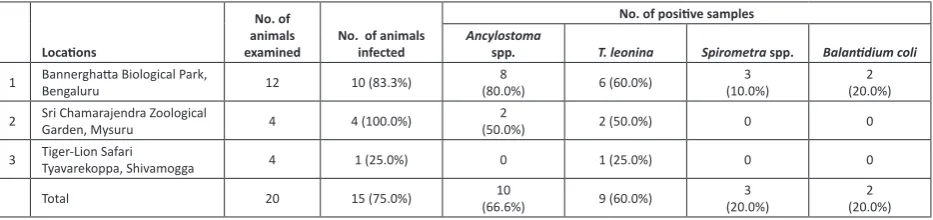
During this study, out of 20 faecal samples examined by direct and concentration methods, 15 samples were found to be positive for helminthic infections of
Ancylostoma spp. (66.6%), T. leonina (60.0%), Spirometra
spp. (20%), and Balantidium coli (13.3%) cysts, with an overall infection rate of 75%. In BBP, SCZG, and TLST, 10 (83.3%), four (100%), and one (25.0%) samples were found to be positive for gastrointestinal parasitic eggs/ cysts, respectively (Table 1). The statistical differences between the infections in the different locations were found to be nonsignificant at P< 0.05. The mixed infections of Ancylostoma spp. and T. leonina (5), Ancylostoma spp.
and Spirometra sp. (2), and Ancylostoma spp. and B. coli
(2) were commonly observed with an overall infection rate of 70%.
Anthelmintic efficacy
The average mean pretreatment EPG counts was found to be 100 ± 0 for Ancylostoma spp., 11,450 ± 11,250 for T. leonina and 100 ± 0 for Spirometra spp. Subsequently, after 3, 7, 10 and 21 days post treatment, the EPG counts were reduced to zero. An examination of faecal samples was negative for gastrointestinal parasitic infections with cent per cent efficacy on 21days post
Efficacy of oxyclozanide and levamisole treatment Ganager et al.
Journal of Threatened Taxa | www.threatenedtaxa.org | 26 December 2019 | 11(15): 15043–15046 15045
Discussion
During this study, one faecal sample from TLST and two from SCZG were found to be positive for eggs of Ancylostoma spp. and T. leonina with very low parasitemia (EPG = 0). Therefore, anthelmintic efficacy was carried out at BBP. All the animals irrespective of the infection and whether the animals were positive or negative were administered a combination of oxyclozonide (6% w/v), a broad spectrum antitrematodal drug and levamisole (3% w/v) which has activity against nematodes and an immunostimulant at the rate of 1ml per 4kg body weight. In the present study, subsequently after 3rd, 7th, 10th and 21st day post treatment, the EPG
counts were reduced to zero per cent and the faecal samples were negative for infections indicating 100% efficacy. During this study, though the Spirometra
infection was recorded, the animals were not
administered with anticestodal drugs. Therefore, based on the present findings zoo veterinarians received the suggestion that wild carnivores under captivity should be regularly dewormed with anthelmintic only after an examination of faecal samples for the presence or absence of gastrointestinal parasitic infections to avoid unnecessary dosing with anthelmintic thereby reducing the cost of treatment and development of resistance in future. Many authors, however, have reported varied efficacy with different modes of action of anthelmintic— Sayid & Mohammad (1997–1998) at Khartoum Zoo, Sudan reported complete clearance of infection with piperazine but incomplete clearance of parasites on 28th
day post treatment with thiabendazole in lions, leopards, jackal, and dwarf mongoose infected with T. leonina; Sur
et al. (2000) treated lions infected with Toxocara and Ancylostoma with ivermectin injection (Ivomec) @ 1ml per 50kg body weight and recorded an absence of eggs
on the 7th day post treatment; Kumar et al. (2005) treated
22 lions which showed the occurrence of Toxocara eggs
in the faeces with piperazine @ 220mg per kg orally at M.C. Zoological Park, Chhatbir, Patiala District, Punjab
and later, with ivermectin at the dose rate of 1ml per 50kg body weight subcutaneously twice at one week intervals for piperazine resistant T. cati and observed
the egg count to be reduced by 98.71%; Moudgil et al. (2017) reported that fenbendazole @ 10mg per kg body weight once daily for three consecutive days was ineffective to eliminate the infection in Asiatic Lions infected with T. leonina and observed eggs reduction by 69.35% at day 3 post treatment with three consecutive treatment schedule, however, extended period of time with fenbendazole for five days and ivermectin @ 100µg per kg body weight once daily for three alternative days resulted in eggs reduction by 95.34% and 95.74%, respectively, and proved to be effective.
The differences in the efficacy of each anthelmintic drug may be attributed to the fact that the vehicle of drug to captive wild animals (especially wild felines) play an important role in administering exact dosage the reason could be that the total dosage of anthelmintic drug cannot be calculated according to their body weight (Moudgil et al. 2017).
In conclusion, though helminthic and protozoan infections are known to occur in captive wild carnivores, the control measures undoubtedly would depend upon several factors. Further, the rationale behind the control of parasitic infections in wild carnivores of Indian zoos presumes that in as much as each carnivore is infected and that the zoo environment cannot be changed frequently because of space confinement, overcrowding, and the movement of keepers from one enclosure to another and the presence of stray dogs and cats which may act as a source of infection (Acharjyo 2004). The present findings indicated that quarterly deworming (once in three months) of all the animals and examination of faecal samples before and after deworming should be followed regularly to confirm the efficacy of treatment. In addition, a change of anthelmintic should be instituted from time to time to avoid drug resistance in captive wild carnivores.
Table 1. Number of faecal samples positive for gastrointestinal parasites in lions at different locations.
Locations
No. of animals
examined No. of animals infected
No. of positive samples Ancylostoma
spp. T. leonina Spirometra spp. Balantidium coli
1 Bannerghatta Biological Park, Bengaluru 12 10 (83.3%) (80.0%)8 6 (60.0%) (10.0%)3 (20.0%)2
2 Sri Chamarajendra Zoological Garden, Mysuru 4 4 (100.0%) (50.0%)2 2 (50.0%) 0 0
3 Tiger-Lion Safari Tyavarekoppa, Shivamogga 4 1 (25.0%) 0 1 (25.0%) 0 0
Journal of Threatened Taxa | www.threatenedtaxa.org | 26 December 2019 | 11(15): 15043–15046
Efficacy of oxyclozanide and levamisole treatment Ganager et al.
15046
References
Acharjyo, L.N. (2004). Helminthiasis in captive wild carnivores and its
control in India. Zoos’ Print Journal 19(7): 1540–1543.https://doi. org/10.11609/JoTT.ZPJ.1001.1540-3
Bowman, D.D. (2014).Georgi’s Parasitology for Veterinarians, 10th
Edition. W.B. Sounders, Philadelphia, 496pp.
Goossens, E., P. Dorny, J. Boomker, F. Vercammen & Vercruysse (2005). A 12-month survey of the gastrointestinal helminths of
antelopes, gazelles and giraffids kept at two zoos in Belgium.
Veterinary Parasitology 127(3–4): 303–312.
Kumar, A., L.D. Singla, N. Singla, G.S. Aulak & J. Singh (2005).
Management of piperazine resistant Toxocariosis with Ivermectin in
Lions (Panthera leo). Journal of Parasitic Diseases 29(2): 156–160.
Moudgil, A.D., L.D. Singla & M.P. Singh (2017). Internal transcribed
spacer sequence based molecular confirmation and drug efficacy
assessment against Toxascaris leonina (Linstow, 1909) infection in Asiatic Lions (Panthera leo persica). Helminthologia 54(2): 152–156.
Muraleedharan, K., I. Vasanthi, K.S. Ziauddin & K. Srinivasan (1990). A
survey of gastrointestinal parasites of animals of Zoological Gardens
at Mysore. Mysore Journal of Agricultural Sciences 24: 250–256.
Pedersen, A.B. & A. Fenton (2015). The role of antiparasite treatment
experiments in assessing the impact of parasites on wildlife. Trends in Parasitology 31(5): 200–211.
Sayid, A.S.A. & B.A. Mohammed (1997–1998). Prevalence and
treatment of Toxoascaris leonina in naturally infected carnivores in old Khartoum Zoo. The Sudan Journal of Veterinary Research 15: 31–38.
Singh, P., M.P. Gupta, L.D. Singla, N. Singh & D.R. Sharma (2006).
Prevalence and chemotherapy of gastrointestinal helminthic infections in wild carnivores of Mahendra Choudhury Zoolgoical
Park, Punjab. Journal of Veterinary Parasitology 20: 17–23
Soulsby, E.J.L. (1982). Helminths, arthropods and protozoa of domesticated animals. VII Edition. Bailliere Tindall, London, 809pp.
Sur, S.K., L.G. Ghosh & D. Chatterjee (2000). Use of ivermectin in tigers
for removing intestinal parasites. Zoos’ Print Journal 16(1): 410.
https://doi.org/10.11609/JoTT.ZPJ.16.1.410
Taylor, M.A., R.L. Coop & R.L. Wall (2015).A Text Book of Veterinary Parasitology. 4th Edition. Blackwell Publishing, Oxford, UK., 799pp.
Zajac, A.M. & G.A. Conboy (2012).A Text Book of Veterinary Clinical Parasitology. 8th Edition. Wiley-Blackwell, UK., 368pp.
ISSN 0974-7907 (Online) | ISSN 0974-7893 (Print)
December 2019 | Vol. 11 | No. 15 | Pages: 14927–15090 Date of Publication: 26 December 2019 (Online & Print)
DOI: 10.11609/jott.2019.11.15.14927-15090
www.threatenedtaxa.org
The Journal of Threatened Taxa (JoTT) is dedicated to building evidence for conservation globally by publishing peer-reviewed articles online every month at a reasonably rapid rate at www.threatenedtaxa.org. All articles published in JoTT are registered under Creative Commons Attribution 4.0 International License
unless otherwise mentioned. JoTT allows allows unrestricted use, reproduction, and distribution of articles in any medium by providing adequate credit to the author(s) and the source of publication.
Peer Commentary
Observations on the ex situ management of the Sumatran Rhinoceros
Dicerorhinus sumatrensis (Mammalia: Perissodactyla: Rhinocerotidae):
present status and desiderata for conservation
– Francesco Nardelli, Pp. 14927–14941
Communications
Revisiting genetic structure of Wild Buffaloes Bubalus arnee Kerr, 1792 (Mammalia: Artiodactyla: Bovidae) in Koshi Tappu Wildlife Reserve, Nepal: an assessment for translocation programs
– Ram C. Kandel, Ram C. Poudel, Amir Sadaula, Prakriti Kandel, Kamal P. Gairhe, Chiranjibi P. Pokheral, Siddhartha B. Bajracharya, Mukesh K. Chalise & Ghan Shyam Solanki, Pp. 14942–14954
A review on status of mammals in Meghalaya, India
– Adrian Wansaindor Lyngdoh, Honnavalli Nagaraj Kumara, P.V. Karunakaran & Santhanakrishnan Babu, Pp. 14955–14970
A comparative analysis of hair morphology of wild and domestic ungulate prey species of Leopard Panthera pardus fusca (Mammalia: Carnivora: Felidae) from Goa, India
– Bipin S. Phal Desai, Avelyno H. D’Costa & S.K. Shyama, Pp. 14971–14978
Understanding people’s perception and attitudes towards mammalian fauna using qualitative data: a case study in Barail Wildlife Sanctuary, India
– Amir Sohail Choudhury, Rofik Ahmed Barbhuiya & Parthankar Choudhury, Pp. 14979–14988
An assessment of bird communities across Ujjani and its five satellite wetlands in Solapur District of Maharashtra, India
– Shraddha Prabhakar Karikar, Subhash Vitthal Mali, Kulkarni Prasad & Aphale Priti, Pp. 14989–14997
Growth rate of captive Gharials Gavialis gangeticus (Gmelin, 1789) (Reptilia: Crocodylia: Gavialidae) in Chitwan National Park, Nepal
– Bed Bahadur Khadka & Ashish Bashyal, Pp. 14998–15003
Amphibian abnormalities and threats in pristine ecosystems in Sri Lanka
– G.K.V.P.T. Silva, W.A.D. Mahaulpatha & Anslem de Silva, Pp. 15004–15014
Diversity and distribution of orchids of Goa, Western Ghats, India
– Jeewan Singh Jalal, Pp. 15015–15042
Short Communications
Efficacy of oxyclozanide and levamisole treatment on the gastrointestinal parasites in captive Lions Panthera leo
– Dhareppa Ganager, Gotakanapura Sanjeevamurthy Mamatha, Asoor
Muralidhara, Nagappa Lakkundi Jaya & Beechagondahalli Papanna Shivashankar, Pp. 15043–15046
First record in 129 years of the Tamil Treebrown Lethe drypetis todara Moore, 1881 (Lepidoptera: Nymphalidae: Satyrinae) from Odisha, India by fruit-baiting
– Anirban Mahata, Sudheer Kumar Jena & Sharat Kumar Palita, Pp. 15047– 15052
A review of the leafhopper tribe Agalliini (Hemiptera: Cicadellidae: Megophthalminae) with a revised key to the known Pakistani genera and
species
– Hassan Naveed, Kamran Sohail, Waqar Islam & Yalin Zhang, Pp. 15053– 15060
The windowpane oyster family Placunidae Rafinesque, 1815 with additional description of Placuna quadrangula (Philipsson, 1788) from India
– Rocktim Ramen Das, Vijay Kumar Deepak Samuel, Goutham Sambath, Pandian Krishnan, Purvaja Ramachandran & Ramesh Ramachandran, Pp. 15061–15067
Notes
Recent records of the rare Mountain Tortoiseshell Aglais rizana (Moore, 1872) (Lepidoptera: Nymphalidae) in the upper Garhwal, western Himalaya, India, after 100 years
– Arun Pratap Singh & Tribhuwan Singh, Pp. 15068–15071
First report of Dicranocentroides indica (Handschin, 1929) (Collembola: Paronellidae) from Odisha, India
– Ashirwad Tripathy, Pp. 15072–15073
Additions to the knowledge of darkling beetles (Coleoptera: Tenebrionidae) from the Indo-Burma Biodiversity Hotspot, Meghalaya, India
– Vishwanath Dattatray Hegde, Pp. 15074–15078
Bhutan Asiabell Codonopsis bhutanica Ludlow (Asterales: campanulaceae): a new addition to the Indian flora
– Samiran Panday, Vikas Kumar, Sudhansu Sekhar Dash, Bipin Kumar Sinha & Paramjit Singh, Pp. 15079–15082
Gentiana urnula Harry Sm. (Gentianaceae), a new record for the flora of
Arunachal Pradesh, India
– Khilendra Singh Kanwal, Umeshkumar Lalchand Tiwari, Lod Yama & Mahendra Singh Lodhi, Pp. 15083–15086
Carex phacota, Spreng. (Cyperaceae): a new record for the central
Western Ghats of Karnataka, India
– E.S.K. Udupa, H.U. Abhijit & K.G. Bhat, Pp. 15087–15088
Book review
Compendium of Traded Indian Medicinal Plants
– Reviewed by A. Rajasekaran, Pp. 15089–15090