every month at a reasonably rapid rate at www.threatenedtaxa.org. All articles published in JoTT are registered under Creative Commons Attribution 4.0 International License unless otherwise mentioned. JoTT allows unrestricted use of articles in any medium, reproduction, and distribution by providing adequate credit to the authors and the source of publication.
For Focus, Scope, Aims, Policies and Guidelines visit http://threatenedtaxa.org/index.php/JoTT/about/editorialPolicies#custom-0
For Article Submission Guidelines visit http://threatenedtaxa.org/index.php/JoTT/about/submissions#onlineSubmissions
For Policies against Scientific Misconduct visit http://threatenedtaxa.org/index.php/JoTT/about/editorialPolicies#custom-2
For reprints contact <[email protected]>
Journal of Threatened Taxa
Building evidence for conservation globallywww.threatenedtaxa.org
ISSN 0974-7907 (Online) | ISSN 0974-7893 (Print)
Communication
The composition and status of waterbirds of Perur Lake
in Tamil Nadu, India
G. Parameswaran & R. Sivashankar
26 October 2018 | Vol. 10 | No. 11 | Pages: 12464-12488 10.11609/jott.3864.10.11.12464-12488
Member
Partners
Communica
tion
DOI: https://doi.org/10.11609/jott.3864.10.11.12464-12488 | ZooBank: urn:lsid:zoobank.org:pub:FEE66370-FDBE-49C7-BB51-1BB7B6CFDAA7
Editor: Anonymity requested. Date of publication: 26 October 2018 (online & print)
Manuscript details: Ms # 3864 | Received 28 October 2017 | Final received 01 July 2018 | Finally accepted 17 October 2018
Citation: Parameswaran, G. & R. Sivashankar (2018). The composition and status of waterbirds of Perur Lake in Tamil Nadu, India. Journal of Threatened Taxa 10(11): 12464–12488; https://doi.org/10.11609/jott.3864.10.11.12464-12488
Copyright: © Parameswaran & Sivashankar 2018. Creative Commons Attribution 4.0 International License. JoTT allows unrestricted use of this article in any medium, reproduction and distribution by providing adequate credit to the authors and the source of publication.
Funding: None.
Competing interests: The authors declare no competing interests.
Author Details: G. Parameswaran is an engineering graduate from PSG College of Technology, Coimbatore, India. He was employed in USA for nearly three decades, mostly in the field of logistics. His interest in birds led him into being a conservation activist and also one of the Board of Directors of Seattle Audubon Society, USA (2003–08). In that capacity he qualified himself as a Master-birder and led many field trips and bird surveys in Washington State. He is currently retired and lives in his home town of Coimbatore, where he is pursuing his passion of bird watching and learning Sanskrit. R. Sivashankar is an engineering graduate from Karpagam College of Engineering. He is currently employed as a Junior Manager at ROOTS INDUSTRIES INDIA LIMITED, an automotive ancillary. He is an active bird watcher and nature enthusiast, who contributes to systematic surveys in and around Coimbatore region. His interests include ecosystem conservation through citizen science activities and systematic data collection to understand avian movements.
Author Contribution: Both the authors contributed equally. GP - contributing more on the subject side and RS contributing more on the computer related
matters like data entry, formatting etc.
Acknowledgements: We thank R. Vridhi, Dilip Joshi, Sai Vivek, and Gajamohanraj for their continuous support and association to this bird count. We thank Chetankumar Joshi, Saravanan Natrayan, G. Prakash, P. Mohanprasath, Sarayu Ramakrishnan, Kavya Ram, and Sharang Satish for their assistance in bird count and bird identification at different stages of this study. We would also like to show our gratitude to Sanjay Molur (Zoo Outreach Organization & Wildlife Information Liaison Development), Payal B. Molur (conservation education consultant), Priyanka Iyer, and Keerthi Krutha for their insight and expertise in understanding the ecology of wetlands.
The composition and status of waterbirds of Perur Lake in
Tamil Nadu, India
G. Parameswaran 1 & R. Sivashankar 2
1 438/11, Mayflower Apartments, 130, Vivekananda Road, Ramnagar, Coimbatore, Tamil Nadu 641009, India 2 110, Ramasamy Layout 1st cut, Ellai Thottam Road, Peelamedu, Coimbatore, Tamil Nadu 641004, India 1 [email protected] (corresponding author), 2 [email protected]
ISSN 0974-7907 (Online) ISSN 0974-7893 (Print)
OPEN ACCESS
Abstract: The composition and status of waterbirds in Perur-Sundakamuthur Lake, a wetland in Coimbatore, Tamil Nadu, was studied from May 2014 to April 2016. This wetland is home to resident and local migrant birds throughout the year and is also used by winter migrant birds during a part of the year (September to March). From the data collected so far, the highest number of birds and species diversity was recorded from February to April. It is, therefore, imperative to maintain adequate water levels in these wetlands during these crucial months for the benefit of the northward migrating waterbirds. During the study period, it was also found that activities like road building could have had a deleterious effect on the number of birds that used this wetland. We recommend that similar studies be carried out in some of the adjoining wetlands of the area in a synchronous manner to further understand the subtlety of local avian movements within the greater Coimbatore area.
INTRODUCTION
Birds occupy a range of habitats and are responsive and sensitive to environmental changes. Wetlands are one of the most productive ecosystems and waterbirds play a vital role in its effective functioning. Urban habitats that include wetlands are continuously disturbed by development activities, which affect bird populations (Raju 2015). Although most urban wetlands in India are considered to be extremely polluted, they still attract a large number of winged visitors (Reginald et al. 2007). Our conclusions are based on the compilation and interpretation of data gathered during monthly bird counts in Perur-Sundakamuthur Lake from May 2014 to April 2016.
STUDY AREA
This study was carried out in Perur-Sundakamuthur Lake (Perur Lake henceforth) (10.968 N & 76.928 E), a wetland complex located in the urban fringe of metropolitan Coimbatore, Tamil Nadu. According to Pragatheesh & Jain (2013), the wetland complex in Coimbatore consisting of around 30 lakes was constructed during the Kongu-Chola regimes in 8th and 9th Century AD in the vicinity of the Noyyal River basin. Considering the nature of the river to flood downstream near Noyyal villages and to exploit the scanty rainfall typical of this region, the Kongu-Chola kings channelized the fury of the monsoon by creating a system of lakes and anicuts to aid the recharging of groundwater. Over a period of time, these wetlands came to house a lot of species of birds, fish, and other forms of life. Thus, the wetlands in this dry region not only provide the much-needed water for agriculture but also perform functions such as flood control, groundwater recharge, water purification, nutrient retention, and biodiversity conservation.
The Perur Lake, which has a catchment area of 5.768km2, is fed by Kuniyamuthur anicut channel from Noyyal River as an overflow of excess water from Ganganarayanasamudhram Lake, located further upstream. The length of the road that adjoins the Perur Lake on the eastern side is approximately 2km (formerly a mere bund), which is shaped like a crescent and filled with partial vegetation on one side and residential areas on the other. Given the lack of industrial activity in the area and non-flow of sewer into this lake, it is relatively unpolluted and contains a rich diversity of molluscs and fish that provide food for waterbirds. According to Wetland (Conservation and Management)Rules, 2010,
the violations in this lake are encroachment and road construction as presented in Table 3 (Pragatheesh & Jain 2013).
Size of the wetland Catchment area: 5.768km2 Water spread area: 1.072km2 Capacity: 1,470,777m3 (51.94 m.cft) Full tank level: 4.51m
Maximum water level: 5.12m Top bund level: 6.49m Depth: 4.511m
Length of the bund: 1,350.00m Length of shoreline: unknown Anicut: 3.5Sq.km
Inlets and outlets
It receives excess water from the Ganganarayanasamudharam Lake. Number of inlets: 1 (channel)
Number of outlets: 7 (one weir & six sluices) Length of surplus escape: 35.67m
MATERIALS AND METHODS
The field observations of birds were carried out from May 2014 to April 2016. The periodicity of the survey was once a month, which usually fell on the second Saturdays. A systematic count of birds that were seen and heard was recorded in a checklist by walking along the 2km road in the mornings. The equipment that was used included binoculars (Nikon 10x42.5, Zeiss 10x42 & Eagle optics 10x42) and a spotting scope (Bausch & Lomb 20–80x magnification). In addition, cameras were also used when necessary during the count. The number of people who participated in the count on any given day varied from three to eight.
The identification of birds was carried out with the help of field guides (Grimmet et al. 2011; Paulson 2005; Rasmussen & Anderton 2012). The checklist was prepared using standardized common and scientific names after Grimmet et al. (2011). The status of birds was categorized as resident, local migrant, winter migrant, and vagrant and are defined as follows. It should be added that some species like Lesser Whistling-duck Dendrocygna javanica and Little Ringed Plover Charadrius dubius have dual status due to their migrant and resident populations.
Local migrant (LM) – A species that stays in an area throughout the year or most of the year whose adult population moves outside the area to breed (e.g.: Painted Stork Mycteria leucocephala).
Winter migrant (WM) – A species that spends its non-breeding winter months (mostly from September to April) in the area (e.g.: Wood Sandpiper Tringa glareola).
Vagrant (V) – A species that occasionally visits an area and whose pattern cannot be discerned (e.g.: Woolly-necked Stork Ciconia episcopus).
RESULTS
The bird species recorded in Perur Lake during this period were 112, belonging to 44 families and 18 orders. Since this study focuses exclusively on waterbirds, which are 49 in number belonging to 14 families and seven orders, only their status is discussed in detail and listed in Table 1.
Anseriformes: Anatidae
1. Lesser Whistling-duck Dendrocygna javanica
is a species that has the potential to breed in this area when conditions are favourable and to not do so when they are not. Therefore, it has the dual status of a possible resident or a local migrant, based on local factors like water levels in the wetland (Ali 2002). This species was recorded throughout the year except during the dry months from April to June (the only exception being that in May 2015 when five birds were recorded due to favourable water conditions). The highest numbers of this species were seen during the winter months of January 2015 and February and March 2016 when 97, 159, and 74 species were recorded, respectively. Based on these observations, this possible breeder in the area during the southwestern monsoon months (Rasmussen & Anderton 2012) is primarily a local migrant during winters in Perur Lake (Fig. 1).
2. Cotton Pygmy-gooseNettapus coromandelianus
is a local migrant duck in the area that was recorded only during winter months in an erratic manner. They were sighted from November 2014 to January 2015; a single individual was sighted in December 2015 (Fig. 2).
3. Indian Spot-billed DuckAnas poecilorhyncha is
a residentspecies that was recorded every month since the count began in March 2014. Its highest counts were recorded during the migratory months of September and October during autumn and also in February, March, and April during spring. In September and October 2014, however, its numbers were depressed due to very high
water levels, which were devoid of shoreline exposure. This dabbling duck favours shallow freshwater lakes with extensive emergent vegetation (Madge & Burn 1988) and shoreline exposure. This characteristic helps to explain its low numbers in September and October of 2014, which were 14 and 22. During similar periods in 2015, however, the numbers of this species were 227 and 114, respectively, due to favourable conditions (Fig. 3). In January 2015, a pair was observed in courtship behaviour, which terminated in copulation. In the October 2015 bird count, when 114 individuals of this species was recorded, an adult bird with a crèche of five chicks was also observed, confirming the breeding status of this bird in this lake.
4. Northern Shoveler Anas clypeata is a winter
migrant species (Fig. 4a) that was recorded during the winter months between December 2014 and March 2015. The numbers were 113, 140, 131, and 99 in each month of this period. Due to some inexplicable reason, three and nine individuals of this species were recorded only in October 2015 and February 2016, respectively, of the second season.
5. Northern Pintail Anas acuta is also a winter
migrant duck (Fig. 5a) that was recorded from December 2014 to March 2015, whose numbers were 71, 218, 436, and 30, respectively. Similar to Northern Shoveler, the Pintails were also reduced in numbers during the subsequent year; only two and 14 individuals were recorded in January and February 2016, respectively.
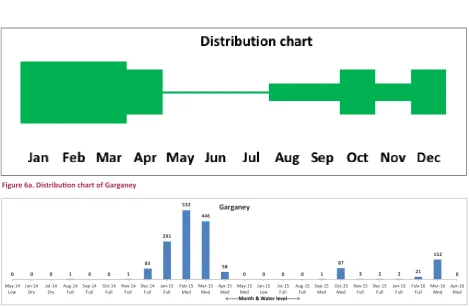
6. GarganeyAnas querquedula, according to our records for Perur Lake, is the most numerous winter migrant duck (Figs. 6a,b). It was recorded every month from December 2014 to April 2015, with peak sightings in February and March 2015, which were 532 and 436, respectively. Its sightings, however, dwindled during the winter months of 2015–2016 as only 21 and 152 individuals were recorded in February and March 2016, respectively. Note: Species 4, 5 & 6 that are winter migrant ducks were recorded in lesser numbers in 2015– 2016 when compared with similar months in 2014–2015. Only continued monitoring can possibly reveal the reasons behind these annual variations.
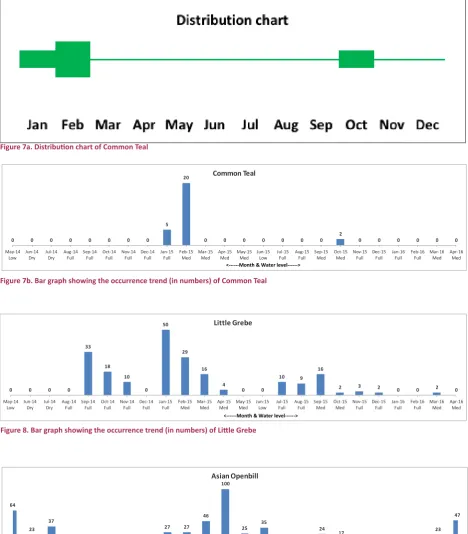
7. Common TealAnas crecca is a winter migrant species with erratic presence in the lake. The species was recorded in January and February 2015 and a pair was observed in October 2015 (Figs. 7a,b).
Podicipediformes: Podicipedidae
8. Little GrebeTachybaptus ruficollisis a resident
Table 1. Waterbirds of Perur Lake, Coimbatore, Tamil Nadu
Common name Scientific name Status Observed months
Anseriformes: Anatidae
1 Lesser Whistling-duck Dendrocygna javanica R/ LM YR except for Apr & Jun
2 Cotton Pygmy-goose Nettapus coromandelianus LM Nov–Jan
3 Indian Spot-billed Duck Anas poecilorhyncha R YR
4 Northern Shoveler A. clypeata WM Oct–Mar
5 Northern Pintail A. acuta WM Dec– Mar
6 Garganey A. querquedula WM Aug–Apr
7 Common Teal A. crecca WM Oct, Jan, Feb
Podicipediformes: Podicipedidae
8 Little Grebe Tachybaptus ruficollis R YR except for May, Jun
Ciconiiformes: Ciconiidae
9 Asian Openbill Anastomus oscitans LM YR
10 Woolly-necked Stork Ciconia episcopus V Mar, Apr
11 Painted Stork Mycteria leucocephala LM Feb–May, Jul, Sep–Dec
Suliformes: Phalacrocoracidae
12 Indian Cormorant Phalacrocorax fuscicollis R YR except for May, Jun
13 Great Cormorant P. carbo LM Dec, Jan
14 Little Cormorant P. niger R YR
Suliformes: Anhingidae
15 Oriental Darter Anhinga melanogaster R YR
Pelecaniformes: Pelecanidae
16 Spot-billed Pelican Pelecanus philippensis LM Jul, Sep, Oct
Pelecaniformes: Ardeidae
17 Yellow Bittern Ixobrychus sinensis LM Feb–Apr
18 Cinnamon Bittern I. cinnamomeus LM Feb, Apr
19 Grey Heron Ardea cinerea R YR
20 Purple Heron A. purpurea R YR
21 Great Egret Casmerodius albus LM YR
22 Intermediate Egret Mesophoyx intermedia LM YR
23 Little Egret Egretta garzetta LM YR
24 Western Reef-Heron E. gularis V O (Mar)
25 Cattle Egret Bubulcus ibis R YR
26 Indian Pond-Heron Ardeola grayii R YR
Common name Scientific name Status Observed months
27 Striated Heron Butorides striata R Mar, Apr, Jun–Aug
28 Black-crowned Night-Heron Nycticorax nycticorax R Feb–Apr, Jul–Sep, Nov
Pelecaniformes: Threskiornithidae
29 Glossy Ibis Plegadis falcinellus WM Sep–Mar
30 Black-headed Ibis Threskiornis melanocephalus LM Mar–May, Aug, Sep
31 Eurasian Spoonbill Platalea leucorodia LM O (Oct)
Gruiformes: Rallidae
32 White-breasted Waterhen Amaurornis phoenicurus R YR except for Jun
33 Grey-headed Swamphen Porphyrio porphyrio R YR
34 Common Moorhen Gallinula chloropus R YR except for Jun, Jul
35 Eurasian Coot Fulica atra R YR
Charadriiformes: Recurvirostridae
36 Black-winged Stilt Himantopus himantopus WM Feb–May, Nov
Charadriiformes: Charadriidae
37 Red-wattled Lapwing Vanellus indicus R YR
38 Little Ringed Plover Charadrius dubius WM/ R Feb–Jun, Sep, Oct
Charadriiformes: Jacanidae
39 Pheasant-tailed Jacana Hydrophasianus chirurgus LM Sep, Oct, Dec, Jan
40 Bronze-winged Jacana Metopidius indicus LM Aug, Jan
Charadriiformes: Scolopacidae
41 Common Sandpiper Actitis hypoleucos WM Aug–Apr
42 Green Sandpiper Tringa ochropus WM Nov, Jan–Apr
43 Common Greenshank T. nebularia WM Oct, Feb–Apr
44 Marsh Sandpiper T. stagnatilis WM Feb–Apr
45 Wood Sandpiper T. glareola WM Sep–Nov, Feb–Apr
46 Temminck's Stint Calidris temminckii WM Feb, Mar
47 Little Stint C. minuta WM Oct, Feb–Apr
Charadriiformes: Laridae
48 Whiskered Tern Chlidonias hybrid WM Sep, Jan–Mar
49 River Tern Sterna aurantia WM Nov, Jan
dependent and rarely leaves the water (Rasmussen & Anderton 2012). Accordingly, its highest counts were recorded during the months when the water level was high, such as 33 in September 2014, 50 and 29 in January and February 2015, respectively (Fig. 8). The breeding season of this species ranges principally between April and October (Ali 2002). This species could probably breed in this lake when water levels are medium to full, which occurs usually after the arrival of the southwestern monsoon. Its breeding status was confirmed in the lake when a flock with three chicks was observed in September 2014. This is evidence of post-breeding dispersal when they were recorded in low numbers from September onwards; however, only future observations can verify this behaviour.
Ciconiiformes: Ciconiidae
9. Asian Openbill Anastomus oscitans is a local migrant stork that breeds in southern India mostly from November to March (Ali 2002). This bird was consistently recorded in Perur Lake from May to July 2014 and again from January to June 2015, with a brief presence in September and October 2015 and then being sighted in sufficient numbers from March 2016 onwards. This pattern indicates that the breeding adults migrate out of the area during its breeding season, which could vary from September to March. High water levels with unexposed shoreline are a deterrent to its presence, as indicated
Table 2. Description of water level
Water level Description
Dry The absence of water in the lake or the presence of a negligible amount of wetness
Low The presence of a small amount of water in a few isolated puddles
Medium The presence of water in the whole lake with shoreline exposure in the periphery
Full Lake completely filled with water without any shoreline exposure
Table 3. Types of encroachments in Perur Lake (Pragatheesh & Jain 2013)
Type of
encroachment Authority Violation of wetland rules
Hutments Private Section 4(1)(vi) Hutments located in the land-filled areas.
Agriculture Private Section 4(2)(x)
Dumping of
waste Section 4(1)(iv)
Dumping debris and domestic solid waste along the bund.
Roads Section 4(1)(vi)
Kovai-Puthur bypass road on the eastern side on the lake & a metal road connecting SH-164 with Kovai-Puthur bypass road on the northern bund.
0 0 0 2 10 6 4 5 97
0 0 0 5 0 3 2 0 0 5 15 12 159
74
0
May-14
Low Jun-14Dry Jul-14Dry Aug-14Full Sep-14Full Oct-14Full Nov-14Full Dec-14Full Jan-15Full Feb-15Med Mar-15Med Apr-15Med May-15Med Jun-15Low Jul-15Full Aug-15Full Sep-15Med Oct-15Med Nov-15Full Dec-15Full Jan-16Full Feb-16Full Mar-16Med Apr-16Med
<---Month & Waterlevel--->
Lesser Whistling-duck
0 0 0 0 0 0
17 18
8
0 0 0 0 0 0 0 0 0 0 1 0 0 0 0
May-14
Low Jun-14Dry Jul-14Dry Aug-14Full Sep-14Full Oct-14Full Nov-14Full Dec-14Full Jan-15Full Feb-15Med Mar-15Med Apr-15Med May-15Med Jun-15Low Jul-15Full Aug-15Full Sep-15Med Oct-15Med Nov-15Full Dec-15Full Jan-16Full Feb-16Full Mar-16Med Apr-16Med
<---Month & Waterlevel--->
Cotton Pygmy-goose
Figure 1. Bar graph showing the occurrence trend (in numbers) of Lesser Whistling-duck
by the full water levels from August to December 2014 when very few individuals of the species were recorded. In contrast, in September and October 2015, when water levels were less than full with some shoreline exposure, 24 and 17 individuals of this species were recorded, respectively (Fig. 9). Exposed shoreline makes prey-finding possible for this species. Subsequently, when water levels became higher from November 2015 onwards, very few numbers of this species were sighted. This species, however, started to return during the winter months after the full water level receded to expose the shoreline and gradually increased in numbers as the lake dried out.
10. Woolly-necked Stork Ciconia episcopus is a
vagrantin Perur Lake and was sighted twice in our count
10 3 25 25 14 22 28 30 59
184
70 105
83
11 12 14 227
114
12 28 25 98
79 32
May-14
Low Jun-14Dry Jul-14Dry Aug-14Full Sep-14Full Oct-14Full Nov-14Full Dec-14Full Jan-15Full Feb-15Med Mar-15Med Apr-15Med May-15Med Jun-15Low Jul-15Full Aug-15Full Sep-15Med Oct-15Med Nov-15Full Dec-15Full Jan-16Full Feb-16Full Mar-16Med Apr-16Med
<---Month & Waterlevel--->
Indian Spot-billed Duck
0 0 0 0 0 2 0 113
140 131
99
0 0 0 0 0 0 3 0 0 0 9 0 0
May-14 Low
Jun-14 Dry
Jul-14 Dry
Aug-14 Full
Sep-14 Full
Oct-14 Full
Nov-14 Full
Dec-14 Full
Jan-15 Full
Feb-15 Med
Mar-15 Med
Apr-15 Med
May-15 Med
Jun-15 Low
Jul-15 Full
Aug-15 Full
Sep-15 Med
Oct-15 Med
Nov-15 Full
Dec-15 Full
Jan-16 Full
Feb-16 Full
Mar-16 Med
Apr-16 Med
<---Month & Waterlevel--->
Northern Shoveler
Figure 3. Bar graph showing the occurrence trend (in numbers) of Indian Spot-billed Duck
Figure 4a. Distribution chart of Northern Shoveler
Figure 4b. Bar graph showing the occurrence trend (in numbers) of Northern Shoveler
period when three and one individuals were recorded in March 2015 and April 2016, respectively. In addition, Sharang (2016) also reported a flock of 62 birds of this stork species on 29 March 2016 from this lake (Fig. 10). These observations, even though scanty in nature, probably indicate that this species might be using Perur Lake as a transit point during spring migration only. A small population of Woolly-necked Stork breeds in the neighbouring districts of Kerala (Sashikumar et al. 2011).
11. Painted Stork Mycteria leucocephala is
0 0 0 0 0 0 0 71
218 436
30
0 0 0 0 0 0 0 0 0 2 14 0 0
May-14 Low
Jun-14 Dry
Jul-14 Dry
Aug-14 Full
Sep-14 Full
Oct-14 Full
Nov-14 Full
Dec-14 Full
Jan-15 Full
Feb-15 Med
Mar-15 Med
Apr-15 Med
May-15 Med
Jun-15 Low
Jul-15 Full
Aug-15 Full
Sep-15 Med
Oct-15 Med
Nov-15 Full
Dec-15 Full
Jan-16 Full
Feb-16 Full
Mar-16 Med
Apr-16 Med
<---Month & Waterlevel--->
Northern Pintail
0 0 0 1 0 0 1 83
291 532
446
58
0 0 0 0 1 87
3 2 2 21 152
0
May-14
Low Jun-14Dry Jul-14Dry Aug-14Full Sep-14Full Oct-14Full Nov-14Full Dec-14Full Jan-15Full Feb-15Med Mar-15Med Apr-15Med May-15Med Jun-15Low Jul-15Full Aug-15Full Sep-15Med Oct-15Med Nov-15Full Dec-15Full Jan-16Full Feb-16Full Mar-16Med Apr-16Med
<---Month & Waterlevel--->
Garganey
Figure 5a. Distribution chart of Northern Pintail
Figure 5b. Bar graph showing the occurrence trend (in number) of Northern Pintail
Figure 6a. Distribution chart of Garganey
0 0 0 0 0 0 0 0 5
20
0 0 0 0 0 0 0 2 0 0 0 0 0 0
May-14
Low Jun-14Dry Jul-14Dry Aug-14Full Sep-14Full Oct-14Full Nov-14Full Dec-14Full Jan-15Full Feb-15Med Mar-15Med Apr-15Med May-15Med Jun-15Low Jul-15Full Aug-15Full Sep-15Med Oct-15Med Nov-15Full Dec-15Full Jan-16Full Feb-16Full Mar-16Med Apr-16Med
<---Month & Waterlevel--->
Common Teal
0 0 0 0 33
18 10
0 50
29 16
4
0 0
10 9 16
2 3 2 0 0 2 0
May-14
Low Jun-14Dry Jul-14Dry Aug-14Full Sep-14Full Oct-14Full Nov-14Full Dec-14Full Jan-15Full Feb-15Med Mar-15Med Apr-15Med May-15Med Jun-15Low Jul-15Full Aug-15Full Sep-15Med Oct-15Med Nov-15Full Dec-15Full Jan-16Full Feb-16Full Mar-16Med Apr-16Med
<---Month & Waterlevel--->
Little Grebe
64
23 37
3 0 0 1 1
27 27 46
100
25 35
0 0 24
17
1 1 2 6 23
47
May-14
Low Jun-14Dry Jul-14Dry Aug-14Full Sep-14Full Oct-14Full Nov-14Full Dec-14Full Jan-15Full Feb-15Med Mar-15Med Apr-15Med May-15Med Jun-15Low Jul-15Full Aug-15Full Sep-15Med Oct-15Med Nov-15Full Dec-15Full Jan-16Full Feb-16Full Mar-16Med Apr-16Med
<---Month & Waterlevel--->
Asian Openbill
Figure 7a. Distribution chart of Common Teal
Figure 7b. Bar graph showing the occurrence trend (in numbers) of Common Teal
Figure 8. Bar graph showing the occurrence trend (in numbers) of Little Grebe
highest counts were recorded in September and October 2015 and in April 2016 when 30, 34, and 35 individuals were sighted, respectively (Fig. 11), when the water level was between shallow and medium, which made prey-finding possible. In the study area, it was present mostly from September to May. This species is listed as Near Threatened due to its moderate population reduction owing to hunting, drainage, and pollution (Rahmani 2012).
Suliformes: Phalacrocoracidae
12. Indian Cormorant Phalacrocorax fuscicollis is a residentcormorant species and its presence is sparse in Perur Lake. This species was observed in all months of the year except during the summer months of May, June, and July 2014 and from March to June 2015. The highest number was recorded in February 2016 when 11 individuals of this species were sighted. Its absence in October 2014 even when the water level was full shows the erratic presence of this species in Perur Lake. This species probably breeds in the area in other water bodies.
13. Great Cormorant Phalacrocorax carbo is a local migrant cormorant species that was sighted twice during our count period, in December 2015 and January 2016. In both the occurrences, only a single bird was recorded (Fig. 13).
14. Little Cormorant Phalacrocorax niger is a
resident cormorant species that was recorded every month since the count began in March 2014. Its highest counts were recorded in the winter months of January and February 2015 when 252 and 203 individuals were sighted, respectively (Fig. 14). The population of this species drastically reduced when the water levels were low, especially during the summer months from April to July. This species could be a possible breeder in this lake when conditions are favourable. The breeding season of this bird in southern India chiefly lies between November and February (Ali 2002).
Suliformes: Anhingidae
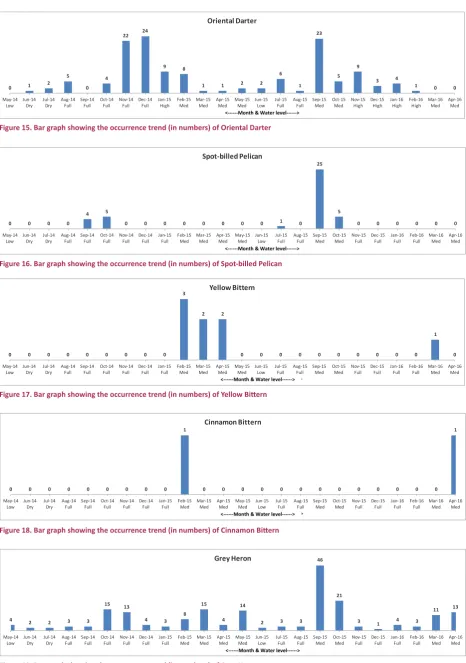
15. Oriental Darter Anhinga melanogaster is a resident species that was recorded year-round except in May & September 2014 and March & April 2016. Its highest counts were recorded in November and December 2014 and in September 2015 when 22, 24, and 23 individuals of this species were sighted, respectively. This species is listed as Near Threatened because of its moderate population reduction due to pollution, drainage, hunting, and collection of eggs and nestlings (Rahmani 2012).
Pelecaniformes: Pelecanidae
16. Spot-billed Pelican Pelecanus philippensis is
a local migrant species and its sighting in Perur Lake is sparse. This species was recorded in September and October of 2014 and 2015; a single member was recorded in July 2015. Its highest count was recorded in September 2015 when 25 numbers of this species were sighted. Notably, the presence of this species was observed in the lake when water levels were above medium. In 2001, Bird Life International listed this species as Vulnerable. Increased protection, however, enabled a recovery in numbers of this species and it was downlisted from Vulnerable to Near Threatened in 2007 (Rahmani 2012)
Pelecaniformes: Ardeidae
Bitterns, as a group, are uncommon in Perur Lake and their secretive nature resulted in infrequent sightings.
17. Yellow Bittern Ixobrychus sinensis &
18. Cinnamon Bittern Ixobrychus cinnamomeusare
the two species of local migrant (LM) bitterns recorded in Perur Lake. Yellow Bittern was recorded in February, March & April 2015 and March 2016 and their numbers were three, two, two, and one, respectively (Fig. 17). Cinnamon Bittern was recorded in February 2015 and April 2016; in both occurrences, a single bird was sighted (Fig. 18). These are possibly local migrants that are sparsely recorded in the lake during winter months.
19. Grey Heron Ardea cinerea is a residentspecies
that was recorded year-round in Perur Lake. Its highest counts were recorded in September and October 2015 when 46 and 21 individuals were sighted, respectively, when the water conditions were probably favourable. Their habitat preferences are brackish water, wetlands, reedbeds, and paddy fields (Rasmussen & Anderton 2012). Its breeding season in southern India ranges from November to March (Ali 2002). It is probable that in September and October this species might be using this lake as a transit point (Fig. 19).
20. Purple Heron Ardea purpurea is a resident
species that was recorded year-round except in May 2014 and July 2015. Its highest counts were recorded in April 2015 and February 2016 when nine and 11 individuals of this species were sighted, respectively. Its breeding season in India ranges from June to March depending on locality (Ali 2002), and in neighbouring Kerala, it reportedly breeds in July and August (Sashikumar et al. 2011).
0 0 0 0 0 0 0 0 0 0 3
0 0 0 0 0 0 0 0 0 0 0 0 1
May-14
Low Jun-14Dry Jul-14Dry Aug-14Full Sep-14Full Oct-14Full Nov-14Full Dec-14Full Jan-15Full Feb-15Med Mar-15Med Apr-15Med May-15Med Jun-15Low Jul-15Full Aug-15Full Sep-15Med Oct-15Med Nov-15Full Dec-15Full Jan-16Full Feb-16Full Mar-16Med Apr-16Med
<---Month & Waterlevel--->
Woolly-necked Stork
1 0 5
0 3 0 1 1 0
8 8 2
20
0 5
0 30
34
0 0 0 0 8
35
May-14
Low Jun-14Dry Jul-14Dry Aug-14Full Sep-14Full Oct-14Full Nov-14Full Dec-14Full Jan-15Full Feb-15Med Mar-15Med Apr-15Med May-15Med Jun-15Low Jul-15Full Aug-15Full Sep-15Med Oct-15Med Nov-15Full Dec-15Full Jan-16Full Feb-16Full Mar-16Med Apr-16Med
<---Month & Waterlevel--->
Painted Stork
0 0 0 3
6
0 6
1 8
1
0 0 0 0 3
7
3 1
5
1 3
11
1 3
May-14
Low Jun-14Dry Jul-14Dry Aug-14Full Sep-14Full Oct-14Full Nov-14Full Dec-14Full Jan-15Full Feb-15Med Mar-15Med Apr-15Med May-15Med Jun-15Low Jul-15Full Aug-15Full Sep-15Med Oct-15Med Nov-15Full Dec-15Full Jan-16Full Feb-16Full Mar-16Med Apr-16Med
<---Month & Waterlevel--->
Indian Cormorant
0 0 0 0 0 0 0 0 0 0 0 0 0 0 0 0 0 0 0
1 1
0 0 0
May-14
Low Jun-14Dry Jul-14Dry Aug-14Full Sep-14Full Oct-14Full Nov-14Full Dec-14Full Jan-15Full Feb-15Med Mar-15Med Apr-15Med May-15Med Jun-15Low Jul-15Full Aug-15Full Sep-15Med Oct-15Med Nov-15Full Dec-15Full Jan-16Full Feb-16Full Mar-16Med Apr-16Med
<---Month & Waterlevel--->
Great Cormorant
8 2 9 52
30 32 33 65
252 203
26
10 15 3 15 110
148
29 64
33 19 109
86 14
May-14
Low Jun-14Dry Jul-14Dry Aug-14Full Sep-14Full Oct-14Full Nov-14Full Dec-14Full Jan-15Full Feb-15Med Mar-15Med Apr-15Med May-15Med Jun-15Low Jul-15Full Aug-15Full Sep-15Med Oct-15Med Nov-15Full Dec-15Full Jan-16Full Feb-16Full Mar-16Med Apr-16Med
<---Month & Waterlevel--->
Little Cormorant
Figure 10. Bar graph showing the occurrence trend (in numbers) of Woolly-necked Stork
Figure 11. Bar graph showing the occurrence trend (in numbers) of Painted Stork
Figure 12. Bar graph showing the occurrence trend (in numbers) of Indian Cormorant
Figure 13. Bar graph showing the occurrence trend (in numbers) of Great Cormorant
0 1 2 5
0 4
22 24
9 8
1 1 2 2 6
1 23
5 9
3 4
1 0 0
May-14
Low Jun-14Dry Jul-14Dry Aug-14Full Sep-14Full Oct-14Full Nov-14Full Dec-14Full Jan-15High Feb-15Med Mar-15Med Apr-15Med May-15Med Jun-15Low Jul-15Full Aug-15Full Sep-15Med Oct-15Med Nov-15High Dec-15High Jan-16High Feb-16High Mar-16Med Apr-16Med
<---Month & Waterlevel--->
Oriental Darter
0 0 0 0
4 5
0 0 0 0 0 0 0 0 1 0 25
5
0 0 0 0 0 0
May-14
Low Jun-14Dry Jul-14Dry Aug-14Full Sep-14Full Oct-14Full Nov-14Full Dec-14Full Jan-15Full Feb-15Med Mar-15Med Apr-15Med May-15Med Jun-15Low Jul-15Full Aug-15Full Sep-15Med Oct-15Med Nov-15Full Dec-15Full Jan-16Full Feb-16Full Mar-16Med Apr-16Med
<---Month & Waterlevel--->
Spot-billed Pelican
0 0 0 0 0 0 0 0 0 3
2 2
0 0 0 0 0 0 0 0 0 0 1
0
May-14
Low Jun-14Dry Jul-14Dry Aug-14Full Sep-14Full Oct-14Full Nov-14Full Dec-14Full Jan-15Full Feb-15Med Mar-15Med Apr-15Med May-15Med Jun-15Low Jul-15Full Aug-15Full Sep-15Med Oct-15Med Nov-15Full Dec-15Full Jan-16Full Feb-16Full Mar-16Med Apr-16Med
<---Month & Waterlevel--->
Yellow Bittern
0 0 0 0 0 0 0 0 0 1
0 0 0 0 0 0 0 0 0 0 0 0 0 1
May-14
Low Jun-14Dry Jul-14Dry Aug-14Full Sep-14Full Oct-14Full Nov-14Full Dec-14Full Jan-15Full Feb-15Med Mar-15Med Apr-15Med May-15Med Jun-15Low Jul-15Full Aug-15Full Sep-15Med Oct-15Med Nov-15Full Dec-15Full Jan-16Full Feb-16Full Mar-16Med Apr-16Med
<---Month & Waterlevel--->
Cinnamon Bittern
4 2 2 3 3
15 13
4 3 8 15
4 14
2 3 3 46
21
3 1 4 3
11 13
May-14
Low Jun-14Dry Jul-14Dry Aug-14Full Sep-14Full Oct-14Full Nov-14Full Dec-14Full Jan-15Full Feb-15Med Mar-15Med Apr-15Med May-15Med Jun-15Low Jul-15Full Aug-15Full Sep-15Med Oct-15Med Nov-15Full Dec-15Full Jan-16Full Feb-16Full Mar-16Med Apr-16Med
<---Month & Waterlevel--->
Grey Heron
Figure 15. Bar graph showing the occurrence trend (in numbers) of Oriental Darter
Figure 16. Bar graph showing the occurrence trend (in numbers) of Spot-billed Pelican
Figure 17. Bar graph showing the occurrence trend (in numbers) of Yellow Bittern
Figure 18. Bar graph showing the occurrence trend (in numbers) of Cinnamon Bittern
numbers ranging from one to eight in this lake; however, the highest count was recorded in April 2016 when 31 individuals of this species were sighted (Fig. 21). This observation shows that this species might be using Perur Lake as a transit point during spring migration.
22. Intermediate Egret Mesophoyx intermedia is a local migrantspecies in the lake. It was recorded year-round in the lake, except for the dry months of May and June 2014 and the months from September to November 2014 when the water level was full. Its highest count was recorded in April 2016 and December 2015 when 24 and 17 individuals of the species were sighted, respectively.
23. Little Egret Egretta garzetta is another local
migrant species in the lake that was recorded year-round. The highest counts of this species were recorded in the spring migration period of March and April 2015 and April 2016 when 60, 116, and 215 individuals were sighted, respectively (Fig. 23).
Note: In analysing the numbers of the three white egret species, namely Great, Intermediate, and Little, it can be deduced that these species probably use Perur Lake as a transit point mostly during the months of March and April. This can be clearly seen in the respective figures (Figs. 21, 22 & 23) when their numbers are at the highest levels.
24. Western Reef-Heron Egretta gularis is a vagrant
species in the area. This bird was recorded once in Perur Lake when a sole bird was sighted in March 2015 (Fig. 24).
25. Cattle EgretBubulcus ibis is a resident species
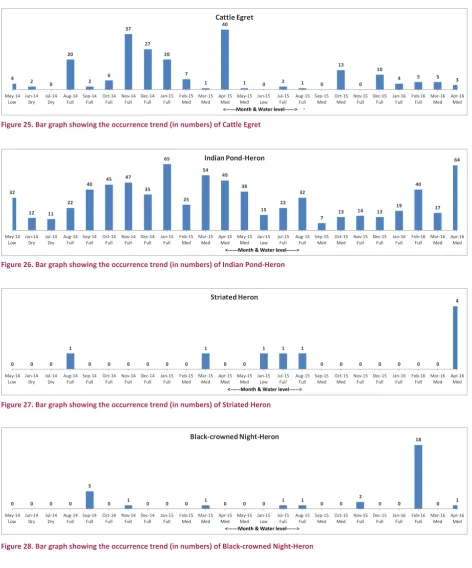
that was recorded year-round in the lake. The highest counts of this species were recorded in November 2014 and April 2015 when 37 and 40 individuals of this species were sighted, respectively (Fig. 25). Birds with breeding plumage were observed during its breeding months of November to March; however, no nests were recorded in the vicinity of the lake. It builds untidy stick nests in mixed colonies with Cormorants and Pond Herons, often in the vicinity of little villages (Ali 2002).
26. Indian Pond Heron Ardeola grayii is a resident
that was recorded year-round in the lake. Its highest counts were recorded in January 2015 and April 2016 when 65 and 64 of this species were sighted, respectively (Fig. 26). According to Ali (2002), its breeding season in southern India is from November to January and its nesting behaviour is similar to that of Cattle Egret. We, however, sighted some birds of this species displaying its breeding plumage in April and May 2015 though no nests were recorded in the vicinity of the lake. Its presence is higher in winter and also during spring migration, indicating that some of them might be using this lake as
a transit point.
27. Striated Heron Butorides striata is a resident
species in our area that was recorded in the months of August 2014, March 2015, June to August 2015, and April 2016. The highest count of this species was recorded in April 2016, when four birds were sighted. Even though a resident breeder, it was unrecorded for many months during our count (Fig. 27), due to its secretive and crepuscular behaviour. Occasionally, however, it may be also active during the daytime, particularly in cloudy overcast weather. Its breeding season is from March to August with local variations (Ali 2002). In April 2016, a single bird in breeding plumage was observed in this lake.
28. Black-crowned Night-Heron Nycticorax
nycticorax is a residentspecies and its presence is sparse in Perur Lake. Its highest count was recorded in February 2016 when 18 individuals of this species were sighted flying overhead (Fig. 28). Most of them were immature or juvenile birds, indicating its possible breeding in the area. This species, however, is largely unrecorded during our counting sessions due to its nocturnal and crepuscular nature similar to that of the Striated Heron. According to (Ali 2002), this species breeds from December to February in southern India.
Pelecaniformes: Threskiornithidae
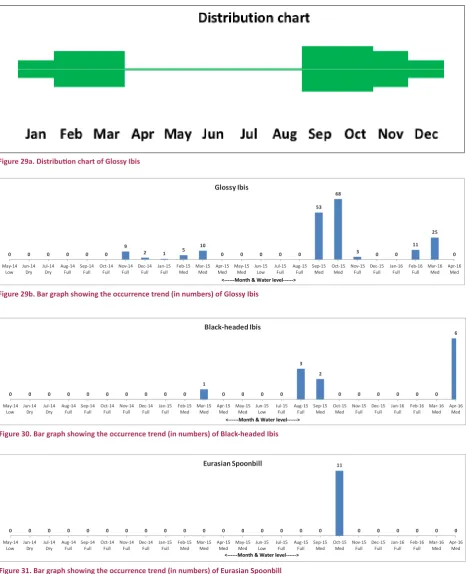
29. Glossy Ibis Plegadis falcinellus is a winter migrant species that was recorded in the lake during the winter months from September to March. The highest counts were recorded in September and October of 2015 when 53 and 68 of this species were sighted, respectively. During September and October of 2014, however, this species was not recorded in the lake. A plausible explanation can be arrived at by analysing its sight recordings in conjunction with the water level variations. When water levels were shallow with shoreline exposure that facilitated prey-finding, this species was recorded in large numbers as was the case in September and October 2015. When water levels were full in September and October of 2014, however, they were absent. This fact can be clearly seen in Fig. 29b where the water level was medium and its numbers were higher.
30. Black-headed Ibis Threskiornis melanocephalus
0 1 1 3
5
2 3
5 6 6 6 9
4 1
0
4 4
1 1 1 5
11
7 5
May-14
Low Jun-14Dry Jul-14Dry Aug-14Full Sep-14Full Oct-14Full Nov-14Full Dec-14Full Jan-15Full Feb-15Med Mar-15Med Apr-15Med May-15Med Jun-15Low Jul-15Full Aug-15Full Sep-15Med Oct-15Med Nov-15Full Dec-15Full Jan-16Full Feb-16Full Mar-16Med Apr-16Med
<---Month & Waterlevel--->
Purple Heron
1 1 2 0 0 0 3
5 4 4
3 4 4
1 0 3 2 6
1 0 2 8
6 31
May-14
Low Jun-14Dry Jul-14Dry Aug-14Full Sep-14Full Oct-14Full Nov-14Full Dec-14Full Jan-15Full Feb-15Med Mar-15Med Apr-15Med May-15Med Jun-15Low Jul-15Full Aug-15Full Sep-15Med Oct-15Med Nov-15Full Dec-15Full Jan-16Full Feb-16Full Mar-16Med Apr-16Med
<---Month & Waterlevel--->
Great Egret
0 0 1 4
0 0 0 3
12
6 5 8
4 3 7 2 13 7 3 17 8 11 10 24 May-14
Low Jun-14Dry Jul-14Dry Aug-14Full Sep-14Full Oct-14Full Nov-14Full Dec-14Full Jan-15Full Feb-15Med Mar-15Med Apr-15Med May-15Med Jun-15Low Jul-15Full Aug-15Full Sep-15Med Oct-15Med Nov-15Full Dec-15Full Jan-16Full Feb-16Full Mar-16Med Apr-16Med
<---Month & Waterlevel--->
Intermediate Egret
17 11 8 7 3 7 7 1 6 5 60
116
15 12 2 10 23 22 5 2 5 11 21 215
May-14
Low Jun-14Dry Jul-14Dry Aug-14Full Sep-14Full Oct-14Full Nov-14Full Dec-14Full Jan-15Full Feb-15Med Mar-15Med Apr-15Med May-15Med Jun-15Low Jul-15Full Aug-15Full Sep-15Med Oct-15Med Nov-15Full Dec-15Full Jan-16Full Feb-16Full Mar-16Med Apr-16Med
<---Month & Waterlevel--->
Little Egret
0 0 0 0 0 0 0 0 0 0 1
0 0 0 0 0 0 0 0 0 0 0 0 0
May-14 Low Jun-14 Dry Jul-14 Dry Aug-14 Full Sep-14 Full Oct-14 Full Nov-14 Full Dec-14 Full Jan-15 Full Feb-15 Med Mar-15 Med Apr-15 Med May-15 Med Jun-15 Low Jul-15 Full Aug-15 Full Sep-15 Med Oct-15 Med Nov-15 Full Dec-15 Full Jan-16 Full Feb-16 Full Mar-16 Med Apr-16 Med
<---Month & Waterlevel--->
Western Reef-Heron
Figure 20. Bar graph showing the occurrence trend (in numbers) of Purple Heron
Figure 21. Bar graph showing the occurrence trend (in numbers) of Great Egret
Figure 22. Bar graph showing the occurrence trend (in numbers) of Intermediate Egret
Figure 23. Bar graph showing the occurrence trend (in numbers) of Little Egret
of water. Since its population reduction in Asia due to an entire gamut of threats from hunting, disturbances at the breeding colonies to drainage, and conversion of foraging habitats to agriculture lands, it is listed as Near Threatened.
31. Eurasian Spoonbill Platalea leucorodia is a local migrant species that was recorded only once in October 2015 when 11 individuals of the species were sighted. It is not possible to conduct an analysis based on this single observation.
Gruiformes: Rallidae
32. White-breasted Waterhen Amaurornis
phoenicurus is a resident species that was recorded year-round except during the drier months in the lake from May to July. Its highest count was recorded in February 2015 when six individuals of this species were sighted (Fig. 32). Its breeding season is from June to October or during southwestern monsoon (Ali 2002).
33. Grey-headed Swamphen Porphyrio porphyrio is
a residentspecies that was recorded year-round in Perur Lake. The highest counts of this species were recorded in February and March of 2015 and 2016 when 48, 25, 44, and 74 individuals were sighted, respectively. In addition, in April 2016, 27 birds were sighted, possibly indicating its larger counts during spring migration. In the lake, this species is mostly recorded when water is present and its highest counts are recorded when the water levels vary between low and medium. Its breeding season is during the monsoon months of June to September (Ali 2002). During the March 2016 count, however, when the highest number of this species was recorded, three chicks were sighted accompanying an adult indicating its possible breeding status.
34. Common Moorhen Gallinula chloropus is a residentspecies that was recorded year-round, except in June and July in the lake. Its breeding season is from June to September or during the southwestern monsoon (Ali 2002). The highest counts were recorded in January and April of 2015 when 25 and 30 individuals of this species were sighted, respectively.
35. Eurasian Coot Fulica atra is a resident species that was recorded year-round in the lake except for the months of July 2014, June 2015, and April 2016. From August 2014 to February 2015, the range of variation of this species sighted was from 68 to 584, when the highest counts occurred between September and October 2014 and also during the winter months of January and February 2015. The plausible reasons behind such an occurrence could be the fact that the combination of local migrant birds, as well as locally breeding birds, could have
been sighted simultaneously, especially in September and October 2014 when the counts were 575 and 584, respectively. It is worth noting that during this period, the water levels were favourable for breeding, which ranged from medium to full. During a similar period in 2015-2016, however, its numbers were significantly reduced due to unfavourable water levels. Even though Ali (2002) states that Eurasian Coots breed during the monsoonal months of July and August, according to Rasmussen & Anderton (2012), this species could possibly breed in southern India up to November. A juvenile bird and a nest of grassy vegetation were recorded during our November 2014 count. Additionally, a single chick was observed in March 2016. These observations confirm its breeding status in the lake when conditions are favourable.
Charadriiformes: Recurvirostridae
36. Black-winged Stilt Himantopus himantopus is
a winter migrant species that was recorded in the lake in a sporadic manner when water levels were less than full with adequate shallow water and shoreline exposure. The highest counts were recorded in March 2015 and 2016 when 26 and 56 of this species were sighted, respectively. During these months, water levels were medium and facilitated prey–finding. Its long stilt-like legs, when compared with other waders, enable it to find prey by walking further in the water (Ali 2002).
Charadriiformes: Charadriidae
37. Red-wattled Lapwing Vanellus indicus is a
resident species that was recorded year-round, except in May and June 2014 when the water level was very low and January of 2015 and 2016 when the water level was high. Its highest count was recorded in September and October of 2015 when 15 and 16 individuals were sighted, respectively. Its breeding season is chiefly from March to August (Ali 2002). A juvenile of this species was observed in July 2015
38. Little Ringed PloverCharadrius dubius has two
4 2 0 20 2 6 37 27 20 7 1 40
1 0 2 1 0 13
0 10
4 5 5 3
May-14 Low Jun-14 Dry Jul-14 Dry Aug-14 Full Sep-14 Full Oct-14 Full Nov-14 Full Dec-14 Full Jan-15 Full Feb-15 Med Mar-15 Med Apr-15 Med May-15 Med Jun-15 Low Jul-15 Full Aug-15 Full Sep-15 Med Oct-15 Med Nov-15 Full Dec-15 Full Jan-16 Full Feb-16 Full Mar-16 Med Apr-16 Med
<---Month & Waterlevel--->
Cattle Egret 32 12 11 22 40 45 47 35 65 25 54 49 38 15 22 32 7 13
14 13 19 40
17 64
May-14
Low Jun-14Dry Jul-14Dry Aug-14Full Sep-14Full Oct-14Full Nov-14Full Dec-14Full Jan-15Full Feb-15Med Mar-15Med Apr-15Med May-15Med Jun-15Low Jul-15Full Aug-15Full Sep-15Med Oct-15Med Nov-15Full Dec-15Full Jan-16Full Feb-16Full Mar-16Med Apr-16Med
<---Month & Waterlevel--->
Indian Pond-Heron
0 0 0 1
0 0 0 0 0 0 1
0 0
1 1 1
0 0 0 0 0 0 0 4
May-14
Low Jun-14Dry Jul-14Dry Aug-14Full Sep-14Full Oct-14Full Nov-14Full Dec-14Full Jan-15Full Feb-15Med Mar-15Med Apr-15Med May-15Med Jun-15Low Jul-15Full Aug-15Full Sep-15Med Oct-15Med Nov-15Full Dec-15Full Jan-16Full Feb-16Full Mar-16Med Apr-16Med
<---Month & Waterlevel--->
Striated Heron
0 0 0 0 5
0 1 0 0 0 1 0 0 0 1 1 0 0 2
0 0 18
0 1
May-14
Low Jun-14Dry Jul-14Dry Aug-14Full Sep-14Full Oct-14Full Nov-14Full Dec-14Full Jan-15Full Feb-15Med Mar-15Med Apr-15Med May-15Med Jun-15Low Jul-15Full Aug-15Full Sep-15Med Oct-15Med Nov-15Full Dec-15Full Jan-16Full Feb-16Full Mar-16Med Apr-16Med
<---Month & Waterlevel--->
Black-crowned Night-Heron
Figure 25. Bar graph showing the occurrence trend (in numbers) of Cattle Egret
Figure 26. Bar graph showing the occurrence trend (in numbers) of Indian Pond-Heron
Figure 27. Bar graph showing the occurrence trend (in numbers) of Striated Heron
Figure 28. Bar graph showing the occurrence trend (in numbers) of Black-crowned Night-Heron
the resident subspecies C.d. jerdoni could be a possible breeder in this lake. In May and June 2015, three and one individuals of this subspecies were recorded, respectively. Due to changing water levels, however, its nesting could not be confirmed.
Charadriiformes: Jacanidae
39. Pheasant-tailed Jacana Hydrophasianus
inexplicable anomaly. It is not been recorded in the lake since then.
40. Bronze-winged Jacana Metopidius indicus is a
local migrant species that is infrequently recorded in the lake, similar to Pheasant-tailed Jacana. A single individual
of this species was sighted in January and August 2015.
Charadriiformes: Scolopacidae
41. Common Sandpiper Actitis hypoleucos is a winter migrant species that was recorded from August to
0 0 0 0 0 0 9
2 1 5 10
0 0 0 0 0 53
68
3 0 0 11
25 0
May-14
Low Jun-14Dry Jul-14Dry Aug-14Full Sep-14Full Oct-14Full Nov-14Full Dec-14Full Jan-15Full Feb-15Med Mar-15Med Apr-15Med May-15Med Jun-15Low Jul-15Full Aug-15Full Sep-15Med Oct-15Med Nov-15Full Dec-15Full Jan-16Full Feb-16Full Mar-16Med Apr-16Med
<---Month & Waterlevel--->
Glossy Ibis
0 0 0 0 0 0 0 0 0 0 1
0 0 0 0 3
2
0 0 0 0 0 0 6
May-14
Low Jun-14Dry Jul-14Dry Aug-14Full Sep-14Full Oct-14Full Nov-14Full Dec-14Full Jan-15Full Feb-15Med Mar-15Med Apr-15Med May-15Med Jun-15Low Jul-15Full Aug-15Full Sep-15Med Oct-15Med Nov-15Full Dec-15Full Jan-16Full Feb-16Full Mar-16Med Apr-16Med
<---Month & Waterlevel--->
Black-headed Ibis
0 0 0 0 0 0 0 0 0 0 0 0 0 0 0 0 0 11
0 0 0 0 0 0
May-14
Low Jun-14Dry Jul-14Dry Aug-14Full Sep-14Full Oct-14Full Nov-14Full Dec-14Full Jan-15Full Feb-15Med Mar-15Med Apr-15Med May-15Med Jun-15Low Jul-15Full Aug-15Full Sep-15Med Oct-15Med Nov-15Full Dec-15Full Jan-16Full Feb-16Full Mar-16Med Apr-16Med
<---Month & Waterlevel--->
Eurasian Spoonbill
Figure 29a. Distribution chart of Glossy Ibis
Figure 29b. Bar graph showing the occurrence trend (in numbers) of Glossy Ibis
Figure 30. Bar graph showing the occurrence trend (in numbers) of Black-headed Ibis
Figure 34. Bar graph showing the occurrence trend (in numbers) of Common Moorhen Figure 33. Bar graph showing the occurrence trend (in numbers) of Gray-headed Swamphen Figure 32. Bar graph showing the occurrence trend (in numbers) of White-breasted Waterhen
3 0 0 2 1 1 3 3 4 6 0 2 3 0 2 0 1 2 1 2 1 0 3 1 May-14 Low Jun-14 Dry Jul-14 Dry Aug-14 Full Sep-14 Full Oct-14 Full Nov-14 Full Dec-14 Full Jan-15 Full Feb-15 Med Mar-15 Med Apr-15 Med May-15 Med Jun-15 Low Jul-15 Full Aug-15 Full Sep-15 Med Oct-15 Med Nov-15 Full Dec-15 Full Jan-16 Full Feb-16 Full Mar-16 Med Apr-16 Med
<---Month & Waterlevel--->
White-breasted Waterhen
0 0 0 1 7
15 15 17 19 48
25 2
15
2 5 1 36
13
2 3 6 44
74
27
May-14
Low Jun-14Dry Jul-14Dry Aug-14Full Sep-14Full Oct-14Full Nov-14Full Dec-14Full Jan-15Full Feb-15Med Mar-15Med Apr-15Med May-15Med Jun-15Low Jul-15Full Aug-15Full Sep-15Med Oct-15Med Nov-15Full Dec-15Full Jan-16Full Feb-16Full Mar-16Med Apr-16Med
<---Month & Waterlevel--->
Gray-headed Swamphen
0 0 0 3 0 2 5 11 25 8 14 30 10
0 0 0 8
0 0 0 0 1 4 9 May-14 Low Jun-14 Dry Jul-14 Dry Aug-14 Full Sep-14 Full Oct-14 Full Nov-14 Full Dec-14 Full Jan-15 Full Feb-15 Med Mar-15 Med Apr-15 Med May-15 Med Jun-15 Low Jul-15 Full Aug-15 Full Sep-15 Med Oct-15 Med Nov-15 Full Dec-15 Full Jan-16 Full Feb-16 Full Mar-16 Med Apr-16 Med
<---Month & Waterlevel--->
Common Moorhen
2 3 0 105
575 584
125 180
241 261 68
4 9 0 42
81 46
5 22 15 35 12 16 0
May-14
Low Jun-14Dry Jul-14Dry Aug-14Full Sep-14Full Oct-14Full Nov-14Full Dec-14Full Jan-15Full Feb-15Med Mar-15Med Apr-15Med May-15Med Jun-15Low Jul-15Full Aug-15Full Sep-15Med Oct-15Med Nov-15Full Dec-15Full Jan-16Full Feb-16Full Mar-16Med Apr-16Med
<---Month & Waterlevel--->
Eurasian Coot
0 0 0 0 0 0 2 0 0 6 26
7
2 0 0 0 0 0 0 0 0 4 56 0 May-14 Low Jun-14 Dry Jul-14 Dry Aug-14 Full Sep-14 Full Oct-14 Full Nov-14 Full Dec-14 Full Jan-15 Full Feb-15 Med Mar-15 Med Apr-15 Med May-15 Med Jun-15 Low Jul-15 Full Aug-15 Full Sep-15 Med Oct-15 Med Nov-15 Full Dec-15 Full Jan-16 Full Feb-16 Full Mar-16 Med Apr-16 Med
<---Month & Waterlevel--->
Black-winged Stilt
Figure 35. Bar graph showing the occurrence trend (in number) of Eurasian Coot
0 0 1 2 3 7 8 1 0 7 3 1 3 1 8 7 15 16 2 2 0 13 5 13 May-14
Low Jun-14Dry Jul-14Dry Aug-14Full Sep-14Full Oct-14Full Nov-14Full Dec-14Full Jan-15Full Feb-15Med Mar-15Med Apr-15Med May-15Med Jun-15Low Jul-15Full Aug-15Full Sep-15Med Oct-15Med Nov-15Full Dec-15Full Jan-16Full Feb-16Full Mar-16Med Apr-16Med
<---Month & Waterlevel--->
Red-wattled Lapwing
0 0 0 0 0 0 0 0 0 12
84
14
3 1 0 0 5 22
0 0 0 8 39
6
May-14
Low Jun-14Dry Jul-14Dry Aug-14Full Sep-14Full Oct-14Full Nov-14Full Dec-14Full Jan-15Full Feb-15Med Mar-15Med Apr-15Med May-15Med Jun-15Low Jul-15Full Aug-15Full Sep-15Med Oct-15Med Nov-15Full Dec-15Full Jan-16Full Feb-16Full Mar-16Med Apr-16Med
<---Month & Waterlevel--->
Little Ringed Plover
0 0 0 0 1 1 0 2
17
0 0 0 0 0 0 0 0 0 0 0 0 0 0 0
May-14
Low Jun-14Dry Jul-14Dry Aug-14Full Sep-14Full Oct-14Full Nov-14Full Dec-14Full Jan-15Full Feb-15Med Mar-15Med Apr-15Med May-15Med Jun-15Low Jul-15Full Aug-15Full Sep-15Med Oct-15Med Nov-15Full Dec-15Full Jan-16Full Feb-16Full Mar-16Med Apr-16Med
<---Month & Waterlevel--->
Pheasant-tailed Jacana
0 0 0 0 0 0 0 0 1
0 0 0 0 0 0 1
0 0 0 0 0 0 0 0
May-14 Low Jun-14 Dry Jul-14 Dry Aug-14 Full Sep-14 Full Oct-14 Full Nov-14 Full Dec-14 Full Jan-15 Full Feb-15 Med Mar-15 Med Apr-15 Med May-15 Med Jun-15 Low Jul-15 Full Aug-15 Full Sep-15 Med Oct-15 Med Nov-15 Full Dec-15 Full Jan-16 Full Feb-16 Full Mar-16 Med Apr-16 Med
<---Month & Waterlevel--->
Bronze-winged Jacana
Figure 37. Bar graph showing the occurrence trend (in numbers) of Red-wattled Lapwing
Figure 38. Bar graph showing the occurrence trend (in numbers) of Little Ringed Plover
Figure 39. Bar graph showing the occurrence trend (in numbers) of Pheasant-tailed Jacana
Figure 40. Bar graph showing the occurrence trend (in numbers) of Bronze-winged Jacana
April. Its highest count was recorded in March 2015 when 21 individuals of this species were sighted. According to Ali (2002), it is one of the earliest wader migrants to arrive (August) and also one of the last to leave (May). The sightings of this species in this lake match this statement to a large extent.
42. Green Sandpiper Tringa ochropus is a winter migrant species that was recorded during the period of
January to March of 2015 and 2016 and additionally in November 2014 and April 2016. The highest counts were five and six recorded in February 2015 and March 2016, respectively, during the spring migration season.
0 0 0 1 1 0 4
1 1 8
21
5
0 0 0 2 14
2 4
0 1 6
11 12
May-14
Low Jun-14Dry Jul-14Dry Aug-14Full Sep-14Full Oct-14Full Nov-14Full Dec-14Full Jan-15Full Feb-15Med Mar-15Med Apr-15Med May-15Med Jun-15Low Jul-15Full Aug-15Full Sep-15Med Oct-15Med Nov-15Full Dec-15Full Jan-16Full Feb-16Full Mar-16Med Apr-16Med
<---Month & Waterlevel--->
Common Sandpiper
0 0 0 0 0 0 1
0 3
5 4
0 0 0 0 0 0 0 0 0 2
4 6
1
May-14
Low Jun-14Dry Jul-14Dry Aug-14Full Sep-14Full Oct-14Full Nov-14Full Dec-14Full Jan-15Full Feb-15Med Mar-15Med Apr-15Med May-15Med Jun-15Low Jul-15Full Aug-15Full Sep-15Med Oct-15Med Nov-15Full Dec-15Full Jan-16Full Feb-16Full Mar-16Med Apr-16Med
<---Month & Waterlevel--->
Green Sandpiper
Figure 41a. Distribution chart of Common Sandpiper
Figure 41b. Bar graph showing the occurrence trend (in numbers) of Common Sandpiper
Figure 42a. Distribution chart of Green Sandpiper
0 0 0 0 0 0 0 0 0 7
6 7
0 0 0 0 0 3
0 0 0 0 1 14
May-14
Low Jun-14Dry Jul-14Dry Aug-14Full Sep-14Full Oct-14Full Nov-14Full Dec-14Full Jan-15Full Feb-15Med Mar-15Med Apr-15Med May-15Med Jun-15Low Jul-15Full Aug-15Full Sep-15Med Oct-15Med Nov-15Full Dec-15Full Jan-16Full Feb-16Full Mar-16Med Apr-16Med
<---Month & Waterlevel--->
Common Greenshank
0 0 0 0 0 0 0 0 0
3 3
0 0 0 0 0 0 0 0 0 0 0 3
0
May-14 Low
Jun-14 Dry
Jul-14 Dry
Aug-14 Full
Sep-14 Full
Oct-14 Full
Nov-14 Full
Dec-14 Full
Jan-15 Full
Feb-15 Med
Mar-15 Med
Apr-15 Med
May-15 Med
Jun-15 Low
Jul-15 Full
Aug-15 Full
Sep-15 Med
Oct-15 Med
Nov-15 Full
Dec-15 Full
Jan-16 Full
Feb-16 Full
Mar-16 Med
Apr-16 Med
<---Month & Waterlevel--->
Marsh Sandpiper
Figure 43a. Distribution chart of Common Greenshank
Figure 43b. Bar graph showing the occurrence trend (in numbers) of Common Greenshank
Figure 44a. Distribution chart of Marsh Sandpiper
0 0 0 0 0 0 3 0 0 15
62
21
0 0 0 0 8 86
0 0 0 22
100
44
May-14
Low Jun-14Dry Jul-14Dry Aug-14Full Sep-14Full Oct-14Full Nov-14Full Dec-14Full Jan-15Full Feb-15Med Mar-15Med Apr-15Med May-15Med Jun-15Low Jul-15Full Aug-15Full Sep-15Med Oct-15Med Nov-15Full Dec-15Full Jan-16Full Feb-16Full Mar-16Med Apr-16Med
<---Month & Waterlevel--->
Wood Sandpiper
0 0 0 0 0 0 0 0 0 4
8
0 0 0 0 0 0 0 0 0 0 0 0 0
May-14
Low Jun-14Dry Jul-14Dry Aug-14Full Sep-14Full Oct-14Full Nov-14Full Dec-14Full Jan-15Full Feb-15Med Mar-15Med Apr-15Med May-15Med Jun-15Low Jul-15Full Aug-15Full Sep-15Med Oct-15Med Nov-15Full Dec-15Full Jan-16Full Feb-16Full Mar-16Med Apr-16Med
<---Month & Waterlevel--->
Temminck's Stint
Figure 45a. Distribution chart of Wood Sandpiper
Figure 45b. Bar graph showing the occurrence trend (in numbers) of Wood Sandpiper
Figure 46a. Distribution chart of Temminck’s Stint
0 0 0 0 0 0 0 0 0 4 49
0 0 0 0 0 0 2 0 0 0 0 22
0
May-14
Low Jun-14Dry Jul-14Dry Aug-14Full Sep-14Full Oct-14Full Nov-14Full Dec-14Full Jan-15Full Feb-15Med Mar-15Med Apr-15Med May-15Med Jun-15Low Jul-15Full Aug-15Full Sep-15Med Oct-15Med Nov-15Full Dec-15Full Jan-16Full Feb-16Full Mar-16Med Apr-16Med
<---Month & Waterlevel--->
Little Stint
0 0 0 0 40
0 0 0 6
2 1 0 0 0 0 0 0 0 0 0 38
0 0 0
May-14 Low
Jun-14 Dry
Jul-14 Dry
Aug-14 Full
Sep-14 Full
Oct-14 Full
Nov-14 Full
Dec-14 Full
Jan-15 Full
Feb-15 Med
Mar-15 Med
Apr-15 Med
May-15 Med
Jun-15 Low
Jul-15 Full
Aug-15 Full
Sep-15 Med
Oct-15 Med
Nov-15 Full
Dec-15 Full
Jan-16 Full
Feb-16 Full
Mar-16 Med
Apr-16 Med
<---Month & Waterlevel--->
Whiskered Tern
Figure 47a. Distribution chart of Little Stint
Figure 47b. Bar graph showing the occurrence trend (in numbers) of Little Stint
Figure 48a. Distribution chart of Whiskered Tern