Şakir Özgür Keşkek
A–F, Sinan Kırım
E, F, Ramazan Kaya
B, C, F,
Abdullah Canataroğlu
E, FThe Effects of Thyroid Dysfunctions on Insulin
Resistance in Patients with Hepatosteatosis
Department of Internal Medicine, Numune Training and Research Hospital, Adana, Turkey
A – research concept and design; B – collection and/or assembly of data; C – data analysis and interpretation; D – writing the article; E – critical revision of the article; F – final approval of article; G – other
Abstract
Background. Hepatosteatosis can develop due to insulin resistance. The effect of thyroid function status on insulin sensitivity and resistance is of great interest but the data is still conflicting.
Objectives. The aim of this study was to evaluate the effects of thyroid dysfunctions on insulin resistance in patients with hepatosteatosis.
Material and Methods. A total of 407 patients with hepatosteatosis were divided into three groups: 102 subjects with hypothyroidism, 103 with hyperthyroidism and 202 with normal thyroid function (control group). We mea-sured serum thyroid stimulating hormone (TSH), free T4 (FT4) and free T3 (FT3) concentrations, blood glucose and insulin levels, serum lipid levels, hepatic transaminases and the homeostasis model assessment of insulin resis-tance (HOMA IR).
Results. Neither hypothyroidism patients nor hyperthyroidism patients showed significant differences in HOMA IR, glucose and insulin levels (p> 0.05 for each). The frequency of insulin resistance was similar in all groups (p> 0.05).
Conclusions. Based on our findings, hypothyroidism and hyperthyroidism are not correlated to insulin resistance in patients with hepatosteatosis. Different causes which are associated with insulin resistance should be investi-gated in patients with thyroid dysfunction and hepatosteatosis (Adv Clin Exp Med 2014, 23, 6, 913–918). Key words: insulin resistance, hepatosteatosis, hypothyroidism, hyperthyroidism.
Adv Clin Exp Med 2014, 23, 6, 913–918 ISSN 1899–5276
ORIGINAL PAPERS
© Copyright by Wroclaw Medical University
Insulin resistance has a key role in the develop-ment of hepatic steatosis and, potentially, steato-hepatitis [1]. Strong epidemiological, biochemi-cal, and therapeutic evidence supports the premise that the primary pathophysiological derangement in most patients with hepatosteatosis is insulin re-sistance [2]. Increases in visceral adipose tissue and intrahepatic fat correlate with increased glu-coneogenesis, increased free fatty acid levels, and insulin resistance [3].
Carbohydrate metabolism disorders have been found to be associated with thyroid dysfunctions and, therefore, thyroid disease prevalence in patients with diabetes is significantly higher than in the gen-eral population [4, 5]. This indicates a possible inter-play between thyroid status and insulin resistance.
In hyperthyroidism, decreased, normal, or even
increased levels of plasma insulin have been report-ed [6]. However, the increasreport-ed degradation of insu-lin in hyperthyroid subjects was a consistent finding [6, 7]. In thyrotoxicosis, glucose absorption from the gastrointestinal tract increases due to the higher rate of stomach emptying and increased blood flow of the portal vein. It has been also postulated that se-vere thyrotoxicosis can lead, in the long run, to irre-versible pancreatic damage [8].
There are many studies which have investi-gated the association between thyroid dysfunc-tions and insulin resistance. The results of these studies are inconsistent and furthermore, hepat-osteatosis, which is strongly associated with insu-lin resistance, was not investigated in these stud-ies [6, 12–15].
In the present study, we aimed to evaluate the effects of thyroid dysfunctions on insulin resis-tance in patients with hepatosteatosis.
Material and Methods
The study was arranged in an internal med-icine department of a tertiary hospital from Sep-tember 2011 to June 2012. A total of 407 patients with hepatosteatosis were included and separat-ed into three groups. One of the study groups was comprised of 102 patients with hypothyroidism and the other one was comprised of 103 patients with hyperthyroidism. The control group includ-ed 202 patients with normal thyroid function. The institution review board of the hospital approved the study and informed consent was obtained from all the study participants. The study was conduct-ed in accordance with the Declaration of Helsin-ki. Inclusion criteria were age of 18–65 years, new-ly diagnosed and untreated patients with thyroid dysfunction and hepatosteatosis. Patients with di-abetes, hypertension, obesity, dyslipidemia, ath-erosclerosis, polycystic ovarian disease, liver dis-orders, renal disdis-orders, congestive cardiac failure, other systemic illnesses, pregnancy, malignancies, alcoholism, intake of oral contraceptive pills, oth-er medications that altoth-er thyroid functions or insu-lin resistance, and subcinsu-linical forms of thyroid dys-function were excluded.
Non-alcohol fatty liver disease (NAFLD) was defined as hepatosteatosis and it was evaluated by experienced radiologists with a Toshiba Xario SSA-790 model ultrasound (2006, Japan). The di-agnosis of NAFLD was based on increased liver echogenicity on ultrasonography compared to the kidneys, vascular blurring and deep attenuation [16]. Four known criteria (hepatorenal echo con-trast, liver brightness, deep attenuation, and vas-cular blurring) are used to diagnose NAFLD [17]. Long-axis images of the right lobe of the liver in-cluding the right kidney and a dual image of the liver and spleen for direct comparison of echo-genicity were obtained. The liver was considered to be normal if there was normal hepatic echogenici-ty and normal beam attenuation.
We measured serum TSH, FT4 and FT3 con-centrations, blood glucose and insulin levels, se-rum lipid levels (LDL, HDL, triglycerides), hepatic
transaminases (AST, ALT) and homeostasis model assessment of insulin resistance (HOMA IR). Pa-tients with a high TSH level with low FT4 level and patients with a low TSH level with high FT4 or FT3 level were considered to have hypothyroidism and hyperthyroidism, respectively. Blood samples were collected after an overnight fasting. Thyroid func-tion profile (TSH, FT3 and FT4) and insulin lev-els were measured by an Abbott Architect I 2000 SR analyzer system (Illinois, USA). Serum glu-cose, lipids, AST, ALT, urea and creatinine were analyzed on a Beckman Coulter LX 20 (Massa-chusetts, USA) using commercially available kits. Weight, height and body mass index (BMI) were documented. A body mass index (kg/(height,m)2)
≥ 30 kg/m2 was considered as an exclusion
criteri-on. Insulin resistance was measured using homeo-stasis model assessment using the Oxford HOMA calculator (http://www.dtu.ox.ac.uk/homa/index. html).
The SPSS 19.0 package program (SPSS Inc., Chicago, Illinois) was used for statistical analysis. The data was reported as the mean ± standard de-viation (SD). Chi square and Kolmogorov-Smirnov tests were used to compare categorical measures between the groups and to show the normal dis-tribution of quantitative measurements, respec-tively. ANOVA or Kruskal Wallis tests were used for comparison of quantitative measurements be-tween the three groups. The level of statistical sig-nificance was considered as p ≤ 0.05 in all tests.
Results
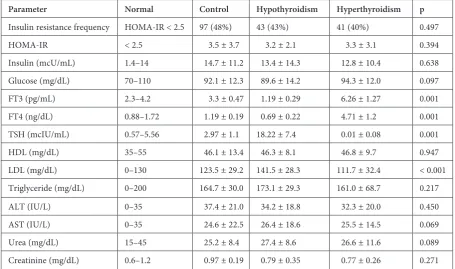
in the control and two study groups. There were 97 (48%), 43 (43%) and 41 (40%) patients with insu-lin resistance in the control, hypothyroidism and hyperthyroidism groups, respectively. There was no statistically significant difference between the groups (p = 0.497, Fig. 1, Table 2).
The mean levels of HOMA-IR were 3.5 ± 3.7, 3.2 ± 2.1 and 3.3 ± 3.1 in the control, hypothyroid-ism and hyperthyroidhypothyroid-ism groups, respectively (p = 0.394, Table 2, Fig. 2). LDL cholesterol lev-els were significantly higher in the hypothyroidism group compared to both the control and hyper-thyroidism groups (p < 0.001). Other biochemical tests (glucose, triglyceride, HDL cholesterol, AST, ALT, urea and creatinine) were not statistically dif-ferent (p > 0.05, respectively, Table 2).
Discussion
In the present study, we investigated the effects of thyroid dysfunction on insulin resistance in pa-tients with hepatosteatosis. The effect of thyroid function status on insulin sensitivity is of great in-terest but the data is still conflicting [5].Several
studies were performed to elucidate the association between insulin resistance and hypothyroidism or hyperthyroidism [12–14, 18]. However, hepatoste-atosis was not evaluated in these studies.
It is well known that insulin resistance is strongly related to hepatosteatosis pathogenesis [19]. The frequency of insulin resistance in healthy individuals with normal glucose tolerance is near-ly 25% of the populations [19, 20]. In the current study, the frequency of insulin resistance in the control group was higher, up to 48%. This differ-ence can be ascribed to hepatosteatosis present in all subjects including the control group.
Of particular interest is the influence of thyroid hormone action on insulin levels. The data on in-sulin levels in patients with thyroid dysfunction is conflicting [5, 14]. For example, patients with hypo-thyroidism can experience hypoglycemia. This phe-nomenon can be attributed to reduced gluconeo-genesis leading to decreased liver glucose output [11, 21]. On the other hand, previous studies in hy-pothyroid animal models demonstrated that insulin resistance is present in peripheral tissues [22, 23].
In contrast to the aforementioned studies, no association between overt hypothyroidism and
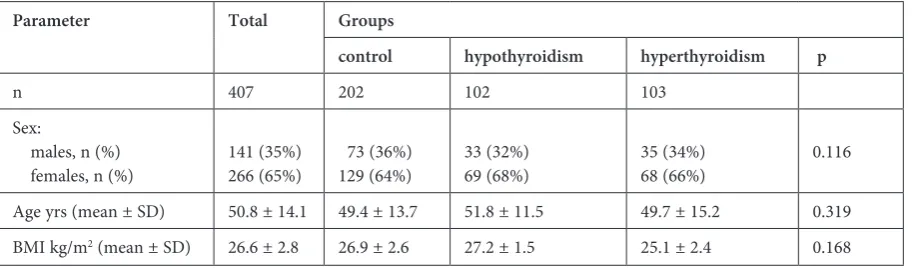
Table 1. Baseline characteristics of the subjects
Parameter Total Groups
control hypothyroidism hyperthyroidism p
n 407 202 102 103
Sex:
males, n (%)
females, n (%) 141 (35%)266 (65%) 73 (36%)129 (64%) 33 (32%)69 (68%) 35 (34%)68 (66%) 0.116 Age yrs (mean ± SD) 50.8 ± 14.1 49.4 ± 13.7 51.8 ± 11.5 49.7 ± 15.2 0.319 BMI kg/m2 (mean ± SD) 26.6 ± 2.8 26.9 ± 2.6 27.2 ± 1.5 25.1 ± 2.4 0.168
BMI – body mass index.
Fig. 1. The frequency of insulin resistance of the groups. There were 97 (48%), 43 (43%) and 41 (40%) patients with insulin resistance in the con-trol, hypothyroidism and hyperthyroidism groups, respectively. There was no statistically significant difference between the groups (p = 0.497) 0
25 50 75 100
Control Hypothyroidism Hyperthyroidism
HOMA-IR was found by Owecki et al. [15]. Con-sistently, patients with hypothyroidism treated with levothyroxine had no impairment of insulin-stimulated glucose disposal in the forearm [24]. Concordant with these last studies, we found that the frequency of insulin resistance in hypothyroid-ism was comparable to both the control and hyper-thyroidism groups.
Next, we tested a possible correlation between insulin resistance in patients with hepatosteatosis
and hyperthyroidism. As discussed extensively in the review by Dimitriadis and Raptis [5], impaired glucose tolerance is a frequent finding in thyro-toxic subjects. Insulin binding at low insulin con-centrations was reduced in thyrotoxic patients and was accompanied by impaired insulin sensitivity of glucose transport and oxidation and lipogenesis. Shen et al. [25] demonstrated decreased peripheral insulin sensitivity in hyperthyroidism.
Unlike other studies, we found that insulin re-sistance frequency and HOMA-IR in patients with hyperthyroidism were comparable to both the con-trol and hypothyroidism groups. This result may be related to hepatosteatosis.
Regarding the association of the lipid profile with insulin resistance, fasting and postprandial li-poprotein lipase activity has been reported to be sig-nificantly reduced in patients with insulin resistance and hyperinsulinemia [26, 27]. In the present study, triglyceride levels were comparable despite thyroid dysfunction. This condition might be a result of li-poprotein lipase activity that was affected by insulin resistance as described above. Fasting insulin levels in the different groups were concordant to the lipid profile and previous reports [26, 27].
Our results suggest that hypothyroidism and hyperthyroidism have no severe effect on insulin resistance in patients with hepatosteatosis.
Our study has some limitations. First, it would have been beneficial if the groups had been com-pared with similar groups without hepatosteato-sis. Second, in addition to hepatosteatosis, genetic
Table 2. Biochemical parameters and HOMA-IR of the subjects
Parameter Normal Control Hypothyroidism Hyperthyroidism p Insulin resistance frequency HOMA-IR < 2.5 97 (48%) 43 (43%) 41 (40%) 0.497 HOMA-IR < 2.5 3.5 ± 3.7 3.2 ± 2.1 3.3 ± 3.1 0.394 Insulin (mcU/mL) 1.4–14 14.7 ± 11.2 13.4 ± 14.3 12.8 ± 10.4 0.638 Glucose (mg/dL) 70–110 92.1 ± 12.3 89.6 ± 14.2 94.3 ± 12.0 0.097 FT3 (pg/mL) 2.3–4.2 3.3 ± 0.47 1.19 ± 0.29 6.26 ± 1.27 0.001 FT4 (ng/dL) 0.88–1.72 1.19 ± 0.19 0.69 ± 0.22 4.71 ± 1.2 0.001 TSH (mcIU/mL) 0.57–5.56 2.97 ± 1.1 18.22 ± 7.4 0.01 ± 0.08 0.001 HDL (mg/dL) 35–55 46.1 ± 13.4 46.3 ± 8.1 46.8 ± 9.7 0.947 LDL (mg/dL) 0–130 123.5 ± 29.2 141.5 ± 28.3 111.7 ± 32.4 < 0.001 Triglyceride (mg/dL) 0–200 164.7 ± 30.0 173.1 ± 29.3 161.0 ± 68.7 0.217 ALT (IU/L) 0–35 37.4 ± 21.0 34.2 ± 18.8 32.3 ± 20.0 0.450 AST (IU/L) 0–35 24.6 ± 22.5 26.4 ± 18.6 25.5 ± 14.5 0.069 Urea (mg/dL) 15–45 25.2 ± 8.4 27.4 ± 8.6 26.6 ± 11.6 0.089 Creatinine (mg/dL) 0.6–1.2 0.97 ± 0.19 0.79 ± 0.35 0.77 ± 0.26 0.271
Fig. 2. The mean level of HOMA-IR of the groups. The mean levels of HOMA-IR were 3.5 ± 3.7, 3.2 ± 2.1 and 3.3 ± 3.1 in the control, hypothyroidism and hyperthyroidism groups, respectively (p = 0.394)
0 3 6 9 12 15
Groups
HOMA-I
R
1 2 3
factors, body fat distribution, new endogenous hormones, inflammatory mediators and differenc-es in lifdifferenc-estyle should be invdifferenc-estigated for bdifferenc-est rdifferenc-esults. Third, we do not have any idea about the duration of thyroid disease. Fourth, evaluation of hepatos-teatosis with ultrasound can be another limitation, but we accepted the ultrasound results for diagno-sis of hepatosteatodiagno-sis because of the high sensitiv-ity, specificity and predictive values of ultrasound in the diagnosis of hepatosteatosis [28, 29].
In conclusion, we can say that insulin resis-tance may not be sufficiently affected by thyroid dysfunctions due to the other strong etiologic
causes in patients with hepatosteatosis (like ge-netic factors, body fat distribution, new endog-enous hormones, inflammatory mediators, dif-ferences in lifestyle, etc.). In hepatosteatosis, the abnormalities in other liver-related metabolic fac-tors are so severe that they presumably minimize any other influencing factor, like thyroid dysfunc-tions here.
Finally, thyroid dysfunctions may have no ef-fect on insulin resistance in patients with hepatos-teatosis. Further studies with greater sample sizes, and with or without hepatosteatosis are needed for clear information.
Acknowledgements. The authors thank Yoel Toledano for his helpful comments.
References
Powers AC:[1] Diabetes Mellitus. In: Harrison’s principles of internal medicine. Eds.: Longo DL et al., Mc Graw Hill, New York 2012, 18th ed., 2972–2975.
Singh
[2] Bhawna M, Goswami B, Mallika V: Association between insulin resistance and hypothyroidism in females attending a tertiary care hospital. IJCB 2010, 25, 141–145.
Gastaldelli A, Cusi K, Pettiti M,
[3] Hardies J, Miyazaki Y, Berria B, Buzzigoli E, Sironi AM, Cersosimo E, Ferrannini E, Defronzo RA: Relationship between hepatic/visceral fat and hepatic insulin resistance in nondia-betic and type 2 dianondia-betic subjects. Gastroenterology 2007, 133, 496.
Reaven GM:
[4] Banting lecture. Role of insulin resistance in human disease. Diabetes1988, 37, 1595–1607. Dimitriadis GD, Raptis SA:
[5] Thyroid hormone excess and glucose intolerance. Exp Clin Endocrinol Diabetes2001, 109, 225–239.
Dimitriadis G, Baker B, Marsh H, Mandarino L, Rizza R, Bergman R, Haymond M. Gerich J:
[6] Effect of thyroid
hormone excess on action, secretion, and metabolism of insulin in humans. Am J Physiol 1985, 248, 593–601. Randin JP, Tappy L, Scazziga B:
[7] Insulin sensitivity and exogenous insulin clearance in Graves’ disease. Measurement by the glucose clamp technique and continuous indirect calorimetry. Diabetes 1986, 35, 178–181.
Ximenes HM, Lortz S, Jörns A, Lenzen S:
[8] Triiodothyronine (T3)-mediated toxicity and induction of apoptosis in insulin-producing INS-1 cells. Life Sciences 2007, 80, 2045–2050.
Serter R, Demirbas B, Korukluoglu B, Culha C, Cakal E, Aral Y:
[9] The effect of L-thyroxine replacement therapy
on lipid based cardiovascular risk in sub clinical hypothyroidism. Invest J Endocrinol2004, 27, 897–903.
[10] American Association of Clinical Endocrinologists medical guidelines for clinical practice for the evaluation and treatment of hyperthyroidism and hypothyroidism. Endocr Pract 2002, 8, 457–469.
Maratou E, Hadjidakis DJ, Kollias A, Tsegka K, Peppa M, Alevizaki M, Mitrou P, Lambadiari V, Boutati E, [11]
Nikzas D, Tountas N, Economopoulos T, Raptis SA, Dimitriadis G: Studies of insulin resistance in patients with clinical and subclinical hypothyroidism. Eur J Endocrinol 2009, 160, 785–790.
Owecki M, El Ali Z, Nikisch E, Sowinski J:
[12] Serum insulin levels and the degree of thyroid dysfunction in hypo-thyroid women. Neuro Endocrinol Lett 2008, 29, 137–140.
Kapadia KB, Bhatt PA, Shah JS:
[13] Association between altered thyroid state and insulin resistance. J Pharmacol Pharmacother 2012, 3, 156–160.
Gierach M, Gierach J, Junik R:
[14] Insulin resistance and thyroid disorders. Endokrynol Pol 2014, 65, 70–76. Owecki M, Nikisch E, Sowiński J:
[15] Hypothyroidism has no impact on insulin sensitivity assessed with HOMA-IR in totally thyroidectomized patients. Acta Clin Belg 2006, 61, 69–73.
Quinn SF, Gosink BB:
[16] Characteristic sonographic signs of hepatic fatty infiltration. Am J Roentgenol 1985, 145, 753–755.
Targher G, Bertolini L, Padovani R, Rodella S, Tessari R, Zenari L:
[17] Prevalence of nonalcoholic fatty liver disease
and its association with cardiovascular disease among type 2 diabetic patients. Diab Care 2007, 30, 1212–1218. Shantha GPS, Kumar AA, Jeyachandran V, Rajamanickam D, Rajkumar K, Salim S, Subramanian KK, [18]
Natesan S: Association between primary hypothyroidism and metabolic syndrome and the role of C reactive pro-tein: a cross–sectional study from South India. Thyroid Res 2009, 2, 2.
Bugianesi E, McCullough AJ, Marchesini G:
[19] Insulin resistance: a metabolic pathway to chronic liver disease. Hepatology2005, 42, 987–1000.
Hollenbeck C, Reaven GM:
[20] Variations in insulin stimulated glucose uptake in healthy individuals with normal glucose tolerance. J Clin Endocrinol Metab 1987, 64, 1169–1173.
McCulloch AJ, Johnston DG, Baylis PH, Kendall-Taylor P, Clark F, Young ET, Alberti KG:
[21] Evidence that
thy-roid hormones regulate gluconeogenesis from glycerol in man. Clin Endocrinol 1983, 19, 67–76. Czech MP, Malbon CC, Kerman K, Gitomer W, Pilch PF:
[22] Effect of thyroid status on insulin action in rat
Dimitriadis GD, Leighton B, Parry-Billings M, West D, Newsholme EA:
[23] Effects of hypothyroidism on the
sensitiv-ity of glycolysis and glycogen synthesis to insulin in the soleus muscle of the rat. Biochem J 1989, 257, 369–373. Harris PE, Walker M, Clark F, Home PD, Alberti KG:
[24] Forearm muscle metabolism in primary hypothyroidism.
Eur J Clin Invest 1993, 23, 585–588.
Shen DC, Davidson MB, Kuo SW, Kuo SW, Sheu WH:
[25] Peripheral and hepatic insulin antagonism in
hyperthy-roidism. J Clin Endocrinol Metab 1988, 66, 565–569.
Jorgen J, Hollenbeck CB, Zhou MY, Ann M Coulston, Claire Jones, Ida Chen YD:
[26] Relation Between Insulin
Resistance, Hyperinsulinemia, Postheparin Plasma Lipoprotein Lipase Activity, and Postprandial Lipemia. Arterıoscl Throm Vas 1995, 15, 320–324.
Frayn KN:
[27] Insulin resistance and lipid metabolism. Curr Opin Lipidol 1993, 4, 197–204. Joy D, Thava VR, Scott BB:
[28] Diagnosis of fatty liver disease: is biopsy necessary? Eur J Gastroenterol Hepatol 2003, 15, 539–543.
Saverymuttu SH, Joseph AE, Maxwell JD:
[29] Ultrasound scanning in the detection of hepatic fibrosis and steatosis. BMJ 1986, 292, 13–15.
Address for correspondence:
Şakir Özgür KeşkekDepartment of Internal Medicine Numune Training and Research Hospital Serin Evler Mah
01240, Yüreğir Adana Turkey
Tel: +90 505 29 96 942 E-mail: [email protected]
Conflict of interest: None declared