“Verification
for PAPR Reduction of OFDM Signal
Using Partial Transmit Sequences
Technique”
Anil Mishra Hemant Kumar Soni Vikash Gupta Manish Srivastava
Abstract - In this paper we propose an algorithm for PAPR reduction in OFDM systems, based on a Partial Transmit Sequence Technique. In this present work an introduction to multi-carrier modulation emphasizing OFDM (Orthogonal Frequency Division Multiplexing) is given followed by mathematical and qualitative description of OFDM. This paper work presents an overview of the most popular OFDM PAPR-reduction techniques demonstrating that Partial Transmit Sequences (PTS) Technique is a particularly promising reduction technique. It achieves considerable PAPR reduction without distortion, but the high computational complexity of multiple Fourier transforms is a problem in practical systems. This new technique significantly decreases the computational complexity while providing comparable PAPR reduction to ordinary PTS (O-PTS), even with a small number of stages after PTS partitioning. All carriers are orthogonal to each other, which means when one particular subcarrier is at its peak other are at zero. It also requires less increase in SNR for the same BER compared to other methods. Numerical results are presented which confirm the PAPR improvements.
Keywords - OFDM (Orthogonal Frequency Division Multiplexing), PAPR (Peak to Average Power Ratio), BER (Bit Error Rate), PTS (Partial Transmit Sequence)
I. I
NTRODUCTIONFuture mobile communications systems reaching for ever increasing data rates require higher bandwidths than those typical used in today’s cellular systems. By going to higher bandwidth (for low bandwidth) the flat fading radio channel becomes frequency selective and time dispersive.
Due to its inherent robustness against time dispersion Orthogonal Frequency Division Multiplexing (OFDM) is an attractive candidate for such future mobile communication systems.
OFDM partitions the available bandwidth into many sub-channels with much lower bandwidth. Such a narrowband sub-channel experiences now due to its low bandwidth an almost flat fading leading in addition to above mentioned robustness also to simple implementations. However, one potential drawback with OFDM modulation is the high Peak to Average Power Ratio (PAPR) of the transmitted signal: The signal transmitted by the OFDM system is the superposition of all signals transmitted in the narrowband sub-channels. The transmit signal has then due to the central limit theorem a Gaussian distribution leading to high peak values compared to the average power.
A system design not taking this into account will have a high clip rate: Each signal sample that is beyond the saturation limit of the power amplifier suffers either
clipping to this limit value or other non-linear distortion, both creating additional bit errors in the receiver.
One possibility to avoid clipping is to design the system for very high signal peaks. However, this approach leads to very high power consumption (since the power amplifier must have high supply rails) and also complex power amplifiers. The preferred solution is therefore to apply digital signal processing that reduces such high peak values in the transmitted signal thus avoiding clipping. These methods are commonly referred to as Peak to Average Power Ratio (PAPR) reduction.
II. M
ULTICARRIERM
ODULATIONDifferently from satellite communication where we have one single direct path from transmitter to receiver, in the classical terrestrial broadcasting scenario we have to deal with a multipath- channel i.e. the transmitted signal arrives at the receiver in various paths of different length as shown in the figure below. Since multiple versions of the signal interfere with each other that means the Inter Symbol Interference (ISI) occurs and it becomes very hard to extract the original information.
III. O
RTHOGONALF
REQUENCYD
IVISIONM
ULTIPLEXINGOrthogonal Frequency Division Multiplexing (OFDM) is a special form of multi carrier modulation, uses DSP algorithms like Inverse Fast Fourier Transform (IFFT) to generate waveform that are mutually orthogonal. After more than thirty years of research and development carried out in different places, OFDM is now being widely implemented in high-speed digital communications. Due to the recent advancements in digital signal processing (DSP) and very large-scale integrated circuits (VLSI) technologies, the initial obstacles of OFDM implementations do not exist anymore. Meanwhile, the use of fast Fourier transform (FFT) algorithms eliminates arrays of sinusoidal generators and coherent demodulation required in parallel data systems and makes the implementation of the technology cost effective. In recent years OFDM has gained a lot of interest in diverse digital communication applications. This has been due to its favorable properties like high spectral efficiency, robustness to channel fading, immunity to impulse interference, uniform average spectral density, capability of handling very strong echoes and less non-linear distortion.
digital radio, ADSL and wireless LANs (HIPERLAN 2, IEEE 802.11a) and many other wireless communication systems. Even though there are many advantages of OFDM, it has two main drawbacks:
1. High Peak to Average Power Ratio (PAPR) 2. Frequency Offset.
IV. P
EAK-T
O-A
VERAGEP
OWERR
ATIO(PAPR) I
NOFDM
High PAPR causes saturation in power amplifiers, leading to inter-modulation products among the sub carriers and disturbing out of band energy. Therefore, it is desirable to reduce the PAPR. In this work, I have focused on problem of high PAPR and various available methods for its reduction are discussed. I have also briefly discussed OFDM and its advantages and disadvantages as compared to single carrier modulation technique.
channel distortion. The tap coefficients of the filter are calculated based on channel information
Input Serial
to
Map IFFT Add cyclic
Parallel to
Transmit Filter Data Paral
lel
Map Map
prefix Serial
Channel
Output
Data Para-llel to Seri-al
De-map De-map De-map
FFT Serial to Parallel
Remove
cyclic
prefix Receive Filter
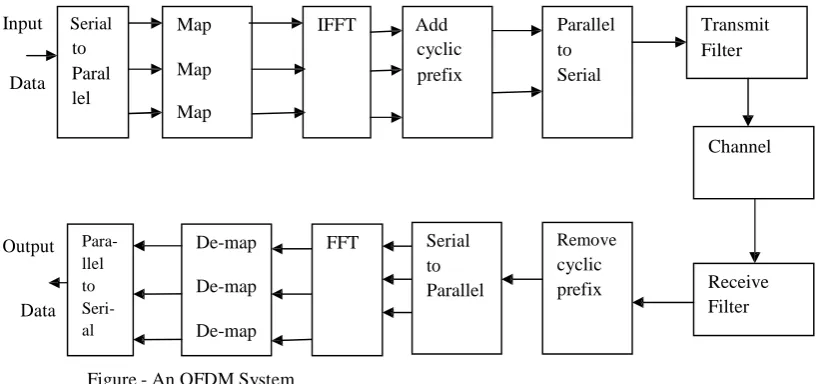
Figure - An OFDM System
Orthogonal Frequency Division Multiplexing (OFDM) belongs to the more general class of multicarrier modulation systems and has found its way to the high-speed wireless and mobile communications arena.
OFDM transmitters generate both the carrier and the data signal simultaneously with purely digital circuits residing in the specialized DSP (Digital Signal Processor) microchips. The specific process of digital signal generation used in OFDM is based on the series of mathematical computations known as an Inverse Fourier Transform, and the process results in the formation of a complex modulated waveform at the output of the transmitter. The incoming serial data is first converted from serial to parallel and grouped into x bits each to form a complex number. The complex numbers are modulated in a base band fashion by the IFFT and converted back to serial data for transmission. A guard interval is inserted between symbols to avoid inter-symbol interference (ISI) caused by multipath distortion. The discrete symbols are converted to analog and low pass filtered for RF up-conversion. The receiver performs the inverse process of the transmitter. One tap equalizer is used to correct
V. E
XPRESSIONO
FP
EAKT
OA
VERAGEP
OWERR
ATIOThe most popular quantification metric of envelope variation is the peak-to-average ratio (PAPR). Rightfully so, as PAPR captures the most important aspect of a signal that has to pass through a peak-power limited device: the peak power.
PAPR is alternately referred to as the peak-to-average power ratio and PMEPR (peak to mean envelope power ratio). PAPR is also directly related to the crest factor (CF) of a signal where CF =√PAR
The PAR of an OFDM signal can be defined as,
PAPR =
Where x be any signal representation (critically sampled baseband, oversampled baseband, continuous-time pass-band, etc.) defined over one symbol period.
is true that the term PAPR is a bit of a misnomer. Despite this slight technical inaccuracy, PAPR is the most widely used term and we will keep with convention here. Also, note that the ensemble average power and the expectation in the denominator of above equation only differ for non-constant modulus constellations.
VI. R
ESULT1. GENERATION OF DM SIGNAL
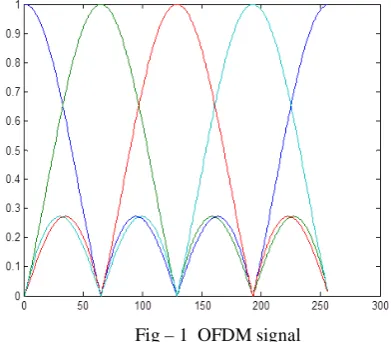
All carriers are orthogonal to each other, which means when one particular subcarrier is at its peak other are at zero as shown in the figure. Figure 1 shows OFDM signal for 4 subcarriers. All four carriers are orthogonal to each other that means when one particular subcarrier is at its peak other are at zero as shown in the figure.
Fig–1 OFDM signal
2. CCDF OF PAPR OF OFDM
A.
For N=16The CCDF of PAPR of OFDM for N=16 is as shown in figure 2. The horizontal and vertical axes represent the threshold for the PAPR and the probability that the PAPR of a data block exceeds the threshold, respectively.
Fig-2 CCDF of PAPR of OFDM for N=16
B.
FORVARIOUSVALUESOFNTHECCDF OFPAPR OFOFDM FORN =16:
The CCDFs are usually compared in a graph such as Figure 3, which shows the CCDFs of the PAPR of an
OFDM signal with 16,128,256 and 1024 subcarriers (N =16,128, 256,1024) for quaternary phase shift keying (QPSK) modulation. The horizontal and vertical axes represent the threshold for the PAPR and the probability that the PAPR of a data block exceeds the threshold, respectively.
Fig -3 CCDF of PAPR of OFDM for Various N
It is shown that the unmodified OFDM signal has a PAPR that exceeds 10 dB for less than 1 percent of the data blocks for N = 256. OFDM signal has a PAPR that exceeds 12 dB for less than 0.1 percent of the data blocks for N = 1024
C.
COMPARISON OF CCDF OF PAPR OFUNMODIFIED OFDM AND OFDM WITH PTS TECHNIQUE
The figure 4 shows that when is used as a PAPR reduction technique, the 0.1 percent PAPR reduce to 8.8 dB, resulting in 1.8 dB reductions. Speaking roughly, the closer the CCDF curve is to the vertical axis, the better its PAPR characteristic.
Fig–4 Comparison of CCDF of PAPR of Unmodified OFDM and OFDM with PTS
D.
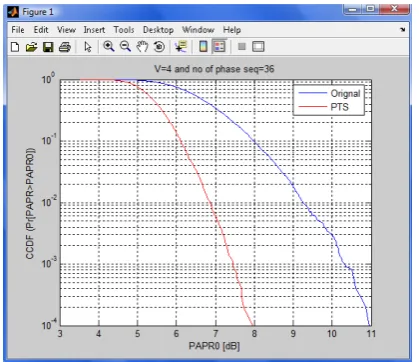
PTS FOR36 PHASESEQUENCESa PAPR reduction technique, the 0.1 percent PAPR reduce to 7.6 dB, resulting in 2.8 dB reductions.
Fig–5 Comparison of CCDF of PAPR of Unmodified OFDM and OFDM with PTS for 36 Phase Sequences
E.
PTS WITHVARIABLEVNow I try to show that the PAPR reduction process can be made more efficient by increasing the number of phase sequences and the number of sub blocks, although there may be a little bit increment of calculation complexity. Figure 6 shows the Comparison of CCDF of PAPR of unmodified OFDM and OFDM with PTS technique with variable V. The figure shows that when is used as a PAPR reduction technique, the 0.1 percent PAPR reduce to 8.6 dB and 7.5 dB, resulting in 1.5 dB and 2.6 dB reductions for V=4 and V=8 respectively.
Fig–6 Comparison of CCDF of PAPR of Unmodified OFDM and OFDM with PTS for Variable V
These results shows that the PAPR reduction process can be made more efficient by increasing the number of phase sequences and the number of sub blocks, although there may be a little bit increment of calculation complexity. Following figure shows the comparison of PAPR for original unmodified OFDM signal and by using
PTS technique for different phase sequences and variation in number of sub blocks.
VII. C
ONCLUSIONIn this paper, we considered partial transmit sequence (PTS) in OFDM systems. In PTS, the receiver must know which vector had actually been used at transmitter to recover the data at receiver correctly. Therefore, the phase factors must be transmitted as side information, resulting in some loss of band efficiency. However to reduce the inter-modulation distortion in high power amplifiers or active devices reduction in PAPR is unavoidable.
The PAPR reduction with the PTS technique is about 1.8 dB for 0.01 % of input symbols. This reduction in PAPR with PTS can be increased by increasing the number of phase sequences and the size of input data block. The simulation results show that PAPR is reduced to 2.8 dB for 0.01 % of input symbols for increasing the number of phase sequences from 16 to 36. Also, PAPR is reduced to 2.7 dB for 0.01 % of input symbols for increasing the size of input data block from 4 to 8. But the cost paid for this reduction in PAPR is increase in calculation complexity.
S.
No 'PA
PR0
[dB]
'CCDF
(Pr[PAP
R>PAPR
0]) of
Original
CCDF
(Pr[PAPR>
PAPR0]) of
PTS for 16
Phase
Sequences
CCDF
(Pr[PAPR>
PAPR0]) of
PTS for 36
Phase
Sequences
CCDF
(Pr[PAPR>
PAPR0]) of
PTS with
Variable
V=8
1. 4 1 1 1 1
2. 6 0.8 0.3 0.7 0.1
3. 8 0.1 0.02 0.0004 0.0007
4. 8.2 0.09 0.016 0 0
5. 9.3 0.08 0 0 0
6. 11 0 0 0 0
R
EFERENCES[1] URBAN, J., MARSALEK, R.: “OFDM PAPR reduction by simplified clipping and filtering with bounded distortion”. In Proc. of the Sixteenth International Electro-technical and Computer Science Conference ERK 2007, pp. 128-131, [Published paper] November 2007.
[2] DENG, S.-K., LIN, M.-CH.”Recursive Clipping and Filtering With Bounded Distortion for PAPR Reduction”. IEEE Transactions on communications. 2007, vol. 55, no. 1 [Published paper] in 2007. [3] Houshou Chen and Hsinying Liang“A Modified Selective Mapping
with PAPR Reduction and Error Correction in OFDM Systems”. Dept. of Electrical Engineering and Graduate Institute of Communication Engineering National Chung Hsing University, 250, Kuo Kuang Rd., Taichung 402, Taiwan, [Published paper] 11-15 March 2007.
[4] Slimane Ben Slimane, M”Reducing the Peak-to-Average Power Ratio of OFDM Signals Through Precoding” IEEE transactions on vehicular technology, vol. 56, no. 2, [Published paper] march 2007. [5] Abolfazl Ghassemi, T.Aaron Gulliver.,(2010),“PAPR reduction of
OFDM using PTS and error-correcting code subblocking”, IEEE Transactions on wireless communications, [Published paper] (March 2010), 980-989.
[6] Lin Yang., 2008.Link-level enhancement schemes utilizing multiple symbol representation for Multicarrier communication. Ph.D. thesis, University of Manchester [Published paper].
[7] MULLER, s. BAUML, R., FISCHER, R., and HUBER. J.: 'OFDM with reduced peak-to-average power ratio by multiple signal representation'. To appear in Annuls of Telecommunications, Special issue on multi rate digital signal processing in telecommunication applications [Published paper].
[8] Xiaodong Li and Leonard J. Cimini. “Effects of clipping and Filtering on the Performance of OFDM”. IEEE,1997, pp.1634-1638 [Published paper].
[9] X. Li and L. J. Cimini, Jr., "Effect of Clipping and filtering on the Performance of OFDM," Elect. Letter, vol. 2, no. 5, pp. 131-133, [Published paper] May 1998.
[10] J. A. Davis and J. Jedwab, “Peak-to-mean power control in OFDM, Golay complementary sequences and Reed-Muller codes,” IEEE Trans. Inform. Theory, vol. 45, no. 11, pp. 2397–2417, [Published paper] Nov. 1999.
[11] Heung-Gyoon Ryu, Jae-Eun Lee, and Jin-Soo Park, "Dummy sequence insertion (DSI) for PAPR reduction in the OFDM communication system," IEEE Transactions on Consumer Electronics, vol. 50, pp.89-94, [Published paper] Feb. 2004. [12] Byung Moo Lee and Rui J.P. de Figueiredo, “Adaptive
Pre-Distorters for Linearization of High Power Amplifiers in OFDM Wireless Communications,”Circuits, Systems & Signal Processing, Birkhauser Boston, vol. 25, no. 1, 2006, pp. 59-80 [Published paper] in 2006.
[13] Jizeng Wang; Jingyu Luo; Yanlong Zhang; “ A New Phase Sequence for SLM in MC-CDMA System”, WiCom Sept. 2007 pp: 938–94 [Published paper] in Sept. 2007.
[14] S. Y. L. Goff, S. S. Al–Samahi, B. K. Khoo, C. C. Tsimenidis, B. S. Sharif, “Selected Mapping Without Side Information for PAPR Reduction in OFDM”, IEEE Transactions on Wireless Communications, Vol. 8, No. 7, [Published paper] July 2009. [15] S. Mohapatra, S. Das, “A New Approach for Performance
Improvement of OFDM System using Pulse Shaping”,Electrical Dept., NIT Rourkela, [Published paper] November 2009.
[16] H Liang, Y Chen, Y Huang, C Cheng, in A Modified Genetic Algorithm PTS Technique for PAPR Reduction in OFDM Systems 15th Asia-Pacific Conference on Communications, APCC 2009, 182–185 [Published paper] in 2009.
A
UTHOR’SP
ROFILEA. Anil Mishra
Place–Bhopal (M.P.), India Date of Birth–10/04/1986
Educational Detail:
1. Pursuing M.Tech with Electronics & Communication from Technocrats Institute of Technology, Bhopal affiliated with RGPV Bhopal (M.P.) India.
2. Completed B.E. with Electronics & Communication from RIT, Rewa affiliated with RGPV Bhopal (M.P.) India 2007.
3. Completed Schooling from Govt. School Rewa.
B. Hemant Kumar Soni Place - Bhopal (M.P.), India Date of Birth - 04/08/1986
Educational Detail:
1. M.Tech with Micro-Electronics & VLSI Design from Technocrats Institute of Technology, Bhopal affiliated with RGPV Bhopal (M.P.) India in 2011.
2. Completed B.E. with Electronics & Communication from PCST Bhopal affiliated with RGPV Bhopal (M.P.) India in 2008.
3. Completed Schooling from Chhindwara (M.P.) India.
Vikash Gupta HOD,
Electronics and Communication, TIT, Bhopal
B.E. (Electronics & Communication), M.Tech (Digital Communication)
Manish Srivastava Assistant Professor,
Electronics & Communication, TIT, Bhopal
B.E. (Electronics & Communication) from BIT Durg, M.Tech (VLSI & CAD Design) from