ISSN(Online): 2320-9801
ISSN (Print): 2320-9798
International Journal of Innovative Research in Computer
and Communication Engineering
(An ISO 3297: 2007 Certified Organization)
Vol. 4, Issue 10, October 2016
Detecting and Improving Distorted
Fingerprints Using Rectification
Techniques
Sandipan Paul, Vaibhav Dalvi, Aditya Chavare, Prof.Lakshmi Madhuri
Dept. of Computer Engineering, Dr. D Y Patil School of Engineering, Pune, India
ABSTRACT : Unique mark coordinating every now and again experiences bungling of fingerprints which is perceived as a flexible mutilation. Because of this it exasperates most extreme of the unique mark acknowledgment entries, especially deduplication applications and can be dangerous if there should be an occurrence of negative acknowledgment applications, occasion watch list. In various situations where clients deliberately distort their fingerprints so as to avoid vindictive movement. In this paper in light of given unique finger impression picture, recommended framework will give novel calculations to sort other than enhancing skin contortion in view of a solitary unique mark picture. Skin contortion is comprehended as a two-class blend, in which period guide of a unique mark and enrolled edge introduction guide are utilized as the component vector and a SVM classifier is capable to play out the order undertaking. If there should be an occurrence of twisting correction or contortion field valuation, it is a crumbling issue in which the information is a bended unique mark and the yield is the mutilation field. To answer this issue, reference database of various incorrect reference fingerprints and proportionate contortion fields is developed in the disconnected stage, and after that in the online stage, the adjoining neighbor of the information unique finger impression is set up in the reference database and the identical twisting field is pushed off to adjustment the info finger impression into a characteristic one. Various idealistic outcomes have been set up on three databanks which containing numerous off base fingerprints, particularly FVC2004 DB1, Tsinghua Distorted Fingerprint database, NIST SD27 inert unique finger impression database.
KEYWORDS : Fingerprint, principal component analysis, support vector machine, nearest neighbor regression, registration distortion.
I. INTRODUCTION
ISSN(Online): 2320-9801
ISSN (Print): 2320-9798
International Journal of Innovative Research in Computer
and Communication Engineering
(An ISO 3297: 2007 Certified Organization)
Vol. 4, Issue 10, October 2016
to turn away unique mark framework from finding the exact personality. Actually, law executives have gone over various situations where guilty parties attempted to dodge distinguishing proof by harming or surgically changing their fingerprints. Flexible mutilation is exhibited because of the intrinsic tractability of fingertips, contact-based unique mark securing method, and an intentionally parallel compel and so forth. Skin deception rises the intra-class dissimilarities and along these lines signs to untrue non-coordinates because of confined ability of present unique mark. Matchers in distinguishing seriously mistaken fingerprints. In Fig. 1, the left two are normal fingerprints, while the right one contains a few deception. As indicated by Veri-Finger, the score of coordinating is among the left two is extensive more noteworthy than the score among the right two. This huge variety is in line for twisting instead of halfway cover territory. Despite the fact that it is probably going to make the coordinating calculations stand expansive skin twisting, this will tip to additional false matches and back off coordinating pace.
Fig. No 1 Sample Fingerprints
From now on it is especially huge for negative unique mark acknowledgment frameworks to find low quality fingerprints and recuperate their quality in this way that the unique finger impression technique is not consulted by vindictive clients. The debasement of unique mark esteem can be photometric or geometrical. Photometric debasement can be influenced by non-ordinary skin state, messy sensor surface, and troublesome picture foundation. Geometrical corruption is to a great extent created by skin lie. Photometric debasement has been broadly contemplated and a numeral of value estimation calculations and change calculations has been suggested. In any case, geometrical debasement because of skin contortion has not yet expected adequate responsiveness.
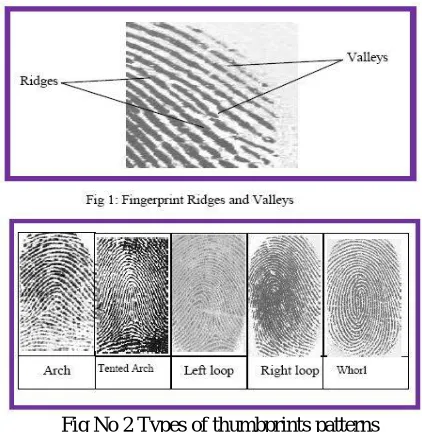
Fig No 2 Types of thumbprints patterns
ISSN(Online): 2320-9801
ISSN (Print): 2320-9798
International Journal of Innovative Research in Computer
and Communication Engineering
(An ISO 3297: 2007 Certified Organization)
Vol. 4, Issue 10, October 2016
distinctive, matchless fingerprints. Fingerprint identification tops amongst all forensic sciences for numerous reasons which including followings:
The past of fingerprinting can be outlined back to primeval times based on the human fingerprints exposed on a big number of archaeological artifacts and historical matters. In 1686, Prof. Marcello Malpighi, of anatomy noted in his treatise, ridges, spirals and loops in fingerprints. He made no reference of their worth as an instrument for distinct identification. A coat of skin was named after him; "Malpighi" layer, which is approximately 1.8mm thick. During the 1870's, Dr. Henry Faulds, the British Surgeon-Superintendent in Tokyo, grabbed up the training of "skin-furrows" after observing finger marks on cases of "prehistoric" ceramic. Dr. Faulds well known industrialist not only predict the prominence of fingerprints as a resources of identification, but developed a method of classification as well. Description of his grouping system and an example of the methods he had planned for footage inked impressions, to Sir Charles Darwin. Darwin, in advanced oldness and unpleasant health, informed Dr. Faulds that he might be of certainly no support to Sir. Darwin, but swore to pass the constituents on to his cousin, Francis Galton. Also in 1880, Dr. Faulds issued an editorial in the Scientific Newsletter, "Nature". He chatted fingerprints by way of an individual identification, besides the custom of printers ink as a system for finding such fingerprints [14]. He is similarly endorsed with the first fingerprint identification of an oily fingerprint left on an alcohol jug. Later, Juan Vucetich prepared the first illegitimate fingerprint identification in 1892.
Today, the major AFIS repository in America is functioned by the Branch of Homeland Security's US Visit Program, comprising over 63 million persons' fingerprints, mainly in the system of two-finger accounts (non-compliant with FBI and Interpol standards). Fingerprint identification is distributed into four modules,
(i) Acquisition,
(ii) Preprocessing,
(iii) Feature extraction
(iv) Feature matching.
II. OBJECTIVE OF THE WORK
1. To design a system that will recognition and rectify the distortion for identification of error. 2. To detect the distortion area complete with high accuracy.
3. To rectify the distortion completely, in this process it is needed to detect the distortion type and then we need to correct the type distortion related error.
III. LITERATURE SURVEY
ISSN(Online): 2320-9801
ISSN (Print): 2320-9798
International Journal of Innovative Research in Computer
and Communication Engineering
(An ISO 3297: 2007 Certified Organization)
Vol. 4, Issue 10, October 2016
ISSN(Online): 2320-9801
ISSN (Print): 2320-9798
International Journal of Innovative Research in Computer
and Communication Engineering
(An ISO 3297: 2007 Certified Organization)
Vol. 4, Issue 10, October 2016
govern that two friction ridge impressions coined from the similar finger, toe, sole or palm to the exclusion of all others. Besides Fingerprint Identification has been cast off for many times in the past decade. In biometric field for individual identity and verification fingerprints are extensively used. Two major kinds of feature which can be used for automatic fingerprint identification and rectification: (i) global ridge and furrow structure that formulae a distinctive plan in the central region of the fingerprint besides (ii) Minutiae information related with the local ridge then furrow structure. Paper proposes the employment of minutiae based approach in which given fingerprint is identified and verified and assist as an evaluation of many different type of techniques which can be used in many steps in improvement of minutiae based Automatic Fingerprint Identification Systems (AFIS). The method which are discussed in this paper are grounded on the basis of extraction of minutiae from the thinned, binarized and segmented version of a fingerprint image. Method routines fingerprint classification for indexing throughout fingerprint matching which significantly improves the performance of the matching algorithm. Decent grades (~92% accuracy) remained achieved by means of the FVC2000 fingerprint databases [10].
IV. EXISTING SYSTEM APPROACH
In Existing system several challenging research problems, for example, recognizing low quality fingerprints. Fingerprint matcher is very sensitive toward image quality as observed in the FVC2006, wherever the matching accurateness of the identical algorithm differs considerably among dissimilar datasets, due to dissimilarity in image quality. The dissimilarity between the precisions of plain, rolled and latent fingerprint matching is even bigger as detected in technology assessments conducted by the NIST. The significance of low quality fingerprints be determined by on the category of the fingerprint recognition system. A fingerprint recognition system basically classified on two systems. They are either a positive or negative system. In a positive recognition system, consider a case of physical access control system where the user is consider to be cooperative and have no problem to be identified. In case of negative recognition system, such that persons who are in watchlists and detecting multiple enrollment under different user names, and the user of many interest (e.g., criminals) is supposed to be uncooperative and does not wish to be identified. In a positive recognition system, low quality will lead to false reject of legitimate users and thus bring inconvenience. Result of low quality for a negative recognition system of distorted fingerprint, though is much further serious, since malevolent users may purposely try to distort fingerprint quality in order to avert fingerprint system from discovering their true identity. In fact, many law enforcement agency have encountered a number of cases where criminals tried to avoid identification by damaging or altering their fingerprints.
V. PROBLEM STATEMENT
Geometrical degradation which cause due to skin distortion has not yet acknowledged adequate responsiveness, regardless of of the significance of this problem .This is the problem it is attempts to be solved. In case of negative fingerprint recognition system, its safety level is the fragile point. Consequently it is crucial to improve distorted fingerprint (DF) detection and rectification algorithms in order to fill the hole.
VI. PROPOSED SYSTEM APPROACH
ISSN(Online): 2320-9801
ISSN (Print): 2320-9798
International Journal of Innovative Research in Computer
and Communication Engineering
(An ISO 3297: 2007 Certified Organization)
Vol. 4, Issue 10, October 2016
not demand any type of changes to existing fingerprint sensors and fingerprint acquisition procedures. Such stuff is significant for convenient integration into present fingerprint recognition systems. The planned system takes on three databases, FVC2004 DB1 whose pictures are noticeably affected by distortion, Tsinghua distorted fingerprint database which comprises 320 distorted fingerprint video files, and NIST SD27 latent fingerprint database. Tentative outcomes determine that the recommended algorithms can develop the matching precision of distorted fingerprints clearly.In this project, distortion detection is observed as a two session classification problem, for which the registered ridge orientation map and period map of a fingerprint are cast-off as the feature vector and a SVM classifier is qualified to execute the classification assignment. Distortion rectification is regarded as a regression problem, everywhere the input is an inaccurate fingerprint and the output is the distortion field. To crack this problem, a database of various distorted reference fingerprints and corresponding distortion fields is constructed in the offline stage, besides in the online stage, the nearest neighbor of the input fingerprint is originate in the database of distorted reference fingerprints and the corresponding distortion field is castoff to correct the input fingerprint. A significant things of the proposed scheme is that it does not necessitate any alterations to existing fingerprint sensors besides fingerprint acquisition procedures. A new technique for producing fingerprints matching scores using the spatial parameters surviving between the minutiae points is anticipated. The inspiration behind the algorithm is the necessity to report the matching problems due to image ridge orientation and size variations. The algorithm take benefit of the information that the relative distance to the core point from each minutia point does not alter regardless of the image directional movement for a given image size. The core point is the point of concentrated turning at which the gradient is zero.
VII. SYSTEM ARCHITECTURE
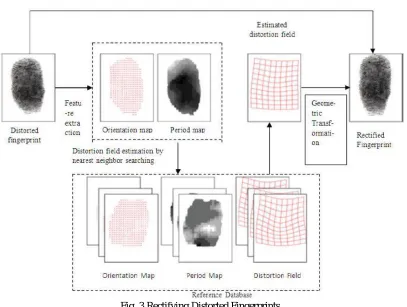
Fig. 3 Rectifying Distorted Fingerprints
Explanation
ISSN(Online): 2320-9801
ISSN (Print): 2320-9798
International Journal of Innovative Research in Computer
and Communication Engineering
(An ISO 3297: 2007 Certified Organization)
Vol. 4, Issue 10, October 2016
fingerprint, it can effortlessly rectify it into the normal fingerprint by relating the inverse of d. So it is needed to discourse a regression problem, which is moderately difficult since of the great dimensionality of the distortion field. In this paper, a nearest neighbor regression method is castoff for this assignment. The suggested distorted fingerprint rectification algorithm consists of mainly two different stages which are an offline stage and an online stage. In case of offline stage, a database of distorted reference fingerprints is produced by altering several normal reference fingerprints with numerous distortion fields sampled from the statistical model of distortion fields. In the online stage, given distorted input fingerprint, it will try to recover its nearest neighbor in the distorted reference fingerprint database besides then use the converse of the corresponding distortion field to resolve the distorted input fingerprint.
1) Generation of Distorted Reference Fingerprint Database: To produce the database of distorted reference fingerprints, it will use nref ¼ 100 normal fingerprints from FVC2002 DB1_A . The distortion fields are produced by consistently sampling the subspace spanned by the first two principle components. For each basis, 11 points are equally sampled in the interval [2,2]. for an example of generating distortion fields and applying such distortion fields to a reference fingerprint to generate corresponding distorted fingerprints. For visualization drive, single reference fingerprint (the fingerprint located at the origin of the coordinate system) is used to produce the database of distorted reference fingerprints, besides meant for each basis, five points are experimented. In run through, numerous reference fingerprints are used to achieve better performance.
2) Distortion Field Estimation by Nearest Neighbor Search: Distortion field estimation is equal to finding the nearest neighbor among all distorted reference fingerprints. The similarity is restrained centered on level 1 features of fingerprint, namely ridge orientation map and period map. We conjecture that distortion detection then rectification of authorities also relies on these features instead of minutiae. The correspondence calculation technique is dissimilar reliant on whether the upper core point can be sensed in the input fingerprint. If the upper core point is noticed, it interpret the input fingerprint by arrange in a line the upper core point to center point. Then we do a full search of u in the interval ½_30; 30 for the maximum similarity.
3) Performance of Distortion Detection: We view distortion detection as a two-class grouping problem. Distorted fingerprints are held as positive examples and normal fingerprints as negative examples. If case of distorted fingerprint is categorized as a positive sample, a true positive follows. And in case of normal fingerprint is ordered as a normal sample, a false positive happens. By altering the decision threshold, it can acquire the receiver operating characteristic (ROC) curve. The examination set of Tsinghua DF database contains 120 pairs of distorted and normal fingerprints. FVC2004 DB1 contains 791 normal fingerprints and 89 distorted fingerprints, which are found by visually examining the images. As we can see from this figure, the current algorithm performs much better. Even though most fingerprints can be appropriately classified, there are some false negatives and some of false positives. False negatives are mainly because the distortion is slight. Providentially, it is founded that this is not a severe problem since fingerprint matchers can successfully match to some extent distorted fingerprints. As the query fingerprint comprises minor distortion, the suggested detection process fails to spot it as distorted one, but the matching score among the query fingerprint besides the galley fingerprint is 305, a very precise matching score according to VeriFinger. If this query fingerprint is put right by the proposed rectification algorithm, the matching score can be further improved to 512. False positives are primarily due to low image quality, small finger area, or non-frontal pose of finger. In such circumstances, there is no sufficient information for correctly aligning and classifying the fingerprint.
VIII. CONCLUSION
ISSN(Online): 2320-9801
ISSN (Print): 2320-9798
International Journal of Innovative Research in Computer
and Communication Engineering
(An ISO 3297: 2007 Certified Organization)
Vol. 4, Issue 10, October 2016
FUTURE WORKS
Also our future work includes camera/projector lens distortion correction, to obtain more surrounding information and higher ridge depth precision of 3-D fingerprints. Furthermore, the same 3-D sensor may be used to capture face, hand and palm-print images and therefore is ideal for a fusion of comprehensive 3-D biometrics of humans.
Upcoming work compromises camera lens distortion correction, in order to obtain more environment information and higher 3D finger depth. Additionally, 3D sensor can be used to capture palm, face, hand images and consequently perfect for a 3D biometrics of human being.
REFERENCS
[1]Qinghai Gao, Xiaowen Zhang, “A Study of Distortion Effects on Fingerprint Matching ” Computer Science and Engineering 2012, 2(3): 37-42 . [2] Abhijeet A. Urunkar, “Survey on fingerprint distortion detection & rectification ”, International Journal of Science, Engineering and Technology Research (IJSETR), Volume 5, Issue 2, February 2016
[3] P.Krishna Sai, A.Dheeraj, “Recognition besides Adjustment of Inaccurate Fingerprints
Matching ”, International Journal of Research in Computer and Communication Technology, Vol 4, Issue 11, Nov- 2015.
[4] RAJESH PASHIKANTI, “A Novel Fake Fingerprint Minutia Matching Imaging Sensors Fabrication Materials”, ISSN 2319-8885 Vol.04,Issue.33, August-2015, Pages:6686-6691.
[5] Xuanbin Si, Jianjiang Feng, Jie Zhou, “Detecting Fingerprint Distortion from a Single Image ”, IEEE December 2012.
[6] Cleopas Officer Angaye, Oluwole Charles Akinyokun and Gabriel Babatunde Iwasokun, “EXPERIMENTAL STUDY OF MINUTIAE BASED ALGORITHM FOR FINGERPRINT
MATCHING”, CS & IT-CSCP 2013.
[7]Andrew W. SENIOR Ruud M. BOLLE, “Improved Fingerprint Matching by Distortion Removal”, IEICE TRANSACTIONS on Information and Systems Vol.E84-D No.7 pp.825-832, 2001.
[8] Xinjian Chen, Jie Tian, Senior Member, IEEE, and Xin Yang, “A New Algorithm for Distorted Fingerprints Matching Based on Normalized Fuzzy Similarity Measure”, IEEE TRANSACTIONS ON IMAGE PROCESSING, VOL. 15, NO. 3, MARCH 2006.
[9] Yongchang Wang, Qi Hao, “Data Acquisition and Quality Analysis of 3-Dimensional Fingerprints”, Member, IEEE.