1 INTRODUCTION
managerial staff, who within their competencies delegate tasks striving towards increasing organization’s profits, play a crucial role in every organization, regardless of its size or sector.
ese days, the key objective of management in an organization is appropriate staff organization oriented towards effective operation of the company. To this end, the system is adjusted so that it supports processes such as recruitment, assessment and maintenance of an employee on a position he successfully occupies. What seems of particular importance is the organization’s ‘possession’ of employees who have key competencies. is is why one should give particular attention to managerial staff and their competencies. To achieve satisfactory results, one should first familiarize himself with methods and tools which, by way of research, enabled their implementation in systems intended for the development of managerial competencies, by assessing and adjusting them to the opportunities for eliminating defects and improving the qualities of managers.
e article attempts to analyse selected research methods associated with managerial competencies, as researchers are not the only ones who work on the development of new techniques regarding managerial competencies, but such attempts can be also observed amongst commercial consulting firms. e reason behind the search for new tools are the growing requirements on the management staff market which becomes more and more competitive.
Journal of HUMAN RESOURCE MANAGEMENT
www.jhrm.eu • iSSN 2453-7683
Chosen methods and tools for measuring managerial competencies
Gabriela roszyk-Kowalska
A B ST r AC T
in contemporary enterprises, a lot of attention is devoted to notions regarding human capital in an organization, putting increasingly higher emphasis on specific professional competences, especially to managerial ones, which are crucial in efficient management of human resources. To achieve satisfactory results, it is at first worth to get familiar with methods and tools, which thanks to scientific research, can be implemented into systems of improving managerial competences, assessing them and adjusting possibilities of elimination of disadvantages and improvement of manager’s assets. e article embraces an attempt to analyze research methods regarding managerial competences, because not only scientific staff works on development of new techniques referring to managerial competences, as such actions may be also identified in case of commercial advisory companies. A reason for searching for new tools lays in continuously increasing requirements, especially within the already competitive market of workers of managerial personnel.
competences, managerial competences, methods and instruments for measuring competences K E Y W O r D S
J E L C o d e : m 5 2
CONTACT iNfOrmATiON:
2 THE ESSENCE OF MANAGERIAL COMPETENCIES
Competencies refer to a collection of predispositions of a given individual to take certain actions. managerial competencies include a selection of features necessary to perform some tasks specific to organizational positions. e possession and efficient use of such competencies enables effective staff management, which translates to the fulfilment of goals by the organization. e development of competencies is a permanent process which should be understood as continuous attempt to improve one’s professional qualifications (Witaszek, 2011). in this development process education and experience complement each other. However, sometimes they may exert negative influence upon the performance of tasks. One should remember that experience, in particular, may affect the competencies through acquired bad habits. e reasons for the development of competencies of managerial staff could be founded on external factors arising out of the objectives of the entity, adjusted to the external and internal environment, and on internal factors arising out of personal reasons (e.g. the need for self-improvement).
‘managerial competencies’ is a very broad concept. Contemporary literature distinguishes between various groups of competencies which can be further divided into two most significant ones:
a) basic competencies which include: cognitive skills understood as the ability to solve conflicts, the ability to adjust to the new surroundings, creativity; social skills which include good manners, conversation and negotiation skills; personal competencies such as conscientiousness, reliability, decision-making skills and stress management skills;
b) competencies of executive nature, such as: task delegation and motivation skills; the ability to plan and communicate tasks; the ability to manage a team and build a strong team composed of co-workers.
Other significant executive features include: a good knowledge of the sector, knowledge of sales techniques, and the ability to predict customer behaviour and needs, knowledge of foreign languages, being able to relate to the organization, general and professional knowledge.
One should note that competency is not a natural gift, but a quality developed by the managerial staff. One of competency development models was developed by maxwell (table 1).
Table 1: Competency development model
Source: compiled on the basis of: maxwell J. C., Tworzyć liderów, medium, Warszawa 1995.
e competency development model points to the way of development of specific competencies by, among others, the managerial staff. it should be pointed out that the above infographic applies to everyday life competencies, such as driving, as well.
e management systems currently in operation expect that the managerial staff will have leadership skills whose development is conditioned by individual approach. ese days, it is not easy to bring into prominence an appropriate ‘universal model of effective manager-leader’. However, the model of leadership competencies is effective insofar as it can be continuously improved (Witaszek, 2011). anks to effective leadership the organization will derive measurable benefits enforced by the features, skills and qualities of a good manager. Competencies which are universal for senior management staff were defined by ornton and Byham (Lévy-Leboyer, 1997):
a) verbal presentation, b) verbal communication, c) written communication,
d) analysis of organizational problems, e) identification of organizational problems,
f ) identification of problems beyond the organization, g) planning and organization,
h) delegating (tasks, rights, responsibility), i) control,
j) development of subordinates, k) sensibility,
l) influence over an individual, m) influence over a group, n) persistence,
o) negotiation skills,
unconscious incompetency: i don’t know what i don’t know
and what i can’t do
conscious incompetency: i know what i can’t do
conscious competency: i can if i pay attention
p) analytical sense, q) assessment skills, r) creativity,
s) the ability to take risks, t) decision-making skills,
u) technical and professional knowledge, v) energy,
w) openness to interests, x) initiative,
y) resistance to stress, z) adaptation skills, aa) independence, bb) motivation.
e complex and multidimensional concept of competencies comprises a selection of predispositions of a human being which determine the effective performance of actions and fulfilment of organizational roles which have a different scope and structure. for some types of actions and roles, very narrow predispositions are required, while for others, very wide ones. management theorists connect the concept of competencies with an action that determines the quality of performance of particular tasks (Turek & Wojtczuk-Turek, 2006).
e author assumes (based on the analysis of reference literature) that managerial competencies refer to predispositions within one’s general and specialist knowledge, skills, personal features and attitudes, qualifications and professional experience, which guarantee the efficiency and, as a result, effectiveness in the performance of professional tasks on an adequate level, which are undoubtedly important factors which influence the pro-market orientation (Wójcik-Kośla, 2013).
To sum up, managerial competencies include a wide spectrum of features, and no manager in the world can have them all. e features are different depending on the sector, specifics of manager’s work or the requirements laid down for a manager. One cannot generalize and determine which features are more and less important, or which are not significant at all. most of all, every manager should have the ability to acquire new competencies through the identification and closure of identified gaps.
3 THE METHODS OF MEASURING MANAGERIAL COMPETENCIES
Over the last years, based on conducted research studies and the results of cooperation with business sector, a few key tools emerged which can be used by human resources departments for the purposes of formulation and adjustment of particular systems to their needs. Among those one could list Assessment and Development Centres, the 90°, 180° and 360° method, mSAi questionnaire or the SHL’s manager test, the so-called Advanced managerial Tests.
e aim of the Assessment Centre is to identify the most desirable managerial competencies and predispositions based on the competency model and job description. e Assessment Centre continues as Development Centre. As a multidimensional assessment of key competencies in the company, whose aim is to identify the strengths and weaknesses of subjects in terms of the competency profile. e final report contains proposals of developmental solutions which enable the elimination of identified competency deficits.
us, a certain standard has been established which researchers continue to improve and define anew. is is a result of the ongoing revision of needs associated with the job market. e above-mentioned tools have many advantages, but they are not free from defects. e most important aspect, however, is that they enable one to see how the managerial staff views the need for constant improvement of its potential based on patterns and actions which come from within the organization and beyond it. e measurement of competencies often consists in observation and forecasting of behaviours which are indicators of the competencies being measured, but these are not always trustworthy. is is why the researchers perform tests whose aim is to define competency indicators to measure competencies. ese tests can be classified into two groups:
a) declarative tests – they consist in the manager’s own description of himself, which is often encumbered with a subjective perception, since they are based on self-assessment and are perceived as not very trustworthy tools for the assessment of competencies for the needs of professional selection (Smółka, 2016);
b) performance tests – they include tasks which require the subject to solve problems, exercises etc.
Another way of measuring managerial competencies is the Social Competencies Questionnaire developed by matczak. e questionnaire comprises ninety questions which enable the measurement of manager’s effectiveness in the performance of tasks. Sixty questions refer to actions for which a manager has to demonstrate that he/she has the ability to handle various social situations, which is assessed on an effectiveness scale from one to four. e questionnaire also enables the establishment of three detailed indicators which determine the level of competencies identified in social situations which require confidence and close interpersonal contact. e method is reliable and, more importantly, it enables a credible interpretation of results. e weakness of this tool is that the competencies are measured here with the questionnaire method, and due to this, the measurement is encumbered with self-assessment of the subjects, and this is why the questionnaire method can make it difficult for the researcher to reach the actual functioning of the subjects in social situations. However, on the other side, the weakness of the tool, related to such a method of measurement, is reduced thanks to the form of questions contained in the questionnaire, in which the subject is asked to assess his/hers personal effectiveness of functioning in actual social situations. Apart from this, it seems that the self-assessment of personal social functioning is strongly correlated to the actual social functioning (markowska, 2012).
Another tool used to assess managerial competencies is the mSAi (management Skills Assessment instrument) questionnaire. e questionnaire was developed by American researchers, Cameron and Quinn. e standards for the test were established on the basis of tests conducted on forty thousand managers. Original statistical analyses were used to assess the accuracy of the test. ose can have a wider application, e.g. in the conversion of the results of assessment of professional competencies. e test includes an analysis of managerial competencies required in four different areas of operation of a manager in an organization. ese areas include management of interpersonal relationships, teams and employee development; management of control systems, assimilation and coordination; motivating employees and promoting customer-oriented approach, management of competitiveness, innovation, future orientation and continuous improvement.
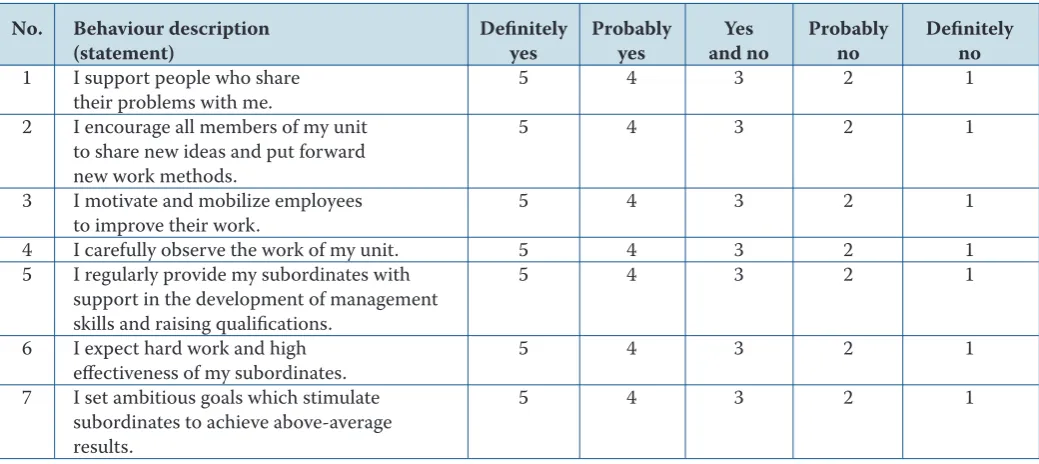
e mSAi questionnaire contains sixty descriptions of behaviours composed of twelve separated competencies. e assessment can be made by someone from the manager’s circle, or by the manager himself, on a five-point scale. e result is the average value from the descriptions included in a given category. Table 2. presents a part of the mSAi questionnaire.
Table 2: A part of mSAi questionnaire
Source: Jurek P., Kolenda J., 2011,Jak kompetentnie zmierzyć kompetencje?, http://testineo.wordpress.com/category/testy-organizacyjne/, 5. 08. 2014, after: Cameron K.S., Quinn r.E., 2003,Kultura organizacyjna – diagnoza i zmiana,Oficyna Ekonomiczna, Kraków.
e mSAi questionnaire is an introduction to the 90°, 180° and 360° assessment. is method, developed by Ward, is an objective technique due to the offered research opportunities. from the point of view of researchers, the tool engages a maximum number of consultees, which makes the assessment more reliable. e 90° method is the assessment made from the point of view of the superior. e 180° method engages the manager as well, while the most authoritative of the three, the 360° method, engages the immediate circle around the manager, including co-workers and customers. e method enables one to establish how the manager and his behaviour are viewed by various people. e person subject to the assessment is provided with only a general assessment, and the opinions
No. Behaviour description Definitely Probably Yes Probably Definitely (statement) yes yes and no no no
1 i support people who share 5 4 3 2 1 their problems with me.
2 i encourage all members of my unit 5 4 3 2 1 to share new ideas and put forward
new work methods.
3 i motivate and mobilize employees 5 4 3 2 1 to improve their work.
4 i carefully observe the work of my unit. 5 4 3 2 1 5 i regularly provide my subordinates with 5 4 3 2 1
support in the development of management skills and raising qualifications.
6 i expect hard work and high 5 4 3 2 1 effectiveness of my subordinates.
7 i set ambitious goals which stimulate 5 4 3 2 1 subordinates to achieve above-average
of other people are anonymous. e feedback is classified into four categories which refer to strengths, hidden strengths, areas for development and discrepancies.
e areas for development and strengths comprise expected results, i.e. such results in case of which the opinions of consultees are similar to the self-assessment made by the manager. e hidden strengths and discrepancies include data about which the respondents and the manager were not unanimous. e mSAi questionnaire makes room for formulation of many conclusions and, more importantly, identification of gaps which point to the competencies which have to be improved.
e SHL’s manager test, the so-called Advanced managerial Tests, is a relatively new competency measurement tool. e test was developed for the needs of companies which require the most advanced managerial skills identified with the use of an instrument measuring verbal and numerical skills. e series comprises three tests: Verbal information Analysis (VmT3) and Numerical Data Assessment (NmT2, NmT4). e VmT3 test evaluates the assessment, understanding, logical thinking, reasoning and summarization skills based on textual information. Whereas NmT2 and NmT4 tests evaluate the ability to solve numerical problems on the basis of various company financial and sales indicators. e task of the person subject to the test is to solve problems by using provided numerical data.
SHL was engaged to support Krispy Kreme in the introduction of a series of psychometric tools comprising Customer Contact Styles Questionnaire (CCSQ), Occupational Personality Questionnaire (OPQ32) and assessment centres composed of simulation and group exercises. e report from the tests and the questionnaire was written in the Krispy Kreme ‘language’ and it reflected the company’s organizational culture (Krispy Kreme, 2014). According to Krispy Kreme’s estimates, the cooperation with SHL and the use of measurement methods enabled the company to reduce the number of bad hiring decisions by 50%, while the involvement of the management staff was reduced by 10%. e new process enabled the company to avoid many costs, and it significantly reduced the amount of time spent by the managers on staff recruitment and selection. Krispy Kreme intends to introduce psychometric assessment tools in its other units (Krispy Kreme, 2014), and Stratton (Hr Director, Krispy Kreme) stated that it is clear that an assessment based on psychometric tools is a fair and objective method of identification of people who match the corporate culture and practices of Krispy Kreme (Krispy Kreme, 2014).
regardless of the competency analysis method selected, the first step is to define the key competencies for a given company and develop a measurement scale for them. is combination is usually referred to as the competency dictionary and matrix. it should be a point of departure for the development of assessment tools. it should be the key used to guide the assessment of participants of competency interviews, Assessment Centre, Development Centre, 360° assessment or competency tests. e company can attempt to develop the key on its own, or hire an expert. How can you do it? What should you do to make sure that the tools you develop will be useful?
first, one should select key competencies. it may emerge that the company cares about universal competencies which should be demonstrated by all employees of a company (general organizational competencies). Such competencies should be linked to the company’s strategic objectives. When making a description of competencies for a particular job position (e.g. for the purposes of recruitment for a given position) one should focus on the objectives towards which the person holding the position should strive. When selecting key competencies one should decide on the skills determining employee’s success at work. it is also important to define the notion of competency itself in an exhaustive manner. e establishment of a clear definition of competency often requires the contribution of many specialists, as the attempts at competency analysis both in its classic and contemporary form, and the interpretation of the concept, may turn out to be difficult (Kraśniak & roszyk-Kowalska, 2013). e diversity of definitions of competency offered by reference literature makes it even more difficult to come up with a universal definition (roszyk-Kowalska, 2014), and an incomplete definition of the notion of competency will translate to incomplete assessment, and, after all, this is contrary to the intentions of researchers and practitioners.
e competency system is a good foundation for activities in the area of recruitment and selection of managerial staff, as the competency structure supports the development of procedures for collecting information about job positions and candidates (Czapla 2011). Being in possession of a well-developed model, we have at hand information such as:
a) examples of model behaviours necessary for effective work on a particular job position; b) ready-made statements which can be used in job advertisements;
c) criteria to be followed in the course of selection of assessment methods, and development of procedures for the assessment;
d) model reference points important in the decision-making process; e) model feedback which can be used in the assessment process;
f ) a collection of criteria for monitoring selection (Whiddett and Hollyforde 2003).
4 CONCUSLION
e analysis of selected research methods is an evidence of development of works on solutions in this area. Not only academic researcher’s work on the development of new techniques, but such works are also taken up by commercial consulting firms. e reason behind the search for new tools for the measurement of managerial competencies is the gap which stimulates researchers, the cognitive curiosity of the researchers and the competitive market where the requirements continue to grow.
However, the condition for effective development of competencies is not the measurement method, but the quality of the education process realized in the organization. A training which misses the long-term objectives, differs from requirements set for the job, is conducted in an unordered manner, according to ready-made patterns, and at an inappropriate time, will not give rise to the development of managerial competencies and will fail to fulfil its motivational function in this respect (Witaszek, 2011).
in relation to the above, some postulate that the formulation of programs aimed at the development (improvement) of managerial competencies should start from the analysis of a particular job position, and based on such analysis (after consultations) should move on to the establishment of a list of components of a competency. e formulation of such a list is significant for the development of managerial staff as it facilitates the selection of managers with adequate competencies, constitutes a basis for objectification, assessment and making opinions, enables one to estimate the dissonance between possessed and desirable competencies, and constitutes a reference point for the design of competency development (Witaszek, 2011).
e existence of competency standards conditions the development of competencies (rakowska & Sitko-Lutek, 2000). e qualification (competency) standard refers to a type of norm which describes the scope and level of knowledge, skills and physical and mental features which are necessary to perform tasks specific to a given profession according to the requirements for basic job positions within a given profession. it is a norm accepted by the representatives of professional and trade-specific organizations, employers, employees and other crucial social partners (National Standards of Professional Qualifications 2014).
in conclusion, the analysis and assessment of the organization’s inside and its surroundings should be the condition for the application of various methods and tools for measurement of managerial competencies. it should be underlined that not only researcher’s work on the development of new methods of measurement of managerial competencies, but such works are also taken up by commercial consulting firms.
REFERENCES
Czapla, T. P. (2011). Modelowanie kompetencji pracowniczych w organizacji.Łódź: Wydawnictwo Uniwersytetu Łódzkiego.
Jurek P., & Kolenda J.Jak kompetentnie zmierzyć kompetencje?, https://testineo.wordpress.com/category/testy-organizacyjne/, 19.02.2016.
Jurek, P., & Kolenda, J. (2011). Jak kompetentnie zmierzyć kompetencje?. http://testineo.wordpress.com/cate-gory/testy-organizacyjne/, 5.08.2014, za: Cameron, K.S., Quinn, r.E. (2003).Kultura organizacyjna – diagnoza i zmiana.Kraków: Oficyna Ekonomiczna.
Krajowe standardy kwalifikacji zawodowych, http://www.mpips.gov.pl/praca/bazy-danych-mpips-dla-potrzeb-edukacji-i-pracy/modulowe-programy-szkolen-zawodowych, 31 maja 2014.
Kraśniak, J., & roszyk-Kowalska, G. (2013). Struktura procesowa. Uwarunkowania wdrażania. Poznań: Wydawnic-two Wyższej Szkoły Handlu i Usług.
Lévy-Leboyer, C. (1997). Kierowanie kompetencjami. bilanse doświadczeń zawodowych. Warszawa: Poltext.
markowska K. (2012).Psychologiczne uwarunkowania kompetencji społecznych, Wydawnictwo Liberi Libri.
maxwell, J. C. (1995).Tworzyć liderów. Warszawa: medium.
Narzędzia psychometryczne pomagają Krispy Kreme zmniejszyć liczbę błędnych decyzji rekrutacyjnych o 50%, http://www.shlpolska.pl/pdf/Case_Study_Krispy_Kreme.pdf, 9 maja 2014.
rakowska, A., Sitko-Lutek, A. (2000). Doskonalenie kompetencji menedżerskich. Warszawa: PWN.
Smółka P., Kwestionariusze osobowości jako narzędzia pomocne w ocenie kompetencji społecznych. Implikacje dla preselekcji kandydatów na stanowiska wymagające wysokich umiejętności interpersonalnych, http://kolegia.sgh.waw.pl/pl/KNoP/struktura/iKL/kwartalnikEEim/archiwum/Documents/21_Edukacja_21_ PaweSm3ka.pdf, 18.02.2016.
Turek, D., & Wojtczuk-Turek, A. (2006). Kompetencje człowieka – tradycja i współczesność. in: Konarski, S. (red.),
Kompetencje społeczno – psychologiczne ekonomistów i menedżerów.47-48. Warszawa: Oficyna Wydawnicza SGH.
Whiddett, S., & Hollyforde, S. (2003). modele kompetencyjne w zarządzaniu zasobami ludzkimi. Kraków: Oficyna Ekonomiczna.
Witaszek, Z. (2011). rozwój kompetencji menedżerskich przesłanką sukcesu organizacji. Gdynia: Zeszyty Naukowe Akademii marynarki Wojennej, rok52(4), 187.
Wójcik-Kośla, D. (2013). Kompetencje i zachowania kadry kierowniczej w sektorach o nasilonej konkurencji. in: