65 | P a g e
International Journal of Pharmaceutical
Development & Technology
e ISSN - 2248 - 910X
www.ijpdt.com
Print ISSN - 2248 - 9096TABLETING PROPERTIES OF THERMALLY ACTIVATED COW
BONE POWDER IN HIGH DOSE FORMULATION
Emenike IV
1*, Timothy SY
2, Okpanachi GO
1, Musa H
31
Department of Pharmaceutics and Pharmaceutical Microbiology, Faculty of Pharmaceutical Sciences, Gombe State University, Gombe, Nigeria.
2Department of Pharmacology and Toxicology, Faculty of Pharmacy, University of Maiduguri, Maiduguri, Nigeria. 3
Department of Pharmaceutics and Pharmaceutical Microbiology, Faculty of Pharmaceutical Sciences, Ahmadu Bello University, Zaria, Kaduna, Nigeria.
ABSTRACT
Activated cow bone powder was evaluated and found suitable as a diluent in the formulation of low and high dose drugs. This study was conducted in order to compare the diluent properties of dicalcium phosphate (DCP) and activated bone powder (ABP) in the formulation of high dose drugs. The mixed powders were pelletized with the specac pelletization machine, using a compaction force between 10-20 metric tonnes. A sample weight of 666 mg of the granules was used to calibrate the volumetric fill of the die using 12.5 mm punch and die set. The appropriate compression force which varied from 10-20 metric tonnes was applied to compress the granules into tablets. The formulated metronidazole tablet was evaluated for properties such as weight uniformity, thickness, crushing strength, friability, disintegration and organoplastic. Compressibility of the pellets increased with decrease in particle size fractions, and the ABP compressibility was found to be higher than that of DCP. The crushing strength of compacts formed, decreased with increase in initial particle size fraction. The disintegration times were within the acceptable time limit. The hardness of the tablets containing same formulation with ABP compared with DCP was higher in all cases. The friability values of formulations I and II of the tablets ranged between 0.4 to 0.8%, all within the value of not more than 1% standard, normally fixed by most tablet manufacturing industries. The tablet weight variations of <2% showed that the weights of the tablets were uniform. Activated cow bone powder was found to be better direct compressible diluents than the commercially available dicalcium phosphate for high dose drugs such as metronidazole.
Keywords: Formulation, Metronidazole, Activated bone powder.
INTRODUCTION
Aside the drug (active ingredients), a tablet also contains other substances called excipients, additives or adjuvant [1]. These substances are used in tablet production to impact aesthetic values, control drug release, enhance drug stability and give a suitable physical form to the tablet as well as mask unpleasant taste [2]. Banker and Anderson [3] and Rubinstein [1] have reported that the tablet is the most common oral dosage form used in this century. This might not be unconnected to the advantage the tablets affords both the manufacturers and the users [4]. Problems encountered in tablet production include capping/ lamination, chipping, sticking, picking and binding. These problems usually occur, due to improper formulation or lack of proper manufacturing processes. Various calcium phosphate salts being marketed for directly compressible purposes have been reported [5]. Roberts [6] and Adikwu [7] reported that bone is largely calcium phosphate salt in
the divalent form and could possess some directly compressible properties when micronised. Emenike and his colleagues [8] recently purified and utilized cow bones for tableting purposes. Activated cow bone powder was found to be better directly compressible diluents than the commercially available dicalcium phosphate in the formulation of folic acid (low dose drug) tablets [9]. Therefore, this study was embarked upon in order to evaluate the role of activated cow bone powder as a diluent in the formulation of poorly compressible high dose material such as metronidazole.
MATERIALS AND METHODS
Metronidazole tablet formulation containing ABP/DCP as diluent
To determine the diluent characteristics of ABP in high dose drug, metronidazole formulations containing
66 | P a g e
varying quantities of ingredients were constituted as shown in Table 1. In Formulation I, all the ingredients except magnesium stearate (lubricant) were admixed, pelletized and comminuted into granules. The lubricant was admixed as extra-granular excipient. ABP when compared to DCP was milled to 5 µm size so as to be comparable to the 4.5 µm size of DCP. This comparative diluents type effect for ABP and DCP was applied in formulation I and formulation II respectively. All ingredients were mixed, pelletized and tableted as described in folic acid formulation reported by Emenike and his colleagues [9]. However, compression forces of 10-20 metric tones were used for pelletization. A sample weight of 666 mg of the granules was used to calibrate the volumetric fill of the die using 12.5 mm punch and die set. The appropriate compression force which varied from 2-10 metric tones, was applied to compress the granules into tablets.
Mixing
The ingredients that were to be pelletized (see Table 1) were mixed together in the Z blade mixer by doubling titration mixing techniques, starting with the active ingredient. This required seven additions, each addition being mixed for one minute. The whole mixed powder was then mixed for three more minutes, making a total mixing time of ten minutes.
Pelletization
Approximately 2.5g weight of mixed powders was pelletized with the Specac pelletization machine, using a compaction force between 10-20 metric tonnes. The weight of the pellets was accurately determined with the mettler balance and the thicknesses of the pellets were measured by the micrometer screw guage. The pellets were comminuted with laboratory designed hammer mill, which hit the pellets at the same speed to crush through a 1.7 mm sieve clamped firmly to the round spouted edge of the stainless steel receptacle. The particles so produced were sieved through a stack of endecott sieves. The mean particle/granule size of the comminuted particles was estimated by relating the sieve mesh with the fraction of the weight of granules retained on the respective sieves.
Final mixing
The weight of extra-granular ingredients according to the desired percentage in Table 1 was added to the known weight of granules comminuted from the pellets in the cylindrical, planetary, tumble mixer, which was set to mix for a total of ten minutes.
Tableting
The weight of 666 mg of granules was put in the die of the 12.5 mm punch and die assembly of the Erweka single station tableting machine to calibrate the die fill volume and set the appropriate compression force which varied between 2 to 10 metric tonnes. The granules were then fed from the hopper and the tableting machine was set
to form tablets at a regular rate.
Evaluation of tablet properties Weight uniformity
Using the Mettler balance, 10 tablets were weighed together and then individually. The mean weight of the tablet and the percentage weight deviation from the mean weight was calculated. The extent of the percentage weight deviation from the mean weight was used as a measure of the tablet uniformity.
Tablet thickness
The tablet thickness was determined using the micrometer screw gauge. The mean of 10 readings was determined. Specific tablet thickness (ST) is defined as the thickness per milligram weight of the compact or tablet.
Tablet crushing strength
The crushing strength was determined with the Monsanto hardness tester. The mean of 10 readings was taken.
Tablet Specific Crushing Strength
Metronidazole tablet weighing 666mg with diameter of 12.5mm was produced in this study (Table 1). Since a comparison of the crushing strengths of a low and high dose tablet formulations is not possible because the two types of tablets (folic acid and metronidazole) had different mean weights and diameters, the crushing strengths were converted to specific crushing strengths (CSs) using this formula. CSS = CS (kg/force) / tablet weight (mg), where CSS is Specific crushing strength and Cs is Crushing strength.
Friability test
Friability test was carried out to determine the extent to which the tablets would withstand chipping and abrasion during transportation and normal handling. By this test, the standard used by most manufacturers is that loss in weight per 10 tablets should not be more than 1%. Ten tablets were dusted, weighed (Iw) and placed in an Erweka friabilator and set to rotate at 25 r.p.m. for 5 minutes. At the stop of the rotation, the tablets were removed and again dusted and re-weighed (FW). The difference in weight expressed in percentage, gave the value of Friability (F). Friability (F) = (1 - FW/IW)100 (Where F is percentage friability, Iw is initial weight of tablets, Fw is final weight of tablets).
Tablet disintegration
67 | P a g e
bath of distilled water maintained at 37oC. The time taken for the tablets to disintegrate was taken as the disintegration time for the batch.
Tablet organoplastic test
The tablets produced were carefully examined physically for any defects such as sticking, picking, capping, lamination, cracking, etc.
Table 1. Metronidazole tablet formulation containing ABP/DCP diluent, indicating composition of ingredients pelletized extra and intra granularly
S/No. Ingredients Content (%) Formulations
I II
1 Metronidazole 30.0 ●200 ●200
2 Diluent 44.7 ●300 ●300
3 MCC 20.0 ●131 ●131
4 SSG 5.0 ●33 ▲33
5 Mg. St. 0.3 ▲2 ▲2
Total 100.0 666.0 mg 666.0 mg
ABP* = activated cow bone powder, DCP* = marketed dibasic calcium orthophosphate powder
MCC = microcrystalline cellulose marketed as Vivapar®, SSG = sodium starch glycollate (super disintegrant), Mg.St. = magnesium stearate, ● = intra-granular ingredient, ▲ = extra-granular ingredient
Table 2. Comparative compressibilities of metronidazole formulation pellets using ABP and DCP as diluent
Formulation Inverse specific thickness
I ABP 0.80
DCP 0.78
II ABP 0.81
DCP 0.80
Table 3. Comparative properties of metronidazole granule formulations using ABP and DCP as diluent
Formulation
Intra-granular Extra-granular
Carr’s index (%)
Flow rate (g/s)
MGS (µm)
Carr’s index
(%) Flow rate (g/s)
MGS (µm)
I ABP 24.8 5.61 441 21.0 7.12 440
DCP 23.6 4.21 456 18.3 5.11 440
II ABP 20.2 7.78 503 27.2 6.42 429
DCP 22.2 7.70 478 24.0 6.31 401
Table 4. Comparative properties of metronidazole tablets using ABP and DCP as diluent
Formulation Weight
(mg)
Weight variation (+%)
Thickness
(mm) IST
CS
(N) DT (min)
Friability (% loss)
I ABP 667 1.5 4.30 0.153 88.2 1.7±0.5 0.5
DCP 668 1.0 4.45 0.149 78.4 1.0±1.0 0.4
II ABP 669 2.0 4.28 0.156 71.5 1.5±0.2 0.8
DCP 664 2.2 4.20 0.159 59.8 1.0±0.4 0.8
CS = Crushing strength, DT = Disintegration time, IST = Inverse specific thickness (103mm/mg),Formulation I & II (Table 1)
Table 5. Effect of particle size of diluent (ABP) on pellet properties of metronidazole formulations
ABP particle size (µm) Inverse specific thickness (10-3mm)
1000 0.83
500 0.80
355 0.76
250 0.79
180 0.83
90 0.81
68 | P a g e
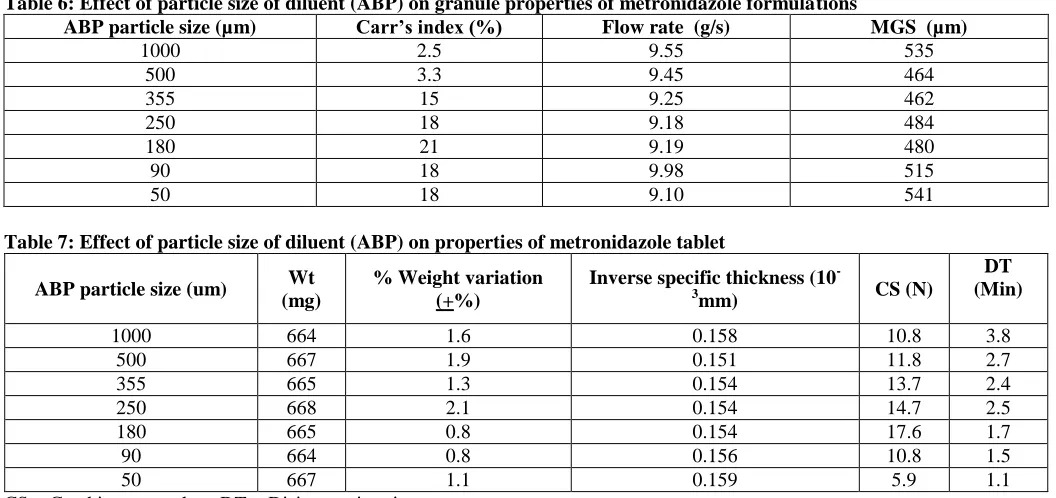
Table 6: Effect of particle size of diluent (ABP) on granule properties of metronidazole formulationsABP particle size (µm) Carr’s index (%) Flow rate (g/s) MGS (µm)
1000 2.5 9.55 535
500 3.3 9.45 464
355 15 9.25 462
250 18 9.18 484
180 21 9.19 480
90 18 9.98 515
50 18 9.10 541
Table 7: Effect of particle size of diluent (ABP) on properties of metronidazole tablet
ABP particle size (um) Wt
(mg)
% Weight variation (+%)
Inverse specific thickness (10
-3
mm) CS (N)
DT (Min)
1000 664 1.6 0.158 10.8 3.8
500 667 1.9 0.151 11.8 2.7
355 665 1.3 0.154 13.7 2.4
250 668 2.1 0.154 14.7 2.5
180 665 0.8 0.154 17.6 1.7
90 664 0.8 0.156 10.8 1.5
50 667 1.1 0.159 5.9 1.1
CS = Crushing strength, DT = Disintegration time
RESULTS AND DISCUSSION
The effects of ABP as diluent in metronidazole formulation on granules and tablet properties were studied (Table 1, 2). The pellets were compacted by 20MT force using a 12.5 mm punch and die, while 4MT force and 12.5 mm punch and die were used for the tablets. Compressibility of the pellets increased with decrease in particle size fractions. The highest compressibility was between 50 μm to 90 μm (fines), and much lower between 180 μm and 1000 μm. This is in agreement with the earlier statement that lower particle size fraction (fines) are more compressible than the larger particle sizes since they are already densely packed. Most of the energy of compression will therefore be used for rupturing of bonds and bringing the granules together for compaction unlike with the larger particle size fractions, where part of the energy will be used for densification. While for the tablets (Table 5-7), there is no appreciable difference for the different particle size fractions. This has also been stated earlier, that possibly after the first pelletization, there is no elastic recovery, so the granules become less compressible into tablets. This is attributable to the heat of activation that has destroyed the crystalline structure of the molecules and the potential for elastic recovery of the bonds. The higher the compressibility values, the harder the compact formed, so also is the crushing strength of the compacts formed. This is depicted in Table 7. The crushing strength of compacts formed decreased with increase in initial particle size fraction. This is in agreement with the compressibility trend of the various particle size fractions. The effect of the initial particle size of ABP as diluent on mean granule size (MGS) in this formulation (metronidazole), followed a similar trend as that of Folic acid formulation [9]. Between 50μm - 500μm, the
MGS produced, decreased with increase in initial particle size of ABP, while between 500 μm – 1000 μm, the reverse was the case, i.e. increase MGS with increase initial particle size fractions of ABP. For the initial particle size fraction of 50 μm – 500 μm, the finer the particles, the more compressible and harder the compacts formed, which on communition give larger MGS. For the larger (granular) initial particle size fractions, which are expected to be more porous, part of the force of compression will be used to densify the granules, before rupturing them for binding together. Depending on the porosity of the granules, which is higher with larger particles [11] the force left for rupturing and binding, would be lower. This probably caused the MGS increase with increase in initial particle size fraction of ABP.
In Tables 3, 4 and 5, the marketed DCP which has a particle size of 4.5 - 5 μm (as earlier determined), which was much lower than that of ABP had lower values of pellet and tablet compressibility as well as MGS. For tablet crushing strength, the DCP also had lower values as compared to those of ABP of small particle sizes. The values of the Carr’s Index, varied from 18 - 27% for the two formulations (Table 3). When the granules were mixed with extra-granular excipients, the flow rate of the granules changed. On mixing with only magnesium stearate, in formulation I, the flow rate increased but when formulation II was mixed with sodium starch glycolate and magnesium stearate, the flow rate of the granules decreased.
69 | P a g e
[12]. By so doing, the resistance to flow by friction is greatly decreased, resulting in increased flow rate. In the case of extra-granular admixture of sodium starch glycolate and magnesium stearate together, the amount of fines had increased. This is more than enough the particles could adsorb on the granules. Therefore, there is expected to be some stagnation or impedient to granule flow. In fact, this has been corroborated by the effective decrease of MGS after the admixture. The particulate flow rate on account of lower surface area to volume ratio for bigger particles, while decrease with finer particle sizes were impediments to flow, are all surface phenomenon [12]. The granule flow rate is fast enough [13] in ensuring uniformity of flow rate of granules into the die. This would assure uniformity of tablet weight, provided that the size distribution of the granules was uniform. The mean particle size of the granules was shown to be high enough (about 400µm size) for fast flow of the granules.
The weight variation of the tablets in the Table 4 was about 2%, meaning that the tablet weight distribution was highly uniform. The 2% range is within more of statistical limits of error, and could not be due to granule size effect. Tables 2 and 4 showed the compressibility of the tablets and pellets containing ABP compared with those containing DCP, ABP was slightly more compressible than DCP. The compressibility was appreciably higher, when magnesium stearate was the only extra-granular excipient, and only slightly higher when sodium starch glycolate and magnesium stearate together were the extra-granular excipients. In other words, the presence of sodium starch glycolate, more or less masked the comparative compressibility of pellets. However, in the two tableted formulations, there was no much difference between the compressibility of ABP and DCP diluents. Possibly, this is due to extra-granular content effect of the granules that were tableted.
The disintegration times of the tablets were between 1.0 minute as the minimum and 1.7 minutes as the maximum. When it is considered that the compendial disintegration timer of not more than 15 minutes is taken note of, the disintegration time was good enough, by virtue of the formulation and by the virtue of the dry granulation process which is well acknowledged to cause fast disintegration of tablets. Dry processed granules do not have aggregates of bound particles as in wet processed granules. Dry processed granules also have longer channel of capillaries than wet processed granules [11], and therefore in tablets processed from dry process granules where there are longer and narrower channels of capillaries, there will be faster entry of disintegrating fluid, by enhanced capillary forces. This leads to much faster disintegration rate experienced with dry processed tablets.
The friability values of formulations I and II of the tablets as in Table 4 range between 0.4 to 0.8%, all within the value of not more than 1% standard normally fixed by most tablet manufacturing industries. The friability of dry processed tablets on the other hand is normally higher than
those processed through wet granulation [14]. This characteristic behaviour is thought to be attributable to attachment of finer particles onto the surface of the tablets, which could easily be abraded during handling and transportation as exemplified by the scooping and banging in the friability tester.
In Tables 5 and 7, it is shown that as the particle size increases from 355µm to 1000µm, for the pellets and 500µm to 1000uµm for the tablets, compressibility value increases. In contrast, as the particle size increases from 50µm to 355µm and 500µm respectively, the compressibility value decreases. This can possibly be attributed to density or porosity of the particles. The consolidation/densification initial phase of compression appears to be the rate-limiting step. The consolidation of the particles is the stage that just precedes the fracturing and binding. At that stage, larger particles have higher compact / binded solid volume to surface area ratio. So the compacting force would enhance the binding of the compacts, which is higher compressibility. The finer the particles, the less porous they become. That is to say that the particles are more closely packed together, therefore, little part of the compaction force is needed for consolidation. The higher energy of compaction left would fracture and bind more particles snugly together. This is probably why there is higher compressibility with finer particles having the same force of compaction compared to the larger particles.
The compressibility of the granules produced from pellets with different initial particle size fractions of diluents was not significantly different, especially the formulation that had intermediate particle size that were produced from ABP initial particle sizes from 180 to 500µm size which produced the mean granule size of 473µm. This could be the reason why the tablet compressibility from pellet derived granules containing initial ABP particle of 180 to 500µm particle size produced the same range of compressibility as shown in Tables 5 and 7.
70 | P a g e
shows the effect of diluent particle size on tablet disintegration time. The disintegration time is shown to be directly related to the particle size, i.e. decreases with increase in particle size fractions. Tablets formed from larger initial particle size are more porous with wider pore size, known to have lower capillary force and therefore slower disintegration time.
CONCLUSION
Formulation studies showed that ABP is better directly compressible diluent than the commercially available DCP for high dose drugs such as metronidazole tablets.
ACKNOWLEDGEMENT
The authors are sincerely thankful to laboratory staff of the Department of Pharmaceutics and Pharmaceutical Microbiology, Faculty of Pharmaceutical Sciences, Ahmadu Bello University Zaria for their technical assistance and support.
CONFLICT OF INTEREST
The authors declare that they have no conflicts of interest.
REFERENCES
1. Rubinstein MH. Tablets Aulton Pharmaceutics; science of dosage form design. Churchil Livingstone, London, 1988, 304-321.
2. Okhamafe AO, Igboechi AC, Ubrufitih CE, Akinyemi BO, Ighalo MO. Cellulose extracted from groundnut shell, and risk hust 2. Pharm World J, 9(1), 1992, 11-16.
3. Banker GS, Anderson NR. Theory and Practice of Industrial Pharmacy, Third Edition, Lea and Febiger, Philadelphia USA, 1986, 293-345.
4. Akande OF. Evaluation of millet starch as tablet binder and disintegrant. MSc Pharmaceutics Thesis, Ahmadu Bello University Zaria, Nigeria, 1988.
5. Conflat P, Bathelomy C, Uyot-Herman AM, Guyot JC, Shemmoud A. What is behind the marketed tricalcium phosphate? S.T.P. Pharma Sci., 7(4), 1997, 282-288.
6. Roberts MBV. Tissues, organs and organization, A functional approach. 2nd Edn. ELBS Low-priced Edition, London, 1978, 32-46.
7. Adikwu MU. Tableting properties of pulverized bones. MSc Pharmaceutics Thesis, Ahmadu Bello University, Zaria, Nigeria, 1988.
8. Emenike IV, Ibrahim YKE, Ojile JE, Timothy SY, Musa H. Production and evaluation of thermally activated cow bone powder as direct compressional tablet excipient. International Journal of Advanced Pharmaceutics, 6(1), 2016a, 7-12. 9. Emenike IV., Ibrahim YKE, Timothy SY., Musa H. Tableting properties of thermally activated cow bone powder in low dose
formulation. Asian Journal of Pharmaceutical Science and Technology, 6(2), 2016b, 63-70.
10. British Pharmacopoeia. Her Majesty’s Stationary Office, University Press, Cambridge, England, 1993.
11. Ojile JE, Selkirk AB, Macfarlane A. Some factors affecting solute migration in granular beds. Int J Pharm, 5, 1980, 207-213.
12. Agada E. Investigating the mechanism of particulate activities during sieving and lubrication of paracetamol granules for tableting. MSc Pharmaceutics Thesis, Ahmadu Bello University, Zaria, Nigeria, 1999.
13. Staniforth JN. Powder flow Aulton Pharmaceutics; the science of dosage form design. Publishers ELBS/Churchill Livingstone, Hong Kong, 1990, 248-613.