Generational similarities in work values of generations X, Y and Z
Shanna D. Dick
A B ST R AC T K E Y W O R D S
Journal of HUMAN RESOURCE MANAGEMENT
www.jhrm.eu • ISSN 2453-7683
1 INTRODUCTION
Human resources professionals (HRPs) and managers must understand the generations’ work values, and the similarities and differences between them, to effectively lead an organization (mencl & Lester, 2014) as today’s workforce includes the traditionalist generation, baby boomer generation, Generation X, Generation Y, and Generation Z. Employees exhibit unique work values respective to their generation which drive differing views in an organization and present managerial opportunities and challenges (Chen & Lian, 2015; Locmele-Lunova & Cirjevskis, 2017; Lyons & Kuron, 2014).
The idea of a generational cohort was established in the 1940s and is used to define the group of individuals born during the same timeframe (Woodward, Vongswasdi & more, 2015). The definition of a generation has numerous meanings in the academic literature; however, the most commonly used definition of a generation is a cohort of individuals who share similar birth years, significant life events, and shared historical atmospheres throughout their critical developmental years and as they collectively move through life (Amayah & Gedro, 2014; Clark, 2017). mannheim’s theory defines generations as a group of people who identify with location, historical-social process, and patterns of experience (mannheim, 1952; Padayachee, 2018).
e traditionalist and the baby boomer generations are retiring, or nearing their retirement age, leaving much of the workforce to be members of Generation X, Generation Y, and Generation Z. Having five generations present in the workforce creates a unique dynamic given their differing views on workplace values. To increase retention and motivate top talent, froese (2013) stated HRPs should create an atmosphere that corresponds with the work values of future employees. HRPs and managers must successfully lead their organization without treating generations of employees differently because of their diverse work values (Dixon, mercado & Knowles, 2015).
Jiri (2016) posits the most significant challenges for managers in the 21st-century workplace are the generations’ differences. Viewing work as an adventure in which they work to live, the baby boomer generation is known as the workaholic generation desiring in-person communication, quality work, and personal fulfillment
Human resources professionals (HRPs) must understand generational work values to lead organizations. While this study acknowledges the generations’ differences in work values throughout the academic literature, its purpose is to identify the similarities in work values between Generations X, Y, and Z employees to provide HRPs the basis for employee motivation. HRPs should be cognizant of individual differences and not focus solely on generational differences and recognize stereotyping of generational differences in the workplace. It is recommended that HRPs motivate employees based on their individual needs, monitor stereotypes in the workforce, and remain committed to employee flexibility. is study’s research purpose, approach, and results prove there are more similarities than differences.
personnel, personnel management, generations, work values, motivation, generation X, millennials.
J E L C o d e : m 5 , m 5 3 0 , m 5 4 0 manuscript re ceive d 15 July 2019 Accepted after revisions 10 October 2019
CONTACT INfORmATION:
Shanna D. Dick / Northcentral University, United States of America / [email protected]
Journal of HUMAN RESOURCE MANAGEMENT
www.jhrm.eu • ISSN 2453-7683
from the workplace whereas Generation X views work as a contract (Jiri, 2016). maintaining self-reliance and a solid work-life balance, Generation X prefers direct and immediate communication and is skeptical of management (Jiri, 2016; Rani & Samuel, 2016). However, mencl and Lester (2014) reported there are more similarities than differences between the generations such as the desire for a challenging job in which the manager consistently provides feedback in addition to the job being financially rewarding with room for career advancement. Employee productivity and turnover drive workplace morale; therefore, HRPs should be aware of the differences in employee work values before the organization’s effectiveness is jeopardized (Ramkumar & Priyal, 2013). Chow, Galambos, and Krahn (2017) stated employees could predict their work values as early as age 18; therefore, Generation Z is determining its work values as it enters the workplace. As the multigenerational workforce continues to evolve, HRPs and managers should acknowledge and celebrate the similarities and differences between the generations to foster high-functioning and effective teams (Bencsik, Horvath-Csikos & Juhasz, 2016; Eastland, 2015).
Individuals may overemphasize the differences between the generations due to their life stage; however, the literature unveils differences between the generations (Anderson, Baur, Griffith & Buckley, 2017; Lyons & Kuron, 2014). These differences in work values cause conflict in the workplace. The differing life stages or generational cohorts exhibit unique characteristics that affect staffing strategies and effectiveness (Joniakova & Blstakova, 2015). Generation Y and Generation Z have rewritten the procedures for how human resources management should function to remain competitive in today’s job market (Bencsik et al., 2016). Conflict can result from varied value systems, behavioral patterns, and character traits across the generations. Eastland and Clark (2015) confirmed the unavoidable conflict and distress that happens in a workplace when employees do not value and respect generational differences. When there is miscommunication in the workplace, work-value conflict can ignite between the different generations of employees (Hillman, 2014). Critical to the telecommunications industry, the conflict in work values can lead to decreased motivation (Kukreja, 2017). When this happens, employee motivation challenges managers to provide quality supervision in a workplace comprised of multigenerational employees. Joniakova and Blstakova (2015) reported staffing idiosyncrasies between the generations, which leads HRPs to adopt personnel policies to be in accordance with respective generations’ differences; however, Bencsik et al. (2016) stated the cooperation and co-working of the generations provides not only conflicts but also positive results for the organization such as more significant potential for increased communication.
2 PROBLEM AND PURPOSE
The problem addressed by this study was to determine the significant differences in work values between Generation X, Generation Y, and Generation Z for HRPs to develop targeted motivational strategies for the multigenerational employees of the telecommunications industry. froese (2013) stated work values are evaluative standards relevant in the workplace. There have been dramatic changes in work values from the baby boomers to Generation Y (Anderson et al., 2017; Twenge & Kasser, 2013). Chen and Lian (2015) discovered a marked difference between the work values of baby boomer employees and Generation Y employees. The baby boomers are workaholics achieving their identity through work performance; whereas, Generation Y values flexible work schedules to create a more family-centric lifestyle (Wiedmer, 2015). There is a minimal number of Generation Z employees in the workplace; therefore, their workplace values and problems are not as easily identified as their preceding generations (Bencsik et al., 2016). With opposing views, attitudes, and behaviors, the three generations differ in their perception of organizational commitment, professional goals, workplace values, and issues related to balancing professional work with personal lives. These generational cohorts display different ways of thinking, different behaviors, different attitudes, different perceptions of flexibility, and different levels of technical knowledge; all of which lead to workplace conflict (Bencsik et al., 2016). HRPs should explore the difference in the generations’ work values in order to motivate their multigenerational employees.
3 LITERATURE REVIEW
generation’s work motivation; however, this study discovered increased similarities between the work values of the three generations. The scholarly literature was reviewed to identify the differences between Generation X, Generation Y, and Generation Z in the workplace with an emphasis on work values and motivation. The literature review is separated into the following thematic areas: the theoretical framework, generational cohorts and differences, motivating a multigenerational workforce, and work values of a multigenerational workforce.
3.1 THEORETICAL FRAMEWORK
The theoretical framework for this study is Abraham maslow’s hierarchy of needs theory. Research supports maslow’s theory that an individual’s need acts as a motivator (Babic, Kordic & Babic, 2014; Zargar, Vandenberghe, marchand & Ayed, 2014; Zameer, Ali, Nisar & Amir, 2014); therefore, this theory can assist HRPs in determining motivational strategies to use with the multigenerational workforce. maslow’s hierarchy of needs was selected over Herzberg’s two-factor theory and other motivational theories because of its close alignment to intrinsic and extrinsic motivation and job satisfaction. In 1991, Howe and Strauss furthered mannheim’s generational theory by viewing generations in a cyclical manner (Howe & Strauss, 1991); however, these theories do not encapsulate the work values and motivation component to this research study. HRPs can utilize maslow’s theory when studying employee retention and talent acquisition. When considering employee performance and business management, Jerome (2013) used maslow’s hierarchy of needs theory. In doing so, employers discovered they should adjust their leadership styles to promote employees’ self-actualization (Jerome, 2013). Atan, Raghavan, and mahmood (2015) used maslow’s theory when studying employees in a manufacturing environment and explained the employees’ performance levels increased through actualization. for employees to achieve self-actualization on the job, employers must ensure the employees fulfill their physiological and safety needs (Atan et al., 2015). Individuals must meet their physiological and safety needs before ascending the pyramid in pursuit of self-actualization (maslow, 1943). In the study of employee retention and human motivation, maslow’s theory is one of the most extensively acclaimed and referred theories (Adiele & Abraham, 2013).
maslow’s theory provides a significant contribution to management research and employee behavior because of the practical implication of the hierarchy of needs (Kaur, 2013). Theories on motivation are scholarly sources for employers and HRPs to discover the levels of motivation which lead employees to act (Lee, Raschke & St. Louis, 2016). It is critical for employers to assist employees with their self-actualization journey if they want to achieve desired workplace results (Kaur, 2013). Additionally, if employers want to increase employee retention and boost organizational success, it is paramount they understand the five levels of maslow’s hierarchy of needs to assess the employees’ developmental and motivational needs.
3.2 GENERATIONAL COHORTS AND DIFFERENCES
Employees are associated with different generational cohorts determined by the year they were born, and the cohorts have specific differences germane to the respective generation. The historical events that occur during an employee’s formative years affect how they perceive the workplace (Twenge, Gentile & Campbell, 2015). This section will address the generational cohorts, describe the historical events which affected the formative years of the generational cohorts and discuss the stereotypes associated with each generational cohort.
As the workplace structure continues to evolve, three generations are simultaneously working together to achieve the common business goal (Jora & Khan, 2014). Ledimo (2015) stated the differences in values, historical experiences, beliefs, and social experiences between the generational cohorts would affect their professional and workplace interactions which can have a negative impact on employee performance and employee retention. Because the generational cohorts use a categorical approach, the timeline for each cohort is subjective as opposed to scientific (Wang & Peng, 2015). This scientific research study will not be negatively affected by the categorical approach because the difference in birth years does not affect the generational cohort descriptions.
STEREOTYPES
Campione (2015) stated there are differences across the generations; however, it is paramount to understand if the difference is attributed to the generation or the individual’s age and maturation level. The individuals of Generation X have been stereotyped as not wanting to climb the corporate ladder; however, they are loyal to the organization for which they choose to work (Al-Asfour & Lettau, 2014; Gilley et al., 2015). Exhibiting little desire to stay in the same position with the same employer for two decades, the individuals of this generation want to reap the benefits of higher paying jobs earlier in their careers (Hernaus & Poloski Vokic, 2014). In other studies, it is noted that members of this generation are not loyal to the organizations for which they work (Karsh & Templin, 2013). However, Al-Asfour and Lettau (2014) confirm how motivated Generation X individuals are in the workplace. Because this generation had to be independent during the formative years due to single-parent homes or dual working parents, it is stated these individuals are more cynical than other generations (Bianchi, 2014; DeVaney, 2015; Karsh & Templin, 2013; Sutton-Bell, Hamilton, mcminn & Bell, 2014).
Challenging to manage, Generation Y employees want to start working in their dream position as opposed to starting in an entry-level position and working their way up (Akkucuk & Turan, 2016; Kong, Wang, & fu, 2015). Considered high-maintenance employees, these individuals want clear direction, immediate feedback, and constant managerial support while maintaining their autonomy in the workplace (Latkovikj, Popovska & Popovski, 2016; Vanmeter, Grisaffe, Chonko & Roberts, 2013). Speaking their mind and asking numerous questions, Generation Y employees have a short attention span, need instant gratification, and yearn for entertainment in the workplace (Bolton et al., 2013). Because this generation of employees was not taught how to be independent during their childhood, they need constant reassurance, feedback, and support in the workplace (Weirich, 2017). Self-interested and overconfident, Generation Z is stereotyped for always being online and connected virtually (Puiu, 2016; Stanton, 2017). Because of their obsession with being online, this generation lacks personality and is confused (Chicca & Shellenbarger, 2018; Seemiller & Grace, 2016; Stanton, 2017); however, Tulgan (2013) stated this generation expects humor from supervisors in the workplace. Stereotyped as theemoji-onalgeneration, this generation frequently uses emojis to express their emotions (Puiu, 2016). Tulgan (2013) stated Generation Z individuals are stereotyped with an escapist mentality in that they escape the pressures of reality by playing video games, and they remain continuously tethered online. Understanding these stereotypical traits about Generation Z will assist HRPs in motivating this generation and ultimately retaining them in the organization.
3.3 MOTIVATING A MULTIGENERATIONAL WORKFORCE
It is essential to understand why employees leave an organization; but, to understand why employees choose to remain with an organization is paramount to the organization’s overall success (George, 2015). George (2015) confirms that retaining top talent eliminates the costly detriment of turnover which impacts sourcing, recruiting, selecting, hiring, onboarding, orienting, and training. Pandta, Deri, Galambos, and Galambos (2015) stated employees’ motivation is the critical component to their overall performance levels and their decisions to remain with an organization. maslow’s hierarchy of needs theory posits unsatisfied needs motivate behavior to the dominant need (Sandrick, Contacos-Sawyer & Thomas, 2014).
An employee’s motivation directly affects his/her productivity level in turn affecting the company’s competitive advantage (Islam & Ahmed, 2014). Tillott, Walsh, and moxham (2013) proved there is a relationship between workplace satisfaction, employee engagement, and empowerment. When employees are not motivated, their performance is negatively affected, their co-workers are negatively affected, and their overall work demeanor will lead to burn out over time (Khan, Khan & Zakir, 2016). The manager’s primary goal is to create cohesive teams composed of employees who work efficiently and effectively, while producing positive results that have a positive impact on the overall bottom line (Pandta et al., 2015). As managers are responsible for creating dynamic teams of employees, they should understand how the different generations of employees are uniquely motivated thereby capitalizing on the multi-generational workforce’s unique characteristics which are exemplified in their teams of employees (Eastland & Clark, 2015). Award and reward systems should be updated to reflect the different motivators of a multigenerational workforce (Chekwa et al., 2013; Giaque, Anderfuhren-Biget & Varone, 2013). HRPs must work in conjunction with organizational leaders to determine feasible motivators and how frequently they should be used (Islam & Ahmed, 2014).
and increased responsibility (Islam & Ahmed, 2014). Generation Y prefers more overtime than Generation X as Generation X values work-life balance more than the money generated from working overtime (Becton, Walker & Jones-farmer, 2014). Generation Y has different work expectations and requirements when compared to other generations (Gordon, 2017; Johnson & Johnson, 2016). They seek immediate feedback, want a structured working environment, and must have daily supervision (Johnson & Johnson, 2016; Özçelik, 2015). This generation is status conscious, and money motivates them to belong to a certain status (Kultalahti & Viitala, 2014). To motivate the millennial employees, managers must frequently communicate work expectations, and when the expectations are met or exceeded, the managers must immediately and frequently recognize and applaud the employees for their work (Clark, 2017; Gordon, 2017; Johnson & Johnson, 2016). When it comes to workplace motivation, Generation Z is different from Generation X and Generation Y. Gordon (2017) posits Generation Z desires nominal face-to-face supervision. managers can succeed in motivating this generation by electronically communicating with them through text messages, instant messages, or emails as opposed to in person (Clark, 2017). Eastland and Clark (2015) confirm Generation Z’s desire to know their work adds value to the organization which is a motivational tool for managers.
Of the three Generations X, Y, and Z, Generation Y needs the most hands-on, face-to-face motivational inspiration from their managers (Stewart, Oliver, Cravens & Oishi, 2017). Acar (2014) reports all generations value intrinsic rewards. However, due to this generation’s sense of entitlement, they expect immediate and frequent rewards for their work (Stewart et al., 2017). muthuveloo, Basbous, Ping, and Long (2013) discovered recognition plays a crucial role in Generation Y’s employee engagement. Appealing to Generation Y’s ownership of work, responsibility, and sense of worth, the rewards they seek are not always cash-based; instead they seek intrinsic rewards such as knowing their manager perceives their work as important (Alexander & Sysko, 2013; Rajput, marwah, Balli & Gupta, 2013).
In contrast, Neckermann and frey (2013) stated monetary awards and rewards have a significant impact on motivation for Generation Y. Kultalahti and Viitala (2014) stated Generation Y demonstrates increased motivation from work composition in that these employees seek new, short-term projects in addition to flexible, as opposed to stringent, scheduling options in the workplace. managers can motivate this generation by providing them with ample time to cultivate close working relationships with colleagues and supervisors (Kilber, Barclay & Ohmer, 2014). Another motivational factor for Generation Y is through formal recognition programs in the workplace (Neckermann & frey, 2013). Because this generation grew up in an era where every child on the sports team received a trophy for participation, they are not accustomed to the rigorous competition other generations faced during their formative years (Alexander & Sysko, 2013). Because of the trophy mentality and the case made through the literature that Generation Y desires such praise into adulthood, formal recognition programs in the workplace motivate this generation (Stewart et al., 2017). Neckermann and frey (2013) discovered a higher motivational factor for Generation Y when their rewards and awards were publicized and incorporated into a ceremony with fanfare. To satisfy their need for competition and praise, employees who seek extrinsic rewards will continually strive for publicized recognition (Achilles, Blaskovich & Pitre, 2013). Peters, Lau, and Ng (2014) stated this generation appreciates a fair rewards and awards system but must receive recognition for all the work they individually accomplished.
3.4 WORK VALUES – MULTIGENERATIONAL WORKFORCE
Contributing to the intricacy of the workplace environment, the differences in work values between the multiple generations in today’s workforce present challenges for the organizational leadership, managers, and HRPs (Yarbrough, martin, Alfred & mcNeill, 2016). This research study is different from other published studies because it includes Generation Z, the up and coming generation to challenge HRPs in today’s workplace. Work values are the factors that influence employees’ behavior and their motivation while at work (Ueda & Ohzono, 2013). Choi et al. (2013) note work values as an individual’s needs and reinforced preferences which are satisfied by their role in the workplace. Popovska, Latkovic, Jakimovski, and Popovski (2015) stated work values change over time and are the justification for individuals’ and generational cohorts’ behaviors and opinions. An employee’s work values directly impact career choice and career development (Choi et al., 2013). To promote employee motivation, transparent communication, and intergenerational synergy, managers must understand each generation’s foundation of work values (Gursoy et al., 2013).
workplace; whereas, the millennials question every directive and policy to understand why policies are made and why they are asked to perform certain tasks (Rajput, marwah, Balli & Gupta, 2013). Another difference in work values is noted in work-life balance which has shifted over the years. Generations preceding Generation X had a primary focus on work; whereas, Generation X and Generation Y desire more of a balance between their personal and professional lives (Bush, 2017; Kroth & Young, 2014). Kroth and Young (2014) stated the older generations viewed work as a critical component to and an important extension of their lives, but Generation X and Generation Y view work as the necessary means to achieve their ambitions. Several studies confirmed the foundational points that drive millennial employees to find employment elsewhere include autonomy, personal freedom to balance work and life, and have a flexible work schedule (Coates, 2017; Queiri, Yusoff & Dwaikat, 2014). Employer loyalty is another work value that has shifted with the generational cohorts. Bush (2017) stated Generation Y employees do not stay with the same employer for the length of their career. To adjust to the newer generations’ needs, managers should cultivate loyalty through robust mentoring and coaching proving the company’s plan for the employee’s future growth (ferri-Reed, 2014; Weirich, 2017).
Additional research proves there are similarities in how the generations relate their work values (De meuse & mlodzik, 2010; fatima, Shafique, Qadeer & Ahmad, 2015; Johnson & Lopes, 2008; montana & Petit, 2008; Peachey, Burton, & Wells, 2014; Peltokorpi, Allen, & froese, 2015; Radford & Chapman, 2015; Wesner & miller, 2008; Yang & Guy, 2006). Older research studies prove more similarities than differences in attitudes and work values between the generations (Deal, 2007; furnham, 1982; Jurkiewicz, 2000; Singer & Abramson, 1973; Tang & Tzeng, 1992). There is no significant difference between the appraisal of work values of the baby boomer generation and Generation X (Yang & Guy, 2006). Generation X and Generation Y share the same work motivators including opportunities for promotion and continuous employment (De meuse & mlodzik, 2010; montana & Petit, 2008). Additionally, the level of workplace commitment is the same across the generations (Johnson & Lopes, 2008), and Generation Y has similar needs to the baby boomer generation (Wesner & miller, 2008).
4 RESEARCH METHOD
is research study’s underlying hypothesis was that there is a difference in motivation for employees due to the difference in work values for each generation. Prasad et al. (2007) categorized the 11 employment arrangements on the Employment Arrangement Survey into three categories of work values which are work security, achievement, and flexibility; therefore, the work values identified by this research study were work security, achievement, and flexibility. In parallel with the research problem statement and purpose, there were three research questions and corresponding hypotheses supporting this quantitative research study.
RQ1. Are there differences in the way Generation X, Generation Y, and Generation Z value work security?
RQ2. Are there differences in the way Generation X, Generation Y, and Generation Z value achievement?
RQ3. Are there differences in the way Generation X, Generation Y, and Generation Z value flexibility?
5 POPULATION AND SAMPLE
e target population for this research study was the employees of a telecommunications company located in the northeastern United States. e company provides telecommunications cabling and equipment modernization services for the private sector. e population size for the company was 100 American professional employees from Generation X, Generation Y, and Generation Z. e population can be narrowly or broadly defined according to Delost nad Nadder (2014). According to Cozby and Bates (2012), if the population increases, the sample size necessary to gain the same result will not significantly fluctuate or compromise the validity. is study achieved a 95% confidence level with a 5% margin of error by using a minimum sample size of 80 participants where the independent variable was the generational cohort, and the dependent variable was the work values. ere were 81 employee participants who responded to the survey. Two respondents did not provide any answers beyond the first question of the survey; therefore, the final sample size used for investigating the research questions had 79 participants that provided answers to the survey questions.
6 INSTRUMENTATION
research at only one employment place in the telecommunications industry limits the generalizability of the results and thus lowers the external validity of the study. Internal validity is defined as the degree to which the detected changes in a dependent variable is attributed to differences detected in the independent variables (Halperin, Pyne & martin, 2015) and will be tested by checking statistical significance of the differences detected in the data.
Although previous research studies using the Employment Arrangement Survey reported high validity and reliability (Prasad et al., 2007) of the instrument, it may vary when the scales are applied to different populations and in a different context; therefore, internal consistency and reliability were re-tested in this study by computing Cronbach’s alpha. Job preference subscales from the Employment Arrangement Survey were first checked for reliability by investigating their internal consistency by calculating Cronbach's alpha statistic that corresponds to the correlation between each of the subscales and the total mean value that is calculated for the set. All 11 subscales showed very good internal consistency (Table 2) with reliability values ranging from .833 to .904 which shows that the scales can be reliably used for further analysis to test the research hypotheses.
7 FINDINGS AND RESULTS
ere were 81 participants who took part in the study, distributed into three generational groups (Table 1). e majority of respondents belonged to Generation Y (n = 45, 55.6%) and to Generation X (n = 28, 34.6%), while only eight participants (9.9%) were born in or after 1995 and belonged to Generation Z. e small size of the Generation Z group is not a limitation to use mANOVA per se, but it could result in showing statistically insignificant results due to small sample size overall and for this particular group.
Table 1: Demographic Characteristics of the Participants
Two respondents did not provide any answers beyond the first question of the survey; therefore, the final sample size used for investigating the research questions had 79 participants that provided answers to the survey questions. According to the Employment Arrangement Survey analysis procedure and manual, the survey consists of 37 questions that can be scored to construct 11 work values subscales. e subscales were constructed by taking the mean responses of the corresponding questions for each subscale for each respondent to indicate his/her perception of the corresponding work value subscale.
Table 2: Employment Arrangement Survey Descriptive Statistics
Note: 5-point Likert scale
Generation Count Percent
Generation X (born between 1965 and 1980) Generation Y (born between 1981 and 1994) Generation Z (born in 1995 or after)
28 45 8 34.6% 55.6% 9.9%
Generation Mean SD # of items Cronbach’s
alpha
Security Job security Pay
Benefits
Achievement Social interaction and support
Specificity of performance requirements Career development opportunities Recognition
Work choice discretion
Job security (m = 4.2, SD = 0.8) and specificity of performance requirements (m = 4.1, SD = 0.8) had the largest mean scores on five-point Likert scale used in the study indicating that these two work values are most preferred by the participants. While travel discretion (m = 2.3, SD = 1.3) and discretion in choosing where to work (m = 3.2, SD = 1.1) had the least values (i.e. they are less preferable by the survey participants compared with other work value measures).
ere were three research questions aimed that will be examined in the current study; each of which corresponding to appropriate null and alternative hypotheses that will be tested. mANOVA was used to test the hypotheses. mANOVA procedure is the most appropriate procedure to compare and test if the work values measures are different across the three generation groups. mANOVA requires several assumptions to be satisfied for the results to be valid. According to Hair, Black, Babin, & Anderson (2004), the following assumptions are required and were checked (Hair et al., 2004, p. 362):
• there should be no univariate or multivariate outliers – that can be checked by visual inspection of the boxplots constructed for each of the variables;
• there should be a multivariate normality of the measures. is can be assessed using Shapiro-Wilk test with a p-value greater than .05 indicating that the distribution is approximately normal;
• there should be a moderate correlation of the dependent variables with the absolute value of correlation coefficients being greater than 0.5 but less than 0.9 (which could indicate a multicollinearity issue);
• there should be the homogeneity of variance-covariance matrices. is can be tested using Box's m test of equality of covariance showing a p-value greater than .001 for the assumption to be satisfied. Here a lower than usual value of significance level is used as Box’s m test is a very sensitive test;
• there should be the homogeneity of variances, which can be assessed using Levene's test of equality of variances, showing a p-value greater than .05.
To further investigate the difference for each of the 11 work values subscales, a set of post hoc ANOVAs was performed (one for each of the 11 work values, if the overall mANOVA is statistically significant). ANOVA test was used to provide a separate analysis for each of the 11 work values. e underlying assumptions of ANOVA are similar to the ones of mANOVA (they are a subset of mANOVA assumptions), no further tests of underlying assumptions are needed. e corresponding p-values of the test statistics were compared to conventional significance level α = .05. e null hypothesis of equality of values was rejected if p < .05.
7.1 RESEARCH QUESTION ONE
The first research question and corresponding hypotheses were to investigate whether work security differs between generational cohorts.
RQ1 Are there differences in the way Generation X, Generation Y, and Generation Z value work security?
H0 There is no statistically significant difference in the way Generation X, Generation Y, and Generation Z
value work security.
H1 There is a statistically significant difference in the way Generation X, Generation Y, and Generation Z
value work security.
mANOVA analysis was used to compare work security values between the three generational cohorts. first, the assumptions of mANOVA were tested. There were no significant outliers in any of the three subscales (job security, pay, and benefits) measuring work security values domain. All mean values were calculated based on five-point Likert scales and their minimum and maximum values ranged between one to five. Several respondents with the least (equal to one) and highest (equal to five) values were included in the analysis as they were not a result of a typo or otherwise invalid data (they were not outliers). The normality of the distribution was violated for all three subscales; however, this result was not a major violation for mANOVA. According to Johnson & Wichern (2007), mANOVA is robust to non-normality. multicollinearity was assessed by calculating Pearson correlation coefficients between the three subscales of security. The test revealed that all subscales are moderately correlated to each other (Pearson correlation coefficients ranged from a minimum of 0.596 to maximum of 0.697, all statistically significant with p < .05, Appendix 1). Homogeneity of variance-covariance matrices was tested using Box’s m test showing a p-value equal to .0012, which is slightly higher than .001 – a borderline for this test. Homogeneity of variance assessed by Levene’s test was proven for job security and pay (p > .05) but not for benefits subscale (p = .015). To account for this violation when running individual scale tests using ANOVA, a more stringent alpha level was used for this subscale (α = .025).
Table 3: Univariate ANOVAs for Work Security Value Subscales by Generational Cohort.
Note: 5-point Likert scale
7.2 RESEARCH QUESTION TWO
The second research question and corresponding hypotheses were to investigate whether work achievement differs between the three generational cohorts.
RQ2 Are there differences in the way Generation X, Generation Y, and Generation Z value achievement?
H0 There is no statistically significant difference in the way Generation X, Generation Y, and Generation Z
value achievement.
H1 There is a statistically significant difference in the way Generation X, Generation Y, and Generation Z
value achievement.
To compare work achievement between generational cohorts, mANOVA was applied. Before running the test, the underlying assumptions for mANOVA were checked. There were no significant outliers in any of the five variables included in the achievement values domain. All mean values were calculated based on five-point Likert scales and their minimum and maximum values were between one to five. Several respondents with the lowest (equal to one) and highest (equal to five) responses were included in the analysis as they were not due to typos or otherwise invalid data. The normality of the distribution was violated for all subscales; however, this result is not major for mANOVA, as according to Johnson & Wichern (2007) this method is robust to non-normality. multicollinearity was assessed by calculating Pearson correlation coefficients for the five subscales. The test revealed that all subscales are moderately correlated to each other (Pearson correlation coefficients ranging from a minimum of 0.383 to maximum of 0.744, all statistically significant with p < .05, Appendix 1). Homogeneity of variance-covariance matrices was proven by Box’s m test showing a p-value equal to 0.798. Homogeneity of variance assessed by Levene’s test was proven for all five subscales (p > .05).
The results of mANOVA showed no statistically significant difference in work achievement between the three generational cohorts (f(10,146) = 0.805, p = .625). These results support the null hypothesis that there is no statistically significant difference in the way Generation X, Generation Y, and Generation Z value work achievement and provide a negative answer to the second research question.
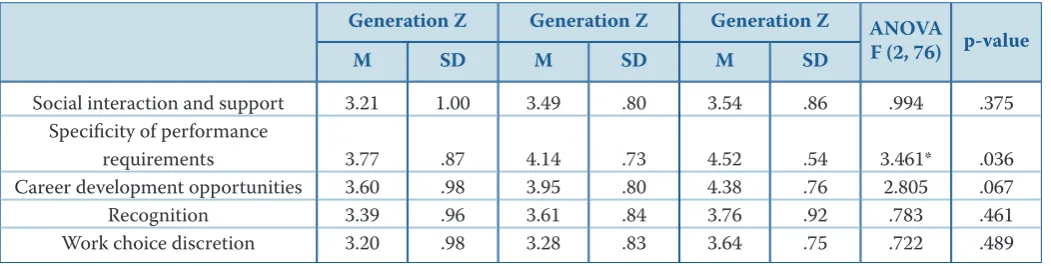
follow-up univariate ANOVAs were performed for each subscale. The results showed no statistically significant difference for all work achievement except the specificity of performance requirements (Table 4). A set of pairwise comparisons were performed to further explore the difference between the three generational cohorts. However, the pairwise comparisons did not show statistically significant differences. These results however indicated that the value of specificity of performance requirements was slightly increasing from Generation X (m = 3.77, SD = 0.87) to Generation Y (m = 4.14, SD = 0.73) and then to Generation Z (m = 4.52, SD = .54), but these differences were not statistically significant.
Table 4: Univariate ANOVAs for Achievement Value Components by Generational Cohort.
Note: * indicates a statistically significant difference at p < .05; 5-point Likert scale
Percent Job security Pay Benefits Generation X 4.05 3.66 3.59 .97 .90 1.05 Generation Y 4.30 3.78 3.67 .66 .76 .70 Generation Z
M SD M SD M SD
4.52 3.86 3.29 .69 1.11 1.41 ANOVA F
(2, 76) p-value
1.425 249 .249 .247 .780 .578 p-value .375 .036 .067 .461 .489 ANOVA F (2, 76)
.994 3.461* 2.805 .783 .722 SD .86 .54 .76 .92 .75 M Generation Z 3.54 4.52 4.38 3.76 3.64 SD .80 .73 .80 .84 .83 M Generation Z 3.49 4.14 3.95 3.61 3.28 SD 1.00 .87 .98 .96 .98 M Generation Z 3.21 3.77 3.60 3.39 3.20 Social interaction and support
Specificity of performance requirements
Career development opportunities Recognition
7.3 RESEARCH QUESTION THREE
The third research question and corresponding hypotheses were dedicated to investigate whether work flexibility value differs between generational cohorts.
RQ3 Are there differences in the way Generation X, Generation Y, and Generation Z value flexibility?
H0 There is no statistically significant difference in the way Generation X, Generation Y, and Generation Z
value flexibility.
H1 There is a statistically significant difference in the way Generation X, Generation Y, and Generation Z
value flexibility.
One of the subscales for work flexibility value was travel discretion that received a lower number of responses (56 compared to 79 for all other subscales) as 23 respondents responded to these questions as inapplicable to them. Therefore, the total number of cases included in the analysis for flexibility subscale was 56. However, to check whether this reduction in sample size plays a significant role on the results, the analysis was performed twice: for 56 responses obtained for these subscales and for 76 responses obtained for discretion in choosing when and where to work subscales. The results were consistent, so the first approach including all three subscales as supposed by Prasad et al. (2007) and was reported below.
The mANOVA was useful to examine the third research question and test the corresponding hypotheses. Before running the mANOVA analysis, the underlying assumptions were tested. There were no significant outliers in any of the three dependent variables included in flexibility values domain as all mean values were calculated based on five-point Likert scales, and their minimum and maximum values did not exceed the range from one to five. Several respondents with the lowest (equal to one) and highest (equal to five) values were included in the analysis as they were not a result of typos or otherwise invalid data. The normality of the distribution was not satisfied for all three subscales; however, this violation was not a major one for mANOVA as according to Johnson & Wichern (2007) this method is robust to non-normality. multicollinearity was assessed by calculating Pearson correlation coefficients among the three subscales. The test revealed that all subscales are moderately correlated to each other (Pearson correlation coefficients ranged from a minimum of 0.342 to maximum of 0.689, all statistically significant with p < .05, Appendix 1). Homogeneity of variance-covariance matrices was proven by Box’s m test results showing a p-value equal to .145, which is higher than .001 – a borderline for this test. Homogeneity of variance was assessed using Levene’s test and showed that all three subscales satisfy the assumption (p > .05).
The results of mANOVA showed no statistically significant difference in work flexibility between the three generational cohorts (f(6,104) = 0.412, p = .870). follow-up univariate ANOVAs were performed for each subscale, and the results revealed no statistically significant difference either (Table 5). These results support the null hypothesis that there is no statistically significant difference in the way Generation X, Generation Y, and Generation Z value flexibility in work and provide a negative answer to the third research question.
Table 5: Univariate ANOVAs for flexibility Value Components by Generational Cohort.
Note: * for travel discretion subscale the error df is equal to 53, as there were only 56 respondents who provided a valid answer to this question.; 5-point Likert scale
8 IMPLICATIONS
first, this study implies there are more similarities between the generations than differences; therefore, HRPs should be cognizant of individual employee differences and not focus solely on employee generational differences. Because there is great variability among people, within generational cohort individual differences likely are far greater than across generational cohort differences (De meuse & mlodzik, 2010; Zhang, Tang, & Tang, 2016). Prudent to the human resources industry, this implication suggests managers should motivate employees based on their individualistic needs as opposed to their subscribed generational cohort’s needs. HRPs should provide individualized consideration to employees as there is a significant relationship between individualmotivation and employee engagement (El Badawy & Bassiouny, 2014). Another noteworthy individual difference is education level. Because p-value
.670 .975 .657
ANOVA F (2, 76)
0.402 0.026 0.424
SD
1.03 1.38 1.66
M
Generation Z
3.64 3.29 2.5
SD
.81 1.03 1.21
M
Generation Z
3.3 3.19 2.15
SD
1.14 1.18 1.25
M
Generation Z
3.32 3.23 2.45 Discretion in choosing when to work Discretion in choosing where to work
an employee’s education level affects his work values (Li, Liu, & Wan, 2008), HRPs must ensure that managers take an individualistic approach when managing employees. is implication is congruent with maslow’s hierarchy of needs theory on the individual pursuit of self-actualization. Individuals, as opposed to generational cohorts, fulfill the five levels of maslow’s pyramid in the pursuit of self-actualization. Given the individualistic nature of people, the individual differences highlightedwithingenerations are more significant than the group differences noted across generations (Davis, Pawlowski & Houston, 2006).
Second, HRPs must recognize stereotyping of generational differences in the workplace. An example stereotype of generational differences is the trophy mentality of Generation Y in which these employees must receive public praise and formal recognition through tangible achievement (Stewart et al., 2017). Because there was not a statistically significant difference in the way the three generations value achievement in the workplace, HRPs should be aware and monitor the risk of the sweeping generational stereotypes regarding achievement. e mere perception of generational differences regarding workplace achievement can cause damage to the workforce (De meuse & mlodzik, 2010). HRPs should educate managers on these generational stereotypes to ensure managerial attitudes and behaviors are not based on all-encompassing generalizations about employees’ generations as opposed to the workforce reality where employees should be treated as individuals. Because managerial attitudes and behavior influence subordinate employees, HRPs should remain vigilant of and sensitive to the generational stereotypes and make a concerted effort to mitigate them by offering professional development training to managers.
ird, employee flexibility is a critical component of HRPs’ recruiting and retention efforts. e findings from this study suggest that employees, regardless of their generation, value flexibility in the workplace. Krywulak and Roberts (2009) posit all employees regardless of their generation want flexibility in the workplace. is concept was echoed in a research study on the Canadian nurse workforce in which Generation X and Generation Y similarly valued flexibility (Lavoie-Tremblay, Paquet, Duchesne, Santo, Gavrancic, Courcy & Gagnon, 2010). Generation Y employees seek employers that have enough flexibility in their benefits and compensation structure to offer development activities, training, and new challenges (Robyn & du Preez, 2013). When bolstering recruitment initiatives, human resources professionals should include the organization’s commitment to embrace employee flexibility. Climate surveys can identify which aspect of flexibility is essential to employees (Li & Hsu, 2016). Remaining committed to understanding the employee’s interpretation of and need for flexibility in the workplace, human resources professionals can strengthen retention efforts. Regardless of the generational differences or similarities, human resources professionals must understand what it takes to recruit and retain individuals for their workplace.
9 RECOMMENDATIONS FOR PRACTICE
e findings of this research study provide evidence that there are no significant differences in the work values between Generation X, Generation Y, and Generation Z. ese findings are supported in the academic literature (Deal, 2007; De meuse & mlodzik, 2010; Hart et al., 2003; Johnson & Lopes, 2008; Jurkiewicz, 2000; Levy et al., 2005; Stapleton et al., 2007; Wesner & miller, 2008; Zhang, Tang & Tang, 2016), and they reinforce the individuality of employees as opposed to stereotypes assigned to the generational cohorts. Employee motivation is an undocumented, psychological contract between an employer and the employee (Kukreja, 2017), and employee motivation is a critical component of organizational success (Zameer et al., 2014). is research study was limited to one employer in the telecommunications industry and may not be indicative of the population as a whole. Because this research study utilized the quantitative method to gather data, it could be lacking in the personal anecdotes that are gleaned from face-to-face interviews via the qualitative methodology. Another limitation could be the risk of system errors as a result of the online environment used to orchestrate the instrument. If there is an insufficient sample size, there could be a limitation of generalizability. future research could revise this cross-sectional study into a longitudinal study following the sample of employees over a more extended period of time. finally, additional research could contain additional demographic questions to include the participant’s educational level, as Li, Liu, and Wan (2008) posit employees’ education level directly impacts their work values.
REFERENCES
Acar, A. B. (2014). Do intrinsic and extrinsic motivation factors differ for Generation X and Generation Y?
International Journal of Business and Social Science, 5(5), 12-21. https://doi.org/10.30845/ijbss
Achilles, W. W., Blaskovich, J., & Pitre, T. J. (2013). The relationship between compensation, motivation, and earn-ings management.Journal of Applied Business Research, 29(2), 579-587. https://doi.org/10.19030/jabr.v29i2.7658 Adiele, E., & Abraham, N. (2013). Achievement of Abraham maslow’s needs hierarchy theory among teachers: Implications for human resource management in the secondary school system in Rivers State. Journal of Curriculum and Teaching, 2(1), 140-153.
https://doi.org/10.5430/jct.v2n1p140
Akkucuk, U., & Turan, C. (2016). mobile use and online preferences of the millennials: A study in Yalova.Journal of Internet Banking and Commerce, 21(1), 1-11.
Al-Asfour, A., & Lettau, L. (2014). Strategies for leadership styles for multi-generational workforce. Journal of Leadership, Accountability and Ethics, 11(2), 58-69.
Alexander, C. S., & Sysko, J. m. (2013). I’m Gen Y, I love feeling entitled, and it shows.Academy of Educational Leadership Journal, 17(4), 127-131.
Amayah, A., & Gedro, J. (2014). Understanding generational diversity: Strategic human resource management and development across the generational “divide.”New Horizons in Adult Education and Human Resource Develop-ment, 26(2), 36-48. https://doi.org/10.1002/nha3.20061
Anderson, H., Bauer, J., Griffith, J., & Buckley, m. (2017). What works for you may not work for (Gen)me: Limita-tions of present leadership theories for the new generation. The Leadership Quarterly, 28(1), 245-260. https://doi.org/10.1016/j.leaqua.2016.08.001
Atan, J., Raghavan, S., & mahmood, N. (2015). Impact of training on employees’ job performance: A case study of malaysian small medium enterprise.Review of Management, 5(1), 40-50.
Babic, L., Kordic, B., & Babic, J. (2014). Differences in motivation of health care professionals in public and private health care centers.European Journal of Applied Economics, 11(2), 45-53. https://doi.org/10.5937/sjas11-6957 Becton, J. B., Walker, J. W., & Jones-farmer, A. (2014). Generational differences in workplace behavior.Journal of
Applied Social Psychology, 44(3), 175-189. https://doi.org/10.1111/jasp.12208
Bencsik, A., Horvath-Csikos, G., & Juhasz, T. (2016). Y and Z generations at workplaces.Journal of Competitiveness,
8(3), 90-106. https://doi.org/10.7441/joc.2016.03.06
Bianchi, E. C. (2014). Entering adulthood in a recession tempers later narcissism.Psychological Science, 25(7), 1429– 1437. https://doi.org/10.1177/0956797614532818
Bolton, R. N., Parasuraman, A., Hoefnagels, A., migchels, N., Kabadayi, S., Gruber, T., Loureiro, Y.K., & Solnet, D. (2013). Understanding Generation Y and their use of social media. A review and research agenda.Journal of Service Management, 24(3), 245–267. https://doi.org/10.1108/09564231311326987
Bush, C. (2017). Leading and motivating Generation Y employees.Radiology Management,39(2), 19-26.
Campione, W. A. (2015). Corporate offerings: Why aren’t millennials staying?Journal of Applied Business and Economics, 17(4), 60-75.
Catania, G., & Randall, R. (2013). The relationship between age and intrinsic and extrinsic motivation in workers in a maltese cultural context.The International Journal of the Arts in Society, 6(2), 31-45.
Chekwa, C., Chukwuanu, m., & Richardson, D. (2013). Generational gap: Intrinsic (nonmonetary) versus extrinsic (monetary) rewards in the workforce.China -USA Business Review, 12, 414-424.
Chen, J., & Lian, R. (2015). Generational differences in work values in China.Social Behavior and Personality: An International Journal,43(4), 567-578. https://doi:10.2224/sbp.2015.43.4.567
Chicca, J., & Shellenbarger, T. (2018). Connecting with Generation Z: Approaches in nursing education.Teaching and Learning in Nursing, 13(3), 180-184. https://doi.org/10.1016/j.teln.2018.03.008
Chow, A., Galambos, N. L., & Krahn, H. J. (2017). Work values during the transition to adulthood and mid-life satisfaction: Cascading effects across 25 years.International Journal of Behavioral Development, 41(1), 105-114. https://doi.org/10.1177/0165025415608518
Clark, K. R. (2017). managing multiple generations in the workplace.Radiologic Technology, 88(4), 379-396. Coates, T. L. (2017). Hearing the voices of Generation Y employees: A hermeneutic phenomenological study.Human
Cozby, P. C., & Bates, S. C. (2012).Method in behavioral research(11th ed.). New York, NY: mcGraw-Hill.
Davis, J. B., Pawlowski, S. D., & Houston, A. (2006). Work commitments of baby boomers and Gen-Xers in the IT profession: Generational differences or myths?Journal of Computer Information Systems, 46(3), 43-49.
Deal, J. J. (2007).Retiring the generational gap: How employees young and old can find common ground. Hoboken, NJ: John Wiley.
Delost, m. E., & Nadder, T. S. (2014). Guidelines for initiating a research agenda: Research design and dissemination of results.Clinical Laboratory Science, 27(4), 237-244.
De meuse, K., & mlodzik, K. (2010). A second look at generational differences in the workforce: Implications for HR and talent management.People & Strategy, 33(2), 50-58.
DeVaney, S. (2015). Understanding the millennial generation.Journal of Financial Service Professionals, 69(6), 11-14.
Dixon, G., mercado, A., & Knowles, B. (2015). followers and generations in the workplace.Engineering Management Journal, 25(4), 62-72. https://doi.org/10.1080/10429247.2013.11431996
Duh, H., & Struwig, m. (2015). Justification of generational cohort segmentation in South Africa.International Journal of Emerging Markets, 10(1), 89-101. https://doi.org/10.1108/IJOEm-08-2012-0078
Eastland, R., & Clark, K. R. (2015). managing generational differences in radiology.Radiology Management, 37(3), 52-56.
El Badawy, T. A., & Bassiouny, m. (2014). Employee engagement as a mediator between transformational leadership and intention to quit.Competition Forum, 12(1), 152-160.
Enns, H. G., Prasad, J., & ferratt, T. W. (2006). Beyond stereotypes of IT professionals: Implications for IT HR practices.Communications of the ACM, 49(4), 105-109. https://doi.org/10.1145/1121949.1121956
fatima, m., Shafique, m., Qadeer, f., & Ahmad, R. (2015). HR practices and employee performance relationship in higher education: mediating role of job embeddedness, perceived organizational support and trust.Pakistan Journal of Statistics and Operation Research, 11(3), 421-439. https://doi.org/10.18187/pjsor.v11i3.882
ferri-Reed, J. (2014). millennializing the workplace.Journal for Quality and Participation, 37(1), 13-14.
froese, f. (2013). Work values of the next generation of business leaders in Shanghai, Tokyo, and Seoul.Asia Pacific Journal of Management 30(1), 297-315. https://doi.org/10.1007/s10490-011-9271-7
furnham, A. (1982). The protestant work ethic and attitudes toward unemployment. Journal of Occupational Psychology, 55(4), 277-285 http://dx.doi.org.proxy1.ncu.edu/10.1111/j.2044-8325.1982.tb00101.x
George, C. (2015). Retaining professional workers: What makes them stay?Employee Relations, 37(1), 102-121. https://doi.org/10.1108/ER-10-2013-0151
Giaque, D., Anderfuhren-Biget, S., & Varone, f. (2013). HRm practices, intrinsic motivators, and organizational per-formance in the public sector. Public Personnel Management, 42(2), 123-150. https://doi.org/10.1177/ 0091026013487121
Gordon, P. A. (2017). Exploring generational cohort work satisfaction in hospital nurses.Leadership in Health Services (1751-1879), 30, 233-248. https://doi.org/10.1108/LHS-02-2016-0008
Gursoy, D., Chi, C. G., & Karadag, E. (2013). Generational differences in work values and attitudes among frontline and service contact employees. International Journal of Hospitality Management, 32, 40-48. https://doi.org/ 10.1016/j.ijhm.2012.04.002
Hair, J. f., Jr., Black, W. C., Babin, B. J., & Anderson, R. E. (2004).Multivariate data analysis: International edition
(7th ed.). New York, NY: Pearson, pp. 361-364.
Halperin, I., Pyne, D. B., & martin, D. T. (2015). Threats to internal validity in exercise science: A review of overlooked confounding variables.International Journal of Sports Physiology and Performance, 10(7), 823-829. https://doi.org/ 10.1123/ijspp.2014-0566
Hart, P. m., Schembri, C., Bell, C. A., & Armstrong, K. (2003).Leadership, climate, work attitudes, and commitment: Is generation X really different?Paper presented at the Academy of management meeting, Seattle, WA.
Hernaus, T., & Pološki Vokic, N. (2014). Work design for different generational cohorts. Determining common and idiosyncratic job characteristics.Journal of Organizational Change Management, 27(4), 615-641. https://doi.org/ 10.1108/JOCm-05-2014-0104
Hillman, D. R. (2014). Understanding multigenerational work-value conflict resolution. Journal of Workplace Behavioral Health, 29(3), 240-257. https://doi.org/10.1080/15555240.2014.933961
Islam, R., & Ahmed, S. (2014). Do managers and employees perceive motivating factors differently in malaysia?
International Journal of Business and Systems Research, 8(1), 72-90. https://doi.org/10.1504/IJBSR.2014.057977 Jerome, N. (2013). Application of the maslow’s hierarchy of need theory; impacts and implications on
organiza-tional culture, human resource and employee’s performance.International Journal of Business and Management Invention, 2(3), 39-45.
Jiri, B. (2016). The employees of baby boomer’s generation, generation X, generation Y, and generation Z in selected Czech corporations as conceivers of development and competitiveness in their corporation.Journal of Competi-tiveness, 8(4), 105-123. https://doi.org/10.7441/joc.2016.04.07
Johnson J. A., & Lopes, J. (2008). The international workforce, revisited.Organization Development Journal, 26(1), 31-36.
Johnson, m., & Johnson, L. (2016).Signposts: Harbingers of things to come. Generations, incorporated: From Boomers to Linksters – managing the friction between generations at work. New York, NY: AmACOm.
Joniakova, Z., & Blstakova, J. (2015). Age management as contemporary challenge to human resources management in Slovak companies.Procedia Economics and Finance, 35, 202-209.
Jora, R., & Khan, S. (2014). motivating multigenerational human resource.International Journal of Organizational Behavior & Management Perspectives, 3, 1276-1281.
Jurkiewicz, C. L. (2000). Generation X and the public employee. Public Personnel Management, 29(1), 55-74. https://doi.org/10.1177/009102600002900105
Kaur, A. (2013). maslow’s need hierarchy theory: Applications and criticisms.Global Journal of Management and Business Studies, 3, 1061-1064.
Karsh, B., & Templin, C. (2013). How millennials will rewrite the rules of management.MWorld,12(4), 36-38. Keys, Y. (2014). Looking ahead to our next generation of nurse leaders: Generation X Nurse managers.Journal of
Nursing Management, 22(1), 97-105. https://doi.org/10.1111/jonm.12198
Khan, A., Khan, I., & Zakir, Z. (2016). Relationship between employee motivation and turnover intention: Empiri-cal study of traffic police of District Charsadda.Sarhad Journal of Management Sciences, 2(2), 19-30.
Kilber, J., Barclay, A., & Ohmer, D. (2014). Seven tips for managing Generation Y.Journal of Management Policy and Practice, 15(4), 80-91.
Kong, H., Wang, S., & fu, X. (2015). meeting career expectation. Can it enhance job satisfaction.International Jour-nal of Contemporary Hospitality Management, 27(1), 147-168. https://doi.org/10.1108/IJCHm-08-2013-0353 Kroth, A., & Young, S. J. (2014). New professionals, new desires: What millennials want in their work.Recreational
Sports Journal, 38(1), 23-32.
Krywulak, T., & Roberts, m. (2009). Winning the “Generation Wars”: making the most of generational differences and similarities in the workplace.The Conference Board of Canada (November 2009).
Kukreja, J. (2017). Internal marketing: a prelude or an outcome of employee motivation?BVIMSR’s Journal of Management Research,9(1), 54–59.
Kultalahti, S., & Liisa Viitala, R. (2014). Sufficient challenges and a weekend ahead -Generation Y describing moti-vation at work.Journal of Organizational Change Management, 27(4), 569-582. https://doi.org/10.1108/JOCm-05-2014-0101
Latkovikj, m. T., Popovska, m. B., & Popovski, V. (2016). Work values and preferences of the new workforce. HRm implications for macedonian millennial generation.Journal of Advanced Management Science, 4(4), 312-319. https://doi.org/10.12720/joams.4.4.312-319
Lavoie-Tremblay, m., Paquet, m., Duchesne, m. A., Santo, A., Gavrancic, A., Courcy, f., & Gagnon, S. (2010). Retaining nurses and other hospital workers: An intergenerational perspective of work climate. Journal of Nursing Scholarship,42(4), 414-422. https://doi.org/10.1111/j.1547-5069.2010.01370.x
Ledimo, O. (2015). Generational differences in organizational justice perceptions: An exploratory investigation across three generational cohorts.Foundations of Management, 7(1), 129-142. https://doi.org/10.1515/fman-2015-0031
Lee, m. T., Raschke, R. L., & Louis, R. S. (2016). Exploiting organizational culture: Configurations for value through knowledge worker’s motivation.Journal of Business Research, 69(11), 5442-5447. https://doi.org/10.1016/j.jbus-res.2016.04.152
Li, W., Liu, X., & Wan, W. (2008). Demographic effects of work values and their management implications.Journal of Business Ethics, 81, 875-885. https://doi.org/10.1007/s10551-007-9554-6
Locmele-Lunova, R., & Cirjevskis, A. (2017). Exploring the multigenerational workforce’s personal and work values: the future research agenda.Journal of Business Management, 13,7-19.
Lyons, S., & Kuron, L. (2014). Generational differences in the workplace: A review of the evidence and directions for future research.Journal of Organizational Behavior, 35(S1), S123-S157. https://doi.org/10.1002/job.1913 mannheim, K. (1952).Essays in the sociology of knowledge. London, UK: Routledge, & Kegan Paul.
maslow, A. H. (1943). A theory of human motivation. Psychological Review, 50(4), 370–396. https://doi.org/ 10.1037/h0054346
mencl, J., & Lester, S. W. (2014). more alike than different: What generations value and how the values affect employee workplace perceptions.Journal of Leadership & Organizational Studies, 21(3), 257-272. https://doi.org/ 10.1177/1548051814529825
montana, P. J., & Lenaghan, J. A. (1999). What motivates and matters most to Generation X and Y?Journal of Career Planning and Employment, 59(4), 27-30.
muthuveloo, R., Basbous, O. K., Ping, T. A., & Long, C. S. (2013). Antecedents of employee engagement in the man-ufacturing sector. American Journal of Applied Sciences, 10(12), 1546-1552. https://doi.org/ 10.3844/ajassp.2013.1546.1552
Neckermann, S., & frey, B. S. (2013). And the winner is…? The motivating power of employee awards.Journal of Socio-Economics, 46, 66-77. https://doi.org/10.1016/j.socec.2013.06.006
Özçelik, G. (2015). Engagement and retention of the millennial generation in the workplace through internal bran-ding.International Journal of Business and Management, 10(3), 99-107. https://doi.org/10.5539/ijbm.v10n3p99 Padayachee, K. (2018). The myths and realities of generational cohort theory on ICT integration in education:
A South African perspective.The African Journal of Information Systems, 19(1), 54-84.
Pandta, J., Deri, L., Galambos, A., & Galambos, T. (2015). Two-factor analysis of employee motivation at postal traffic department in Novi Sad. European Journal of Economics Studies,12(2), 101-111. https://doi.org/ 10.13187/es.2015.12.101
Peachey, J., Bruton, L., & Wells, J. (2014). Examining the influence of transformational leadership, organizational commitment, job embeddedness, and job search behaviors on turnover intentions in intercollegiate athletics.
Leadership & Organization Development Journal, 35(8), 740-755. http://dx.doi.org.proxy1.ncu.edu/10.1108/LODJ-10-2012-0128
Peltokorpi, V., Allen, D., & froese, f. (2015). Organizational embeddedness, turnover intentions, and voluntary turnover: The moderating effects of employee demographic characteristics and value orientations.Journal of Or-ganizational Behavior, 36(2), 292-312. https://doi.org/10.1002/job.1981
Peters, S., Lau, T., & Ng, C. (2014). Determinants of job satisfaction and ethical behaviour towards organisational commitment - a review.International Journal of Academic Research in Business and Social Sciences, 4(7), 573-591. https://doi.org/10.6007/IJARBSS/v4-i7/1052
Popovska, m. B., Latkovic, m. T., Jakimovski, J., & Popovski, V. (2015). Work values of the macedonian work-force.Journal of Advanced Management Science, 3(2), 158-161. https://doi.org/10.12720/joams.3.2.158-161 Prasad, J., Enns, H. G., & ferratt, T. W. (2007). One size does not fit all: managing IT employees’ employment
arrange-ments.Human Resource Management, 46(3), 349-372. https://doi.org/10.1002/hrm.20168 Puiu, S. (2016). Generation Z: A new type of consumers.Young Economists Journal, 13(27), 67-78.
Queiri, A., Yusoff, W. f. W., & Dwaikat, N. (2014). Generation-Y employees’ turnover: Work-values fit perspec-tive.International Journal of Business and Management, 9(11), 199-213. https://doi.org/10.5539/ijbm.v9n11p199 Radford, K., & Chapman, G. (2015). Are all workers influenced to stay by similar factors, or should different reten-tion strategies be implemented? Comparing younger and older aged-care workers in Australia.Australian Bul-letin of Labour, 41(1), 58-81.
Rajput, N., marwah, P., Balli, R., & Gupta, m. (2013). managing multigenerational workforce: Challenge for millen-nium managers.International Journal of Marketing and Technology, 3(2), 132-149.
Rakic, T., & Zivkovic, S. (2017). Hierarchy of needs and correlation connections as an important element of successful employees’ motivation.Ekonomika, 63(4), 61-73. https://doi.org/10.5937/ekonomika1704061R
Rani, N., & Samuel, A. (2016). A study on generational differences in work values and person organization fit and its effect on turnover intention of Generation Y in India.Management Research Review, 39(12). https://doi.org/ 10.1108/mRR-10-2015-0249
Robyn, A., & du Preez, R. (2013). Intention to quit amongst Generation Y academics in higher education.SA Jour-nal of Industrial Psychology, 39(1), 1-14. https://doi.org/:10.4102/sajip.v39i1.110
Sandrick, C., Contacos-Sawyer, & Thomas, B. (2014). Effects of long-term care insurance on employee motivation, satisfaction, and retention.Competition Forum, 12, 228-233.
Seemiller, C., & Grace, m. (2016).Generation Z goes to college. San francisco, CA: Jossey-Bass.
Shaw, H. (2013).Sticking points: How to get 4 generations working together in the 12 places they come apart.Carol Stream, IL: Tyndale House.
Singer, H., & Abramson, P. (1973). Values of business administrators: A longitudinal study.Psychological Reports, 33(1), 43-46. http://dx.doi.org.proxy1.ncu.edu/10.2466/pr0.1973.33.1.43
Stanton, R. (2017). Communicating with employees: Resisting the stereotypes of generational cohorts in the work-place. IEEE Transactions on Professional Communication, 60(3), 256-272. https://doi.org/10.1109/ TPC.2017.2702078
Stapleton, J. L., Wen, H. J., Starrett, D., & Kilburn, m. (2007). Generational differences in using online learning systems.Human Systems Management, 26(2), 99-109.
Stewart, J. S., Oliver, E. G., Cravens, K. S., & Oishi, S. (2017). managing millennials: Embracing generational differences.Business Horizons, 60(1), 45-54. https://doi.org/10.1016/j.bushor.2016.08.011
Sutton-Bell, N., Hamilton, H. C., mcminn, N. A., & Bell, N. (2014). Bringing out the best in every generation.Insights to A Changing World Journal, 2014(1), 64-80.
Tang, T., & Tzeng, J. (1992). Demographic correlates of the protestant work ethic.Journal of Psychology, 126(2), 163-170. https://doi.org/10.1080/00223980.1992.10543351
Tillott, S., Walsh, K., & moxham, L. (2013). Encouraging engagement at work to improve retention. Nursing Management, 19(10), 27-31. PmID: 23577562
Tulgan, B. (2013). How to bring out the best in today’s talent.Professional Safety, 58(10), 38-40.
Twenge, J. m., & Kasser, T. (2013). Generational changes in materialism and work centrality, 1976–2007: Associa-tions with temporal changes in societal insecurity and materialistic role modeling. Personality and Social Psychology Bulletin, 39(7),883-897. https://doi.org/10.1177/0146167213484586
Twenge, J. m., Gentile, B., & Campbell, W. K. (2015). Birth cohort differences in personality. In m. mikulincer, P. R. Shaver, m. L. Cooper, & R. J. Larsen (Eds.),APA handbook of personality and social psychology, Vol. 4. Personal-ity processes and individual differences (pp. 535-551). Washington, DC: American Psychological Association. http://dx.doi.org/10.1037/14343-024
Ueda, Y., & Ohzono, Y. (2013). Effect of work values on work outcomes: Investigating differences between job categories.International Journal of Business Administration, 3(2), 98-111.
Vanmeter, R. A., Grisaffe, D. B., Chonko, L. B., & Roberts, J. A. (2013). Generation Y’s ethical ideology and its potential workplace implications. Journal of Business Ethics, 117(1), 93-109. https://doi.org/10.1007/s10551-012-1505-1
Wang, Y., & Peng, Y. (2015). An alternative approach to understanding generational differences.Industrial and Organizational Psychology, 8(3), 390-395. https://doi.org/10.1017/iop.2015.56
Weirich, B. (2017). A millennial leader’s views on the millennial workforce. Nurse Leader, 15, 137-139. https://doi.org/10.1016/j.mnl.2016.12.003
Wesner, m. S., & miller, T. (2008). Boomers and millennials have much in common. Organization Development Journal, 26(3), 89-96.
Wiedmer, T. (2015). Generations do differ: Best practices in leading traditionalists, boomers, and generations X, Y, and Z.Delta Kappa Gamma Bulletin,82(1), 51-58.
Woodward, E., Vongswasdi, P., & more, E. (2015). Generational diversity at work: A systematic review of the research.INSEAD Working Papers Collection, 48, 1-71.
Yang, S. B., & Guy, m. E. (2006). GenXers versus Boomers: Work motivators and management implications.Public Performance & Management Review, 29(3), 276-284. https://doi.org/10.2753/PmR1530-9576290302
Zameer, H., Ali, S., Nisar, W., & Amir, m. (2014). The impact of the motivation on the employees’ performance in beverage industry of Pakistan.International Journal of Academic Research in Accounting, Finance and Manage-ment Sciences,4(1), 293-298. http://dx.doi.org/10.6007/IJARAfmS/v4-i1/630
Zargar, m. S., Vandenberghe, C., marchand, C., & Ayed, A. K. (2014). Job scope, affective commitment, and turnover: The moderating role of growth need strength.Journal of Occupational and Organizational Psychology,87(2),
Appendix 1: Pearson Correlation Coefficients for Work Values Subscales
Note: * p < .05; ** p < .01
10
.441**
9
.640** .524**
8
.670** .689** .342**
7
.499** .469** .514** .225
6
.594** .546** .527** .526** .369**
5
.763** .539** .476** .510** .394** .167
4
.489** .485** .681** .402** .328** .340** .088
3
.396** .570** .571** .387** .501** .388** .476** .221
2
.697** .383** .637** .692** .540** .560** .654** .672** .451**
1
.661** .593** .409** .744** .693** .512** .519** .500** .502** .301* 1. Job security
2. Pay 3. Benefits
4. Social interaction and support 5. Specificity of performance
requirements 6. Career development
opportunities 7. Recognition
8. Work choice discretion 9. Discretion in choosing when
to work
10. Discretion in choosing where to work