THADDEUS E. PROUT
Department of Medicine, Johns Hopkins University School of Medicine, Baltimore, Maryland
I would like to begin with a brief historical review of the subject of insulin antigenicity before I discuss its clinical significance.
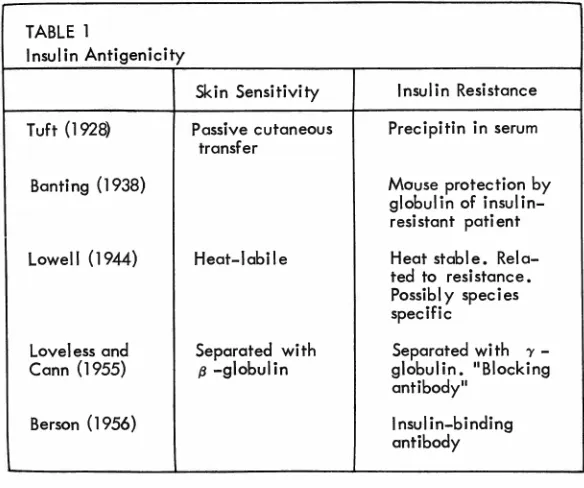
After the discovery of insulin, a little over four decades ago, some of the early preparations of insulin were relatively crude; and, as might be expected, a number of reactions occurred. In one of the first studies on insulin allergy utilizing pure crystalline insulin, Tuft ( 1928) established that it was the insulin itself which caused the skin reac-tion and not the protein of the animal from which the insulin came. He further demonstrated that the material causing the skin reaction could be passively trans-ferred to the skin of a normal individual by an intradermal injec-tion of serum from the insulin-allergic individual. He also showed the presence of a precipitin against insulin in the serum of the insulin-allergic patient and demonstrated that the skin-sensitizing antibody remained in serum long after the precipitin was lost. He presented some evidence of an increased in-sulin requirement in the patient when the precipitin was present and suggested that antibodies to insulin might be associated with insulin resistance. Other workers confirmed the fact that insulin was antigenic (Prout, 1962) and Sir Frederick Banting (1938) made the observation that psychiatric pa-tients receiving insulin for shock therapy required more and more insulin to produce shock as time went on. He demonstrated that serum from these patients pro-tected mice from convulsions when injected with insulin and later showed that the anti-insulin
mate-rial was located in the serum globu-lin rather than the albumin.
In 1944 Lowell defined the two kinds of antibodies against insulin, one a reagin which was heat labile and caused skin sensitization, and the other a heat-stable factor that prevented the hypoglycemic effect of insulin in vivo.
Loveless and Cann (1955) showed that the heat-stable pre-cipitin, the material with anti-insulin effect in the intact animal, could in fact act as a blocking anti-body for the skin-sensitizing reagin or the heat labile factor. These anti-bodies traveled in two distinct areas on serum electrophoresis; the block-ing antibody was a y-globulin, while the skin-sensitizing reagin traveled with the ft-globulins.
Up to this time insulin was thought to be rarely associated with host reactions except for the occa-sional local reaction to injection.
It was Berson and his associates (1956) who showed that insulin antigenicity was a common phe-nomenon. In patients who have been treated with intermediate or long-acting insulin, 80% have anti-bodies in the serum that are meas-ureable by techniques utilizing in-sulin labelled with iodine 131 (table 1).
TABLE l
Insulin Antigenicity
Skin Sensitivity I nsu Ii n Resistance
Tuft (1928) Passive cutaneous Precipitin in serum transfer
Banting (1938) Mouse protection by
globulin of insulin-resistant patient
Lowell (1944) Heat-labile Heat stable. Reio-ted to resistance. Possibly species specific
Loveless and Separated with Separated with ')'
-Cann (1955) 13 -globulin globulin. "Blocking antibody"
Berson (1956) Insulin-binding
antibody
TABLE 2
Saturation in Insulin-binding Antibodies*
Daily % Retention in Serum % Free Serum Insulin
Insulin 60 min 5 min
45 u/day 83 2. l
90 u/day 72 3.3
190 u/day 48 17.6
*The relationship between dailh dose of insulin and saturation of insulin-binding antibodies is s own by these results. Free insulin is increased and becomes availqble for peripheral use. The in-crease in daily insulin does not stimulate the over-production of antibodies in this type of patient.
'
treating the patient with local reac-tions, it is essential to be certain that the patient is injecting himself properly, that he is using a clean syringe and not injecting alcohol. Some physicians advocate that syringes and sites of injection be changed or that the insulin be warmed or even boiled; after sev-eral weeks in which sevsev-eral tech-niques have been tried, the local re-actions subside. I suspect that this is not related to the ingenuity of the therapeutic maneuvers, but to time that has been consumed while waiting for the blocking antibodies to block the skin-sensitizing anti-body. The patient has been de-sensitized in precisely the same way that he has been desensitized for ragweed antigen, and the im-portant part of therapy has been the continuation of injections until the patient is desensitized.
Other phenomena at the injec-tion site are of great interest al-though it is not provi;!n that they are related to insulin antigenicity. These are the insulin-induced fat atrophy and/or fat hypertrophy. Their cause remains an enigma. I
have wondered whether insulin may become fixed to adipose tissue at the injection site and set up a tissue-fixed antigen-antibody reaction with circulating antibodies. The time sequence suggests the validity of this possibility and on occasions a change to insulin of a different species has coincided with the end to fat atrophy. I am currently try-ing to improve these demonstra-tions and determine their signifi-cance. These phenomena may well relate to the effect of insulin on fat metabolism, but thus far the rea-sons for both fat atrophy and fat hypertrophy are obscure.
In general the titre of antibodies is low, and as a group the patients who have been on insulin the long-est period of time have the higher titres. There is, of course, great variability. There are several inter-esting exceptions to this generaliza -tion. Insulin antibodies have been noted to disappear in patients re-ceiving steroid for sarcoidosis. In other patients having the pro-teinuria of Kimmelstiel-Wilson syn
-drome, insulin-binding antibodies are often lost along with other pro
-teins. Part of the insulin sensitivity
seen in patients with this syndrome is probably related to the loss with the proteinuria of the buffering effect of the antibodies. In such pa-tients the antibody titre seen in the serum is low even through the pa-tient had been on insulin for more than 20 years.
As Berson ( 1956) demonstrated, the presence of antibodies is readily shown in vivo. In patients with little or no antibody, there is rapid disappearance from the blood of in-sulin labelled with 1''11 following an intravenous injection. Patients with insulin resistance show a marked prolongation of the half-time of labelled insulin in blood, and it is easy to show that the insulin J'31 continues to circulate because it is bound to the y-globulin.
Let me give an illustration of the clinical significance of this. A man previously controlled on 40 units of insulin developed ketoacidosis without obvious cause. He was treated successfully and discharged on his previous dose of 40 units daily. In a short time he returned again with ketoacidosis. An insulin effect had been obtained and the acidosis had been treated succes s-fully, but this effect was promptly dissipated when he returned to his maintenance dose that was less than his daily needs. It was postulated that by saturating the circulating antibodies with larger daily doses of insulin the anti-insulin effect of his antibodies could be neutralized. It was first demonstrated that ap-proximately 90% of the injected
insulin J'31 remained in circulation for more than two hours while he was on an inadequate dose of in-sulin. We then progressively raised his insulin dose, and he began to come under better control. Now we found that injected insulin 1'31 disappeared from the blood more quickly, presumably because some of the binding sites of the insulin-binding antibody were being occu-pied by the daily dose of insulin he was receiving. As his insulin ·
dose was increased during the next week, he showed progressive short-ening of the half-time of insulin in his blood and reciprocally a greater amount of the insulin was free to be utilized in the periphery. Insulin bound to antibody is preserved not only from peripheral use but also from peripheral degradation. The results of these studies of ins ulin-1'31 over this period are shown in table 2. As the increased daily dose of insulin occupied more of the binding sites of the insulin-binding globulin, more of the daily insulin dose was free to exert its physio-logical effects, and the control of his diabetes was thereby improved (Prout and Katims, 1959).
Insulin resistance is not always related to insulin-binding antibod-ies, of course, and in the differen-tial diagnosis of this problem a number of other conditions must be considered (table 3). Obesity is
usually associated with relative
in-sulin resistance. Obese patients who have never received insulin may require three or four times as much insulin to produce the same fall in blood glucose on an insulin toler-ance test as their colleagues of normal weight. Obese diabetic sub-jects who have not followed their prescribed diet and who hence are not controlled may require 50 to 60 units daily at the onset to achieve control, although they are not dependent on insulin to prevent ketoacidosis.
Moderate degrees of insulin
Cyclic resistance associated with the menstrual cycle has been reported. None of these states are related to antibodies and are all relatively mild forms of resistance for the most part.
Infection, of course, is the most common cause of insulin resistance and resistance quickly disappears as the infection is brought under control. Although an increase in insulbinding antibodies with in-fection would appear likely, we have not found a significant rise in circulating antibodies of any of these patients' studies, the most remarkable of whom has been re-ported by Knowles and his col-leagues (see Tucker et al., 1964).
Peripheral or tissue resistance to the effects of insulin has been postu-lated and there are remarkable instances reported of severe resist-ance on this basis that are unre-lated to insulin antibodies (Field, 1962). Another cause of apparent insulin resistance is the so-called Somogyi effect or paradoxical hy-perglycemia (Somogyi, 1959). This refers to the patient who appears to need more insulin but in whom control becomes more difficult de-spite the increase in his insulin dose. Hypoglycemia that often goes undetected is followed by rebound hyperglycemia and the patient and the physician are likely to increase the dose further unless the para-doxical hyperglycemia is recog-nized. The proper treatment is to decrease rather than increase the insulin dose after which the appar-ent insulin resistance disappears.
Evidence that the antibodies are not the result of high insulin dosage used in insulin resistance rather than a cause is difficult to find. I had an opportunity to study one patient who has helped to answer this question. A woman had had diabetes for a number of years and had developed insulin resistance with requirements of insulin ex-ceeding 1,500 units per day. Her physician had told her that insulin was useless for her and the patient had discontinued her injections.
When seen, she had been off all treatment for four years. During this time, she had had constant glycosuria and had developed se-vere peripheral neuropathy. We measured her insulin-binding capac-ity after four years on no insulin and found an insignificant amount of binding still present, about 50 microunits per ml. We began in-sulin in relatively low doses and at the dose of 60 units of insulin per day, an insulin effect was seen. Her urine became free of glucose for the first time in four years. On the eighth day after beginning ther-apy she was again found to be extremely resistant to insulin and impossible to control; her insulin-binding antibodies had increased ten fold. An attempt was made immediately to saturate the high level of circulating antibodies by giving her 500 units of insulin in-travenously which, under these spe-cific circumstances, was quite safe and no effect of this insulin was seen on the blood glucose. Insulins from different species were tried as well as steroids; but in spite of this, on insulin in doses up to 1,500 units daily, she did not respond. After oral agents became available, hyperglycemia was controlled to some degree. This patient was found responsive to insulin in moderate doses before the recurrence of in-sulin resistance. Antibodies devel-oped before massive doses of in-sulin were used and resistance became clinically significant with the rapid rise of antibodies.
What steps do we take when con-fronted with an insulin-resistant pa-tient? Let us assume that the ob-vious causes of insulin resistance, such as obesity or infection, have been ruled out and that the insulin requirements are in excess of 200 units per day. First we should determine whether the patient is really insulin dependent. The two phenomena do not necessarily go hand in hand. Insulin dependency is related to the presence or ab-sence of retrievable insulin from the pancreas. Insulin resistance is
related to response to injected insulin and may develop in patients still capable of responding to oral agents. The patient just described illustrates this. If the patient is not insulin dependent, an oral hypo-glycemic agent may be effective. If this fails, and insulin therapy is mandatory, one may attempt to saturate the antibodies by rapidly increasing the insulin dose as I have described above. This can sometimes be best accomplished by using crystalline insulin in multiple doses throughout the day; this is always more effective in patients with a large amount of insulin-binding antibody than is intermedi-ate or long-acting insulin. If this does not succeed, insulin from dif-ferent species, usually pork insulin, can be tried.
TABLE 3
Differential Diagnosis of Insulin Resistance
I) Obesity
2) Endocrine states:
a) acromegaly b) Cushing's syndrome
c) hyperthyroidism d) menstrual cycle
3) Peripheral resistance
4) Infection
5) Antibodies to insulin
TABLE 4
Relative resistance easily
Mild resistance. Usually less than 100 units/day
of insulin required unless
other complications ore present. Unusual condition
diffi-cult to prove. Very high quantities of insulin used
with little effect. Commonest form of re-sistance, Rapidly rev
er-sed with treatment of
infection.
Demonstration by in vivo or in vitro techniques.
Treatment of Insulin Resistance Related to Insulin-binding Antibodies
l) Determine insulin dependency
2) Antibody saturation
3) Change to insulin of another species (pork, fish)
4) Adrenal steroids or ACTH
5) Anti-metabolites not recommended
Antimetabolites such as
6-mer-captopurine theoretically might
help these patients by suppressing formation of antibodies. This has been tried on several occasions without any great success (Meri-mee, 1965).
Adrenal steroids are relatively low on the treatment list for
insu-lin resistance. It is better to have
a patient maintained on 300 units of insulin a day than to have him on steroids for life. Steroids can sometimes be used to decrease insulin resistance but the resistance frequently returns when steroids are tapered and stopped, and long-term steroid treatment may be re-quired. Steroids must be used, as elsewhere in medicine, with cir-cumspection.
Not the least important in the treatment of insulin resistance due to insulin binding antibodies is the
use of time. If the resistant patient
can be maintained on a high dose of insulin required for control, eventually the resistance may dis-appear in the same way it came, indeed, with less explanation. Con-tinuation of insulin, especially as crystalline or regular insulin, is essential in such patients (table 4). Interruption of insulin therapy may in fact be one of the settings in which relative insulin resistance occurs when insulin is restarted.
Thus we have seen that evidence of insulin antigenicity in one or more forms is present in most dividuals receiving intermediate in-sulins for six weeks or longer. A number of clinical manifestations of insulin antigenicity and their treatment have been discussed.
REFERENCES
BANTING, F. G., W. R. FRANKS, AND S. GAIRNS. Anti-insulin activity of serum of insulin-treated . patient.
Am. J. Phychiat. 95: 562-566, 1938.
BERSON, S. A., R. S. YALOW, A. BAUMAN, M. A. ROTHSCHILD, AND K. NEWERLY. Insulin P"'- metabo-lism in human subjects: demonstra-tion of insulin binding globulin in
the circulation of insulin treated subjects. J. Clin. Invest. 35: 170-190, 1956.
FIELD, J. B. Insulin resistance in dia-betes. Ann. Rev. Med. 13: 249-260, 1962.
LOVELESS, M. H. AND J. R. CANN. Distribution of "blocking" anti-body in human serum proteins frac-tionated by electrophoresis convec-tion. J. Immunol. 74: 329-339, 1955.
LOWELL, F. C. Immunologic studies in insulin resistance. I. Report of a case exhibiting variations in resist-ance and allergy to insulin. J. Clin. Invest. 23: 225-231, 1944. LOWELL, F. C. Immunologic studies
in insulin resistance. II. The pres-ence of a neutralizing factor in the blood exhibiting some characteris-tics of an antibody. J. Clin. Invest. 23: 233-240, 1944.
MERIMEE, T. J. Insulin resistance: study of effect of 6-mescaptopurine. Lancet 1: 69-71, 1965.
PROUT, T. E. The antigenicity of insulin: a review. J. Chron. Dis. 15: 879-885, 1962.
PROUT, T. E., AND R. B. KATIMS. Effect of insulin-binding serum globulin on insulin requirement. Diabetes 8: 425-431, 1959. SOMOGYI, M. Exacerbation of diabetes
by excess insulin action. Am. J. Med. 26: 169-191, 1959.
TuCKER,