http://dx.doi.org/10.9717/JMIS.2017.4.2.83
83
I. INTRODUCTION
It was thought that objects are equal partners of human beings with their own way of being undergoing outbreak and considered technical activities as a cultural intermediary that can communicate and regulate human society up and down [1]. According to Gilbert Simondon, the problem of alienation created from the relationship between man and technology arose from the human-machine relationship, which did not match with the level of technology development. The technical objects were generated and embodied as individual beings in the internal and external networks and became an object as a mode of existence by making relationship with humans and with the world in their individual structure or mode of operation, and is increasingly subject to the way they exist in relation to the world [2].
This study begins with the interest in communication with digitized objects based on the technical philosophy of Simondon. The study of emotional objects, a technical object for emotional interaction between humans and objects, is the human's visual approach to objects in our
future age where all objects communicate. It can be an opportunity to examine both the value of human being as a material that mediates virtual and reality.
Regarding Nicholas Negroponte's “Digital Revolution
toward Bit World,” Professor William Mitchell pointed
out that 'Bit, which emerged as an information revolution, killed a physical city, a symbol of the space revolution'.
At present, we live in the structure of a world where virtual reality and actual reality coexist. Accordingly, the writer approached the negative narrative between virtual space and physical space in the digital world through story telling on emotional expression objects and tried to make digitized object a cultural mediator as a viable organism.
In the ultra-connection culture, objects can also be personified by intelligence software and regarded as viable organisms, and can become friends of humans through making friends. Emotional objects that generate emotions in this study were produced as prototypes based on the study on color and movements according to the status of human emotions. They express their emotional states as a color change of light and various movements based on a multiple sensing technology as if they were living
An Art-Robot Expressing Emotion with Color Light and Behavior
by Human-Object Interaction
Yanghee Kwon
1,
Sangwook Kim
2, *Abstract
The era of the fourth industrial revolution, which will bring about a great wave of change in the 21st century, is the age of super-connection that links humans to humans, objects to objects, and humans to objects. In the smart city and the smart space which are evolving further, emotional engineering is a field of interdisciplinary researches that still attract attention with the development of technology. This paper proposes an emotional object prototype as a possibility of emotional interaction in the relation between human and object. By suggesting emotional objects that produce color changes and movements through the emotional interactions between humans and objects against the current social issue-loneliness of modern people, we have approached the influence of our lives in the relation with objects. It is expected that emotional objects that are approached from the fundamental view will be able to be in our lives as a viable cultural intermediary in our future living space.
Key Words: Emotional Expression, Emotional Objects, Interaction, Objects.
Manuscript received June 15, 2017; Revised June 24, 2017; Accepted June 27, 2017. (ID No. JMIS-2017-0013)
Corresponding Author (*): Sangwook Kim, School of Computer Science and Engineering, Kyungpook National Univ., +82-53-950-6371, [email protected]
1
Dept of Digital Media Art, Kyungpook National University, Daegu, Korea, [email protected]
2
84
creatures. Based on this research, it is tried to develop its existential values by communicating between humans and objects with emotional production from cognitive senses of emotional objects.
The composition of this paper is as follows. In Chapter
II “Related Works” cases that objects include emotional
elements by digital technology are introduced. In Chapter III, the implementation processes and production intent of the emotional object prototype were described. In Chapter IV, the developed work was introduced and in ChapterV, conclusion was made.
II. RELATED WORKS
2.1. Adam Ben-dror, “Pinokio”
Fig. 1. Adam Ben-dror, Pinokio,2012[4]
Pinokio is an interactive desk lamp that recognizes the face of the user and introduces the form of sympathy between human and animal. The human face is recognized through the webcam in the lamp head and the emotional gestures are realized through the servo motor using the figure of a desk lamp. It recognizes face through Arduino and OpenCV, open source prototype platforms, and it implemented using a design centered programming
language ‘Processing’.
2.1. Hoffman, Guy. “Robots with soul”
Fig. 2. Hoffman, Guy. Simon(L), Travis (R), 2013[5]
Guy Hoffman is not only a robot engineer, but also an animator and jazz musician. As he begins to make robots that communicate with people, he is inspired by animation and concentrates on subtle and fluid movements. The robot marimba player "Shimon", a rapper and can perform improvised play, and "Travis" with two robotic speakers on the head, were studied focusing on emotional movements to enjoy music with humans.
In the case of "Pinokio", the object is embodied as the movement of a lamp header according to the location of face through face recognition rather than making body movement for emotional expression. "Shimon" and "Travis" are examples of implementation of movement intensity according to bit strength.
It is aimed to create more familiar and diverse communications by implementing the emotional objects in this study based on 5 color changes and human sign languages.
Fig. 3. Orlagh O’Brien expressed the five emotional words in color chart and drawing [6].
III. EMOTIONAL OBJECT STORY
TELLING
3.1. Emotional Expression Storytelling
The prototype emotional object has a character that pretends to be disgusted when someone approaches, but actually likes it in its deep inside.
It has a head and a body based on the Balanced Arm Lamp [3].
Two methods were applied to the emotional object producing emotions for mutual sympathy. It is the movement based on color change of the light and kinetic art. It does not like loud noise and someone coming to it.
When something comes close to it, the color of the eyes changes according to each mood, and sometimes it goes back to have distance from the thing coming closer to it.
http://dx.doi.org/10.9717/JMIS.2017.4.2.83
85
expresses its uncomfortable feelings by shaking its head at a continuous loud sound.
Color is a language representing diverse psychology. Color change of light of the emotional object reflects the research results of communication designer Orlagh
O’Brien and expresses emotion with eye color.
The emotional object expresses happiness in yellow, curiosity in magenta, depression (pretending to be angry or feeling frustrated) in blue, anger in red, and stability in
green based on Orlagh O’Brien’s chart.
Fig. 4. Change in Eye Colors according to Emotions of the Emotional Object.
The second choice of emotion expression is movement. Among many body languages such as dancing, acting and psychology, the emotional object uses dropping head, moving body backward, shy body twist and pouting. When it expresses disgust at extremely loud noise, it performs head banging 8 times. It expresses its emotion with fast or slow movement.
3.2. Purpose and Goal of Emotional Object Production
Individual lives of modern people are being destroyed and alienated because of the indiscreet expansion of the city. For alienated humans, 'light' is a medium of communication and information delivery as well as medium of healing.
The power and formality of light is a medium for producing artistic concepts and a communication medium as a clear visual language.
Humans perceive things differently through the medium of light and make new imaginations of what is seen through the light. It can affect human internal psychology and external behavior.
The emotional object in this study (color of light) expresses the emotional state of things in visual language so that human can get psychological comfort from the behavior to communicate with objects.
Emotional approach in the digitalization process of objects is the goal of this study and a useful research object on an alienated person.
V. DEVELOPMENT WORKS
4.1. Hardware Configuration and Production
We selected auditory and visual perception from five senses of human beings. We used an IR (infrared) proximity sensor for sight, and SparkFun's microphone sensor for hearing
Fig. 5. Input Device IR proximity sensor and Sound sensor
The IR proximity sensor transmits light through a photo-trigonometric method unlike an ultrasonic sensor. It measures the angles with the focus and calculates a value using the triangle geometry in the condition that the two receiving eyes have the focus. SparkFun's microphone analog sound sensor is an OPA334 module that amplifies voice sound 100 times. Neo-pixel LEDs control various colors and brightness to express emotions according to the data values through the two sensors. To represent movements, three motors are installed at the neck, waist and body to express the movement of the emotional object. The emotional object is implemented as Arduino, a board completed with an open source based microcontroller.
86
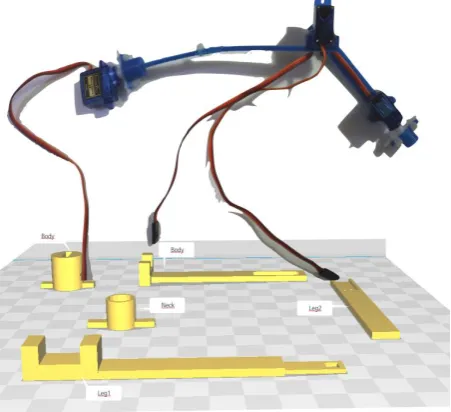
The body of the emotional object is made up of 3D printed materials and LEGO blocks. For 3D modeling,
‘ThikerCad’ by Autodesk was used.
Fig. 7. Circuit and Diagram of the Emotional Object.
Five volt constant voltage power is supplied to three motors and two neo-pixels of the emotional object through the 7805 Linear Ball Racing Regulator. It was designed to supply 11v to Arduino through power jack and VIN pin (11V). To embody the emotional story of an emotional object, you must control the movement of three motors simultaneously or individually and control them slowly or quickly. As Arduino basically does not support multitasking, it has been subjected to a lot of tests such as how to control the sensor value to be read and how to control the motor. As a result, the work proceeds in sequential progression of the code read by Arduino in a loop.
[Configuration Components of the Emotional Object]
1. An Arduino Uno board acting as her brain/heart 2. Three micro servos, acting as joints
3. Two Neo-Pixel mini cells, acting as eyes 4. A sound sensor, acting as ears
5. A IR proximity sensor, acting as a spatial sense 6. A 11v 600mA battery, the food source
7. A rocker switch 8. Lego
9. 3D printer to make the skeleton 10. 7805 linear voltage regulator 11. 100uF capacitor
12. 1000uF capacitor 13. 470ohm resistor 14. breadboard
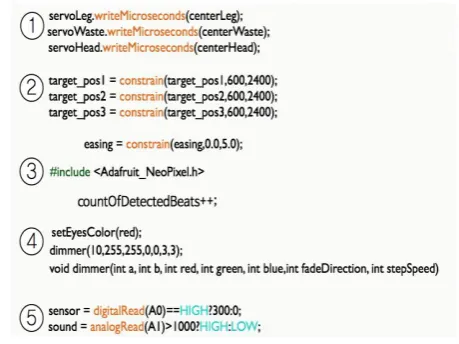
Figure 8 is the core coding part, which has the following content.
①. It is basically impossible to move three servo
motors at the same time in Arduino. For the precise control, we used writeMicroseconds ( ) instead of write ( ). As the motor 1 performs its work again in the loop until it reaches the target value although motors run a step at a time, the three motors appear to move at the same time resultantly.
②. It is designed to have elements that can control speed with three target positions on three motors. In the target position, it was set to have 600 ~ 2400ms at the start and the end of the motor, and the servo motor speed was set from 0.0 to 5.0. But in the test, it seems that speed up to 1.0 was enough. For example, it had slow and smooth movement when it was 0.05, meaning it showed better movement when the speed was closer to 0.
③. Neo-pixel library was basically used to control eye color, brightness, and blink rate according to emotion. The eye color is converted by counting the number of repetitions of the input device.
④. For the color and dimming, setEyesColor( ) and dimmer( ) functions were used.
⑤. The proximity sensor had a recognition range of 2 ~ 10cm. The proximity sensor worked smoothly when the recognition start point was set to be 3 cm. In the case of a microphone sound sensor, the value is set to be > 1000 in order to eliminate noise interference.
Fig. 8. Core Coding Part
IV. CONCLUSION
http://dx.doi.org/10.9717/JMIS.2017.4.2.83
87
objects to be friendlier as a medium of communication in accordance with the purpose of emotional interactions between humans and objects. For future studies, it is recommended to overcome the limitations of space by interacting with objects through IoT (Internet of the Things) and to study objects as things that can be learned and the forms of emotional objects that are friendlier to human emotions.
REFERENCES
[1] W. T. Lee, “Human and Technology Communication
Models in Post Human Age,” Networked Cyborg, Future Horizon 26, 2015.
[2] J. H. Kim, “The Technical Philosophy of Simondon,” Blueprint for Post-human Society, Acanet Press, 2017. [3] Balanced Arm Lamp. Wikipedia. Web Site:
https://en.wikipedia.org/wiki/Balanced- arm_lamp
[4] Adam Ben-dror,“Pinokio”, Web Site:
http://www.ben-dror.com/pinokio/ 2012.
[5] Hoffman, Guy. "Robots with soul", 2013.
[6] Orlagh O’Brien,Web Site; orlaghobrien.com
Authors
Yanghee Kwon is a doctoral st udent in Department of Digital Me dia Art at Kyungpook National Uni versity. She received master's degre e in Department of Digital Media Art from Kyungpook National Univ ersity in February, 2017. The field of his interest is humans and comp uters and She studies digitized obje cts for emotional interactions. She is a member of the Kore a Multimedia Society, the Korea Contents Association, and the Korean Society of Media& Arts. she also serves as the Director of Deagu Gyeongbuk Public Creative Institute.
Sangwook Kim received Bachelor's Degree in Computer Engineering from Kyungpook National University in February, 1979. He received his master's degree in Computer Science from Seoul National University in February, 1981. He obtained his Ph.D.
in Computer Science from Seoul National University in February, 1989. He has been a professor of Computer Science at Kyungpook National University since 1982.
![Fig. 1. Adam Ben-dror, Pinokio,2012[4]](https://thumb-us.123doks.com/thumbv2/123dok_us/8814360.1779484/2.595.80.258.302.435/fig-adam-ben-dror-pinokio.webp)