University of Kentucky University of Kentucky
UKnowledge
UKnowledge
Theses and Dissertations--Management Management
2017
MANAGERS' NETWORK CHANGE AND THEIR PROMOTABILITY
MANAGERS' NETWORK CHANGE AND THEIR PROMOTABILITY
DURING A MERGER
DURING A MERGER
Wookje Sung
University of Kentucky, [email protected] Author ORCID Identifier:
https://orcid.org/0000-0001-5027-6118
Digital Object Identifier: https://doi.org/10.13023/ETD.2017.372
Right click to open a feedback form in a new tab to let us know how this document benefits you. Right click to open a feedback form in a new tab to let us know how this document benefits you.
Recommended Citation Recommended Citation
Sung, Wookje, "MANAGERS' NETWORK CHANGE AND THEIR PROMOTABILITY DURING A MERGER" (2017). Theses and Dissertations--Management. 9.
https://uknowledge.uky.edu/management_etds/9
STUDENT AGREEMENT: STUDENT AGREEMENT:
I represent that my thesis or dissertation and abstract are my original work. Proper attribution has been given to all outside sources. I understand that I am solely responsible for obtaining any needed copyright permissions. I have obtained needed written permission statement(s) from the owner(s) of each third-party copyrighted matter to be included in my work, allowing electronic distribution (if such use is not permitted by the fair use doctrine) which will be submitted to UKnowledge as Additional File.
I hereby grant to The University of Kentucky and its agents the irrevocable, non-exclusive, and royalty-free license to archive and make accessible my work in whole or in part in all forms of media, now or hereafter known. I agree that the document mentioned above may be made available immediately for worldwide access unless an embargo applies.
I retain all other ownership rights to the copyright of my work. I also retain the right to use in future works (such as articles or books) all or part of my work. I understand that I am free to register the copyright to my work.
REVIEW, APPROVAL AND ACCEPTANCE REVIEW, APPROVAL AND ACCEPTANCE
The document mentioned above has been reviewed and accepted by the student’s advisor, on behalf of the advisory committee, and by the Director of Graduate Studies (DGS), on behalf of the program; we verify that this is the final, approved version of the student’s thesis including all changes required by the advisory committee. The undersigned agree to abide by the statements above.
MANAGERS' NETWORK CHANGE AND THEIR PROMOTABILITY DURING A
MERGER
_______________________
DISSERTATION
________________________
A dissertation submitted in partial fulfillment of the requirements for the degree of Doctor of Philosophy in the
College of Business and Economics at the University of Kentucky
By
Wookje Sung
Florence, Kentucky
Co-directors: Dr. Daniel J. Brass, J. Henning Hilliard Professor of Innovation Management
and Dr. Giuseppe Labianca, Gatton Chaired Professor of Management
Lexington, Kentucky
ABSTRACT OF DISSERTATION
MANAGERS' NETWORK CHANGE AND THEIR PROMOTABILITY
DURING A MERGER
I investigate whether cross-functional or cross-organizational networking
following a large corporate merger and acquisition improves managers’ career outcomes. Previous research on networks and career success has focused on stable organizational environments, finding that large, open networks with many structural holes are most advantageous because of superior information benefits and control power, while closed networks provide redundant information that is unhelpful career-wise. However, I suggest that while dense, closed networks formed within knowledge (functional) or identity (legacy organization) boundaries might be detrimental to executives’ future promotability, closed networks are helpful if they are created across those boundaries. These ties help to facilitate knowledge transfer and develop a new superordinate post-merger identity and are ultimately valued by the organization. I tested this on junior executives’ email and survey data collected at two time points (pre-merger and a year later) from a newly-merged organization. Results show that while closed networks with higher constraint in general were detrimental to executive’s promotability pre-merger, they lose the negative effect in the post-merger tumult. Controlling for overall network constraint, increasing closed networks across functional and legacy organizational boundaries led to managers receiving higher promotability evaluations from top management, whereas increasing closed networks within one functional and legacy organizational boundary did not have a significant impact. Managers’ rank and
networking strategy that joins other employees (i.e., having a tertius iungens orientation) 2 moderated the relationships between networks and promotability. Implications are discussed for career and social networks research.
Wookje Sung___________
MANAGERS' NETWORK CHANGE AND THEIR PROMOTABILITY DURING A MERGER
By
Wookje Sung
Dr. Giuseppe Labianca_________________
Co-Director of Dissertation
Dr. Daniel J. Brass ____________________
Co-Director of Dissertation
Dr. Kenneth R. Troske_________________
Director of Graduate Studies
DEDICATION
iii
ACKNOWLEDGMENT
iv
TABLE OF CONTENTS
Acknowledgment...iii
List of Tables………..vi
List of Figures………...vii
Chapter 1: Introduction………...……….………1
Chapter 2: Literature Review………...6
Social Capital and Career Success………6
Bridging Organizational Identity and Knowledge Boundaries………..14
Chapter 3: Hypotheses………..……….…….23
Social Networks and Managers’ Promotability………..…23
Network Closure Within and Across Identity Boundaries………...25
Network Closure Within and Across Knowledge Boundaries………31
Moderation Effects……….33
Rank………...…34
Tertius Iungens Orientation………35
Chapter 4: Methods…………..………..37
Research Setting……….37
Sample and Procedures………..39
Measures………....44
Moderators……….48
Control Variables………...…49
Chapter 5: Analyses and Results………..……..52
Chapter 6: Supplementary Analyses………..65
Promotability vs. performance………...…65
The potential effects of secondhand structural holes……….…65
Ties and alters vs. network structure………...66
Integration effort vs. legitimacy……….67
Chapter 7: Discussion………68
Chapter 8: Conclusion………73
Appendix 1.Determining the threshold for email networks………..75
v
II. Correlation matrices of betweenness centrality scores (2013 and 2014) and
plots………76
III. Correlation matrices of eigenvector centrality scores (2013 and 2014) and plots………....77
Appendix 2.The “Ninebox” Information (Performance X Promotability Matrix)……….79
Appendix 3. Ordinal Logistic Regression Predicting Performance...81
Appendix 4. Using secondhand structural holes……….83
Appendix 5. Using betweenness centrality……….85
References………..87
vi
LIST OF TABLES
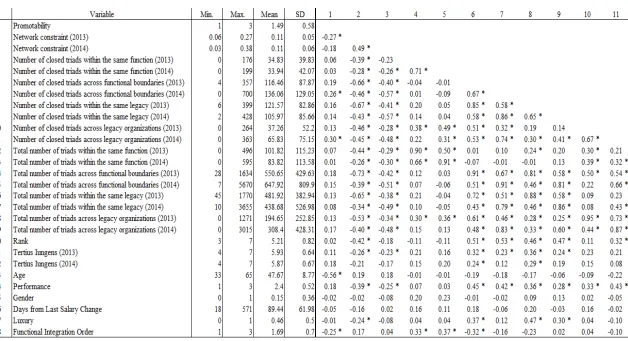
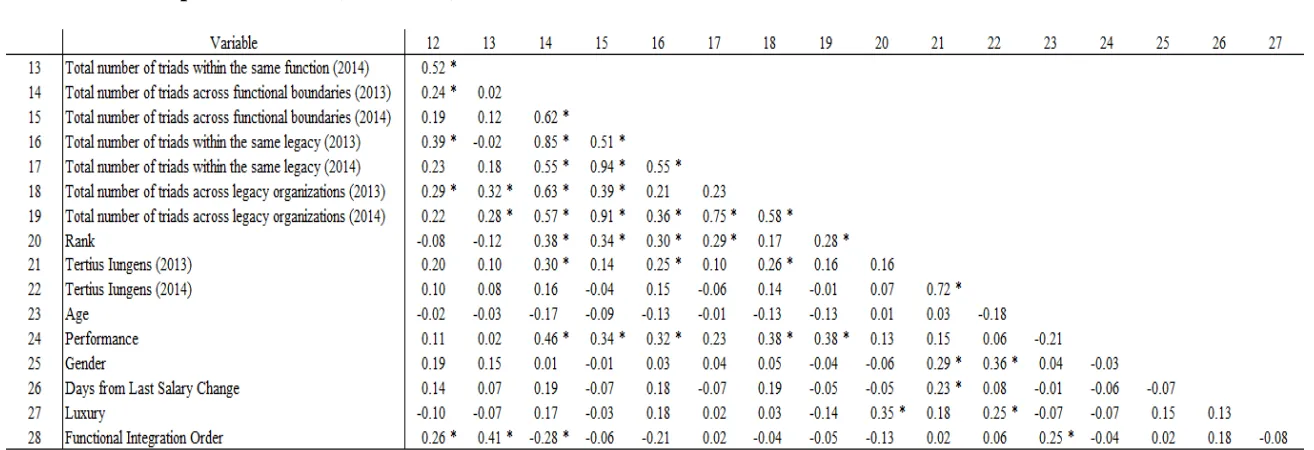
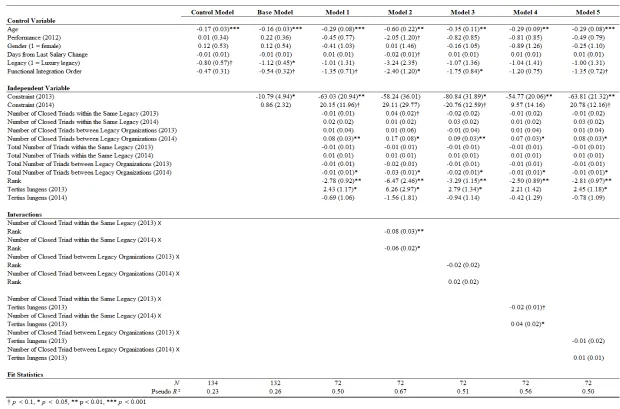
Table 5-1. Descriptive Statistics……….………57
Table 5-2. Results of Ordinal Logistic Regression Predicting Promotability: Identity boundaries (legacy organizations)………..59
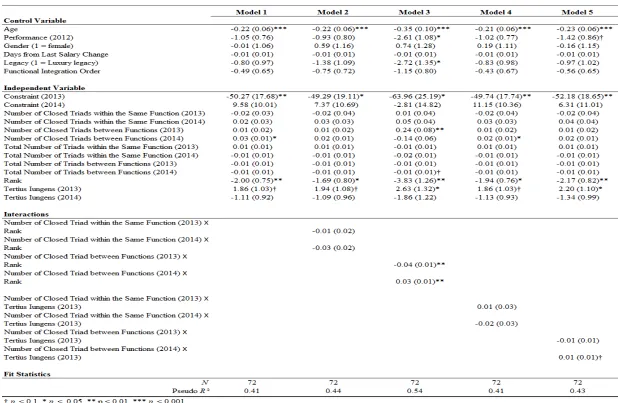
Table 5-3. Results of Ordinal Logistic Regression Predicting Promotability:
vii
LIST OF FIGURES
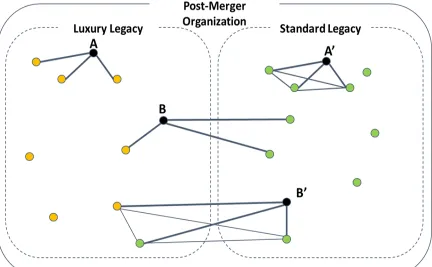
Figure 2-1. Ego-networks within and across functional boundaries…….………….……21
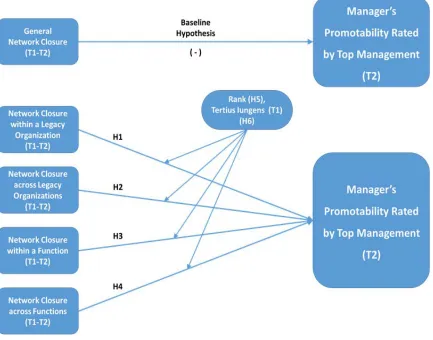
Figure 2-2. Ego-networks within and across legacy organizational boundaries….……...21
Figure 2-3. Summary of hypotheses…….……….22
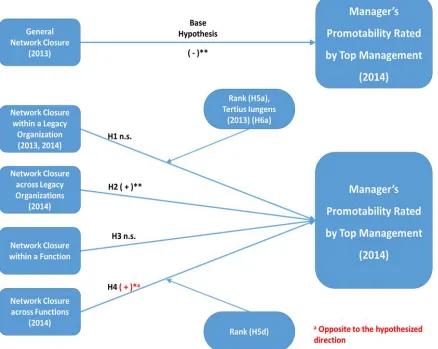
Figure 5-1. Summary of Results……….………...61
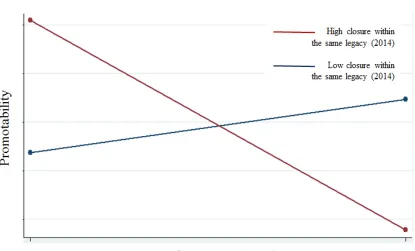
Figure 5-2. Interaction between Network Closure within the Same Legacy (2013)
and Rank………62
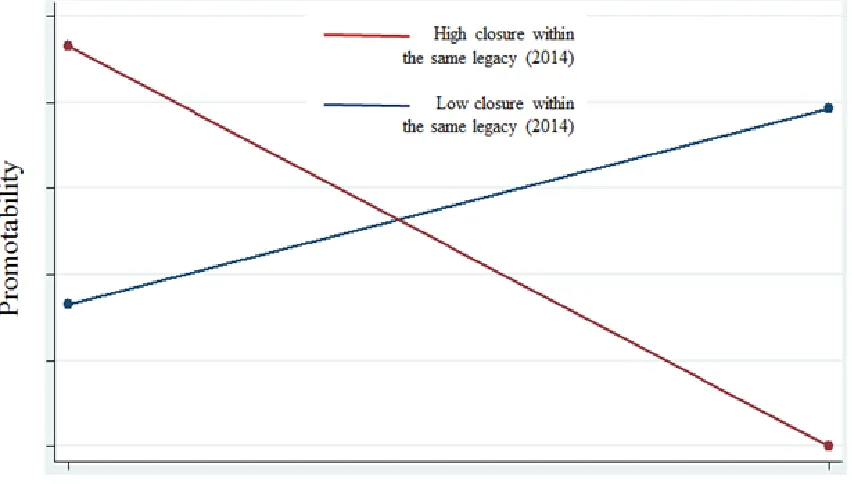
Figure 5-3. Interaction between Network Closure within the Same Legacy (2014)
and Rank………62
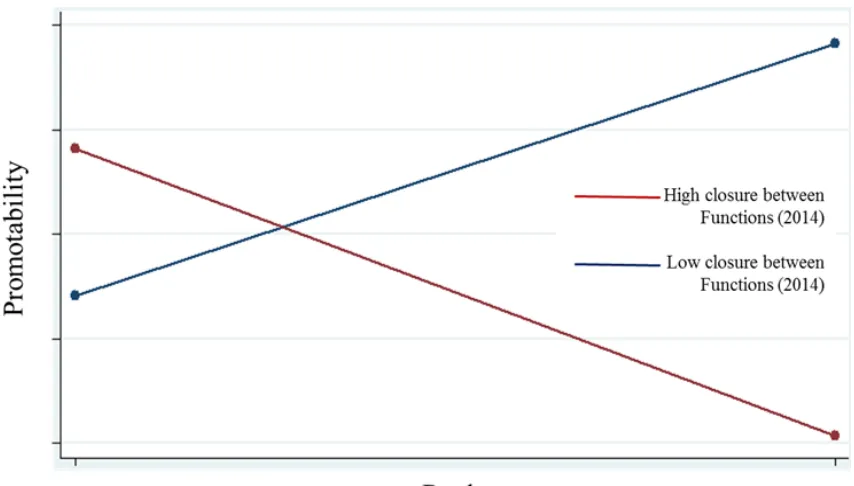
Figure 5-4. Interaction between Network Closure between Functions (2013) and
Rank………...63
Figure 5-5. Interaction between Network Closure between Functions (2014) and
Rank………...63
Figure 5-6. Interaction between Network Closure between Legacy Organizations
(2013) and Tertius Iungens Orientation (2013)……….…64
Figure 5-7. Interaction between Network Closure between Legacy Organizations
1
CHAPTER 1: INTRODUCTION
Global mergers and acquisitions (M&A) have become prevalent strategic moves,
with deal volumes exceeding $5 trillion in 2015 (Dealogic, 2015). Businesses choose to
engage in M&As in order to enhance market competitiveness, but these mergers usually
entail extremely disruptive organizational changes, such as organizational restructuring
and layoffs, which create a great deal of uncertainty among organizational members.
Members can bring with them sudden shifts in roles, routines, intra-organizational
relationships, and processes, all of which can precipitate major role change, demotion, or
even job loss (Ghauri & Buckley, 2003; Marks, 2005), both for lower-level members, but
also for the managers and executives at the heart of this study. There is a wide variety in
career outcomes among managers, with some managers experiencing unexpected career
crises, while other managers manager to find even greater career opportunities in a larger
and more powerful new organization, finding new roles and even being promoted. For
example, a regional sales director of a newly merged organization might assume larger
responsibilities with the addition of new product lines from the other legacy organization.
Unraveling why these different career outcomes occur, therefore, would help managers
enhance their chances to survive and succeed during the turbulence of a merger. While
most prior work focused on managers’ individual characteristics to predict these career
outcome differences (e.g., Greenhaus, Parasuraman, & Wormley, 1990; Stroh, Brett,
Reilly, 1992), I suggest that the resources managers access through their social ties, i.e.,
their social capital, might play an important role in predicting which managers succeed
career-wise during a merger event.
2
merger context has examined the relationship patterns managers should have for optimal
career outcomes. Burt’s (1992, 2005) structural holes theory has widely dominated the
discourse on maximizing career outcomes among managers and executives. Structural
holes are the lack of relationships between people (Burt, 1992). When your contacts do
not have direct relationships between themselves, you are more likely connecting
different pockets of the organization than when your contacts have direct relationships.
Connecting people from disparate areas that are not directly communicating with each
other can provide three benefits (Burt, 1992): (1) access to diverse information sources
(Gargiulo & Benassi, 2000); (2) early access to useful information; and (3) control over
information flow. Thus, researchers have hypothesized and provided evidence that open
networks with many structural holes are better for career advancement than closed, dense
networks where one’s contacts are also communicating directly with each other (e.g.,
Burt, 1992; Seibert, Kraimer, & Liden, 2001). In contrast, being involved in closed, dense
networks has generally been revealed to slow one’s career advancement. Because closed
networks tend to create unique cultures and strong identities that are very different from
others (Burt, 2005; Coleman, 1988), they generally serve as impediments to individuals
when they attempt to reach out to other social groups for greater opportunities
(Granovetter, 1973; Krackhardt, 1999; Oh, Labianca, & Chung, 2006; Portes &
Sensenbrenner, 1993).
In spite of the theoretical arguments in favor of open networks full of structural
holes, there has been recent empirical evidence suggesting that closed networks can
indeed bring career advantages in certain contexts. For example, in a study of Chinese
3
(“brokers”) could not enjoy career benefits, such as higher salaries or bonuses, because
the companies had cultures that valued mutual investment and cooperation (i.e.,
“high-commitment” cultures). Rather, it was the “integrators” who brought others together by
introducing unconnected others to each other that achieved better career outcomes. These
integrators and their closed networks better fit their organizational culture and met top
management’s expectations, which encouraged interpersonal collaboration rather than
competition. Obstfeld (2005) also noted that engineers who join other engineers together
(through the “tertius iungens” process, which inherently closes structural holes) were
involved in innovation more actively because the tacit, unwritten, and difficult-to-convey
knowledge necessary for innovation is more likely to be exchanged through strong,
trusting networks of densely connected engineers. Likewise, Dokko, Kane, and
Tortoriello (2014) and Tortoriello and Krackhardt (2010) found that creativity and
innovation occurs more often from closed networks across organizational boundaries that
have unique identities. Specifically, I introduce the concepts of knowledge boundaries,
such as functional background, and identity boundaries, such as legacy organizations, as
important organizational boundaries that influence the effects of managers’ networks on
their promotability during a merger.
Following this work, I will argue that there are two types of organizational
boundaries that influence the relationship between managers’ networks and their
promotability during a merger event: knowledge boundaries, such as functional
department membership, and identity boundaries, such as legacy organization
membership. This study adopts the perspective that networks full of structural holes
4
related to a career outcome, such as promotability, is a function of the specific
organizational boundaries they cross. When actors need to develop a collaborative
atmosphere, develop a shared identity, and overcome any potential concerns for
opportunism, as is often the case in the merger integration process across legacy
organizations, the liabilities of having many structural holes might prevail over the
benefits.
In sum, career benefits from structural holes might not be universal, and closed
networks can have positive impacts on individual’s career when the organizational
context requires mutual understanding, interpersonal trust, building a strong
organizational identity, and collaboration. Mergers are dramatic organizational changes
that call for quickly building a newly merged organization as a new target of
organizational identification among employees that have previously been focused and
identified with their “legacy” organizations. Employees from different legacy
organizations must work closely together to create synergistic effect, as demanded by top
management to ensure a successful merger. Therefore, I suggest that career benefits from
closed social networks might arise for managers and executives during a merger when
that network closure is focused on crossing important organizational identity boundaries
(e.g., from one legacy organization to another), even while information benefits from
open networks still persist within the confines of more familiar organizational boundaries
(e.g., functional boundaries).
This study is designed to explore the potential career advantages of closed
networks during an organizational merger. In the literature review below, I detail the
5
organizational boundaries as factors that influence the effects of open and closed
networks on manager’s career outcomes during a merger. I predict that having closed
networks across certain organizational boundaries (namely, identity boundaries) will be
more advantageous to managers’ promotability rated by top management than open
networks while closed networks across other types of boundaries (namely, knowledge
boundaries) will be still detrimental. Moderating effects of rank and networking strategy
6
CHAPTER 2: LITERATURE REVIEW
Social Capital and Career Success
There are two major perspectives within social capital research – the bridging
view and the bonding view (Adler & Kwon, 2002; Borgatti & Halgin, 2011). The
bridging view of social capital is concerned with individuals’ competitive career
advantages gained from having certain relationship patterns. In his seminal research on
individual social capital, Burt (1992) demonstrated career advantages to having large,
“open” networks where many of one’s contacts are not themselves directly connected
(i.e., having structural holes in one’s personal network). Since then, social capital
researchers have generally suggested that open networks are more helpful for career
outcomes compared to closed networks. For example, Brass (1984) found that employees
brokering between groups (i.e., those high in betweenness centrality) were more
influential because other employees were dependent on them for information and
resources. Similarly, Burt (1992) and Seibert and colleagues (2001) demonstrated that
managers who had many structural holes in their individual networks tended to enjoy
more favorable career outcomes, such as faster promotion and higher compensation.
Mehra, Kilduff, and Brass (2001) and Zaheer and Soda (2009) also showed that spanning
many structural holes was closely associated with higher individual performance ratings
from superiors.
The career advantages of open networks are argued to come from at least three
sources (Burt, 2005). First, open networks spanning unconnected individuals and social
groups can provide access to more diverse sources of information and resources. Unlike
7
different social groups (Granovetter, 1973). Since these groups are less likely to interact
directly, each group is more likely to retain unique information and resources than when
the groups are connected. As many creativity and innovation studies argue, combining
heterogeneous knowledge or information is a crucial step for creativity and innovation
(Collins & Smith, 2006; Obstfeld, 2005; Taylor & Greve, 2006; Grosser, Venkataramani,
& Labianca, forthcoming; Tortoriello & Krackhardt, 2010). Given that the organizational
environment is ever changing and unpredictable, organizations are looking for more
creative and innovative employees. It is reasonable to think, therefore, that organizations
would favor employees with more open networks in career advancement over others with
closed networks.
Second, open networks can bring in information in a more timely manner than
closed networks. Due to their diverse sources of information, individuals with open
networks are, on average, more likely to receive new information faster than others who
are embedded in closed networks. Because the very definition of creativity is the
“production of novel and useful ideas” (Amabile, Conti, Coon, Lazenby, & Herron,
1996), receiving timely information is important for creativity.
Finally, employees with open networks tend to enjoy more power and influence in
organizations. An actor has power over others to the extent that the others are dependent
on the actor for resources or information (Pfeffer & Salancik, 1978). Employees with
open networks brokering many social groups can often control information flows
between groups, particularly if those groups lack other connecting pathways for
information flow. Those employees whose personal networks are more embedded in one
8
necessary resources or information available only through other groups (Brass, 1984;
Burt, 1992; Padgett & Ansell, 1993). Employees are already seen as powerful and
influential because of their network position and control over inter-group resource flows
are more likely to be seen as ready for more powerful, influential roles by top
management.
Open networks with many structural holes can provide other career advantages
beyond these informational advantages. Structural holes tend to exist between different
social groups and classes. Thus, employees with open networks are more likely to have
direct or indirect access to individuals who have the most influence and the authority to
make decisions in the organization, i.e., the dominant coalition (Brass, 1985) outside of
their own group’s boundaries (Burt, 1992; Ibarra, 1993; Seibert et al., 2001). Connections
to the organization’s dominant coalition are helpful to an individual’s career because they
both facilitate resource acquisition, which can improve performance, as well as through
influencing policy (Oh, et al., 2006). For example, a regional marketing director can
influence the organizational budget in favor of her region through her close relationships
with senior managers that control the budgeting process. She may even receive more
favorable performance evaluations or enhanced promotion prospects because top
management will see better performance due to the superior resources and information.
In sum, the bridging view of social capital argues that open personal networks with many
structural holes have been generally considered as helpful to individuals’ career
outcomes. This view of social capital is relatively less concerned with the impact of these
networks on the collective or its performance than it is with individuals’ outcomes;
9
In contrast, the bonding view of social capital focuses on the collective and on the
social benefits of mutual trust, norms, and identification which emerge from having a
densely connected group of individuals. The extant literature tends to argue that
collective benefits of bonding social capital may limit individual members’ freedom to
explore outside their own social circle for resources or information. As people in a dense
network become more similar through frequent interaction, they find it difficult to work
or communicate with different or diverse others (McPherson, Smith-Lovin, & Cook,
2001). This may lead to a lack of understanding between different social groups, and
developing negative outgroup biases (Brewer, 1979; Portes & Sensenbrenner, 1993;
Tajfel & Turner, 1979). Thus, resources and information from other groups are not likely
to be sought out or well received in dense networks (Granovetter, 1973; Portes &
Sensenbrenner, 1993), hence, leading to a “closed” group. Because of this disadvantage,
bonding social capital has been generally viewed as detrimental to individual career
success even while being helpful for groups’ and organizational survival (Burt, 1992;
2005).
However, recent research started to highlight potential career benefits of bonding
social capital of closed networks. According to Burt (2005), structural holes of open
networks alone may not help individuals enjoy career success. If an individual has too
many structural holes, she may lack trust and legitimacy necessary to utilize diverse
information because she does not belong to any social group. Conversely, Coleman
(1988, 1990) explained that dense, strong relationships among community members
engender “enforced trust” as they can monitor each other’s behaviors. If anyone behaves
10
sanctioned by others for harming the group (Coleman, 1988). The bonding social capital
inherent in a densely connected group can bring great economic efficiency because
members can cooperate without worrying about being betrayed or paying the search costs
for new transaction partners (Granovetter, 1985; Uzzi, 1997; Williamson, 1979). These
characteristics of closed networks are helpful for brokers to share information, mutually
understand and collaborate with the group members to make it useful (Obstfeld, 2005;
Tortoriello & Krackhardt, 2010). Therefore, bonding social capital of network closure
contributes to stability, trust, and collaboration within the group necessary to capitalize
on the diverse information received from other social groups. In sum, the social capital
literature suggests that the optimal personal network structure keeps many structural
holes externally, but build dense ties internally.
One important consideration, however, with regard to most of the previous studies
on the relationship between social networks and career success is that they have been
conducted in relatively stable organizational environments, rather than during times of
organizational change and upheaval. For example, Burt (1992, 2005) and Podolny and
Baron (1997) studied large U.S. high-technology firms during relatively calm phases of
normal operation. Mehra and colleagues (2001) studied a small high-technology firm
undergoing normal growth patterns. Although high-technology-based firms may have
fast-paced external environments, they tend to have stable patterns of internal
relationships, either because certain internal structures are dominant at one era of time
(DiMaggio & Powell, 1983; Meyer & Rowan, 1977) or because existing organizational
structures are inertial to ensure reliability (Hannan & Freeman, 1977). Seibert et al.’s
11
changes or in fluctuations, such as an organizational merger. Boxman, De Graaf, and
Flap (1991) collected their samples from multiple companies in the Netherlands. Their
sample, too, was from generally stable environments because organizational changes and
mergers are relatively rare events in an organization’s history and when they do occur, it
is rare for a company to invite in social network researchers in the midst of the change.
Thus, few previous studies have focused on managerial career outcomes in the face of the
type of intense organizational change brought about during an organizational merger, as
compared to those conducted during relatively stable time periods (e.g., Burt, 1992;
Greenhaus et al., 1990).
This study looks to better understand the relationship between individuals’ social
networks and their career outcomes in the context of a corporate merger. In doing so, I
hope to illustrate that whether an individual has an open or closed network is important in
predicting how their career is affected during the merger, and that I need to specifically
take into account whether their network contacts cross formal boundaries or not (e.g.,
whether the ties are inter-functional or across the legacy firms in a merger). Merely
understanding the structure of the employee’s network in terms of the presence or
absence of structural holes is not enough to understand in detail what occurs to
individuals throughout the course of this major organizational upheaval. To fully
understand the relationships between individuals’ networks and career outcomes, I study
managers’ career outcomes of a newly-merged organization over two time points:
immediately after the merger ratification (T1) and a year later (T2).
My study is focused specifically on managers’ career outcomes for several
12
and therefore, have latitude to be more “entrepreneurial” (Burt, 1992). Thus, their careers
are more likely to be sensitive to their networking patterns. Second, managers are key to
mergers’ success or failure. (Fried, Tiegs, Naughton, & Ashforth, 1996; Guth &
MacMillan, 1986). Managers can bring employees from two different organizations
together by communicating and reinforcing a new organizational identity. Managers can
also reduce employees’ stress and confusion due to the merger by providing personalized
attention and readjusting tasks among employees. Finally, managers are employees, too,
and may feel helpless, withdraw psychologically, and intend to leave the organization if
they evaluate the merger negatively and perceive that it will unfairly impact their career
development (Fried et. al., 1996). Therefore, managers’ career outcomes deserve closer
investigation, particularly in organizations undergoing merger.
There are reasons to believe that the effects of social networks on managers’
career outcomes might diverge during a merger from the normal relationship studied
previously in more stable organizational contexts. Social network research on individual
social capital focuses on the diversity of information and resources that open networks
access while downplaying the communal advantages of closed networks, such as trust,
reciprocity, and coordination. However, managerial roles are not limited to their own
individual performance and creativity; managers are assessed as well by their ability as
leaders. Effective leadership involves promoting trust and coordinating effort among
followers and among others in the organization who might not have a reporting
relationship with the manager in order to achieve organizational goals (Hogg, van
Knippenberg, & Rast, 2012). In a stable organizational environment, trust and
13
as routines, meetings, plans, and schedules to promote coordination. Okhuysen and
Bechky (2009) summarized that these mechanisms create accountability, predictability,
and common understanding, which are three integrative conditions for coordinated
activity. In other words, stable organizations can substitute interpersonal coordination
processes with formal mechanisms. Therefore, stable organizations are likely to need
creativity advantages of open networks more than they need coordination advantages of
closed networks. This is probably one major reason why previous research on stable
organizations has found largely positive effects for open networks and largely negative
impacts for closed networks on career outcomes. Mergers, however, are disruptive events
that can change these coordination mechanisms. Routines, meetings, plans, and schedules
might lose their predictability during a merger because the two legacy organizations have
had their own unique modes of operation. Therefore, the importance of bonding social
capital, such as trust, coordination, and identity reinforcement, might increase when two
organizations during the time period when two legacy organizations are merging into one
new entity.
I am not arguing that the advantages obtained through open networks, such as
diverse, timely information and controlling power, disappear during a merger. Rather,
employees and managers alike need more accurate, timely information in times of abrupt
integration. Mergers excite employees’ anxiety about ambiguity in their job continuity,
changes in compensation package, job security, and career prospects in new organization
(Chung, Du, & Choi, 2014; Fried et al., 1996; Makri & Ntalianis, 2015; Rafferty &
Restubog, 2010). To make sense of the changes during a merger (Weick, 1995),
14
already know what people in their circle know (Srivastava, 2015). Managers with more
open networks are likely to receive more accurate, timely information to help them
respond to volatile situations and will enjoy better prospects of keeping jobs or advancing
to higher positions. I do not intend to disprove the generally positive effects of open
networks on career outcomes during a merger -- I still believe it to be the case that having
many structural holes in one’s network will lead to better career outcomes. However, my
study will also suggest that when ties cross formal organizational boundaries in this
merger context, it is network closure -- having closed cross-boundary ties -- that will
further improve career outcomes.
Bridging Organizational Identity and Knowledge Boundaries
Much of the research from the bridging perspective on social networks tends to
ignore the theoretical implications of formal boundaries in organizations with the notable
exception of Fernandez and Gould (1994), who proposed a typology of brokers according
to their roles within and across group boundaries. They found evidence that brokering
institutions had different levels of power depending on their roles and the actors they
broker around the boundaries dividing health institutions. Likewise, intra-organizational
boundaries can affect brokers’ advantages and influence obtained from social networks.
Although formal boundaries play a crucial role in defining relationships (Feld, 1981), the
effects of organizational boundaries on the relationship between social networks and
career outcomes have been underexplored (for a notable exception, see Seibert et al.,
2001). Because employees are likely to interact more frequently within the boundaries
15
more structural holes (i.e., opportunities to broker between disconnected actors) across an
organization’s formal boundaries than within. Social capital benefits obtained by bridging
organizational boundaries can vary depending on what types of boundaries one is
bridging.
Two broad categories of intra-organizational boundaries can affect relationships
and ultimately employee outcomes: “identity boundaries” (Hogg & Terry, 2000; Tajfel &
Turner, 1979), and “knowledge boundaries” (Carlile, 2002). Identity boundaries are
dividing lines between employees who identify themselves with different entities, in this
specific instance, with the different legacy organizations. Identity boundaries provide
employees with a reference point to determine whether other employees are one of them.
For example, when two organizations are merging, employees of the legacy organizations
might not consider themselves as belonging to the newly created organization and might
view employees from the other legacy organization as outsiders. In this case, the divide
between legacy organizations can be a strong identity boundary. Knowledge boundaries,
in contrast, demarcate employees from different knowledge backgrounds within the
organization and are usually instantiated in the formal organizational structure (e.g., as
functional departments). For example, accounting department encompasses employees
with knowledge on such topics as financial status, cash flows, and tax, whereas
employees in marketing department specialize in understanding target customers,
conducting market research, and developing product concepts.
During a normal, non-merger phase in the organization’s lifespan, identity
boundaries and knowledge boundaries may or may not overlap within an organization.
16
within the one company. This can be especially the case in small-sized organizations
where intra-organizational boundaries are not salient and employees can run into each
other in the hallways (Carton & Cummings, 2012; Krackhardt, 2003). Identity boundaries
and knowledge boundaries may overlap when employees consider themselves as a
“marketing person” as well as sharing knowledge about company’s marketing strategies
within the boundary of marketing function.
However, identity boundaries and knowledge boundaries can also diverge
markedly during a merger. Although a person can have multiple social identities, the
most salient identity depends on the situation and context (Brewer, 1991; Tajfel &
Turner, 1979). Because organizations with different cultures and histories are abruptly
combined into one company through merger, “legacy” organization membership becomes
more salient, sharpening distinctive identity boundaries more so than boundaries created
by knowledge pools or functional distinctions (Brewer, 1991). Knowledge boundaries
from the legacy organization, such as functional boundaries, will continue to persist, but
the introduction of a “foreign” legacy organization might make the cross-organization
identity boundary more salient and important during merger. Because of this changing
salience and importance, I suggest that the effects of managers’ open and closed networks
will be different across these two types of boundaries during a merger.
The beneficial effects of open networks on managerial career outcomes will
prevail even during a merger if the open networks broker employees from different
knowledge boundaries (i.e., they involve cross-functional ties; see Figure 2-1 for an
illustration of cross-functional open and closed networks). Mergers are abrupt events that
17
Managers who can gather information across diverse knowledge boundaries, such as
different functional departments, may be able to better understand where the organization
is headed, how everything will change, and what top management wants from managers
and junior executives. This information might help a manager navigate a better career
path during the merger. For example, a marketing director is more likely to become
aware of the company’s plan to downsize a product line post-merger if she has contacts
in the HR and R&D departments. If she receives the information faster than others, she
could move to a position in a more promising product line, rather than continue her career
focus on the ill-fated one. While having ties certainly gains access to this type of
information, having disconnected ties is what provides competitive advantage for careers.
In the above example, if the manager’s contacts communicate directly, the information
may already be circulating in the closed network enough where other directors already
know about the upcoming product line closure, increasing the competition for a different
job opening and reducing the possibility of the beneficial career move. The manager can
even control the information flows between knowledge boundaries to her advantage,
making herself more influential among competitors (Brass, 1984). Also, managers
spanning knowledge boundaries may contribute to a merger’s success by being more
creative. According to researchers, creativity comes from combining diverse knowledge
in a novel way (e.g., Perry-Smith & Shalley, 2003). Knowledge boundary spanners can
achieve this novel combination with knowledge derived from different pools. During a
merger, top management seeks more synergistic effects to improve the likelihood of
merger success (Chatterjee, 1986), and knowledge boundary spanners may suggest
18
arguments are similar to what one would expect even in a stable organization -- those
with open networks between knowledge boundaries such as formal organizational
departments or units will benefit career-wise from sitting in a broker position.
Where my work diverges from previous work is to argue that closed networks are
not always harmful to managers’ career outcomes, particularly in the turbulent merger
setting. The negative effects of closed networks on manager’s career outcomes might not
come to pass if a manager has a closed network with employees from the different legacy
organizations (see B’ in Figure 2-2 for an illustration of an inter-legacy organization
closed network). Mergers tear down previous organizational boundaries to build up new
ones. Employees may have difficulties in adjusting to and identifying with the new
organization created by the merger because the new organization now includes
“foreigners” (Terry, 2003; Terry, Carey, & Callan, 2001). This post-merger integration
problem has led many mergers to failure (Shrivastava, 1986). Because the synergistic
effects and success of a merger depend on post-merger integration (Larsson &
Finkelstein, 1999), top management expects managers to help promote the sense of unity
among all employees of the newly-merged organization. Building networks with both
legacy organizations can enable managers to bring employees together in the beginning
of a merger process by playing a role of mediating communications between the two.
Eventually, however, the employees will need to interact and influence directly to
understand better and assimilate to each other because relying on a few brokers is not an
efficient or effective way of communication. Moreover, for a merger to be successful,
two legacy organizations need to acculturate to each other, and it gives intense pressure
19
achieve fast stabilization of the post-merger organization when their subordinates do not
communicate directly with each other. For example, an HR manager in the newly-merged
organization might want her staffs from the different legacy organizations to talk to each
other directly rather than requiring them to go through her to eliminate minor
discrepancies in policies across the two legacy organizations (e.g., compensation, rank
order, and training policies). Managers play an important role in forging a new, united
post-merger organizational identity by communicating personalized previews of what
will happen next and coaching desirable behaviors (Schweiger & Denisi, 1991; Sung,
Woehler, Fagan, Grosser, Floyd, & Labianca, forthcoming). If managers encourage
strong, closed social network ties during a merger among employees from different
legacy organizations, they can encourage mutual understanding and trust between the
members of the legacy organizations, making the communication and coaching much
easier than would be the case through maintaining open networks. Therefore, building
closed networks with other employees from different legacy organizations can be helpful
for managerial career advancement during a merger.
Mutual trust, smooth coordination, and identity reinforcement might be of less
importance between two employees within the same organizational boundary, whether a
knowledge or identity boundary, during a post-merger integration. Within a knowledge
boundary, employees share similar knowledge backgrounds, practices and problems
(Brown & Duguid, 1991; Orr, 1996). Employees in the same knowledge boundary may
not need closed networks for better coordination and trust because they already
understand the nature of colleagues’ work (Huber & Lewis, 2010). Likewise, employees
20
without the support from closed networks. When employees are similarly identified with
the organization (e.g., “we are proud to be members of Company A”), they are likely to
share certain historical patterns of working together (e.g., “The Company A Way”).
Because people tend to trust and value their in-group members more than out-group
members (Brewer, 1979), it is less likely that there will be coordination or trust issues
within an identity boundary, even in the absence of closed networks.
Thus, on the whole, I expect that the information benefits of open networks with
many structural holes still hold within a social system that is bounded. Managers
brokering unconnected employees will still enjoy diverse information sources, timely
information, and control power within the boundary, which can enhance their career
outcomes. However, in situations where the need for collaboration and coordination
among people surpasses the need for information benefits, as is the case in bridging the
legacy organization identity boundary, having closed networks may be more helpful for
managers’ career. In the empirical study presented below, I test hypotheses derived from
21
Figure 2-1. Ego-networks within and across functional boundaries
23
CHAPTER 3: HYPOTHESES
Social Networks and Managers’ Promotability
It has been well established in the social capital literature that an open network
with many structural holes (i.e., a lack of relationships between one’s contacts) brings
numerous benefits to a social actor, including greater prospects for career success (Burt,
1992; Seibert et al., 2001). When people are connected by dense, closed social
relationships, information and knowledge they possess tend to become similar and
redundant through the process of interaction. On the contrary, when people do not
interact directly with each other, they are more likely to have different information,
unique knowledge bases, and cultures. Therefore, structural holes tend to exist between
disparate social groups (Burt, 1992; Granovetter, 1973). When a manager’s network has
many structural holes, she is likely to be “bridging” the relational gaps between these
unconnected groups. Burt (2005) called this actor connecting unrelated groups a broker,
and summarized three advantages of playing a broker in a network as: (1) access to more
diverse source of information, (2) early access to information, and (3) control over
information flow between groups. Being a broker between groups provides an individual
manager with additional values because the resources from unique groups are more likely
to be diverse than those from a homogenous group. Having diverse sources of
information may also provide earlier access to novel information than having fewer
unique contacts. Lastly, brokers can control information diffusion from one group to
another because they are the ones in a position to pass, or not pass, information between
groups. Thus, people are likely to be reliant on these brokers for useful information from
24
information flows (i.e., having high closeness and betweenness centrality) brought more
power to individuals.
On the other hand, network closure with densely connected individuals is often
considered to be detrimental to one’s career success. Managers with few structural holes
in their networks (i.e., closed networks) will receive redundant information from their
contacts because most of their contacts are connected and information they have is likely
to become similar through the process of interaction (Burt, 1992). This limitation on
information access can block the way of promotion for several reasons. First,
homogenous information may limit a manager’s creativity because creative ideas are
generated by combining heterogenous information (Perry-Smith, 2006). Given that
managers are required to think strategically rather than focusing on daily routines, poor
creativity would be considered disqualifying for higher organizational positions. Second,
unlike lower level employees who generally focus on their own tasks, a manager should
work in coordination with other departments, functions, and the organization’s top
management. If she is not aware of what is happening in other parts of the organization,
her ability to collaborate with others will be damaged or diminished (Gargiulo & Benassi,
2000), which, in turn, will dim the prospect of her future promotion. Moreover, she may
need to ask for help from other managers who are brokers to make up for this limited
access to useful information. This will further lower her promotability because she has to
rely on others, which is a sign of lack of influence, and because when she receives the
necessary information, if possible, she is already behind her competitors in the internal
job market. Burt (1992) explain this as network constraint as opposed to the structural
25
Over time, closed networks may have even more detrimental effects on a
manager’s promotability during a merger. Mergers cause abrupt changes in organizations
including managers’ careers (Ghauri & Buckley, 2003). To cope with the ambiguity
caused by merger, employees and managers desperately search for information about
changes in formal structures, promotions, layoffs, and so on by utilizing network ties to
others from all over the organization (Srivastava, 2015). If managers want to collect as
much information as possible, they need to add new contacts and increase the proportion
of structural holes in their social networks. If, instead, they increase network closure in
response to the uncertainties, they may be trapped in their own network, not be exposed
to timely information about change, and eventually lack the ability to adapt to the new
environment (Gargiulo & Benassi, 2000). Therefore, I posit that if a manager increases
network closure across their entire personal (“ego”) network over time, her promotability
will decrease at the end of the period.
Base hypothesis: Increases in a manager’s ego-network closure from T1 to T2 are
negatively related to the manager’s promotability at T2.
Network Closure Within and Across Identity Boundaries
The deleterious effects of having more closed networks may be stronger within
the same identity boundary (e.g., within the legacy organization; see A and A’ in Figure
2-2 for illustrations of open and closed networks within the same legacy organization). In
a merger, two organizations with different organizational cultures and histories are
integrated. The M&A literature has argued that mergers frequently fail because of
26
2009). Thus, faster integration and stabilization of the organization as one company are
likely to be top management team’s number one priority during a merger. Indeed, one
executive vice president in my research site lamented that few managers were
demonstrating leadership to initiate collaboration between organizational boundaries
during the merger. Accordingly, managers who contribute to integrating and stabilizing
the merger of two organizations will be evaluated as more promotable during a merger
process. Increasing network closure within a legacy organization in response to a merger
may cause harm to a manager’s ability to integrate legacy organizations. First of all,
network closure discourages building new ties outside of the closed network because of
network inertia (Briscoe & Tsai, 2011). A closed network tends to reinforce trusted
relationships among members because everyone can monitor each other’s behavior
through densely connected relationships (Coleman, 1988). This reinforced trust generates
unique patterns of behavior and perspectives that members share, and, in turn, group
identity differentiated from other groups (Burt, 1992; Coleman, 1988). Members of a
closed network will find difficulties in building relationships with people from other
groups because it is harder to make shared understanding with different others, and also
because it simply feels uncomfortable being with them (McPherson et al., 2001). Even if
one manages to reach out to other groups, the information or resources from the external
contacts are likely to be downplayed by other members because of positive in-group
biases and negative out-group biases (Brewer, 1979; Portes & Sensenbrenner, 1993;
Tajfel & Turner, 1985). In a merger, two previous organizations have reinforced different
identities, unique cultures, and organization-specific knowledge over the history of those
27
rivals in the industry. When a merger compels these two organizations to become one,
these differences can be major obstacles. Building strong social ties between the two
legacy organizations can lower the wall between them and facilitate understanding
through frequent interaction and mutual assimilation (Huber & Lewis, 2010; Nelson,
1989).
Managers who have more open networks within their legacy organization are
relatively “free” to build new ties with other groups because they are not constrained by
their pre-existing dense net of relationships (Burt, 1992; Granovetter, 1973), and they can
change their behavior vis-a-vis different groups more easily than others in closed
networks (Mehra et al., 2001). Indeed, research has found that people who are heavily
embedded in closed networks within their own groups are less likely to build new social
ties with other groups during an organizational change (Briscoe & Tsai, 2011; Gargiulo
& Benassi, 2000). Likewise, managers who increased their investments in closed
networks within their own legacy organizations during a merger are less likely to build
meaningful relationships with the other legacy organization over time. From the top
management’s perspective, these managers and junior executives are less suitable for
promotion because they are not adequately facilitating the obstacles to organizational
integration.
Hypothesis 1: Increasing network closure within the same legacy organization in
a manager’s ego-network from T1 to T2 will be negatively related to the
manager’s promotability as rated by the top management at T2.
28
organizations) may actually increase conducive to managers’ promotability (see B and B’
in Figure 2-2 for illustrations of open and closed networks across legacy organizations).
Among Mintzberg’s (1990) three categories of managerial roles, interpersonal roles and
informational roles are two preceding factors for decision making roles, the ultimate top
managerial roles. Increasing network closure across legacy organizations can help
managers do a better job during a merger in several ways, and, hence, increasing their
promotability. First, having closed networks between one’s own legacy organization and
the other facilitates coordination between the two legacy organizations. When two people
do not directly communicate, they need to rely on common third-party contacts to share
information and to allocate resources properly. However, going through other people may
cause distortion of the information being passed and will take much more time to
coordinate actions than direct communication. Thus, indirect communications between
two legacy organizations block sense-making processes which are crucial to post-merger
integration (Maitlis & Christianson, 2014). Lack of coordination and sense-making
between legacy organizations may impede people of different identities and cultures to
perform smoothly for common organizational goals, which add up to raise doubts about a
manager’s ability as leader.
On the contrary, building closed networks across previous organizational
boundary generate mutual understanding, trust, coordination and helping behavior
between different legacy organizations (Bowler & Brass, 2006; Coleman, 1988;
Podsakoff, MacKenzie, Paine, & Bachrach, 2000). Strong mutual relationships among
people help employees share information and reduce conflict across organizational
29
Also, introducing unconnected contacts to each other can make co-working more
efficient and less demanding for the broker (Krackhardt, 1999; Mehra & Schenkel, 2008)
because the contacts can work together first hand without always requiring help from the
broker. These coordination issues may be less problematic among people already sharing
organizational identity, culture, and knowledge, such as employees from the same legacy
organization. Hence, previous social capital studies conducted within one identity
boundary suggested that the bridging social capital from open networks are more helpful
career-wise than bonding social capital from network closure (Burt, 1992, 2005; Oh et
al., 2004). However, coordination benefits (i.e., bonding social capital from network
closure) may have advantages over information benefits from open networks during a
merger as many mergers and acquisitions end up in failure because of poor post-merger
integration (Datta, 1991; Shrivastava, 1986; Zollo & Singh, 2004). This might put a lot of
pressure on managers to overcome poor post-merger integration by creating networks
that can do a better job of coordinating. Also, more closed networks can generate
superordinate identity beyond legacy organizations. For example, Podolny and Baron
(1997) suggested that a small, densely connected network of buy-in relationships is more
helpful for careers than a large, sparse network because organizational identity flows
through and is reinforced by cohesive ties. In sum, managers can make a major impact on
the success of a newly merged organization by facilitating knowledge and identity
integration. Managers’ closed networks across the legacy organization boundary are one
important mechanism for them to use in facilitating post-merger integration. Therefore,
managers who increase network closure between legacy organizations will be more
30
Lack of information diversity to which network closure is susceptible may not be
a critical issue if the closed networks are between legacy organizations because each
legacy organization can provide unique information and perspective. Previous research
that has found the negative effects of network closure on career emphasize information
advantages and control power (e.g., Brass, 1984; Burt, 1992; Gargiulo & Benassi, 2000).
However, Podolny and Baron (1997) explained that they did not find the effects of
structural holes on career advancement because of their sample’s heterogeneity in
organizational identity and belonging, while Burt’s (1992) sample did not have salient
organizational identity difference. Without similar knowledge bases and mutual trust,
diverse knowledge from disparate sources may not generate creative ideas and innovation
because the tacit, “deep” knowledge necessary for innovation is shared and utilized only
when people understand and trust each other (Hansen, 1999). Indeed, researchers have
found evidence that people who are connected with closed, strong networks are more
likely to be innovative if they are from different organizational units (e.g., Dokko et al.,
2014; Obstfeld, 2005; Tortoriello & Krackhardt, 2010). Fleming, Mingo, and Chen
(2007) argued that creative knowledge combination is more likely to occur within
cohesive collaboration networks if the members of the networks bring broad experience.
If managers build more closed networks across legacy organizations that possess unique
knowledge pools, they can generate more synergy from the merger by utilizing and
combining diverse knowledge. Therefore, I predict that managers who increase network
closure across legacy organizations during a merger will have higher promotability than
others who do not.
31
manager’s ego-network from T1 to T2 will be positively related to the manager’s
promotability at T2.
Network Closure Within and Across Knowledge Boundaries
Increasing network closure in a manager’s network may have negative effects
during a merger if it occurs within the manager’s own functional boundary (see A and A’
in Figure 2-1 for illustrations of open and closed networks within the same function).
Regardless of the merger context, managers are expected to coordinate individual tasks
within their own functions and with other functions. When a manager has closed
networks within a function, she may be a part of a densely connected coalition that
includes most employees within the function. The manager may be investing too much
time and effort to maintain network ties only with others in her own function (Burt, 1992;
Granovetter, 1973). This type of networking may limit the manager’s capacity to reach
out to other parts of the organization because her time and effort are heavily invested in
her own function (Burt, 1992). As strong identity or unique culture generated in this type
of cohesive group might further restrict generating new ties outside the group (Briscoe &
Tsai, 2011; Portes & Sensenbrenner, 1993; Granovetter, 1973). Therefore, being
constrained in a densely connected network in one function can ultimately negatively
affect a manager’s information diversity and her ability to coordinate tasks across
functional boundaries, which will lower the promotability of the manager. This can be
even more problematic when the manager increases network closure over time within her
own function in response to a merger because she is restricting her information capability
32
increases in network closure in a manager’s network will be detrimental to the manager’s
promotability.
Hypothesis 3: Increasing network closure within the same functional boundary in
a manager’s ego-network from T1 to T2 will be negatively related to the
manager’s promotability at T2.
Increasing network closure may have negative effects as well if it is across
functional boundaries (see B and B’ in Figure 2-1 for illustrations of open and closed
networks across functional boundaries). Functions in organization are knowledge-based
formal boundaries that are specialized in one area of organizational operations (Carton &
Cummings, 2012). Carton and Cummings (2012) theorized that having more
knowledge-based subgroups in a team would improve the team’s ability to consider alternative
sources of knowledge and information, which in turn would lead to better team-level
outcomes, such as team learning. This suggests that preserving unique, diverse sources of
knowledge in organizations is helpful. Because closed networks tend to develop uniform
perspectives within, increasing network closure across functional boundaries may harm
organizational learning. Network researchers also show that having network ties with
diverse knowledge bases helps managers achieve faster promotion (Burt, 1992, 2005) and
be ready for a new task environment during organizational change (Gargiulo & Benassi,
2000). If managers add more structural holes across functional boundaries during a
merger process, they are more likely to gather diverse information than others who did
not. For example, Marketing vice president A may have communicated with engineer B
33
relationship, they are likely to work on different projects with A. Then, A may be able to
hear from B and C about the organization’s overall strategic changes for various projects.
This will not only help A achieve better performance and improved team learning, but
also better cope with organizational changes due to the merger, which all add up to A’s
improved prospect for promotion. Conversely, if B and C have a direct tie, A’s source of
information will be limited because B and C are likely to have redundant information as
they communicate, which may restrict A’s promotability in the future. Thus, I
hypothesize here that increasing network closure over time will have negative effects on
manager’s promotability.
Hypothesis 4: Increasing network closure across functional boundaries in a
manager’s ego-network from T1 to T2 will be negatively related to the manager’s
promotability at T2.
Moderation Effects
The aforementioned relationships between manager’s ego networks and
promotability are likely to change depending on factors that affect their networking
patterns. There are a couple of factors that I consider within my work that may affect the
patterns of network change of managers, and thus, their promotability. The first is rank,
because the need to coordinate across legacy organizations increases as one moves
further up the hierarchy. The second is an individual difference in the propensity to keep
open or closed triads in one’s network owing to one’s tertius iungens orientation
34
Rank
Higher ranking managers are expected to have more open, diverse networks than
lower ranking managers. Their contacts may include top management, their subordinates,
and other managers from different departments. The hierarchical chain of reporting in
most organizations might dictate that lower ranking managers will not often contact other
functions or top management directly. Accordingly, higher ranking managers are likely to
have more open networks with many structural holes between their contacts simply by
virtue of their roles. In fact, playing a liaison between their own “silo” and others is one
of many roles that managers play (Mintzberg, 1990). Top management will expect high
ranking managers to broker different parts of organization more than they will lower
ranking managers. Also, higher ranking managers tend to oversee much broader units in
the organization. For example, a senior vice president of marketing may have
relationships with the marketing teams for several independent product lines. It will be
more beneficial for her career to come up with creative product mix and take control of
information flows between the lines than to encourage irrelevant or redundant
conversations among them. Therefore, I predict the following:
Hypothesis 5: Manager’s rank will moderate the relationships in H1-4, such that
the higher the manager’s rank: (a) the stronger the negative effects of higher
network closure within the same legacy organization on the manager’s
promotability; (b) the stronger the positive effects of higher network closure
across legacy organizations on the manager’s promotability; (c) the stronger the
negative effects of higher network closure within the same function on the
35
network closure across functional boundaries on the manager’s promotability.
Tertius Iungens Orientation
Tertius iungens orientation is defined as “a strategic, behavioral orientation
toward connecting people in one’s social network by either introducing disconnected
individuals or facilitating new coordination between connected individuals” (Obstfeld,
2005: 102). If a manager is high in tertius iungens, she is more likely to try to create
connections between her contacts who do not have direct relationships. If this tendency
operates within one knowledge (function) or identity (legacy organization) boundary, it
may exacerbate the proposed negative effects of closed networks increases on manager’s
promotability because it will create more densely closed networks around the managers.
On the other hand, tertius iungens orientation may create beneficial effects for building
closed networks across functional or legacy organization boundaries because top
management will appreciate that manager’s effort to bring people together. Of course, the
unconnected contacts may not form stable, long-term relationships even if the manager
attempts to connect them because he or she alone cannot fully control others’ actions
(Emirbayer & Goodwin, 1994). For example, a manager might introduce two
unconnected subordinates in an effort to create a closed triad. The two may talk to and
get to know each other for certain period of time at first. However, if the two find that
they do not need to communicate any longer, or if they feel socially incompatible, the
relationship may not persist for a long time (Casciaro & Lobo, 2008). Even then,
however, highly tertius iungens-oriented managers are contributing to temporary tie
36
orientation amplifies both beneficial and deleterious effects of building closed networks
on manager’s promotability, depending on the type of boundary those ties cross.
Hypothesis 6: A manager’s tertius iungens orientation at T1 will moderate the
relationships in H1-4, such that it will: (a) strengthen the negative effects of
higher network closure within the same legacy organization on the manager’s
promotability; (b) strengthen the positive effects of higher network closure across
legacy organizations on the manager’s promotability; (c) strengthen the negative
effects of higher network closure within the same function on the manager’s
promotability; and (d) strengthen the negative effects of higher network closure