Research Article
The
Prevalence
and
Risk
Factors
of
Stress
Urinary
Incontinence
in
Postpartum
Prevalensi
dan
Faktor
Risiko
Inkontinensia
Urin
Tipe
Tekanan
Pascasalin
Renny Pratiwi, Eddy Suparman, Rudy A Lengkong
Department of Obstetrics and Gynecology Faculty of Medicine Universitas of Sam Ratulangi/
Prof. Dr. R.D. Kandou General Hospital Manado
INTRODUCTION
Stress Urinary Incontinence (SUI) is an involuntary outflow of the urine which causes social and hygiene problem.1 This problem is more common
in postpartum women and it will affect their physical and quality of life because the symptoms may change their body image and confidence due to the unpleasant odor. Apart from that, it causes the limitation to their daily activities, such as shopping, dancing, playing with their children, laughing, and sneezing.1,2
In 2006, World Health Organization (WHO) stated that 200 million people globally had urinary incontinence. In North America, the number of it reached 13 million whereas it attacked to 85%
women and 18-21% of them had SUI at 6 week-postpartum period. It was related to the prolonged active labor period, macrosomia, and assisted vaginal delivery.1,2
Urinary incontinence is a medical condition problem for women which the prevalence is twice higher than men. Several studies reported the prevalence of it was around 20-30% and actually, this number was too small compared to the reality of unreported cases.3 According to Yunizaf, et al. in
2002, these cases were alike iceberg phenomenon in Indonesia because it was difficult to accept the stigma of urinary incontinence in women, particu-larly after laboring. Besides, the women are usually ashamed to get this condition.4
Abstract
Objective: To know the incidence of stress urinary incontinence in postpartum and determine the relationship among age, parity, infant birth weight, mode of delivery, episiotomy and perineum rupture. Method: This study used cross sectional analytic design. Qualified subjects from inclusion criteria were interviewed by researchers using pre-defined MESA questioner. Subjects with stress urinary incontinence were found from the questionnaire result. The acquired data was measured and analyzed using SPSS v. 22.0 software and discussed using available literature.
Result: From 162 subjects, 36 cases (22.22%) had stress urinary incontinence, 47.22% aging 35 years old, 72.22% had multiple pregnancies, 88.89% had per vaginal delivery. Using multivariate logistic regression test, we found there was a relationship between stress urinary incontinence with age and parity (p<0.05).
Conclusion: There is a relationship between stress urinary inconti-nence with women aging > 35 years old and multiple parities. [Indones J Obstet Gynecol 2016; 4-3: 153-157]
Keywords: multiple parities, post-partum, stress urinary inconti-nence
Abstrak
Tujuan: Mengetahui prevalensi stres inkontinensia urin pascapersali-nan, mengetahui apakah terdapat hubungan antara faktor usia, pari-tas, berat lahir bayi, cara melahirkan, episiotomi dan ruptur perineum dengan kejadian stres inkontinensia urin pascapersalinan.
Metode: Penelitian ini menggunakan desain penelitian potong lintang analitik. Sampel yang memenuhi kriteria inklusi dilakukan wawan-cara oleh peneliti dengan menggunakan kuesioner MESA yang telah ditetapkan. Dari hasil MESA Questionnaire Incontinence didapatkan sampel menderita stres inkontinensia urin. Data yang diperoleh diolah dengan menggunakan perangkat lunak SPSS versi 22.0 dan dilakukan pembahasan menggunakan teori kepustakaan yang ada.
Hasil: Seratus enam puluh dua responden yang memenuhi kriteria se-banyak 36 kasus (22,22%) mengalami SIU. usia 35 tahun 47,22%, multigravida (72,22%), partus pervaginam (88,89%). Hasil uji regresi logistik multivariate (p<0,05) terdapat hubungan antara stres inkon-tinensia urin dengan usia dan paritas.
Kesimpulan: Terdapat hubungan antara stres inkontinensia urin dengan usia 35 tahun dan multiparitas.
[Maj Obstet Ginekol Indones 2016; 4-3: 153-157]
Kata kunci: multiparitas, pascasalin,stres inkontinensia urin
Stress urinary incontinence is a common problem in postpartum period. In USA, 18-21% of stress urinary incontinence was found at 6 week-postpartum women. In cases of vaginal delivery, SUI happens due to the excess stretch to the anterior levator ani muscles group causing the weakness and the damage to muscles which finally, it cannot maintain their function properly in closing the urethra from bladder pressure.
Muscle and nerve tissue damage in vaginal de-livery is the main contributing factor to the urinary incontinence. In addition, pregnancy itself is a source of mechanical and hormonal change con-tributing to this symptom.5 In vaginal delivery, the
stretch stress occurs not only to the anterior leva-tor muscle group, but also to the neck of bladder, urethra sphincter muscle, and its ligament.4
Se-veral risk factors were found to increase the inci-dence of SUI in postpartum, such as age, parity, delivery, birth weight, episiotomy, spontaneous perineum rupture, assisted vaginal delivery by vacuum or forceps. Some studies concluded that SUI in postpartum was contributed to 40-60% from the total incidence of incontinence.4,5
Pregnancy and delivery are the predisposition to urinary incontinence and is the risk will be higher in multiple parities.1 The weakness of
mus-cle group from the first pregnancy is untreated and the pressure from the sequential pregnancies cau-ses the stress to endure.6,7 Stainton, Strahle and
Fethney in 2005 confirmed that women with uri-nary incontinence in their first pregnancy had 4.14 times higher risk to have urinary incontinence in their sequential pregnancies.8
The first delivery, macrosomia baby, and parities are some causes of becoming complication in de-livery.2,3 Daneshgari, et al. found that the length of
delivery time could cause damage to nerve and le-vator ani muscle group.3
Several studies concluded that urinary inconti-nence was a serious health problem in postpartum period and it could easily disrupt the daily activity.9-11 Therefore, this study aims to know
the incidence of SUI in postpartum and determine the relationship among age, parity, infant birth weight, mode of delivery, episiotomy and peri-neum rupture.
METHODS
This study used analytical cross-sectional design for 162 subjects who were postpartum with vaginal and abdominal delivery for more than 42 days in Prof. Dr. R.D. Kandou General Hospital and other affiliated hospitals from December 2015 to May 2016. Data was collected using interview and Medical, Epidemiological, and Social aspects of Aging (MESA) questionnaire.
We included all 15-45-year-old postpartum wo-men using vaginal or abdominal delivery who came to Prof. Dr. R.D. Kandou General Hospital and affiliated hospitals and they would like to partici-pate in this study. Subjects qualifying through in-clusion criteria were interviewed and asked to fill out the questionnaire. From the MESA question-naire, we sorted the samples showing SUI. We ex-cluded the patients having complications on their pregnancy (chronic hypertension, pregnancy-induced hypertension, diabetes, IUFD), a history of pelvic abnormalities and urinary tract diseases, undergoing major surgery (hysterectomy, myo-mectomy, cystectomy, or salpingectomy) after childbirth and 3-month postpartum, also they had history of urinary incontinence complaint.
The MESA Incontinence Questionnaire consists of 15 questions including 9 questions for the SUI type and 6 others for the urge urinary incontinence (UUI) type. We give the score for each question. The maximum score was 27 of 9 questions for the SUI and 18 of 6 questions for UUI. To determine the predominant type of SUI, the percentage score obtained divides into the maximum possible total score. The SUI is considered predominant when the score as a percentage of the stress is greater than the urge (SUI 25% UUI).
Each patient enrolled in this study was adjusted to the research ethic principles. Patients who were willing to participate in the study after giving the counseling had to sign on the informed consent. As the compensation of the willingness to join our study, we gave Kegel tutorial video for 8 minutes in CD to practice at home. This education and practice were considered as the first-line treatment of SUI.
RESULTS
were diagnosed with SUI (22.22%) in postpartum. Other obtained risk factors were age, parity, infant birth weight, delivery method, episiotomy, and perineum rupture.
From the data based on subjects’ characteristics, we found that SUI happened in less than 35 years old age group was 52.78% and 47.22% for more than 35 years old. Most of subjects (72.22%) were multiparity. Based on educational level, 4 (11.11%), 12 (33.33%), 3 (8.33%), 12 (33.33%), and 5 (13.89%) subjects were uneducated, elemen-tary school, junior high school senior high school, and undergraduate graduate; respectively. Based on occupation, most of subjects (75%) were house-wives.
Stress urinary incontinence was happened in <35-year-old postpartum women (19 subjects, 52.78%) and 17 subjects (47.22%) for 35-year-old postpartum women. According to the number of parities, 26 subjects (72.22%) had multiple parities. The educational level of subjects was mainly elementary and high school graduate (33.33% for each). Most subjects were also housewives (75%).
Table 2. The Distribution of SUI
Category
Stress Urinary Incontinence
N %
Age (years)
<35 19 52.8
35 17 47.2
Parities
Single 10 27.8
Multiple 26 72.2
Infant Birth Weight (grams)
< 4000 33 91.67
4000 3 8.33
Mode of Delivery
Vaginal birth 32 88.89
SC 4 11.11
Episiotomy
Yes 8 22.22
No 28 77.78
Perineum Rupture
Yes 12 33.33
No 24 66.67
Table 1. Subjects’ Characteristics
Characteristics Stress Urinary Incontinence Normal
N % N %
Age <35 years old 19 52.78 101 80.16
35 years old 17 47.22 25 19.84
Parity Single parity 10 27.78 57 45.23
Multiple parities 26 72.22 69 54.77
Education Uneducated 4 11.11 4 3.17
Elementary School 12 33.33 16 12.69
Junior high School 3 8.33 27 21.43
Senior High School 12 33.33 56 44.44
Undergraduate 5 13.89 23 18.25
Occupation Housewives 27 75.00 88 69.84
Entrepreneur 6 16.67 23 18.25
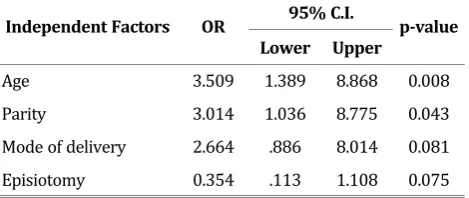
Table 3. The Bivariate Analysis for the Relationship among Age, Parity, Mode of Delivery, Episiotomy to SUI
Independent Factors OR 95% C.I. pvalue Lower Upper
Age 3.509 1.389 8.868 0.008
Parity 3.014 1.036 8.775 0.043
Mode of delivery 2.664 .886 8.014 0.081
Episiotomy 0.354 .113 1.108 0.075
Table 3 pointed out the relationship between several associated factors and SUI. Of the several factors, only age and parity had the influence to the occurrence of SUI. More than 35-year-old women had 3.509 (95% CI 1.389-8.868) times to be SUI. Apart from that, multiparity had 3.014 time to have SUI.
DISCUSSION
We measured the relationship between SUI and patients’ age. Stress urinary incontinence was found in 17 cases in 35-year-old age group (47.22%). There was 3.5 times higher risk of more than 35-year-old women to have SUI. In this study, we concluded that SUI incidence would raise as the increase of age.
Thomason, et al. reported that many women aging from 35-50 years old had SUI symptoms.1
The notion was supported by Glazener in 2006 reporting that older women had higher chance to acquire SUI compared with younger women (OR 2.02, 95% CI, 1.35-3.02).12 Meanwhile, Kondon, et
al. found that SUI was more prevalent in > 40-year-old women.3,5 In this study, we also found that
more incidence of SUI were occurred in those with advance age. Lower urinary tract may decrease the endurance as the increase of age. The muscle strength to close the urethra decrease as people grow older.1,2
Based on their babies’ birth weight, SUI was found higher in babies born with <4000 grams (91.67%) compared to 4000 grams (8.33%). Mul-tivariate logistic regression test showed that birth weight (p>0.25) had no significant relationship with the SUI. In this study, we indicated more SUI incidence in women with history of delivery <4000 grams. Susanto, et al. study in Palembang and Santy in Jakarta also pointed out the same result. Statis-tical analysis could not find a significant
relation-ship between birth weight and SUI.13-15 From the
literature, pressure and stretching of the hip mus-cles by the fetus during vaginal delivery is one of the causes for the damage muscle; thus, bigger ba-bies create higher pressure to the structure. This study had more samples of <4000 gram of birth weight; hence, it was unable to find a significant relationship between SUI and birth weight.
Glazener in 2006 concluded that birth weight had no significant relationship with incontinence either in labor or after delivery.12 The same study
was conducted by Ali HS, et al. in Pakistan which found that the SUI mostly happened in 3-month postpartum (53.3%) and there was no significant result (p=0.946) between incontinence and birth weight.13
Based on parities, multiple parities group had more incidence of SUI compared with single parity. The multivariate logistic regression test showed a significant relationship between multiparity and SUI. Pregnancy and delivery are the predisposition factors for urinary incontinence and it is found higher in women with multiple parities compared with single parity.1 The reason is the weakness of
muscle group in the first pregnancy went un-treated and the recurrent pressure for the sequen-tial pregnancy causes more injury to the muscles.6,7
In this study, we found that those with multiple parities had 3 times higher risk for SUI compared with first parity. Nygaard in 2006 concluded that after their first delivery, women had twice risk for incontinence in their next.16 Chaandini in Michigan
also found that SUI was found mainly in women with multiple parities (23 subjects from 131 total).17 Delivery causes the stretching of auxiliary
muscle tissue during labor and disrupts the function of urethra sphincter in contraction.3
Vaginal delivery group had 32 cases (88.89%) of SUI. Multivariate logistic regression test did not indicate the relationship between mode of delivery and SUI. This result was supported by previous finding by Mason in Liverpool which found that SUI in postpartum was 31%.6 The more parity rate, the
higher the SUI incidence. There was no difference in SUI prevalence in vaginal delivery and assisted vaginal delivery. The incidence of SUI in caesarean section was lower compared with vaginal spontaneous delivery.3,18
they did not found the significant result between SUI and mode of delivery. Similar study by Glazener in 2006 identified other factors related to incontinence in pregnancy and postpartum. The study was conducted in 3,405 women with single parity and 29% of them had urinary incontinence. Vaginal delivery method might cause higher incon-tinence incidence compared with those with caesarean section (OR 0.28, 95% CI 0.19-0.41) and there was no significant relationship between vaginal delivery and caesarean section.12
Eight subjects (22.22%) from those who under-went episiotomy had SUI, whereas 28 subjects (77.78%) who did not undergo episiotomy had SUI. Using multivariate logistic regression test, we found no significant relationship between SUI and episio-tomy. According to DeLancey, the hip can be divided into 4 levels namely level 1 consists of endopelvic fascia, level 2 consists of hip diaphragm muscles, level 3 consists of urogenital diaphragm muscles, and level 4 consists of external anal sphincter and perineal bodies.6,18 Hargrove, el al. in
2011 reported that episiotomy increased the risk of three of four degree perineal tear, wound infection, and postpartum hemorrhage without decreasing the long term complication, such as perineal pain or SUI. In this study, we found no relationship between SUI and episiotomy (p>0.05) due to the lack of rupture degree data caused by episiotomy.
Based on perineum rupture, SUI was found mostly in those without rupture (66.67%). Perineum rupture causes damage to several muscles group in the hip region, particularly trans-versal perineum muscle.5 Multivariate logistic
regression test showed no significant relationship between SUI and perineum rupture. This finding was supported by Eason, et al, study which found no statistical significance between SUI and spontaneous perineum rupture.19 Similarly, Ali HS,
et al. found no significant relationship between SUI and perineum rupture in 3-month postpartum in a total of 141 women (p = 0.197).13
CONCLUSION
There is a relationship between stress urinary incontinence with women aging 35 years old and multiple parities.
REFERENCES
1. Thomason AD, Miller JM, Delancey JOL. Urine incontinence symptoms during and after pregnancy in continenct and in-continent primiparas. Int Urogynecol J. 2007; 18: 147-51.
2. Runa B, Sudarsan S, Padma K, Talukdar A. Postpartum uri-nary stress incontinence-its relation with the mode of de-livery. J Obstet Gynecol lnd. 2006; 4 (56): 337-9.
3. Daneshgari F, Moore C. Pathophysiology of Stress Urinary lncontinence in Women. ln Multidisciplinary Management of Female Pelvic Floor Disorder, 2007: 45-50.
4. Yunizaf. Stres inkontinensia. Dalam: Yunizaf, Josoprawiro MJ, Santoso BI. Buku ajar uroginekologi. Jakarta: Sub ba-gian uroginekologi-rekonstruksi FK-UI, 2002: 90-5. 5. De Lancey JOL. Anatomy of The Female Bladder and
Ure-thra. ln: Ostergard DR, Bent AE (eds). Urogynecology and Urodynamics Theory and Practice. 4th ed. Williams and Wilkins. Baltimore, 1998: 3-18.
6. Rortveit G, Daltveit AK, Hannestad YS, Hunskaar S. Urinary lncontenence After Vaginal Delivery or Cesarean Section. N Engl J Med. 2003; 388: 900-7.
7. Goldber RP, Kwon C, Gandhi S, Atkuru LV, Sorensen M, Sand PK. Urinary incontinence among mothers of multiples: The protective effect of cesarean delivery. AJOG. 2003; 189(6): 1447-52.
8. Kazemirad Nl. The Effect of Caesarean Section in Preventing Postpartum Stress Urinary lncontinence in Primiparous Women after One Year of Delivery. Research J Obstet Gyne-col. 2009; 2(1): 1-5.
9. Gosling J. Gross anatomy of lower trac. In: Abrams P, Khoury S, Wein S. editors, inconteninence. Playmouth Health Pu-blication Ltd. 2000. p. 21-51.
10. Lose G. Simultaneous Recording of Pressure and Gross Sec-tional Area in Female Uretra: A Study of Urethral Closure Function in Healthy and Stress lncontinent Women. Neu-rourol J Rodyn. 1992; 11: 55-89.
11. Perkash I. Management of neurogenic bladder dysfunction of the bladder and bowel, In Kottke FJ, Krusen’s handbook of physical medicine and rehabilitaion. 4th ed. Philadelphia: WB Sounders, 1990. p. 810-31.
12. Glazener CM, Herbison GP, MacArthur C. New postnatal uri-nary incontinence: obstetric and other risk factors in primi-parae. BJOG. 2006; 113(2): 208-17.
13. Ali HS, Lakhani NA, Sarwar NG. Urinary incontinensce three months after delivery; prevalence and risk factors. Profes-sional Med J. 2013; 20(4): 530-6.
14. Susanto S. Status perineum post partum sebagai predictor kelemahan otot dasar panggul pada primipara. Dibawakan pada PIT XVI POGI. Mataram 2007.
15. Santi D, Junizaf. Hubungan antara seksio terencana dan seksio darurat pada wanita primipara dengan kejadian stress inkontinensia. Dibawakan pada PIT XVI POGI. Ma-taram 2007.
16. Nygaard I, Bradley C. Stress urinary incontinence. Obstet Gynecol. 2006; 104: 607-20.
17. Jayachandran C. Prevalence of stress, urge and mixed uri-nary incontinence in women. Eastern Michigan University. 2007: 30-1.
18. Maclennan AH, Taylor AW, Wilson DH, Wilsin D. The preva-lence of pelvic floor disorder and their relationship to gen-der, age, parity and mode of delivery. Br J Obstet Gynaecol. 2000; 107: 1460-70.