The Thirty-Third AAAI Conference on Artificial Intelligence (AAAI-19)
Improving Domain-Specific Classification by
Collaborative Learning with Adaptation Networks
Si Wu,
1,2Jian Zhong,
1Wenming Cao,
2Rui Li,
2Zhiwen Yu,
1Hau-San Wong
21School of Computer Science and Engineering, South China University of Technology, Guangzhou, Guangdong, China 2Department of Computer Science, City University of Hong Kong, Kowloon, Hong Kong
[email protected], [email protected],{wenmincao2-c, ruili52-c}@my.cityu.edu.hk, [email protected], [email protected]
Abstract
For unsupervised domain adaptation, the process of learning domain-invariant representations could be dominated by the labeled source data, such that the specific characteristics of the target domain may be ignored. In order to improve the performance in inferring target labels, we propose a target-specific network which is capable of learning collaboratively with a domain adaptation network, instead of directly min-imizing domain discrepancy. A clustering regularization is also utilized to improve the generalization capability of the target-specific network by forcing target data points to be close to accumulated class centers. As this network learns and specializes to the target domain, its performance in in-ferring target labels improves, which in turn facilitates the learning process of the adaptation network. Therefore, there is a mutually beneficial relationship between these two net-works. We perform extensive experiments on multiple digit and object datasets, and the effectiveness and superiority of the proposed approach is presented and verified on multiple visual adaptation benchmarks, e.g., we improve the state-of-the-art on the task of MNIST→SVHN from 76.5% to 84.9% without specific augmentation.
Introduction
Sufficient amount of labeled data is vital for machine learn-ing applications. However, it may not always be feasible to expend significant human effort for collecting and labeling data in many tasks. The objective of domain adaptation is to utilize the data in a label-rich (source) domain for in-ferring the class labels in a label-scarce (target) domain. In this domain adaptation setting, the source data may be sam-pled from a related but different distribution. How to effec-tively transfer knowledge learnt from source data is crucial for facilitating learning tasks in the target domain. A suc-cessful domain adaptation strategy is to learn cross-domain representations in a common space, such that the instances from different domains cannot be distinguished in the fea-ture space. Impressive progress has been achieved, espe-cially the adoption of deep convolutional neural networks in recent years. To guide network learning, some measures of distribution variance, e.g., Maximum Mean Discrepancy (MMD) (Long et al. 2015), are used, and the domain
dis-Copyright c2019, Association for the Advancement of Artificial Intelligence (www.aaai.org). All rights reserved.
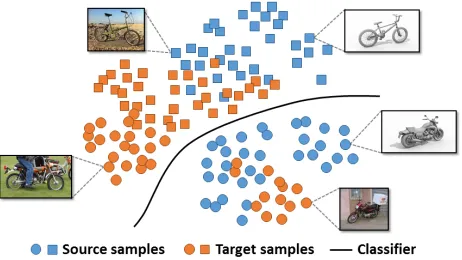
Figure 1: An example which illustrates that the training process of unsupervised domain adaptation on VisDA-2017 may be dominated by the labeled source data. The learnt representation is indiscriminative, and the resulting classi-fier performs unsatisfactorily on the target data, although the source samples of classes ‘bicycle’ and ’motorcycle’ can be well distinguished.
crepancy can be effectively alleviated by optimizing the net-works. Another way is to utilize adversarial training (Ganin and Lempitsky 2015) in the form of a minimax game be-tween domain classification and representation learning to make domain labels as indistinguishable as possible. As a re-sult, the classification model trained under supervision from the source can also be applied to the target domain.
final objective is to infer class labels as accurately as possi-ble on the target data rather than the source data, we propose to leverage the discriminative information from an adapta-tion network, and softly label the target data for learning a target-specific classification model.
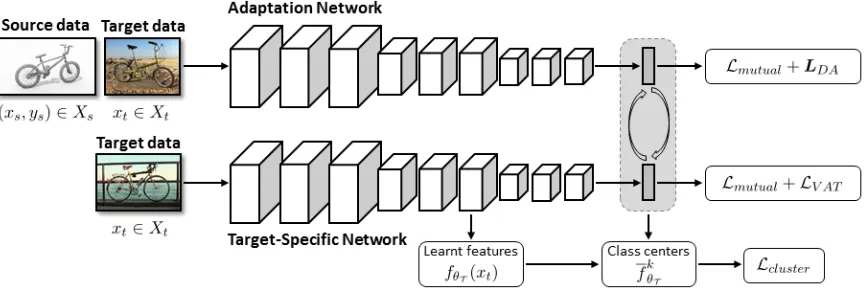
In this work, we explore a collaborative learning frame-work between a deep adaptation netframe-work and a target-specific network for improving unsupervised domain adap-tation. The proposed approach aims at training a model spe-cialized to the target domain only, instead of directly reduc-ing domain discrepancy. Since the labels in the target do-main are unavailable, we employ a deep dodo-main adaptation network which is capable of inducing domain confusion as a teacher for guiding a target-specific network. Specifically, these two networks are jointly optimized by minimizing the difference in class probability predictions for the same tar-get instance. Furthermore, the discriminative capability of the target-specific network can be improved by minimizing the distances of target data points to a set of accumulated class centers. This is based on the assumption that the data points in a cluster should come from the same class. To avoid degradation, an orthogonality constraint is included to make the class centers dissimilar. Different from the existing dis-tillation methods (Hinton, Vinyals, and Dean 2014), there is a mutually beneficial relationship between the two networks in our model. Since the target-specific network specializes to the target domain, it is able to outperform the adaptation net-work as it learns, and can in turn improve the performance of the adaptation network. An overview of the proposed ap-proach is shown in Figure 2. Extensive experimental results demonstrate that collaborative learning and clustering reg-ularization can lead to significant performance gains, and the proposed approach can achieve state-of-the-art results on multiple unsupervised domain adaptation benchmarks. This work makes the following contributions:
Instead of directly learning on both source and target data, we exploit a deep adaptation network as a teacher to guide the training of a target-specific network on the target data only, such that the latter is able to specialize to the target domain.
To enhance the generalization capability of the target-specific network, we introduce an effective clustering reg-ularization to force the target data points to move to the accumulated class centers in the latent feature space.
The adaptation and target-specific networks are trained in a collaborative learning fashion, and thus both networks can learn from each other. It is observed that the target-specific network outperforms the adaptation network in most cases.
Related Work
Domain adaptation has shown to be effective for bridging different domains (or tasks) while avoiding labor-intensive manual labeling (Pan and Yang 2010). Recently, CNN-based methods have become a mainstream technique for unsuper-vised visual domain adaptation. Many works focus on re-ducing the discrepancy between domains. Since the trans-ferability of the learnt features reduce significantly in higher
layers, Long et al. (Long et al. 2015) applied multiple kernel-based MMDs to regularizing the fully-connected layers of the networks, such that the mean embedding of data from different domains can be matched. Also based on MMD for domain confusion, Venkateswara et al. (Venkateswara et al. 2017) utilized both source and target data to learn deep hash codes to classify unseen target data. In addition to the distribution matching-based methods, reconstruction-based methods have shown effectiveness in regularizing do-mains. Ghifary et al. (Ghifary et al. 2016) proposed a deep reconstruction-classification network, which jointly learns supervised classification on source data and unsupervised reconstruction on target data. Based on the private-shared component hypothesis, Bousmalis et al. (Bousmalis et al. 2016) proposed domain separation networks for learning im-age representations through two subspaces: one which is private to each domain and another which is shared across domains. Based on the two subspaces, the images from both domains can be reconstructed. To learn a common fea-ture space, French and Mackiewicz (French and Mackiewicz 2018) adopted a mutual learning strategy to train a student network on both source and target data under the supervision of a teacher network trained only on target data.
Maximizing domain confusion can also be achieved by utilizing adversarial training to learn representations which fool a domain classifier. Ganin et al. (Ganin and Lempit-sky 2015) adopted a gradient reversal layer to train a do-main classifier while learning dodo-main-confusion representa-tion. In (Pinheiro 2018), Pinheiro used an adversarial loss to learn domain-invariant features, and simultaneously train a similarity-based classifier by measuring the similarity of each sample to categorical prototypes. Tzeng et al. (Tzeng et al. 2017) proposed an adversarial discriminative domain adaptation method, in which a source encoder is combined with a target encoder for adversarial adaptation. To take into account the category of instances during matching marginal distributions, Saito et al. (Saito et al. 2018) utilized two task-specific classifiers to ensure that target samples are close to source samples by maximizing the classification discrep-ancy. In (Shu et al. 2018), Shu et al. adopted a virtual adver-sarial domain adaptation model to learn domain-confusion representations in the first stage, and then refined decision boundaries by minimizing the conditional entropy on target instances. To learn data distributions and generate samples across domains, Liu and Tuzel (Liu and Tuzel 2016) pro-posed a coupled GAN to learn the joint distribution of multi-domain data. Sankaranarayanan et al. (Sankaranarayanan et al. 2018) adopted an adversarial image generation model to address the domain-mismatch in the feature space learnt by an encoder, such that the target embeddings can be used to generate source-like images. In (Russo et al. 2018), Russo et al. proposed a bi-directional GAN to generate target-like images from the source and source-like images from the tar-get.
Figure 2: Overview of the proposed approach to train a target-specific network via collaborative learning with a domain adapta-tion network. The target-specific network learns to predict target labels only through the supervision of the adaptaadapta-tion network output and the accumulated class centers, so that it is able to specialize to the target domain without directly minimizing the domain discrepancy.
target-specific network. As the performance of this network improves, it will in turn help the adaptation network through collaborative learning.
Deep Adaptation Networks
Before describing the proposed collaborative learning framework, we first introduce an adversarial domain adap-tation network (Shu et al. 2018), which plays an important role in our framework. For unsupervised domain adaptation, there are labeled source data(xs, ys) ∈ Xsand unlabeled target dataxt∈Xt. For the purpose of low source classifi-cation error and small feature divergence between domains, the overall loss function of this domain adaptation model is defined as follows:
LDA(θ;X) =LcrosEnt(θ;Xs) +LcondEnt(θ;Xt)
+Ldomain(θ;X) +LV AT(θ;Xt), (1)
whereX =Xs∪Xt,θdenotes the parameters of the net-work,LcrosEntdenotes the standard cross entropy function on labeled source data, and LcondEnt denotes the condi-tional entropy function on unlabeled target data. To learn domain-confusion representations, the third term Ldomain is formulated as follows:
Ldomain(θ;X) =λdsup ω
X
xs∈Xs
[ lnhω(fθ(xs))]
+ X
xt∈Xt
[ ln(1−hω(fθ(xt)))]
,
(2)
wherefθ(·) denotes the representations learnt by the net-work, and hω(·) denotes a domain discriminator parame-terized by ω. Domain adversarial training is to minimize
Ldomainvia mini-max optimization, which enforces the net-work to learn the representation which reduces the diver-gence between source and target domains. In order to obtain a reliable empirical estimate of conditional entropy, the term
LV ATfor virtual adversarial training is defined as follows:
LV AT(θ;Xt) =λv
X
xt∈Xt
max
kγk≤D(pθ(xt)kpθ(xt+γ))
,
(3) wherepθ(·)denotes the predicted class probability distribu-tion of the network,Ddenotes the Kullback-Leibler (KL)
di-vergence between two distributions, andis a hyperparam-eter controlling the intensity of the adversarial perturbation
γ. As a result, adversarial samples are generated by includ-ing small perturbations to the input in the direction sensitive to the model prediction. Virtual adversarial training can be applied on both source and target data. In Eqs.(2-3),λdand
λvare the weighting factors for achieving a balance among the terms inLDA.
Training Target-Specific Networks
The optimal classification model for source data does not often coincide with that for target data. Since the adaptation network is trained under the main supervision from the cat-egory information of the source data, we consider that a bet-ter classification model is achievable by introducing another network (target-specific network) specialized to the target data. Since the labels of target instances are unavailable, we adopt a collaborative learning framework to mutually rein-force the consistency of the two network predictions.
Our adaptation network parameterized by θA is built
based on the model described in Section III, and the over-all loss functionLAis defined as the sum of the loss
func-tion defined in Eq.(1) and an addifunc-tional regularizafunc-tion term as follows:
LA(θA;X) =Lmutual(θA;Xt, θT) +LDA(θA;X), (4)
where the target-specific network is parameterized by θT,
and target-specific networks as follows:
Lmutual(θA;Xt, θT) =λm
X
xt∈Xt
S(pθA(xt);pθT(xt)),
(5) whereS(·;·)denotes a similarity measure between two
dis-tributions, such as the KL divergence, cross entropy, mean square error, and so on.
The target-specific network is a separate network which has the same architecture as the adaptation network. In or-der to avoid error propagation during pseudo-labeling in the target domain, the predictions produced by the adapta-tion network are used as soft labels to guide the training of the target-specific network. Adversarial training for domain-confusion is no longer necessary due to the reason that this network is trained on the target data only. More formally, the loss functionLT for the target-specific network can be
defined as follows:
LT(θT;Xt) =Lmutual(θT;Xt, θA)
+Lcluster(θT,C;Xt) +LV AT(θT;Xt), (6)
where Lmutual(θT;Xt, θA) denotes the mutual learning
term enforcing the target-specific network to learn from the adaptation network by using its predictions as soft labels,
Lcluster denotes a clustering term encouraging the target data points to be close to the class centers C, and the vir-tual adversarial termLV AT helps to stabilize empirical es-timates of class probabilities for target data. Specifically,
Lmutual(θT;Xt, θA)is defined as follows:
Lmutual(θT;Xt, θA) =λm
X
xt∈Xt
S(pθT(xt);pθA(xt)).
(7) Different from Lmutual(θA;Xt, θT), the class probability
predictionpθT(·)inLmutual(θT;Xt, θA)will be improved
under fixedpθA(·). Also, different from minimization of the
conditional entropy which moves the decision boundaries to low-density regions, our network encourages the unla-beled target data points to form tighter clusters, because the clustering assumption that the data points of the same class should concentrate together hold in most cases. For this pur-pose, the clustering regularization term is defined as follows:
Lcluster(θT,C;Xt) =λc
X
xt∈Xt
K
X
k=1 δ(ybtA, k)
fθT(xt)−ck 2
+µkCTC −Ik2
F
,
(8)
where
δ(ybtA, k) =
1 if
b ytA=k,
0 ifbytA6=k,
b
ytAdenotes the predicted class of samplextby the adapta-tion network, fθT denotes the learnt representation on the
middle hidden layer of the target-specific network, C = [c1, c2, . . . , cK] denotes a matrix with its columns corre-sponding to the accumulated class centers,k · k2
F denotes
the squared Frobenius norm, andIdenotes the identity ma-trix. We require CTC to be close to I, such that the class centers become orthogonal. Minimizing this clustering reg-ularization term ensures that the class centers will be dis-similar to each other and each target data point moves to a specific class center. In each mini-batch based update step, the accumulated class centers are also updated as follows:
ck ←αck+
1−α mk
X
xt∈Bt
δ(ybAt, k)fθT(xt), (9)
whereBtdenotes a mini-batch of target instances, andmk denotes the number of the target instances predicted as class
kby the adaptation network. As a result, the target-specific network is able to learn more discriminative representations on the target data, due to the reason that the adaptation net-work provides training targets as well as relationship infor-mation among target instances for representing the underly-ing structure.
The adaptation and target-specific networks are jointly trained in our collaborative learning framework. These two networks learn from each other to correctly predict the true labels of target samples, as well as to match their predic-tions. During this training process, the target-specific net-work tends to produce more accurate results than the adap-tation network because of its specialization to the target do-main. In turn, we can take advantage of this improved ac-curacy during collaborative learning to guide the adaptation network by providing better targets. The implementation de-tails are summarized in Algorithm 1.
Algorithm 1Pseudo-code of collaborative learning between adaptation and target-specific networks.
1: Input: Labeled source data Xs and unlabeled target dataXt.
2: Initialize: Adaptation network θA and target-specific
network θT with different initial conditions, learning
ratesζAandζT, and class centersC.
3: forn= 1toNdo
4: Sample mini-batchesBsfromXsandBtfromXt.
5: foreach mini-batchBsandBtdo
6: Evaluate adaptation network predictionspθA(xs)
andpθA(xt), and target-specific network
predic-tionspθT(xs)andpθT(xt).
7: Update adaptation network:
θA←Adam(∇θALA, θA, ζA).
8: Compute the mid-level representationsfθT(xt).
9: Update class centersckaccording to Eq.(9).
10: Update target-specific network:
θT ←Adam(∇θTLT, θT, ζT).
11: end for
12: end for
13: ReturnθAandθT.
Experiments and Discussion
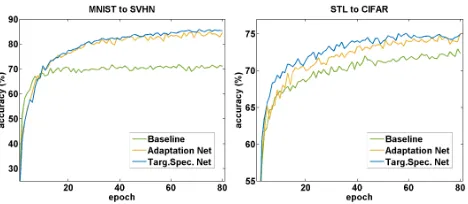
pro-Figure 3: The training curves of the baseline model and the two networks in the proposed model on the MNIST→SVHN (left) and STL→CIFAR (right) tasks. The adaptation and target-specific networks have very similar performance, and significantly outperform the baseline model due to collabo-rative learning.
posed approach on multiple standard adaptation tasks by us-ing the digit datasets: MNIST (LeCun et al. 1998), USPS (Hull 1994), Syn-Digits (Ganin and Lempitsky 2015) and SVHN (Netzer et al. 2011), the object datasets: CIFAR-10 (Krizhevsky and Hinton 2009) and STL-10 (Coates, Lee, and Ng 2011), and the VisDA-2017 dataset (Peng et al. 2017). We use the standard evaluation protocol (Shu et al. 2018) for all the tasks, and report a comparison with state-of-the-art unsupervised domain adaptation methods.
For adaptation between the digit and object datasets, we adopt a relatively small CNN architecture, which is the same as in (Shu et al. 2018). For the experiments on the VisDA-2017 dataset, we use a larger CNN architecture, ResNet-50 (He et al. 2016), due to the high resolution of the training images. In our collaborative learning framework, the adapta-tion and target-specific networks have the same architecture but with different initializations and dropout. At each train-ing step, two mini-batches of source and target instances are drawn from their respective datasets. We adopt the ADAM optimization method (Kingma and Ba 2015) to update the networks.
Results on Digit and Object Datasets
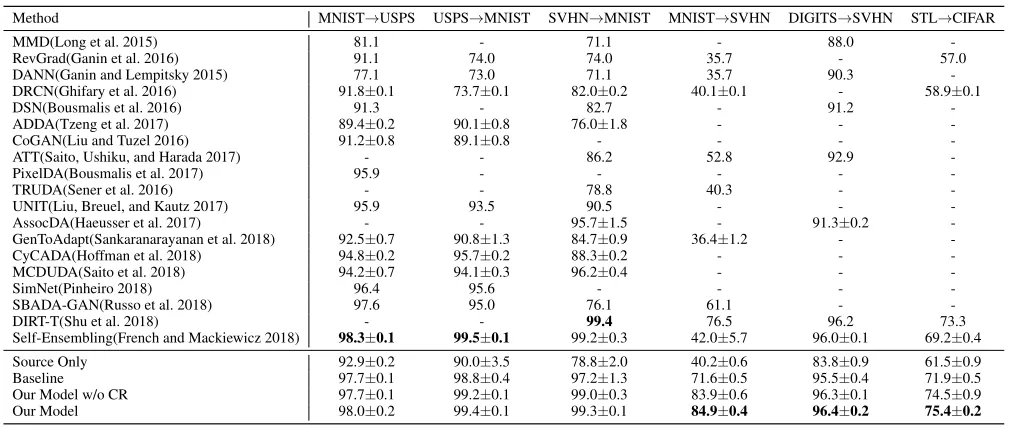
Comparison to Previous Work. We first compare the proposed model with state-of-the-art unsupervised domain adaptation methods in this sub-section. The results of the competed methods are shown in Table 1. Most of the competing methods were tested on three of the tasks: MNIST→USPS, USPS→MNIST and SVHN→MNIST. Since the discrepancy between MNIST and USPS is rela-tively small and SVHN is more challenging than MNIST, recent methods, such as ‘DIRT-T’ and ‘Self-Ensembling’, have high accuracies on the three tasks. The proposed ap-proach also achieves comparable results in these tasks.
Compared with the above three tasks, the remaining tasks including SVHN→MNIST, DIGITS→SVHN and STL→CIFAR are more difficult and important. A few of the competing methods had been tested on these tasks. The MNIST→SVHN adaptation performance of the pro-posed approach is the best in the comparison. Specifi-cally, the accuracy of our approach attains 84.9%, which is higher than ‘DIRT-T’ and ‘Self-Ensembling’ by about
Figure 4: The t-SNE plots of the middle hidden layers of the baseline network (left) and target-specific network (right) in the proposed model on the task of MNIST→SVHN. In the right subfigure, each black circle denotes an accumulated class center, and the embedding of each class forms a rel-atively tight cluster. We use this comparison with the base-line network to highlight the improvement brought by the clustering regularization to the target-specific network.
8.4 and 42.9 percentage points, respectively. On the task of DIGITS→SVHN, we achieve an accuracy of 96.4%, which is the highest in the comparison. In addition, the proposed approach achieves an accuracy of 75.4% on the task of STL→CIFAR, and outperforms ‘Self-Ensembling’ by about 6.2 percentage points. The main reason the proposed ap-proach outperforms the competing methods on these diffi-cult adaptation tasks is that the collaborative learning and clustering regularization play an important role in training the target-specific network by specializing the learning pro-cess to the target domain.
Table 1: Classification accuracy (%) of the proposed approach and previous works in the experiments of unsupervised domain adaptation on the digit and object datasets. w/o CR indicates ‘without clustering regularization’.
Method MNIST→USPS USPS→MNIST SVHN→MNIST MNIST→SVHN DIGITS→SVHN STL→CIFAR
MMD(Long et al. 2015) 81.1 - 71.1 - 88.0
-RevGrad(Ganin et al. 2016) 91.1 74.0 74.0 35.7 - 57.0
DANN(Ganin and Lempitsky 2015) 77.1 73.0 71.1 35.7 90.3
-DRCN(Ghifary et al. 2016) 91.8±0.1 73.7±0.1 82.0±0.2 40.1±0.1 - 58.9±0.1
DSN(Bousmalis et al. 2016) 91.3 - 82.7 - 91.2
-ADDA(Tzeng et al. 2017) 89.4±0.2 90.1±0.8 76.0±1.8 - -
-CoGAN(Liu and Tuzel 2016) 91.2±0.8 89.1±0.8 - - -
-ATT(Saito, Ushiku, and Harada 2017) - - 86.2 52.8 92.9
-PixelDA(Bousmalis et al. 2017) 95.9 - - - -
-TRUDA(Sener et al. 2016) - - 78.8 40.3 -
-UNIT(Liu, Breuel, and Kautz 2017) 95.9 93.5 90.5 - -
-AssocDA(Haeusser et al. 2017) - - 95.7±1.5 - 91.3±0.2
-GenToAdapt(Sankaranarayanan et al. 2018) 92.5±0.7 90.8±1.3 84.7±0.9 36.4±1.2 -
-CyCADA(Hoffman et al. 2018) 94.8±0.2 95.7±0.2 88.3±0.2 - -
-MCDUDA(Saito et al. 2018) 94.2±0.7 94.1±0.3 96.2±0.4 - -
-SimNet(Pinheiro 2018) 96.4 95.6 - - -
-SBADA-GAN(Russo et al. 2018) 97.6 95.0 76.1 61.1 -
-DIRT-T(Shu et al. 2018) - - 99.4 76.5 96.2 73.3
Self-Ensembling(French and Mackiewicz 2018) 98.3±0.1 99.5±0.1 99.2±0.3 42.0±5.7 96.0±0.1 69.2±0.4
Source Only 92.9±0.2 90.0±3.5 78.8±2.0 40.2±0.6 83.8±0.9 61.5±0.9
Baseline 97.7±0.1 98.8±0.4 97.2±1.3 71.6±0.5 95.5±0.4 71.9±0.5
Our Model w/o CR 97.7±0.1 99.2±0.1 99.0±0.3 83.9±0.6 96.3±0.1 74.5±0.9
Our Model 98.0±0.2 99.4±0.1 99.3±0.1 84.9±0.4 96.4±0.2 75.4±0.2
Figure 5: Visualization of the accumulated class cen-ters learnt by the proposed model on the task of SVHN→MNIST. One can observe that each center repre-sents the prototype of a specific class, which confirms that the clustering regularization is beneficial to exploring target data structures.
the performance is improved in all the cases. On the tasks of MNIST→SVHN and STL→CIFAR, the accuracies of the proposed approach are increased to 84.9% and 75.4%, re-spectively. We consider that the clustering regularization is of benefit to improving the network generalization capabil-ity.
Visualization. To further illustrate the process of col-laborative learning, Figure 3 shows the accuracy curves of the adaptation and target-specific networks during train-ing, from which we can observe the relationship between these two networks on the tasks of MNIST→SVHN and STL→CIFAR. Compared to the baseline, the accuracies of both adaptation and target-specific networks are improved as collaborative learning proceeds. It is noted that collaborative learning consistently improves the target-specific network. Since only target data is fed to this network, it specializes to the target domain and produces better predictions than the adaptation network. This result confirms that specialization to the target can lead to better adaptation.
In addition, we analyze the effectiveness of the cluster-ing regularization by showcluster-ing the t-SNE (Maaten and Hin-ton 2008) embedding of the learnt features of our network when adapting from MNIST to SVHN. Figure 4 visualizes the features of the target instances on the middle hidden lay-ers of the ‘Baseline’ network and the target-specific network in our model, respectively. Each class is encoded by a color, and the corresponding accumulated class center is shown as a black circle. For the ‘Baseline’ network, the target data points are not clustered strongly, due to the reason that this network is trained without any clustering regularization. In contrast, our target-specific network is able to improve clus-tering of the target data points in the latent feature space. As expected, the accumulated class centers lie in the center regions of the clusters, and the target data points are better separated.
To further demonstrate what accumulated class centers represent, we visualize them via an auxiliary network map-ping the data points in the latent space to the correspond-ing original images. For simplicity, this network consists of four deconvolution layers reconstructing a 32×32 grey-scale imagesx, conditioned on the representationfθT(x).
Since the MNIST images have simple background facilitat-ing visualization, we train this auxiliary network to visual-ize the class centers learnt by the our model on the task of SVHN→MNIST, and the result is shown in Figure 5. It is noted that the resulting class centers represent a set of proto-types for the classes. We consider that these visualized cen-ters directly reveal the reason of the clustering regularization stabilizing and improving the classification performance of our model in the target domain.
Results on VisDA-2017
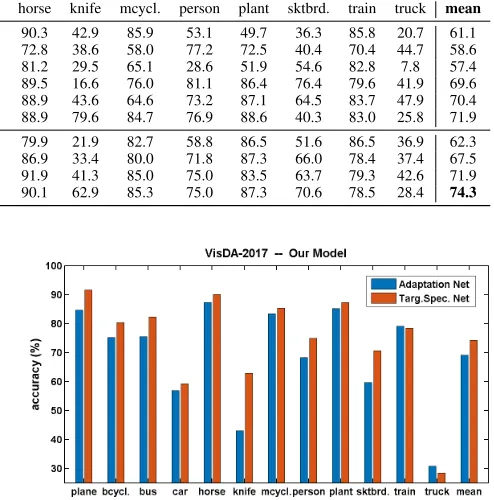
Table 2: Classification accuracy (%) of the proposed approach and previous works in the experiment of unsupervised domain adaptation on the VisDA-2017 dataset. w/o CR indicates ‘without clustering regularization’.
Method plane bcycl. bus car horse knife mcycl. person plant sktbrd. train truck mean
MMD(Long et al. 2015) 87.1 63.0 76.5 42.0 90.3 42.9 85.9 53.1 49.7 36.3 85.8 20.7 61.1 RevGrad(Ganin et al. 2016) 75.9 70.5 65.3 17.3 72.8 38.6 58.0 77.2 72.5 40.4 70.4 44.7 58.6 DANN(Ganin and Lempitsky 2015) 81.9 77.7 82.8 44.3 81.2 29.5 65.1 28.6 51.9 54.6 82.8 7.8 57.4 SimNet(Pinheiro 2018) 94.5 80.2 69.5 43.5 89.5 16.6 76.0 81.1 86.4 76.4 79.6 41.9 69.6 Self-Ensembling(French and Mackiewicz 2018) 94.9 84.1 71.1 40.9 88.9 43.6 64.6 73.2 87.1 64.5 83.7 47.9 70.4 MCDUDA(Saito et al. 2018) 87.0 60.9 83.7 64.0 88.9 79.6 84.7 76.9 88.6 40.3 83.0 25.8 71.9
Source Only 78.8 57.5 54.4 52.5 79.9 21.9 82.7 58.8 86.5 51.6 86.5 36.9 62.3
Baseline 72.7 73.4 72.7 49.7 86.9 33.4 80.0 71.8 87.3 66.0 78.4 37.4 67.5
Our Model w/o CR 91.5 83.5 77.0 48.5 91.9 41.3 85.0 75.0 83.5 63.7 79.3 42.6 71.9
Our Model 91.5 80.4 82.3 59.2 90.1 62.9 85.3 75.0 87.3 70.6 78.5 28.4 74.3
images in the datasets used in the previous experiments, we use a larger CNN architecture, ResNet-50, in our model, and most competing methods are also based on the same back-bone architecture in this experiment. Due to the high res-olution, we reduce the batch size to 44. Table 2 shows the performance of different unsupervised adaptation methods tested on the VisDA-2017 task. The results reported are in the form of the average per-class classification accuracy and the corresponding mean over all the classes. In this com-parison, we train the proposed model with the minimum augmentation (French and Mackiewicz 2018), and present the result achieved by the target-specific network in our model as it outperforms the adaptation network. ‘SimNet’ and ‘Self-Ensembling’ perform better than the other com-peting methods, and the proposed approach achieves the best performance. In some difficult classes such as ‘knife’ and ‘sktbrd.’, ‘SimNet’, ‘Self-Ensembling’ and ‘MCDUDA’ perform less satisfactory, and the proposed model produces more accurate prediction.
Comparison to Baseline and Model Variants.In addi-tion, we also report the results of the variants of the proposed model including ‘Source Only’, ‘Baseline’, and ‘Our Model w/o CR’. As expected, ‘Baseline’, the proposed model and its variant ‘Our Model w/o CR’ improve the ‘Source Only’ model and achieve higher classification accuracies on all the class, and the overall average accuracy is improved by about 5.2, 12 and 9.6 percentage points, respectively. The signif-icant performance gains are attributable to domain adapta-tion. The proposed model also outperforms ‘Baseline’ and ‘Our Model w/o CR’ on most classes, since the collabora-tive learning and clustering regularization lead to more ac-curate classification in the target domain. Furthermore, we compare the adaptation and target-specific networks of our model in Figure 6. It is noted that the target-specific net-work is able to achieve higher classification accuracies than the adaptation network on most classes, which confirms that the specialization of the target-specific network to the target domain benefits unsupervised domain adaptation.
Conclusion
In this work, we explore how to improve unsupervised do-main adaptation without directly reducing the discrepancy between domains with different data distributions. To learn a target-specific network, we exploit a separate adaptation
Figure 6: Per-class average classification accuracy and the corresponding mean over all the classes of the adaptation and target-specific networks of the proposed model in the experiment on the VisDA-2017 dataset. The target-specific network outperforms the adaptation network on most classes due to its specialization to the target domain.
network to guide its training on the target data. The clus-tering regularization, which enforces target data points to be close to accumulated class centers in the latent feature space, is applied to further improve the generalization capability of the target-specific network. Since this network specializes to the target domain, it captures the domain-specific informa-tion to facilitate more effective inference of class labels on the target data. In addition, we adopt a collaborative learn-ing framework to mutually reinforce the performance of the target-specific and adaptation networks. The effectiveness of the proposed approach is verified by extensively evaluating the performance improvement in inferring target labels on multiple visual adaptation benchmarks.
Acknowledgments
References
Bousmalis, K.; Trigeorgis, G.; Silberman, N.; Krishnan, D.; and Erhan, D. 2016. Domain separation networks. InNIPS, 343 – 351.
Bousmalis, K.; Silberman, N.; Dohan, D.; Erhan, D.; and Krishnan, D. 2017. Unsupervised pixel-level domain adap-tation with generative adversarial networks. InCVPR, 95 – 104.
Coates, A.; Lee, H.; and Ng, A. 2011. An analysis of sin-gle layer networks in unsupervised feature learning. In AIS-TATS.
French, G., and Mackiewicz, M. 2018. Self-ensembling for domain adaptation. InICLR.
Ganin, Y., and Lempitsky, V. 2015. Unsupervised domain adaptation by backpropagation. InICML, 1180 – 1189. Ganin, Y.; Ustinova, E.; Ajakan, H.; Germain, P.; Larochelle, H.; Laviolette, F.; Marchand, M.; and Lempitsky, V. 2016. Domain adversarial training of neural networks.JMLR17:1 – 35.
Ghifary, M.; Kleijn, W.; Zhang, M.; Balduzzi, D.; and Li, W. 2016. Deep reconstruction-classification networks for unsupervised domain adaptation. InECCV, 597 – 613. Haeusser, P.; Frerix, T.; Mordvintsev, A.; and Cremers, D. 2017. Associative domain adaptation. InICML.
He, K.; Zhang, X.; Ren, S.; and Sun, J. 2016. Deep residual learning for image recognition. InCVPR, 770 – 778. Hinton, G.; Vinyals, O.; and Dean, J. 2014. Distilling the knowledge in a neural network. InNIPS Workshop on Deep Learning and Representation Learning.
Hoffman, J.; Tzeng, E.; Park, T.; Zhu, J.; Isola, P.; Efros, A.; and Darrel, T. 2018. CyCADA: cycle-consistent adversarial domain adaptation. InICML.
Hull, J. 1994. A database for handwritten text recognition research.IEEE TPAMI16(5):550 – 554.
Kingma, D., and Ba, J. 2015. Adam: a method for stochastic optimization. InICLR.
Krizhevsky, A., and Hinton, G. 2009. Learning multiple lay-ers of features from tiny images. InUniv. Toronto, Toronto, ON, Canada, Tech. Rep.
LeCun, Y.; Bottou, L.; Bengio, Y.; and Haffner, P. 1998. Gradient-based learning applied to document recognition. Proceedings of the IEEE86(11):2278 – 2324.
Liu, M., and Tuzel, O. 2016. Coupled generative adversarial networks. InNIPS, 469 – 477.
Liu, M.; Breuel, T.; and Kautz, J. 2017. Unsupervised image-to-image translation networks. InNIPS, 700 – 708. Long, M.; Cao, Y.; Wang, J.; and Jordan, M. 2015. Learn-ing transferable features with deep adaptation networks. In ICML, 97 – 105.
Maaten, L., and Hinton, G. 2008. Visualizing data using t-sne.JMLR9(11):2579 – 2605.
Netzer, Y.; Wang, T.; Coates, A.; Bissacco, A.; Wu, B.; and Ng, A. 2011. Reading digits in natural images with unsuper-vised feature learning. InNIPS Workshop on Deep Learning and Unsupervised Feature Learning.
Pan, S., and Yang, Q. 2010. A survey on transfer learning. IEEE TKDE22(10):1345 – 1359.
Peng, X.; Usman, B.; Kaushik, N.; Hoffman, J.; Wang, D.; and Saenko, K. 2017. VisDA: the visual domain adaptation challenge. InarXiv:1710.06924.
Pinheiro, P. 2018. Unsupervised domain adaptation with similarity learning. InCVPR.
Russo, P.; Carlucci, F.; Tommasi, T.; and Caputo, B. 2018. From source to target and back: symmetric bi-directional adaptive GAN. InCVPR.
Saito, K.; Watanabe, K.; Ushiku, Y.; and Harada, T. 2018. Maximum classifier discrepancy for unsupervised domain adaptation. InCVPR.
Saito, K.; Ushiku, Y.; and Harada, T. 2017. Asymmetric tri-training for unsupervised domain adaptation. In ICML, 2988 – 2997.
Sankaranarayanan, S.; Balaji, Y.; Castillo, C.; and Chel-lappa, R. 2018. Generate to adapt: aligning domains using generative adaversarial networks. InCVPR.
Sener, O.; Song, H.; Saxena, A.; and Savarese, S. 2016. Learning transferable representations for unsupervised do-main adaptation. InNIPS, 2110 – 2118.
Shu, R.; Bui, H.; Narui, H.; and Ermon, S. 2018. A DIRT-T approach to unsupervised domain adaptation. InICLR. Tzeng, E.; Hoffman, J.; Saenko, K.; and Darrel, T. 2017. Ad-versarial discriminative domain adaptation. InCVPR, 2962 – 2971.