Making digital HRM work
A study in changes in perceived consequences
of e-HRM in the past decade
Name
Dionne Démeijer
Supervisors
Prof. Dr. T. Bondarouk Dr. H. Ruël
Date
February 2017
Master Business Administration – HRM Faculty of Behavioral Management,
and Social Sciences University of Twente Enschede, The Netherlands 2017
3
MANAGEMENT SUMMARY
In the last decade, the adoption of Electronic Human Resource Management (e-HRM) increased due to the rapid development of Information Technology (IT). Every year, organizations spend a significant amount of their budget towards the investment of a digital HRM solution. The field is developing very quickly and an increasing amount of organizations keep on investing in e-HRM continuously. The implementation of e-HRM solutions has several consequences, which can be divided into operational-, relational-, and transformational. The operational consequences are related and have been commonly explored with outcomes of efficiency, effectiveness, and cost- and time reduction/ savings for HRM. The relational consequences imply improvements in the HRM service for management as well as employees, improved HR communication, HR relationships, and changes in the HR professional status. The transformational consequences are characterized by the focus on organizational change/ strategic reorientation, strategic knowledge management, strategic competency management, globalization, and HR scheduling.
The aim of this study is to get insights in the consequences of a digital HRM solution for an organization its HRM- and business performance. To achieve this aim, the central question is: ‘What are the consequences of an e-HRM implementation’?Additionally, we will look at the changes in the development of perceptions of e-HRM consequences in the last 10-12 years. Therefore, we have drawn the following sub-question: “What are the changes in the
development of perceptions of e-HRM consequences in the past decade”?
In this study, a qualitative research method was used in 21 large Dutch organizations. In each participating organization were 3 interviews conducted: 1 with an HR professional, 1 with a digital HR professionals/ IT professional, and 1 with a Business / Finance leader. This was done so not only the different experiences between numerous organizations could be analyzed and compared, as well as the opinions in 1 and the same organization. For this study, there are in total 40 interviews conducted. We collected the data in this study with semi-structured interviews. Most interviews were executed with 3 persons: 1 senior researcher and 2 peer researchers. The analysis of all 40 interviews with 47 participants was done in 3 steps. In order to be able to make a comparison, we divided the respondents into 3 groups: HR professionals, IT professionals and Business leaders. Each group of respondents is analyzed in 2 or 3 steps and after each round we discussed the steps in a research team of 3 people.
4
HR professionals, but there are also some critical voices, which should be kept in mind. The research analysis of the 5 IT professionals presented 6 main themes and 11 perceived consequences. In general, the IT professionals are satisfied with the digital HRM solution in their organization. However, there were critical voices about the impersonalization of the digital HRM solution. The research analysis of the 10 Business leaders revealed 12 main themes and 35 perceived consequences. The business leaders were in general satisfied about the digital HRM solution. However, there were critical voices who said that there are more steps/ actions required for the managers and that the digital HRM solution was too much cost-driven based instead of service-cost-driven. These perceived critical voices of the business leaders should be kept in mind.
5
PREFACE
In April 2016, I was together with my fellow student from the Master Business Administration, Maartje Kuipers, invited to participate in the study of T. Bondarouk and S. van den Heuvel. In collaboration with Capgemini Consulting, the University of Twente conducts a research on digital HRM. In appendix A, the research flyer is shown. The results of this study were presented during the sixth International e-HRM Conference, which had the central theme ‘From Digital to Smart Human Resource Management’ in October 2016. The conference returned to the where it started 10 years ago: the University of Twente.
We have helped with conducting the interviews and the transcript of the interviews. In exchange for this help, we can do our own research for our master thesis to this topic. We divided this research topic in two parts. Maartje is focusing on the implementation of digital HRM and I am focusing with this master thesis on the consequences of a digital HRM solution.
Acknowledgements
I would like to thank some people for their support and guidance during my master thesis. I would first like to thank my thesis supervisor Tanya Bondarouk of the Behavioural Management and Social Sciences faculty at the University of Twente. The door to Prof. Bondarouk her office was always open whenever I ran into a trouble spot or had a question about my research. She consistently allowed this paper to be my own work, but steered me in the right the direction whenever she thought I needed it.
I would also like to acknowledge Dr. Huub Ruël, Lector International Business at Windesheim, Zwolle as the second reader of this thesis, and I am grateful for his very valuable comments on this thesis. Next, I would like to thank Dr. Sjoerd van den Heuvel for inviting us to take part in the interviews.
Furthermore, I would like to thank Jan Brouwer, Senior Vice president HR transformation, Anneke Zijlstra, MSc, MBA, Vice president, and Anita van Oss, LLM, MBA, Principal Consultant HR transformation of Capgemini Consulting for their collaboration and for their help in creating the first contact with the 21 organizations.
6
I would also like to thank Maartje Kuipers for the wonderful collaboration. You supported me greatly and was always willing to help me. Finally, I deeply thank my family and friends for their unfailing support and continuous encouragement throughout my years of study and through the process of writing this thesis. This end result would not have been possible without them.
Enschede, February 2017
7
TABLE OF CONTENTS
1. INTRODUCTION 8
2. CONSEQUENCES OF E-HRM IN ACTION: LITERATURE REVIEW 11
2.1 History 11
2.2 Performance 12
2.3 Operational consequences 13
2.4 Relational consequences 14
2.5 Transformational consequences 16
3. METHODOLGY 18
3.1 The Sampling technique 19
3.1.1 Organizations 20
3.2 The method of data collection 22
3.3 Analyzing the data 23
3.4 Trustworthiness of the data collection and interpretations 26
4. FINDINGS: PERCEIVED CONSEQUENCES OF E-HRM 28
4.1 Perceptions perceived by HR professionals 28
4.2 Perceptions perceived by IT professionals 35
4.3 Perceptions perceived by Business leaders 38
5. DISCUSSION 46
6. CONCLUSION 57
REFERENCES 59
APPENDIX 62
Appendix A – Research flyer From Digital HR of Performance 62
Appendix B – Overview interviews 64
Appendix C – Overview participating organizations 67
Appendix D – Interview guide 69
Appendix E – First level analysis of perceptions of HR professionals 70
Appendix F – Second level analysis of perceptions of HR professionals 79
Appendix G – Third level analysis of perceptions of HR professionals 89
Appendix H – First level analysis of perceptions of IT professionals 95
Appendix I – Second level analysis of perceptions of IT professionals 97
Appendix J – Third level analysis of perceptions of IT professionals 99
8
1. INTRODUCTION
The world becomes increasingly complex and today’s organizations manage this with the use of Information Technology (IT) applications (Ruël, Magalhães, & Chiemeke, 2011). The integration of IT is also increasingly being used in the Human Resource Management (hereafter called HRM) field, which has resulted in an extensive growth of the research into Electronic Human Resource Management (hereafter called e-HRM). The extent of the research has contributed to obtain an overview of the value creation of e-HRM (Ruël & Bondarouk, 2014; Ruël et al., 2011). Every year, organizations spend a significant amount of their budgets on the investment of a digital HRM solution (Centraal Bureau voor de Statistiek, 2014).The field is developing very quickly and increasingly more organizations are investing further into e-HRM (Bondarouk & Ruël, 2009). Some organizations are successful in managing the implementation of the digital HRM solution and let it contribute to HRM- and business performance, whereas other organizations are less or not successful in managing the implementation to the benefit of the organization. The reason for these variations remains often unclear.
9
There are a lot of different definitions of e-HRM. To avoid confusion about the concept of e-HRM, this paper uses the definition of Bondarouk, Harms, & Lepak (2015). E-HRM is defined as “the integration of IT and the HRM field of scholarly inquiry. This focuses on all the HRM content that is shared through IT that aims to make HRM processes distinctive and consistent, more efficient, high in quality and which create long-term opportunities within and across organizations for targeted users” (Bondarouk et al., 2015, p. 2). In the early years, the term e-HRM was used under different names, such as HR Information System (HRIS), Intranet-based HRM, Computerized Information Systems in Personnel, Virtual HR(M), Personnel Systems, HR Portals or web-based HRM (Bondarouk & Furtmueller, 2012; Bondarouk & Ruël, 2009; Ruël et al., 2004). From all these different terms, HRIS is most intensively discussed (Ruël et al., 2004; Johnson et al., 2015). The most significant difference between HRIS and e-HRM is that HRIS is used for the people from HR itself in order to improve the HR-services, whereas e-HRM is used for the employees and managers, or in other words, the internal clients of HRM (Ruël et al., 2004; Johnson et al., 2015). This difference shows that in the last few years there has been a shift from the automation of HRM services towards the support of information through the use of IT (Ruël et al., 2004).
According to Lepak and Snell (1998) e-HRM can influence HRM in 3 different ways. First, the implementation of an e-HRM system has consequences for the operational aspects of HRM. These aspects include efficiency and effectiveness outcomes that provide cost reduction and alleviating administrative burdens for the organization (Lepak & Snell, 1998; Strohmeier, 2007; Reddick, 2009; Bondarouk & Furtmueller, 2012). Secondly, it has consequences for the relational aspects of HRM. This implies that it improves the service level for internal clients as well as external partners of HRM (Lepak & Snell, 1998; Reddick, 2009; Bondarouk & Furtmueller, 2012). Thirdly, e-HRM has consequences for the transformational role of HRM. This implies changes for the function and the scope of the HRM department, where strategic re-orientation and change management is important (Reddick, 2009; Bondarouk & Furtmueller, 2012).
10
implementation of the digital HRM solution successfully and to let it contribute to HRM- and business performance, while other organizations do not successful in doing this. To, get insight in the consequences of a digital HRM solution the central question is:
“What are the consequences of an e-HRM implementation?”
Additionally, we will look at the changes in the development of perceptions of e-HRM consequences in the last 10-12 years. Therefore, we have drawn the following sub-question:
“What are the changes in the development of perceptions of e-HRM consequences in the past
decade”?
This research paper focuses on the consequences of an e-HRM implementation and is set up as follow. In the next session, the theoretical framework, focused on the history of e-HRM and the consequences of an e-HRM implementation are discussed. The insights of e-HRM decades ago, compared with the results of this study will help to get insight in the development and changes of e-HRM the last 10-12 years. After that, the methodology section of this qualitative research study, based on grounded theory, starts with an overview of the research design, followed by the data collection, which discusses the organizations that participated in the project. In addition, the data analysis explains the methods of how the interviews were analyzed. Subsequent, the validation of the trustworthiness of this paper is described. Lastly, the results of this study are presented, followed by the discussion and thereby related conclusion.
11
2. CONSEQUENCES OF E-HRM IN ACTION: LITERATURE REVIEW
2.1 History
Insights in the history of e-HRM research has improved the understanding of the relationship between HRM and IT (Ruël & Bondarouk, 2014). Furthermore, it gives a clear overview about how e-HRM has developed over the years. With the insights of the history of e-HRM, a comparison can be made with insights of today’s e-HRM solutions.
Since the 1940s, HRM is using IT but IT has only significantly affected the HRM processes and practices for the last 20 years, through the growing importance of IT (Johnson et al., 2015; Ruël et al., 2011; Beulen, 2009). In these 20 years, HRM has changed in various ways, and made use of different forms of IT to support the business function and to achieve its goals (Johnson et al., 2015). Over the years, IT has supported the HRM-function with different forms of IT, including mainframe computing in the 1940s till the mid 1980s, client-server computing from the mid 1980s till the mid 1990s, web-based enterprise resource planning systems from mid 1990s till 2010 and cloud-based software since 2010 (Johnson et al., 2015).
During the mainframe phase (1940s – 1980s) the digital HRM solutions were primarily implemented to automate the basic HRM-functions such as payroll and recordkeeping of the employees (Bondarouk & Ruël, 2009; Johnson et al., 2015). The focus during this period was on the operational consequences, which implies that digital HRM resulted in cost savings, capabilities for faster reporting, improved precision, increased workload without recruit more staff, generating information of reports previously unprocurable, and a decrease of the administrative burdens of the HRM departments (Tomeski & Lazarus, 1974; Bondarouk & Furtmueller, 2012; Johnson et al., 2015).
12
By using web-based enterprise resource planning systems (1990s – 2010) a lot of goals of the HRM department, including recruitment, selection, training, performance management and compensation were achieved (Johnson et al., 2015). In comparison with the previous decades, the research into e-HRM is growing since 2000 (Johnson et al., 2015). From this period, the term e-HRM is used, that promises improvements in the strategic orientation of HRM and improvements in the service delivery for management and employees (Ruël, Bondarouk, & Van der Velde, 2007; Marler, 2009; Bondarouk & Furtmueller, 2012). In this decade, the transformational consequences were entirely acknowledged, besides the operational- and relational consequences. This resulted in re-orientation of HRM, extensive access to the internal- and external stakeholders of HRM, improvement in the HR planning, increased knowledge management, and change management (Ruël et al., 2004; Reddick, 2009; Bondarouk & Furtmueller, 2012; Johnson et al., 2015)
In de past 7 years (since 2010), the Cloud-Based applications are being used (Johnson et al., 2015). This transition to cloud computing has resulted in an increased use of mobile and social technologies and applications by organizations (Johnson et al., 2015). As a consequence, the selection of potential employees is shifted to an electronic selection, with inter alia the increased use of social media (Johnson et al, 2015; Stone et al., 2015).
2.2 Performance
13
McMahan (1992) define strategic HRM as “the pattern of planned HR deployments and activities intended to enable an organization to achieve its goals” (p. 298). With this change to a more strategic role is, according to Gardner et al. (2003), the focus of an HR professional more on issues including the strategy development, organizational wide issues, and change efforts of the organization.
This study is focusing on the operational-, relational-, and transformational consequences of e-HRM. The starting point for many organizations is the focus on the operational outcomes through the use of IT within HRM (Reddick, 2009). Automating and streamlining different tasks and practices can help to reduce costs and improve the productivity (Reddick, 2009; Marler, 2009). The operational impact is often one of the first arguments to obtain support or funding for a project (Reddick, 2009). Also, the use of IT within HRM has influenced the external HR relationships with other parties in the organization (Reddick, 2009). With the use of IT, HRM can improve the timeliness of HRM services. By providing management and employees access to the HR database, the internal communication increased and managers and employees can perform HRM activities by themselves, which decreases the response time (Reddick, 2009; Marler, 2009). Through the transformational consequences, the e-HRM solutions are more focused on a larger extent to internal customers, including management and employees (Bondarouk & Furtmueller, 2012; Marler, 2009; Reddick, 2009). Reddick (2009) states, “the transformational impact involves reengineering or aligning employee activities with the needs of customers or clients” (p. 21-22). This implies changes in the scope and function of the HRM department, whereas jobs are more flexible and not build around stable tasks but around projects, skills, and roles in a function (Reddick, 2009). Not only information sharing between employees inside the organization, but also with people outside the organization, across geographical boundaries, is important here. To manage these changes in an organization, an organizational change orientation is crucial (Ruël et al., 2011). In the following section, the different underlying aspects of the operational-, relational-, and transformational consequences of e-HRM are discussed in more detail.
2.3 Operational consequences
14
Reddick (2009) found in his study that the use of e-HRM results in an increase of HR operating efficiency, an increase in automated routine aspects of different HRM duties, a decrease in administrative burdens, and the productivity of the HR employees increased. Similarly, reduction of the administrative burden, an increase in efficiency of the operating HRM, and an increase in the automation of different HRM duties were found in the study of Ruël et al., (2004). Furthermore, it was found that the use of e-HRM enhances the efficiency of the recruitment and screening system (hiring process) that an organization used (Buckley, Minette, Joy, & Michaels, 2004). Other researchers state that the use of e-HRM results in improved data/ reports accuracy by Human Resource Developers (Reddick, 2009) and to a higher HRM effectiveness (Ruta, 2009). In addition, some authors found evidence that the use of e-HRM results in a reduction of the costs for HRM (Ruël et al., 2004; Buckley et al., 2004; Ruta, 2005). From the literature it becomes clear that HR professionals can do their HR work with fewer personnel (Bondarouk et al., 2016).
2.4 Relational consequences
15
updated about the developments and changes in the organization, for example via the use of an intranet tool (Ruël et al., 2004). Reddick (2009) observed improvements in the working relationship of HR with the upper management in the organization.
The use of e-HRM has also influence on the attitude or behavior of the employees in an organization. It is important to understand that implementing e-HRM tools and instruments is foremost a change in the mindset and behaviors of the employees of the HRM department itself, the managers and the employees in the organization (Ruël et al., 2004). E-HRM can influence the attitudes of the employees in a positive way, but also have challenges to deal with. Different authors found positive outcomes due to the use of e-HRM tools and instruments. Through the use of e-HRM, the awareness, the appreciation, and the use of the HRM services and systems increased by employees in the organization (Reddick, 2009). Ruël et al. (2004) observed improvements in satisfaction of the manager and employee about the obtained HRM-service.
However, the use of e-HRM tools and instruments can be limited due to the lack of employees’ willingness to adapt these tools and instruments (Ruël et al., 2004). Not all employees are willing to adapt the responsibilities of the e-HRM tools and instruments. For instance some employees believe that the responsibility of their personal career and so the initiatives of their career development activities is the task of their manager instead of themselves. In other words, it can be difficult to obtain support for the use of e-HRM from employees in the organization and so the human challenges should not be overlooked (Ruël et al., 2004; Ruta, 2005).
16 2.5 Transformational consequences
Mentioned earlier, transformational consequences are characterized by the focus on organizational change/ strategic reorientation, strategic knowledge management, strategic competency management, globalization, and HR-scheduling (Bondarouk & Furtmueller, 2012; Ruël et al., 2011; Beulen, 2009; Reddick, 2009; Ruël et al., 2004).
Some researchers state that e-HRM results in an increase of the flexibility of HRM (Reddick, 2009). This flexibility improved the overall quality of HRM services, enabled HR employees to serve more on a strategic level and so can fulfill the role as strategic business partner in the organization (Reddick, 2009). The competences of the HR professionals are more directed in supporting risk taking and innovation (Ruël et al., 2004). In addition, Reddick (2009) found in his study that with the use of e-HRM, Human Resource Developers had the feeling that they were more enabled to become an effective manager. The digital HRM systems enabled HR professionals to adopt HR strategic decisions (Cronin, Parry, & Furtmueller, 2010). Haines and Lafleur (2008) add that HR professionals are more involved in change activities in the organization and are seen as a partner of the business and as change agent in the organization. With the transformation to a strategic level, HR professionals spend more time on issues organization-wide, strategy development and organization change effort, with other words the transformational activities (Gardner et al., 2003).
HR knowledge management is found important in today’s organizations. Reddick (2009) observed an increase in knowledge management, i.e. creation, capture, transfer, and the use of knowledge. Similarly, Ruta (2009) found an increase of shared knowledge in organizations. Employees share their ideas and suggestions with colleagues in the organization, for example due to the use of internal blogs.
17
the organization (Ruël et al., 2004). Moreover, Buckley et al. (2004) found conservative savings due to reduced employee turnover.
Transformational consequences are also known in the form of HR globalization. Ruël et al. (2004) state in their study that the most important effect of the use of e-HRM is the strategic integration and alignment of HRM with the strategy, the structure and the culture of the organization.
Research map. Digital HRM environment-in-action
Based on the above-discussed literature, the following research map is drawn for this study. Mentioned earlier, this study will focus on the e-HRM consequences operational, relational, and transformational.
e-HRM
consequences
• Operational • Relational• Transformational
e-HRM
implementation
success
e-HRM
implementation
factors
18
3. METHODOLGY
In this study, we used a qualitative exploratory research approach with semi-structured interviews. We have chosen for an exploratory research approach in order to seek for new insights into the consequences of the implementation of an e-HRM solution. With exploratory research, we are able to put consequences in a new light. Furthermore, the advantage of using exploratory research is that it is a very flexible research approach (Saunders, Lewis, & Thornhill, 2008). We have chosen for qualitative research design, which allows for an open, more informal setting during the interviews and it allows the interviewee(s) to participate in an active conversation. When conducting the interviews, we gave the interviewee(s) the possibility to create their own answer, based on their own perceptions (Myers & Newman, 2007). Furthermore, we gave the participant(s) the opportunity to think out loud in regards to the discussed themes during the interview (Amaratunga, Baldry, Sarshar, & Newton, 2002; Myers & Newman, 2007; Saunders et al., 2008). In this way, we could explore specific themes like: what does digital HRM mean in the opinion of the interviewee(s). Furthermore, goals that organizations want to reach with the e-HRM implementation, consequences for the organization after an implementation and organizations their most and least successful digital HRM solutions were discussed. With these different interview topics we gain insights in complete process from selecting e-HRM systems to implementing them, and finding out the impact of these digital HRM solutions organization-wide. By giving the interviewee(s) the possibility to express their opinion freely, we were able to collect very detailed and rich information for our research (Saunders et al., 2008). Furthermore, it allowed us to probe specific meanings of interviewee(s). This will add increasingly more depth to our obtained data (Saunders et al., 2008). Another reason that we chose to conduct face-to-face interviews, is that we preferred to have personal contact with the interviewee(s). Respondents of surveys feel that it is not appropriate to give sensitive and confidential information to someone who they never met. Conducting face-to-face interviews meant that the respondents saw us in person, and studies have shown that this type of interviewing results in a higher response than handing out surveys (Saunders et al., 2008).
19
viewed as “the integration of IT and the HRM field of scholarly inquiry. This focuses on all the HRM content that is shared through IT that aims to make HRM processes distinctive and consistent, more efficient, high in quality and which create long-term opportunities within and across organizations for targeted users” (Bondarouk et al., 2015, p. 2). Moreover, we elaborated further on the history, the development and the goals of e-HRM in their organization. After these topics, we discussed the successful and less successful solutions of digital HRM. The discussion contained different elements: the implementation of a digital HRM solution, the contribution to HRM-performance and the contribution to business performance. For each topic, the interviewees were asked about the factors of prerequisites that contribute to the implementation, HRM- and business performance.
Then we moved to the next topic, which covered the experienced consequences of the e-HRM implementation. Consequences are initially viewed as “consequences of e-HRM are all phenomena that accompany and/or follow the application of IS in HRM, whether desired or undesired and whether expected or unexpected” (Strohmeier, 2009, p. 528). This study focused primarily on the consequences of digital HRM.
The interviews were finalized with a wrap up, where the key points of the interview were communicated back to the interviewee(s). Further, we mentioned that the transcripts of the interviews would be sent to the interviewee(s) for a member check. We also invited the interviewee(s) to the e-HRM conference, which was held at the end of October 2016 at the University of Twente. We ended the interviews with our thanks for their participation in this research project.
3.1 The Sampling technique
20 3.1.1 Organizations
The participating organizations represent a range of different sectors. In this study the following type of organizations participated: 2 chemical companies, 1 consultancy company, 3 banking companies, 2 education companies, 1 energy supplier company, 2 government companies, 2 ICT companies, 3 insurance companies, 2 public services company, and 3 retail companies. The participating organizations are significantly varied in size and they differ from one another based on the status of their digital HRM implementation. From these 21 organizations, 10 are multinationals and 11 are local organizations.
Within each organization, we spoke with different people, each of them having different responsibilities. At the first chemical company, we interviewed a Project Manager. This company has 13 locations in The Netherlands, with 4,300 employees nationwide and a further 25,000 employees worldwide. This organization is headquartered in Heerlen, The Netherlands. At the second chemical company, we spoke with the Chief Human Resources Officer and the Global Director GBS People Services. This company has approximately 47,000 employees in 80 countries and is headquartered in Amsterdam, The Netherlands. At the consultancy company, we spoke with the Vice President HR. This company has approximately 180,000 employees in 40 countries and is headquartered in Utrecht, The Netherlands.
We spoke with 3 banking companies. At the first banking company, we spoke with an International Interim HR & Project Manager. This company has 24,341 employees in The Netherlands and 51.859 employees worldwide in 40 countries, and is headquartered in Amsterdam, The Netherlands. At the second banking company, we spoke with the General Manager HR, the Director HR Employment Conditions & Operations, and a Managing consultant. This company has more than 52,368 FTE worldwide in more than 40 countries, and is headquartered in Amsterdam, The Netherlands. At the third banking company, we spoke with the Director HR Policy & Innovation and the Manager Shared Services P&O. This company has 3,500 employees and is headquartered in Utrecht, The Netherlands.
21
Wageningen, The Netherlands. Moreover, we spoke with 1 energy supplier. At this energy supplier, we spoke with an IT-Manager HR-systems, a HR-Executive, and an IT-Manager. This company has 7,000 employees and is headquartered in Arnhem, The Netherlands.
For this study we have conducted interviews with 2 different government companies. At the first government company, we spoke with the Department Manager HR and the HRM-Advisor. This company has 8,666 employees and is headquartered in The Hague, The Netherlands. At the second government company, we spoke with the Program Director and the Deputy Head of Service HRM. This company has 63,000 employees in The Netherlands.
2 ICT companies were part of this research project. At the first ICT company, we spoke with the Workforce Innovation Consultant and the Director HR. This company has 78,230 employees in more than 130 countries and is headquartered in Walldorf, Baden-Württemberg, Germany. At the second ICT company, we spoke with the Account Executive. This company has 6,200 employees in 30 countries and is headquartered in Pleasanton, California, United States.
For this study we also conducted interviews in 3 insurance companies. At the first insurance company, we spoke with the Director Group Human Resources & Business Development, the Senior People Development Professional, and a team leader. This company has approximately 6,700 employees in The Netherlands and Belgium and is headquartered in Amsterdam, The Netherlands. At the second insurance company, we spoke with the Director HR, a Senior Project manager and a manager Transitions. This company has 3,650 FTE and is headquartered in Utrecht, The Netherlands. At the third insurance company, we spoke with the Head of Global HR Operations. This company has 4,300 employees in The Netherlands, 31,530 employees worldwide and is headquartered in The Hague, The Netherlands. Furthermore, we spoke with 2 public services companies. At the first public services company, we spoke with the Director HR, the Senior Advisor HRM and the e-HRM Program Manager. This company has more than 34,000 employees and is headquartered in Utrecht, The Netherlands. At the second public services company, we spoke with the Director HR Commerce, the Program Manager Business Support (HR & Finance), and an HR Analytics and Innovation. This company has 49,000 employees and is headquartered in The Hague, The Netherlands.
22
The Netherlands. At the second retail company, we interviewed the HR Business Development Manager and the Global Human Resources Manager. This company has 6,500 employees in The Netherlands, 155,000 employees worldwide in 43 countries and is headquartered in Leiden, The Netherlands. At the third retail company, we spoke with the Director HR, a Manager HR-Operations and the Head of Trade Marketing & E-commerce. This company has 650 employees and is headquartered in Enschede, The Netherlands.
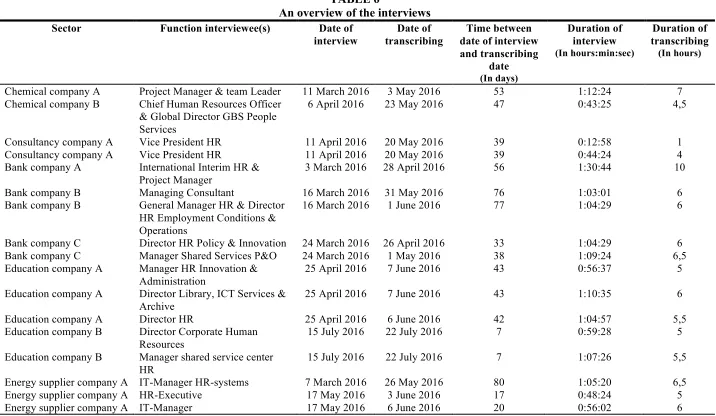
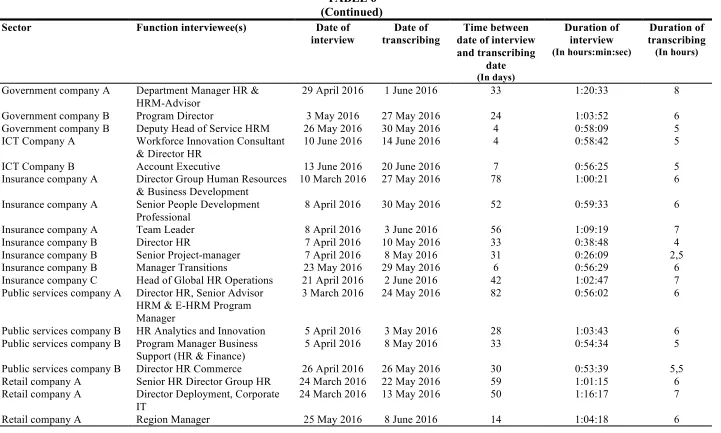
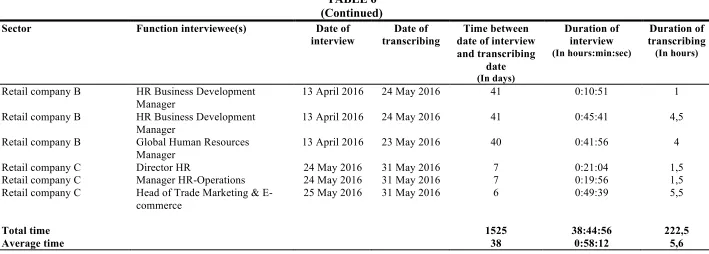
When categorizing the participants from all 21 organizations in different functions, the following distinction are made: 3 project managers, 16 HR-managers/directors, 1 managing consultant, 1 digital HR professional, 2 managers HR-operations, 5 managers HR-innovation, 4 IT-managers, 5 business support managers, 1 account executive, 1 region manager and 3 HRM-advisors. In most organizations, an interview was arranged with an HR-manager or director. When this was not the case, an interview with an HR employee that was directly linked to an e-HRM implementation was arranged. Appendix B, table 6 shows an overview of the different interviews and Appendix C, table 7 gives an overview of the different organizations and their e-HRM solutions.
3.2 The method of data collection
We collected the data in this study with semi-structured interviews. During most of the interviews three researchers were present: 1 senior researcher and 2 peer researchers. For each interview, we had a list of questions and themes to discuss. However, the order of the questions varied in each interview, due to the national flowing state of each conversation. This is also referred as an interview guide, which provides a written checklist of themes that we wanted to cover in the different interviews (Myers & Newman, 2007). We covered the following aspects in the interviews: the goals of the digital HRM solution, the successful and less successful digital HRM implementations, the consequences of an e-HRM implementation, prerequisites of a successful digital HRM implementation, the contribution of the digital HRM solution to HRM- and business performance, and the prerequisites to contribute to HRM- and business performance. The interview guide for this study is shown in appendix D. Most of the time, the senior researcher was guiding the interviews. We, as peer researchers were able to ask questions if desired, in order to obtain a better view of the situation in that specific organization.
23
permission has to be requested. No names of individuals or organizations are mentioned in the publication without obtaining the permission of the concerning individuals or organization.
3.3 Analyzing the data
This subsection is written in collaboration with Kuipers (2017). To analyze the data, the interviews are recorded and thereafter transcribed. In total the transcribing interviews have 739 pages of text. We put together a table with an overview of the participating organizations. In this table the following information is presented: sector type, number of employees, local/ multinational, operating countries, e-HRM tools, e-HRM experience, and HRM practices supported by e-HRM are presented. The table provides the opportunity to see at a glance to what degree a particular participating organization is evolved in terms of their e-HRM solution. Furthermore, the differences of digital HRM solutions between multinationals and local organizations can be examined, which is shown in appendix C, table 7.
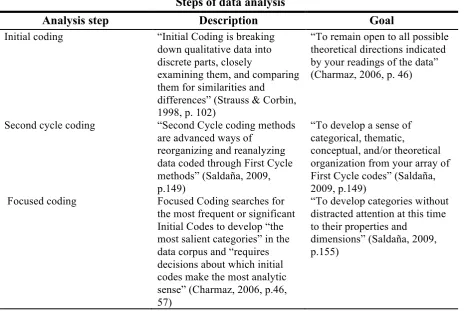
24 TABLE 1
Steps of data analysis
Analysis step Description Goal
Initial coding “Initial Coding is breaking down qualitative data into discrete parts, closely
examining them, and comparing them for similarities and
differences” (Strauss & Corbin, 1998, p. 102)
“To remain open to all possible theoretical directions indicated by your readings of the data” (Charmaz, 2006, p. 46)
Second cycle coding “Second Cycle coding methods are advanced ways of
reorganizing and reanalyzing data coded through First Cycle methods” (Saldaña, 2009, p.149)
“To develop a sense of categorical, thematic,
conceptual, and/or theoretical organization from your array of First Cycle codes” (Saldaña, 2009, p.149)
Focused coding Focused Coding searches for
the most frequent or significant Initial Codes to develop “the most salient categories” in the data corpus and “requires decisions about which initial codes make the most analytic sense” (Charmaz, 2006, p.46, 57)
“To develop categories without distracted attention at this time to their properties and
dimensions” (Saldaña, 2009, p.155)
The analysis of the 40 interviews with 47 participants is done in 3 steps. We divided the respondents in 3 groups: HR professionals, IT professionals, and Business leaders. Each group of respondents is analyzed in 2 or 3 steps and during each round we discussed the steps in a research team of 3 people. During the first level of analysis, it was important to develop themes as closely related to the text as possible.In order to get a clear overview, we used 3 colors to mark implementation-, consequences, or other important citations mentioned by the respondents.
25
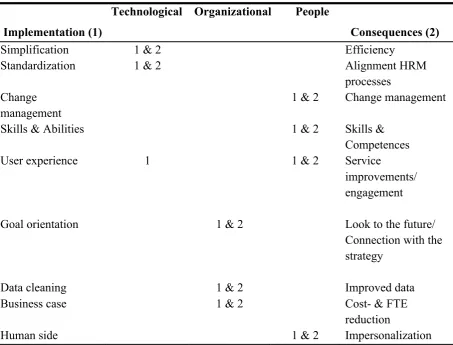
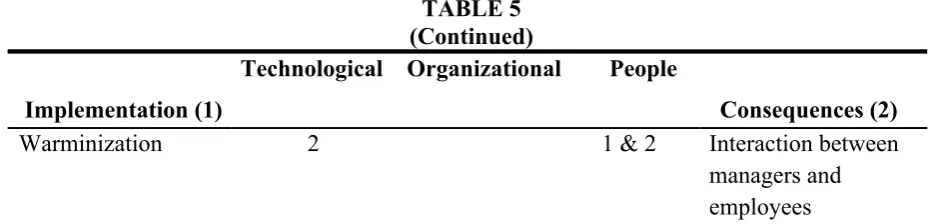
showed 72 relevant quotes, which is shown in appendix F,table 9. For the third level reading, we categorized all the consequences with a similar subject to the same category. Furthermore, we combined similar relevant consequences to 1 consequence, which is supported with different relevant quotes. So, at the end the analysis showed 15 main themes and 47 relevant consequences, which is presented in table 10, appendix G
Next, we analyzed the transcripts of the 5 IT professionals. With the analysis of the IT professionals the discussion consensus became higher, 95% with 5% disagreement. All relevant quotes were noted in the analysis table and we linked it to different consequences. The analysis of perceptions from IT professionals showed 13 relevant consequences, which are show in appendix H, table 11. For the second level reading, we categorized all consequences with a similar subject to the same main theme. From the 5 IT professionals, 6 main themes are obtained and 13 relevant consequences are emerged, which is shown in table 12, appendix I. For the third level reading, we combined similar relevant consequences to 1 consequence, which is supported with different relevant quotes. The analysis showed 6 main themes and 11 relevant consequences, which are presented in appendix J, table 13.
[image:25.595.66.528.672.742.2]Lastly, we focused on the analysis of the 10 business leaders. The discussion consensus with my peer researcher stated on a 95% level, with 5% disagreement. We linked all relevant quotes in the analysis table to different consequences. After this, we categorized all consequences with a similar subject to the same main theme. The analysis of perceptions of the business leaders about e-HRM consequences showed 12 main themes and 40 relevant consequences, which are shown in appendix K, table 14. For the second level reading, we combined similar relevant consequences to 1 consequence, which is supported with different relevant quotes. This analysis showed 12 main themes and 35 relevant consequences, which are presented in table 15, appendix L. Below, table 2 shows an overview of the number of themes and relevant consequences per respondent group.
TABLE 2
Number of themes per respondent group
Respondent group Number of main themes Number of consequences
HR professionals 15 47
IT professionals 6 11
26 3.4 Trustworthiness of the data collection and interpretations
By conducting interviews, we should consider some threats concerning the validity and reliability of our study (Dooley, 2001). The reliability of a study indicates the extent to which this study is consistent over time between different investigators and methods and the extent to which the measurement is free from random error (Van Aken & Andriessen, 2011, p. 153; personal communication, October 23, 2015). The validity of this study explains the extent to what the conclusions are meaningful based on the measured instruments (personal communication, October 23, 2015).
In order to increase the trustworthiness of the data collection and interpretations, several steps are taken. First of all, the interviews are recorded and transcribed. With the recorded interviews, we made the database for our research. On average, each interview lasted 58 minutes and 12 seconds. The transcribing of the interviews lasted on average 5 hours and 36 minutes. In total, the transcription of the interviews has 739 pages of text, this is on average 18 pages per transcribed interview. At last, there are on average 38 days between the date of the conducted interviews and the date of the transcribing. In table 6, appendix B, an overview is given of the time spends per interview and per transcription, including the total and average duration of the interviews and transcribing.
Secondly, for all interviews, verifications were made. All interview transcripts were sent by email to the participants. The transcriptions of the interviews were sent to the participants to give them the opportunity to confirm or disconfirm the transcript of their interview. Furthermore, it gave them the opportunity to add some more detail and important information or to clarify any information that was unclear/ vague (Harper & Cole, 2012). Sending the interviews to the participants gave us the certainty that we understood each other well. No interviews were returned with comments of the participants, so all the participants of this study approved the transcription.
Moreover, we have conducted the interviews with 3 researchers. During most of the interviews, we were with a senior researcher and 2 peer researchers. Directly after the interviews we reflected with the 3 of us how the interview went. Furthermore, we discussed points that we thought were interesting and remarkable in the interviews, in comparison with the previous interviews we conducted. Through the use of this strategy, we summarized the interviews and checked if everybody had understood the interviews in similar manner.
27
participants, all varying in functions and responsibilities. We conducted different interviews within the organizations to gain a better understanding of its operations and to be able to compare the different opinions of the different functions in an organization. Collecting all these different opinions and perceptions, we have a better understanding and obtained a better and a more clear view of e-HRM implementations in the different organizations.
Furthermore, we made notes during the interviews. This is for the trustworthiness of our interpretations. During the transcribing and later on in this study during the analysis of the transcripts, the notes can help to refresh our mind, and to interpret our results. The notes that we made during the interviews are used as a backup.
28
4. FINDINGS: PERCEIVED CONSEQUENCES OF E-HRM
This chapter presents the perceived consequences of e-HRM that are considered as important for the 3 respondent groups: HR professionals, IT professionals, and Business leaders. We elaborate on the perceived consequences per group of respondents.
4.1 Perceptions perceived by HR professionals
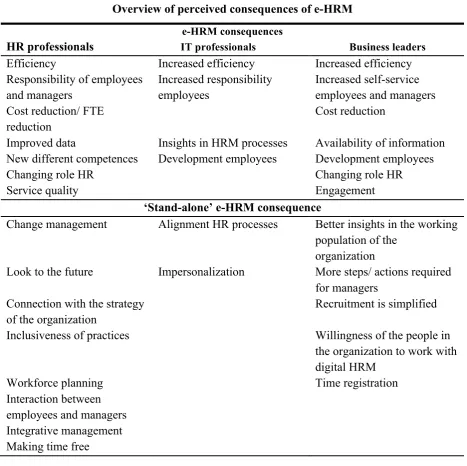
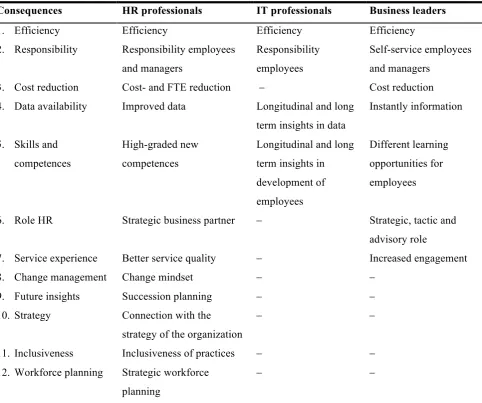
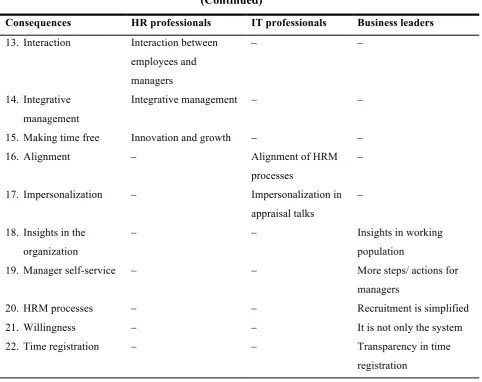
The research analysis revealed 15 main themes and 43 consequences as perceived by the 32 HR professionals, which are presented in table 10, appendix G.
1. Cost- and FTE reduction
The HR professionals recognize consequence issues from digital HRM as cost- and FTE reduction. They see that many HRM processes are digitized and this makes the processes more simplified, which in turn leads to cost- and FTE reduction for the organization. Some respondents argue that the digitalization has saved hundreds of thousands of euros in a few years. They see that some functions are lifted due to the digitalization of HRM processes and therefore less office space is needed. According to a few respondents the cost reduction does not only affect the organization itself, but also the contracts with their suppliers. In the opinion of the HR professionals, the quality of the HRM processes is increased and the costs are low. They try to optimize this process continuously. Further, they mention that reducing the costs is important, however business achievements should always be taken into account. As a HR professional of a banking organization said: “You must be cost sensitive, but in terms what we want to achieve with each other” (Resp. 8).
29 2. Efficiency
The HR professionals do not only recognize cost- and FTE reduction as important e-HRM consequences. The HR professionals acknowledge efficiency as an important consequence of digital HRM. They mention that with the digitalization, increasingly more HRM processes are simplified for HR professionals, but also for managers and employees. They see that in the previous years people had to process 36 steps in different systems and now these steps are reduced and more simplified. As one of the HR professionals of a banking organization said:
“People must fill in 36 fields in six different systems. At the moment if someone is leaving the organization, they must fill in only three fields and everything is arranged” (Resp. 8). It is perceived by the HR professionals that employees and managers are satisfied with these simplified changes in their processes.
Further, it is perceived that some organizations are quite advanced with the digitalization of their HRM processes, such as that declarations can be arranged by an APP on their smartphone. HR professionals are of the opinion that with these simplified processes the lead-time of a lot of HRM processes are quicker. They see, for example, that the duration from declaration to payment takes 4 or 5 days. They are of the opinion that this is a lot quicker than a few years ago and everyone in the organization considers that as normal.
Furthermore, the HR professionals mention that there are fewer documents to fill in and so the administrative burden for the business is decreased. They believe that the digitalization of different HRM processes has also ensured that the chance on mistakes decreased. HR professionals perceive that the processes ensure fewer mistakes of people, faster lead-times, and the systems are easier to understand. In addition, it is perceived that a lot of organizations have standardized their HRM processes, which has increased the efficiency. As an HR manager of a chemical organization mentioned: “Previously you were busy with administrative tasks. Now you can spent the time to innovation to your internal clients, the business” (Resp. 2).
30 3. Service quality
Furthermore, HR professionals mention that the service quality of HRM is improved with the use of e-HRM. They see that employees and managers are more engaged and enthusiastic about the HRM service. They mention that easy questions are answered by the system and so the HRM department can reach a higher qualitative level. HR professionals perceived that people of the contact center can focus more on the difficult administrative question, and the advisors can focus more on questions on the strategic level and organization development. HR professionals think that these changes make HRM more able to improve their service level for the employees in the organization. The HR professionals mention that they are abler to respond on priorities, wishes, and needs of the business. They believe that employees and managers receive quicker and better answers on their questions to HRM. In addition, they see that these service improvements lead to a higher satisfaction about the digital HRM solutions. As a HR manager of an insurance organization said: “We do the work with less people, but we have more quality and we are more appreciated” (Resp. 30). Further, it is perceived by HR professionals that due to the higher engagement of the employees, the customer satisfaction in general is also increased.
However, some HR professionals were critical and state that the digital HRM system is not flexible and intuitive and so the usability for the employees and managers decreased. As an HR professional of a banking organization state: “I see that there is a lot of negativity about HRM. This is because the system is very complex and works not very well. It takes a lot of time, it is not flexible and not intuitive. The people in the organization have the feeling that they have to do it, because they system say so. Their question is how does this system support me with the things that I have to do as a manager. The contribution of the system is not clear for them” (Resp. 5). It is perceived by the HR professionals that it depends per organization how employees and managers respond to these e-HRM solutions.
4. Increased responsibility of employees and managers
Additionally, the HR professionals state that the digital HRM solution results in increased responsibility of the employees and managers in the organization. They believe that managers and employees arrange HRM processes by themselves as much as possible and HR supports them when needed. 1 of the HR professionals of a banking organization mentioned:
31 them as much as possible (Resp. 8). They think that with this switch of responsibility, the employees and managers make their own decisions and can even implement it. It is perceived by the HR professionals that with the increase of responsibility, the self-service for HRM processes for both employees and managers will increase as well. As an HR manager of a public service organization argue: “Earlier it was the task of the HR advisor. At this time, the managers do it by themselves. You can see that more and more people call themselves sick”
(Resp. 39). They argue that it is important to trust the employees and managers in this process.
On the other hand, according to different HR professionals it is not only the responsibility for administrative tasks of importance anymore, but as well the responsibility for employees their own development. As 1 of the HR professionals of a government organization said: “We want to shift the responsibility to the employees in the organization. It are goals of their own responsibility and also the responsibility of their own development is very important” (Resp. 23). They see that employees can manage their own development issues in consultation with their manager. HR professionals state that HRM should facilitate more on the self-service level of managers and employees to make this kind of changes possible in the organization.
5. Improved data
Further, from the opinion of some HR professionals it becomes clear that digital HRM solutions have ensured that the data quality of HRM improved. They state that it is easier to make connections between different kinds of data. They mention for example, connections between absenteeism in the organization and the involvement of employees. It is perceived by HR professionals that with the improved data, HR professionals are more capable to ask questions more deeply about different kind of situations. They think that certain situations can be better analyzed with the improved data quality. HR professionals mention that the improved data has ensured that they can quicker see where they have to intervene and so they can take quicker action to solve problems. As an HR professional of an insurance organization stated: “You can perform the role of HR better. You can see quickly where to intervene and so you can take quicker action” (Resp. 27).
32
responsibility of their data instead of deposit the data to HRM. It is perceived by the HR professionals that employees and managers can look in their own data instead of asking this information to HRM. In their opinion, the added value as HR business partner is increased for the business. They believe that HRM is no longer necessary to maintain the data; employees and managers do that by themselves. They think that an HR business partner can perform the role as partner of the business better.
6. Changing role of HR
It is perceived by the HR professionals that the added value of HRM is increased due to the use of digital HRM solutions. They think that with the availability of more and better information they can provide other HRM services to the business and so they are able to give better advise. As an HR manager of a banking organization mentioned: “The added value of HR is growing. The added value means that HR can give better advice based on facts and figures” (Resp. 9).
There are also voices that say they have more time and focus to pursue the people agenda. They believe that with the digitalization of HRM processes, HRM would no longer be bothered with operational issues. The HR professionals mention that they are now more able to perform the role of HR strategic business partner. They think that they can focus more on the quality for the business and on organization-wide activities to add more value to the organization. There are also voices that say that HR advisors should be able to work more with HR analytics. 1 of the HR professionals of an insurance organization said: “That means that my advisors need to show more progress. They should be able to conduct a strategic discussion with more analytics skills” (Resp. 30). Most of them state that this will be the focus for the next few years, to create highly skilled HR-analytics people. They believe that they will become more capable to add value to the organization with HR-analytics.
7. Change management
33
future. As an HR professional of an insurance organization said: “It is important to have another mindset. You must be open-minded to things that are differently than before” (Resp. 27).
Some HR professionals mention that they have a mental program in the organization for both employees and managers. In this program, they receive intensive trainings to prepare them for the new way of working in the organization. This HR professional thinks that this program has contributed to the changing mindset of the employees and managers in the organization.
8. New different competences
Furthermore, the HR professionals express that the need for new high-graded competences is growing in organizations. They mention that they try to develop competences, which they have not in the organization yet. The HR professionals state that they need another type of employee, which are educated on a different level, with other competences. They believe that they need people who have a total overview and are capable to bring different things together as 1 component. Further, they think that they also need people with communication skills, advisory skills, people that can perform a scenario planning, and can look forward. 1 of the HR professional of a chemical organization stated: “We are developing new competencies that we do not have. People should be able to act between the business and the technology. It is a new breath of people. It is not HR, it is not IT, it is in-between” (Resp. 3). Furthermore, it is perceived by the HR professionals that employees who do not have the right competences are offered help with their development to improve their skills and knowledge that they can use both in- or outside the organization.
9. Look to the future
34
mentioned: “It is a quality improvement to look at the future with different questions like: Do I have enough qualified people in the organization? With this kind of question the quality of your organization becomes better” (Resp. 20).
10. Connection with the strategy of the organization
Furthermore, the HR professionals express that it is important that digital HRM solutions must fit with the strategy of the organization. They mention that it is important that the digital HRM solution and the strategic goals of the organization are in the same direction and complement each other.
11. Inclusiveness of practices
It is perceived by the HR professionals that it become easier to increase the employability of the employees in the organization. They believe that it also becomes easier for the employees with a disability. They state that the employees are more in their strengths in all places in the organization.
12. Workforce planning
The HR professionals express that the digital HRM solutions has improved the workforce planning. As 1 of the HR professionals of a government organization said: “It is also one of the resources that helps to shape your tasks. We do not want to bully them with again another system. We want to help them, to facilitate them from HRM. We want to help them with a system” (Resp. 20). They mention that the improved workforce planning helps with the realization of the cost reduction in the organization.
13. Interaction between employees and managers
35 14. Integrative management
From the opinion of the HR professionals it becomes clear that managers are more able to manage their team in an integrative manner. They believe that this is due to the fact that managers have directly access to important information about their employees. They think that in this way a manager can perform the role of an integral manager. An HR director of a retail organization said: “It enables managers to manage the teams more on an integrative manner. They manage not only on the daily things that have to happen, but also on talent planning and performance management” (Resp. 45).
15. Making time free
Furthermore, HR professionals state that e-HRM enables them to make time free for employees. With this time reduction they can spend it to more important things, such as innovation, growth and their own development. As a HR director of a chemical organization argue: “We go to the end user and measure how much time the spent on their activities. We put targets for time reduction. We give time back for innovation and growth” (Resp. 3). Further, they mention that HRM is able to realize this changes due to the simplified HRM processes.
Overall, there are 15 main consequences of e-HRM perceived by the HR professionals. Most of the perceived consequences are positive formulated by the HR professionals, but there are also some critical voices, which should be kept in mind.
4.2 Perceptions perceived by IT professionals
The research analysis revealed 6 main themes and 11 consequences as perceived by the 5 IT professionals, which are presented in table 13, appendix J.
1. Efficiency
36
new computer/ laptop. So, they believe that HRM processes are more quickly arranged in the organizations. As an IT professional of an education organization said: “Earlier, the purchase of computers took two months. At the moment it takes a week or sometimes two days to have your computer” (Resp. 13).In addition, IT professionals believe that the simplified processes make it more enjoyable for HR professionals, but also for the employees and managers to occupy with the different HRM processes. 1 of the respondents mentions a new tool for the selection of new employees. The IT professional of a banking organization argues: “It has a matching functionality. There is a vacancy and different CVs are sent, and with this tool you can already do a rough selection. They get 500 till 600 CVs per month. So the matching functionality saves money, but it is also efficient. It is a beautiful tool and it makes the work of the employee more fun” (Resp. 6).
2. Increased responsibility of the employees
Furthermore, the IT professionals mention that the responsibility of employees and managers has increased the last few years. They see that the employees and managers become increasingly more self-supported in performing HRM processes. It is perceived from the IT professionals that this is the result of the higher level of self-service for the employees and managers. They see that a lot of operational tasks of HRM shifted to the employees and managers in the organization. As an IT professional of an education organization said: “For example, to reset a password or something like that, you can arrange that by yourself. Besides the savings, the advantage is that it is available 24/7” (Resp. 13). They mention that with this change, HRM can focus more on the value added processes. In addition, the IT professionals express that the employees and managers are satisfied with the increased self-service and that they can arrange HRM processes without the help of the HR business partner. An IT manager of an energy supplier organization stated: “I do not want to call. On that moment I do not want a Business partner. I want to click and be done. That is what I like about it” (Resp. 19). Further, it is perceived by the IT professionals that more centralized HRM processes are shifted to different other links in the organization.
3. Development employees
37
longitudinal and long-term insights of development employees. As an IT professional of an education organization argues: “It is good to record the results of the employees online. With this tool you can see the development of different employees through the years” (Resp. 13). They think that providing more challenges to the employees and to make them aware of the different development opportunities, the sustainable employability of the employees increases. It is perceived by the IT professionals that the development of the employees is not only professionally, but can also focus on a better collaboration with other employees in the organization or can focus on the soft skills of employees.
4. Impersonalization
Some of the IT professionals were critical about the appraisal talks. They mention that since the digitalization of a lot of HRM processes, the appraisal talks become more impersonal. It is perceived by the IT professionals that they have difficulties with the new way of working for the appraisals with their employees. They mention that in earlier years, during the appraisal talks, the manager and employee filled in together the different forms on paper. Now, everything is digital and the managers consider this as impersonal. An IT manager of an energy supplier organization said: “I found the changeover with the appraisals difficult. Having a conversation with my employee with a laptop is not working in my opinion” (Resp. 19).
5. Insights in the HRM processes
Furthermore, the IT professionals mention that e-HRM makes it possible that managers have longitudinal and long-term insights in important information about their employees. They believe that the added value for managers becomes increasingly higher in for example, the appraisal process or the development of the employees. As an IT professional of an energy supplier organization states: “That means that it is very transparent. We can look at it, from both sides; the employee and the manager. Recently I got a new role. To appraise my new employees, I look in the system to their appraisals from their former managers of the last two years. That was not possible with paperwork” (Resp. 19).
6. Alignment HRM processes (for MNCs)
38
world. An IT manager of a banking organization said: “So, everything that was conceived in The Netherlands, must also apply for the world. So, that was continuously taken into account” (Resp. 6). They argue that this made it more difficult, but now there is consistency of the digital HRM solutions for all the organizations. It is perceived by the IT professionals that the HRM processes are replicable between the different organizations in the world.
In short, there are 6 main consequences of e-HRM perceived by the IT professionals. In general, the IT professionals are satisfied with the digital HRM solutions in their organization. However, there are some critical voices about the impersonalization as result of the digital HRM solutions.
4.3 Perceptions perceived by Business leaders
The research analysis revealed 12 main themes and 35 consequences as perceived by the 10 Business leaders, which are presented in table 15, appendix L.
1. Increased self-service for employees and managers
It is perceived by the business leaders that e-HRM has ensured an increase in the self-service level for employees and managers. They mention that employees and managers become more self-sufficient in performing HRM processes. They experience that they can arrange a lot of HRM processes by themself without the help of the HR business partner. They see that with this change, the responsibility of employees and managers increased a lot. The business leaders express that the system creates openness and transparency in the communication between employees and managers. They state for example that employees can evaluate themselves and managers can see this in the system. As 1 of the business leaders of an insurance organization mentioned: “It is more open and transparent what the manager and employee do in the system. Employees can give themselves an evaluation in the system and a manager can see that” (Resp. 31).
2. Cost reduction
39 opinion it was more cost-driven. We have made the change from different forms on paper to record it in the system. And this saves a lot of time. But it is not very service-driven. In my opinion, they have not included questions like what kind of services they can give to us or in which is a high demand. That is not included” (Resp. 32). According to them, the organization has not looked at what is important for the business and what their important questions are. They hope that this will change in the coming few years.
In addition, they mention that the digital HRM solution has lead to FTE reduction in the organization. But they argue also that the FTE reduction is the beginning of the consequences of the digital HRM solution. As one of the business leaders of an ICT organization states:
“On FTE, it is a huge win, but this is only the beginning of the consequences of e-HRM. This is only the cost factor and the processes that are made very short” (Resp. 24). They acknowledge that there are many other consequences to recognize in the organization.
3. Efficiency
From the opinion of the business leaders it becomes clear that efficiency is also an important e-HRM consequence. They mention that the HRM processes are easier, faster, and you can perform HRM processes place independent. It is perceived by the business leaders that employees and managers can retrieve their information at home or other places and not only at the office. In addition, they pronounce that HR professionals can offer HRM services to more people in the organization with less people due to the automation of increasingly more HRM tools. 1 of the business leaders of an ICT organization mentioned: “For example, if the number of employees is growing, they can serve us with the same HR population. That are savings and an efficiency boost that you realize” (Resp. 26).