The Thirty-Third AAAI Conference on Artificial Intelligence (AAAI-19)
How Does Knowledge of the AUC
Constrain the Set of Possible Ground-Truth Labelings?
Jacob Whitehill
Department of Computer ScienceWorcester Polytechnic Institute Worcester, MA, USA
Abstract
Recent work on privacy-preserving machine learning has considered how datamining competitions such as Kaggle could potentially be “hacked”, either intentionally or inad-vertently, by using information from an oracle that reports a classifier’s accuracy on the test set (Blum and Hardt 2015; Hardt and Ullman 2014; Zheng 2015; Whitehill 2016). For bi-nary classification tasks in particular, one of the most common accuracy metrics is the Area Under the ROC Curve (AUC), and in this paper we explore the mathematical structure of how the AUC is computed from ann-vector of real-valued “guesses” with respect to the ground-truth labels. Under the assumption of perfect knowledge of the test set AUCc=p/q, we show how knowingcconstrains the setW of possible ground-truth labelings, and we derive an algorithm both to compute the exact number of such labelings and to enumerate efficiently over them. We also provide empirical evidence that, surprisingly, the number of compatible labelings can actually
decreaseasngrows, until a test set-dependent threshold is reached. Finally, we show howWcan be efficiently whittled down, through pairs of oracle queries, to infer all the ground-truth test labels with complete certainty.
Introduction and Related Work
Datamining contests such as Kaggle and KDDCup can accelerate progress in many application domains by pro-viding standardized datasets and a fair basis of compar-ing multiple algorithmic approaches. However, their util-ity will diminish if the integrutil-ity of leaderboard rankings is called into question due to either intentional or ac-cidental overfitting to the test data. Recent research on privacy-preserving machine learning (Blum and Hardt 2015; Zheng 2015) has shown how information on the accuracy of a contestant’s guesses, returned to the contestant by an oracle, can divulge information about the test data’s true la-bels. Such oracles are often provided by the organizers of the competition themselves. For example, in the 2017 Intel & MobileODT Cervical Cancer Screening competition (Kaggle 2017), every contestant can submit her/his guesses up to 5 times per day, and for each submission the oracle returns the log-loss of the guesses with respect to the ground-truth values of the entire512-element test set. The contestant can use the
Copyright c2019, Association for the Advancement of Artificial Intelligence (www.aaai.org). All rights reserved.
accuracy information to improve (hopefully) the classifier design and then re-submit.
AUC: For binary classification problems, one of the most commonly used accuracy metrics is the Area Under the Re-ceiver Operating Characteristics Curve (AUC). In contrast to other accuracy metrics such as log-loss and 0/1 loss, which can be computed as the sum of example-wise losses over each example in the test set, the AUC statistic is computed over all possiblepairsof test examples, such that each pair contains one example from each class. In a recent paper (Whitehill 2016), we showed that an oracle that provides contestants with information on the AUC of their guesses can inadver-tently divulge information on the ground-truth labels of the test examples. The AUC can help the contestant to deduce the labels of particular examples, as well as the number of negative and positive examples; we provide examples below. Labels of specific examples: Suppose that a tiny test set contains just 4 examples; a contestant’s real-valued guesses for these labels is yˆ = (0.2,0.5,0.9,0.1); and an oracle informs the contestant that her/his guesses have achieved an AUC of exactly0.75 = 3/4. How does perfect knowledge of the AUC (i.e., no noise added) constrain the set of possible binary ground-truth vectors for the test set? In this example, it turns out that there isexactly onepossible ground-truth vector – namelyy= (1,0,1,0)– for which the AUC of the contestant’s guesses is exactly0.75. Hence, based on a single oracle query, the contestant has managed to deduce the test labels with complete certainty.
Number of negative and positive examples: Suppose that the oracle reports an AUC ofc=p/q, wherep/qis a re-duced fraction, i.e.,pandqare relatively prime. Ifn0andn1 are the numbers of negative and positive examples in the test set (respectively), thenqmust divide the total number (n0n1) of pairs containing one example from each class. Knowledge ofq thus constrains the set{(n0, n1)|n0+n1 = n}of possibilities forn0andn1. For instance, ifn = 1000and
c =p/q= 450/479 ≈0.939, then(n0, n1)must be in the set{(42,958),(479,521),(521,479),(958,42)}– i.e., only
4choices instead of999.
These simple examples raise more general questions: For a test set withnexamples and a fixed AUC ofc=p/q(where
p, q∈Z), how many compatible binary ground-truth vectors
number of test examples n, number of positively labeled examples n1, and the contestant’s AUC c, such that this number is small? If the number is small, can the solution candidates be enumerated efficiently? This paper explores these questions in some detail.
Related work: In recent years there has been growing in-terest in the statistical validity of scientific results that are ob-tained fromadaptivedata analyses, in which the results of one experiment inform the design of the next (Dwork et al. 2015; Hardt and Ullman 2014). For the particular application of datamining contests – in which contestants can submit their guesses to an oracle, receive information on their accuracy, revise their guesses, and resubmit – a potential danger is that the rankings and accuracy statistics of different con-testants may be unreliable. Therefore, the design of algo-rithms to generate contest leaderboards that are robust to “hacking”, whether intentional as part of an attack or in-advertently due to adaptive overfitting, has begun to gen-erate significant research interest (Blum and Hardt 2015; Zheng 2015). Blum and Hardt 2015 proposed an algorithm (“Ladder”) that can reliably estimate the accuracy of a contes-tant’s classifier on the true test data distribution, even when the classifier has been adaptively optimized based on the output of an oracle on the empirical test distribution.
While the availability of an oracle in datamining contests presents potential problems, it is also useful for helping con-testants to focus their efforts on more promising algorithmic approaches. Our research is thus related to privacy-preserving machine learning and differential privacy (e.g., (Dwork 2011; Chaudhuri and Monteleoni 2009; Blum, Ligett, and Roth 2013)), which are concerned with how to provide useful aggregate statistics without disclosing private information about particular examples in the dataset. The AUC statistic, in particular, has been investigated in the context of privacy: (Stoddard, Chen, and Machanavajjhala 2014) proposed an algorithm for computing “private ROC” curves and associ-ated AUC statistics. (Matthews and Harel 2013) showed how an attacker who already knows most of the test labels can estimate the remaining labels if he/she gains access to an empirical ROC curve, i.e., a set of classifier thresholds and corresponding true positive and false positive rates.
In previous work (Whitehill 2016), we showed a weak form of lower bound on the number of possible binary ground-truth vectorsy∈ {0,1}nfor which the contestant’s guesses
ˆ
yachieve any fixed AUCc. Specifically, for every AUC value
c=p/q∈(0,1), there exists an infinite sequence of dataset sizes (n= 4q,8q,12q, . . .) such that the number of satisfying ground-truth vectorsy∈ {0,1}ngrows exponentially inn. However, this result does not preclude the possibility that there might be certain pathological cases – combinations ofp,q,n0, and n1 – for which the number of satisfying ground-truth vectors is actually much smaller. Conceivably, there might be values ofnthat lie between integer multiples of4qfor which the number of satisfying solutions is small. Moreover, the lower bound in (Whitehill 2016) applies only to datasets that contain at least4qexamples and says nothing about smaller (but possibly still substantial) datasets.
Main contributions: The novel contributions of our paper are the following: (1) We show how a pair of oracle queries
can retrieve the ground-truth label of any test example k. (2) We derive an algorithm to compute the exact number ofn-dimensional binary ground-truth vectors for which a contestant’s real-valued vector of guesses achieves a fixed AUC, along with an algorithm to efficiently generate all such vectors. (3) Based on (1) and (2) above, we describe a novel attack to infer all the test set labels in typically far fewer than2noracle calls. (4) We provide empirical evidence that the number of satisfying binary ground-truth vectors can actuallydecreasewith increasingn, until a test set-dependent threshold is reached.
Notation and Assumptions
Lety= (y1, . . . , yn)∈ {0,1}nbe the ground-truth binary labels ofntest examples, and letyˆ = (ˆy1, . . . ,yˆn) ∈ Rn
be the contestant’s real-valued guesses. LetL1(y) = {i :
yi = 1} andL0(y) = {i : yi = 0} represent the index sets of the examples that are labeled1and0, respectively. Similarly definen1(y) = |L1(y)|andn0(y) = |L0(y)|to be the number of examples labeled1and0iny, respectively. For brevity, we sometimes write simplyn1,n0,L0, orL1if the argument to these functions is clear from the context.
We assume that the contestant’s guessesyˆ1, . . . ,yˆnare all distinct(i.e.,yˆi = ˆyj ⇐⇒ i =j). In machine learning applications where classifiers analyze high-dimensional, real-valued feature vectors, this is common.
Importantly, but without loss of generality, we assume that the test examples are ordered according toyˆ1, . . . ,yˆn, i.e.,yˆi >yˆj ⇐⇒ i > j. This significantly simplifies the notation.
Finally, we assume that the oracle provides the contestant withperfectknowledge of the AUCc=p/q, wherep/qis a reduced fraction (i.e., the greatest common factor ofpandq
1) on theentiretest set, and that the contestant knows bothp
andq.
AUC Accuracy Metric
The AUC has two mathematically equivalent definitions (Tyler and Chen 2000; Agarwal et al. 2005): (1) the AUC is the Area under the Receiver Operating Characteristics (ROC) curve, which plots the true positive rate against the false positive rate of a classifier on some test set. The ROC thus characterizes the performance of the classifier over all possi-ble thresholds on its real-valued output, and the AUC is the integral of the ROC over all possible false positive rates in the interval[0,1]. (2) The AUC represents the fraction ofpairs of test examples – one labeled1and one labeled0– in which the classifier can correctly identify the positively labeled ex-ample based on the classifier output. Specifically, since we assume that all of the contestant’s guesses are distinct, then the AUC can be computed as:
AUC(y,yˆ) = 1
n0n1 X
i∈L0
X
j∈L1
I[ˆyi <yˆj] (1)
Equivalently, we can define the AUC in terms of the number ofmisclassified pairsh:
AUC(y,yˆ) = 1−h(y,yˆ)
where
h(y,yˆ) = X
i∈L0
X
j∈L1
I[ˆyi >yˆj]
As is evident in Eq. 1, all that matters to the AUC is the relative orderingof theyˆi, not their exact values. Also, if all examples belong to the same class and eithern1= 0or
n0 = 0, then the AUC is undefined. Finally, the AUC is a rationalnumber because it can be written as the fraction of two integerspandq, whereqmust dividen0n1.
Iterative Attack to Deduce Each Example
Here we show that the binary labelyk of each examplek can be deduced through a pair of oracle queries. In particular, when deducing example k, we setyˆk to either 1 or 0; set the guesses for the remainingn−1examples all to distinct values (so that there are no ties) that are greater than 0 and less than 1; and then submit the vector of guesses to the oracle. If the AUC achieved byˆyis higher whenyˆk = 1than whenyˆk = 0, then we know thatyk = 1. Thus, in total2n oracle queries are required to infer the labels of the entire test set definitively.Proposition 1. Letybe a vector ofnbinary labels, and letyˆ
be the corresponding vector of guesses. Letc1andc0be the AUC resulting when we setyˆk = 1andyˆk = 0, respectively, and the values of all the other guesses to any distinct values in the open interval(0,1). Thenc1> c0 ⇐⇒ yk = 1. Proof. Supposeyk = 1. Based on Equation 1, we can com-pute the number of correctly classified pairs firstwithout examplek, thenwithexamplek, and then add them together:
n0n1c1 = X
i∈L0
X
j∈L1
I[ˆyi<yˆj]
= X
i∈L0
X
j∈L1\{k}
I[ˆyi<yˆj] + X
i∈L0
I[ˆyi<yˆk]
= X
i∈L0
X
j∈L1\{k}
I[ˆyi<yˆj] +n0
since yˆk = 1 which is greater than all other guesses. By similar reasoning, we have:
n0n1c0= X
i∈L0
X
j∈L1\{k}
I[ˆyi<yˆj] + 0
sinceyˆk= 0which is less than all other guesses. Therefore,
c1> c0. Ifyk= 0, then an analogous argument proves that
c0> c1.
This attack enables the inference of allntest examples using2nqueries. In the next section, we show how asingle oracle query can sometimes narrow down the set of ground-truth possibilities more quickly.
Computing the Exact Number of Binary
Labelings for which AUC=
c
We are interested in determining the number of unique binary vectorsy∈ {0,1}nsuch that the contestant’s guessesyˆ ∈
Rn achieve a fixed AUC ofc. The bulk of the effort is to
derive a recursive formula for the number of unique binary vectors with afixednumbern1of1s that give the desired AUC value.
Intuition: Given a real-valued vectoryˆ representing the contestant’s guesses and a corresponding binary vectory
representing the ground-truth test labels, the numberh(y,yˆ)
of misclassified pairs of examples (such that each pair con-tains one example from each class) can be increased by1by “left-swapping” any occurrence of1iny(at indexj0) with a
0that occurs immediately to the left of it (i.e., at indexj0−1) – see Figure 1. To generate a vectorysuch thath(y,yˆ) =d
for any desiredd∈ {0, . . . , q}, we start with a vectorrin “right-most configuration” – i.e., where all the0s occur to the left of all the1s – because (as we will show)h(r,yˆ) = 0. We then apply a sequence of multiple left-swaps to each of the1s inr, and count the number of ways of doing so such that the total number isd. Because we want to determine the number ofunique vectorsysuch thath(y,yˆ) = d, we restrict the numberss1, . . . , sn1of left-swaps applied to then1different
1s inr(where the first1is left-swappeds1times, the second
1is left-swappeds2times, etc.) so thatsi≥sjfor alli < j. This results in a proof that the number of possible ground-truth binary labelings, for any given value ofn1and for which a given vector of guesses misclassifiesdpairs of examples, is equal to the number of points in an1-dimensional discrete simplex {(s1, . . . , sn1) ∈ Z
n1 | P
isi = d, si ≥ 0 ∀i} that has been truncated by the additional constraint that
n0≥s1≥. . .≥sn1.
To get started: Since we assume (without loss of gen-erality) that the contestant’s guesses are ordered such that
ˆ
yi<yˆj ⇐⇒ i < j, then we can simplify the definition of
hto be:
h(y,yˆ) = X
i∈L0
X
j∈L1
I[i > j] (2)
Now we define “left-swap” and “right-most configuration” more precisely:
Definition 1. For any y ∈ {0,1}n and i ∈ {2, . . . , n} where yi = 1 and yi−1 = 0, define the (partial) func-tion σ : {0,1}n ×
Z+ → {0,1}n such that σ(y, i) =
(y1, . . . , yi, yi−1, yi+1, . . . , yn). Function σis said to per-form aleft-swap onyfrom indexi.
Definition 2. For anyy ∈ {0,1}n,i ∈ {2, . . . , n}, and
k < iwhereyi= 1andyi−1=. . .=yi−k = 0, define the (partial) functionρ:{0,1}n×
Z+×Z+→ {0,1}n, where
ρ(y, i, k) =σ(y, i)fork= 1, and
ρ(y, i, k) =σ(. . .(σ(σ
| {z } k
(y, i), i−1), . . .), i−(k−1))
fork >1. Functionρis said to performkconsecutive left-swaps onyfrom indexi.
Example 1. Let y = (y1, y2, y3, y4, y5) ∈ {0,1}5. Then σ(y,4) = (y1, y2, y4, y3, y5) and ρ(y,4,3) =
(y4, y1, y2, y3, y5).
Definition 3. Letybe a vector ofnbinary labels such that
n1entries are1. LetL1(y) ={p1, . . . , pn1}, ordered such
thatpi < pj ⇐⇒ i < j, be the indices of the1s in the vector. Then we sayy is in aright-most configurationiff
Proposition 2. Letr = (r1, . . . , rn)be a binary vector of lengthnin right-most configuration such thatn1entries are
1. Letyˆ= (ˆy1, . . . ,yˆn)be a vector ofnreal-valued guesses, ordered such thatyˆi<yˆj ⇐⇒ i < j. Thenh(r,yˆ) = 0. Proof. Sinceris in right-most configuration, it is clear that the right-hand side of
h(r,yˆ) = X
i∈L0(r)
X
j∈L1(r)
I[i > j]
sums to0.
Proposition 3. Let y be a vector ofnbinary labels, and letz= σ(y, j0)be another vector of binary labels that is produced by a single left-swap ofyat indexj0∈ {2, . . . , n}, whereyj0 = 1and yi0 = 0, and i0 = j0 −1. Letyˆ be
a vector of real-valued guesses. Then the number of pairs misclassified byyˆ w.r.t.zis one more than the number of pairs misclassified byyˆw.r.t.y– i.e.,h(z,yˆ) =h(y,yˆ) + 1. Proof. To shorten the notation, let L0 = L0(y),L1 =
L1(y), and letL0˜ =L0(z),L1˜ =L1(z). We can split the summation in Equation 2 into four sets of pairs (see Figure 1): (a) those involving neitheri0norj0; (b) those involvingj0
but noti0; (c) those involvingi0but notj0; and (d) the single pair involving bothi0andj0. By grouping the pairs this way, we obtain:
h(z,yˆ)
=
X
i∈ ˜ L0\{j0}
X
j∈ ˜ L1\{i0}
I[i > j]
+
X
i∈ ˜ L0\{j0}
I[i > i0]
+
X
j∈ ˜ L1\{i0}
I[j0 > j]
+I[j0> i0]
Notice thatL0˜ = (L0(y)\ {i0})∪ {j0}, and henceL0(y)\ {i0}= ˜L0(z)\ {j0}. Similarly,L1˜ \ {i0}=L1\ {j0}. Then we have:
h(z,yˆ) = X
i∈ L0\{i0}
X
j∈ L1\{j0}
I[i > j] +
X
i∈ L0\{i0}
I[i > i0] +
X
j∈ L1\{j0}
I[j0> j] +I[j0> i0]
Sincei0 + 1 = j0, then there cannot exist any index i ∈ L0\ {i0}whose value is “between”i0andj0; in other words,
i > i0 ⇐⇒ i > j0 for everyi ∈ L0\ {i0}. Similarly,
j0> j ⇐⇒ i0 > jfor everyj∈ L1\ {j0}. Hence:
h(z,yˆ) = X
i∈ L0\{i0}
X
j∈ L1\{j0}
I[i > j] + X
i∈ L0\{i0}
I[i > j0] +
X
j∈ L1\{j0}
I[i0> j] +I[j0 > i0]
Finally, sinceI[j0> i0] = 1andI[i0< j0] = 0, then:
h(z,yˆ) = X
i∈ L0\{i0}
X
j∈ L1\{j0}
I[i > j] +
X
i∈ L0\{i0}
I[i > j0] +
X
j∈ L1\{j0}
I[i0> j] +I[i0> j0] + 1
= h(y,yˆ) + 1
Proposition 4. Suppose a dataset containsnexamples, of which n1 are labeled 1 andn0 = n−n1 are labeled0. LetYn1 = {y ∈ {0,1}
n : P
iyi = n1}, and let Sn1 =
{(s1, . . . , sn1) ∈Z
n1 : n
0 ≥s1 ≥. . . ≥sn1 ≥0}. Then
Yn1andSn1are in 1-to-1 correspondence.
Proof. Every binary vectory ∈ Yn1 of lengthn, of which n1 entries are1, can be described by a unique vector of integers in the setPn1 ={(p1, . . . , pn1)∈Z+ : 1≤p1< . . . < pn1 ≤ n}specifying the indices of the 1s in yin
increasing order. In particular, Yn1 and Pn1 are in 1-to-1
correspondence with a bijectionfp : Yn1 → Pn1. Hence,
if we can show a bijectionfs : Pn1 → Sn1, then we can
composefswithfpto yield a new functionf :Yn1 → Sn1;
since the composition of two bijections is bijective, thenf
will be bijective.
We can construct such anfsas follows:
fs(p1, . . . , pn1) = (s1, . . . , sn1) wheresi=n−n1+i−pi
We must first show that(s1, . . . , sn1) =fs(p1, . . . , pn1)∈
Sn1 for every(p1, . . . , pn1)∈ Pn1; in particular, we must
show thatn0 ≥s1 ≥. . .≥sn1 ≥0. Since everypiis an
integer, we have thatpj−pi≥j−ifor everyj > i. Hence:
n−n1+pj−pi≥n−n1+j−i
We then addito and subtractpjfrom both sides to obtain:
n−n1+i−pi ≥ n−n1+j−pj
si ≥ sj ∀j > i The two boundary cases aresn1:
sn1=n−n1+n1−pn1 =n−pn1 ≥0
ands1:
s1=n−n1+ 1−p1=n0+ 1−p1≤n0
fs is 1-to-1: Suppose (s1, . . . , sn1) = fs(p1, . . . , pn1)
and(s01, . . . , s0n1) = fs(p01, . . . , p0n1), and supposesi =s
0 i for eachi. Then:
n−n1+i−pi = n−n1+i−p0i (3)
⇐⇒ (4)
pi = p0i (5) for eachi.
fsis onto: For every(s1, . . . , sn1) ∈ Sn1, we can find
1
2
3
4
i
′=5
j
′=6
7
8
9
10
0
0
1
0
0
1
0
1
1
1
0
0
1
0
1
0
0
1
1
1
Guess
ŷ
Label
y
Label
z
h
(
y
,
ŷ
)=4
h
(
z
,
ŷ
)=5
Figure 1: Illustration of how performing a left-swap on binary vectoryat indexj0yields a new vectorzsuch that the number of misclassified pairsh(z,yˆ)is one more thanh(y,yˆ). Specifically,yˆmisclassifies pairs(3,4),(3,5),(3,7), and(6,7)w.r.t. toy, since for each such pair(i, j),yˆi<yˆjbutyi> yj. In contrast,yˆmisclassifies(3,4),(3,6),(3,7),(5,6), and(5,7)w.r.t. toz.
0
0
1
0
0
1
0
1
1
1
r
y
0
0
0
0
0
1
1
1
1
1
Figure 2: Illustration of how any binary vectorywithn11s can be produced by repeatedly left-swapping the1’s in a right-most binary vectorr. In the example above, the indices of the1s inyarep1= 3, p2= 6, p3= 8, p4= 9, p5= 10. Left-swaps of the
1s inrto produceyare indicated with blue arrows, withs1= 3, s2= 1, ands3=s4=s5= 0.
settingpi=n−n1+i−sifor eachi. It only remains to be shown that1≤p1< . . . < pn1 ≤n: For anyj > i,
pj−pi=j−i+si−sj Sincesi≥sj(by definition ofSn1), we have:
pj−pi ≥ j−i
> 0
and hencepj > pi. Moreover,
p1 = n−n1+ 1−s1 ≥ n−n1+ 1−n0 ≥ 1
and
pn1 = n−n1+n1−sn1
≤ n
Theorem 1. Suppose a dataset contains n examples, of whichn1 are labeled1 andn0 are labeled0. LetY
(d) n1 =
{y ∈ {0,1}n : P
iyi = n1 ∧ h(y,yˆ) = d}, and let Sn(d1) ={(s1, . . . , sn1) ∈ Z
n1 : n
0 ≥ s1 ≥ . . . ≥ sn1 ≥
0 ∧ P
isi =d}. ThenY (d) n1 andS
(d)
n1 are in 1-to-1
corre-spondence.
Proof. SinceYn(d1) ⊂ Yn1 andS
(d)
n1 ⊂ Sn1, and sinceYn1
andSn1are in 1-to-1 correspondence with bijectionf (from
Proposition 4) then we must show only that the image of
Yn(d1)throughf isS
(d)
n1. Suppose that(s1, . . . , sn1) = f(y)
for somey∈ Yn(d1). Then we can writeyas
y=ρ(ρ(. . .(ρ
| {z } n1
(r, n−n1+1, s1), n−n1+2, s2). . .), n, sn1)
In other words,y∈ Yn(d1)can be obtained fromr(a binary
vector of lengthn, such thatn1elements are labeled1, in right-most configuration) by performing a sequence of con-secutive left-swaps on the1s inr. To see this, observe that the first1inris always immediately preceded byn00s; hence, we can performs1 ≤n0consecutive left-swaps onrfrom indexn−n1+ 1. (See Figure 2 for an illustration.) More-over, after performing these consecutive left-swaps, then the second1inrwill be immediately preceded bys10s; hence, we can performs2 ≤s1consecutive left-swaps onrfrom indexn−n1+ 2. After performing these consecutive left-swaps, then the third1inrwill be immediately preceded by
s20s; and so on. After performing the consecutive left-swaps for each of the1s inr, then the position of theith1in the resulting vector isn−n1+i−si=pifor eachi, as desired.
Next, recall that, by Proposition 2,h(r,yˆ) = 0. Moreover, by Proposition 3, each left-swap increases the value ofh
by1; hence, applyingρto performsiconsecutive left-swaps increases the value ofhbysi. Summing over all1s results in a total ofPn1
i=1simisclassified pairs, i.e.,h(y,ˆy) = Pn1
i=1si. But since y ∈ Yn(d1), we already know that h(y,yˆ) = d.
Therefore,P
isi =d, and hence(s1, . . . , sn1)∈ Y
(d) n1.
Summing over all possible
n
1Based on Theorem 1, we can compute the number,
v(n0, n1, d)
.
n0+n1, such thatn1 of the entries are labeled1and for whichh(y,yˆ) =d. Recall that the AUC can be computed by dividing the numberdof misclassified pairs by the total number of example-pairsn0n1. Hence, to compute the to-talnumber,w(n, c), of binary vectors of lengthnfor which AUC(y,yˆ) =c, we must first determine the setN1of possi-ble values forn1, and then sumv(n0, n1, d)over every value inN1and the corresponding valued.
Suppose that the oracle reports an AUC ofc=p/q, where
p/qis a reduced fraction, Sincecrepresents the fraction of all pairs of examples – one from each class – that are classified by the contestant’s guesses correctly, thenqmust divide the total number (n0n1) of pairs in the test set. Hence:
N1={n1: (0< n1< n) ∧ (q|(n−n1)n1)}
Since it is possible thatq < n0n1, we must scale(q−p)by
n0n1/qto determine the actual number of misclassified pairs
d. In particular, we define
d(n1) = (q−p)n0n1/q= (q−p)(n−n1)n1/q Based onN1andd(n1), we can finally compute:
w(n, c) =
[
n1∈N1
S(d(n1))
n1
= X
n1∈N1
v(n−n1, n1, d(n1))
since theS(d(n1))
n1 are disjoint.
Recursion Relation
We can derive a recursion relation forv(n0, n1, d)as follows: Given any binary vectorrof lengthn, withn11s, in right-most configuration, we can applyk∈ {0,1, . . . ,min(d, n0)} left-swaps onrfrom indexn−n1+ 1(i.e., from the left-most1) to yieldy =ρ(r, n−n1+ 1, k). Then the vector
(yn−n1−k+2, yn−n1−k+3, yn−n1−k+4, . . . , yn)(i.e., the last n1−1+kelements ofy) consists ofk0s followed by(n1−1) 1s; in other words, it is in right-most configuration. Thus, by iterating over all possiblekand computing for each choice how manymoreleft-swaps are necessary to reach a total of
d, we can definevrecursively:
v(n0, n1, d) =
min(d,n0)
X
k=0
v(k, n1−1, d−k)
with initial conditions:
v(n0, n1,0) = 1 ∀n0≥0, n1≥0
v(0, n1, d) = 0 ∀n1≥0, d >0
v(n0,0, d) = 0 ∀n0≥0, d >0
Dynamic programming using a three-dimensional memoiza-tion table can be used to computevin timeO(n0n1d).
The recursive algorithm above can also be used construc-tively(though with large space costs) to compute the setWof all binary vectorsyof lengthn, of whichn1are1, such that
Test Labelsy
a 1 1 0 0 1 0 1 1 1 1 1
b 1 0 1 1 0 0 1 1 1 1 1
c 1 0 1 0 1 1 0 1 1 1 1
d 0 1 1 1 0 1 0 1 1 1 1
e 1 0 0 1 1 1 1 0 1 1 1
f 0 1 1 0 1 1 1 0 1 1 1
g 0 1 0 1 1 1 1 1 0 1 1
h 0 0 1 1 1 1 1 1 1 0 1
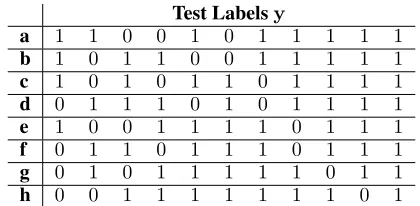
Table 1: Set W of possible ground-truth labelings y for
n0 = 3, n1 = 8, c = 17/24. Columns correspond to dif-ferent test examples (indexed by their rank order inyˆ), and rows correspond to different possible values ofy. Eachy
is generated by performingd= 7left-shifts on the vector
(0,0,0,1,1,1,1,1,1,1,1).
h(y,yˆ) = dfor anyd. In order to apply this construction, the test examples must first be sorted in increasing value of the contestant’s guesses; the constructive algorithm is then applied to generateW; and then the components of each of the possible binary vectors must be reordered to recover the original order of the test examples. An example ofWfor
n0= 3, n1= 8, c=p/q= 17/24is shown in Table 1.
Growth of
w
(
n, c
)
in
n
for fixed
c
In prior work (Whitehill 2016) we showed that, for every fixed rationalc=p/q ∈(0,1), the number of possible bi-nary ground-truth vectors for which the contestant’s guesses achieve AUC of exactlyc, grows exponentially inn. How-ever, their result applies only to datasets that are at least
n= 4qin size. What can happen for smallern?
Using the recursive formula from the section above, we found empirical evidence thatw(n, c)may actually be (ini-tially) monotonically decreasing in n, until n reaches a threshold (specific toq) at which it begins to increase again. As an example withp = 1387andq = 1440(and hence
d = 1440−1387 = 53), we can compute the number of possible binary labelings that are compatible with an AUC of exactlyc =p/q= 1387/1440(which is approximately
96.3%) as a function ofn:
n N1 w(n, c) 76 {36,40} 657488 77 {32,45} 654344 78 {30,48} 650822 84 {24,60} 622952 92 {20,72} 572728 98 {18,80} 529382 106 {16,90} 468686
Here,w(n, c)decreases steadily untiln= 106. We con-jecture thatw(n, c)is monotonically non-increasing innfor
c depends, in part, on the set of tuples(n0, n1)such that
n0+n1=nandq|n0n1. (See section “Summing over all possiblen1” above.) Whenngrows to be at least2q, then many more possibilities for(n0, n1)may become feasible because if(n0, n1)is feasible, then so is(2n0, n1), and so is
(n0,2n1).
While the number of satisfying solutions in this example forn= 106is still in the hundreds of thousands, it is easily small enough to allow each possibility to be considered indi-vidually, as we explore below. We note that test sets on the order of hundreds of examples are not uncommon; the Intel & MobileODT Cervical Cancer Screening (Kaggle 2017) and ASSISTments datamining competitions (Heffernan et al. 2017) are two examples.
A More Efficient Exploit
In the sections above, we showed (1) a simple mechanism whereby a pair of oracle calls can reveal the label of any examplek; and (2) an algorithm for enumerating all possible labelings compatible with the AUCcobtained by a vector of guesses. Below we describe how these two mechanisms can be combined to infer the identity ofalltest labels with fewer than2noracle queries:
1. Submit a vector of guessesyˆand obtain the AUCc. 2. Determine the setWof all possible ground-truth vectors
compatible withcandyˆ. 3. SetW1=W.
4. Forτ = 1,2, . . .:
(a) If|Wτ|= 1, then returny∈ Wτ.
(b) Choose the examplek(where examples are numbered according to theirrank orderinyˆ) whose labelykwould provide the greatest reduction in the number of com-patible members ofWτ. This is equivalent to finding
k= arg mink0|0.5− |{y∈Wτ :yk0 = 1}|/|Wτ||.
(c) Submit a pair of oracle queries to infer the ground-truth label of examplek; call itl.
(d) ComputeWτ+1={y∈ Wτ:yk=l}.
The loop at Step 4 is equivalent to traversing a binary tree from the root downwards. While constructing a minimum-height binary tree is NP-complete (Laurent and Rivest 1976), heuristics such as maximizing the reduction in uncertainty (Quinlan 2014) are often used, which we also use here.
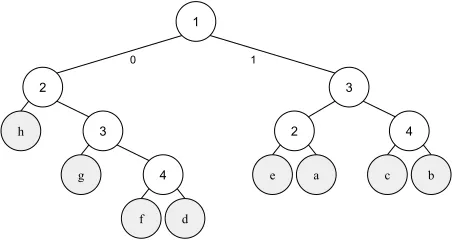
Example 1: For the example (n0= 3, n1= 8, c= 17/24) shown in Table 1, we could choosek = 1during the first iteration since there are 4 examples for whichy1 = 1and 4 examples for which y1 = 0. (Note that we could also choosek= 2.) Suppose that, using a pair of oracle queries, we deduce thaty1 = 0. Then for the second iteration we would choosek= 2and infery2using another pair of oracle queries, and so on. The binary decision tree is shown in Figure 3. Since the height of the tree is 4, then only2×4+1 = 9total oracle queries are required (including the initial query before the loop). This is fewer than the2×11 = 22queries using the naive approach presented earlier in the paper.
Example 2: Suppose we wished to infer the labels of a dataset consisting ofn = 106examples, and our guesses
1
2
h 3
g 4
f d
3
2
e a
4
c b
0 1
Figure 3: Binary decision tree to deduce which element of W is the actual ground-truth vectory. Each internal node signifies the index (according to the rank order ofyˆ) of the example whose label should be inferred (using a pair of oracle queries). Each left edge corresponds to a label of0. Leaf nodes indicate which ground-truth vector in Table 1 is correct.
attained an AUC ofc=p/q= 1387/1440(as in the section above). Then the number of satisfying solutions is468686. By following the algorithm listed above, we can iteratively query the oracle to most quickly reduce the number of pos-sible solutions down to 1. In this example, it turns out that the maximum depth of any node in the decision tree is35; hence, at most35×2 + 1 = 71queries (including the initial one) need to be made to infer all 106ground-truth labels unambiguously. This is significantly less than2×106 = 212
using a naive strategy.
Discussion
Here we discuss some points raised by the anonymous re-viewers regarding the practicality of the proposed attack.
Is there experimental evidence that labels can be in-ferred in this way in a real competition?In order to per-form the attack described in our paper in a real datamining contest, we would need to find an ongoing competition that fulfills several criteria:
(a) It uses AUC as the evaluation criterion.
(b) The size of the test set is modest, i.e.,O(100)examples. (c) The oracle returns the AUC on the entire test set, not just
a random subset.
(d) Contestants can submit multiple oracle queries during the competition.
To be clear: We do not claim that our attack is feasible (computationally, or within the allowed number of oracle queries) foralltest sets, even when all the criteria above are fulfilled. In the vast majority of cases, the competition would not allow enough oracle queries, and/or the computational time and storage costs would become intractable. However, the purpose of our paper is to show that thereexisttest sets on which attacks could successfully be waged.
Does the proposed method apply if the AUC is re-ported as a floating-point number instead of an exact fractionp/q?Sometimes. Many competition oracles report AUC results with 5 decimal digits. If the value ofp/qcan be represented exactly using less than or equal to 5 digits, then no information is lost. Even if it cannot be, there may still be some useful information about(p, n0, n1)that can be ex-tracted. Consider, for example, a competition of the size used in the ASSISTments Datamining Competition, withn= 172
examples. If the actual values ofn0 andn1were100and
72, respectively, and if a contestant’s classifier achieved an AUC of (say)6500/(100∗72)which were truncated by the oracle at 5 decimal figures (i.e.,0.90278), then the contestant could greatly reduce the set of(n0, n1, p)that are compatible with this result to just18possibilities. Moreover, through subsequent oracle calls with slightly different AUCs (which could be performed by adding noise to the guesses), then the possible values can be whittled away further by intersecting the subsets of feasible(n0, n1). Of course, having more than just one possibility for(n0, n1, p)will weaken the attack, and the attacker might need to make far more oracle queries (to handle each possible tuple) to deduce the test set labels with certainty. Speculatively, we could imagine that one might generalize our proposed attack in this way, but this would require further research.
What would happen if the oracle added noise to c? Adding noise to the AUC returned by the oracle would likely thwart the proposed attack because it assumes perfect knowl-edge ofpandq. However, in practice, datamining competi-tion organizers are reluctant to add such noise to the oracle responses. One possible reason is that it might bother con-testants that they could receive a score that is (sightly) lower than what they deserved.
Conclusions
We have investigated the mathematical structure of how the Area Under the Receiver Operating Characteristics Curve (AUC) accuracy metric is computed from the binary vector of ground-truth labels and a real-valued vector of guesses. In particular, we derived an efficient recursive algorithm with which to count the exact number of binary vectors for which the AUC of a fixed vector of guesses is some valuec. We also derived a constructive algorithm with which to enumerate all such binary vectors. Finally, we showed a novel exploitation mechanism whereby the setWof possible ground-truth vec-tors can be iteratively whittled down using a binary decision tree to a unique valuey. As an important limitation noted above, our algorithm assumesperfectknowledge of the AUC, i.e., no noise added.
Future work: It would be interesting to explore more sophisticated adaptive mechanisms of choosing guess vectors
ˆ
y; based on theWresulting from the first vector of guesses, there might be a way of choosing the next guess vectoryˆ
that results in a more efficient deduction of the ground-truth values than the method we presented.
References
Agarwal, S.; Graepel, T.; Herbrich, R.; Har-Peled, S.; and Roth, D. 2005. Generalization bounds for the area under the ROC curve. InJournal of Machine Learning Research. Blum, A., and Hardt, M. 2015. The ladder: A reliable leader-board for machine learning competitions. arXiv preprint arXiv:1502.04585.
Blum, A.; Ligett, K.; and Roth, A. 2013. A learning theory approach to noninteractive database privacy.Journal of the ACM (JACM)60(2):12.
Chaudhuri, K., and Monteleoni, C. 2009. Privacy-preserving logistic regression. InAdvances in Neural Information Pro-cessing Systems.
Dwork, C.; Feldman, V.; Hardt, M.; Pitassi, T.; Reingold, O.; and Roth, A. L. 2015. Preserving statistical validity in adaptive data analysis. InProceedings of the Forty-Seventh Annual ACM on Symposium on Theory of Computing. Dwork, C. 2011. Differential privacy. In van Tilborg, H., and Jajodia, S., eds.,Encyclopedia of Cryptography and Security. Springer US. 338–340.
Hardt, M., and Ullman, J. 2014. Preventing false discovery in interactive data analysis is hard. InFoundations of Computer Science (FOCS), 2014 IEEE 55th Annual Symposium on, 454–463. IEEE.
Heffernan, N.; Baker, R.; Woolf, B.; and Patikorn, T. 2017. ASSISTments data mining competition 2017. https://sites.google.com/view/assistmentsdatamining/data-mining-competition-2017.
Kaggle. 2017. Intel & mobileodt cervical cancer screen-ing dataminscreen-ing competition. https://www.kaggle.com/c/intel-mobileodt-cervical-cancer-screening.
Laurent, H., and Rivest, R. L. 1976. Constructing optimal binary decision trees is np-complete.Information processing letters5(1):15–17.
Matthews, G. J., and Harel, O. 2013. An examination of data confidentiality and disclosure issues related to publication of empirical roc curves.Academic radiology20(7):889–896. Quinlan, J. R. 2014. C4. 5: programs for machine learning. Elsevier.
Stoddard, B.; Chen, Y.; and Machanavajjhala, A. 2014. Dif-ferentially private algorithms for empirical machine learning. CoRRabs/1411.5428.