The Thirty-Third AAAI Conference on Artificial Intelligence (AAAI-19)
Memory Bounded Open-Loop Planning
in Large POMDPs Using Thompson Sampling
Thomy Phan
LMU Munich [email protected]Lenz Belzner
MaibornWolff [email protected]Marie Kiermeier
LMU Munich [email protected]Markus Friedrich
LMU Munich [email protected]Kyrill Schmid
LMU Munich [email protected]Claudia Linnhoff-Popien
LMU MunichAbstract
State-of-the-art approaches to partially observable planning like POMCP are based on stochastic tree search. While these approaches are computationally efficient, they may still con-struct search trees of considerable size, which could limit the performance due to restricted memory resources. In this paper, we proposePartially Observable Stacked Thompson Sampling (POSTS), a memory bounded approach to open-loop planning in large POMDPs, which optimizes a fixed size stack of Thompson Sampling bandits. We empirically evalu-ate POSTS in four large benchmark problems and compare its performance with different tree-based approaches. We show that POSTS achieves competitive performance compared to tree-based open-loop planning and offers a performance-memory tradeoff, making it suitable for partially observable planning with highly restricted computational and memory resources.
Introduction
Many real-world problems can be modeled asPartially Ob-servable Markov Decision Process (POMDP), where the true state is unknown to the agent due to limited and noisy sensors. The agent has to reason about the historyof past observations and actions, and maintain a belief state as a distribution of possible states. POMDPs have been widely used to model decision making problems in the context of planning and reinforcement learning (Ross et al. 2008).
Solving POMDPs exactly is computationally intractable for domains with enormous state spaces and long planning horizons. First, the space of possible belief states grows ex-ponentially w.r.t. the number of statesN, since that space is N-dimensional, which is known ascurse of dimensionality
(Kaelbling, Littman, and Cassandra 1998). Second, the num-ber of possible histories grows exponentially w.r.t. the hori-zon length, which is known as thecurse of history(Pineau, Gordon, and Thrun 2006).
In the last few years,Monte-Carlo planninghas been pro-posed to break both curses with statistical sampling. These methods construct sparse trees over belief states and actions, representing the state-of-the-art for efficient planning in
Copyright c2019, Association for the Advancement of Artificial Intelligence (www.aaai.org). All rights reserved.
large POMDPs (Silver and Veness 2010; Somani et al. 2013; Bai et al. 2014). While these approaches avoid exhaus-tive search, the constructed closed-loop trees can still be-come arbitrarily large for highly complex domains, which could limit the performance due to restricted memory re-sources (Powley, Cowling, and Whitehouse 2017). In con-trast, open-loop approaches only focus on searching ac-tion sequences and are independent of the history and be-lief state space. Open-loop approaches are able to achieve competitive performance compared to closed-loop planning, when the problem is too large to provide sufficient computa-tional and memory resources (Weinstein and Littman 2013; Perez Liebana et al. 2015; Lecarpentier et al. 2018). How-ever, open-loop planning has been a less popular choice for decision making in POMDPs so far (Yu et al. 2005).
In this paper, we propose Partially Observable Stacked Thompson Sampling (POSTS), a memory bounded approach to open-loop planning in large POMDPs, which optimizes a fixed size stack of Thompson Sampling bandits.
To evaluate the effectiveness of POSTS, we formu-late a tree-based approach, called Partially Observable Open-Loop Thompson Sampling (POOLTS)and show that POOLTS is able to find optimal open-loop plans with suffi-cient computational and memory resources.
We empirically test POSTS in four large benchmark problems and compare its performance with POOLTS and other tree-based approaches like POMCP. We show that POSTS achieves competitive performance compared to tree-based open-loop planning and offers a performance-memory tradeoff, making it suitable for partially observable planning with highly restricted computational and memory resources.
Background
Partially Observable Markov Decision Processes
A POMDP is defined by a tuple M =
hS,A,P,R,O,Ω, b0i, whereSis a (finite) set of states,A
is the (finite) set of actions,P(st+1|st, at)is the transition
probability function,R(st, at)is the scalar reward function,
O is a (finite) set of observations, Ω(ot+1|st+1, at)is the
observation probability function, and b0 is a probability
distribution over initial statess0 ∈ S. It is always assumed,
Ahistoryht=
a0, o1, ..., at−1, ot
is a sequence of ac-tions and observaac-tions. Abelief statebht(st)is a sufficient
statistic for historyhtand defines a probability distribution
over statesstgivenht.Bis the space of all possible belief
states. b0 represents the initial belief state bh0. The belief state can be updated by Bayes theorem:
bht(st) =ηΩ(ot|st, a) X
s∈S
P(st|s, a)bh(st) (1)
whereη =Ω(o 1
t+1|bh,a)is a normalizing constant,a=at−1
is the last action, andhis the history withoutaandot.
The goal is to find apolicyπ:B → A, which maximizes the returnGtat statestfor a horizonT:
Gt= T−1
X
k=0
γk· R(st+k, at+k) (2)
whereγ∈[0,1]is the discount factor. Ifγ <1, then present rewards are weighted more than future rewards.
Thevalue functionVπ(b
t) = Eπ[Gt|bt
is the expected return conditioned on belief states given a policy π. An optimal policy π∗ has a value function Vπ∗ = V∗ with
V∗(bt)≥Vπ
0
(bt)for allbt∈ Bandπ06=π∗.
Multi-armed Bandits
Multi-armed Bandits (MABs or bandits)are fundamental de-cision making problems, where an agent has to repeatedly select an arm among a given set of arms in order to max-imize its future pay-off. MABs can be considered as prob-lems with a single state s, a set of actionsa ∈ A, and a stochastic reward functionR(s, a) := Xa, where Xa is a
random variable with an unknown distributionfXa(x). To
solve a MAB, one has to determine the action, which max-imizes the expected reward EXa. The agent has to
bal-ance between sufficiently trying out actions to accurately es-timate their expected reward and to exploit its current knowl-edge on all arms by selecting the arm with the currently highest expected reward. This is known as the exploration-exploitation dilemma, where exploration can lead to actions with possibly higher rewards but requires time for trying them out, while exploitation can lead to fast convergence but possibly gets stuck in a local optimum. In this paper, we will cover UCB1 and Thompson Sampling as MAB algorithms.
UCB1 In UCB1, actions are selected by maximizing the upper confidence bound of action valuesUCB1(a) =Xa+
c q
log(Ntotal)
Na , whereXa is the current average reward when
choosinga,c is an exploration constant,Ntotal is the total number of action selections, andNa is the number of times
actionawas selected. The second term represents the ex-ploration bonus, which becomes smaller with increasingNa
(Auer, Cesa-Bianchi, and Fischer 2002).
UCB1 is a popular MAB algorithm and widely used in various challenging domains (Kocsis and Szepesv´ari 2006; Bubeck and Munos 2010; Silver et al. 2016; 2017).
Thompson Sampling Thompson Samplingis a Bayesian approach to balance between exploration and exploitation of actions (Thompson 1933). The unknown reward distri-bution of Xa of each action a ∈ A is modeled by a
parametrized likelihood functionPa(x|θ)with a parameter
vectorθ. Given a prior distributionPa(θ)and a set of past
observed rewardsDa = {xa,1, xa,2, ..., xa,Na}, the
poste-rior distribution Pa(θ|Da)can be inferred by using Bayes
rule Pa(θ|Da) ∝ QiPa(xa,i|θ)Pa(θ). The expected
re-ward of each actiona ∈ Acan be estimated by sampling θ∼Pa(θ|Da)from the posterior. The action with the
high-est sampled expected rewardEθXais selected.
Thompson Sampling has been shown to be an effective and robust algorithm for making decisions under uncertainty (Chapelle and Li 2011; Kaufmann, Korda, and Munos 2012; Bai, Wu, and Chen 2013; Bai et al. 2014).
Planning in POMDPs
Planning searches for an (near-)optimal policy given a model Mˆ of the environment M, which usually consists of explicit probability distributions of the POMDP. Unlike
offline planning, which searches the whole (belief) state space to find the optimal policyπ∗,local planningonly fo-cuses on finding a policy πt for the current (belief) state
by taking possible future (belief) states into account (We-instein and Littman 2013). Thus, local planning can be ap-plied online at every time step at the current state to rec-ommend the next action for execution. Local planning is usually restricted to a time or computation budget nb due to strict real-time constraints (Bubeck and Munos 2010; Weinstein and Littman 2013; Perez Liebana et al. 2015).
In this paper, we focus on local Monte-Carlo planning, where Mˆ is a generative model, which can be used as black box simulator (Kocsis and Szepesv´ari 2006; Silver and Veness 2010; Weinstein and Littman 2013; Bai et al. 2014). Given st and at, the simulator Mˆ provides a
sample hst+1, ot+1, rti ∼ Mˆ(st, at). Monte-Carlo
plan-ning algorithms can approximate π∗ and V∗ by itera-tively simulating and evaluating action sequences with-out reasoning abwith-out explicit probability distributions of the POMDP.
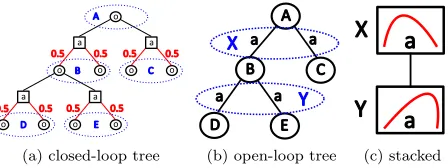
Local planning can be closed- or open-loop.Closed-loop planningconditions the action selection on histories of ac-tions and observaac-tions.Open-loop planningonly conditions the action selection on previous sequences of actionspT = [a1, ..., aT] (also called open-loop plans or simply plans)
and summarized statistics about predecessor (belief) states (Bubeck and Munos 2010; Weinstein and Littman 2013; Perez Liebana et al. 2015). An example is shown in Fig. 1. A closed-loop tree for a domain withΩ(st+1|st, at) = 0.5
(a) closed-loop tree (b) open-loop tree (c) stacked
Figure 1: Illustration of closed- and open-loop planning schemes. (a) Closed-loop tree with state observations (cir-cular nodes) and actions (rectangular nodes). Red links cor-respond to stochastic observations made with a probability of 0.5. (b) Open-loop tree with links as actions and history distribution nodes according to the blue dotted ellipses in Fig. 1a. (c) Open-loop approach with stack of action distri-butions according to the blue dotted ellipses in Fig. 1b.
Partially Observable Monte-Carlo Planning (POMCP)is a closed-loop approach based onMonte-Carlo Tree Search (MCTS) (Silver and Veness 2010). POMCP uses a search tree of histories witho-nodesrepresenting observations and
a-nodes representing actions (Fig. 1a). Eacho-node has a visit countN(ht)and a value estimateV(ht) =V(bt)for
historyhtand belief statebt. Eacha-nodehas a visit count
N(ht) and a value estimateQ(ht, at) = E[Gt|ht, at]for
actionat and historyht. A simulation starts at the current
belief state and is divided into two stages: In the first stage, a tree policyπtreeis used to traverse the tree until a leaf node is reached. Actions are selected viaπtree(ht)and simulated
inMˆ to determine the next nodes to visit.πtreecan be imple-mented with MABs, where eacho-noderepresents a MAB. In the second stage, a rollout policyπrolloutis used to sample action sequences until a terminal state or a maximum search depthT is reached. The observed rewards are accumulated to returnsGt(Eq. 2), propagated back to update the value
estimate of every node in the simulated path, and a new leaf node is added to the search tree. πrollout can be used to in-tegrate domain knowledge into the planning process to fo-cus the search on promising states (Silver and Veness 2010). The original version of POMCP uses UCB1 forπtreeand is shown to converge to the optimal best-first tree with suffi-cient computation (Silver and Veness 2010).
(Lecarpentier et al. 2018) formulates an open-loop vari-ant of MCTS using UCB1 asπtree, calledOpen-Loop Upper
Confidence bound for Trees (OLUCT), which could be easily extended to POMDPs by constructing a tree, which summa-rizes allo-nodesto history distribution nodes (Fig. 1b).
Open-loop planning generally converges to sub-optimal solutions in stochastic domains, since it ignores (belief) state valuesV(bt)and optimizes the node valuesV(Nt)(Fig. 1b)
instead (Lecarpentier et al. 2018). If the problem is too com-plex to provide sufficient computation budgetnb or
mem-ory capacity, then open-loop approaches are competitive to closed-loop approaches, since they need to explore a much smaller search space to converge to an appropriate solution (Weinstein and Littman 2013; Lecarpentier et al. 2018).
Related Work
Tree-based approaches to open-loop planning condition the action selection on previous action sequences as shown in Fig. 1b (Bubeck and Munos 2010; Perez Liebana et al. 2015; Lecarpentier et al. 2018). Such approaches have been thor-oughly evaluated for fully observable problems, but have been less popular for partially observable problems so far (Yu et al. 2005). POSTS is based on stacked open-loop plan-ning, where a stack ofT distributions over actions is main-tained to generate open-loop plans with high expected return (Weinstein and Littman 2013; Belzner and Gabor 2017). Unlike previous approaches, POSTS is amemory-bounded
open-loop approach topartially observable planning. (Yu et al. 2005) proposed an open-loop approach to plan-ning in POMDPs by using hierarchical planplan-ning. An open-loop plan is constructed at an abstract level, where uncer-tainty w.r.t. particular actions is ignored. A low-level plan-ner controls the actual execution by explicitly dealing with uncertainty. POSTS is more general, since it performs plan-ning directly on the original problemand does not require the POMDP to be transformed for hierarchical planning.
(Powley, Cowling, and Whitehouse 2017) proposed a memory bounded version of MCTS with a state pool to add, discard, or reuse states depending on their visitation frequency. However, this approach cannot be easily adapted to tree-based open-loop approaches, because it requires (be-lief) states to be identifiable. POSTS does not require a pool to reuse states or nodes, but only maintains afixed size stack
of Thompson Sampling bandits, which adapt according to thetemporal dependenciesbetween actions.
Open-Loop Search with Thompson Sampling
Generalized Thompson Sampling We use a variant of Thompson Sampling, which works for arbitrary reward dis-tributions as proposed in (Bai, Wu, and Chen 2013; Bai et al. 2014) by assuming thatXat follows a Normaldistribu-tionN(µ,τ1)with unknown meanµand precisionτ = σ12, whereσ2is the variance.hµ, τifollows a Normal Gamma distribution N G(µ0, λ, α, β) with λ > 0, α ≥ 1, and
β ≥ 0. The distribution over τ is a Gamma distribution τ ∼ Gamma(α, β)and the conditional distribution overµ givenτis a Normal distributionµ∼ N(µ0,λτ1).
Given a prior distribution P(θ) = N G(µ0, λ0, α0, β0)
andnobservationsD = {x1, ..., xn}, the posterior
distri-bution is defined byP(θ|D) =N G(µ1, λ1, α1, β1), where
µ1 = λ0λµ00++nnX, λ1 = λ0 + n, α1 = α0 + n2, and
β1 = β0 + 12(nσ2 + λ0n(X−µ0)
2
λ0+n ). X is the mean of all values inDandσ2= 1
n Pn
i=1(xi−X)
2is the variance.
The posterior is inferred for each actionat ∈ Ato
sam-ple an estimateµat for the expected return. The action with
the highest estimate is selected. The complete formulation is given in Algorithm 1.
Algorithm 1Generalized Thompson Sampling
procedureThompsonSampling(Nt)
forat∈ Ado
Inferhµ1, λ1, α1, β1ifrom prior andXat, σ
2
a, nat
µat, τat∼ N G(µ1, λ1, α1, β1)
returnargmaxat∈A(µat)
procedureUpdateBandit(Nt, Gt)
nat ←nat+ 1
hXold,at, Xati ← hXat,(natXold,at+Gt)/(nat+ 1)i
sat ←[(nat−1)sat+ (Gt−Xold,at)(Gt−Xat)]/nat
sampled (almost) uniformly. This can be achieved by choos-ing the priors such that the variance of the resultchoos-ing Nor-mal distributionN(µ0,λ10τ)becomes infinite (λ01τ0 → ∞
and λ0τ → 0). Since τ follows a Gamma distribution
Gamma(α0, β0) with expectationE(τ) = αβ00,α0 and β0 should be chosen such that α0
β0 →0. Given the hyperparam-eter spaceλ0>0,α0≥1, andβ0 ≥0, it is recommended
to setα0 = 1andµ0 = 0to center the Normal
distribu-tion.λ0should be chosen small enough andβ0should have
a sufficiently large value (Bai et al. 2014).
Monte Carlo Belief State Update The belief state can be updated exactly according to Eq. 1. However, exact Bayes updates may be computationally infeasible in POMDPs with large state spaces due to the curse of dimensionality. For this reason, we approximate the belief statebht for history
htwith a particle filter as described in (Silver and Veness
2010). The belief statebht is represented by a setˆbht ofK
sample states or particles. After execution ofatand
observa-tion ofot+1, the particles are updated by Monte Carlo
sim-ulation. Sampled statesst∼ˆbht are simulated withatsuch
thathst+1, o0t+1, rti ∼Mˆ(st, at). Ifo0t+1=ot+1, thenst+1
is added toˆbhtatot+1 = ˆbht+1.
POOLTS To evaluate the effectiveness of POSTS com-pared to other open-loop planners, we first definePartially Observable Open-Loop Thompson Sampling (POOLTS)and show that POOLTS is able to converge to an optimal open-loop plan, if sufficient computational and memory resources are provided. POOLTS is a tree-based approach based on OLUCT from (Lecarpentier et al. 2018). Each nodeNt
rep-resents a Thompson Sampling bandit and storesXat, sa, and
nat for each actionat∈ A.
A simulation starts at a statest, which is sampled from
the current belief statebht. The belief state is approximated
by a particle filterˆbhtas described above. An open-loop tree
(Fig. 1b) is iteratively constructed by traversing the current tree in a selection step by using Thompson Sampling to se-lect actions. When a leaf node is reached, it is expanded by a child nodeNnewand a rollout is performed by using a policy πrolloutuntil a terminal state is reached or a maximum search depthTis exceeded. The observed rewards are accumulated to returnsGt(Eq. 2) and propagated back to update the
cor-responding bandit of every node in the simulated path. When the computation budgetnbhas run out, the actionatwith the
highest expected returnXat is selected for execution. The
complete formulation of POOLTS is given in Algorithm 2.
Algorithm 2POOLTS Planning
procedurePOOLTS(ht, T, nb)
CreateN0forht
whilenb >0do
nb←nb−1
st∼ˆbht
TreeSearch(N0, st, T,0)
returnargmaxat∈A(Xat)
procedureTreeSearch(Nt, st, T, d)
ifd≥T orstis a terminal statethen return0
ifNtis a leaf nodethen
ExpandNt
Perform rollout withπrolloutto sampleGt
returnGt
at←ThompsonSampling(Nt)
hst+1, rt, ot+1i ∼Mˆ(st, at)
Rt←TreeSearch(Nt+1, st+1, T, d+ 1)
Gt←rt+γRt
UpdateBandit(Nt, Gt)
returnGt
(Kocsis and Szepesv´ari 2006; Bubeck and Munos 2010; Lecarpentier et al. 2018) have shown that tree search al-gorithms using UCB1 converge to the optimal closed-loop or open-loop plan respectively, if the computation bud-get nb is sufficiently large. This is because the expected
state or node values in the leaf nodes become stationary, given a stationary rollout policy πrollout. This enables the values in the preceding nodes to converge as well, lead-ing to state- or node-wise optimal actions. By replaclead-ing UCB1 with Thompson Sampling, the tree search should still converge to the optimal closed-loop or open-loop plan, since Thompson Sampling also converges to the optimal action, if the return distribution of Gt becomes
station-ary (Agrawal and Goyal 2013). (Chapelle and Li 2011; Bai et al. 2014) empirically demonstrated that Thompson Sampling converges faster than UCB1, when rewards are sparse and when the number of arms is large.
POSTS Partially Observable Stacked Thompson Sam-pling (POSTS)is an open-loop approach, which optimizes a stack ofTThompson Sampling bandits to search for high-quality open-loop plans (Fig. 1c). Each bandit Nt stores
Xat, sa, andnatfor each actionat∈ A.
Similarly to POOLTS, a simulation starts at a state st,
which is sampled from a particle filter ˆbht, representing
the current belief state bht. Unlike POOLTS, a fixed size
stack of banditsN1, ..., NT is used to sample plans pT = [a1, ..., aT]. pT is evaluated with the generative model Mˆ
to observe immediate rewardsr1, ..., rT, which are
accumu-lated to returnsG1, ..., GT (Eq. 2). Each banditNtis then
updated with the corresponding returnGt. When the
compu-tation budgetnbhas run out, the actionatwith the highest
formulation of POSTS is given in Algorithm 3.
Algorithm 3POSTS Planning
procedurePOSTS(ht, T, nb)
whilenb>0do
nb←nb−1
st∼ˆbht
Simulate(N0, st, T,0)
returnargmaxat∈A(Xat)
procedureSimulate(st, T, d)
ifd≥Torstis a terminal statethen return0
at←ThompsonSampling(Nt)
hst+1, rt, ot+1i ∼Mˆ(st, at)
Rt←Simulate(st+1, T, d+ 1)
Gt←rt+γRt
UpdateBandit(Nt, Gt)
returnGt
The idea of POSTS is to only regard the temporal de-pendencies between the actions of an open-loop plan. The bandit stack is used to learn these dependencies with the expected (discounted) return. When a bandit Nt samples
an actionatwith a resulting reward of rt, then all
preced-ing bandits Nt−k withk < t are updated with Gt−k =
rt−k+γrt−k+1+...+γkrt, using a discounted value ofrt.
This is because the actions sampled by all preceding bandits are possibly relevant for obtaining the rewardrt. By only
regarding these temporal dependencies, POSTS ismemory bounded, not requiring a search tree to model dependencies between histories or history distributions (Fig. 1a and 1b).
Experiments
Evaluation Environments
We tested POSTS in theRockSample,Battleship, and Poc-Man domains, which are well-known POMDP benchmark problems for decision making in POMDPs (Silver and Ve-ness 2010; Somani et al. 2013; Bai et al. 2014). For each domain, we set the discount factorγas proposed in (Silver and Veness 2010). The results were compared with POMCP, POOLTS, and a partially observable version of OLUCT, which we call POOLUCT. The problem-size features of all domains are shown in Table 1.
TheRockSample(n,k)problem simulates an agent moving in ann×ngrid containingk rocks (Smith and Simmons 2004). Each rock can begoodor bad but the true state of each rock is unknown. The agent has to sample good rocks, while avoiding to sample bad rocks. It has a noisy sensor, which produces an observationot ∈ {good, bad}for a
par-ticular rock. The probability of sensing the correct state of the rock decreases exponentially with the agent’s distance to that rock. Sampling gives a reward of +10, if the rock is good and−10otherwise. If a good rock was sampled, it becomes bad. Moving and sensing do not give any rewards. Moving past the east edge of the grid gives a reward of+10
and the episode terminates. We setγ= 0.95.
InBattleshipfive ships of size 1, 2, 3, 4, and 5 respectively are randomly placed into a10×10grid, where the agent has to sink all ships without knowing their actual positions (Silver and Veness 2010). Each cell hitting a ship gives a reward of+1. There is a reward of−1per time step and a terminal reward of+100for hitting all ships. We setγ= 1.
PocManis a partially observable version ofPacMan (Sil-ver and Veness 2010). The agent navigates in a17×19maze and has to eat randomly distributed food pellets and power pills. There are four ghosts moving randomly in the maze. If the agent is within the visible range of a ghost, it is getting chased by the ghost and dies, if it touches the ghost, termi-nating the episode with a reward of−100. Eating a power pill enables the agent to eat ghosts for 15 time steps. In that case, the ghosts will run away, if the agent is under the effect of a power pill. At each time step a reward of−1is given. Eating food pellets gives a reward of+10and eating a ghost gives+25. The agent can only perceive ghosts, if they are in its direct line of sight in each cardinal direction or within a hearing range. Also, the agent can only sense walls and food pellets, which are adjacent to it. We setγ= 0.95.
Methods
POMCP We use the POMCP implementation from (Sil-ver and Veness 2010).πtreeselects actions from a set of le-gal actions at ∈ Alegal(st) with UCB1.πrollout randomly selects actions fromAlegal(s0), depending on the currently simulated states0 ∈ S.
In each simulation step, there is at most one expansion step, where new nodes are added to the search tree. Thus, tree size should increase linearly w.r.t.nbin large POMDPs.
POOLTS and POOLUCT POOLTS is implemented ac-cording to Algorithm 2, where actions are selected from a set of legal actions at ∈ Alegal(st) with Thompson
Sam-pling (Algorithm 1) in the first stage.πrollout randomly se-lects actions fromAlegal(s0), depending on the currently sim-ulated states0 ∈ S. POOLUCT is similar to POOLTS but uses UCB1 as action selection strategy in the first stage. Since, open-loop planning can encounter different states at the same node (Fig. 1), the set of legal actions may vary for each statest∈ S. We always mask out the statistics of
cur-rently illegal actions, regardless of whether they have high average action values, to avoid selecting them.
Similarly to POMCP, the search tree size should increase linearly w.r.t.nb, but with less nodes, since open-loop trees
store summarized information about history distributions.
POSTS POSTS is implemented as a stack of Thompson Sampling banditsNi with1 ≤ i ≤ T according to
Algo-rithm 3. Starting atst, all banditsNiapply Thompson
Sam-pling to a set of legal actions Alegal(s0), depending on the currently simulated states0 ∈ S. Similarly to POOLTS and POOLUCT, we mask out the statistics of currently illegal actions and only regard the value statistics of legal actions for selection during planning.
Table 1: The problem-size features of the benchmark domainsRockSample,Battleship, andPocMan.
RockSample(11,11) RockSample(15,15) Battleship PocMan
# States|S| 247,808 7,372,800 ∼1012 ∼1056
# Actions|A| 16 20 100 4
# Observations|O| 3 3 2 1024
Results
We ran each approach onRockSample,Battleship, and Poc-Manwith different settings for 100 times or at most 12 hours of total computation. We evaluated the performance of each approach with theundiscounted return(γ= 1), because we focus on the actual effectiveness instead of the quality of op-timization (Bai et al. 2014). For POMCP and POOLTS we set the UCB1 exploration constantcto the reward range of each domain as proposed in (Silver and Veness 2010).
Prior Sensitivity Since we assume no additional domain knowledge, we focus on uninformative priors withµ0 = 0,
α0= 1, andλ0= 0.01as proposed in (Bai et al. 2014). With
this setting,β0controls the degree of initial exploration
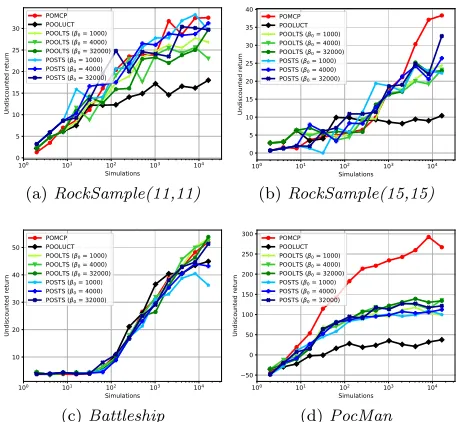
dur-ing the planndur-ing phase, thus its impact on the performance of POOLTS and POSTS is evaluated. The results are shown in Fig. 2 forβ0= 1000,4000,32000for POOLTS and POSTS.
(a)RockSample(11,11) (b)RockSample(15,15)
(c)Battleship (d)PocMan
Figure 2: Average performance of POSTS, POOLTS, POOLUCT, and POMCP with different prior values forβ0,
different computation budgetsnb, and a horizon ofT = 100.
In RockSample, POSTS slightly outperforms POOLTS and keeps up in performance with POMCP. POOLTS slightly outperforms POSTS and POMCP inBattleshipwith POSTS only being able to keep up when nb < 104 or
whenβ0 = 32000. POMCP clearly outperforms all
open-loop approaches inPocMan. POOLTS slightly outperforms POSTS inPocMan with POSTS only being to keep up, if β0= 32000. POOLUCT performed worst in all domains
ex-ceptBattleship, where it performs best with a computation budget ofnb≤1024. POSTS performs slightly better, ifβ0
is large, but POOLTS seem to be insensitive to the choice of β0except inPocMan, where it performs better, ifβ0is large.
Horizon Sensitivity We evaluated the sensitivity of all ap-proaches w.r.t. different horizonsT. The results are shown in Fig. 3 fornb = 40961andβ0 = 1000,4000,32000for
POOLTS and POSTS.
(a)RockSample(11,11) (b)RockSample(15,15)
(c)Battleship (d)PocMan
Figure 3: Average performance of POSTS, POOLTS, POOLUCT, and POMCP with different planning horizons T and a computation budget ofnb= 4096.
In RockSample(11,11), there is a performance peak at T = 10for POMCP and POOLUCT, while for POSTS and POOLTS it is about T = 50. In all other domains, there seems to be a performance peak atT = 100for most ap-proaches. IfT >100, there is no significant improvement or even degrading performance for most approaches except for POMCP, which slightly improves in all domains but Rock-Sample(11,11), ifT = 400.
Performance-Memory Tradeoff We evaluated the performance-memory tradeoff of all approaches by intro-ducing a memory capacitynmem, where the computation is interrupted, when the number of nodes exceeds nmem. For
1
Using computation budgets between 1024 and 16384 led to similar plots, thus we stick tonb = 4096with all approaches
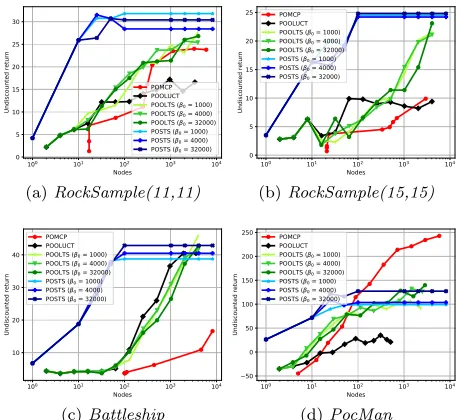
POMCP, we count the number ofo-nodesanda-nodes(Fig. 1a). For POOLTS and POOLUCT, we count the number of history distribution nodes (Fig. 1b). For POSTS, we count the number of Thompson Sampling bandits, which is always min{nmem, T}. The results are shown in Fig. 4 for nb = 4096, T = 100, and β0 = 1000,4000,32000
for POOLTS and POSTS. POSTS never uses more than
102= 100nodes in each setting.
(a)RockSample(11,11) (b)RockSample(15,15)
(c)Battleship (d)PocMan
Figure 4: Average performance of POSTS, POOLTS, POOLUCT, and POMCP with memory bounds, a compu-tation budget ofnb= 4096and a horizon ofT = 100.
InRocksampleandBattleship, POMCP is outperformed by POSTS and POOLTS (and also POOLUCT in Battle-ship). POSTS always performs best in these domains, when nmem < 1000. POMCP performs best in PocMan by out-performing POSTS, whennmem>100and POOLTS keeps up with the best POSTS setting, when nmem > 1000. POOLUCT performs worst except in Battleship, improv-ing less and slowest with increasimprov-ing nmem. It outperforms POMCP inRocksample(15,15), whennmem≤1000though. InPocMan, POOLUCT creates less than 550 nodes, when nb = 4096, indicating that the search tree construction has
converged and does not improve any further.
Discussion
The experiments show that partially observable open-loop planning can be a good alternative to closed-loop planning, when the action space is large, stochasticity is low, and when computational and memory resources are highly restricted. Especially approaches based on Thompson Sampling like POOLTS and POSTS seem to be very effective and robust w.r.t. the hyperparameter choice. Setting a large value forβ0
seems to be beneficial for large problems (Fig. 2). This is be-cause an enormous search space needs to be explored, while avoiding premature convergence to poor solutions. However, ifβ0is too large, POSTS and POOLTS might converge too
slowly, thus requiring much more computation (Bai et al. 2014). IfT is too large, then the value estimates have very high variance, making bandit adaptation more difficult. This could explain the performance stagnation or degradation for most approaches in Fig. 3, whenT >100. The performance of POSTS scales similarly to POOLTS w.r.t.nbandT(Fig.
2 and 3). POSTS is also more robust than POOLUCT w.r.t. changes to nb andT except inBattleship, where both
ap-proaches scale similarly, whenβ0is sufficiently large.
POSTS is competitive to POOLTS and superior to POOLUCT in all settings except inBattleship(whennb is
large) with POOLTS and POOLUCT being shown to the-oretically converge to optimal open-loop plans, given suf-ficient computation budgetnb and memory capacity nmem. POSTS is shown to be superior to all other approaches in
RockSample and Battleship, when memory resources are highly restricted, only being outperformed by the tree-based approaches inBattleshipafter thousands of nodes were cre-ated, consuming much more memory than POSTS, which only uses 100 nodes at most. This might be due to the rela-tively large action space of these domains (Table 1), where all tree-based planners construct enormous trees with high branching factors, when exploring the effect of each action.
RockSample and Battleship have low stochasticity, since state transitions are deterministic. In both domains the agent is primarily uncertain about the real state, thus the planning quality only depends on the belief state approximation and the uncertainty about observations (only inRockSample).
POMCP performs best in PocMan. This might be due to the small action space (Table 1) and high stochasticity (where all ghosts primarily move randomly), since open-loop planning is known to converge to sub-optimal solutions in such domains (Weinstein and Littman 2013; Lecarpen-tier et al. 2018). However, POMCP has the highest memory consumption, since it constructs larger trees than open-loop approaches with the same computation budget (Fig 1a). In
PocMan, POSTS is able to keep up with POOLTS, while being much more memory-efficient (Fig. 2d and 4d).
Conclusion and Future Work
In this paper, we proposed Partially Observable Stacked Thompson Sampling (POSTS), a memory bounded approach to open-loop planning in large POMDPs, which optimizes a fixed size stack of Thompson Sampling bandits.
To evaluate the effectiveness of POSTS, we formulated a tree-based approach, called POOLTS and showed that POOLTS is able to find optimal open-loop plans with suf-ficient computational and memory resources.
We empirically tested POSTS in four large benchmark problems and showed that POSTS achieves competitive performance compared to tree-based open-loop planners like POOLTS and POOLUCT, if sufficient resources are provided. Unlike tree-based approaches, POSTS offers a performance-memory tradeoff by performing best, if com-putational and memory resources are highly restricted, mak-ing it suitable for efficient partially observable plannmak-ing.
References
Agrawal, S., and Goyal, N. 2013. Further Optimal Regret Bounds for Thompson Sampling. InArtificial Intelligence and Statistics, 99–107.
Auer, P.; Cesa-Bianchi, N.; and Fischer, P. 2002. Finite-Time Analysis of the Multiarmed Bandit Problem.Machine learning47(2-3):235–256.
Bai, A.; Wu, F.; Zhang, Z.; and Chen, X. 2014. Thomp-son Sampling based Monte-Carlo Planning in POMDPs. In
Proceedings of the Twenty-Fourth International Conferenc on International Conference on Automated Planning and Scheduling, 29–37. AAAI Press.
Bai, A.; Wu, F.; and Chen, X. 2013. Bayesian Mixture Mod-elling and Inference based Thompson Sampling in Monte-Carlo Tree Search. InAdvances in Neural Information Pro-cessing Systems, 1646–1654.
Belzner, L., and Gabor, T. 2017. Stacked Thompson Ban-dits. InProceedings of the 3rd International Workshop on Software Engineering for Smart Cyber-Physical Systems, 18–21. IEEE Press.
Bubeck, S., and Munos, R. 2010. Open Loop Optimistic Planning. InCOLT, 477–489.
Chapelle, O., and Li, L. 2011. An Empirical Evaluation of Thompson Sampling. InAdvances in neural information processing systems, 2249–2257.
Honda, J., and Takemura, A. 2014. Optimality of Thomp-son Sampling for Gaussian Bandits depends on Priors. In
Artificial Intelligence and Statistics, 375–383.
Kaelbling, L. P.; Littman, M. L.; and Cassandra, A. R. 1998. Planning and Acting in Partially Observable Stochastic Do-mains. Artificial intelligence101(1):99–134.
Kaufmann, E.; Korda, N.; and Munos, R. 2012. Thompson Sampling: An Asymptotically Optimal Finite-Time Analy-sis. InInternational Conference on Algorithmic Learning Theory, 199–213. Springer.
Kocsis, L., and Szepesv´ari, C. 2006. Bandit based Monte-Carlo Planning. InECML, volume 6, 282–293. Springer. Lecarpentier, E.; Infantes, G.; Lesire, C.; and Rachelson, E. 2018. Open Loop Execution of Tree-Search Algorithms. In
Proceedings of the 27th International Joint Conference on Artificial Intelligence, 2362–2368. IJCAI Organization. Perez Liebana, D.; Dieskau, J.; Hunermund, M.; Mostaghim, S.; and Lucas, S. 2015. Open Loop Search for General Video Game Playing. In Proceedings of the 2015 Annual Conference on Genetic and Evolutionary Computation, 337–344. ACM.
Phan, T.; Belzner, L.; Gabor, T.; and Schmid, K. 2018. Leveraging Statistical Multi-Agent Online Planning with Emergent Value Function Approximation. In Proceedings of the 17th International Conference on Autonomous Agents and Multiagent Systems, AAMAS ’18, 730–738. Richland, SC: International Foundation for Autonomous Agents and Multiagent Systems.
Pineau, J.; Gordon, G.; and Thrun, S. 2006. Anytime Point-based Approximations for Large POMDPs.Journal of Arti-ficial Intelligence Research27:335–380.
Powley, E.; Cowling, P.; and Whitehouse, D. 2017. Memory Bounded Monte Carlo Tree Search. AAAI Conference on Artificial Intelligence and Interactive Digital Entertainment. Ross, S.; Pineau, J.; Paquet, S.; and Chaib-Draa, B. 2008. Online Planning Algorithms for POMDPs. Journal of Arti-ficial Intelligence Research32:663–704.
Silver, D., and Veness, J. 2010. Monte-Carlo Planning in Large POMDPs. In Advances in neural information pro-cessing systems, 2164–2172.
Silver, D.; Huang, A.; Maddison, C. J.; Guez, A.; Sifre, L.; Van Den Driessche, G.; Schrittwieser, J.; Antonoglou, I.; Panneershelvam, V.; Lanctot, M.; et al. 2016. Mastering the Game of Go with Deep Neural Networks and Tree Search.
Nature529(7587):484–489.
Silver, D.; Schrittwieser, J.; Simonyan, K.; Antonoglou, I.; Huang, A.; Guez, A.; Hubert, T.; Baker, L.; Lai, M.; Bolton, A.; et al. 2017. Mastering the Game of Go without Human Knowledge. Nature550(7676):354–359.
Smith, T., and Simmons, R. 2004. Heuristic Search Value It-eration for POMDPs. InProceedings of the 20th conference on Uncertainty in artificial intelligence, 520–527. AUAI Press.
Somani, A.; Ye, N.; Hsu, D.; and Lee, W. S. 2013. DESPOT: Online POMDP Planning with Regularization. InAdvances in neural information processing systems, 1772–1780. Thompson, W. R. 1933. On the Likelihood that One Un-known Probability exceeds Another in View of the Evidence of Two Samples. Biometrika25(3/4):285–294.
Weinstein, A., and Littman, M. L. 2013. Open-loop Plan-ning in Large-Scale Stochastic Domains. In Proceedings of the Twenty-Seventh AAAI Conference on Artificial Intelli-gence, 1436–1442. AAAI Press.