Oxygen deprivation and the cellular response to hypoxia in
adipocytes – perspectives on white and brown adipose
tissues in obesity
Paul Trayhurn1,2,3* and Suliman Yousef Alomar2
1
Clore Laboratory, Buckingham Institute for Translational Medicine, University of Buckingham, Buckingham, UK 2College of Science, King Saud University, Riyadh, Saudi Arabia
3Obesity Biology Unit, Institute of Ageing and Chronic Diseases, University of Liverpool, Liverpool, UK
Edited by:
Daniela Patrizia Foti, Università “Magna Graecia” di Catanzaro, Italy
Reviewed by:
Justin J. Rochford, University of Cambridge, UK
Jocelyne Magre, INSERM, France
*Correspondence:
Paul Trayhurn, Clore Laboratory, Buckingham Institute for Translational Medicine, University of Buckingham, Hunter Street, Buckingham MK18 1EG, UK
e-mail: [email protected]
Relative hypoxia has been shown to develop in white adipose tissue depots of different types of obese mouse (genetic, dietary), and this leads to substantial changes in white adipocyte function. These changes include increased production of inflammation-related adipokines (such as IL-6, leptin, Angptl4, and VEGF), an increase in glucose utilization and lactate production, and the induction of fibrosis and insulin resistance. Whether hypoxia also occurs in brown adipose tissue depots in obesity has been little considered. However, a recent study has reported low pO2 in brown fat of obese mice, this involving
mito-chondrial loss and dysfunction. We suggest that obesity-linked hypoxia may lead to similar alterations in brown adipocytes as in white fat cells – particularly changes in adipokine pro-duction, increased glucose uptake and lactate release, and insulin resistance. This would be expected to compromise thermogenic activity and the role of brown fat in glucose homeostasis and triglyceride clearance, underpinning the development of the metabolic syndrome. Hypoxia-induced augmentation of lactate production may also stimulate the “browning” of white fat depots through recruitment of UCP1 and the development of brite adipocytes.
Keywords: adipocyte, brite cell, brown adipose tissue, hypoxia, lactate, uncoupling protein-1, oxygen, white adipose tissue
INTRODUCTION
Oxygen is rarely considered as an essential nutrient in mammals and this is primarily because it is delivered through the lungs rather than in the diet via the gastrointestinal tract. However, at a cellular level, it is a key nutritional factor without which oxidative metabolism – particularly oxidative phosphorylation in mitochondria – cannot take place. The delivery of O2to cells from
the circulation is via a specific carrier protein, hemoglobin, paral-leling the general mechanism by which a number of nutrients are delivered. At a whole-body level, the consequences of, and adap-tations to, low O2tension have been extensively investigated. This
is especially so in relation to high altitude and in response to the O2deprivation experienced during deep-sea diving. The effect of
a lack of O2has also been widely considered in relation to
disor-ders such as obstructive pulmonary disease where lung function is impaired, and during the periodic reduction in O2delivery in
sleep apnea (1).
These states impact on the provision of O2 to the body as
a whole. Changes in O2 level in individual tissues, specifically a
reduction, can occur even when the total supply is not compro-mised. Examples include at the site of wounds during healing from tissue damage, and in the center of solid tumors (2–4). There is growing recognition that low O2tension, indeed overt hypoxia, can
occur in tissues with important implications for cellular function. White adipose tissue (WAT) is one site where hypoxia has been
demonstrated and this occurs with the expansion of adipocyte size and total adipose mass in obesity (5–8).
In this article, we provide a perspective on the effects of hypoxia on the function of white adipocytes and consider, in particular, whether hypoxia also occurs in brown adipose tissue (BAT). It has been argued, of course, that collectively white and brown fat constitute a single adipose organ (9). We speculate on the effects that reduced O2 tension might have on the function of
brown adipocytes and the possible implications for obesity and the metabolic syndrome.
WHITE ADIPOSE TISSUE
Subsequent investigations demonstrated that white fat cells secrete a large and diverse range of “adipokines” (13–16), with proteomic studies suggesting that there are several hundred such protein factors (17). Multiple adipokines are associated with inflammation, including classical cytokines and chemokines such as TNFα, IL-1β, IL-6, and MCP-1 (13–15). The synthe-sis and release of a number of inflammation-related adipokines increase in obesity, adipose tissue depots becoming “inflamed” with the inflammatory state underpinning the development of obesity-associated diseases – particularly insulin resistance and the metabolic syndrome (10,15,18,19).
Adipokines are not the only inflammation-related moieties produced by white adipocytes, various prostaglandins also being released (8). These lipid factors have received much less atten-tion in considering the inflammatory response in adipose tissue. Indeed, there has been markedly less focus overall on the lipid secretions from the tissue – apart from fatty acids. This is despite white adipocytes releasing multiple lipid moieties, which include endocannabinoids (such as anandamide), cortisol (by the conver-sion of cortisone), vitamin D3, vitamin A, and cholesterol – some
of which are sequestered within WAT rather than being synthesized
de novo(1,8).
HYPOXIA IN WHITE ADIPOSE TISSUE
Hypoxia is one of the central mechanisms postulated to explain the development of inflammation and the subsequent metabolic dysfunction of WAT in obesity (10,20,21). This is linked to the growing recognition that O2levels are far from the same in all
tis-sues, and neither are they constant. For example, while the general level of tissue oxygenation (pO2) is 45–50 mmHg, that of the
thy-mus is 10 mmHg, while for the brain it is as low as 0.4–8 mmHg (3,
22) – and the center of solid tumors can be essentially anoxic (2,3). In the case of WAT, it was proposed that as fat mass expands in the obese, large adipocytes become distant from the vasculature and areas of O2deprivation occur (10,20). Hypoxia was subsequently
demonstrated in WAT in various obese rodents – genetically obese
ob/ob andKKAy mice, and mice with diet-induced obesity (5–
7). Two distinct experimental approaches documented hypoxia in these obese mice; in one, which utilized the hypoxia marker pimonidazole, low pO2was shown qualitatively. Quantitative
mea-surements have been obtained using needle-type O2sensors, and
these found between 2- and 3.5-fold reductions in pO2 in WAT
ofob/oband dietary obese mice relative to lean controls – down to 15 mmHg compared with 45–50 mmHg, for obese and lean animals, respectively (5–7,23).
In contrast to the clear evidence for hypoxia in WAT in rodent obesity, the situation in obese humans is more problematic. Sev-eral earlier studies demonstrated reduced pO2in human obesity,
consistent with the more limited vascularization in the obese – limited since the blood supply to WAT does not rise despite the substantial increase in the size of the fat depots (24–26). Propor-tionally, the vascular supply is reduced per unit adipose mass in obese humans, capillary density being lower than in the lean. A further key observation is that obese humans do not exhibit the post-prandial rise in blood flow to WAT that occurs in lean indi-viduals (27,28). While the degree of hypoxia is the modest in the human studies recording reduced O2tension, two recent reports
have found no evidence for lower O2levels (28,29). Indeed, in one
study, hyperoxia rather than hypoxia was noted (28). In the study reporting neither hypoxia nor hyperoxia, reduced delivery of blood and lowered consumption of O2 were observed, nevertheless; in
addition, there was a net release of lactate, consistent with anaero-bic glycolysis (29). At present, it is not evident why such divergent results have been obtained, although methodological issues may be important.
In parallel with in vivo investigations on the O2 tension of
WAT in obesity, extensivein vitrostudies on the molecular and cellular response to hypoxia of adipocytes (human and rodent) in culture have been undertaken (5, 6, 8, 30–32). These ini-tially focused on the expression (and in some cases release) of key adipokines, both those directly linked to inflammation and the signature adipocyte hormones leptin and adiponectin. The expression and release of leptin, VEGF, serum amyloid A, Angptl4, and IL-6, for example, are increased in the presence of hypoxia, while adiponectin production is reduced (5,6,8,30–32). This is indicative of the induction of an inflammatory state. Microar-ray studies have shown that the expression of up to 1,300 genes is hypoxia-sensitive (~50% upregulated/~50% downregulated) in human adipocytes, indicating an extensive effect of low O2
ten-sion on gene expresten-sion in these cells (33,34). The genes encoding proteins in key pathways and processes modulated by low pO2
include those associated with glycolysis, mitochondrial (oxida-tive) metabolism, cell death, and inflammation (33,34). Some of these changes clearly reflect a switch from aerobic to anaerobic metabolism.
Alterations in gene expression in hypoxia, not all of which are necessarily primary, are, of course, significant, but it is changes in metabolic function that are of greatest importance. Studies with 2-deoxy-d-glucose demonstrate that glucose uptake into adipocytes
is stimulated by hypoxia, and this is a transport-mediated process (35,36). The key transporter involved is GLUT1, responsible for basal glucose uptake in many cells, since hypoxia induces a sub-stantial increase in its expression and amount (35,37). There is a parallel elevation in the release of lactate from hypoxic adipocytes, this also involving the recruitment of a specific transport pro-tein – MCT1, a monocarboxylate transporter (38). Increases in glucose uptake and lactate release are indicative of the stimulation of anaerobic glycolysis and the levels of glycolytic enzymes, as well as the expression of genes linked to glycolysis, are raised in hypoxic adipocytes (33,34,39).
Other functional changes in fat cells in response to low pO2
include the rates of lipolysis and lipogenesis. Lipolysis is reported as both increased and unchanged; however, the evidence for the former appears stronger (23,30,40). Lipogenesis is reduced in hypoxia, as is the uptake of fatty acids, and the effect of reduced pO2on these processes may be mediated through an inhibition of
hexosamine biosynthesis (23,40). A major direct effect of hypoxia on adipocyte function is the induction of insulin resistance. Thus, there is a loss of insulin-stimulated glucose uptake, as indicated by 2-deoxy-d-glucose studies, and an inhibition of the insulin
A further area of adipocyte function in which low O2tension
plays a role is in the induction of a pro-fibrotic transcriptional program, fibrosis resulting from the disruption of the extracellular matrix (41,42). Fibrosis is now considered as part of adipose tissue dysfunction in obesity, and the expression of a number of genes encoding proteins of the extracellular matrix, including specific collagens, is altered in adipocytes by hypoxia (42).
Other cells in WAT additional to adipocytes are sensitive to hypoxia, including macrophages and pre-adipocytes. In the case of macrophages, the inflammatory state is stimulated by low pO2(6, 43,44). A major effect of hypoxia on pre-adipocytes is to inhibit the differentiation of these precursor cells into adipocytes, this involving a downregulation of PPARγthrough the key hypoxia-inducible transcription factor, HIF-1 (8). A particularly intrigu-ing effect of low pO2 on pre-adipocytes is their conversion into
leptin-secreting, endocrine cells; prior to their differentiation into mature adipocytes, pre-adipocytes do not express theLep gene (45). This effect is evident with overt hypoxia (1% O2) and an
important question is at what O2level pre-adipocytes express the Lep gene and secrete functional leptin. It has been argued that the lack of leptin production by pre-adipocytes cultured under normal conditions may be an artifact, reflecting an inhibitory effect of hyperoxia since the cells are customarily incubated under 21% O2(1).
This raises the broader question of the appropriate O2
ten-sion at which to culture or incubate cells in general. Again, the 21% O2 present in air is usually employed, but this represents
a considerably higher O2 tension than the 45–50 mmHg (~7%
O2equivalent) that most tissues normally experience. A study on
human adipocytes exposed to different levels of O2indicates that
at physiological levels of oxygenation the cells exhibit increased expression of those adipokine genes that are hypoxia-sensitive and there is elevated secretion of the functional protein relative to 21% O2(37). Similarly, glucose uptake and lactate release, together with
the expression of their respective transporters, are greater at 7% O2
than at so-called “normoxia” (37). Thus, at physiological levels of O2adipocytes (and other cells) are relatively hypoxic and exhibit
some of the cellular changes characteristic of this state – though greater effects are evident with 1% O2.
BROWN ADIPOSE TISSUE
There has been little consideration of whether hypoxia occurs in BAT in obesity, and if so whether the key functions of brown adipocytes are modified. The primary role of BAT as a special-ized organ for generating heat by non-shivering mechanisms (46,
47) is dependent on the extensive vascularization that is evident in the tissue. A substantial blood supply is required to provide O2
and other nutrients to fuel thermogenesis and to rapidly distribute heat throughout the body – in part, to ensure that BAT is not itself damaged through an inappropriate elevation in local temperature. Heat constitutes, of course, the primary form of cross-talk from BAT to other tissues.
Heat is generated in brown adipocytes through the uncou-pling of oxidative phosphorylation such that the proton gradient across the inner mitochondrial membrane is dissipated as heat rather than being coupled to ATP synthesis (47,48). This pro-ton conductance pathway is dependent on, and regulated by, the
32,000 mol. wt. mitochondrial uncoupling protein, UCP1 (49,50). Thermogenesis is stimulated by noradrenaline released from the sympathetic nervous system, with the sympathetic system also playing a central role in the development of thermogenic capacity (51). By virtue of its role in heat production for thermoregula-tion, BAT is prominent in small rodents adapted to the cold, in the newborn of precocial species (such as lambs and cattle), and in hibernators (such as ground squirrels). BAT is also a site of diet-induced thermogenesis with this form of adaptive heat production being a component in the regulation of energy balance and body fat (52–54). Throughout the 1980s, BAT was a key focus of obesity research, reflecting the proposition that reduced thermogenesis is important in the etiology of the obese state (54–56).
The recent renewed interest in BAT has followed from reports in which definitive evidence for metabolically active brown fat in adult humans has been presented. The application of fluo-rodeoxyglucose positron emission tomography (FDG-PET) has identified sites of fat tissue that exhibit high glucose uptake (57), and together with immunostaining for UCP1 has unambiguously identified BAT in adult humans (58–60). Subsequent reports have demonstrated that the abundance and thermogenic activity of brown fat in humans exhibits considerable plasticity, FDG-PET investigations indicating that acute exposure to cold activates BAT in humans (59,61–63). Importantly, in relation to energy balance, observations from FDG-PET indicate an inverse relationship of BAT activity to age and BMI, the tissue being less active, or less evident, in older subjects and in the obese (64–66).
While the central role of BAT is to generate heat, brown adipocytes produce and secrete specific protein signals – in effect adipokines similar to white fat – and these include leptin and IL-6 (67–69). The actions of these adipokines is likely to be essentially autocrine/paracrine, rather than endocrine, since the contribution from brown fat to circulating levels will be small relative to that of WAT. Whether the “adipokinome” in brown adipocytes is exten-sive is unknown. BAT is increasingly recognized to have direct metabolic functions, FDG-PET studies showing that the tissue has a high rate of glucose uptake, which can be stimulated by insulin as well as cold exposure (59,61–63). Recent reports have demon-strated that brown fat is important in glucose homeostasis with the tissue being proposed as a major organ in glucose disposal and insulin sensitivity (70,71). A further metabolic role now attrib-uted to the tissue is in triglyceride clearance, particularly during cold exposure (70,72).
An apparent substantive contribution of BAT to glucose home-ostasis, insulin sensitivity and lipid clearance has led to the sug-gestion that reduced activity of the tissue may be implicated in the development of the metabolic syndrome, with re-activation potentially leading to a reversal of the syndrome (72,73).
HYPOXIA IN BROWN ADIPOSE TISSUE
As noted above, BAT is highly vascularized consistent with the need to supply O2and other nutrients to meet the metabolic demands
vein, which drains the main interscapular depot in rodents, O2
extraction appears almost total (76).
Increased lipid deposition occurs in brown adipocytes in obe-sity with BAT enlarging in obese animals, similar to the expansion of white fat depots. The increase in adipocyte size in BAT raises the possibility that pockets of reduced O2tension develop in the
tissue in the obese and that this leads to the inhibition of the acute thermogenic response. Indeed, hypoxia may have major effects on gene expression and cellular metabolism in brown adipocytes, as in white, BAT function being compromised through the development of insulin resistance and reduced thermogenesis.BAT thermoge-nesis is recognized to be reduced in obese rodents, as indicated by measurements of regional blood flow and O2 utilization in
response to noradrenaline, as well as from studies on the amount and activity of UCP1 (55,56,77).
Hypoxia has been observed through pimonidazole staining in BAT of lean mice exposed to the cold (4°C), but it is not evident in mice acclimated to the warm (30°C);Ucp1knockout indicates that it occurs only with thermogenic activity (78). A recent study has directly examined whether there is hypoxia in brown fat in the obese and described evidence for vascular “rarefaction” in BAT of mice with diet-induced obesity, leading to a “whitening” of the tissue with enlarged lipid droplets together with mitochondr-ial dysfunction and loss (79). Hypoxia was demonstrated in the obese by pimonidazole staining and with a fiber-optic O2sensor,
the latter indicating a>5-fold reduction in pO2compared with
BAT of lean mice – a greater degree of hypoxia than occurred in WAT of the same animals. Among the other changes observed in the obese BAT were increases in the level of the hypoxia-sensitive
transcription factor subunit, HIF-1α, and falls inUcp1expression andβ-adrenergic signaling (79).
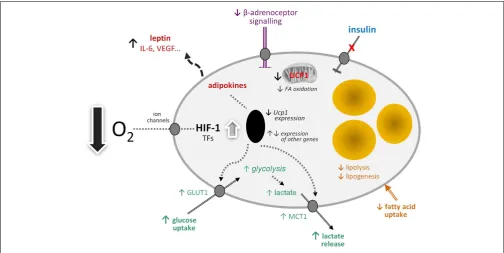
By analogy with white adipocytes, there are a number of other potential effects of hypoxia on brown adipocytes in obesity (Figure 1). These include changes in the transcription of a range of hypoxia-sensitive genes, including those encoding adipokines; the expression of leptin, VEGF, and IL-6, for example, may increase. Glucose uptake would be expected to rise through increased expression and recruitment of GLUT1. Insulin-stimulated glucose uptake, on the other hand, may fall through the development of insulin resistance. A loss of insulin sensitivity is evident in BAT of obese animals and occurs inob/obmice soon after weaning (80,
81). This development of resistance is associated with a reduction in acute thermogenesis, and its reversal with ciglitazone restores the thermogenic response of BAT to cold (82).
Further potential metabolic changes in brown adipocytes in response to low O2tension include the induction of fibrosis and
a fall in lipogenesis and fatty acid uptake. Reduced lipid uptake as well as the induction of insulin resistance would be consistent with hypoxia being a mechanism for the development of the metabolic syndrome in obesity, given the postulated role of BAT in glucose homeostasis and triglyceride clearance. This, together with direct effects on limiting thermogenesis itself, suggests that hypoxia has the potential to severely compromise BAT function with important implication for metabolic homeostasis and disease processes.
[image:4.595.45.550.411.664.2]If mitochondrial loss and dysfunction are induced in BAT by hypoxia and glucose utilization is elevated, this would indicate a switch to anaerobic glycolysis. One of the consequences of such a switch would be an increase in lactate production and release,
involving the further recruitment of the MCT1 transporter. Lac-tate has recently emerged as an important metabolic signal, the functions attributed to it including the stimulation of inflam-mation in macrophages and – importantly – mediation of the anti-lipolytic effect of insulin (83,84). This anti-lipolytic action is via the GPR81 receptor, which is expressed principally in adipose tissues (84).
HYPOXIA AND THE RECRUITMENT OF BRITE ADIPOCYTES
A further major function recently identified for lactate is in the “browning” of white adipocytes (85). The concept of browning has emerged with the recognition that there is a third type of adipocyte in addition to white and brown fat cells – the brite (or beige) adipocyte. Brite cells are found especially in white fat depots and have many, though not all, of the molecular characteristics of brown adipocytes (86,87). The key feature shared by brite and brown adipocytes is the presence of UCP1, providing the potential for thermogenesis (86,88).
Cold exposure of mice results in an elevation in circulating lac-tate levels andMct1gene expression is stimulated in both BAT and WAT (85). Treatment with lactate,in vivoorin vitro, inducesUcp1
gene expression in white adipocytes and the expression of genes associated with fatty acid oxidation and mitochondrial function, indicative of the recruitment of a thermogenic profile (85). Lac-tate does not lead to the induction of UCP1 in white fat cells through the GPR81 receptor, but rather by modulation of MCT activity; preventing lactate influx by pharmacological inhibition of MCTs suppressed the lactate-induced expression ofUcp1. Corre-spondingly, knockdown of MCT4, the transporter responsible for lactate efflux, strongly enhancedUcp1expression in adipocytes. It is suggested that the lactate-induced expression ofUcp1in white adipocytes, which is independent of HIF-1α, is a mechanism for reducing oxidative stress resulting from high intracellular lactate levels (85).
There are, of course, an increasing number of agents which have been reported to stimulate “browning” (89), but lactate is of particular interest because of its direct physiological relevance. WAT is an important site of lactate production and the levels in the tissue are increased in obesity (5,90). A model can be pro-posed in which lactate production rises in WAT in obesity in response to developing hypoxia as large adipocytes switch from aerobic to anaerobic metabolism (Figure 2). The lactate then stim-ulatesUcp1expression in neighboring white adipocytes, through an autocrine/paracrine action, leading to the recruitment of brite cells and the emergence of the “browning” phenotype in WAT. This could reflect a counter-regulatory response with the accumula-tion of large adipocytes resulting, via a hypoxia-induced elevaaccumula-tion in lactate, in the production of thermogenic cells, which would oxidize lipid. However, the extent to which brite adipocytes may contribute to thermogenesis is debatable, with an extensive vascu-larization being one of the factors required for clusters of brite cells to make a significant contribution to adaptive heat production.
CODA
The effects of hypoxia on white adipocytes are extensive, rang-ing from the stimulation of the production of adipokines linked to inflammation to the induction of insulin resistance. Hypoxia also occurs in BAT in obesity, compromising thermogenic activity and potentially the role of the tissue in metabolic homeostasis. Mitochondrial loss and dysfunction, insulin resistance, fibrosis, increased glucose uptake, and lactate production may all occur in BAT following hypoxia, paralleling many of the changes in WAT induced by low pO2. Hypoxia-induced increases in lactate
pro-duction by white adipocytes in obese WAT provides a signal for the induction of browning such thatUcp1is expressed and brite fat cells recruited.
It is suggested that reduced O2 tension may be a critical
[image:5.595.45.553.459.683.2]influence on all forms of adipose tissue in obesity, profoundly
altering the function of classical white and brown adipocytes and stimulating the development of brite fat cells.
ACKNOWLEDGMENTS
The authors are grateful to the Distinguished Scientist Program at King Saud University for financial support.
REFERENCES
1. Trayhurn P. Hypoxia and adipocyte physiology: implications for adipose tissue dysfunction in obesity.Annu Rev Nutr(2014)34:207–36. doi:10.1146/annurev-nutr-071812-161156
2. Semenza GL. Targeting HIF-1 for cancer therapy.Nat Rev Cancer (2003)
3:721–32. doi:10.1038/nrc1187
3. Brahimi-Horn MC, Pouysségur J. Oxygen, a source of life and stress.FEBS Lett
(2007)581:3582–91. doi:10.1016/j.febslet.2007.06.018
4. Brahimi-Horn C, Pouysségur J. Hypoxia in cancer cell metabolism and pH reg-ulation.Essays Biochem(2007)43:165–78. doi:10.1042/BSE0430165 5. Hosogai N, Fukuhara A, Oshima K, Miyata Y, Tanaka S, Segawa K, et al.
Adi-pose tissue hypoxia in obesity and its impact on adipocytokine dysregulation.
Diabetes(2007)56:901–11. doi:10.2337/db06-0911
6. Ye J, Gao Z, Yin J, He Q. Hypoxia is a potential risk factor for chronic inflam-mation and adiponectin reduction in adipose tissue ofob/oband dietary obese mice.Am J Physiol Endocrinol Metab(2007)293:E1118–28. doi:10.1152/ajpendo. 00435.2007
7. Rausch ME, Weisberg SP, Vardhana P, Tortorielllo DV. Obesity in C57BL/6J mice is characterised by adipose tissue hypoxia and cytotoxic T-cell infiltration.Int J Obes (Lond)(2008)32:451–63. doi:10.1038/sj.ijo.0803744
8. Trayhurn P. Hypoxia and adipose tissue function and dysfunction in obesity.
Physiol Rev(2013)93:1–21. doi:10.1152/physrev.00017.2012
9. Cinti S. The adipose organ.Prostaglandins Leukot Essent Fatty Acids(2005)
73:9–15. doi:10.1016/j.plefa.2005.04.010
10. Trayhurn P, Wood IS. Adipokines: Inflammation and the pleiotropic role of white adipose tissue.Br J Nutr(2004)92:347–55. doi:10.1079/BJN20041213 11. Zhang YY, Proenca R, Maffei M, Barone M, Leopold L, Friedman JM.
Posi-tional cloning of the mouse obese gene and its human homolog.Nature(1994)
372:425–32. doi:10.1038/372425a0
12. Maeda K, Okubo K, Shimomura I, Mizuno K, Matsuzawa Y, Matsubara K. Analy-sis of an expression profile of genes in the human adipose tissue.Gene(1997)
190:227–35. doi:10.1016/S0378-1119(96)00730-5
13. Frühbeck G, Gómez-Ambrosi J, Muruzabal FJ, Burrell MA. The adipocyte: a model for integration of endocrine and metabolic signaling in energy metabo-lism regulation.Am J Physiol Endocrinol Metab(2001)280:E827–47. 14. Trayhurn P, Beattie JH. Physiological role of adipose tissue: white adipose
tis-sue as an endocrine and secretory organ.Proc Nutr Soc (2001)60:329–39. doi:10.1079/PNS200194
15. Rajala MW, Scherer PE. The adipocyte – at the crossroads of energy home-ostasis, inflammation, and atherosclerosis.Endocrinology(2003)144:3765–73. doi:10.1210/en.2003-0580
16. Rosen ED, Spiegelman BM. Adipocytes as regulators of energy balance and glu-cose homeostasis.Nature(2006)444:847–53. doi:10.1038/nature05483 17. Dahlman I, Elsen M, Tennagels N, Korn M, Brockmann B, Sell H, et al.
Func-tional annotation of the human fat cell secretome.Arch Physiol Biochem(2012)
118:84–91. doi:10.3109/13813455.2012.685745
18. Trayhurn P. Endocrine and signalling role of adipose tissue: new perspectives on fat.Acta Physiol Scand(2005)184:285–93. doi:10.1111/j.1365-201X.2005. 01468.x
19. Hotamisligil GS. Inflammation and metabolic disorders. Nature (2006)
444:860–7. doi:10.1038/nature05485
20. Trayhurn P, Wang B, Wood IS. Hypoxia in adipose tissue: a basis for the dysregulation of tissue function in obesity? Br J Nutr (2008)100:227–35. doi:10.1017/S0007114508971282
21. Ye J. Emerging role of adipose tissue hypoxia in obesity and insulin resistance.
Int J Obes (Lond)(2008)33:54–66. doi:10.1038/ijo.2008.229
22. Erecinska M, Silver IA. Tissue oxygen tension and brain sensitivity to hypoxia.
Respir Physiol(2001)128:263–76. doi:10.1016/S0034-5687(01)00306-1 23. Yin J, Gao Z, He Q, Zhou D, Guo Z, Ye J. Role of hypoxia in obesity-induced
dis-orders of glucose and lipid metabolism in adipose tissue.Am J Physiol Endocrinol Metab(2009)296:E333–42. doi:10.1152/ajpendo.90760.2008
24. Kabon B, Nagele A, Reddy D, Eagon C, Fleshman JW, Sessler DI, et al. Obesity decreases perioperative tissue oxygenation.Anesthesiology(2004)100:274–80. doi:10.1097/00000542-200402000-00015
25. Pasarica M, Sereda OR, Redman LM, Albarado DC, Hymel DT, Roan LE, et al. Reduced adipose tissue oxygenation in human obesity: evidence for rarefaction, macrophage chemotaxis, and inflammation without an angiogenic response.
Diabetes(2009)58:718–25. doi:10.2337/db08-1098
26. Pasarica M, Rood J, Ravussin E, Schwarz J-M, Smith SR, Redman LM. Reduced oxygenation in human obese adipose tissue is associated with impaired insulin suppression of lipolysis.J Clin Endocrinol Metab(2010)95:4052–5. doi:10.1210/ jc.2009-2377
27. Karpe F, Fielding BA, Ilic V, Macdonald IA, Summers LKM, Frayn KN. Impaired postprandial adipose tissue blood flow response is related to aspects of insulin sensitivity.Diabetes(2002)51:2467–73. doi:10.2337/diabetes.51.8.2467 28. Goossens GH, Bizzarri A, Venteclef N, Essers Y, Cleutjens JP, Konings E,
et al. Increased adipose tissue oxygen tension in obese compared with lean men is accompanied by insulin resistance, impaired adipose tissue cap-illarization, and inflammation. Circulation (2011) 124:67–76. doi:10.1161/ CIRCULATIONAHA.111.027813
29. Hodson L, Humphreys SM, Karpe F, Frayn KN. Metabolic signatures of human adipose tissue hypoxia in obesity.Diabetes (2013)62:1417–25. doi:10.2337/ db12-1032
30. Lolmède K, Durand de Saint Front V, Galitzky J, Lafontan M, Bouloumié A. Effects of hypoxia on the expression of proangiogenic factors in differenti-ated 3T3-F442A adipocytes.Int J Obes Relat Metab Disord(2003)27:1187–95. doi:10.1038/sj.ijo.0802407
31. Wang B, Wood IS, Trayhurn P. Dysregulation of the expression and secretion of inflammation-related adipokines by hypoxia in human adipocytes.Pflügers Arch(2007)455:479–92. doi:10.1007/s00424-007-0301-8
32. Chen B, Lam KSL, Wang Y, Wu D, Lam MC, Shen J, et al. Hypoxia dysregulates the production of adiponectin and plasminogen activator inhibitor-1 indepen-dent of reactive oxygen species in adipocytes.Biochem Biophys Res Commun
(2006)341:549–56. doi:10.1016/j.bbrc.2006.01.004
33. Geiger G, Leiherer A, Muendlein A, Stark N, Geller-Rhomberg S, Saely CH, et al. Identification of hypoxia-induced genes in human SGBS adipocytes by microarray analysis.PLoS One(2011)6:e26465. doi:10.1371/journal.pone. 0026465
34. Mazzatti D, Lim F-L, O’Hara A, Wood IS, Trayhurn P. A microarray analysis of the hypoxia-induced modulation of gene expression in human adipocytes.Arch Physiol Biochem(2012)118:112–20. doi:10.3109/13813455.2012.654611 35. Wood IS, Wang B, Lorente-Cebrian S, Trayhurn P. Hypoxia increases
expres-sion of selective facilitative glucose transporters (GLUT) and 2-deoxy-D-glucose uptake in human adipocytes.Biochem Biophys Res Commun(2007)361:468–73. doi:10.1016/j.bbrc.2007.07.032
36. Regazzetti C, Peraldi P, Gremeaux T, Najem-Lendom R, Ben-Sahra I, Cormont M, et al. Hypoxia decreases insulin signaling pathways in adipocytes.Diabetes
(2009)58:95–103. doi:10.2337/db08-0457
37. Wood I, Stezhka T, Trayhurn P. Modulation of adipokine production, glucose uptake and lactate release in human adipocytes by small changes in oxygen tension.Pflügers Arch(2011)462:469–77. doi:10.1007/s00424-011-0985-7 38. Pérez de Heredia F, Wood IS, Trayhurn P. Hypoxia stimulates lactate release
and modulates monocarboxylate transporter (MCT1, MCT2, and MCT4) expression in human adipocytes.Pflügers Arch(2010)459:509–18. doi:10.1007/ s00424-009-0750-3
39. Choi S, Cho K, Kim J, Yea K, Park G, Lee J, et al. Comparative proteome analysis using amine-reactive isobaric tagging reagents coupled with 2D LC/MS/MS in 3T3-L1 adipocytes following hypoxia or normoxia.Biochem Biophys Res Com-mun(2009)383:135–40. doi:10.1016/j.bbrc.2009.03.124
40. O’Rourke RW, Meyer KA, Gaston G, White AE, Lumeng CN, Marks DL. Hex-osamine biosynthesis is a possible mechanism underlying hypoxia’s effects on lipid metabolism in human adipocytes.PLoS One(2013)8:e71165. doi:10.1371/ journal.pone.0071165
41. Halberg N, Khan T, Trujillo ME, Wernstedt-Asterholm I, Attie AD, Sherwani S, et al. Hypoxia-inducible factor 1αinduces fibrosis and insulin resistance in white adipose tissue.Mol Cell Biol(2009)29:4467–83. doi:10.1128/MCB.00192-09 42. Sun K, Tordjman J, Clement K, Scherer PE. Fibrosis and adipose tissue
dysfunc-tion.Cell Metab(2013)18:470–7. doi:10.1016/j.cmet.2013.06.016
44. Murdoch C, Muthana M, Lewis CE. Hypoxia regulates macrophage func-tions in inflammation.J Immunol(2005)175:6257–63. doi:10.4049/jimmunol. 175.10.6257
45. Wang B, Wood IS, Trayhurn P. Hypoxia induces leptin gene expression and secretion in human preadipocytes: differential effects of hypoxia on adipokine expression by preadipocytes.J Endocrinol(2008)198:127–34. doi:10.1677/JOE-08-0156
46. Smith RE, Horwitz BA. Brown fat and thermogenesis. Physiol Rev (1969)
49:330–425.
47. Cannon B, Nedergaard J. Brown adipose tissue: function and physiological sig-nificance.Physiol Rev(2004)84:277–359. doi:10.1152/physrev.00015.2003 48. Nicholls DG, Locke RM. Thermogenic mechanisms in brown fat.Physiol Rev
(1984)64:1–64.
49. Ricquier D, Kader JC. Mitochondrial protein alterations in active brown fat: a sodium dodecyl sulfate-polyacrylamide gel electrophoretic study.Biochem Bio-phys Res Commun(1976)73:577–83. doi:10.1016/0006-291X(76)90849-4 50. Ricquier D. Molecular biology of brown adipose tissue.Proc Nutr Soc(1989)
48:183–7. doi:10.1079/PNS19890028
51. Himms-Hagen J. Neural control of brown adipose tissue thermogenesis, hyper-trophy, and atrophy.Front Neuroendocrinol(1991)12:38–93.
52. Rothwell NJ, Stock MJ. A role for brown adipose tissue in diet-induced thermo-genesis.Nature(1979)281:31–5. doi:10.1038/281031a0
53. Brooks SL, Rothwell NJ, Stock MJ, Goodbody AE, Trayhurn P. Increased proton conductance pathway in brown adipose tissue mitochondria of rats exhibiting diet-induced thermogenesis.Nature(1980)286:274–6. doi:10.1038/ 286274a0
54. Rothwell NJ, Stock MJ. Brown adipose tissue. Recent Adv Physiol (1986)
10:349–82.
55. Trayhurn P. Brown adipose tissue and energy balance. In: Trayhurn P, Nicholls DG, editors.Brown Adipose Tissue. London: Edward Arnold (1986). p. 299–388. 56. Himms-Hagen J. Brown adipose tissue thermogenesis and obesity.Prog Lipid
Res(1989)28:67–115. doi:10.1016/0163-7827(89)90009-X
57. Nedergaard J, Bengtsson T, Cannon B. Unexpected evidence for active brown adipose tissue in adult humans. Am J Physiol Endocrinol Metab (2007)
293:E444–52. doi:10.1152/ajpendo.00691.2006
58. Cypess AM, Lehman S, Williams G, Tal I, Rodman D, Goldfine AB, et al. Identi-fication and importance of brown adipose tissue in adult humans.N Engl J Med
(2009)360:1509–17. doi:10.1056/NEJMoa0810780
59. Virtanen KA, Lidell ME, Orava J, Heglind M, Westergren R, Niemi T, et al. Func-tional brown adipose tissue in healthy adults.N Engl J Med(2009)360:1518–25. doi:10.1056/NEJMoa0808949
60. Zingaretti MC, Crosta F, Vitali A, Guerrieri M, Frontini A, Cannon B, et al. The presence of UCP1 demonstrates that metabolically active adipose tissue in the neck of adult humans truly represents brown adipose tissue.FASEB J(2009)
23:3113–20. doi:10.1096/fj.09-133546
61. Orava J, Nuutila P, Lidell Martin E, Oikonen V, Noponen T, Viljanen T, et al. Different metabolic responses of human brown adipose tissue to activation by cold and insulin.Cell Metab(2011)14:272–9. doi:10.1016/j.cmet.2011.06.012 62. Cypess AM, Chen Y-C, Sze C, Wang K, English J, Chan O, et al. Cold but not
sympathomimetics activates human brown adipose tissue in vivo.Proc Natl Acad Sci U S A(2012)109:10001–5. doi:10.1073/pnas.1207911109
63. Ouellet V, Labbe SM, Blondin DP, Phoenix S, Guerin B, Haman F, et al. Brown adipose tissue oxidative metabolism contributes to energy expendi-ture during acute cold exposure in humans.J Clin Invest(2012)122:545–52. doi:10.1172/JCI60433
64. Lee P, Greenfield JR, Ho KKY, Fulham MJ. A critical appraisal of the prevalence and metabolic significance of brown adipose tissue in adult humans. Am J Physiol Endocrinol Metab (2010) 299:E601–6. doi:10.1152/ ajpendo.00298.2010
65. Pfannenberg C, Werner MK, Ripkens S, Stef I, Deckert A, Schmadl M, et al. Impact of age on the relationships of brown adipose tissue with sex and adipos-ity in humans.Diabetes(2010)59:1789–93. doi:10.2337/db10-0004
66. Yoneshiro T, Aita S, Matsushita M, Okamatsu-Ogura Y, Kameya T, Kawai Y, et al. Age-related decrease in cold-activated brown adipose tissue and accumulation of body fat in healthy humans.Obesity(2011)19:1755–60. doi:10.1038/oby. 2011.125
67. Burysek L, Houstek J. β-adrenergic stimulation of interleukin-1α and interleukin-6 expression in mouse brown adipocytes. FEBS Lett (1997)
411:83–6. doi:10.1016/S0014-5793(97)00671-6
68. Buyse M,Viengchareun S, Bado A, Lombes M. Insulin and glucocorticoids differ-entially regulate leptin transcription and secretion in brown adipocytes.FASEB J(2001)15:1357–66. doi:10.1096/fj.00-0669com
69. Villarroya J, Cereijo R, Villarroya F. An endocrine role for brown adipose tis-sue?Am J Physiol Endocrinol Metab(2013)305:E567–72. doi:10.1152/ajpendo. 00250.2013
70. Bartelt A, Bruns OT, Reimer R, Hohenberg H, Ittrich H, Peldschus K, et al. Brown adipose tissue activity controls triglyceride clearance.Nat Med(2011)17:200–5. doi:10.1038/nm.2297
71. Stanford KI, Middelbeek RJW, Townsend KL, An D, Nygaard EB, Hitchcox KM, et al. Brown adipose tissue regulates glucose homeostasis and insulin sensitivity.
J Clin Invest(2013)123:215–23. doi:10.1172/JCI62308
72. Bartelt A, Heeren J. The holy grail of metabolic disease: brown adipose tissue.
Curr Opin Lipidol(2012)23:190–5. doi:10.1097/MOL.0b013e328352dcef 73. Nedergaard J, Bengtsson T, Cannon B. New powers of brown fat: fighing
the metabolic syndrome.Cell Metab(2011)13:238–40. doi:10.1016/j.cmet.2011. 02.009
74. Foster DO, Frydman ML. Nonshivering thermogenesis in the rat. II. Measure-ments of blood flow with microspheres point to brown adipose tissue as the dominant site of the calorigenesis induced by noradrenaline.Can J Physiol Phar-macol(1978)56:110–22. doi:10.1139/y78-015
75. Foster DO, Frydman ML. Tissue distribution of cold-induced thermogenesis in conscious warm- or cold-acclimated rats re-evaluated from changes in tis-sue blood flow: the dominant role of brown adipose tistis-sue in the replacement of shivering by non-shivering thermogenesis.Can J Physiol Pharmacol(1979)
57:257–70. doi:10.1139/y79-039
76. Thurlby PL, Trayhurn P. Regional blood flow in genetically obese (ob/ob) mice: the importance of brown adipose tissue to the reduced energy expen-diture on non-shivering thermogenesis. Pflügers Arch (1980)385:193–201. doi:10.1007/BF00647457
77. Himms-Hagen J, Desautels M. A mitochondrial defect in brown adipose tissue of the obese (ob/ob) mouse: reduced binding of purine nucleotides and a failure to respond to cold by an increase in binding.Biochem Biophys Res Commun
(1978)83:628–34. doi:10.1016/0006-291X(78)91036-7
78. Xue Y, Petrovic N, Cao R, Larsson O, Lim S, Chen S, et al. Hypoxia-independent angiogenesis in adipose tissues during cold acclimation.Cell Metab(2009)
9:99–109. doi:10.1016/j.cmet.2008.11.009
79. Shimizu I, Aprahamian T, Kikuchi R, Shimizu A, Papanicolaou KN, MacLauch-lan S, et al. Vascular rarefaction mediates whitening of brown fat in obesity.
J Clin Invest(2014)124:2099–112. doi:10.1172/JCI71643
80. Mercer SW, Trayhurn P. Developmental changes in fatty acid synthesis in inter-scapular brown adipose tissue of lean and genetically obese (ob/ob) mice.
Biochem J(1983)212:393–8.
81. Mercer SW, Trayhurn P. The development of insulin resistance in brown adipose tissue may impair the acute cold-induced activation of thermogenesis in genet-ically obese (ob/ob) mice.Biosci Rep(1984)4:933–40. doi:10.1007/BF01116891 82. Mercer SW, Trayhurn P. Effects of ciglitazone on insulin resistance and thermo-genic responsiveness to acute cold in brown adipose tissue of genetically obese (ob/ob) mice.FEBS Lett(1986)195:12–6. doi:10.1016/0014-5793(86)80120-X 83. Samuvel DJ, Sundararaj KP, Nareika A, Lopes-Virella MF, Huang Y. Lac-tate Boosts TLR4 signaling and NF-κB pathway-mediated gene transcription in macrophages via monocarboxylate transporters and MD-2 up-regulation.
J Immunol(2009)182:2476–84. doi:10.4049/jimmunol.0802059
84. Liu C, Wu J, Zhu J, Kuei C, Yu J, Shelton J, et al. Lactate inhibits lipolysis in fat cells through activation of an orphan G-protein-coupled receptor, GPR81.J Biol Chem(2009)284:2811–22. doi:10.1074/jbc.M806409200
85. Carrière A, Jeanson Y, Berger-Müller S, André M, Chenouard V, Arnaud E, et al. Browning of white adipose cells by intermediate metabolites: an adaptive mechanism to alleviate redox pressure.Diabetes(2014)63:3253–65. doi:10.2337/db13-1885
86. Petrovic N, Walden TB, Shabalina IG, Timmons JA, Cannon B, Nedergaard J. Chronic peroxisome proliferator-activated receptorγ(PPARγ) Activation of epididymally derived white adipocyte cultures reveals a population of ther-mogenically competent, UCP1-containing adipocytes molecularly distinct from classic brown adipocytes.J Biol Chem(2010)285:7153–64. doi:10.1074/jbc. M109.053942
87. Wu J, Boström P, Sparks Lauren M, Ye L, Choi Jang H, Giang A-H, et al. Beige adipocytes are a distinct type of thermogenic fat cell in mouse and human.Cell
88. Waldén TB, Hansen IR, Timmons JA, Cannon B, Nedergaard J. Recruited vs. nonrecruited molecular signatures of brown, “brite,” and white adipose tis-sues.Am J Physiol Endocrinol Metab(2012)302:E19–31. doi:10.1152/ajpendo. 00249.2011
89. Nedergaard J, Cannon B. The Browning of white adipose tissue: some burning issues.Cell Metab(2014)20:396–407. doi:10.1016/j.cmet.2014.07.005 90. DiGirolamo M, Newby FD, Lovejoy J. Lactate production in adipose tissue: a
regulated function with extra-adipose implications.FASEB J(1992)6:2405–12.
Conflict of Interest Statement:The authors declare that the research was conducted in the absence of any commercial or financial relationships that could be construed as a potential conflict of interest.
Received: 07 January 2015; paper pending published: 28 January 2015; accepted: 02 February 2015; published online: 19 February 2015.
Citation: Trayhurn P and Alomar SY (2015) Oxygen deprivation and the cellular response to hypoxia in adipocytes – perspectives on white and brown adipose tissues in obesity. Front. Endocrinol.6:19. doi: 10.3389/fendo.2015.00019
This article was submitted to Genomic Endocrinology, a section of the journal Frontiers in Endocrinology.