The Thirty-Third AAAI Conference on Artificial Intelligence (AAAI-19)
A
TOMIC
: An Atlas of Machine Commonsense for
If-Then
Reasoning
Maarten Sap,
†?Ronan Le Bras,
†Emily Allaway,
?Chandra Bhagavatula,
†Nicholas Lourie,
†Hannah Rashkin,
?Brendan Roof,
†Noah A. Smith,
†?Yejin Choi
†??Paul G. Allen School of Computer Science & Engineering, University of Washington, Seattle, USA
†Allen Institute for Artificial Intelligence, Seattle, USA
Abstract
We present ATOMIC, an atlas of everyday commonsense rea-soning, organized through 877k textual descriptions of infer-ential knowledge. Compared to existing resources that center around taxonomic knowledge, ATOMICfocuses on inferential knowledge organized as typedif-thenrelations with variables (e.g., “if X pays Y a compliment,thenY will likely return the compliment”). We propose nineif-thenrelation types to distinguish causes vs. effects, agents vs. themes, voluntary vs. involuntary events, and actions vs. mental states. By gen-eratively training on the rich inferential knowledge described in ATOMIC, we show that neural models can acquire simple commonsense capabilities and reason about previously un-seen events. Experimental results demonstrate that multitask models that incorporate the hierarchical structure ofif-then
relation types lead to more accurate inference compared to models trained in isolation, as measured by both automatic and human evaluation.
Introduction
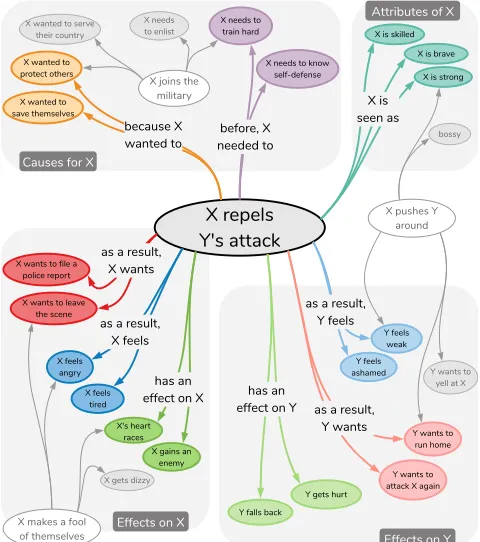
Given a snapshot observation of an event, people can easily anticipate and reason about unobserved causes and effects in relation to the observed event: what might have happened just before, what might happen next as a result, and how different events are chained through causes and effects. For instance, if we observe an event “X repels Y’s attack” (Fig-ure 1), we can immediately infer various plausible facts sur-rounding that event. In terms of the plausible motivations
behind the event, X probably wants to protect herself. As for theplausible pre-conditionsprior to the event, X may have been trained in self-defense to successfully fend off Y’s at-tack. We can also infer theplausible characteristics of X; she might be strong, skilled, and brave. As a result of the event, X probably feels angry and might want to file a po-lice report. Y, on the other hand, might feel scared of getting caught and want to run away.
The examples above illustrate how day-to-day common-sense reasoning can be operationalized through a densely connected collection of inferential knowledge. It is through this knowledge that we can watch a two-hour movie and un-derstand a story that spans over several months, as we can reason about a great number of events, causes, and effects,
Copyright c2019, Association for the Advancement of Artificial Intelligence (www.aaai.org). All rights reserved.
X repels Y's attack
X w anted to save themselves
X w anted to protect others
Y w ants to run home X w ants to file a
police report
X w ants to leave the scene
X needs to know self- defense
X is skilled
as a result, X w ants
Y w ants to attack X again Y feels w eak
X is strong
X feels angry
X feels tired
Y feels ashamed
Y gets hurt X gains an
enemy X's heart
races
Y falls back as a result,
X feels
X pushes Y around
X makes a fool of themselves
as a result, Y w ants
Y w ants to yell at X
bossy
X joins the military
before, X needed to X needs to train hard X w anted to serve
their country
X needs to enlist
X gets dizzy has an
effect on X has an effect on Y
as a result, Y feels
Effects on Y Effects on X
Causes for X
Attributes of X
because X w anted to
X is brave
X is seen as
Figure 1: A tiny subset of ATOMIC, an atlas of machine com-monsense for everyday events, causes, and effects.
while observing only on a small fraction of them. It also en-ables us to develop Theories of Mind about others (Moore 2013). However, this ability, while common and trivial for humans, is lacking in today’s AI systems. This is in part be-cause the vast majority of AI systems are trained for task-specific datasets and objectives, which lead to models that are effective at finding task-specific correlations but lack simple and explainable commonsense reasoning (Davis and Marcus 2015; Lake et al. 2017; Marcus 2018).
In this paper, we introduce ATOMIC,1an atlas of machine
1
X attribute X intent
X need
Why does X cause the event? What does X need to do before the event?
X reaction X want
Effect on X What effects does the event have on X?
What would X likely want to do after the event?
How does X feel after the event?
Other reaction
Other want
Effect on other
How do others' feel after the event?
What would others likely want to do after the event
What effects does the event have on others? How would X
be described?
causes
EVENT
effects stativeagent agent theme
If-Event-Then-Event If-Event-Then-Persona
If-Event-Then-MentalState
Types of relation
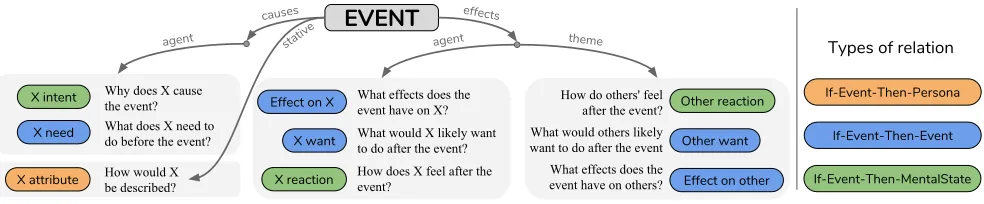
Figure 2: The taxonomy ofif-thenreasoning types. We consider nineif-thenrelations that have overlapping hierarchical struc-tures as visualized above. One way to categorize the types is based on the type of content being predicted: (1) If-Event-Then-Mental-State, (2)If-Event-Then-Event, and (3)If-Event-Then-Persona. Another way is to categorize the types based on their causal relations: (1)“causes”, (2)“effects”, and (3)“stative”. Some of these categories can further divide depending on whether the reasoning focuses on the “agent” (X) or the “theme” (Other) of the event.
commonsense, as a step toward addressing the rich spectrum of inferential knowledge that is crucial for automated com-monsense reasoning. In contrast with previous efforts (Lenat 1995; Speer and Havasi 2012) that predominantly contain taxonomic or encyclopedic knowledge (Davis and Marcus
2015), ATOMIC focuses on inferential if-then knowledge.
The goal of our study is to create a knowledge repository that meets three requirements: scale, coverage, and quality. Therefore, we focus on crowdsourcing experiments instead of extracting commonsense from corpora, because the latter is subject to the significant reporting bias in language that can challenge both the coverage and quality of the extracted knowledge (Gordon and Van Durme 2013).
We propose a new taxonomy ofif-then reasoning types
as shown in Figure 2. One way to categorize the types is
based on the content being predicted: (1)
If-Event-Then-Mental-State, (2) If-Event-Then-Event, and (3) If-Event-Then-Persona. Another way to categorize is based on their causal relations: (1) “causes”, (2) “effects”, and (3) “stative”. Using this taxonomy, we gather over 877K instances of in-ferential knowledge.
We then investigate neural network models that can ac-quire simple commonsense capabilities and reason about previously unseen events by embedding the rich inferen-tial knowledge described in ATOMIC. Experimental results demonstrate that neural networks can abstract away
com-monsense inferential knowledge from ATOMIC such that
given a previously unseen event, they can anticipate the likely causes and effects in rich natural language descrip-tions. In addition, we find that multitask models that can in-corporate the hierarchical structure of if-then relation types lead to more accurate inference compared to models trained in isolation.
If-Then
Relation Types
To enable better reasoning about events, we improve upon existing resources of commonsense knowledge by adding nine new causal and inferential dimensions. Shown in Fig-ure 2, we define dimensions as denoting a particular type ofIf-Thenknowledge, answers to questions about an event,
collected through crowdsourcing. Contrary to most previous
work, ATOMICalso characterizes knowledge of events and
theirimpliedparticipants (e.g., “Alex calls for help” implies someone will answer the call), in addition to explicitly men-tioned participants (e.g., “Alex calls Taylor for help”).
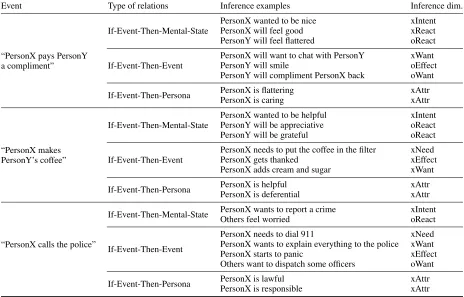
Illustrated in Table 1, our nine dimensions span three types ofIf-Thenrelations, outlined below.
If-Event-Then-Mental-State We define three relations relating to the mental pre- and post-conditions of an event. Given an event (e.g., “X compliments Y”), we reason about (i) likelyintentsof the event (e.g., “X wants to be nice”), (ii) likely(emotional) reactionsof the event’s subject (“X feels good”), and (iii) likely(emotional) reactionsof others (“Y feels flattered”).
If-Event-Then-Event We also define five relations re-lating to events that constitute probable pre- and post-conditions of a given event. Those relations describe events likely required to precede an event, as well as those likely to follow. For instance, people know that “X needs to put coffee in the filter” before “X makes Y’s coffee”. For post-conditions, we focus on both voluntary (“X adds cream and sugar”) and involuntary (“X gets thanked by Y”) possible next events. We also define voluntary and involuntary possi-ble next events for (implied) participants.
If-Event-Then-Persona In addition to pre- and post-conditions, we also define a stative relation that describes how the subject of an event is described or perceived. For instance, when “X calls the police”, X is seen as “lawful” or “responsible”.
An Alternative Hierarchy The above relation types can
be categorized via a different hierarchical structure as
Event Type of relations Inference examples Inference dim.
“PersonX pays PersonY a compliment”
If-Event-Then-Mental-State
PersonX wanted to be nice PersonX will feel good PersonY will feel flattered
xIntent xReact oReact
If-Event-Then-Event
PersonX will want to chat with PersonY PersonY will smile
PersonY will compliment PersonX back
xWant oEffect oWant
If-Event-Then-Persona PersonX is flattering PersonX is caring
xAttr xAttr
“PersonX makes PersonY’s coffee”
If-Event-Then-Mental-State
PersonX wanted to be helpful PersonY will be appreciative PersonY will be grateful
xIntent oReact oReact
If-Event-Then-Event
PersonX needs to put the coffee in the filter PersonX gets thanked
PersonX adds cream and sugar
xNeed xEffect xWant
If-Event-Then-Persona PersonX is helpful
PersonX is deferential
xAttr xAttr
“PersonX calls the police”
If-Event-Then-Mental-State PersonX wants to report a crime Others feel worried
xIntent oReact
If-Event-Then-Event
PersonX needs to dial 911
PersonX wants to explain everything to the police PersonX starts to panic
Others want to dispatch some officers
xNeed xWant xEffect oWant
If-Event-Then-Persona PersonX is lawful
PersonX is responsible
xAttr xAttr
Table 1: Examples ofIf-Event-Then-Xcommonsense knowledge present in ATOMIC. For inference dimensions, “x” and “o”
pertain to PersonX and others, respectively (e.g., “xAttr”: attribute of PersonX, “oEffect”: effect on others).
“agent” or the “theme” of the event. We omit cases where the combination is unlikely to lead to commonsense anticipa-tion. For example, it is usually only the “agent” who causes the event, rather than the “theme”, thus we do not consider that branching. We later exploit this hierarchical structure of inferential relations for designing effective neural network architectures that can learn to reason about a given event.
Data
To build ATOMIC, we create a crowdsourcing framework
that allows for scalable, broad collection ofIf-Then knowl-edge for given events.
Compiling Base Events
Asbase events for our annotations, we extract 24K com-mon event phrases from a variety of corpora. To ensure broad and diverse coverage, we compile common phrases from stories, books, Google Ngrams, and Wiktionary id-ioms (Mostafazadeh et al. 2016; Gordon and Swanson 2008; Goldberg and Orwant 2013). Following Rashkin et al. (2018), we define events as verb phrases with a verb predicate and its arguments (“drinks dark roast in the morn-ing”). If a verb and its arguments do not co-occur frequently
enough,2we replace the arguments with a blank placeholder
(“drinks in the morning”). In order to learn more
gen-eral representations of events, we replace tokens referring to people with aPersonvariable (e.g. “PersonX buys Per-sonY coffee”). In future work, other types of variables could be added for other entity references (e.g. “PersonX moves to CityX”).
For events with multiple people explicitly involved, we run a short annotation task to help resolve coreference chains within phrases. Disambiguating the participants is impor-tant, since it can drastically change the meaning of the event (e.g., “PersonX breaks PersonX’s arm” vs. “PersonX breaks PersonY’s arm” have very different implications). Three workers selected whether each “Person” mention in an event refers to PersonX, PersonY, or PersonZ, and we keep base events with combinations that at least two workers selected as valid (ppa=77%).
Crowdsourcing Framework
To ensure scalability, we implement a free-form text annota-tion setup which asks workers to write answers to quesannota-tions about a specific event. We chose free-text over structured or categorical annotation for two reasons. First, categorical
an-2
Event
PersonX pays PersonY a compliment
Full Instructions (Expand/Collapse)
...
Additional Examples Additional Examples (Expand/Collapse)(Expand/Collapse)
Before
1. Does PersonX typically need to do anything before this event?
After
2. What does PersonX likely want to do next after this event?
3. Does this event affect people other than PersonX?
(e.g., PersonY, people included but not mentioned in the event)
Yes No
a). What do they likely want to do next after this event?
Figure 3: Template of the crowdsourcing task for gather-ing commonsense knowledge around events. Specific setups vary depending on the dimension annotated.
notations with a large labeling space have a substantial learn-ing curve, which limits the annotation speed and thereby the coverage of our knowledge graph. Second, the categorical labels are likely to limit the ability to encode the vast space of commonsense knowledge and reasoning as depicted in Figure 1 and Table 1.
We create four tasks on Amazon Mechanical Turk (MTurk) (sample task in Figure 3) for gathering common-sense annotations.3, 4For each dimension, up to three work-ers are asked to provide as many as four likely annotations for an event, covering multiple possible situations (e.g., if “PersonX drinks coffee”, then “PersonX needed to brew cof-fee” or “PersonX needed to buy cofcof-fee”; both are distinct but likely). Note that some events are not caused by PersonX, and some do not affect other people, making annotations for certain dimensions not necessary (specifically, for xIntent, xNeed, oReact, oEffect, and oWant) for all events. For those dimensions, we first ask workers whether this specific infer-ence dimension is relevant given an event.
A
TOMICStatistics
Table 2 lists descriptive statistics of our knowledge graph. Our resulting knowledge graph contains over 300K nodes,
3
The tasks were used to collect the following four sets of di-mensions: (1) intent and reaction, (2) need and want, (3) effects, and (4) attributes.
4
Our payment rate was above $12/hour, going well beyond the federal minimum rate of $8/hour.
Count #words
# triples: If-Event-Then-* 877,108
-- Mental--State 212,598
-- Event 521,334
-- Persona 143,176
-# nodes: If-Event-Then-* 309,515 2.7
- Mental-State 51,928 2.1
- Event 245,905 3.3
- Persona 11,495 1.0
Base events 24,313 4.6
# nodes appearing>1 47,356 –
Table 2: Statistics of ATOMIC. Triples represent distinct <event, relation, event>. #words represents the average number of words per node.
collected using 24K base events. Nodes in the graph are short phrases (2.7 tokens on average), ranging from 1 token for stative events (attributes) to 3.3 and 4.6 tokens on aver-age for more active events. Unlike denotational tasks where experts would only consider one label as correct, our anno-tations correspond to a distribution overlikelyinferences (de Marneffe, Manning, and Potts 2012). To measure the de-gree of ade-greement, we run a small task asking turkers to determine whether an individual annotation provided by a different turker is valid. Table 4 shows that annotations are deemed valid on average 86.2% of the time for a random subset of events. For quality control, we manually and semi-automatically detected and filtered out unreliable workers.
Methods
Our goal is to investigate whether models can learn to per-formIf-Thencommonsense inference given a previously un-seen event. To this extent, we frame the problem as a condi-tional sequence generation problem: given an event phrase
eand an inference dimensionc, the model generates the tar-gett=fθ(e, c). Specifically, we explore various multitask
encoder-decoder setups.
Encoder We represent the event phrase as a sequence ofn word vectorse={e0, e1, . . . , en−1} ∈Rn×iencwhere each word is anienc-dimensional vector. The event sequence is
compressed into a hidden representation hthrough an
en-coding functionfenc:Ri×henc →
Rh.
In this work, we use 300-dimensional static GloVe pre-trained embeddings (Pennington, Socher, and Manning 2014) as our base word vectors. We augment these em-beddings with 1024-dimensional ELMo pre-trained embed-dings (Peters et al. 2018). ELMo provides deep contextual-ized representation of words using character-based represen-tations, which allows robust representations of previously unseen events. The encoding function is a bidirectional GRU (Cho et al. 2014) of hidden sizehenc.
Decoder Each decoder is a unidirectional GRU of hid-den size hdec, with a hidden state initialized to h
(0)
Dataset Model xIntent xNeed xAttr xEffect xReact xWant oEffect oReact oWant
DEV
9ENC9DEC 8.35 17.68 5.18 10.64 5.38 13.24 6.49 5.17 12.08
NearestNeighbor 6.14 11.36 3.57 5.81 4.37 7.73 8.02 6.38 8.94
EVENT2(IN)VOLUNTARY 7.51 17.80 5.18 10.51 4.78 12.76 7.04 4.84 12.48
EVENT2PERSONX/Y 7.31 17.08 5.26 9.78 4.83 12.14 6.38 4.84 11.45
EVENT2PRE/POST 7.58 17.17 – 10.50 4.73 11.78 6.71 4.87 11.52
TEST
9ENC9DEC 8.68 18.15 5.18 10.34 5.43 14.50 6.61 5.08 12.73
NearestNeighbor 6.64 11.35 3.37 5.52 4.59 8.17 7.58 5.88 9.18
EVENT2(IN)VOLUNTARY 7.94 18.22 5.02 9.78 4.78 13.67 7.16 4.71 13.23
EVENT2PERSONX/Y 7.67 17.33 5.09 9.45 4.82 13.19 6.59 4.68 11.70
EVENT2PRE/POST 7.96 17.42 – 9.79 4.75 12.85 6.90 4.76 11.97
Table 3: Average BLEU score (reported as percentages) for the top 10 generations for each inference dimension: comparison of multitask models to single-task model. Note that BLEU scores are known to be brittle to generations worded differently from the references (Liu et al. 2016). We embolden the best performing model for each dimension.
Model xNeed xIntent xAttr xEffect xReact xWant oEffect oReact oWant average
9ENC9DEC 48.74 51.70 52.20 47.52 63.57 51.56 22.92 32.92 35.50 45.32
EVENT2(IN)VOLUNTARY 49.82 61.32 52.58 46.76 71.22 52.44 26.46 36.04 34.70 47.93
EVENT2PERSONX/Y 54.04 53.93 52.98 48.86 66.42 54.04 24.72 33.80 35.08 46.41
EVENT2PRE/POST 47.94 57.77 52.20 46.78 72.22 47.94 26.26 34.48 35.78 46.76
gold ATOMICannotations 81.98 91.37 78.44 83.92 95.18 90.90 84.62 86.13 83.12 86.18
Table 4: Precision at 10 (%) of generated inferences as selected by human judges for four models, averaged and broken down
by dimension. We embolden the best performing model for each dimension. EVENT2(IN)VOLUNTARYoutperforms all other
models significantly (p <0.05). For comparison, we show precision of gold ATOMICannotations. Note that there is a varying number of gold annotations per event/dimension, while all models were constrained to make 10 predictions.
h. The target is represented by a sequence of vectors
t = {t0, t1, . . .}, where each ti ∈ Rhdec is based on a learned embedding. The decoder then maximizes p(ti+1 |
h(deci), t0, . . . , ti) =softmax(Wo×GRU(h
(i)
dec, ti) +bo).
Single vs. Multitask Learning We experiment with var-ious ways to combine the commonsense dimensions with multitask modeling. We design models that exploit the hier-archical structure of the commonsense dimensions (depicted in Figure 2), sharing encoders for dimensions that are re-lated. Specifically, we explore the following models:
• EVENT2(IN)VOLUNTARY: We explore grouping dimen-sions together depending on whether they denote volun-tary (e.g., xIntent, oWant) or involunvolun-tary (e.g., xReact, oEffect) events. This model has one encoder for four “vol-untary” decoders, as well as another encoder for five “in-voluntary” decoders.
• EVENT2PERSONX/Y: We dissociate dimensions relating to the event’s agent (PersonX) from those relating to the event’s theme (others, or PersonY). This model has one encoder for six “agent” decoders as well as another en-coder for three “theme” deen-coders.
• EVENT2PRE/POST: We split our dimensions based on
whether they are related to causes (xNeed, xIntent) or
ef-fects (e.g., xWant, oEffect, xReact). In this model, there are two encoders and eight decoders.5
As a single task baseline, we train nine separate encoder-decoders, one for each dimension (9ENC9DEC).
Training Details To test our models,
we split seed events into training, validation, and test sets (80%/10%/10%), ensuring that events that share the same first two content words are in the same set.
As is common in generation tasks, we minimize the cross entropy of the distribution over predicted targets compared to the gold distribution in our data.6During multitask train-ing, we average the cross entropy of each task. Since multi-ple crowdworkers annotated each event, we define our train-ing instances to be the combination of one worker’s anno-tations. During experiments, we use the 300-dimensional GloVe embeddings, yielding an encoder input size ofienc = 1324 once concatenated with the 1,024-dimensional ELMo embeddings. In the encoder, ELMo’s character-level model-ing allows for an unlimited vocabulary. We set the encoder and decoder hidden sizes tohenc= 100andhdec = 100.
5
We omit xAttr in this model, as it is trivially covered in the single task baseline.
6
Results
We evaluate models on their ability to reason about previ-ously unseen events. Given an unseen event, models gen-erate natural language expressions for each of the nine di-mension ofif-theninferences. We report performance using automatic scores and a human evaluation of the generated inferences.
Automatic Scores
We automatically evaluate the sequence generation for each model and each inference dimension using BLEU scores. Specifically, we compute the average BLEU score (n = 2, Smoothing1; Chen and Cherry, 2014) between each se-quence in the top 10 predictions and the corresponding set of MTurk annotations. As an event may not involve all nine inference dimensions (e.g., “PersonX sees PersonX’s house” has no implications for anybody other than “PersonX”), an-notators may decide to leave an inference dimensionempty. When computing BLEU scores, we omit instances with one-third or moreemptyannotations. Table 3 presents the results on both DEVand TESTdatasets. The experiments show that models that exploit the hierarchical structure of the com-monsense relations perform better than the model that uses separate parameters (9ENC9DEC). Importantly, BLEU is a crude measure of performance as it is based on the exact match ofn-grams and fails to capture semantically relevant generations that are worded differently (Liu et al. 2016). As shown in Figure 4, the generated samples depict vary-ing word and phrase choices, thus we also perform human evaluation to complement automatic evaluations.
Human Evaluation
Since automatic evaluation of generated language is an open research question (Liu et al. 2016), we also assess our mod-els’ performance through human evaluation. We randomly select 100 events from the test set and use beam search to generate the 10 most likely inferences per dimension. We present five crowdworkers with the 10 generated inferences, and ask them to select all inferences they think are valid. Table 4 shows each model’s precision at 10, computed as the average number of correct generations per dimension. Following the same crowdsourcing setup, we also assess the quality of the gold ATOMICannotations for the same set of test events. Human evaluation (last line of Table 4) indicates that 86.2% of the descriptions are valid, showcasing the
quality of commonsense knowledge contained in ATOMIC.
Human evaluation supports our conclusion from
auto-matic evaluation – that models that leverage the if-then
hierarchy perform better than models that don’t. Specifi-cally, explicitly modeling whether inference dimensions de-scribe voluntary actions (e.g., what X wants to do next) or involuntary effects (e.g., X or Y’s reactions) yields more sensible generations, as evidenced by the performance of EVENT2(IN)VOLUNTARY.
Qualitative Results
We present sample commonsense predictions in Figure 4. Given an event “PersonX bakes bread”, our model can cor-rectly infer that X probably needsto “go to the store” or
PersonX bakes bread
As a result, X will buy ingredients
go to the store gather ingredients mix ingredients turn on oven turn on stove Before, X needed to
salivate get dirty eat get messy get full eat food
covered in flour sweat get dirty buy the ingredients
prepare the dough turn on the oven
PersonX wins the title
celebrate brag
congratulate themselves celebrate their achievement celebrate the event celebrate with the team As a result, X wants to
happy jealous competitive impressed defeated proud of PersonX As a result, Y feels
happy that PersonX won desire to work harder be the best
dominate the competition celebrate
PersonX leaves without PersonY
be alone go home leave
go somewhere else move on
get away from PersonY Because X wanted to
cry miss PersonX be killed miss a friend miss his family have a good time As a result, Y will
become nervous look for PersonX ask about PersonX leave the person
be alone
Figure 4: Examples of machine ( ) generated inferences
for three events from the development set, ordered from most likely (top) to least likely (bottom) according to the EVENT2(IN)VOLUNTARYmodel. Human ( ) generated in-ferences are also shown for comparison.
“mix ingredients” or “turn on the oven”. Our model also correctly predicts that the likely effect of this event would be that X will “get dirty” or “eat food”.
Comparison with ConceptNet
ConceptNet (Speer, Chin, and Havasi 2017) represents
com-monsense knowledge as a graph ofconceptsconnected by
relations. Concepts consist of words or phrases, while rela-tions come from a fixed set of edge types.
knowledge—much of which is taxonomic in nature7— ATOMIC focuses on sequences of events and the social commonsense relating to them. This focus means that while
events and dimensions in ATOMIC loosely correspond to
concepts and relations from ConceptNet, individual dimen-sions, such as intents, can’t be mapped cleanly onto any combination of ConceptNet’s relations. The correspondence is neither one-to-one nor one-to-many. Still, in order to empirically investigate the differences between ConceptNet
and ATOMIC, we used the following best-effort mappings
between the dimensions and relations:
• Wants: MOTIVATEDBYGOAL, HASSUBEVENT, HAS -FIRSTSUBEVENT, CAUSESDESIRE
• Effects: CAUSES, HASSUBEVENT, HASFIRST -SUBEVENT, HASLASTSUBEVENT
• Needs: MOTIVATEDBYGOAL, ENTAILS, HASPREREQ -UISITE
• Intents: MOTIVATEDBYGOAL, CAUSESDESIRE, HAS -SUBEVENT, HASFIRSTSUBEVENT
• Reactions: CAUSES, HASLASTSUBEVENT, HAS -SUBEVENT
• Attributes: HASPROPERTY
We then computed the overlap of <event1,
dimension, event2> triples in ATOMIC with the <concept1, relation, concept2> triples in ConceptNet. We found the overlap to only be as high as 7% forwants, 6% foreffects, 6% forneeds, 5% forintents, 2% for reactions, and 0% for attributes. Moreover, only 25%
of the events in ATOMIC are found in ConceptNet. Thus,
ATOMIC offers a substantial amount of new inferential knowledge that has not been captured by existing resources.
Related Work
Descriptive Knowledge from Crowdsourcing Knowl-edge acquisition and representation have been extensively studied in prior research (Espinosa and Lieberman 2005; Speer and Havasi 2012; Lenat 1995). However, most prior efforts focused on taxonomic or encyclopedic knowledge (Davis and Marcus 2015), which, in terms of epistemol-ogy, corresponds toknowledge of “what”. Relatively less
progress has been made onknowledge of “how”and“why”.
For example, OpenCyc 4.0 is a large commonsense knowl-edge base consisting of 239,000 concepts and 2,039,000 facts in LISP-style logic (Lenat 1995), known to be mostly taxonomic (Davis and Marcus 2015). In fact, only 0.42% of ATOMIC events appear in OpenCyc, which we found con-tains 99.8% relations that are either taxonomic (isA), string formatting relations, or various definitional relations. A typ-ical example is shown below:
(genls (LeftObjectOfPairFn
SuperiorLobeOfLung) LeftObject) (isa (WordNetSynsetReifiedFn
460174) WordNetSynset) (genls (AssociatesDegreeInFn
EngineeringField) AssociatesDegree)
7
While ConceptNet includes various inferential relations (e.g., “entails”, “causes”, “motivated by”), their instances amount to only about 1% of ConceptNet.
Importantly, these LISP-based representations of OpenCyc are non-trivial to integrate into modern neural network based models, as it is not straightforward to compute their embed-ding representations. In contrast, the natural language rep-resentations in ATOMIC can be readily used to obtain their neural embeddings, which can also be mixed with pretrained embeddings of words or language models.
Similarly, ConceptNet (Speer, Chin, and Havasi 2017) represents commonsense knowledge as a graph that con-nects words and phrases (concepts) with labeled edges ( re-lations). While ConceptNet provides relatively more infer-ential relations (e.g., “entails”, “causes”, “motivated by”), they still amount to only about 1% of all triples in the graph. In contrast, ATOMICis centered around events represented with natural language descriptions. While events and dimen-sions in ATOMIC loosely correspond to concepts and rela-tions in ConceptNet, the two represent very different infor-mation and ultimately have relatively small overlap as dis-cussed in the Results section.
Recent work by Gordon and Hobbs (2017) compiles a list of nearly 1,400 commonsense axioms in formal logic, which connect abstract concepts to each other. For example, they
define an event as being made up of subevents,
ex-pressed by:
(forall (e) (iff (event e)
(or (exists (e1 e2)
(and (nequal e1 e2)(change’ e e1 e2))) (exists (e1)
(subevent e1 e)))))
These axioms are abstract in that they are not grounded with respect to specific objects, events, or actions. In contrast, our work presents 880K triples of commonsense knowledge ex-pressed in natural language and fully grounded with con-crete events, actions, mental states.
The recent work of Rashkin et al. (2018) introduced a commonsense inference task about events and mental states: given an event described in natural language, the task is to generate the reaction and intent of actors involved in the event. ATOMIC is inspired by this work, but substantially scales up (i) the crowdsourcing procedure to nine dimen-sions per event, and (ii) the size of the knowledge graph— from 77K events in Event2Mind to 300K events in ATOMIC. Moreover, while the primary focus of (Rashkin et al. 2018) was inferential knowledge, its scope was limited to mental states.
Acquired Knowledge from Extraction and Induction
approaches have sought to induce commonsense rules from large knowledge bases (Gal´arraga et al. 2013; Yang et al. 2015). While these approaches have also had success, the choice of schema and information represented in current knowledge bases limits the scope of propositions such sys-tems can learn.
Scripts and Narrative Reasoning Other work has fo-cused more specifically on representing and reasoning about sequences of events, similarly to ATOMIC. Early work on event sequences studiedscripts, a kind of structured repre-sentation for prototypical sequences of events (Schank and Abelson 1977). More recently,narrative event chainshave been proposed as a similar formalism for prototypical se-quences of events that may be learned from raw text (Cham-bers and Jurafsky 2008). This work additionally proposed the Narrative Cloze Test as a benchmark for story under-standing. In contrast to narrative event chains, theROC Sto-ries Corpus crowdsources event sequences represented as natural language stories rather than using a specific for-malism (Mostafazadeh et al. 2016). Additionally, theStory Cloze Testadapts these stories into a new benchmark by re-quiring systems to choose between the true and a false end-ing to the story. Our work interpolates between these two approaches by representing events in natural language while structuring the relationships between events into the edges
of a graph. TheChoice of Plausible Alternatives (COPA)
task offers a similar benchmark for commonsense under-standing of events and their relationships (Roemmele, Be-jan, and Gordon 2011). In COPA, a system is presented a premise and two alternatives that might have a causal rela-tionship with the premise. While COPA, like ATOMIC, rep-resents events as free-form text with structured relationships, it covers only a limited number of relations (cause and ef-fect) and is smaller in scale (contains only 1,000 instances).
Conclusion
We present ATOMIC, an atlas of everyday commonsense in-ferential knowledge about events described in natural lan-guage and associated with typedif-thenrelations. ATOMIC consists of over 300k events associated with 877k infer-ential relations, making it the largest knowledge graph of its kind. Our crowdsourcing framework gathers annotations in the form of free-form textual responses to simple ques-tions which enables large-scale high quality collection of commonsense about events. We also present neural network models that can learn to reason about previously unseen events to generate their likely causes and effects in natural language.
Acknowledgments
We thank the anonymous reviewers for their many insightful comments. We also thank Peter Clark, Dan Weld, Keisuke Sakaguchi, Vidur Joshi, Mark Neumann, xlab, Mosaic and AllenNLP team members, for their helpful comments and suggestions. Experiments were conducted on the AllenAI Beaker platform. This work was supported in part by NSF GRFP DGE-1256082, NSF IIS-1714566, IIS-1524371,
IIS-1703166, Samsung AI Grant, DARPA CwC program through ARO (W911NF-15-1-0543), and the IARPA DIVA program through D17PC00343.
References
Chambers, N., and Jurafsky, D. 2008. Unsupervised learning of narrative event chains. InACL.
Chen, B., and Cherry, C. 2014. A systematic comparison of smoothing techniques for sentence-level bleu. In Proceed-ings of the Ninth Workshop on Statistical Machine Transla-tion, 362–367.
Cho, K.; van Merrienboer, B.; Bahdanau, D.; and Bengio, Y. 2014. On the properties of neural machine translation:
Encoder-decoder approaches. InSSST@EMNLP.
Chu, C. X.; Tandon, N.; and Weikum, G. 2017. Distilling
task knowledge from how-to communities. InWWW.
Davis, E., and Marcus, G. 2015. Commonsense reason-ing and commonsense knowledge in artificial intelligence.
Commun. ACM58:92–103.
de Marneffe, M.-C.; Manning, C. D.; and Potts, C. 2012. Did it happen? the pragmatic complexity of veridicality
as-sessment.Comput. Linguist.38(2):301–333.
Espinosa, J. H., and Lieberman, H. 2005. Eventnet: Infer-ring temporal relations between commonsense events. In
MICAI.
Gal´arraga, L.; Teflioudi, C.; Hose, K.; and Suchanek, F. M. 2013. Amie: association rule mining under incomplete
evi-dence in ontological knowledge bases. InWWW.
Gardner, M.; Grus, J.; Neumann, M.; Tafjord, O.; Dasigi, P.; Liu, N. F.; Peters, M.; Schmitz, M.; and Zettlemoyer, L. S. 2017. Allennlp: A deep semantic natural language process-ing platform.
Goldberg, Y., and Orwant, J. 2013. A dataset of syntactic-ngrams over time from a very large corpus of english books. InSEM2013.
Gordon, A. S., and Hobbs, J. R. 2017. A Formal Theory of
Commonsense Psychology: How People Think People Think. Cambridge University Press.
Gordon, A. S., and Swanson, R. 2008. StoryUpgrade: find-ing stories in internet weblogs. InICWSM.
Gordon, J., and Van Durme, B. 2013. Reporting bias and
knowledge acquisition. In Proceedings of the 2013
Work-shop on Automated Knowledge Base Construction, AKBC ’13, 25–30. New York, NY, USA: ACM.
Lake, B. M.; Ullman, T. D.; Tenenbaum, J. B.; and Gersh-man, S. J. 2017. Building machines that learn and think like people.The Behavioral and brain sciences40:e253.
Lenat, D. B. 1995. Cyc: A large-scale investment in
knowledge infrastructure. Communications of the ACM
38(11):33–38.
Marcus, G. 2018. Deep learning: A critical appraisal.CoRR
abs/1801.00631.
Moore, C. 2013.The development of commonsense
psychol-ogy. Psychology Press.
Mostafazadeh, N.; Chambers, N.; He, X.; Parikh, D.; Batra, D.; Vanderwende, L.; Kohli, P.; and Allen, J. 2016. A corpus and cloze evaluation for deeper understanding of common-sense stories. InNAACL.
Pennington, J.; Socher, R.; and Manning, C. D. 2014. Glove: Global vectors for word representation. InEMNLP. Peters, M. E.; Neumann, M.; Iyyer, M.; Gardner, M.; Clark, C.; Lee, K.; and Zettlemoyer, L. 2018. Deep contextualized word representations. InProc. of NAACL.
Rashkin, H.; Sap, M.; Allaway, E.; Smith, N. A.; and Choi, Y. 2018. Event2mind: Commonsense inference on events, intents, and reactions. InACL.
Roemmele, M.; Bejan, C. A.; and Gordon, A. S. 2011.
Choice of plausible alternatives: An evaluation of common-sense causal reasoning. InAAAI Spring Symposium: Logical Formalizations of Commonsense Reasoning.
Schank, R., and Abelson, R. 1977. Scripts, Plans, Goals,
and Understanding: An Inquiry Into Human Knowledge Structures. The Artificial Intelligence Series. Lawrence Erl-baum Associates.
Schubert, L. 2002. Can we derive general world knowledge from texts? InProceedings of the Second International Con-ference on Human Language Technology Research, HLT ’02, 94–97. San Francisco, CA, USA: Morgan Kaufmann Publishers Inc.
Speer, R., and Havasi, C. 2012. Representing general rela-tional knowledge in conceptnet 5. InLREC.
Speer, R.; Chin, J.; and Havasi, C. 2017. Conceptnet 5.5: An open multilingual graph of general knowledge. InAAAI, 4444–4451.
Tandon, N.; de Melo, G.; and Weikum, G. 2017. Webchild 2.0 : Fine-grained commonsense knowledge distillation. In
ACL.