SEPARATION AND IDENTIFICATION OF ACTIVE CONSTITUENTS
OF CALOTROPIS GIGANTEA LATEX, BY HPLC, FTIR, UV-VISIBLE
AND CLASSICAL TECHNIQUES.
Ramkrushna P. Pawar*
Department of Chemistry, Government Vidarbha Institute of Science and Humanities
Amravati, Maharashtra 444604, India.
Article Received on 22/11/2016 Article Revised on 12/12/2016 Article Accepted on 01/01/2017
ABSTRACT
Calotropis gigantea is a well known Indian medicinal plant, distributed
in most parts of India. Medicinally important parts of this plant are
flower, terminal leaf pairs, root with root bark and latex. Out of that the
most significant part which drew attention of researchers is latex
because of its medicinal properties. Some parts of plant have laxative
property and beneficial in skin diseases, promotes digestive power. It is
a very good purgative, in ancient ayurvedic medicine, the plant
Calotropisgigantea is known as “Sweta Arka” and Calotropis procera
as “Raktha Arka”. Both of them are often similar in their botanical aspects and also have
similar pharmacological effects. In present work Isolation and Characteration of calotropis
gigantea latex, were done by HPLC, FTIR, UVVisible and classical techniques.
KEYWORDS: Calotropis gigantea, sweta arka, terminal leaf pairs, akado, latex.
INTRODUCTION
The milky latex contains hydrocarbons, fatty acids, sterols and terpenels. Their active
principles are calactin, calotropin, calotoxin, and uscharidin.[1] The flowers, leaves, rootbark,
and milky juice of calotropis are extensively used in the form of poultice, tincture, powder,
and snuff. Latex is a natural plant polymer secreted by highly specialized cells known as
laticifers. Latex is milky fluid secreted by ducts of laticiferous tissue.[2] Mainly flow inside
*Corresponding Author
Dr. Ramkrushna P.
Pawar
Department of Chemistry,
Government Vidarbha
Institute of Science and
Humanities Amravati,
Maharashtra 444604,
India.
World Journal of Pharmaceutical and Life Sciences
WJPLS
like sticky material that exudes from various plant parts after having a small tissue injury. In
most plant species latex is squirt out as white glue from bark of plants. It is a complex
mixture of proteins, alkaloids, starch, sugars, oils, tannins, resins and gums.[4] In most plants,
latex color is normally white, yellow, orange, or scarlet but its colour changes after an air
exposure.
MATERIAL AND METHODS
Calotropis gigantea plants latex from leaves were aseptically collected into the three
different beakers having the solvents methanol, ethanol, and water respectively for the
extraction of glycosides and alkaloids and other material which is subjected to further
study.[5] After 4-5 hours ethanol and methanol dissolved samples were filtered through the
Whatman filter paper, and sample dissolved in water were filtered after 7-8 hours through the
Whatman filter paper, filtrated ethanol and methanol samples were concentrated by
evaporating the solvents. The water dissolved sample is extracted by separating funnel by
using the diethyl ether, organic layer of extracted sample of diethyl ether were concentrated
and shaken with the aqueous acid (10% HCL) to get separation of alkaloids and glycosides.
Solvents used for extraction and purification were from MERCK, HPLC grade.
Thin layer chromatography
In thin layer chromatography silica gel is coated on the glass plate. A solvent or mixture is
selected and kept in a wide mouth container having a top cover to it. The plate is placed in
this container such that the liquid solvent does not touch the line marked with spot with a
pencil. The number of spots that come on the silica plate depends on the solvent used, and
number of compounds present in the dissolved liquid to be spotted on the line on the plate.
Selection of the solvent is done keeping in mind the polarity and non-polarity of the solvent.
The Rf value was calculated in different phases, some are mentioned below.
Test for alkaloids Mayer’s Test (Reagent): (potassium mercuric iodide solution) to the 2 ml
extract in a test tube, picric acid solution was added after some minute, orange colour was
developed. It indicates the presence of alkaloids in the sample.
Hagerac’s Test To the 1 ml of extract in a test tube 3ml of reagent (saturated aqueous
solution of picric acid), were added, yellow precipitate indicates the presence of alkaloids.
Test For Tannins 0.5 g (powdered sample of Calotropis dried extract) was boiled in 20 ml water in a test tube, to its filtrate 0.1 % of ferric chloride were added, which gives a brownish
green colour, shows the presence of Tannin.
Tannins are generally found in woody plants. Tannins are of two types hydrolyzed tannins or condensed tannins. This property of tannins to bind proteins, is used in leather industry for
tanning of leather.
Test For Cardiac Glycosides To the 5 ml of the extract filtrate 2 ml of glacial acetic acid and 1 drop of ferric chloride solution were added, followed by 1ml conc. Sulfuric acid along
the side of test tube, this gives a brown ring at the interface which changes to greenish after
some time in acetic acid. This proves presence of cardiac glycosides.
IR spectra: The absorption bands at 1100 – 1000 cm–1 in the fingerprint region indicate several modes such as C-H deformation or C-O or C-C stretching, pertaining to
carbohydrates. The stronger the relative intensity of the band, the higher the chemical
constituents. From the IR obtained, figure.1, it shows that the bands 3434 cm–1 (O-H)
stretching, 2974 cm–1 C-H Stretchig planer due to ring (CH3CH2), 2886 cm-1 C=O-H, 1663
cm-1 (C=O), 1391 cm–1 (C-O), 1086-1386 cm–1 Stretching (C-O,C-C) and 1044 cm–1
Figure 1: IR Spectra of Calotropis gigantea.
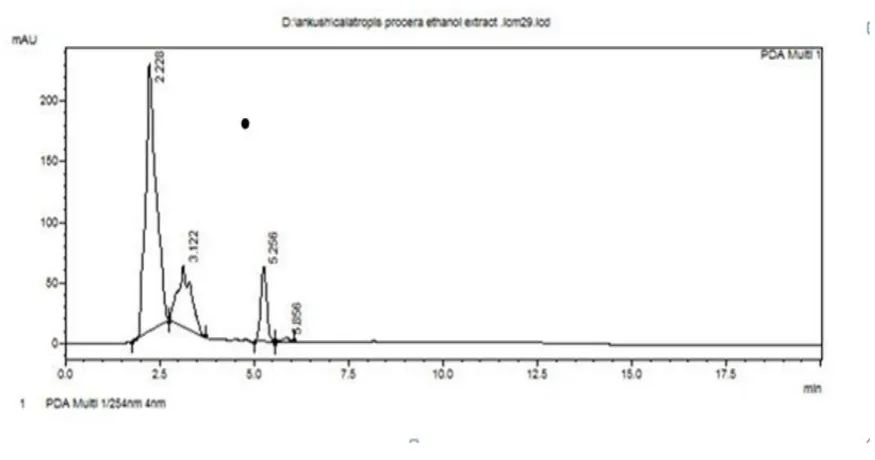
HPLC : Solvent system used were acetonitrile water (60:40), flow rate 1 ml/min, run time 10 min. pump pressure max 380 psi, column- C18, detector PDA, model Shimadzu, solvent
quantity 20 micro litters. The sample of latex dissolved into the ethanol were filtered through
the Whatman filter paper no.1 and injected for HPLC analysis, the following peaks were
Table1. Retention time
Sr. No. Peak Retantion Time Concentration Area Height
1 1 2.234 67.77041 3138948 167628
2 2 3.122 17.31792 802121 29445
3 3 5.256 14.03909 650254 61151
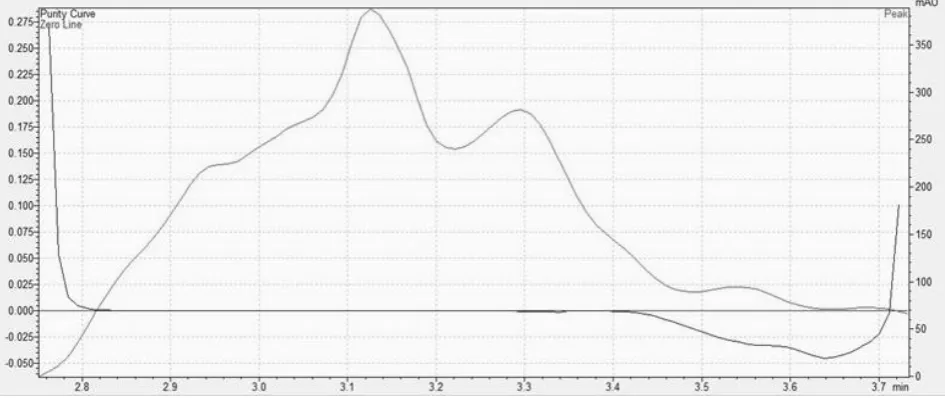
Figure 3: Putity Index of sample.
Purity index shows, detected at 1.94minute, pick purity index is -0.709386, single point
threshold 0.922612 and minimum purity index is -1631998, figure. 3.
Impurity index shows, detected at 3.64 minute, pick purity index is 0.946405, single point
threshold 0.991337 and minimum pick purity index is -44931 fig.4
UV-Visible: The sample of calatropis gigantea, were analyzed by uv visible spectrophotometry of Perkin Elmer at the Government Institute of Forensic Science Auranga
bad. The sample was prepared in ethanol, the absorbance and the lambda max of the alkaloids
and glycosides containing sample is obtained. The UV of Calatropis Gigantea lambda max
is found to be at 217.37 nm, 245.27nm and 288.55nm.The lambda max of Calatropis
Gigantea glycosides indicates the presence of glycosides or alkaloids in the extracted sample.
hese may be calactin, calotropin, calotoxin Figure. 5.
200 300 400 500 600 700
0.29
-0.17 -0.15 -0.10 -0.05 0.00 0.05 0.10 0.15 0.20 0.25
nm
A
217.37
245.27
288.55
Figure 5: UV-Visible absorption.
RESULT AND DISCUSSION
The active constituents of Calotropis Gigantea such as alkaloids are studied by different
instrumental techniques and spot tests. These glycosides or alkaloids are hazardous to human
CONCLUSION
The result of phytochemical screening of water, methanol and ethanol extracts of Calotropis
Gigantea latex revealed the presence of alkaloids, such as calactin, calotropin, and calotoxin.
Which is confirmed by colour test, TLC Rf values, HPLC retention time data,
UV-absorbance and IR spectra. Though Calotropis gigantea has various medicinal applications,
but it is the need of hour to explore its medicinal values at molecular level with the help of
various biotechnological tools and techniques. Further studies should be conducted to
elucidate the molecular mechanism of interaction of various plant based drugs with human in
different diseases.
ACKNOWLEDGEMNT
Author is thankful to Director, Government Institute of Forensic Science Aurangabad, for
providing laboratory facilities.
REFERENCE
1. Kumar G, Karthik L, Bhaskara Rao KV. A Review on Pharmacological and
Phytochemical profile of Calotropis gigantea Linn. Pharmacology online., 2011; 1: 1-8.
2. Murti PBR and Seshadri TR; Chemical composition of Calotropis gigantea Part II. Wax
and Resin Components of the Stem Bark Proc. Ind. Acad. Sci., 1944; 8–18.
3. Joshi Amit et al, has been studied Phytochemistry and evaluation of Antioxidant activity
of whole plant of Calatropis Gigantea Linn, IJRAP., 2010; 1(1): 120-125.
4. Watt, J.M. & Breyer-Brandwijik, M.G. - The Medical and Poisonous Plants of Southern
and Eastern Africa, 2nd edn., 1962; 121.
5. Tenpe CR, Upaganlawar AB, Dongre PA and Yeole PG. Screening of methanolic extract
of Calotropis gigantea leaves for hepatoprotective activity. Indian drugs., 2007; 44(11):
874-5.
6. Subramanian SP, Saratha V. Evaluation of antifungal activity of Calotropis gigantea
latex extract: an in vitro study. IJPSR., 2010; 1(9): 88-96.
7. Chitme HR, Chandra M, Kaushik S. 2004. Studies on antidiarrhoeal activity of Calotropis