08
On the Development of a Model for Teaching English as a Vocation among
Iranian Teachers
1Ali Asghar Poorbehzadi 2
Shahram Afraz* IJEAP- 1905-1387
3
Fazlolah Samimi
Abstract
Teachers’ perspectives towards teaching are still a hotly-debated topic that often divide opinions. Some teachers, believe that teaching is a profession and a sole source of income, while many other teachers claim that teaching is an inside spiritual call and a vocational and moralistic duty. This study, following a qualitative grounded theory approach, looked deeply into the interrelationship of data extracting from teachers' perspectives toward teaching as vocation to propose a model in this regard. Consequently, twenty-six Iranian English teachers, teaching at schools and Farhang language institute were asked to brainstorm their ideas as to how they view teaching as a vocation. The 3-session semi-structured interviews with 20 participants and focus-group interviews with 6 participants were conducted. The data was then transcribed and codified based on Corbin and Strauss (2014) systematic steps for grounded theory. The findings led to an eight-factor model encompassing 39 categories. The factors include: a) financial concerns and insufficient salary, b) love and passion for teaching, c) low social status, d) high demands for becoming a teacher, e) devotion and high sense of responsibility, f) limitations and lack of freedom, g) setting a pattern and gaining experience, h) equivocal images of teachers. The proposed model is conducive for training centers, policy makers, ministry of education, and those who care about quality education, and students' academic achievements to seriously take into account teachers' real concerns, and improve their social status to avoid falling them into a state of socioeconomic inequality and feeling marginalized.
Keywords: Teaching; Teachers; Vocation; Model; Grounded theory
1. Introduction
There seem to be different perspectives toward teaching in general and teachers in particular. Many teachers and education experts view teaching as a simple job and mere source of income, whilst many others believe that teaching is beyond a simple job and a sole source of income; On the contrary, they view teaching as a spiritual and moralistic duty and a call from deep within which is practiced with love, devotion, and commitment. Chikering and Gamson (1987) advocated for teachers who believed, education is a shared process creating knowledge between learners, a lifelong endeavor, not just a job. Gilakjani and Sabouri (2017) in a study on the teachers' beliefs in English language teaching and learning came to this conclusion that teachers' beliefs affect what they accomplish in their classroom, their attitudes, and their learners' beliefs and that investigating teachers' belief will help them change their methods to teaching and learning over time in order to bring about more improvement for language learners (Gilakjani & Sabouri, 2017). Game and Metcalfe (2008) argued that pedagogic authority relies on love, not actions and subjects. Loving authority is a matter of spontaneous and simultaneous calling and vocation. Atkins (2009) contended that twenty-first century education is largely vocational. Lohman (2016) believes that the thirst for knowledge remains unchanged, as
1 PhD Candidate, [email protected]; Department of English Language, Qeshm Branch, Islamic Azad University , Qeshm, Iran
2 Assistant Professor (Corresponding Author), [email protected]; Department of English Language, Qeshm Branch, Islamic Azad University, Qeshm, Iran
08
technologies change, and ideally, people who teach college students do so because they consider it to be their vocation.
According to the Cambridge International Dictionary of English, vocation is a type of work that you feel you are suited to doing and to which you should give all your time and energy or the feeling of suitability itself. Vocation is a theological word. It has been defined as a career with a spiritual calling from deep within. As Dbanj (2009) states teaching is closer to an art than it is to a craft or technique, in other words teaching is a basic human activity, before it is a professional one. Sammons, Davis, Day and Gu (2014) argued that despite likely connections between self-efficacy, well-doing, commitment, emotional energy, resilience and standards of teaching and learning, there have been few empirical studies which have focused upon understanding why, for some teachers, teaching becomes just a job whilst for others it remains a passionate calling.
Reviewing the body of literature on the challenges which teaching in general and teachers in particular face with recently, direct the researchers' attention to the major issues, including financial, attitudinal, personal, ideological perspectives toward teaching, academic achievement, and education quality. As Biddle, Good, and Goodson (1997) argued in their article that there are two classic views toward teachers. The first view considers teachers as workers in other type of formal organizations, who are either motivated by their assigned responsibility and salaries, or by their loyalties on the entity that employs them. The second classic view focuses on teachers' role in classrooms, schools, and school systems. This view puts the teachers on the dilemmas that are created for teachers by limited budgets, unbending curricula, public disputes about education, diffuse goals for schools, unruly students, and the fact that teachers have normally low social status in the bureaucratic organization of the school system.
The purpose of this study is manifold. The study, both contributes efficiently to the body of knowledge and deepens our understanding of the main concepts of teaching as a vocation. Firstly, through a qualitative grounded study approach, the study explores teacher's perspectives and insights toward teaching as a vocation and, investigates the real challenges teachers are facing in their working conditions and the society as a whole. Secondly, probes the nature of vocation as a teaching concept, and via investigating the genuine data extracted from the participants of the study, tries to find the developmental process of forming factors, categories and themes which lead to the final model of teaching as vocation. The Iranian context of the study focuses on, English teachers at schools, from nearly all parts of Iran, including Amol and Ramsar in the north, Kermanshah and Malayer in the west, Mashhad in the east, Shiraz in the south west, Lamerd, Kahnouj, Manoujan, Ghale Ganj, and Faryab, in south and Farhang private language institute in Kahnouj. The main concern of the study is to find out what perspectives Iranian teachers share toward teaching as a vocation when they view it as a vocational and moralistic career and a call, and duty from deep within, and what kind of a model comes out as the result; therefore, the researcher aims to find deep, sound, and convincing answers to the questions raised in the research, and explore ,using face to face interviews and focus group discussions, the perspectives of English teachers as the participants of the study toward teaching as vocation. Consequently, theorize the model in this regard, as a result of qualitative grounded theory study.
2. Literature Review
08
religions calling that overcomes economic, social, and cultural change, and working in a vocation is a process that involves continually improving and expanding field of knowledge and experience.
In a comprehensive research, Monica and Cristian (2012) worked on teaching vocation today in the opinion of students based in psychological and pedagogical module and concluded that redefining and rethinking of the role of teacher, and teacher training is needed due to disappointing problems facing teachers like¸ lack of motivation, poor selection for the teaching¸ decreasing numbers of those attracted to teaching career, decline in quality of supply and many more. Sammons, Davis, Day and Gu (2014) in their books, argued that in spite of self-efficacy, commitment, well-being, and emotional energy, there is a big gap focusing on teaching as a profession or a vocation among teachers. Henderson (2014) in an article reporting different teacher views toward teaching, as a vocation believed that teaching is a divine commission and teachers like angels occupy the hearts and minds of students. Monsfield, Beltman, Broadley, and Weatherby-Fel (2016) in an article on teacher resilience ¸ argued that personal and contextual resources along with use of particular strategies all contribute to resilience outcomes of teachers.
After reviewing the literature, there seems to be no existing model grounded in the teachers' viewpoints in generating a model for teaching as a vocation, so as to put forth a model of teaching as vocation in the context of Iranian teachers. As a result, the present study investigated this overlooked area as the researchers assumed few or no studies were conducted to fully investigate teachers' perspectives on teaching as a vocation to theorize a model for it. Consequently, this research addressed the following research question:
1. What kind of model comes out as a result of perspectives shared by Iranian teachers toward teaching as a vocation?
3. Method
The present study followed a qualitative grounded theory approach. It deeply looked into the interrelationship of data inquiring from English teachers' perspectives toward teaching as vocation to propose a model in this regard.
3.1. Participants and Settings
Twenty-six English teachers, teaching at schools from different parts of Iran and Farhang private language institute were cooperated as the participants of this study. To fulfill the demands of transferability and generalizability, the participants were chosen from nearly major parts of Iran, including Amol and Ramsar in the north, Kermanshah and Malayer in the west, Mashhad in the east, Shiraz in the south west, Lamerd, Kahnouj, Manoujan, Ghale Ganj, and Faryab, in south. Since the potential population was too large, for the reasons of time, distance, traveling, resources, and to increase the credibility of the study, participants were selected according to random purposeful sampling from among English teachers. English as a foreign language is too hard to teach and requires more time and energy; therefore, better and more realistic elicitation of data was expected. Although there were more teachers who were interested and showed their willingness to take part in the study, due to the yardstick of data saturation, and after analyzing the data, the researcher came to this conclusion that no new forthcoming information and theme were likely to come out of subsequent interviews. As a result, the number of participants were restricted to this particular number.
3.2. Instruments
08
of teaching as vocation, and finally managed to formulate seven open-ended extensive questions to be included in the interview guide.
The questions were piloted in advance with four interviewees accessible in Kahnouj Shahed high school, and Farhang language institute in Kahnouj at the next stage. Consequently, two questions were modified and one more question was added to the interview guide. Thanks to the potentiality and particular nature of qualitative grounded theory approach, the researcher benefited from simultaneously collecting and analyzing the data and follow up memos which were transcribed after each interviews' talks. Moreover, final evolved interview guide emerged over time (see appendix A). By developing an interview guide, firstly, the researcher came to assurance that the whole domain had been covered and no key issues and concepts were put behind, and secondly proper and appropriate questions, not impromptu ones, were included in the study.
3.3. Data Collection Procedures
Twenty participants were interviewed in the form of face to face talks, and focus group discussions interviews with six participants were conducted to collect the required data. Seidman (2006), puts forth a framework for in-depth phenomenologically-based interviewing that involves conducting a series of three interviews spaced days or weeks apart; therefore, the data of the present study were collected in three steps.
Step 1: A tentative interview guide/protocol was developed. Body of relevant research on teaching as vocation was reviewed efficiently and finally seven open-ended appropriate questions were included in the interview guide.
Step 2: The developed interview guide was piloted with four participants prior to be used in the main study. Piloting the interview guide resulted the modifications of two questions and additions of one more question.
Step 3: A 3-session interview was held with the same participants to extract meaningful data. The first session was somehow a familiarization and briefing session between the interviewee and interviewer. Interviewees also were informed about the areas to be interviewed. The space between the first session and the second gave the participants the opportunity to reflect upon the matter and prepare themselves for the next session. The researcher also found enough time to update the interview guide. The real interview was conducted with each participant face to face and in the form of focus group discussions in the second session. For the reasons of distance, traveling, and limitations of resources, some interviews were conducted virtually and synchronously via the live connections with the participants in Instagram, and WhatsApp internet- based applications. As Ary, Jacobs, Sorensen, and Walker (2014) maintain that benefits to conducting online interviews include removing barriers to participation such as time, traveling, and scheduling. He also argues that "one of the most efficient way to collect interview data is to use an audio or video recorder. Smart phones, and other new technologies are often inexpensive, compact, and easy to use in recording video." (Ary. et al, 2014 p.467).
The following steps were also taken into consideration by the researcher in the interview sessions: a) In order to feel free, the participants were allowed to use any language either L1 or L2 with which they felt comfortable most.
b) Participants were kept informed about the purpose of the study, and made assured that their viewpoints would remain confidential, and only used for the purpose of the study.
c) The participants became aware of recording their voices and, on their permission and agreement the recording key was pushed.
08
f) At the end of the interview, the researchers took notes of the main points and asked the clarification questions to make the points straightforward for themselves.
g) The participants were given the necessary motivation to continue the interview and freely express their ideas.
h) The researchers signaled the end of each interview by saying; If there is anything else to share with us, please let us know?
At the third and the final interview session, the researcher found the opportunity to focus on the lame data, misunderstandings and confusing points extracted from the participants and analyzed during the last two sessions. As a result, the researcher required the participants to return to the issue and shed more lights on it. A summary of the significant points analyzed and transcribed by the researcher were copied and distributed to the participants. Consequently, the participants reviewed their own viewpoints and added or remove any inconsistency.
The above mentioned process was done to assure the accuracy of findings known as validity or credibility of findings. Ary et Al. (2014) hold that consistencies viewed as the extent to which variation can be tracked or explained. This is referred to as dependability or trustworthiness. Three steps were taken to assure the reliability or dependability of the study. First the researcher himself continuously compared the data with the assigned codes and the follow up memos to make sure that the codes and their definitions resemble the stretches of phrases or sentences. Second, twenty percent of the data were independently cross-checked by two more coders and compared in terms of stability and consistency on the given codes. As a result, consistency was achieved by more than 80% among the coders. Miles and Huberman (1994) recommended that consistency among coder be in accord at least by 80% for an acceptable qualitative dependability index. Third, the researcher and the coders held documented meetings and exchanged their independent coding in an attempt to reach agreement.
Ary, et al (2014) holds that the integrity of qualitative research depends on attending to the issue of validity. Validity or credibility in fact concerns the accuracy or truthfulness of the findings. To convince the readers about the accuracy of findings, the researcher applied a variety of procedures to assess the validity or credibility of findings: A) the final draft of findings were given back to the participants to judge whether the data are actually derived from the participants' viewpoints. Necessary to mention that a three-session interview was conducted for each participant and in the final session a synopsis of each participants' transcription was given to him to comment on the findings. This strategy is known as member checking). An expert as a peer debriefer was asked for help to check the genuineness of the data. The researcher also asked an external auditor or an independent investigator to investigate who were unaware of the identity of the researcher and the whole project to review the study meticulously. He inspected the transcriptions and scrutinized the relationship between the research questions and the collected data. Eventually, he confirmed that the data are genuinely collected, transcribed and interpreted.
3.4. Data Analysis Procedure
08
presented the main point of each segment. Briefly, many labels were assigned to the data and the data were broken into small segments. The memos which are indicative of the researcher thoughts and feelings and play key role in summarization and organization of data were inserted into the software and added to the coded data. What came out finally from this stage was a large number of codes and their frequency of occurrences (249) codes.
After termination of initial coding, the broken data in the previous stage were linked and compiled into workable categories (39) categories. To acquire a better understanding of data, the reduction of a large number of codes and subcategories into smaller categories were done. Constant comparative method was applied to the data to combine the codes and group them into similar and/or different groups. In the final stage, the most difficult of the three stages, namely the selective coding was conducted. Selective coding, as the final integration of data connects and amalgamates the categories into themes. It is regarded as a very big step toward the establishment of the overall model of teaching as vocation. Generally, based on the existing data and body of literature, the researcher went and thought far beyond the data and reorganized the categories into eight themes. Consequently, the probable model of teaching as vocation comprised eight themes.
4. Results
In short, eight main factors were pulled out as the outcomes of grounded theory. The factors and the follow up instances are presented in details as follows:
A: Financial concerns and insufficient salary
Based on the participants' viewpoints, this theme encompasses considerable subcategories, which naturally reflects real teachers' concerns. They range from failure in affording their simple and ordinary needs in everyday life to low salary and high expenses and compelling teachers to choose a second job to make a living. The other main category elicited from participants in face to face and focus group interviews contains sense of smallness and deprivation among many teachers, compared with other beneficial jobs. The following contains comments taken from participants' viewpoints:
1. In our country, teachers are neglected and put aside (a1), and teaching cannot be considered as a source of income (a2).
2. The big defect with teachers is that their salary is very low (a3) compared with other jobs.
3. Teachers’ financial problems (a4) hinders them to fulfill their duties (a5) correctly.
4. Due to extreme low salary, some teachers have chosen a second job (a6) to afford the expenses of their families.
5. My salary did not match the endeavor and sweat that I gave to my job (a7), and as a result sense of smallness and negligence (a8) covered my whole body.
08
Figure1: Financial Concerns and Low Pay B: Love and passion for teaching
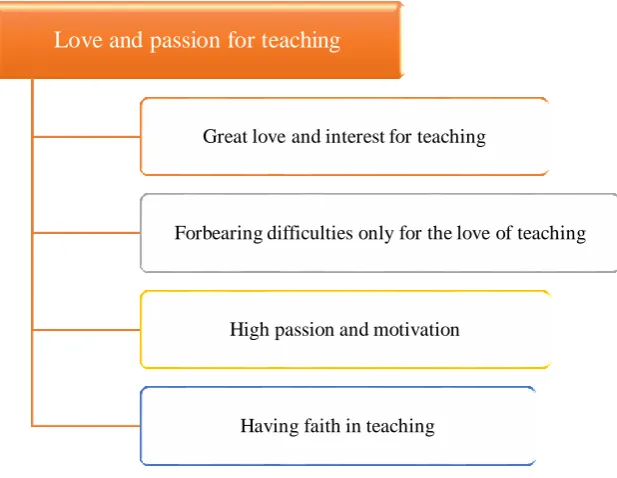
Another highly reported relevant to the above theme were the love, interest, commitment and great passion which teachers award to teaching and learners. Seemingly the only reason why teachers still remain teachers and despite the hardships and defects teach passionately is the true love and high interest of them to this mostly vocational phenomenon rather a sole profession. The following items are some natural and genuine viewpoints mentioned by English teachers as participants of the study.
1. I had little interest in teaching first, but later I fell in love with teaching (b1).
2. I Love teaching and feel wonderful (b2) as I give useful information to my students.
3. I become teacher with love and interest (b3) and still believe it.
4. Even my pregnancy did not affect my quality of teaching (b4) and my love for teaching.
5. Focus group: After nearly a decade of teaching, we are still highly motivated and similar to the first days and years of teaching (b5).
Financial concerns and insufficient salary
Loosing concentration on conducting duties correctly due to financial hardships
Sense of negligence and deprivation
Low amoumt of salary
Choosing a second job to make a living
08
Figure 2: Love and Passion for Teaching C: Low social status
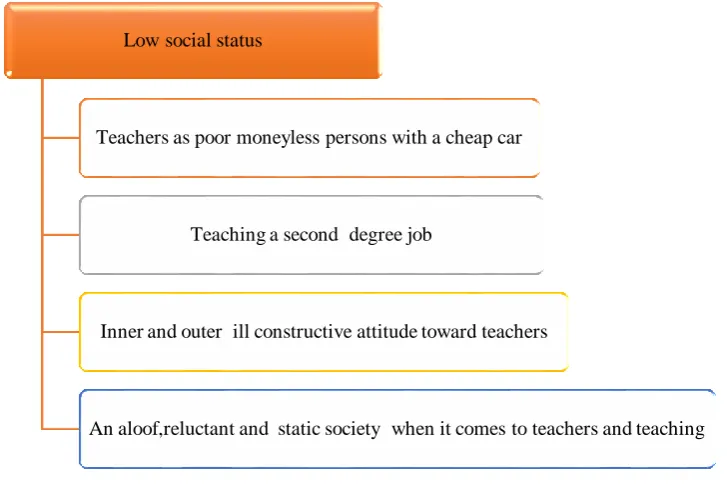
The viewpoints extracted from participants in interviews denote to this important theme that the society nowadays has a low opinion of teachers. Some people think of teachers as poor, moneyless workers with a cheap car and plain cloth. Teachers in particular and teaching in general are not families' center of attention and the first agenda. As elicited from teacher's viewpoints, the society as a whole has a negative attitude towards teachers. Below comments extracted from participants' viewpoints are presented:
1. Society’s attitude toward teachers are humiliating and underestimating (c1)
2. Our society is aloof, reluctant, and static to teachers and education. (c2)
3. The society should award teachers a high social status and view them as the trainers of a successful generation. (c3)
4. People view teaching as a second degree job. (c4)
5. Focus group: Our society is suffering from an inner and outer constructive disease in terms of teachers' true value and status in the society. (c5)
Love and passion for teaching
Great love and interest for teaching
Forbearing difficulties only for the love of teaching
High passion and motivation
00
Figure 3: Low Social Status D: High demand for becoming a teacher
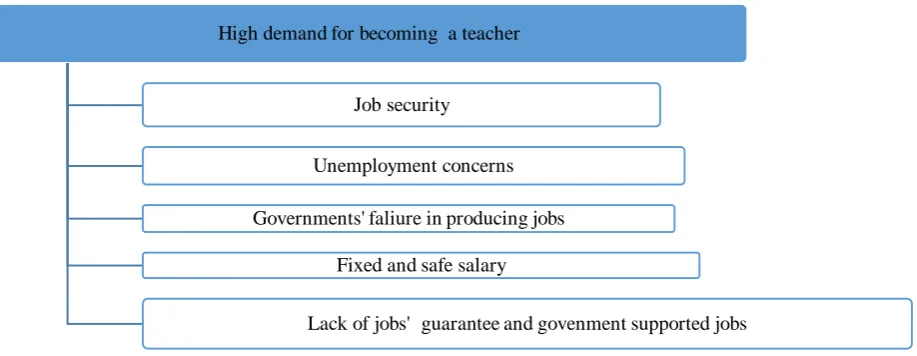
Another issue worth considering is the increasing demands for becoming teachers due to job security and high rate of unemployment among the educated youths. Elicitation of data from participants testify to the fact that these days some family's priorities and inclination to becoming a teacher have increased rapidly. The reasons are, according to this study's' participants point of view, lack of sufficient job opportunity for the young with higher education, constant and fixed salary of teachers, though very low and insufficient, and the governments' failure in providing, and producing jobs for the needy applicants. Genuine excerpts from this study's participants are given below:
1. Families are inclined to teaching's career, because of financial support and job security. (d1)
2. Teaching career is welcomed by families nowadays, because of unemployment concerns and lack of
job's guarantee. (d2)
3. Teachers have a fixed salary though low and insufficient. (d3)
4. Lack of governmental jobs and finalized employment (d4) are the main reasons for becoming teachers among students and their families.
5. Lack of proper jobs with sufficient salary in the society (d5) is the main reason for increasing demand for becoming teachers.
6, Focus group: Government's failure in producing suitable jobs particularly educated youths, (d6) forms the main reason for the students and their families' inclination in becoming teachers.
Low social status
Teachers as poor moneyless persons with a cheap car
Teaching a second degree job
Inner and outer ill constructive attitude toward teachers
08
Figure 4: High Demand for Becoming a Teacher E: Devotion and high sense of responsibility
In the interview procedure, the most prominent and consecutive view point pulled out from participants of the study was devotion and high sense of responsibility which teachers either possess or expected to have. The scope of this perspective begins from ignoring their own personal problems, and putting them behind classrooms' door, focusing on moral sense and the quality of teaching, forbearing the hardships just for the love of teaching, not influencing the quality of teaching even in the pregnancy period, and leads to being committed and morally attached to fulfilling the duties properly, and owing themselves to both students and their parents in terms of commitment and responsibility. The utterances of participants are summarized in the following lines:
1. I do not take my personal problems with me to the classroom (e1) and leave them behind the door.
2. Even the pregnancy period did not affect my quality of teaching. (e2)
3. The materialistic aspect of my job is not important to me and I just think of quality in education and moral sense. (e3)
4. Teachers are morally committed and responsible for both students and their parents. (e4)
5. Sensitivity in doing my duties and high sense of responsibility (e5) caused me sometimes to fear my job and think of quitting it.
6. Focus group: Inside teachers, spirituality, morality and responsibility (e6) are abundant.
Figure 5: Devotion and High Sense of Responsibility High demand for becoming a teacher
Job security
Unemployment concerns
Governments' faliure in producing jobs
Fixed and safe salary
Lack of jobs' guarantee and govenment supported jobs
Devotion and high sense of responsibility
Moral sense and committment
quality of educatuon
responsible for students and their parents Ignoring self and focusing on the students
Resisting the life difficulties and enhancing spirituality,moral sense and responsibility
88 F: Limitation and lack of freedom
The data elicited from the participants of the study, through face to face interviews and focus group discussions speaks out the limitations and lack of freedom which teachers encounter in their career and work place. These limitations range from the problems with teachers' training centers, clothing and general appearance, to constant monitoring, dictated teaching methodology in the classes and taking care of behavior permanently inside and outside of schools. Below some segments of participants' utterances are presented:
1. Teacher training centers train teachers in a very closed and limited atmosphere (f1) with gender-specific classes and censored books containing poor contents.
2. As a teacher, I always control my behavior to be a pattern for my students. (f2)
3. In my class, I do not have the necessary freedom of expression and methodology of teaching. (f3)
4. I have to behave always in pre dictated framework. (f4)
5. Because I am a teacher, I avoid behaviors that are against my social and career status. (f5)
6. Education and training office constantly monitors me, and this limits my whole life style. (f6)
7. Focus group discussions: Kind of cloth and hair style which are personal affaires are typical and pre-determined (f7) for us.
Figure 6: Limitations and Lack of Freedom G: Setting a pattern and gaining experience
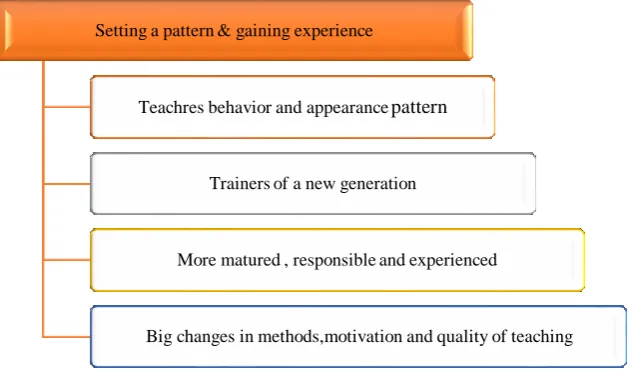
Another highly reported theme by participants of this study is to set an example, on part of the teachers for the students and acquiring priceless experience as time passes on. Teachers are real patterns for their students and their behavior affects the students directly. As one becomes a teacher his life style even his clothing and hair style seemingly changes drastically. Teachers are in fact the trainer of an educated and excellent generation in the society, as a result their life and personality changes as they become more experienced. Inasmuch as time passes, teachers become more matured, and confident in fulfilling their duties moralistically. Below are some genuine utterances mentioned by English teachers as participants of this study:
1. Teachers are patterns for their students (g1) and their deeds affect their trainees.
2. I live my life in a way that society expects a teacher to be. (g2)
3. To show respect for my job as a teacher I change my appearance. (g3)
4. A teachers' life is mostly affected by the job(g4) he is doing.
Limitations & Lack of freedom
Teaching training centers limitations
Constant monitoring of education office
Lack of Freedom of expression and metohdology of teaching
88
5. At first I was not able to get along with my students but as time passed I became more experienced
(g5) in handling different situations.
6. After 11 years of teaching, I am akin to my first years of teaching (g6) and highly motivated.
7. Focus group discussions: In the first years of teaching you are not experienced but later you become professional in your job. (g7)
Figure 7: Setting a pattern and gaining experience H: Equivocal image of teachers
Data extracted from the participants of the study gives an insight to two different images of teachers, one very clear and white, and another blurred and dark. Based on participant's viewpoints, some teachers are committed, responsible, accountable, and consultant. They have high moralistic duties, set examples for the students and enjoy a fixed, secured, and guaranteed salary and some others are disappointed, less motivated, limited, less paid, and misused sometimes. They object to many issues, including society's' low opinion of them, financial and welfare challenges, low attention to qualifications, unqualified teacher training centers, and having no proper and fixed plan for the present and future progress of teachers. Some genuine stretches of talk mentioned by teachers are given below:
1. Teachers are real pattern for the students and the society (h1) as a whole.
2. The training of a new generation (h2) is given to teachers.
3. I am committed and responsible (h3) in my job.
4. Teachers enjoy job security and a fixed salary. (h4)
5. Teachers are not like judges and physicians financially. (h5)
6. I feel misused when I see some relatives respect for me only because I guarantee their banking loans. (h6)
7.Focus group: Society has a negative view toward teachers, teacher training centers are not qualified, there is no plan for future progress, and many factors other than qualifications over comes the real evaluation of teachers. (h7)
Setting a pattern & gaining experience
Teachres behavior and appearance pattern
Trainers of a new generation
More matured , responsible and experienced
88
Figure 8: Equivocal Images of Teachers 5. The Emerging Model
This model as stated in the method section, is grounded in the data which were collected from face to face interviews and focus group discussions with English teachers from all parts of Iran including Ramsar and Amol in the north, Ivan Gharb, Kermanshah, and Malayer in the west, Mashhad in the east and Shiraz, Lamerd in the south west and Kahnouj, Manoujan, Ghale Ganj, Roodbar, and Faryab in the south. According to Corbin and Strauss’s (2014) systematic approach for codification and analysis of the data, the data collected in this study then were analyzed. As a result, the final model involves eight main themes (see figure9) and 39 categories (see table 1).
Table 1: The gist of the Main Themes and Categories of the Preliminary Model of Teaching as Vocation Category
Theme
1.Sense of negligence and deprivation 2.Low amount of salary
3.Choosing a second job to make a living
4.Mismatch of endeavor and sweat by teachers with their monthly salaries
5.Lossing concentration in conducting duties truly, due to financial hardships
Financial concerns and insufficient salary
6.Forbearing difficulties only for the love of teaching 7.High passion and motivation
8.Having faith in teaching
9.Great love and interest for teaching Love and passion for teaching
10.Teaching as a second degree job
11.Inner and outer ill-constructive attitude toward teachers 12.A reluctant, aloof, and static society when it comes to teachers and teaching
13.Teachers as poor, moneyless, persons with a cheap car Low social status
14.Job security
15.Unemployment concerns
16.Governments' failure in producing jobs 17.Fixed and safe salary
18.Lack of jobs' guarantee and government supported jobs High demand for becoming a teacher
19.Moral sense and commitment 20.Quality of education
21.Responsible for the students and their families 22.Ignoring himself and focusing on the students
23.Resisting the life difficulties and enhancing spirituality, morality and responsibility
Devotion and high sense of responsibility
Equivocal image of teachers
Setting patterns
New generation trainers
Comitted,responsible and accountable
88
24.Forbearing the hardships for the sake of students 25. Teacher training centers limitations
26.Constant monitoring of teachers by education office authorities
27.Lack of freedom of expression and methodology of teaching
28.Particular predetermined clothing and hair style Limitations and lack of freedom
29.Trainers of a new generation
30.Becoming more matured, and experienced as time passes 31.Big changes in methods, motivation, and quality of teaching 32.Teachers' behavior and appearance pattern
Setting a pattern and gaining experience
33.Th first trainer of all strata in the society 34.Committed, responsible and accountable 35.Misused and depressed
36.No plan for teachers' future progress 37.Unqualified teacher training centers 38.Low pay, low motivation
39.Setting pattern for the students and their parents Equivocal image of teachers
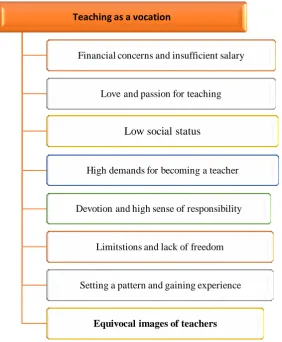
As Table 1 shows, the emerging model of teaching as a vocation contains eight themes and 39 categories. Through face to face interviews and focus group discussions with Iranian English teachers, the components of the model were taken. Having analyzed the data, the proposed model of teaching as a vocation was emerged as follows in Figure 9.
Figure 9: Presented Model of Teaching as a Vocation
Teaching as a vocation
Financial concerns and insufficient salary
Love and passion for teaching
Low social status
High demands for becoming a teacher
Devotion and high sense of responsibility
Limitstions and lack of freedom
Setting a pattern and gaining experience
88 6. Discussion
The results revealed eight main themes in the developed model of teaching as a vocation. As to the first factor of the present study, that is financial concerns and insufficient salary; a couple of studies testify to the fact that there is a correlation between the teachers' pay and the quality of teaching, as well as the overall viewpoints of teachers toward teaching as a whole. Briton and Proper (2016) claimed that a ten percent shock to the wage gap between local labor market and teacher wages resulted in an average loss of around two percent in average school performance in the key exams taken at the end of compulsory schooling in England. In other words, school performance was adversely affected, where wages paid to the teachers were below market rates. In another study, over the effect of teacher's financial incentives on students' scholastic outcomes, Lavy (2003) argued that teachers' monetary performance incentives have a significant effect on students' achievements in English and Math.
Many studies provided confirmatory findings to the second factor of this study that is love and passion for teaching. Loui (2006) in a study conducted on the love, passion, and the amateur teacher contended that "we professional teachers remain amateurs, who teach for the love of our subjects and the love of our students. We teach, because we are intensely, profoundly, passionately love." Hoversten (1987) argued that with constant care, nourishment, and positive thinking, teaching can be a continuing love affair. She also suggested the following five ways to stay in love with teaching: "accept the things you cannot change; get to know kids outside of the classroom; renew yourself professionally; do not give up too soon, and develop a support system within your school" (Hoversten, 1987, p. 32-34). Lakin (2007) holds that teaching and learning are essentially acts of love and this encourages teachers as they remember why they entered teaching in the first place.
Extensive body of research lend support to the third factor of this study, that to say, low social status. In a study Orlov (2000) held that "failure to pay salaries on time over the past few years has had negative socioeconomic and psychological-pedagogical consequences that has led to the decline in the prestige of the teaching profession in the society, and young peoples' desertion from the field of education, and further feminization of education owing to men's' switching to other fields"( Orlov, 2000, p. 17). He also continues that in a sample of 1000 teachers in a research, only one out of eight teachers are satisfied with their jobs and one out of two are not satisfied with the profession. The reason, he argues, is the working conditions and sense of finding themselves in a state of socioeconomic inequality.
In the present study, the reasons for high demands for becoming a teacher that is the fourth factor of the presented model are lack of job security in the society, financial problems and influencing others which are confirmatory with the findings of studies conducted on South Korean preservice teachers. Lee, Kang & Park (2019), based on Watt and Richardson (2008) FIT-choice scale that is factors influencing teaching choice, argued that South Korean preservice teachers reported relatively high values for the Influencing others and Benefits, including salary and job security, while task returns and teaching as fallback career indices were lower than other factors.
Considerable body of research lend support to the fifth factor of this study that is devotion and high sense of responsibility. Lauermann (2014) in his research argued that responsibility has important motivational implications in terms of effort investment, persistence, and commitment to students, but can also come at a personal cost such as hard work, lack of sleep, and less family time. Hubackova and Semradova (2016) working on teacher responsibility in distance education held that responsibility is often addressed in declarative documents, codes of ethics, and legal regulations, and also responsibility in traditional face to face teaching is generally higher than in distance education. Limitations and lack of freedom 'the sixth factor of the study" such as constant monitoring by education office, teacher training limitations, lack of freedom of expression and methodology of teaching in the classroom, and particular predetermined clothing and hair style are rarely reported in the literature; as a result, the findings might contribute to the advancement of the subject under study, and add a novel factor to the body of knowledge.
88
significantly differentiated Iranian EFL teachers, concerning reflective teaching, i.e. high experienced teachers significantly outperformed mid-experienced teachers, who in turn, outperformed their low-experienced counterparts in this regard. Afshar, Rahimi, Gonchepour and Saedpanah (2015) in their research project concluded that there is a significant effect of experience on teachers’ sense of efficacy and no significant impact on their beliefs about characteristics and differentiated them from teachers of other subjects. The researchers found no trace of the eighth factor 'equivocal image of teachers. Despite that, the findings that are genuine excerpts from participants' points of view might download a new part to the body of knowledge and open a new scope for further research.
7. Conclusion
The present study concludes by proposing a model of teaching as a vocation among Iranian teachers. Viewpoints extracted from teachers who believed that teaching is not a sole source of income, rather an inside spiritual call from deep within and a vocational and moralistic duty, prompted the researchers to come up with interesting and reflecting conclusions. Despite the fact that, financial concerns and insufficient salary, low social status, limitations and lack of freedom, and falling into a state of socioeconomic inequality, and feeling marginalized, teachers still possess a high sense of devotion, responsibility and sense of love and passion towards teaching in particular and students in general. Due to lack of appropriate jobs among the young, there seems to form a high and increasing demand for becoming teachers, but setting a pattern for students, gaining more experience and love for teaching and students as the future generation of the whole nation overcomes other aspects of the profession.
As a matter of fact, the proposed model, helps education researchers, governments' policy and decision makers, ministry of education, teacher trainer centers, and those who are thoughtful, and careful about quality education and students' academic achievements, to take serious steps in this regard, and to make all out efforts to increase the social status of teachers in the society and improve the socioeconomic position and financial concerns of teachers, and put an end to this type of inequality and feeling of being marginalized.
88 References
Afshar, H. S., & Farahani, M. (2015). Reflective thinking and reflective teaching among Iranian teachers: Do gender and teaching experience make a difference? Procedia-Social and behavioral sciences, 192, 615-620.
Afshar, H. S., Rahimi, A., Gonchepour, A., & Saedpanah, E. (2015). The impact of teaching experience on Iranian EFL teachers’ sense of efficacy and their perception of English teacher distinctive characteristics. Procedia-Social and Behavioral Sciences, 192, 714-719.
Ary, D., Jacobs, L. C., Sorensen, C., & Walker, D. A. (2014). Introduction to research in education. USA: Cengage Learning.
Atkins, G. D. (2009). Essaying to be: Higher education, the vocation of teaching, and the making of persons. In D. Atkins (Ed), On the Familiar Essay (pp. 161-176), New York: Palgrave Macmillan.
Biddle, B. J., Good, T. L., & Goodson, I. F. (1997). The changing world of teachers. In Biddle, B. J., Good, T. L., & Goodson, I. F., International handbook of teachers and teaching (pp. 1-9). Netherlands: Springer.
Briton, J., & Proper, C. (2016). Teacher pay and school productivity: Exploiting wage regulation. Journal of Public Economics, 133, 75-89.
Chikering, A. W., & Gamson, Z. F. (1987). Seven principles for good practice in undergraduate education. AAHE Bulletin, 39, 3-7.
Corbin, J., & Strauss, A. (2014). Basics of qualitative research: Techniques and procedures for
developing grounded theory. USA: SAGE Publications.
Game, A., & Metcalfe, A. (2008). The teacher’s vocation: Ontology of response. Studies in Philosophy and Education, 27(6), 461-473.
Gilakjani, A. P., & Sabouri, N. B. (2017). Teachers' beliefs in English language teaching and learning: a review of the literature. English Language Teaching, 10(4), 78-86.
Henderson, J.V. (2014). Economic theory and the cities. New York: Academic Press.
Hof, S., Strupler, M., & Wolter, S. C. (2011). Career changers in teaching jobs: A case study based on the Swiss vocational education system. Discussion Paper No. 5806 IZA, Bonn.
Hoversten, C., (1987). How to stay in love with teaching. Middle School Journal, 18(2), 32-34.
Hubackova, S., & Semradova, I. (2016). Evaluation of blended learning. Procedia-Social and Behavioral Sciences, 217, 551-557.
Lakin, R., (2007). Teaching as an act of love, New York: Lincoln publications.
Lauermann, F., (2014). Teacher responsibility from teachers' perspective. International Journal of Education Research, 65, 75-89.
Lavy, V. (2003). Paying for performance: The effect of teachers’ financial incentives on students’ scholastic outcomes. Research Paper No 3862.Center for Economic Policy Research, U.K. Lee, J. A., Kang, M. O., & Park, B. J. (2019). Factors influencing choosing teaching as a career: South
Korean preservice teachers. Asia Pacific Education Review, 1-22.
Lohman, L. L. (2016). Teaching as Vocation: Reflections and Advice. In Saucier, D. et al. Reflections on Life in Higher Education (pp. 61-77). London: Palgrave Macmillan.
88
Miles, M. B., & Huberman, M. A. (1994). Qualitative data analysis: A sourcebook of new methods. Beverly Hills, CA: SAGE Publication.
Monica, M., & Cristian, P. (2012). Teaching vocation today in the opinion of students enrolled in courses psychological and pedagogical module–level I and II. Procedia-Social and Behavioral Sciences, 46, 5069-5073.
Monsfield, C. F., Beltman, S., Broadley, T., & Weatherby-Fell, N. (2016). Building resilience in teacher education: An evidenced informed framework. Teaching and Teacher Education, 54, 77-87. Orlov, A. A. (2000). Today's teacher: Social prestige and professional status. Russian Education and
Society, 42(8), 18-34.
Samimi, F., Sahragard, R., & Razmjoo, S. A. (2016). On the Development of a Model of Discipline- specific Reading Strategies in the Context of Iranian EFL Learners. International Journal of Foreign Language Teaching and Research, 4(15), 99-115.
Sammons, P., Davis, S., Day, C., & Gu, Q. (2014). Using mixed methods to investigate school improvement and the role of leadership: An example of a longitudinal study in England. Journal of Educational Administration, 52(5), 565-589.
Seidman, I., (2006). Interviewing as qualitative research (3rd Ed). New York: Teacher's college press. Watt, H. M., & Richardson, P. W. (2008). Motivations, perceptions, and aspirations concerning teaching
as a career for different types of beginning teachers. Learning and Instruction, 18(5), 408-428.
Appendix A: Interview Guide/Protocol 1) Why did you become a teacher?
2) Do you view teaching as a social and spiritual responsibility, commitment, and a call from inside or as a source of income and a tool for making living? Why?
3) What are society's perspective towards teachers and teachers toward the society? 4) Is your life affected by being a teacher or becoming a teacher has affected your life? 5) How much have you changed, compared with the first years of teaching?
6) What are the main limitations and shortcomings and strength points of your job?