A Joint Probabilistic Classification Model of
Relevant and Irrelevant Sentences in
Mathematical Word Problems
SULEYMAN CETINTAS AND LUO SI Department of Computer Sciences,
Purdue University, West Lafayette, IN, 47907, USA {scetinta,lsi}@cs.purdue.edu
and
YAN PING XIN, DAKE ZHANG AND JOO YOUNG PARK Department of Educational Studies,
Purdue University, West Lafayette, IN, 47907, USA {yxin,zhang60,park181}@purdue.edu
and RON TZUR
Department of Mathematics Education
University of Colorado Denver, Denver, CO, 80217, USA [email protected]
________________________________________________________________________
Estimating the difficulty level of math word problems is an important task for many educational applications. Identification of relevant and irrelevant sentences in math word problems is an important step for calculating the difficulty levels of such problems. This paper addresses a novel application of text categorization to identify two types of sentences in mathematical word problems, namely relevant and irrelevant sentences. A novel joint probabilistic classification model is proposed to estimate the joint probability of classification decisions for all sentences of a math word problem by utilizing the correlation among all sentences along with the correlation between the question sentence and other sentences, and sentence text. The proposed model is compared with i) a SVM classifier which makes independent classification decisions for individual sentences by only using the sentence text and ii) a novel SVM classifier that considers the correlation between the question sentence and other sentences along with the sentence text. An extensive set of experiments demonstrates the effectiveness of the joint probabilistic classification model for identifying relevant and irrelevant sentences as well as the novel SVM classifier that utilizes the correlation between the question sentence and other sentences. Furthermore, empirical results and analysis show that i) it is highly beneficial not to remove stopwords and ii) utilizing part of speech tagging does not make a significant improvement although it has been shown to be effective for the related task of math word problem type classification.
Keywords and Phrases: text categorization, math word problems, relevant and irrelevant sentences, probabilistic graphical model, support vector machine, stopword removal, part of speech tagging, correlation between sentences
________________________________________________________________________
1. INTRODUCTION
Math performance on high-stakes tests has become increasingly important in recent years
and there has been some improvement in academic achievement following the passage of
the No Child Left Behind Act in 2002 [US. Dept. of Education, 2006]. Yet, the overall performance of American students in math has been of particular concern [Gollup et al.
development of various intelligent tutoring systems (ITS) in the math domain [Beal, 2007; Koedinger et al., 1997; Shiah et al., 1995].
Intelligent Tutoring Systems (ITS) provide their effective, individualized instruction
by adjusting the characteristics (e.g., type, difficulty level, context) of their educational
materials dynamically for each student. For instance, if a student is found to benefit from
a specific difficulty level, then such a problem should be available. Similarly, if a student
seems bored of a particular problem, the problem type or context can be adjusted
according to the student's interests. If a system runs out of educational materials of a
particular kind, the benefits of ITS become limited. Therefore, providing sufficient content is very essential for ITS [Arroyo et al., 2001; Arroyo and Woolf, 2003; Birch and
Beal, 2008; Hirashima et al., 2007; Ritter et al., 1998]. However, providing sufficient
educational content is a time consuming, labor intensive process that requires expert
knowledge of the domain, and has long been seen as a major bottleneck for the
development of tutoring systems [Arroyo et al., 2001; Arroyo and Woolf, 2003; Birch
and Beal, 2008; Hirashima et al., 2007; Ritter et al., 1998]. There have been some
attempts to reduce the development costs by bringing teachers and students into the
process of content creation (specifically, math word problem creation) [Arroyo et al., 2001; Arroyo and Woolf, 2003; Birch and Beal, 2008; Hirashima et al., 2007]. However,
teachers are extremely busy people, and authoring process makes their work even harder
instead of easing their load [Arroyo and Woolf, 2003]. Having students create math word
problems (i.e., content) from available information is known as problem posing, and have
been noted to reduce the development time significantly (as much as creating 60+ math
word problems from 2 days to 2 hours [Birch and Beal, 2008]). Yet, created content
needs reviewing in terms of language, accuracy, quality, difficulty level, etc. [Arroyo and
Woolf, 2003; Birch and Beal, 2008].
Problem posing not only helps intelligent tutoring system developers accelerate
content authoring, but is well-recognized as an important way to learn mathematics
[Brown and Walter, 1990; Hirashima et al., 2007]. However, it has explicitly been noted
that analysis of student created problems puts a very high burden on teachers, meaning
that problem posing could become less popular as a learning method in reality despite its
importance [Hirashima et al., 2007]. According to these authors, to evaluate student
posed problems, the type of the created problems should be detected, important
information (i.e., relevant information for the solution of the problem) in the sentences
problems were provided to students to arrange) that could analyze the student created problems automatically with its sentence integration framework. However it does not
allow students to create problems directly, therefore does not help to analyze the
fully-student-generated problems automatically. Cetintas et al.[2009], recently attempted to
solve the first task for the analysis of user-generated problems, namely the identification
of math word problem types. However, the identification of relevant and irrelevant
information, as the second step, still remains to be solved. An early work that is relevant
to this task was done in [Bobrow, 1964]. He developed the STUDENT system that
accepts high school algebra word problems from its users, analyzes the user-asked problems automatically, and answers the questions based on the information contained in
the inputted problems. The STUDENT system, which has been manually designed by
exploiting the structure of the high school algebra problems, tries to interpret the
sentences of problems with format matching. Although the STUDENT system has been
shown to be effective for most of the algebra word problems in the first year high school
text books, it is noted that it would not handle problems with excessive verbiage or
implied information [Bobrow, 1964]. Therefore the need to identify relevant and
irrelevant information still remains to be resolved. Another related work that focuses on relevant and irrelevant information was recently done by Cetintas et al., who proposed to
automatically identify students’ relevant and irrelevant questions asked in a
micro-blogging supported classroom by utilizing the correlation between questions and
available lecture materials [Cetintas et al., 2010; Cetintas et al., To Appear]. Yet, their
work focused on classifying the questions asked in a lecture, which is a different task
from identifying the relevant and irrelevant sentences in a math word problem, and they
did not use a joint classification technique that considers the correlation among all
questions.
In mathematics education, word problem or story problem is the term that is often
used to refer to any mathematical exercise on which significant background information
is presented as text rather than in mathematical notation [Verschaffel, 2000]. The focus of
this paper is a novel application of text categorization to identify two sentence types in an
arithmetic word problem, namely relevant and irrelevant sentences (examples given in
Table I). A relevant sentence in a math word problem is a sentence that contains useful
information for the solution of the problem, whereas an irrelevant sentence is
non-informative. Students with math learning disabilities have difficulties in solving all types
Therefore, the level of noisy data (i.e., the number of irrelevant sentences and
non-informative numbers in those sentences) is one of the factors in determining the difficulty
level of the math word problem, along with other factors such as the readability level.
This paper studies the classification problem of relevant and irrelevant sentences in
mathematical word problems and aims to be a component of math tutoring systems i) that
need to automatically construct libraries of word problems, and ii) that aim to make
problem posing an easy-to-use technique by automating the analysis of student-generated problems. Unlike traditional text categorization that only considers the text in the
documents to be classified, relevant and irrelevant sentences in math word problems are
short and correlated with each other as they together form the math word problem. The
correlation between those sentences can be utilized to improve the effectiveness of the
categorization.
This paper proposes a novel joint probabilistic classification model to estimate the
joint probability of the classification decisions of all sentences in a math word problem.
The proposed approach that utilizes the correlation between all sentences in a math word problem along with the correlation between the question sentence and other sentences
and the sentence text, is compared to i) a traditional text categorization approach that
only considers sentence text and ii) a novel text categorization approach that utilizes the
correlations between the question sentence and other sentence in a math problem along
with the sentence text. We show that i) the approach of utilizing the correlation between
the question sentence and other sentences along with the sentence text significantly
outperforms the traditional text categorization approach of only using the text in
sentences, ii) the approach that additionally considers the correlation between all sentences outperforms both of the aforementioned approaches. Furthermore, the paper
explores the effect of using stopword elimination and part of speech tagging in all the
models. Experiment results show that including stopwords i) into the feature space of
SVM classifiers and ii) into the feature space to be used for estimating the correlation
between sentences, significantly improve the effectiveness of the classifiers. Moreover,
Table I. A Math Word Problem Example with Relevant and Irrelevant Sentences. The irrelevant
sentences that are shown in italics are not informative for the solution of the problem. Note that
the stopwords are in bold.
The Island Tours Theater opens except for Sunday. The theater opens only in the morning.Thereare 210 people ona tour. The tourists are divided into equal groups. If each group has 7 people, how many groups
utilization of part of speech tagging has not been found to result in consistent and significant improvements in this work, although it has been shown to be beneficial in
prior work for the related task of categorizing math word problems with respect to their
types [Cetintas et al., 2009].
2. METHODS AND MODELING APPROACHES
This section describes several modeling approaches for the categorization of relevant and
irrelevant sentences in mathematical word problems.
2.1 Independent Classification Model (SVM_TermsOnly)
A standard text categorization (TC) model, which will be referred as the independent classification model, makes the classification decisions of documents independently by
only considering the individual features of the documents (i.e. bag of words
representation of the sentences in math word problems). In this work a SVM classifier is
chosen as the independent classification model1since it is one of the most accurate and
widely used text categorization techniques. Particularly the simplest linear version of
SVM is chosen since it is fast to learn and fast to classify new instances [Joachims, 1998;
Yang and Liu, 1999]. The SVM model in this work can be formulated as a solution to an
optimization problem as follows:
where is the document represented as a bag of words in the TC task; 1, 1
is the binary classification of , is the parameters of the SVM model and b is the bias
parameter. has the control over the tradeoff between classification accuracy and
margin, which is tuned empirically. The categorization threshold of each SVM classifier
is learned by 2-fold cross validation in the training phase (i.e., sentences from half of the
training problems are used for the first-fold while sentences from the problems in the
other half are used for the second-fold).
This independent model is a standard TC method, as mentioned, and will be referred
to as SVM_TermsOnly.
1 The SVMlight toolkit [Joachims, 1999] is utilized.
,
1 2
1 0 0
2.2 Improved Classification Model (SVM_TermsQSSim)
The independent classification model neglects the valuable information that is hidden in
the correlations among sentences, especially the correlation between a question sentence
and other sentences in a math word problem. As the question sentence depends on the
information given in the relevant sentences, it is important to investigate the correlation
between individual sentences and the question sentence. This sets the grounds for the
motivation of this improved classification model.
We propose an improved version of the SVM_TermsOnly classifier by incorporating
the correlations between all sentences in a problem with respect to the question sentence. The correlation between the question sentence and other sentences are calculated via the
common cosine measure [Baeza-Yates and Ribeiro-Neto, 1999] as follows:
, , (2)
where is the ith sentence and is the question sentence in a problem, and are
sentences represented as the bag of words vectors, and “ ” denotes the dot product of
these vectors. We use the common tf-idf weighting scheme along with the cosine measure
to calculate the sentence to question sentence similarities [Baeza-Yates & Ribeiro-Neto,
1999]. Tf-idf weighting scheme uses term frequency (i.e., frequencies of terms in a
sentence) and inverse document frequency (that favors discriminative terms that only
reside in a small number of sentences). Adding these similarity scores into the baseline
SVM classifier as a new dimension of the feature space enables us to use the correlation
between the question sentence and other sentences in this improved model, which will be
referred to as SVM_TermsQSSim. The categorization threshold of this classifier is also learned by 2-fold cross validation in the training phase.
2.3 Joint Probabilistic Classification Model (JointProbClass_Model)
Utilizing the correlation between the question sentence and other sentences in a problem
is an effective way of improving the classification performance over a standard TC
method with an independent classification model. However, there is still more room to
improve. In a math word problem, there is often some correlation between a relevant
sentence with another relevant sentence as well as an irrelevant sentence with another irrelevant sentence. This is intuitive as all relevant sentences are giving information for
the final question that the problem is asking while most irrelevant sentences tend to talk
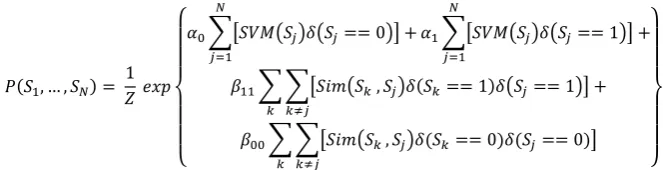
The proposed joint probabilistic classification model considers the classification score from the SVM_TermsQSSim classifier on every sentence as well as the correlations
among all sentences to estimate the joint probability of the classification decisions of all
sentences via a probabilistic graphical model.
Applications of graphical models have been used to solve problems in many different
domains. As undirected graphs can be used to represent correlations between variables
[Cowell et al., 1999], an undirected probabilistic graphical model is used in this work for
the joint classification model. A Boltzmann machine [Hinton and Sejnowski, 1986] is a
special type of undirected graphical models that has been applied to tasks such as question answering [Ko et al., 2007]. The proposed joint probabilistic classification
model is a version of a Boltzmann machine adapted for text classification and can be seen
in detail in Figure 1.
is the classification score from the SVM_TermsQSSim classifier for the ith
sentence in a problem and is used to produce a sentence relevance score for an individual
sentence; , is the similarity score between a sentence and another sentence
in a problem and represents the correlation among sentences; 1 is an indicator
function and is 1 if the sentence is relevant, 0 otherwise; 0 is again an
indicator function and is 1 if the sentence is irrelevant, 0 otherwise; , , , are
model parameters and are estimated from the training data by maximizing the log
likelihood using the Quasi-Newton algorithm [Minka, 2003]. As can be seen in Figure 1, the joint probabilistic classification model not only utilizes the correlation between the
question sentence and other sentences along with the sentence text (i.e., by including
scores), but also considers the correlation among all sentences (i.e., by
incorporating , scores). The joint model helps to make a more accurate
decision for the sentences whose SVM_TermsQSSim scores are not accurate (i.e.,
leading to wrong categorization) but have high similarity with sentences of the same , … , 1
0 1
, 1 1
, 0 0
class, as high similarity scores will compensate for the total sum in the exponential in Figure 1.
For a test problem of N sentences, all possible configurations that consider sentences
as relevant or irrelevant are calculated (i.e. each sentence can be relevant or irrelevant, making a total of 2 configurations to consider for N sentences) with the joint
probabilistic model using the estimated parameters. The configuration with the highest
probability gives the joint probabilistic classification decision for all sentences of that
problem. Note that calculation of all configurations is a burden if the number of nodes in
the graph (i.e., number of sentences to jointly classify) is large. In a math word problem,
there are less than 10 sentences which is a key point that makes it possible to model a
joint probabilistic classifier, unlike traditional classification tasks where there are too
many documents to consider and joint classification is intractable.
The joint probabilistic classification model will be referred to as
JointProbClass_Model.
2.4 Avoiding Stopwords’ Elimination
As a common text preprocessing technique, stopword removal, suggests that many of the
most frequent terms in English such as why, where, he, she, there, is, etc. are not content
words as they appear almost in every document, do not carry important information about
the context of the documents and should be removed [Frakes and Baeza-Yates, 1992;
Scott and Matwin, 1999; Sebastiani, 2002]. However, prior research has also shown that
stopwords can be useful for text categorization of mathematical word problems (i.e. with respect to their types) [Cetintas et al., 2009]. In this paper, the effect of avoiding
stopwords' removal over classifier performance is explored in two ways: i) when they are
not removed for the bag of words representation of the input space for the SVM
classifiers, and ii) when the correlations among sentences are calculated with the cosine
similarity measure. We used the Lemur information retrieval toolkit2 for stopwords'
removal and stemming. Stemming is applied to the data for all the models in this work. In
particular the INQUERY stopwords list and Porter stemmer were utilized respectively [Porter, 1980].
2.5 Utilizing Part of Speech (POS) Tagging
Part of speech (POS) tagging is the process of identifying the corresponding linguistic
category (e.g. noun, verb, adjective, adverb, etc.) of words in a text. In recent prior
research, part of speech tagging has been shown to be useful for the classification of mathematical word problem with respect to their types [Cetintas et al. 2009]. The main
intuition for utilizing the part of speech tagging is the fact that different parts of speech
can be discriminative for different classes in classification tasks. In this work, the effect
of utilizing part of speech tagging3 is explored for all proposed classification models. In
particular, part of speech frequencies of each sentence are included in the input space of
the SVM classifiers by including each of the frequencies as an additional input
feature/dimension (i.e. 1 new feature for each part of speech, making a total of 36 new
features).
3. EXPERIMENTAL METHODOLOGY
3.1 Dataset
To the best of our knowledge, there is no work done using mathematical word problems
so far and therefore we built our own corpora for our experiments. Hence we manually collected 120 mathematical word problems that totally include 518 sentences (out of
which 308 are relevant, and 210 are irrelevant) from Grade 3-5 mathematics textbooks
[Maletsky et al., 2004] under the guidance and with the help of our collaborators who are
experts in educational studies. The problems are grouped with respect to the number of
irrelevant sentences within each problem: there are 56 problems having exactly 1, 40
problems having exactly 2, and 24 problems having at least 3 irrelevant sentences. One
fourth of the problems in each group are used to train the models and the other three
fourths of the problems are used for testing. Details about the relevant/irrelevant
sentences are given in Table II.
3http://nlp.stanford.edu/software/tagger.shtml is used.
Table II. Statistics About Each Sentence Type. The number of average terms for each sentence
type after stemming and stopwords' removal under the default column; after stemming and
avoiding stopwords' removal under the with stopwords column.
Sentence Type
Number of Total Sentences
Average Length (Words)
default with stopwords
Relevant 308 5.42 10.39
3.2 Evaluation Metric
To evaluate the effectiveness of the categorization of relevant and irrelevant sentences,
we use the common measure, which is the harmonic mean of precision and recall
[Baeza-Yates et al., 1999; Rijsbergen, 1979]. Precision (p) is the ratio of the correct categorizations by a model divided by all the categorizations of that model. Recall (r) is
the ratio of correct categorizations by a model divided by the total number of correct
categorizations. A higher value indicates a high recall as well as a high precision.
2
(3)
4. EXPERIMENT RESULTS
This section presents the experimental results of the methods that are proposed in the
Methods and Modeling Approaches section. All the methods were evaluated on the
datasets as described in Section 3.1.
An extensive set of experiments was conducted to address the following questions:
1. How effective is the TC method that utilizes the correlation between the question sentence and other sentences along with sentence text
(SVM_TermsQSSim) in comparison to the approach that only uses sentence text
(SVM_TermsOnly)?
2. What is the effect of stopwords’ removal over the performances of all
classifiers?
3. What is the effect of utilizing part of speech (POS) tagging over the
performances of all classifiers?
4. How effective is the joint probabilistic classification model that additionally
utilizes the correlation between all sentences (JointProbClass_Model)?
4.1 The Performance of SVM_TermsQSSim
The first set of experiments was conducted to measure the effect of utilizing the
correlation between the questions sentence and other sentences in the classification
model. The details about this approach can be found in Section 2.2.
More specifically, SVM_TermsQSSim classifier is compared with SVM_TermsOnly
classifier on the categorization of relevant and irrelevant sentences in math word
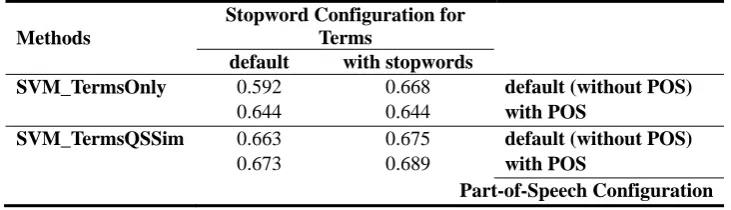
the SVM_TermsQSSim classifier almost always outperforms (for 5 out of 6 comparisons; i.e., for 4 comparisons in Table III and 2 additional comparisons in Table IV) the
SVM_TermsOnly classifier. The only exception occurs due to the fact that
SVM_TermsQSSim classifier loses it advantage of utilizing the correlation between the
question sentence and other sentences when stopwords are removed during the
correlation estimation in which case estimated correlations are not accurate enough.
Paired t-tests have been applied for this set of experiments and statistical significance
with p-value of less than 0.001 has been achieved in 4 out of 6 comparisons in favor of
using the correlation between the question sentence and other sentences along with terms
Table III. Results of the SVM_TermsQSSim and SVM_TermsOnly classifiers in comparison to
each other for two stopword configurations: when stopwords are i) removed or not for the bag of
words representation of the input space for the SVM classifiers and ii) when stopwords are
removed or not while correlations between the question sentence and other sentences are
calculated for each problem. The performance is evaluated with the measure.
Methods
Stopword Configuration for Terms
default with stopwords
SVM_TermsOnly 0.592 0.668
SVM_TermsQSSim 0.651 0.660 default
0.663 0.675 with stopwords
Stopword Configuration for Similarity Estimation
Table IV. Results of the SVM_TermsQSSim and SVM_TermsOnly classifiers in comparison to
each other for two main configurations for the bag of words representation of the input space for
the SVM classifiers: i) when stopwords are removed or not and ii) when part of speech tagging
is utilized or not. The performance is evaluated with the measure.
Methods
Stopword Configuration for Terms
default with stopwords
SVM_TermsOnly 0.592 0.668 default (without POS)
0.644 0.644 with POS
SVM_TermsQSSim 0.663 0.675 default (without POS)
0.673 0.689 with POS
over the standard text categorization approach of only using the sentence text. To the best of our knowledge, this is the first work to categorize relevant and irrelevant sentences in
math word problems. Results discussed above show that utilizing the correlation between
the question sentence and other sentences significantly improves the categorization of
relevant and irrelevant sentences in math word problems and the correlation should not
be neglected.
4.2 The Effect of Stopwords’ Removal
The second set of experiments was conducted to evaluate the effectiveness of including stopwords along with other words i) as terms that constitute the feature space of the SVM
models, and ii) as terms that constitute the feature space to be used by the Cosine
similarity to measure the similarity between sentences (or term vectors) in a word
problem. The details about this approach are given in Section 2.4.
This section specifically compares all classifiers with themselves with respect to their
performances when stopwords are included or not as additional dimensions to their
feature spaces. It can be seen from the results in Table III that SVM_TermsOnly
classifier has a statistically significant performance improvement (with p-value less than 0.001) when stopwords are included in the feature space of the SVM_TermsOnly
classifier. For the SVM_TermsQSSim classifier, inclusion of stopwords are two-fold, as
discussed above, i) they can be incorporated into the feature space of their SVM models
(note that 2 comparisons in Table III and 1 more comparison in Table IV can be made),
ii) they can be incorporated into the feature space of Cosine similarity (note that 2
comparisons can be made in Table III). For the second configuration (i.e., when
stopwords are incorporated into the feature space of Cosine similarity or not), statistically
significant results have been achieved (with p-value less than 0.01) in favor of including the stopwords into the feature space of Cosine similarity for both comparisons. For the
first configuration, statistically significant results (with p-value less than 0.05) have again
been achieved in favor of including the stopwords into the feature space of SVM models
for 2 out of 3 comparisons and these results are consistent with the prior work on the
categorization of mathematical word problems with respect to their types [Cetintas et al.,
2009]. The only exception occurs due to the fact that SVM_TermsQSSim classifier
behaves relatively bad when stopwords are removed during the correlation estimation in
which case estimated correlations are not accurate enough (note the same exception
performance of SVM_TermsQSSim classifier due to the fact that incorporation of the sentence to question sentence similarities into the SVM model becomes effective enough
for resulting in a superior performance over the configuration of the SVM_TermsOnly
classifier that eliminates stopwords.
4.3 The Performance of Utilizing Part of Speech (POS) Tagging
The third set of experiments was conducted to evaluate the effectiveness of utilizing part
of speech tagging (i.e., including part of speech frequencies) into the feature space of the
feature space of the SVM models. The details about this approach are given in Section 2.5.
This section specifically compares all classifiers with themselves with respect to their
performances when part of speech frequencies are included or not as additional
dimensions to their feature spaces. It can be seen from the results in Table IV and V that
utilization of part of speech tagging does not always improve the categorization
performance. Statistical significance (with p-value less than 0.001) has been achieved for
some of the comparisons both in favor of and against using part of speech tagging.
Specifically, statistical significance (with p-value less than 0.05) has been achieved in favor of using POS tagging for SVM_TermsQSSim classifier for both stopword
configurations in Table IV. Similarly, significant improvement has been observed (with
p-value much less than 0.001) for SVM_TermsOnly classifier for the “default”
configuration of stopwords in Table IV whereas significantly worse (with p-value less
than 0.001) results have been observed for the “with stopwords” configuration in Table
IV. For the JointProbClass_Model classifier, the observed results that can be seen in
Table V have been found to be not significantly different (i.e., p-value bigger than 0.05)
in favor of or against using POS tagging. Overall, utilizing POS tagging has not been found to be an effective approach to improve the effectiveness of the categorization
although it has been shown to be effective for the categorization of math word problems
with respect to their types in [Cetintas et al., 2009]. This can be explained by the fact that
almost all of the POS frequencies (except for NNPN & WRP) are uniformly distributed
among the relevant and irrelevant sentences in math word problems as it can be seen in
Figure 2. Indeed, WRP tag covers some discriminative stopwords like “how” that can
mostly be seen in relevant sentences. This helps the SVM_TermsOnly classifier alleviate
the performance loss in case of stopwords removal (i.e., the “default” stopword
4.4 The Performance of the Joint Probabilistic Classification Model
(JointProbClass_Model)
The final set of experiments was conducted to evaluate the effectiveness of incorporating
the correlations between all sentences into the classification models, namely the joint
probabilistic classification model. The details about this approach are given in Section
2.3.
Particularly JointProbClass_Model classifier is compared with SVM_TermsQSSim
classifier (with the configuration that includes stopwords in the feature space used during the correlation estimation) and SVM_TermsOnly classifier. The performance of
JointProbClass_Model classifier is shown in Table V. It can be seen that the
JointProbClass_Model classifier outperforms both the SVM_TermsOnly classifier and
the SVM_TermsQSSim classifier for both POS configurations. Statistical significance
(with p-value much less than 0.001) has been achieved in favor of utilizing the Fig. 2. Distribution of parts of speech across relevant and irrelevant sentences (frequencies averaged per
sentence) in math word problems.
Table V. Results of the JointProbClass_Model, SVM_TermsQSSim and SVM_TermsOnly
classifiers in comparison to each other for two configurations: when part of speech tagging is i)
utilized and ii) not utilized for the input space of the SVM classifiers. The performance is evaluated
with the measure.
Methods Part-of-Speech Configuration
with POS without POS
SVM_TermsOnly 0.644 0.668
SVM_TermsQSSim 0.689 0.675
JointProbClass_Model 0.710 0.716
CCCD DT EXFW IN JJ JJR JJS LS MDNN NNS NNPNNPS PDT POS PRP PRP$ RB RBR RBS RP SYM TO UH VBVBD VBG VBN VBP VBZ WDT WP WP$ WRB 0
0.2 0.4 0.6 0.8 1 1.2 1.4 1.6
Part-of-Speech (POS) Tags
A
ver
ag
e #
o
f P
O
S
T
ag
s
correlation between all sentences for all four comparisons in Table V. It should be noted that the improvement gained by using the correlation between all sentences help to
achieve the highest and most significant improvement among all models, and
configurations (except the performance jump by the approach of including stopwords into
the feature space of the SVM_TermsOnly classifier over the weak baseline). This set of
experiments explicitly shows that although utilizing the correlation between the question
sentence and other sentences in a problem is highly beneficial to better see the
relationship between relevant sentences in the problem, it is not enough when some of the
relevant sentences do not have too much in common with the question sentence. Therefore, a joint classification model in which the correlations between all sentences are
taken into account becomes significantly much more effective. Regarding the fact that
irrelevant sentences do not have much in common with the question sentence, this joint
model is able to capture the relationship between irrelevant sentences as well as the
relationship between relevant sentences. Prior work on categorization of relevant and
irrelevant questions asked in a micro-blogging supported classroom showed the
effectiveness of utilizing the correlation between the questions and available lecture
materials [Cetintas et al., 2010]. Since i) there is no external source that can be utilized for the categorization of sentences in math word problems, and ii) there are much less
sentences in a math word problem than questions asked in a lecture, a joint probabilistic
model becomes tractable to capture the correlations between all sentences in math word
problems. Experiments results demonstrate the effectiveness of utilizing a joint
probabilistic classification approach as well as utilizing the correlations between all
sentences.
5. CONCLUSIONS, DISCUSSION AND FUTURE WORK
Categorization of relevant and irrelevant sentences in math word problems is an
important step for estimating the difficulty level of math word problems [Marzocchi et
al., 2002; Mastropieri and Scruggs, 2006; Passolunghi and Siegel, 2001] and this is an important task for many applications. Systems that use problem posing for accelerating
content authoring or for deepening students’ understanding need to automatically assess
the difficulty level of problems posed by students (especially for being able to model
students’ problem posing performances) [Birch and Beal, 2008]. Systems that try to
automate the process of problem solving (e.g., STUDENT system) need to deal with
verbose problems and irrelevant information [Bobrow, 1964]. Similarly, systems that try
analyzing the math word problems (e.g., by categorizing their types as in [Cetintas et al., 2009]) need to also analyze the difficulty levels of the problems before the problems
become usable.
This paper proposes a novel application of text categorization to identify relevant and
irrelevant sentences in math word problems. Several modeling approaches and several
preprocessing configurations are studied for this application through extensive
experiments. Empirical results show that utilizing the correlation between the question
sentence and other sentences is significantly more effective than using sentence text only.
Similarly, utilizing the correlations among all sentences (along with the correlation between the question sentence and other sentences and sentence text) has been found to
be significantly more effective than i) the approach of utilizing the correlation between
the question sentence and sentence text and ii) the approach that only uses sentence text.
Furthermore, it is found to be significantly more effective to include stopwords into the
feature space of SVM classifiers as well as into the feature space to be used by the Cosine
measure during the correlation estimation. Finally, utilizing part of speech tagging is
found not to be effective, although it has been shown to be useful for categorizing
mathematical word problems with respect to their types in prior work.
There are several possibilities to extend the research. The first direction for potential
future work results from the fact that the accuracy of the proposed classifiers is not high
enough to utilize directly. It should be noted that this is the first work on categorization of
relevant and irrelevant sentences in mathematical word problems, and several
state-of-the-art text categorization techniques have been used as well as several novel approaches
that have been proven to be effective. The fact that the accuracy of the best classifier is
still not high enough is mainly due to three reasons. Firstly, sentences are very short (as
shown in Table II), and this makes the classification task substantially harder due to data sparsity. Secondly, although both relevant and irrelevant sentences are correlated among
themselves more, they are also correlated with each other since all of them give
information about the same problem within the same context. This correlation makes the
classification task significantly harder as well. These challenges have also been observed
in the recent related study on identifying relevant and irrelevant questions in a
micro-blogging supported classroom [Cetintas et al., 2010; Cetintas et al., To Appear]. Thirdly,
only a small amount of training data has been used in this study. Therefore, it is
worthwhile to see the effect of using more training data on the performance of the
used directly whereas the decisions that the classifiers are not confident enough can be forwarded for human judgment). The second direction for potential future work is due to
the fact that the SVM classifiers in this work are using single words as their features (i.e.,
unigram model). It may be helpful to explore n-gram models. However, it should be
noted that bi-gram or n-gram models are harder to learn (due to much larger feature
space). With the fact that the sentences are short and the number of available math
problems is limited, overfitting will be a problem that will have to be dealt with. Yet, it is
still worthwhile to explore this direction in detail in a separate throughout study.
ACKNOWLEDGEMENTS
This research was partially supported by the NSF grants IIS-0749462, IIS-0746830 and DRL-0822296. Any opinions, findings, conclusions, or recommendations expressed in this paper are the authors', and do not necessarily reflect those of the sponsor.
REFERENCES
ARROYO, I. & WOOLF, B. P. 2003. Students in AWE: changing their role from consumers to producers of ITS content. In Proceedings of the 11th International
AIED Conference, Workshop on Advanced Technologies for Math Education.
ARROYO, I., SCHAPIRA, A. & WOOLF, B. P. 2001. Authoring and sharing word problems with AWE. In Proceedings of the 10th International AIED Conference. BAEZA-YATES, R. AND RIBEIRO-NETO, B. 1999. Modern information retrieval.
ACM Press Series/Addison Wesley, 75-82.
BEAL, C. R. 2007. On-line tutoring for math achievement testing: A Controlled Evaluation. In Journal of Interactive Online Learning, 6(1):43-55.
BIRCH, M., & BEAL, C. R. 2008. Problem posing in AnimalWatch: an interactive system for student-authored content. In Proceedings of the 21st International
FLAIRS Conference.
BOBROW, D. 1964. Natural Language Input for a Computer Problem Solving System. PhD Thesis, MIT.
BROWN, S. I. & WALTER, M. I. 1990. The art of problem posing. Hillsdale NJ: Lawrence Erlbaum.
CETINTAS, S., SI, L., CHAKRAVARTY, S., AAGARD, H. P., BOWEN, K. 2010. Learning to identify students’ relevant and irrelevant questions in a micro-blogging supported classroom. In Proceedings of ITS-10, the 10th International
Conference on Intelligent Tutoring Systems, 281-284.
CETINTAS, S., SI, L., AAGARD, H. P., BOWEN, K., & CORDOVA-SANCHEZ, M. (To Appear). Micro-blogging in classroom: Classifying students’ relevant and irrelevant questions in a micro-blogging supported classroom. In IEEE Transactions on Learning Technologies (Accepted October 2010).
CETINTAS, S., SI, L., XIN, Y. P., ZHANG, D., PARK, J. Y. 2009. Automatic text categorization of mathematical word problems. In Proceedings of the 22nd
International FLAIRS Conference, 27-32.
COWELL, R. G., DAWID, A. P., LAURITZEN, S. L. & SPIEGELHALTER, D. J. 1999.
FRAKES, W. and BAEZA-YATES, R. 1992. Information retrieval: data structures and
algorithms. Prentice Hall, Englewood Cliffs, NJ.
GOLLUP, J.P., BERTENTHAL, M., LABOV, J., CURTIS, P. C. 2002. Understanding: improving advanced study of mathematics and science in US high schools. National Academy Press, Washington, DC.
HINTON, G. and SEJONWSKI, T. 1986. Learning and relearning in Boltzmann
machines. In Rumelhart, editor, Parallel Distributed Processing, 282–317. MIT
Press.
HIRASHIMA, T., YOKOYAMA, T, OKAMOTO, M., & TAKEUCHI, A. 2007. Learning by problem-posing as sentence-integration and experimental use. In
Proceedings of the 13th International AIED Conference.
JOACHIMS, T. 1998. Text categorization with support vector machines: learning with many relevant features. In Proceedings of ECML-98, 10th European Conference
on Machine Learning.
JOACHIMS, T. 1999. Making large-scale support vector machine learning practical. MIT Press.
KO, J. and NYBERG, E. and SI, L. 2007. A probabilistic graphical model for joint answer ranking in question answering. In Proceedings of ACM SIGIR-07, 30th ACM SIGIR Conference on Research and Development in Information Retrieval, 343-350.
KOEDINGER, K. R., ANDERSON, J.R., HADLEY, W.H., & MARK, M. A. 1997. Intelligent tutoring goes to school in the big city. In International Journal of
Artificial Intelligence in Education, 8, 30-43.
MALETSKY, E. M., ANDREWS, A. G., BURTON, G. M., JOHNSON, H. C., LUCKIE, L. A. 2004. Harcourt Math (Indiana Edition). Chicago: Harcourt.
MARZOCCHI, G. M., LUCANGELI, D., MEO, T. D., FINI, F., CORNOLDI, C. 2002. The disturbing effect of irrelevant information on arithmetic problem solving in inattentive children. In Developmental Psychology, 21(1): 73-92.
MASTROPIERI, M. A. & SCRUGGS, T. E. 2006. The inclusive classroom: Strategies
for effective instruction. New Jersey: Prentice Hall.
MINKA, T. 2003. A comparison of numerical optimizers for logistic regression. Unpublished draft.
PASSOLUNGHI, M. C. AND SIEGEL, L. S. 2001. Short-term memory, working memory, and inhibitory control in children with difficulties in arithmetic problem solving. In Journal of Experimental Child Psychology, 80(1): 47-57.
PORTER, M. F. 1980. An algorithm for suffix stripping. In Program: Electronic Library
and Information Systems, 14(3):130–137.
RIJSBERGEN, C. J. v. 1979. Information retrieval, 2nd edition. University of Glasgow. RITTER, S., ANDERSON, J., CYTRYNOWICZ, M., & MEDVEDEVA, O.1998.
Authoring content in the PAT algebra tutor. In Journal of Interactive Media in
Education, 98(9).
SCOTT, S. and MATWIN, S. 1999. Feature engineering for text classification. In Proceedings of ICML-99, 16th International Conference on Machine Learning. SEBASTIANI, F. 2002. Machine learning in automated text categorization. In ACM
Computing Surveys, 34(1):1–47.
SHIAH, R., MASTROPIERI, M. A., SCRUGGS, T.E., & FULK, B..M. 1995. The effects of computer-assisted instruction on the mathematical problem solving of students with learning disabilities. In Exceptionality.
U.S. DEPT. OF EDUCATION. 2006. No Child Left Behind is working. Retrieved
VERSCHAFFEL, L., GREER, B., CORTE, D. E. 2000. Making sense of word problems. Taylor & Francis.
YANG, Y. & LIU, X. 1999. A re-examination of text categorization methods. In Proceedings of SIGIR-99, 22nd ACM SIGIR Conference on Research and