© 2016, IRJET | Impact Factor value: 4.45 | ISO 9001:2008 Certified Journal
| Page 1533
PAPR REDUCTION IN MIMO-OFDM SYSTEM USING LDPC CODES
Samboju Alekya
11
M.Tech Student( wireless and mobile communications),
Department of ETM,
GNIT, Hyderabad, Telangana,
India
[email protected]
---***---Abstract
-
Peak-to-average power ratio (PAPR) is a
major drawback in most multi-carrier communication
techniques such as orthogonal frequency division
multiplex system (OFDM). OFDM consists of lots of
independent modulated subcarriers, as a result the
amplitude of such a signal can have very large values.
These large peaks increase the amount of
intermodulation distortion resulting in an increase in
the error rate. The PAPR of an OFDM signal can be
reduced in several ways: selective mapping, Golay
sequences, cyclic coding, clipping and filtering, and
multiple signal representation techniques. The authors
have improved the performance of the OFDM system by
using low-density parity-check (LDPC) codes as an
alternative to turbo coding in mitigating the PAPR
problem which has been used in the pervious works of
the authors. The authors present the design for the
proposed (LDPC) code technique that achieves good
error correction performance and is used to lower the
PAPR in a multiple-input multiple-output OFDM system.
By using QCLDPC codes the PAPR can be further reduced
in OFDM system compared to that of LDPC codes. The
simulation results show that 6–60% reduction in PAPR
over current values in the literature can be achieved
depending on the system type.
Key Words: Peak to Average Power Ratio, Orthogonal Frequency Division Multiplexing, Low Density Parity Check Codes, Quaci-cyclic LDPC codes.
1.INTRODUCTION
In the past decade, two powerful techniques have come to the forefront of technology, namely orthogonal frequency division multiplex (OFDM) and input multiple-output (MIMO) and when combined, prove to have serious advantages over traditional communications systems. OFDM has several significant advantages over traditional serial communications; such as the ability to support high data rates for wide area coverage, robustness to multipath fading and a greater simplification of channel equalisation. Because of these advantages, OFDM has been adopted in both wireless and wired applications in recent years [1–4] including wireless networking (IEEE 802.11), digital
terrestrial television broadcasting and Broadband Radio Access Network (BRAN). However, the main drawback of OFDM is its high PAPR.
In an OFDM system the data is transmitted over a number of parallel frequency channels, each being modulated by a baseband QAM or PSK symbol. As a result the amplitude of such a signal can have very large values. When high-peak power signals pass through power amplifiers, A/D and D/A converters, peaks are distorted non-linearly because of amplifier and converters imperfection [2]. Thus, the output signal will suffer from intermodulation distortion resulting in energy being generated at frequencies outside the allocated bandwidth. Therefore average signal power must be kept low in order to prevent the transmitter amplifier and other circuitry limiting. Minimising the PAPR allows a higher average power to be transmitted for a fixed peak power, improving the overall signal to noise ratio at the receiver. To ease the impairment caused by high sensitivity to nonlinear distortion of OFDM; Al-Akaidi et al. [5] introduced a novel technique to improve the OFDM systems’ efficiency by mitigating the PAPR problem based on turbo coding. The deficiency can be mitigated by a number of other techniques proposed for tackling the PAPR problem which include amplitude clipping; clipping and filtering; coding; and multiple signal representation techniques, selected mapping or partial transmit sequences. It has been shown that amplitude clipping leads to an increase in the bit error rate (BER), whereas coding schemes decrease the net bit rate. As a general rule, these techniques achieve PAPR reduction at the expense of an increase in transmitted signal power, an increase in BER, a higher loss in data rate, or an increase in computational complexity.
In this paper we continue the work we started in [5–7], in that work we have used LDPC Codes to mitigate the PAPR problem, in this work we improve the performance of the MIMO-OFDM system by using Quasi-cyclic low-density parity-check (QCLDPC) codes.
© 2016, IRJET | Impact Factor value: 4.45 | ISO 9001:2008 Certified Journal
| Page 1534
2.LDPC CODES
LDPC code is a linear error correcting code, a method of transmitting a message over a noisy transmission channel. LDPC is constructed using a sparse bipartite graph. LDPC codes are capacity approaching codes, which means that practical constructions exist that allow the noise threshold to be set very close (or even arbitrarily close on the BEC) to the theoretical maximum (the Shannon limit) for a symmetric memory less channel. The noise threshold defines an upper bound for the channel noise, up to which the probability of lost information can be made as small as desired. Using iterative propagation techniques, LDPC codes can be decoded in time linear to their block length.
LDPC codes (also known as Gallager codes) have recently received much attention from the communications industry because of their excellent error-correcting performance as well as having a highly parallelisable decoding algorithm even though they were developed half century ago. In 2003, the LDPC code beat six alternative turbo codes to become the error correcting code in the second generation standard for satellite transmission of digital television [8] and has already been proposed for the next generation digital terrestrial television standards [9]. However, two challenges still remain largely unsolved: (1)Complexity reduction and effective VLSI architecture design for LDPC encoder remain largely unexplored; (2) Given the desired node degree distribution, no systematic method has ever been proposed to construct the code for hardware implementation. The current practice largely relies on handcraft [10]. In this paper, a code design is proposed for LDPC codes to tackle the above two challenges. In designing the LDPC code the following design properties should be observed in order to obtain good code performance; first the code should be long enough, as performance improves with the code length. Second, few small cycles in the code bipartite graph as too many of them will seriously degrade the error-correcting performance. it can be seen that the encoding complexity could be reduced significantly by using a criteria based on back-substitution once the parity check matrix has been changed into an upper matrix.
Fig 1: The encoder-aware parity check matrix structure
On the other hand, despite the parity check matrix is approximate upper matrix the back-substitution operation is highly reused. This drawback mitigated in [11] (where the back-substitution operation is replaced by a few matrix-vector multiplications). To fulfil this replacement, the approximate upper triangular parity check matrix has the form shown in Fig 1, where I1 and I2 are identity matrices, Z is a zero matrix and g is the gap of the approximate
triangulation and is used to change the matrix into an upper triangular matrix. Most recently proposed LDPC decoder designs schemes share the same property; the parity check matrix is a block structured matrix that can be partitioned into an array of square block matrices where each is either a zero matrix or a cyclic shift of an identity matrix. Such block-structured parity check matrix directly leads to effective decoder hardware implementations.
2.1 QCLDPC codes
In this section, we introduce a quasi-cyclic LDPC code with circulant permutation matrices.
A.Classical Quasi-Cyclic LDPC Codes with Circulant Permutation Matrices:
Let P be a positive integer. Let I(∞) be a zero matrix of size P and I(1) = (aj,l) a matrix of size P such that aj,l = 1 if l − j = 1 and aj,l = 0 otherwise:
I(1)=
For an integer b, put I(b) := I(1)b. The matrix I(b) is called a circulant permutation matrix. The integer b is called the index of a circulant matrix I(b).
A linear code C is called a quasi-cyclic (QC) LDPC code (with circulant permutation matrices), if a parity-check matrix HC of C has the following block form:
,
where cj,l ∈ [P∞] := {0,1,...,P − 1}∪{∞}. We call such a matrix HC a QC-LDPC matrix. As it is known, a parity-check matrix is not determined uniquely for a given C. On the other hand, we would like to characterize a QC-LDPC code by a parity-check matrix. Therefore we describe a QC-LDPC codes as a pair (C,HC). Furthermore, we regard that (C,HC) and (C,HC′ ) are different LDPC codes for different QC-LDPC matrices HC and HC′ even if they have the same code space C. Let HC denote a matrix which consists of the indices of HC, in other words,
© 2016, IRJET | Impact Factor value: 4.45 | ISO 9001:2008 Certified Journal
| Page 1535
have fruitful advantages for LDPC code theory. One ofadvantages is the memory size for storing the parity-check matrix. Widely meaning, an LDPC code (C,HC) is defined as a kernel space C associated with a low-density matrix HC, where a low-density matrix is a matrix such that that most of elements are zero. It is possible to construct a low-density parity-check matrix randomly. Imagine a randomly constructed low-density parity-check matrix. Because of the randomness, large size memory is required to store the parity-check matrix. On the other hand, it is not the case for QC-LDPC codes because the parity-check matrix is reconstructed by its model matrix.
QC-LDPC codes have advantage not only from the viewpoint of memory, but also from the viewpoint of error-correcting performance. In particular, with sum-product decoding, it is shown that the error-correcting performances of short length QC-LDPC codes, e.g. of length 100 , 1,000, 10,000, are similar to the ones of random LDPC codes with the same lengths [13]. In practical use, the available length of error-correcting code depends on a communication system. In fact, short length QC-LDPC codes are chosen for real communication systems, e.g. WiMAX and DVB-s2 [11], [12].
3. Proposed Technique
3.1 QCLDPC Design
For an effective encoder–decoder implementation, the parity check matrix has the approximation shown in Fig. 1 and has to be a block-structured matrix. There are two main constraints in constructing a good LDPC code: an approximate upper triangular form with as small gap matrix, g, as possible and the block-structured matrix feature. Starting from the observation in tackling these constraints, for irregular LDPC codes the variable nodes with high degree tend to converge more quickly than those with low degree. Therefore with a finite number of decoding iterations, not all the small cycles in the code bipartite graph are equally harmful. In other words, those small cycles that pass more low-degree variable nodes degrade the performance more seriously than others which do not. Thus, it is intuitive that small cycles should be prevented from passing too many low-degree variable nodes.
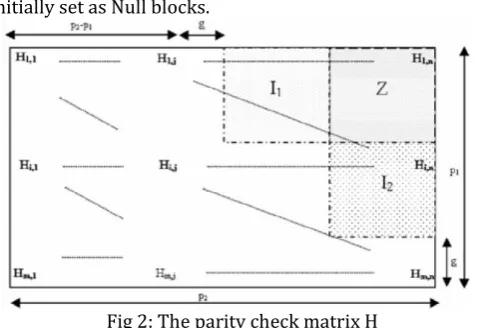
The size of each block matrix is b × b; the size of parity check matrix is p1 ×p2, where p1= mb and p2=nb (where m and n define the size of the parity check matrix) and g=γb, where γ is the total number of blocks in the g submatrix. The row and column weight distributions are{wr1, wr2, ... , wrn} and {wc1, wc2, ... , wcn} where wr1 and wcj represent the weight of ith block rows and jth columns, respectively. The output from these parameters will provide the components of the p1 × p2 parity check matrix, H. This matrix will be either a right cyclic shift of an identity matrix or a zero matrix. Fig. 2 shows the general case structure of the H matrix. As described in Fig. 2, I1 and I2 are identity matrices
[image:3.595.316.555.112.276.2]with same size and Z is a zero matrix. The other blocks are initially set as Null blocks.
Fig 2: The parity check matrix H
According the weight distribution of the matrix columns and rows, two different sets of weight distributions have been generated
{a1, a2, ... , an}, where wcn, 1≤ j ≤(n − m +γ)
aj = wcj −1, 1 ≤ (n – m + γ ≤ j ≤ n) (1)
{b1, b2, ... , bm}, where
wri −1, 1 ≤ i ≤ (m −γ) ai=
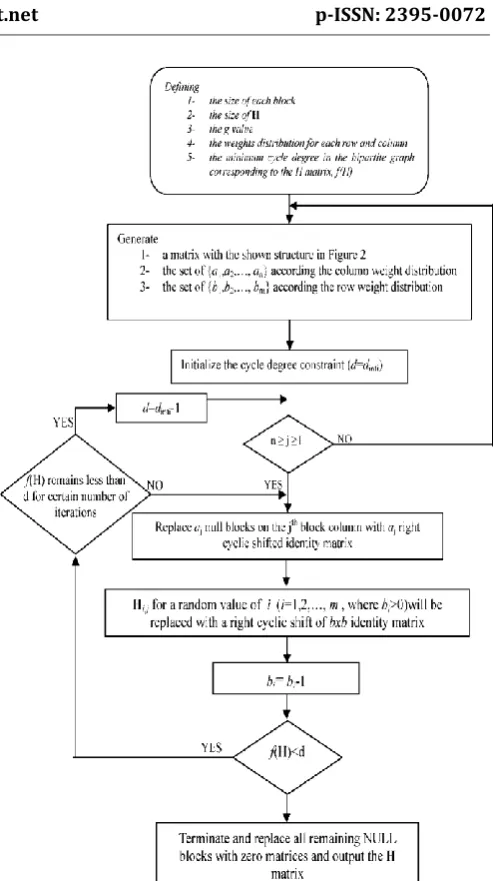
wri , (m − γ +1 ≤ i ≤ m) (2) Starting with j=1, the aj null blocks on the jth block column will be replaced by aj identity matrix. This is attained by:
1. Replacing Hi,j ,with a right cyclic shift of b×b identity
matrix with a randomly generated shift value (i is randomly picked from the set of f1, 2, ... , mg and bi . 0).
2. If the minimum cycle degree is less than the initial cycle
degree, the replacement will be rejected and step 1 will be repeated (bearing in mind that for all variable nodes on a cycle, the sum of degrees is defined as the cycle degree of this cycle. The node degree distribution is equivalent to the parity check matrix row and column weight distribution [14]. It is, therefore intuitively desirable to make the cycle degree as large as possible for those unavoidable small cycles).
3. Let bi =bi −1
4. If d , dmin, terminate and restart the procedure where d
and dmin are the calculated node degree distribution and the minimum node distribution threshold.
5. The remaining null blocks should then be replaced with
zero matrices resulting in the output matrix. For more clarity, a flowchart of the encoding procedure is shown in Fig 3.
© 2016, IRJET | Impact Factor value: 4.45 | ISO 9001:2008 Certified Journal
| Page 1536
parity check matrix could be written according to Fig. 2 asan upper triangular matrix and a combination of some other sparse matrices (each of them consist of at most O(p2) elements) as follows
H
where, A is (p1 − g) × (p2 −p1), B is (p1 − g) × ( g), C is an upper triangular matrix (where C = C−1) in the size of (p1 − g) × (p1 2 g), D is ( g) × (p2 − p1), E is ( g) × ( g) and F is ( g)× (p1 − g).
After creating H matrix encoding is performed for the OFDM system and PAPR is calculated before transmission and the decoding used is Log domain Sum-Product decoding algorithm and then BER is calculated.
PEAK-TO-AVERAGE POWER RATIO In presence of large number of independently modulated sub-carriers in OFDM system the peak value of the some signals can be very high as compared to the average of the whole system. The complex envelope of an OFDM signal is an overlap of N complex oscillation with different frequencies, phases and amplitudes. As a result, we get a time domain signal with high peak to Average Power Ratio. These peaks may cause signal clipping at high levels and may force the amplifier in the transmitter side to work in the non linear region, thereby producing frequency components in addition to the original and results in out of band radiation. The main concept of this paper is to reduce the high peak value before transmission is carried out. The ratio of the peak to average power value is termed as Peak To Average Power Ratio. Mathematically PAPR can be given as:
(3)
Where is the peak signal power and is the average signal power. The average power is calculated using the formula:
Average power=
[image:4.595.315.562.64.505.2]The Complementary Cumulative Distribution Function (CCDF) of the PAPR is one of the most frequently used method to check how often the PAPR exceed the threshold values.
Figure 3: The flowchart of generating the H matrix
Graph is plotted among threshold and CCDF values. The CCDF can be calculated by the relation
P(PAPR>X) =1-P(PAPR<X). The formula for calculating the threshold value is:
4. SIMULATION RESULTS
© 2016, IRJET | Impact Factor value: 4.45 | ISO 9001:2008 Certified Journal
| Page 1537
column of the parity check matrix is given by M=r×p andN=c×p respectively.
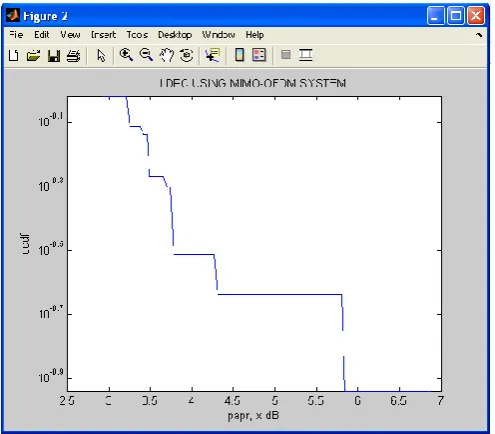
Figure 4 shows the CCDF plot for ½ coding rate of LDPC code with MIMO-OFDM system has reduced PAPR .The PAPR of OFDM is 6.73db and LDPC code with MIMO-OFDM is 3.243db. Hence PAPR is reduced.
[image:5.595.313.561.96.276.2]Figure 5 shows the CCDF plot for ½ coding rate, there is 3.011db reduction for QCLDPC. There is a difference of 1.113db when compared to LDPC codes and 2.249db difference when compared with OFDM system.
Figure 6 shows the BER plot vs SNR in which the result of QCLDPC OFDM system has better performance compared to that LDPC and OFDM system.
Fig. 4.Plot for PAPR reduction MIMO-OFDM system using LDPC codes.
[image:5.595.42.290.285.502.2]Fig. 5. Plot PAPR reduction in OFDM system with BPSK modulation.
Fig. 6. BER plot for OFDM without coding, LDPC codes, and QCLDPC codes
Table1:Comparison of PAPR reduction values by using LDPC, QCLDPC and OFDM system.
The comparison Table 1 states the PAPR reduction by applying different coding techniques with BPSK in OFDM and MIMO-OFDM systems. The simulation results and comparison table defines that LDPC codes shows good PAPR reduction when compared to MIMO-OFDM system and QCLDPC codes gives better reduction when compared to LDPC codes.
5. CONCLUSION AND FUTURESCOPE
The QCLDPC codes have been used to reduce the PAPR effectively. The required memory size for storing the parity check matrices in QCLDPC codes can be reduced by the utilization of circulant matix. The advantages of QCLDPC codes in OFDM systems is that there is no need to store the full ‘H’ matrix since tail bits are not required for coding scheme where it provides additional bits for data transmission. The above work can be improved by using different LDPC, QCLDPC decoding algorithms in the receiver side to calculate the BER of the OFDM systems.
Future work can be extended by increasing the coding and spreading rates with different modulation schemes and BER can be analaysed for MIMO-OFDM QCLDPC by using different decoding methods at the receiver side.
Parameters Witho ut pre-coding
LDPC QC-LDPC
PAPR with
OFDM 6.73 4.124 3.011
PAPR with
[image:5.595.43.289.536.713.2]© 2016, IRJET | Impact Factor value: 4.45 | ISO 9001:2008 Certified Journal
| Page 1538
REFERENCES
[1] Reimers U.: ‘Digital video broadcasting’, IEEE
Commun.Mag., 1998, 36, (10), pp. 104–110.
[2] Nee V., Prasad R.: ‘OFDM wireless multimedia
communications’(Artech House, Boston, London, 2000).
[3] Saltzberg B.R.: ‘Comparison of single-carrier and
multitone digital modulation for ADSL applications’, IEEE Commun. Mag., 1998, 36, (11), pp. 114–121.
[4] Juntti M., Vehkapera M., Leinonen J., Zexian V., Tujkovic
D., Tsumura S., Hara S.: ‘MIMO MC-CDMA communications for future cellular systems’, IEEE Commun. Mag., 2005, 43, (2), pp. 118–124.
[5] Al-Akaidi M., Daoud O., Linfoot S.: ‘A new turbo coding
approach to reduce the peak-to-average power ratio of a multi-antenna-OFDM’, Int. J. Mobile Commun., 2007, 5, (3), pp. 357–369.
[6] Al-Akaidi M., Daoud O.: ‘Reducing the peak-to-average
power ratio using turbo coding’, IEE Proc. Commun., 2006, 153, (6), pp. 818–821.
[7] Al-Akaidi M., Daoud O., Gow J.: ‘MIMO-OFDM-based
DVBH systems: a hardware design for a PAPR reducing technique’, IEEE Trans. Consumer Electron., 2006, 52, (4) , pp. 1201–1206.
[8] European Telecommunication Standards Institute
(ETSI): ‘Digital video broadcasting; second generation framing structure, channel coding and modulation systems for broadcasting, interactive services, news gathering and other broadband satellite applications’, TR102 376, V 1.1.1, 2005.
[9] Digital Video Broadcasting Group: DVB-T2 Call for
Technologies, SB1644 r1, April 2007.
[10] Hocevar D.E.: ‘LDPC code construction with flexible
hard-ware implementation’. IEEE Int. Conf. Commun., 2003, pp. 2708–2712.
[11] Zhang T., Parhi K.K.: ‘Joint (3, k)-regular LDPC code and
decoder/encoder design’, IEEE Trans. Signal Process., 2004, 52, (4), pp. 1065–1079.
[12] R.M.Tanner, D.Sridhara and T.Fuja, “A Class of
Group-Structured LDPC Codes,” Proc. of ISTA, Ambleside, England, 2001.
[13] M.P.C.Fossorier, “Quasi-Cyclic Low-Density
Parity-Check Codes From Circulant Permutation Matrices,” IEEE Trans. Inform. Theory, Vol.50, No.8, pp.1788-1793, 2004.
[14] Richardson T., Shokrollahi A., Urbanke R.: ‘Design of
capacity-approaching low-density parity-check codes’, IEEE Trans. Information Theory, 2001, 47, (2), pp. 619– 637.
[15] Abhishek Tripathi, Komal Arora, “Different Channel
coding techniques in MIMO-OFDM”.
[16] Gede Puja Astawa,Yoedy Moegiharto, Ahmad
Zainudin,“Performance Analysis of MIMO-OFDM using Convolution codes with QAM modulation”.
[17] O.Daoud, O.Alani, “Reducing the PAPR by utilization of
LDPC Code”.
[18] Omar Daoud, “Use of LDPC to improve the OFDM
system performance”.
[19] Richardson T., Urbanke R.: ‘Efficient encoding of
lowdensity parity-check codes’, IEEE Trans. Information Theory, 2001, 47, (2), pp. 638–656.
[20] Suverna.S, Partha PratimBhattacharya “Performance