Efficiency of economic development models
Oana Camelia IACOB, PhD candidate
Valahia University, Târgovişte, Romania [email protected]
Ana-Maria VOLINTIRU, PhD candidate
Valahia University, Târgovişte, Romania [email protected]
Andrei Mihai CRISTEA, PhD candidate Hyperion University, Faculty of Economic Sciences Calea Calarașilor no. 169, district 3, Bucharest, 030615
Abstract
The world economy is becoming increasingly integrated. Integrating emerging economies of Asia, such as China and India increase competition on the world stage, putting pressure on the "actors" already existing. These developments have raised questions about the effectiveness of European development model, which focuses on a high level of equity, insurance and social protection. According to analysts, the world today faces three models of economic development with significant weight in the world: the European, American and Asian. This study will focus on analyzing European development model, and a brief comparison with the United States. In addition, this study aims to highlight the relationship between efficiency and social equity that occurs in each submodel in part of the European model, given that social and economic performance in the EU are not homogeneous. To achieve this, it is necessary to analyze different indicators related to social equity and efficiency respectively, to observe the performance of each submodel individually. The article analyzes data to determine submodel performance according to social equity and economic efficiency.
Keywords: economic development; social justice; economic performance; European economic model.
JEL Classification: O11, E37
1. Introduction
Jacques Delors invented the term "European Social Model" in the mid 1990s to designate as an alternative to American capitalism. The basic idea of this model is that economic and social processes must go hand in hand, in other words, economic growth is combined with social cohesion. There are three key dimensions that characterize European socio-economic model and are reflected in different ways in a variety of European countries: accountability, regulation and redistribution.
model, the Anglo-Saxon, Continental, Mediterranean and more recently appeared "catching-up".
Northern sub-model is the model of European social-democratic and based on a high
level of social protection expenditure and ensuring the universality of social assistance. Countries can be ascribed to this development model (Denmark, Finland, Sweden and the Netherlands) are characterized by strong social dialogue and social partners close cooperation with the government, the unions involved in the economic.
Anglo-Saxon sub-model is a model of liberal capitalism in Europe (Ireland and UK) and emphasizes individual responsibility for themselves. Since the labor market is not regulated, there is strong competition in the market. Social transfers are lower than in other countries, more targeted and better "tested".
Continental sub-model (Austria, Belgium, France, Germany and Luxembourg) is
European capitalism model and it is based on employment and labor as the basis of social transfers. These transfers are financed by contributions from employers and employees. Social partners play an important role in industrial relations and wage bargaining is centralized. In addition, submodel is characterized by involvement of banks in financing projects in the medium and long term, with a more stable workforce and a stronger focus on the social protection system, although it can be noted an insufficient volume of investment in training and retraining processes of labor.
Mediterranean sub-model (Spain, Portugal, Italy and Greece) is characterized by low
social transfers, families still play an important role in providing security and shelter, unions and employers are important to the decentralized bargaining for wages and working conditions. Employment rate is low, especially for women. In addition, social spending is more concentrated for allocation pension. Welfare system is moving towards employment protection and early retirement provisions to exempt certain segments of the workforce from labor market participation.
As for "catching-up" model, it consists of the new Member States of Central and Eastern Europe (CEE) - former socialist states. This submodel includes the following countries: Czech Republic, Poland, Hungary, Slovakia, Slovenia, Estonia, Latvia, Lithuania, Romania and Bulgaria. There is heterogeneity within this submodel, because although these countries climb a transition to a developed market economy, there are differences in terms of national systems. Some countries (Slovakia, Hungary) offers more social protection through increased costs and other (Baltic States) prefer to remain at a low level and choose the stimulation of catching from other countries, promoting a similar tax the Anglo-Saxon model. Countries in this submodel recorded growth rates, which is characteristic of less developed economies, which led to a polarization of income6.
Thus, some countries in this submodel can be closer to the Anglo-Saxon (Baltics and Slovakia), low level of social protection expenditure, low taxes and redistribution, others may be closer to the continental (Slovenia and Czech Republic) - higher taxes and redistribution and a strong link between social transfers and the employment rate, and Poland, Romania and Bulgaria have similar characteristics to those of the Mediterranean model, characterized by an average level of spending on social protection, high levels of inequality and low rates of labor employment. In addition, countries are divided into two groups: Visegrad countries (Czech Republic, Hungary, Poland, Slovakia) and Slovenia on the one hand, and on the other hand are economies that implemented flat tax: the Baltic countries, Romania and Bulgaria.
6
2. Social equity analysis Social spending
Social expenditures are benefits provided by public institutions (and private) to households and individuals in order to assist in the event of circumstances that might affect the welfare, given that granting these benefits and financial contributions is not a direct payment for a specific good or service, nor is an individual contract or transfer7. Social expenditures are often used as instruments for measuring the welfare state. Clearly, a more comprehensive social security requires more resources. These costs are included pensions, health, family and children, unemployment and avoid social exclusion (see Fig. 1).
Fig. no. 1 Structure of social expenditure in EU-27, 2008
Source: www.eurostat.ro
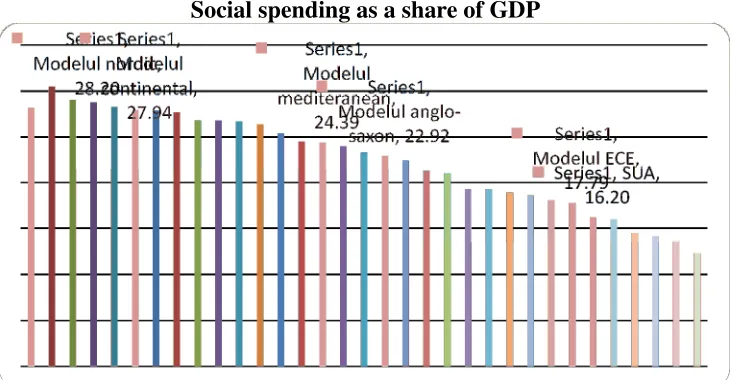
Differences between countries in the level and distribution of social spending are partly related to the level of economic development, but also their diversity related to social protection systems, demographic trends, economic exposure to external shocks of globalization, aging, unemployment rates, and other economic, institutional and social (see fig. no. 2).
Fig. no. 2 Social spending as a share of GDP
Source: www.eurostat.ro. Sub-models values were calculated based on the weighted average of the countries.
7
Definition from www.oecd.org Series1,
Modelul nordic, 28.20
Series1, Modelul continental,
27.94
Series1, Modelul mediteranean,
24.39
Series1, Modelul
anglo-saxon, 22.92 Series1, Modelul ECE,
17.79 Series1, SUA,
As can be seen, the Nordic model has the highest amount of social spending, allocating approximately 28.19% of the GDP, followed by continental submodel with 27.93% of GDP. For these two groups, France (30.5%), Sweden (29.1%) and Denmark (28.8%) had the highest amounts allocated for social policy. Anglo-Saxon sub-model countries (22.93%), Mediterranean (24.38%) and CEE (17.78%) spend less of GDP on social protection, although these values are still high if you compare with United States , which allocates 16.2% of GDP on social policy. Submodel economies in Anglo-Saxon labor markets are flexible; unemployment benefits are lower, leading to further reduction of life to work and long-term unemployment. Thus, given the low costs for pensions and unemployment total expenditure for social policy are lower than for other regions. Continental and southern countries are characterized by a high share of expenditures for the elderly. This reflects their weak participation on a new type of labor market and the possibility of early retirement in these countries. In the Mediterranean countries, there are still gaps between pension systems, giving more public workers and workers who have full time contract type of large private enterprises. In addition, the state's distributive role puts less emphasis on young segment of the population. Young people who are still learning and trying to look for work receive very little support from the state, as well as for families with young children. On the other hand, the Nordic countries allocate a much larger share of families. Moreover, in most Nordic countries are made available to support maintenance income youth. As CEE sub-model (submodel new member) you can see that it has the lowest value allocated to social spending: 17.78% of GDP. This is explained by low amounts granted pensions and health care. In addition, given the catching-up process of the Baltic countries, Romania and Bulgaria, they will be able to increase their budget for social policy only when it will reduce the income gap with the EU-27, currently they focus more heavily on economic growth, increasing employment and reducing black economy.
3. Reducing poverty
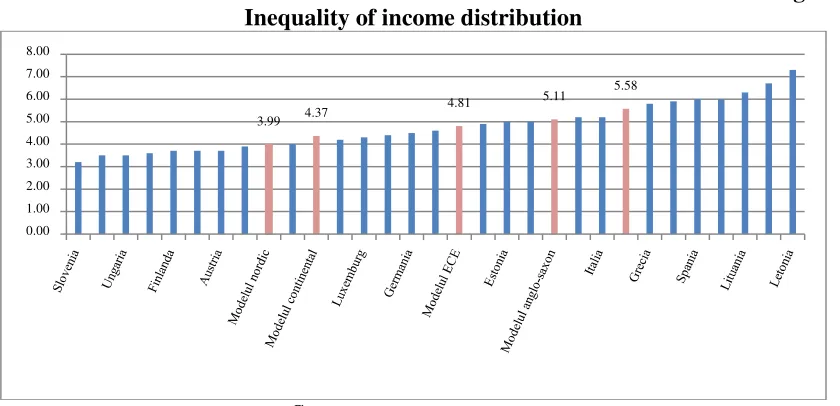
Fig. no. 3 Inequality of income distribution
Source: www.eurostat.ro
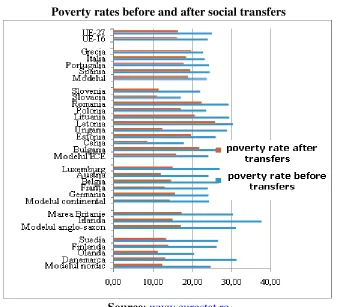
In terms of inequality of income distribution in 2009 (calculated as the ratio between the amounts of income of the richest 20% and the poorest 20%), we can see that the fairest is the northern submodel (3.9) with redistribution effect through taxes but more resistant and transfers, followed by continental (4.37) and CEE model 4.8. The most unequal are the Anglo-Saxon model (5.10) and the Mediterranean (5.5). It is interesting to see that CEE submodel seems competitive for Anglo-Saxon sub-model bud also from south sub-model. Moreover, it can be seen that the first four countries with the lowest rates of inequality of distribution submodel part of CEE economies within it there so comparable to the Nordic model: Slovenia (the most egalitarian economy EU) 3.2, Czech Republic and Hungary had same value 3.5 and Slovakia 3.6. To analyze differences between sub-models over the incidence of poverty rate will be used the following indicators: risk of poverty rate before social transfers, the poverty risk rate after social transfers and an indicator of the percentage reduction in poverty rates after social transfers granted. Risk of poverty rate before social transfers is calculated as the share of persons with an income equivalent available before social transfers, which is below the calculated risk of poverty after transfers. Pensions are calculated as income (before social transfers) and not as transfers. This indicator examines the hypothetical non-existence of social transfers. EU-27 in 2009 one installment of poverty prior to social transfers amounting to 25.1% and 16.3%, the difference consisting in effect of social policy pursued by each state. Submodel which recorded the lowest poverty rate before transfers is the southern (23.65%), but on the other hand, after redistribution has the highest poverty rate value of 18.86%, which means that the benefits are not distributed fairly between individuals (see fig. no. 4).
3.99 4.37
4.81 5.11
5.58
Fig. no. 4 Poverty rates before and after social transfers
Source: www.eurostat.ro
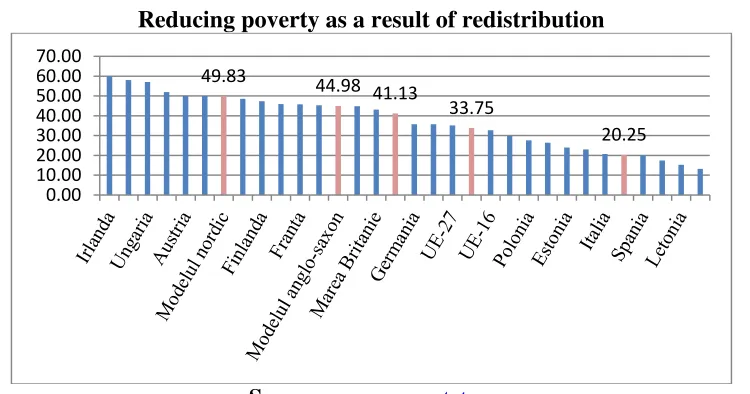
Fig. no. 5 Reducing poverty as a result of redistribution
Source: www.eurostat.ro
It can be seen that the Nordic model is the most effective social protection system, recording a 49.8% reduction in the poverty rate (from 24.6% to 12.3%). Although Anglo-Saxon submodel showed a high poverty rate, in 2009 managed to reduce the poverty rate by 44.9% (from 31.05% to 17.08%). Although this exceeded the continental submodel, from which expected to decrease further given that the poverty rate is lower, the value of this submodel is explained by the result of poor social security system in Germany (which accounts for 50% of GDP this submodel) reducing the poverty rate from 24.1% to 15.5%. The social system of the continental submodel damages the need to search of a job, resulting in maintenance of high unemployment to Anglo-Saxon countries (Dinu & Marinas, 2005). The CEE model is more efficient from this point of view towards the south, since it allocates fewer resources to social policy and decreases in greater poverty rate. As southern submodel in 2009 he held the highest poverty rate of 18.86% is the least powerful reducing the poverty rate of only 20.24%.
4. Protection against labor market risks
In terms of protection against labor market risks, this objective is the protection against labor market risks, which may be provided by applicable law employment (against dismissal) and benefits provided by unemployment8.
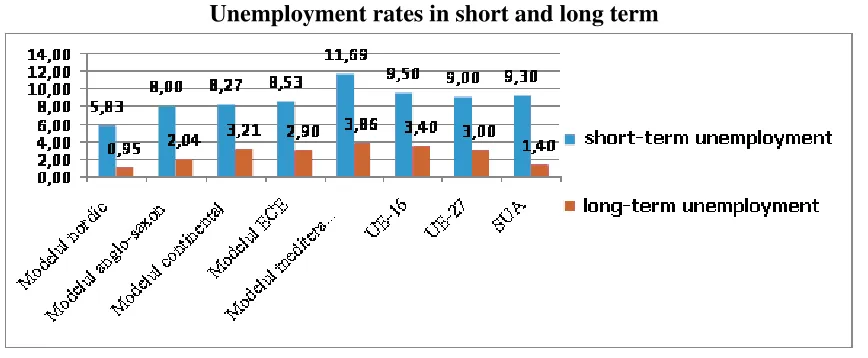
Thus the differences between the two systems are: EPL9 system protects those who already have a job and does not impose any tax burden, while UB10 provides insurance general population and is usually financed by a levy placed on the working. Thus, those who prefer stable work EPL insurance system instead of UB. Since both systems are designed to achieve a common goal, there is a compromise between them. With a generous unemployment insurance system will reduce restrictions on dismissals and vice versa. In the figure below (see fig. No. 6) can see that EU countries have chosen different systems to protect people against unemployment.
8
Molănescu, G., Aceleanu, M., I., Consequences of the Budget Deficit in the Current Crisis in Romania. Implications on the Labor Market, Theoretical and Applied Economics, Volume XVIII (2011), No. 2(555), pp. 59-74
9
Abbreviation for „Employment Protection Legislation”, indicator for labor flexibility measurement 10
Abbreviation for „Unemployment Benefits”
49.83
44.98 41.13
33.75
20.25
Fig. no. 6 Unemployment rates in short and long term
Source: www.eurostat.ro
In terms of short-term unemployment, it can be seen that in the European sub-models, the north has the lowest rate of 5.8%. It is followed by the Anglo-Saxon submodel (7.9%) and Continental (8.2%). The CEE and Mediterranean recorded the highest values of short-term unemployment: 8.5% and 11.6% respectively. Analysis of the five sub-models in order starting with the northernmost performance. This submodel is characterized by 'flexicurity', i.e. large amounts of unemployment assistance and less strict employment legislation, increased labor flexibility, and greater social security. At the opposite, southern countries have very strict legislation on employment, and a low level of support for unemployed people. Continental countries are characterized by strict laws against dismissal but also through generous financial aid for unemployed people. Regarding the Anglo-Saxon countries, it gives little protection both employment and unemployment. The effects of these measures are shown in Figure 6 by long-term unemployment; their efficiency is much higher as long-term unemployment (longer than 12 months) is below. Nordic countries recorded the lowest rate (0.94%) and Southern countries highest (3.86%). In the case of the CEE (2.9%) recorded lower values for long-term unemployment than those that are part of the continental model (3.2%) as the Visegrad countries began to reduce unemployment benefits. Analyzing the U.S., it can be seen that recorded in 2009 a short-term unemployment to 1.4%. The U.S. is unique in that in addition to reduced employment protection granted (resembling Anglo-Saxon) and unemployment benefits are extremely low. Therefore, the American model offers less risk insurance on the labor market and the European model, on the other hand, much more. In other words, the European model is based more on a UB, providing more social security and insurance American model more labor market, as evidenced by the low incidence of long-term unemployment.
5. Conclusions
Employment rate of labor is closely related to economic performance11. In addition, one of the goals adopted at the Lisbon strategy was the employment rate of the working population is greater than 70%. It can be seen that the Nordic countries show the highest rate of employment (75.7%), followed by Anglo-Saxon countries (74.8%). The new member countries holds third place in the labor market participation with a share of 69.3%, and
11
continental and Mediterranean countries have significantly lower rates of employment (65.5% and 65.4%).
Particular attention should be attributed to labor force participation of women, older people and young people. Female labor force participation varies in the five sub-models of development: the Nordic countries have the highest rate of female participation in the labor market (71.6%), followed by Anglo-Saxon countries (67.3%). Sub-models with the lowest rates are the southern (57.7%) and the new member countries (55%). Provisions of public services (e.g. childcare) and increasing part-time jobs largely explain the female labor participation rate in the Nordic countries and the marketisation of household services (low-wage jobs) explains the high rate Anglo-Saxon countries. As the working age population between 55-64 years, employment is high in Nordic countries (60.4%) and Anglo-Saxon (58.1%) than the mainland (45.5%), southern (49 3%) and the new member countries (37.7%). On the other hand, for most Southern countries and the CEE sub-model of the labor market is still not regulated education systems are not effective, promote high taxes on workers, which discourages the creation of new jobs. U.S. efficiency can be seen in terms of employment rate (60.6%) being higher than that for the EU-27 (47.6%).
If young people between 15 and 24 years, as expected, the models and the Anglo-Saxon north have the highest employment rates (48% and 58.10%), values are explained by the fact that there are places part-time work more, allowing young people to continue their studies but also to work. In this chapter, the lowest values are recorded rate submodel CEE and Southern (30% and 38% respectively).
Social models that are not fair can be very well sustainable, and this is demonstrated by their effectiveness. These reforms need not be supported by changes related to social justice. Moreover, it is possible to reform higher efficiency can trigger a change in the equity. In conclusion, it is important to take place in the labor market reforms and European social policies, especially in the continental model, Mediterranean and the new member states.
Europe should consider a change by initiating reforms. This change could be a difficult one, with many obstacles and opposition from some groups, particularly the attitudes and institutions have deep roots in historical traditions, political and intellectual. However this change is important given that Europe should face competition from other superpowers, become more productive and therefore more competitive. European model of development could become a role model and other states and, why not, to decide the direction of globalization.
Europeans are aware of the social assistance system feasibility, the impact of competition from Asia, demographic pressures caused by migration coming from Eastern Europe and North Africa, the emigration of the best students and researchers in Europe for the United States. However, European leaders instead join forces to solve these problems, promising "protection" - protection from Chinese imports, protection of cultural diversity that comes with immigration, technologically superior protection for American companies, protection of workstations higher education, protect rich farmers, notaries public, the unemployed, the poor. All these issues need to be addressed if the EU wants to become a development model as a model of globalization and also to compete with other major players: the U.S. and Asia on political and economic scene. Thus, proposed the following urgent needs in Europe: the liberalization of markets for goods and services, liberalization of labor, research and development, immigration, fiscal and judicial systems and the cost of doing business.
6. References
2. Aiginger K. (2007), “Coping with Globalization and Unemployment: New Challenges for the European Model”, in: Bienkowski W., Brada J.C. and Radlo M.J. (eds.), “Growth versus Security - Old and New EU Member’s Quest for a New Economic and Social Model”, Palgrave Macmillan
3. Albert M. (1994), “Capitalism contra Capitalism”, Editura Humanitas, Bucureşti 4. Alesina A. and Giavazzi F. (2006), “Viitorul Europei: reforma sau declin”, Ed. ARC,
Chişinău
5. Archick K. and Kim J. (2008), “The efect of the European Union on Human development”, International Research Journal of Finance and Economics 6. Attali J. (2007), “Scurta istorie a viitorului”, Editura Polirom, Iaşi
7. Axtmann R. (1998), “Globalization and Europe: Theoretical and Empirical Reflections”, London Pinter
8. Boeri T. (2002), “Let Social Policy Models Compete and Europe Will Win”, paper presented at a Conference hosted by the Kennedy School of Government, Harvard University, 2002
9. Burghelea C. (2012), “The Sustainable Development Model”, Theoretical and Applied Economics, Volume XIX (2012), No. 5(570), pp. 125-136
10.Churchill G.A. (1998), “Marketing research: methodological foundations”, Fort Worth, TX ; Londra : Dryden Press, 6th ed., 1998
11.Crăciun L. (2012), “Viitorul şi noua faţă a economiei”, Economie teoreticăşi aplicată, Volumul XIX (2012), No. 1(566), pp. 65-72
12.Dinu M. and Marinaş M. (2006), “Transformarea economică a Uniunii Europene în contextul ciclurilor Kondratieff”, Economie Teoreticăşi Aplicată no. 8
13.Keohane R and Nye J. (2009), “Putere si interdependentă”, Ed. Polirom, Iaşi
14.Molănescu G. and Aceleanu M.I. (2011), “Consequences of the Budget Deficit in the Current Crisis in Romania. Implications on the Labor Market”, Theoretical and Applied Economics, Volume XVIII, No. 2(555), pp. 59-74
15.Popescu C. (2006), “Metodologia cercetării ştiinţifice economice”, Ed. ASE, Bucureşti
16.Rifkin J. (2006), “Visul european. Despre cum, pe tăcute, Europa va pune în umbră
Visul American”, Ed. Polirom, Iaşi
17.Rossamund B. (1999), “Globalization and the Social Construction of the European Identities”, Journal of European Public Policy
18.Sapir A. (2005), “Globalisation and the reform of European Social Models”, ECOFIN Informal Meeting in Manchester
19.Socol C., Marinaş M. and Socol A.G. (2010), “Sustenabilitate fiscala şi coeziune socială. Comun şi specific în submodelele Uniunii Europene”, Economie Teoreticăşi Aplicată, vol.XVII, No.3(544), pp.25-44
20.Socol C., Marinaş M. and Socol A.G. (2010), “The impact of welfare state to labour market. European submodels differences”, Economie Teoreticăşi Aplicată, vol.XVII, No.8 (549), pp.63-86