Modern Journal of Language Teaching Methods (MJLTM)
ISSN: 2251 - 6204
www.mjltm.com
Editor – in – Chief
Hamed Ghaemi, Assistant Professor in TEFL, Islamic Azad University (IAU)
Editorial Board:
1.
Abednia Arman, PhD in TEFL, Allameh Tabataba’i University, Tehran, Iran
2.
Afraz Shahram, PhD in TEFL, Islamic Azad University, Qeshm Branch, Iran
3.
Amiri Mehrdad, PhD in TEFL, Islamic Azad University, Science and research
Branch, Iran
4.
Azizi Masoud, PhD in Applied Linguistics, University of Tehran, Iran
5.
Basiroo Reza, PhD in TEFL, Islamic Azad University, Bushehr Branch, Iran
6.
Dlayedwa Ntombizodwa, Lecturer, University of the Western Cape, South Africa
7.
Doro Katalin, PhD in Applied Linguistics, Department of English Language
Teacher Education and Applied Linguistics, University of Szeged, Hungary
8.
Dutta Hemanga, Assistant Professor of Linguistics, The English and Foreign
Languages University (EFLU), India
9.
Elahi Shirvan Majid, PhD in TEFL, Ferdowsi University of Mashhad, Iran
10.
Fernández Miguel, PhD, Chicago State University, USA
11.
Ghaemi Hamide, PhD in Speech and Language Pathology, Mashhad University
of Medical Sciences, Iran
12.
Ghafournia Narjes, PhD in TEFL, Islamic Azad University, Neyshabur Branch,
Iran
13.
Grim Frédérique M. A., Associate Professor of French, Colorado State University,
USA
14.
Izadi Dariush, PhD in Applied Linguistics, Macquarie University, Sydney,
Australia
15.
Kargozari Hamid Reza, PhD in TEFL, Payame Noor University of Tehran, Iran
16.
Kaviani Amir, Assistant Professor at Zayed University, UAE
17.
Kirkpatrick Robert, Assistant Professor of Applied Linguistics, Shinawatra
International University, Thailand
18.
Mehrani Mehdi, PhD in TEFL, University of Neyshabur, Neyshabur, Iran
19.
Morady Moghaddam Mostafa, PhD in TEFL, University of Tabriz, Iran
20.
Mouton Nelda, PhD in Education Management, North-West University
(NWU), South Africa
21.
Najafi Sarem Saeid, PhD Candidate in TEFL, Islamic Azad University, Science
and Research Branch, Tehran, Iran
22.
Naicker Suren, Department of Linguistics and Translation, University of South
Africa
23.
Ndhlovu Finex, PhD, Linguistics Programme, University of New England,
Australia
24.
Raddaoui Ali Hechemi, PhD, Associate Professor of Applied Linguistics,
University of Wyoming in Laramie, USA
25.
Rezaei Saeed, PhD in TEFL, Sharif University of Technology, Tehran, Iran
26.
Rolstad Kellie, PhD, Associate Professor of Education, University of Maryland,
USA
27.
Roohbakhshfar Hamid, PhD in TESOL, Islamic Azad University, Neyshabur
Branch, Iran
28.
Sanatifar Mohammad Saleh, PhD in Translation Studies, Tabaran Institute of
Higher Education, Mashhad, Iran.
29.
Shafiee Sajad, Department of English, Shahrekord Branch, Islamic Azad
University, Shahrekord, Iran
30.
Stobart Simon, PhD, Dean of Computing, Teesside University, UK
31.
Suszczynska Malgorzata, Senior Assistant Professor, University of Szeged,
Hungary
32.
Tabeifard Sayed Javad, PhD in ELT, University of Tehran, Kish International
Campus, Iran
33.
Weir George R. S., PhD in Philosophy of Psychology, University of Strathclyde,
Glasgow, UK
34.
Zabihi Reza, PhD in TEFL, University of Neyshabur, Neyshabur, Iran
35.
Zegarac Vladimir, PhD, University of Bedfordshire, UK
Abstracting/Indexing
Index
Copernicus 2011
Linguistics Abstract
EBSCO Publication
Lulu Publication
Directory of Open Access Journals
ProQuest
Modern Language Association
Cabell's Directories
COPE
Directory of Research Journal Indexing (DRJI)
Indian Citation Index
International Society of Universal Research in Sciences
Ulrich's
Table of Contents
INVESTIGATING THE RELATIONSHIP BETWEEN LANGUAGE LEARNERS’ CLASSROOM ANXIETY AND THEIR SELF-ESTEEM, GENDER, AGE AND EDUCATIONAL LEVEL
Farahnaz Abedini Zahra Khodadadi Sousan Sahami
INVESTIGATION OF GOOGLE TRANSLATE TRANSLATION BASED ON
LEXICO-GRAMMAR-ERROR MODEL OF HAR INSPIRED FROM SFG CONCERNING VERBAL PROCESS
Aghagolzadeh Ferdows Kambuziya Aliyeh Golfam Arsalan Rahmani Zeinolabedin
DYNAMIC ASSESSMENT OF EFL LEARNERS’ READING SKILLS AND STRATEGIES: INTRODUCING SAUCE FORMAT MEDIATION
Ghorban Ahmadi Behrooz Azabdaftari Seyyed Mohammad Alavi
CRITICAL THINKING ASSESSMENT: SPECIFYING THE CONTENTS TIPPING THE BALANCE IN FAVOR OF A DISCIPLINE-SPECIFIC APPROACH IN EFL LEARNING CONTEXT
Dr. Reza Ghafar Samar Seyed Reza Basiroo
THE IMPACT OF ORAL STORY REPETITION ON IRANIAN INTERMEDIATE EFL LEARNERS’ WORD CONTEXTUAL MEANING
Sahel Akhzari, Dr. Morteza Khodabandehlou
THE INVESTIGATION OF THE LEXICAL VARIATIONS IN SABZEVARI DIALECT AMONG THREE GENERATIONS
Sahar Zahed Alavi Rahman Sahragard
WHICH TYPE OF FEEDBACK IS MORE CONDUCTIVE TO BETTER WRITING ACHIEVEMENT? COMPUTER- ASSISTED, PEER OR TEACHER FEEDBACK?
Reza Ghafar Samar Majid Nemati Shahrzad Amini
THE IMPACT OF SYSTEMATIC IMPLEMENTATION OF FORMATIVE ASSESSMENT (FA)
ON EFL LEARNERS’ AFFECT
Amir Asadifard Akbar Afghari
USING WRITTEN INSTRUCTION IN DEVELOPING EFL LEARNERS' STRESS RECOGNITION AT THE PRE-INTERMEDIATE LEVEL
Bahman Gorjian Emad Arvand
EFFECTS OF ONLINE READING ON IRANIAN EFL LEARNERS’ WRITING APPREHENSION
Leila Noorizadeh-Honami Ahmad Ameri-Golestan
THE EFFECT OF GUIDED-WRITING STRATEGY ON IRANIAN INTERMEDIATE EFL LEARNERS’ WRITING IMPROVEMENT
Siamak Pouyan Marjan Heydarpour Ghasem Aghajanzadeh
THE STUDY OF THE EFFECT OF DYNAMIC ASSESSMENT ON IRANIAN INTERMEDIATE EFL LEARNERS’ RECALL OF COLLOCATION
Nasrin Asadi
Malahat Shabani Minaabaz
CREATIVE WRITING: COMPOSING AND ENJOYING HAIKU IN THE EFL CLASSROOMS
Farzaneh Aladini Marjan Heydarpour
IRANIAN EFL LEARNERS’ ATTITUDE TOWARDS THE DEVELOPMENT OF L2 WRITING THROUGH COLLABORATIVE BLOGGING
Bahareh Masaeli
Mohammad Ali Heidari-Shahreza
INVESTIGATING THE RELATIONSHIP BETWEEN
LANGUAGE LEARNERS’ CLASSROOM ANXIETY AND
THEIR SELF-ESTEEM, GENDER, AGE AND
EDUCATIONAL LEVEL
Farahnaz Abedini
Department of English Language, College of Humanities, Marvdasht Branch, Islamic Azad University, Marvdasht, Iran
Zahra Khodadadi
Department of statistics, Marvdasht Branch, Islamic Azad University, Marvdasht, Iran
Sousan Sahami
Assistance Professor, Department of Sociology, Marvdasht Branch, Islamic Azad University, Marvdasht, Iran
ABSTRACT
THE PRESENT STUDY WAS AN ATTEMPT TO EXPLORE THE RELATIONSHIP BETWEEN EFL UNIVERSITY STUDENTS’ FOREIGN LANGUAGE CLASSROOM ANXIETY AND THEIR SELF-ESTEEM, GENDER, AGE AND EDUCATIONAL LEVEL. IT ALSO SOUGHT TO INVESTIGATE HOW WELL THE INDEPENDENT AFFECTIVE VARIABLE OF SELF-ESTEEM AND BACKGROUND VARIABLES OF GENDER AND AGE AND EDUCATIONAL LEVEL PREDICTED LANGUAGE LEARNERS’ FOREIGN LANGUAGE CLASSROOM ANXIETY.THE FOREIGN LANGUAGE CLASSROOM ANXIETY SCALE AND THE ROSENBERG SELF-ESTEEM SCALE WERE ADMINISTERED TO UNDERGRADUATE ENGLISH TRANSLATION STUDENTS WHOSE AGE RANGED FROM 19 TO 48 (M=24.59, SD=4.47). THE RESULTS REVEALED A LOW LEVEL OF FOREIGN LANGUAGE CLASSROOM ANXIETY. THE FINDINGS WERE ALSO INDICATIVE OF THE FACT THAT SELF-ESTEEM HAD A SIGNIFICANT NEGATIVE RELATIONSHIP WITH FOREIGN LANGUAGE CLASSROOM ANXIETY WHILE AGE AND EDUCATIONAL LEVEL DID NOT REVEAL ANY SIGNIFICANT RELATIONSHIP. THE RESULTS OF MULTIPLE REGRESSION ANALYSES SHOWED THAT THE INDEPENDENT VARIABLES OF SELF-ESTEEM AND GENDER SIGNIFICANTLY PREDICTED THE LEARNERS’ FOREIGN LANGUAGE CLASSROOM ANXIETY.
KEYWORDS: FOREIGN LANGUAGE CLASSROOM ANXIETY, SELF-ESTEEM, GENDER,
AGE,EDUCATIONAL LEVEL
1. Introduction:
Foreign language learning is often associated with a specific type of anxiety called foreign language learning anxiety. In fact, since foreign language learning almost always occurs in the classroom context, this kind of anxiety is specifically known as foreign language classroom anxiety (FLCAS). In the social context of the classroom, learners have constant interaction with each other and with their teachers, and they are regularly being evaluated by their teachers and peers. This constant evaluative situation makes them susceptible to the feeling of discomfort and anxiety. Foreign language teachers have repeatedly reported that EFL learners who are competent in other situations experience an anxiety reaction which impedes their desirable performance in a foreignlanguage class (Horwitz, Horwitz & Cope,1986). Oxford (1999) also states that this anxiety is directly linked to performing in the target language rather than being a general type of anxiety. In fact, foreign language class can be much more anxiety-provoking compare to language learners’ other courses (Liu, 2007; Ohata, 2005). Thus, language learning setting is likely to be prone to anxiety arousal (Price, 1991).
Krashen (1982, 1985) viewes anxiety as debilitative since it leads to affective filter which prevents language learners from fully processing language input. Consequently, language learners are not able to improve their language learning. Many scholars regard foreign language anxiety as one of the influential factors of the affective domain (Balemir, 2000, cited in Öztürk &Gürbüz, 2013). MacIntyre & Gardner, (1994, p. 283) define foreign language anxiety as “the feeling of tension and apprehension specifically associated with second language contexts, including speaking, listening, and learning”. Horwitz et al.(1986) assert that foreign language anxiety cannot be simply viewed as a combination of fears, tension, and nervousness transformed to foreign language learning situation, but it is perceived as “a distinct complex of self-perceptions, beliefs, feelings, and behaviors related to classroom language learning arising from the uniqueness of the language learning process” (p.128).
As such, many studies have sought to investigate language learners’ level of foreign language anxiety and its relationship with language achievement and such affective variables as shyness, self-esteem, introversion, motivation etc. (Yamini &Tahriri, 2006; Chu, 2008; Farjami & Amerian, 2012).Nevertheless, it seems that they have not succeeded in arriving at conclusive results and more studiesare required in the area of foreign language anxiety and its relationship with affective variables.
1.2. Significance of the study:
Due to the fact that anxiety is one of the affective factors whichmay greatly influence different aspects of foreign language learning, it is vital to investigate language learners’ FLCA level as well as those learners who are anxious in FL classes(Horwitz et al., 1986). In addition,according to Campbell and Ortiz (1991), university students’ foreign language anxiety must be considered “alarming” with half language learners experiencing the negative effects of learning anxiety.
In this connection, the motive behind conducting the present study was the fact that the results regarding the relationship between FLCA and gender are controversial. Moreover, the relationship between FLCA and age has been reported by few studies. Also, research investigating the impact of both self-esteem and the background variables of gender, age and educational level on EFL learners’ FLCA seems to be scant.Finally, few studies have attempted to go beyond reporting the total level of FLCA and to analyze individual anxiety-provoking items related to the three underlying constructs of FLCA.
1.3. Research questions:
The present study aimed at revealing English translation students’ level of foreign language classroom anxiety. Furthermore, it sought to investigate the relationship between FLCA on the one hand and their self-esteem, gender, age and educational level on the other. It was also intended to show how well these independent variables predictedEFL learners’ level of FLCA. In this regard, the following research questions were posed to guide the study:
1. What is EFL learners’ level of foreign language classroom anxiety?
2. Do males and females differ with respect to their level of foreign language classroom anxiety?
3. Is there any significant relationship between EFL learners’ level of foreign language classroom anxiety and their self-esteem?
4. How well do the independent variables of self-esteem, gender, age andeducational levelpredict learners’ level of foreign language classroom anxiety? Which is the best predictor?
2. Review of the literature: 2.1. Foreign language anxiety:
Affective variables concern personality factors (Brown, 1994) such as anxiety, shyness, self-esteem, introversion, extroversion,risk-taking, motivation etc. which are regarded as the intrinsic side of affectivity (Brown, 2007). Among affective factors, anxiety is viewed as an important factor in the affective domain (Balemir, 2009, cited in Ozturk & Gurbuz, 2013). Blau (1955) viewed anxiety as an uncomfortable emotional state which makes an individual perceive danger, feel powerless and experience tension. According to Brown (2000, p. 151) anxiety “is associated with feelings of uneasiness, frustration, self-doubt, apprehension, or worry”.
By the arrival of humanistic psychology, researchers’ attention shifted from focusing solely on the cognitive aspect of learning to considering both the psychological and cognitive aspects of language learning. Accordingly, a growing body of research attempted to investigate the relationship between language learning and affective variables (Chastain, 1975; Horwit et al., 1986; Schumann, 1999; Samimy & Tabuse, 1992; Yamini & Tahriri, 2006; Chu, 2008;Bashosh, Abbas Nejad, Rastegar & Marzban, 2012). These studies have revealed that in the process of language learning affective variables play a key role.
In the domain of language learning, anxiety is regarded as “the apprehension experienced when a situation requires the use of a second language with which the individual is not fully proficient” (Gardner & MacIntyre (1993, p.5). Therefore, language learning anxiety is distinct from general anxiety (MacIntyre & Gardner,1989). It is, further, believed that it is directly concerned with performing in the target language (Gardner & MacIntyre,1993; Horwitz al., 1986). Thus, it cannot be viewed as general performance anxiety, either. Horwitz (2001, p.116) believed that in the process of language learning experiencing foreign language anxiety is natural since learners have to present “a less precise version of themselves” particularly during the initial period. Brown (2001)stated that language learners need to develop a new mode of thinking, feeling, and acting which may lead to the feeling of anxiety.Guiora (1983, cited in Horwitz al., 1986, p.25) asserted that language learning itself is "a profoundly un-settling psychological proposition" directly threatening language learners’self-concept and worldview.
In the 1970s, a growing body of researched focused on language learners’ self-reported anxiety. The results, however, were regarded as contradictory both because of inadequateconceptualization of L2 anxiety and because of the general measures of anxiety. (Horwtiz, et al., 1986; MacIntyre & Gardner, 1989; Zhang, 2001). In 1980s, many researchers tried to address the problem by conceptualizing anxiety as unique form of anxiety which specifically associated with L2 learning situations(Gardner, 1985; Horwtiz
et al.,1986; MacIntyre & Gardner,1991a). Adapting the situation-specific anxiety approach, Horwtiz et al. (1986) developed the Foreign Language Classroom Anxiety Scale (FLCAS).
According to Horwtiz et al. (1986, p.127), “because foreign language anxiety concerns performance evaluation within an academic and social context, it is useful to draw parallels between it and three related performance anxieties: 1) communication apprehension; 2) test anxiety; and 3) fear of negative evaluation”.
Since communication apprehension emphasizes interpersonal interaction, it is relevant to the conceptualization of the foreign language anxiety (McCroskey,1977). Communication apprehension is defined as a type of shyness characterized by fear of or anxiety about communicating with people” (Horwtiz et al., 1986, p.127). It can be manifested in the form of difficulty in speaking (oral communication anxiety) or in listening to or learning a spoken message (receiver anxiety). In fact, this type of anxiety in the context of foreign language class occurs because the learner knows that he is unable to understand the others or to make himself understood as well as he does in his native language.
Test-anxiety refers to a type of performance anxiety which is the result of fear of failure (Gordon & Sarason, 1955). Students with high test-anxiety are constantly under pressure because they feel that success means perfect test performance; this unrealistic demand causes them to experience the feeling of
failure and consequently anxiety in the classroom (Horwtiz et al., 1986). Anxious students are afraid to make mistakes in the foreign language. These students feel that they are constantly being tested, and they feel that every correction is a failure (Horwtiz et al., 1986).
Fear of negative evaluation is defined as "apprehension about others' evaluations, avoidance of evaluative situations, and the expectation that others would evaluate oneself negatively" (Watson & Friend, 1969, cited in Horwtiz et al., 1986, p.128). Students who experience fear of negative evaluation are very much sensitive to the evaluations of their teacher and their classmates.Therefore, “they may skip class, over study, or seek refuge in the last row in an effort to avoid the humiliation or embarrassment of being called on to speak” (Horwtiz et al., 1986, p.130).
2.2. Foreign language anxiety and language learning:
The effect of foreign language anxiety on language achievement/performance has been subjected to a great many research over the last two decades.With regard to second/foreign language learning anxiety, two approaches are generally adopted. In the first approach, a more general type of anxiety is of concern. State/trait anxiety, facilitating/debilitating anxiety, and test anxiety fall in this approach. In this area of research, the relationship between such general types of anxiety and language achievement/performance is investigated. The results of such research are scattered and inconclusive (Young, 1991). Some found foreign language anxiety as being debilitatingwhile some others regard it as facilitative (Onwuegbuzie, Bailey, Christine & Daley 1999; Spielmann & Radnofsky 2001; Kleinmann, 1977). The second approach concerns anxiety which is particularly experienced inlanguage classroom (Horwitz & Young, 1991). There is a growing body of research in both approaches.
Young (1991) conducted a study to find out the impact of anxiety on oral interview performance of foreign language learners. A significantly negative correlation between anxiety and oral proficiency interview was found. The findings revealed that as the level of learners’ anxiety increased, their oral proficiency level decreased. In another study, MacIntyre, Noels& Clement (1997) found a negative relationship between students’ self-ratings of their language proficiency and their anxiety level. In a study intended to investigate the reactions of anxious and non-anxious foreign language learners to their own errors, Gregerson (2003) video-taped the participants once while they were interviewed in English and again when they were watching themselves in the taped interview. Compared to non-anxious learners, anxious learners were found to make more errors, recognized fewer errors in the recall session, and participated less in language learning activities. The results suggested that they were not able to develop their linguistic abilities due to the lack of participation in the class. Abu-Rabia’s (2004) study also showed a negative relationship between foreign language anxiety and achievement. Still in another study,Gregerson (2005) concluded that foreign language anxiety serve as a good predictor of foreign language achievement. El-Anzi (2005) found a negative relationship between academic anxiety and achievement concluding that “anxiety may be one of the obstacles blocking high academic achievement in adolescence, since anxiety plays a role in reducing some factors that help to increase academic achievement” (p. 100).
Negative correlation between foreign language classroom anxiety and language proficiency has also been reported by several studies. There was a negative correlation between foreign language classroom anxiety scores and the final grades of Japanese language learners’ performance. Similar findings were found by Saito & Samimy (1996) and Coulombe (2000) with Japanese and Canadian language learners, respectively. Neisi & Yamini (2010)also revealed that foreign language classroom anxiety had a negative correlation with academic achievement.In contrast, Bashosh et al.,(2013reported that no significant relationship existed between foreign language classroom anxiety and foreign language proficiency.Similarly,Pite (1996) found no correlation between oral English proficiency and Japanese EFL students’ anxiety level.
2.3. Research on the relationship between anxiety and self-esteem:
Michie, Glachan& Bray (2001, P.458) regard self-esteem as “the evaluative dimension of the self which is a conscious experience accessible to introspection”. In the literature, three major principles of self-esteem formation are acknowledged. Self-attribution is one of the principles of self-esteem formation.
Rosenberg (1986) stated that the principle of self-attribution is reflective of the fact that self-observation is the basis of people’s attribution of intentions to themselves. In foreign language classes, students with inefficient performance may observe their own performance and make a judgment of it which may lead to anxiety. Reflective appraisal is another principle ofself-esteem formation. This principle holds that “people’s feelings about themselves are strongly influenced by their judgments of what others think of them” (Rosenberg, Schooler & Schoenbach, 1989, p. 1005). This may increase FLCA since learners are anxious about the negative evaluation of others. They are constantly worried about their teachers’ and peers’ attitude toward themselves. Festinger (1954, cited in Rosenberg, et al., 1989) proposed social comparison, the third principle of self-esteem formation. According tothis principle, in the absence of objective information, the comparisons that people make forms their judgment about themselves. In foreign language classes, students may make comparisons between their own performance and that of their classmates. Such comparisons may result in FL learners’ anxiety.
Horwitz et al. (1986) put forward that any performance in L2 classes probably challenges the learners’ self-concept and may lead to self-consciousness and fear. In fact their inability to present themselves as well as their first language threatens their “self-perceptions of genuineness” (p.128).
They concluded that language learners’ self-esteem is vulnerable to the awareness that their immature command of the second language limits authenticity and choices when communicating in the second language. Therefore,foreign language anxiety is likely to have a threatening effect on the learners’self-esteem.
Accordingly, many studies in the literature have focused on the relationship between self-esteem and FL anxiety. Cheng & Page (1989) found that there existed a negative correlation between the anxiety level of the learners and their self-esteem. Males were found to have a higher self-esteem compared to females. Similar findings were reported by Newbegin & Owens(1996) and Byrne (2000).
Yamini & Tahriri (2006) conducted a study to find out the relationship between EFL learners FLCA and their global self-esteem (GSE). The results revealed a significant relationship between the two variables for both genders. The relation was found to be much stronger for females than for males.
2.4. Research on the relationship between anxiety and gender/age/educational level:
The results of investigating the relationship between Anxiety and gender are far from being conclusive. GhorbanDordinejad & Moradian Ahmadabad (2014) found that there was a significant difference between males and females with regard to FLCA; with males (M=94.48) showing less anxiety compare to femlaes (M=95.40). Similar results were reported by Chu (2008) and Mesri (2012) with Taiwanese and Iranian EFL learners, respectively. In contrast, Mejías, Applebaum, Applebaum & Trotter (1991), Abu- Rabia (2004), Hossein, Shahid, & Zaman (2011) reported a higher level of anxiety for male participants compare to female ones. Other studies found no significant relationship between gender and anxiety (Cheng & Page, 1989; Pappamihiel 2002; Yamini & Tahriri 2006; Farjami & Ameriam, 2012; Bashooshet al., 2013).
Still in another study, Ayash Ezzi (2012) explored Yemeni university students with regard to the relationship between FLCA and the EFL learners’ gender, age, educational level and residence. Female students were found to be significantly more anxious (M=95.40) compare to male students (M=89.33). It was further found that there was no significant relationship between FLCA and age or educational level. Farjami & Amerian’s (2012) study also revealed that the age of Iranian university students was not significantly correlated with their level of FLCA. Similarly, Yamini & Tahriri (2006) reported no significant relationship between anxiety andeducational level.The results of Casado and Dereshiwsky’s (2001) study also revealed that anxiety of beginner students did not change as their level of education increased.
3. Method:
3.1. Participants:
A total of 136English translation university students from seven intact classes participated in the study. All the participants in each class received the two questionnaires. There were 22 males (16.4%) and
groups: 19-23 (N=71, 53%), 24-28 (N=37, 27.6%) and 29- (N==26, 19.4%). They were also divided into four groups of educational level: Freshman (N=30, 22.4%), sophomore(N=22, 16.4%), junior(N=31, 23.1%), and senior(N=51, 38.1%).2 participants were excluded from the study due to incomplete responses. A total of 134 participants comprised the subjects of the study.
3.2. Instruments:
The research instruments used for the present study were the Foreign Language Classroom Anxiety(FLCAS) designed by Horwitz et al.(1986) and the Rosenberg Self-esteem Scale (Rosenberg, 1965). The FLCAS concerns three related performance anxieties: 1) communication apprehension; 2) test anxiety; and 3) fear of negative evaluation. It consists of 33 items on a 5-point Likert scale with 1 referring to strongly agree and 5 referring to strongly disagree. After negatively worded items are reversely coded, the total score is obtained by summing the responses of the 33 items. The total possible score ranges from 33 to 165. Higher scores indicate higher intensity of the learners’ anxiety in the language class. The validity of the scale has been confirmed by Onwuegbuzie et al., (1999) who reported a significant correlation with communication apprehension and test anxiety. The internal validity, test-retest reliability, and construct validity of FLCA have been rigorously validated (Horwitz et al., 1986; Horwitz& Young, 1991). Furthermore, FLCAS has achieved an alph coefficient of .93 and test-retest reliability of .83 over eight weeks (Horwitz et al., 1986). Aida (1994), Yamini & Tahriri (2006) and Chu (2008) also reported reliability coefficient of .94, .93 and .92, respectively. The reliability coefficient of this study was .93. It is worth mentioning that minor modifications were made to the instrument in this study: the words ‘foreign language’ were changed to ‘English’ throughout the questionnaire.
The Rosenberg Self-esteem Scale is a widely used scale whichis comprised of 10 items with a 4-point Likert scale with the lowest score of 10 and the highest possible total soreof40. It measures global self-esteem and aims at “a broad and stable sense of personal competence to affectively deal with a variety of stressful situation” (Rashidi, Yamini & Shafiei, 2011, p.155).In their studies, Rashidi et al.(2011) and Yamini & Tahriri, (2006) reported reliability coefficients of .85 and .77, respectively. This study found a reliability index of .85.
3.3. Data collection procedure:
The questionnaires were distributed by the researcher among undergraduate translation students at their classroom hour. After they were briefly informed about the aim of the study, they were asked to select a choice which best showed their characteristics. They were also requested to provide information regarding their gender, age and educational level. It took themabout 20 minutes to complete both questionnaires.
3.4. Data analysis procedure:
Using IMB SPSS Statistics 21, the descriptive statistics of the learners’ performance on the FLCA were obtained for the whole sample data. Also, an Independent- samples t-test was usedto compare the mean scores of males and females on the FLCA scale. Pearson product-moment correlation was also used to investigate the relationship between the EFL learners’ level of FLCA and their self-esteem. Finally, multiple regression analyses were conducted to find out how well the variables of self-esteem, gender, age and educational level predicted the EFL learners’ level of FLCA and to reveal which was the best predictor.
4. Results:
The first research question aimed at identifyingthe level of FLCA among university EFL learners. Thus, the descriptive statistics of the EFL learners’ performance on the FLCA were obtained for the whole sample.As table 1 presents, the mean total score for 134 participants on the FLCA was 86.49 (SD=23.91). The minimum score was 37 (N=1) and the maximum score was 149 (N=1).
Table 1. Descriptive statistics on the FLCA for the whole sample
N Minimum Maximum Mean SD
Anxiety 134 37.00 149.00 86.4925 23.91047
Since theFLCA questionnaire has 33 items on a 5-graded Likert scale, the scores can range from 33 to 165. In this study the participants who had a total score of more than 132 were assumed to have high level of FLCA. The scores that ranged from 132-99 meant that the participants had a moderate level of FLCA. The participants who had a total score less than 99 showed a low level of FLCA. This is in line withwhat Chu (2008) reported from her personal communication with Horwitz whostated that if learners’ total score divided by thenumber of items (33) exceeds 4 (above 132), that student is considered to be anxious in the FL classroom; if it is below 3(below 99), he is not regarded as anxious.
Table 2. The frequency of EFL learners who obtained above 4, between 4 and 3’ and below3 on FLCA
Above 4
( 165-132) Between 4 and 3 ( 131-99) Below 3 ( 98- )
Number of participants 3 (2.2%) 42 (31.4%) 89 (66.4%)
This table reveals that only 2.2% of the learners showed a high level of FLCA while 66.4% of them showed a low level of anxiety. Even though, the mean total score for the whole group (86.49) indicated that the learners had a low level of FLCA, it was felt that itmight be a very broad conclusion considering the fact that FLCA encompasses three constructs of communication apprehension, test anxiety, and fear of negative evaluation, and in order to obtain an in-depth understanding,the data has to be further studied focusing on the individual items which have the highest mean scores of FLCA level and on the items which were reported by the highest percentage of the learner as anxiety provoking situations.
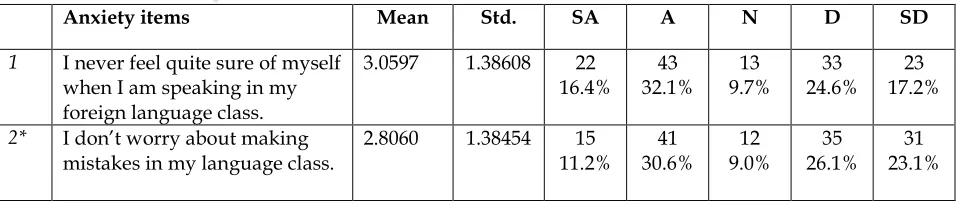
Table 3 presents the responses to all FLCA items accompanied by the percentages (rounded) of the number of the students who agreed and strongly agreed or disagreed and strongly disagreed with the statements given in each item. Studying the mean score (out of 5) of each anxiety itemrevealedthat item 10 (M=3.3), item 9 (M=3.27), item 15 (M=3.09), item1 (M=3.05) and item 29(M=3.05) were reported as the highest anxiety-provoking situations. Items 1,9,15,and 29 were related to communicativeapprehension, and item 10 related to test-anxiety.
Table 3 also reveals that the three items with the highest percentage of anxious learners were items 8 in which 69% of the participants reported that they were not at ease during tests in their English class, item 18 in which 65% of the participants put forward that they did not feelconfident when they spoke in their English class, and item 5 with 63% of the participants who indicated that it would bother them to take more English classes.
Table 3: FLCA items with mean and standard deviation of each item along with the number and percentages of EFL learners selecting each item.
Anxiety items Mean Std. SA A N D SD
1 I never feel quite sure of myself when I am speaking in my foreign language class.
3.0597 1.38608 22 16.4%
43 32.1%
13 9.7%
33 24.6%
23 17.2%
2* I don’t worry about making
mistakes in my language class. 2.8060 1.38454 11.2% 15 30.6% 41 9.0% 12 26.1% 35 23.1% 31
3 I tremble1 when I know that I’m going to be called on in the language class.
2.5639 1.35038 14 10.4% 25 18.7% 20 14.9% 37 27.6% 37 27.6%
4 It frightens me when I don’t understand what the teacher is saying in the foreign language.
2.7761 1.32439 17 12.7% 29 21.6% 20 14.9% 43 32.1% 25 18.7%
5* It wouldn’t bother me at all to take more foreign language classes.
2.2537 1.18059 7
5.2% 11.2% 15 20.1% 27 30.6% 41 32.8% 44
6 During the language class, I find myself thinking about things that have nothing to do with the course.
3.1119 1.14156 13 9.7% 45 33.6% 31 23.1% 34 25.4% 11 8.2%
7 I keep thinking that the other students are better at
languages than I am.
2.9474 1.36135 25
18.7% 17.9% 24 17.2% 23 30.6% 41 14.9% 20
8* I am usually at ease during tests in my language class.
2.3383 1.05807 5 3.7% 19 14.2% 17 12.7% 67 50.0% 25 18.7%
9 I start to panic when I have to speak without preparation in the language class.
3.2707 1.34349 27 20. %1 44 32.8% 17 12.7% 28 20.9% 17 12.7%
10 I worry about the
consequences of failing my foreign language class.
3.3106 1.54886 42
31.3% 23.1% 31 9.0% 12 14.9% 20 20.1% 27
11* I don’t understand why some people get too upset over foreign language classes.
2.5672 1.15978 10 7.5% 13 9.7% 50 37.3% 31 23.1% 30 22.4%
12 In the language class, I can get so nervous I forget things I know.
2.4254 1.32856 10 7.5 28 20.9 14 10.4% 39 29.1% 43 32.1%
13 It embarrasses me to volunteer answers in my language class.
2.3433 1.31563 12 9.0% 22 16.4% 8 6.0% 50 37.3% 42 31.3%
14* I would not be nervous speaking the foreign language with native speakers.
2.4254 1.11973 8 6.0% 14 10.4% 34 25.4% 49 36.6% 29 21.6%
15 I get upset when I don’t understand what the teacher is correcting.
3.0985 1.20343 17 12. %7 37 27.6% 34 25.4% 30 22.4% 14 10.4%
16 Even if I am well prepared for the language class, I feel anxious about it.
2.2576 1.29957 10
7.5% 16.4% 22 4.5% 6 35.8% 48 34.3% 46
17 I often feel like not going to my language class.
2.2030 1.14653 4 3.0% 21 15.7% 16 11.9% 49 36.6% 43 32.1%
18* I feel confident when I speak in my foreign language class.
2.3636 1.23110 7 5.2% 26 19.4% 12 9.0% 50 37.3% 37 27.6%
19 I am afraid that my language teacher is ready to correct
2.5075 1.16816 6 4.5% 28 20.9% 22 16.4% 50 37.3% 28 20.9%
every mistake I make.
20 I can feel my heart pounding when I’m going to be called on in the language class.
2.9624 1.41103 22 16.4% 38 28.4% 11 8.2% 37 27.6% 25 18.7%
21 The more I study for a language test, the more confused I get.
2.1119 1.14813 6 4.5 14 10.4 18 13.4 47 35.1 49 36.6
22* I don’t feel pressure to prepare
very well for language class. 2.6194 1.14901 5.2% 7 20.9% 28 21.6% 29 35.1% 47 17.2% 23
23 I always feel that the other students speak the foreign language better than I do.
2.8582 1.33294 17
12.7% 25.4% 34 15.7% 21 27.6% 37 18.7% 25
24 I feel very self-conscious about speaking the foreign language in front of other students.
2.2164 1.31138 10 7.5% 20 14.9% 12 9.0% 39 29.1% 53 39.6%
25 Language class moves so quickly I worry about getting left behind.
2.5448 1.26619 10 7.5% 27 20.1% 22 16.4% 42 31.3% 33 24.6%
26 I feel more tense and nervous in my language class than in my other classes
2.3582 1.29431 10
7.5% 17.9% 24 9.0% 12 34.3% 46 31.3% 42
27 I get nervous and confused when I am speaking in my language class.
2.5379 1.27456 11 8.2% 26 19.4% 17 12.7% 47 35.1% 31 23.1%
28* When I’m on my way to the language class, I feel very sure and relaxed.
2.4662 .98126 4
3.0% 10.4% 14 32.1% 43 38.1% 51 15.7% 21
29 I get nervous when I don’t understand every word the language teacher says.
3.0597 1.30217 20
14.9% 29.1% 39 16.4% 22 26.1% 35 13.4% 18
30 I feel overwhelmed by the number of rules you have to learn to speak a foreign language.
2.6045 1.17632 6 4.5% 34 25.4% 19 14.2% 51 38.1% 24 17.9%
31 I am afraid that the other students will laugh at me when I speak the foreign language.
2.3806 1.34217 11
8.2% 18.7% 25 10.4% 14 28.4% 38 34.3% 46
32 I would probably feel comfortable around native speakers of the foreign language.
2.5263 1.07717 5 3.7% 20 14.9% 40 29.9% 43 32.1% 25 18.7%
33* I get nervous when the language teacher asks questions which I haven’t prepared in advance.
2.9776 1.31770 18
13.4 37 27.6 26 19.4 30 22.4 23 17.2
Items 2*, 5*, 8*, 11*, 14*, 18*, 22*, 28*, and 32* are reversed when scoring.
The second research question aimed at investigating whether males and females differed with regard to their FLCA level. An independent-samples t-test was conducted to address this research question.
Table 4. Descriptive statistics and t-test of FLCA for males and females
gender N Mean
Std. Deviation
Std. Error
Mean F t df sig
Anxiety male 22 76.5909 16.87675 3.59814 8.318 -2.764 132 .005 female 112 88.4375 24.65538 2.32971
According to Levene’s test used in this study (F=8.318, p<.01), the obtained variance of the two genders were not equal; therefore, Bronz-Fisher’s F-test of the equality of two varianceswas used to compare the mean scores of the two groups.As Table 4 shows, there existed a significant relationship between gender and FLCA (t=-2.15, p<.01).The mean score of 76.59 and 88.43 were obtained for the males and females, respectively.
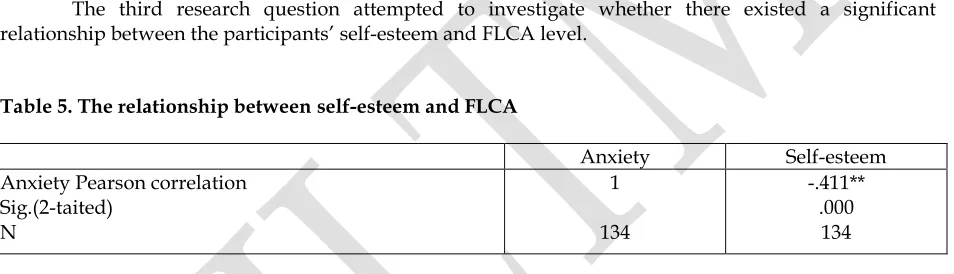
The third research question attempted to investigate whether there existed a significant relationship between the participants’ self-esteem and FLCA level.
Table 5. The relationship between self-esteem and FLCA
Anxiety Self-esteem Anxiety Pearson correlation
Sig.(2-taited) N
1
134
-.411** .000
134
Drawing on the data illustrated in Table 5, there was a significantly negative correlation between the learners’ FLCA level and their level of self-esteem (r=-.411, p<.01). That is, an increase in their level of self-esteem would result in a decrease in their FLCA level and with the decrease in their self-esteem level, there would be an increase in the learners’ FLCA level.
The forthresearch question attempted to show how well the independent variables of self-esteem, gender, age and educational level predicted the learners’ FLCA level.
Table 6. Model summary of the multiple regression analysis
Model R R Square Adjusted R Square Std. Error of the Estimate
1 .452a .204 .179 21.65907
As the findings in Table 6show, the obtained R Square is .20 indicating that 20% of the variation in the level of FLCA was accounted for by the independent variables.
To make sure that the independent variables could significantly predict the variance in the dependent variable, the results of ANOVA for the effect of independent variables on FLCA had to be taken into consideration.
The results presented in Table 7 were indicative of the fact that the relationship between FLCA and the independent variables of self-esteem, gender, age and educational level was significant (F=8.272, p<.01). To investigate whether all the independent variables predicted FLCA, the results of the coefficients had to be taken into consideration.
Table 7. ANOVA for the effect of independent variables on FLCA
Model Sum of Squares df Mean Square F Sig.
1
Regression 15521.590 4 3880.398 8.272 .000b
Residual 60515.902 129 469.116
Total 76037.493 133
As the results in Table 8 show, age andeducational level did not reveal a significant relationship with FLCA. By contrast, the variables of self-esteem and gender made a unique statistically significant contribution (less than .05) to the prediction of the dependent variable. In order of their significance, on the basis of their beta value, self-esteem (beta=--.417) came first and gender (beta=.189) stood on the second place.
Table 8. Coefficients for the degree of prediction of independent variables
Model Unstandardized
Coefficients
Standardized Coefficients
t Sig.
B Std. Error Beta
(Constant) 120.414 16.014 7.519 .000
Self-esteem -1.955 .372 -.417 -5.250 .000
gender 12.149 5.272 .189 2.304 .023
3 age groups 1.551 2.552 .051 .608 .545
educational level .698 1.636 .034 .427 .670
5. Discussion and Conclusion:
Four main results were obtained from the present study. The results of the first research question revealed that foreign language learners had a low level of FLCA (M=86.49, the mean was between 4 and 3) with only 3 participants (2.2%) who had an average above 4 or higher on the FLCA, and 89 (66.4%) had an average below 3.This is in line with the study conducted by Yamini & Tahriri (2006) who reported a mean score of 93.36 (2.83) which was also below 3 and thus below average. In addition, Farjami & Ameriam (2012), Bashoshet al.,(2013) and Ghorban&Moradian(2014) found the total score of 93.66, 84.00 and 98.90, respectively.However, Chu’s study (2008) revealed an average level of FLCA (2.3) with sixteen students (4.4%) above 4 and 166 students (46.65%) below 3. She concluded that as a whole, the participants were not excessively anxious with regard to their English studies.
Table 9 compares the obtained FLCA level from nine studies.Compared to the results reported by the studies in Table 9, the mean for the present study is slightly lower. It seems that Iranian EFL learners in this study experienced less anxiety in their English classes.
Table 9: Comparison of the FLCAS results from nine Studies
Study Language
Class Enrolled
Number of Students
FLCAS Items Used
Mean SD Rescaled Mean
Horwitz (1986)
Aida (1994) Cheng (1998)
Yamini & Tahriri (2006) Chuh (2008)
Farjami & Ameriam (2012) Bashoshet al.,(2013)
Ghorban Dordinejad &Moradian Ahmadabad(2014)
The present study
Various foreign languages Japanese English English English English English English English 108 96 423 123 364 151 60 400 134 33 33 33 33 31 33 33 33 33 94.5 96.7 94.9 93.36 93.4 93.66 84.00 98.90 86.49 21.4 22.1 20.0 20.33 17.7 16.29 .67075 23.91 2.86 2.93 2.88 2.82 3.01 2.83 2.54 2.99 2.62
Of the three constructs of FLCA, communicative apprehension which encompasses both speech anxiety (items 1 and 9) and receptive anxiety (items 15and 29) was found to be the most frequently reported anxiety-producing circumstances. Regarding speech anxiety, items 1(49%), 9 (53%), 14 (58%), 18 (65%), and 32 (51%) indicated that speaking anxietywas experienced by about one half of the participants. According to Horwitz at al.(1986), learners feel deep self-consciousness when they are required to speak in the presence of their teachers and classmates because they have to risk revealing themselves in such situations. Farjami & Ameriam (2012) also found items 9 (M=3.05), 14(M=3.06), 18 (M=3.53) and 32 (M=3.12) among the highestanxiety-producing circumstances indicating that language learners do share similar characteristics which are identifiable through investigation (Horwitzet al., 1986).
With regard to test anxiety, the second construct of FLCA, 6 items revealed that more than one third of the participants experienced anxiety. Items 2 (49%), 8 (69%), and 10 (34%) which are indicative of fear of making mistakes, fear during tests, and fear of failing the class, respectively. Also they felt anxious when they were called on in the class (item 20, 45%), when they felt pressure to prepare very well for the language class (22, 45%) and when the teacher asked questions for which they had not prepared in advance (item33, 41%). Likewise, Farjami & Ameriam (2012) reported items 8 (M=3.34), 10 (M=3.25), 20 (M=3.08), 22 (M=3.38), and 33 (M=3.35) as anxious situations.Such similarities in two different studies confirm the fact that language learners do have similar identifiable problems with regard to their FLCA. These problems can be identified and the learners can be helped to overcome their problem.
The third construct of FLCA is fear of negative evaluation for which only 2 items (7, 37%; 23, 38%) were reported by more than one third of the participants. Interestingly, Farjami & Ameriam (2012) also found items 7 and 23 to be less anxiety provoking situation with the mean scores of 2. 84 and 2.83, respectively. It seems that fear of negative evaluation is not as anxiety provoking as communication apprehension and test anxiety.
On the whole, the findings of the study revealed that FLCA is likely to be experienced by many EFL learners. Considering the fact that out of 33 item, 8 items were supported by more than half of the EFL learners, 20 out of 33 items were supported by one third or more of the learners, and on the whole, 29 out of 33 items were supported by one forth or more of them. This is well supported by Horwitzet al.’s(1986 p. 130) study who found that 7 statements were supported by over half of the students and 19 out of 33 itemswere supported by a third or more of the students surveyed. They conclude that “significant foreign language anxiety is experienced by many students in response to at least some aspects of foreign language learning”. They further state that, the obtained results “imply that anxious students are common in foreign language classrooms (at least in beginning classes on the university level)” (p.131). It seems quite fair to conclude the same thing with regard to the findings of the present study. If so, it is possible and quite essential to identify anxious learners so that they can be helped to overcome their anxiety.
The result of the second research question puts forward that there was a significant difference in males and females’scores (t=-2.15, p<.01). The male participants demonstrated a lower level of FLCA
(M=76.59, SD=16.87) than the females (M=88.44, SD=24.65). Thus, gender did affect the participants FLCA level. This finding supports several studies (Chu, 2008; Ayash Ezzi, 2012; Mesri, 2012; GhorbanDordinejad & Moradian Ahmadabad, 2014) which showed that male language learners were less anxious than their female counterparts. Many other studies have reported a significant relationship between gender and FLCA although, contrary to the finding of this study, they found that females had a higher level of FLCA (Mejíasetal.,1991; Abu- Rabia, 2004; Hossein, Shahid & Zaman, 2011). In contrast, Cheng & Page (1989), Pappamihiel (2002), Yamini & Tahriri (2006), Farjami & Ameriam, (2012), and Bashooshet al. (2013) found no significant relationship between gender and anxiety. It seems that further research is required to clarify the real nature of the relationship between gender and FLCA.
The result of the third research question revealed that self-esteem and FLCA correlated significantly. In fact, a moderate negative correlation was found between the two constructs (r=-.411, p<.01). This study shows parallelism with several other studies (Cheng, & Page, 1989; Newbegin & Owens, 1996;Byrne, 2000; Yamini & Tahriri,2006).
The results of the forth research question put forward that self-esteem, gender, age and educational level predicted 20% of the variation in the in the level of FLCA. The obtained beta value showed the unique contribution of each variable when the overlapping effects of all other variables were statistically removed. As it is presented in Table 8, self-esteem was found to be the best predictor of FLCA; it recorded a higher beta value (-.417) compared to gender (.189). Gender was the second predictor of FLCA. This variable also showed a significant relationship with FLCA indicating that it was an influencing factor.
Never the less, age and educational level did not make a unique contribution to FLCA. No meaningful relationship was observed between EFL learners’ age and FLCA or between their level of education and FLCA. These findings support Ayesh Ezzi (2012) and Farjami & Amerian (2012) whose study showed that age was not significantly correlated with FLCA among Yemeni and Iranian university students, respectively.Similarly, Yamini & Tahriri (2006) and Ayash Ezzi (2012) reported no significant relationship between anxiety and educational level. The results of Casado and Dereshiwsky’s (2001) study also revealed that anxiety of beginner students did not change as their level of education increased.
6. Implications:
The results of this study have several implications for language teachers. First, as Horwitz et al. (1986) states, in a foreign language class, students with debilitating anxiety share a number of characteristics, so the first step in helping such students is to identify them according to their common characteristics. The in-depth analysis of the FLCAS in this study revealed the specific situations with which EFL showed the highest anxiety level and also those situations which were reported by the highest percentages of the learners as the most anxiety-provoking. These findings facilitatehelpinganxious learners by helping learners to acknowledge the situations with which they feel more anxious with.
Second, language teachers can encourage learners to talk about their feelingsand help them learn strategies to reduce their anxiety in class or cope with it. They should also receive training to offer peer academic and personal support because as Huang, Eslami & Hu’s (2010) discovered, all types of support correlated with language learning anxiety and were facilitative in lowering such anxiety. Meihua (2006) also found that the highest level of anxiety was felt when thestudents responded to theirteacher while when doing pair work, they felt the least level of anxiety. Furthermore, as gender was found to have a significant relationship with FLCA, teachers should alsobe aware of gender differences as an important factor influencing learners’ anxiety and consequently their learning.
Third, in the theory of self-efficacy, Bandura (1991) asserted that the anxiety which is experienced in threatening situations is dependent on the individual perception of his ability to deal positively with threat and that self-esteem may act as a mitigating factor in anxiety- provoking situations. Foss & Reitzel (1988) also stated that students with low self-esteem perceive themselves as less worthy, with less effective communication abilities, compared to others; consequently, they are apprehensive when communicating in a second or foreign language. As so, language teachers are recommended to utilize techniques to improve learners’ self-esteem so that FLCA is reduced and leaning is enhanced.
7.Further research:
To investigate other noteworthy aspects of the issue at hand, further research is recommendedwith regard to the relationship between FLCA and such affective factors as self-efficacy, self-concept, students’ expectations and motivationas well as thelearners’ cultural background. In addition, conducting a mixed method approach, with such powerful ways of gathering data as interviewing, can shed more light on this issue.
REFERENCES
Abu- Rabia, S. (2004). Teachers' role, learners' gender differences, and FL anxiety among seventh-grade students studying English as a FL. Educational Psychology, 24 (5), 711-721.
Aida, Y. (1994). Examination of Horwitz, Horwitz, and Cope's construct of foreign language anxiety: The case of students of the Japanese. Modern Language Journal, 78 (2), 155-168.
Ayash Ezzi, N. A. (2012). The impact of gender on the foreign language anxiety of the Yemeni university students.International Journal of Applied Linguistics & English Literature, 1 (2), 65-75.Bandura, A. (1991). Social cognitive theory of self-regulation. Organizational behavior and human decision processes, 50, 248-287. Bashosh S., Abbas Nejad, M., Rastegar, M., & Marzban, A. (2013). The relationship between shyness, foreign language classroom anxiety, willingness to communicate, gender, and EFL proficiency. Theory and Practice in Language Studies, 3 (11), 2098-2106.
Blau, A. (1955). A unitary hypothesis of emotion: Anxiety, Emotion, of Displeasure, and Affective Disorder. Psychoanalytic Quarterly, 24, 75-103.
Brown, H. D. (1994). Principles of language learning and teaching. London, England: Prentice Hall Regents. Brown, H. D. (2000). Principle of Language Learning and Teaching (4th ed.). Pearson Education: Longman. Brown, H. D. (2001). Teaching by principles: An interactive approach to language pedagogy. NY: Pearson Longman.
Brown, H. D. (2007). Principles of Language Learning and Teaching (5th ed.). United States of America: Pearson Longman.
Byrne, B. (2000). Relationships between anxiety, fear, self-esteem, and coping strategies in adolescence.
Adolescence, 35(1), 201-215.
Campbell C. M. & Ortiz, J. (1991). Helping students overcome foreign language anxiety: A foreign language anxiety workshop. In E. K. Horwitz and D. J. Young (Eds.). Language anxiety from theory to research to classroom implications. (pp. 153-168). Englewood Cliffs: Prentice Hall.
Casado, M. A. & Dereshiwsky, M. I. (2001). Foreign language anxiety of university students. College Student Journal, 35(4), 539-549.
Chastain, K. (1975). Affective and ability factors in second language learning. Language Learning, 25, 153-161.
Cheng, H. & Page, R. C. (1989). The relationship among sex, academic performance, anxiety, and self-esteem of junior high school students in Taiwan. Journal of Multicultural Counseling and Development, 17
(3), 123-133.
Chu, H. R. (2008). Shyness and EFL learning in Taiwan: A study of shy and non-shy college students’ use of strategies, foreign language anxiety, motivation, and willingness to communicate.Unpublished doctoral dissertation, University of Texas, Austin
Coulombe, D. (2000). Anxiety and beliefs of French-as-a-second-language learners at the university level. Unpublished doctoral dissertation, University of Laval, Quebec, Canada.
El-Anzi, F. O. (2005). Academic achievement and its relationship with anxiety, self-esteem, optimism, and pessimism in Kuwaiti students. Social Behavior and Personality, 33(1), 95-104.
Farjami, H. & Ameriam, M. (2012). Relation between EFL learners’ perceived social self-efficacy and their foreign language classroom anxiety. Journal of English Language Teaching and Learning, 10, 77-103.
Foss, K. A. & Reitzel, A. C. (1988). A relational model for managing second language anxiety, TESOL Quarterly, 22, 437-454.
Gardner, R. C. (1985). Social psychology and second language learning: The role of attitudes and motivation. London: Edward Arnold.
Gardner, R.C. & MacIntyre, P.D. (1993). On the measurement of affective variables in second language learning. Language Learning, 43, 157-194.
Gardner, R.C. & MacIntyre, P.D. (1993).A student's contributions to second language learning: Affective variables. Language teaching, 26, 1-11.
Ghorban D. F. &Moradian A.R. (2014).Examination of the relationship between foreign language classroom anxiety and English achievement among male and female Iranian high school students.International Journal of Language Learning and Applied Linguistics World,6 (4), 446-460.
Gordon, E. M. &. Sarason, S. B. (1955). The relationship between test anxiety and other anxieties. Journal of Personality, 23, 317-23.
Gray-little, B., Williams, V. S. L., & Hacncock, T. D. (1997). An item response theory analysis of the Rosenberg Self-esteem Scale. Personality and Social Psychology Bulletin, 23, 443-451.
Gregersen, T. S. (2005). Nonverbal cues: Clues to the detection of foreign language anxiety. Foreign language Annals, 38 (3), 388-400.
Gregerson, T. (2003). To err is human: A reminder to teachers of language-anxious students. Foreign Language Annals, 36 (1), 25–32.
Horwitz, E. K. (2001). Language anxiety and achievement. Annual Review of Applied Linguistics, 21, 112-126.
Horwitz, E. K., Horwitz, M. B. & Cope, J. (1986). Foreign language classroom anxiety. The Modern Language Journal, 70 (2), 125-132.
Horwitz, E. K. & Young, D. (1991). Language learning anxiety: From theory and research to classroom implication. Englewood cliffs, N. J.: Prentice Hall.
Hossein, M. A., Shahid, S. & Zaman, A. (2011). Anxiety and attitude of secondary school students towards foreign language learning. Procedia Social and Behavioral Sciences, 29, 583 – 590.
Huang, Sh., Eslami, Z. & Hu, R. S. (2010). The relationship between teacher and peer support and English-language learners’ anxiety. English Language Teaching, 3 (1), 32-40.
Kleinmann, H. (1977). Avoidance behavior in adult second language acquisition. Language Learning, 27, 93-107.
Krashen, S. (1985). The input hypothesis: Issues and implications. New York, NY: Longman.
Krashen, S.D. (1982). Principles and practice in second language acquisition. Oxford, England: Pergamon Press.
Liu, M. (2007). Anxiety in oral English classroom: A case study in China. Indonesian Journal of English Language Teaching, 3 (10), 119-137.
McCroskey, J. C. (1977).Oral Communication Apprehension: A Summary of Recent Theory and Research. Human Communication Research, 4, 78-96.
MacIntyre, P. D. & Gardner, R. C. (1989). Anxiety and second-language learning: Toward a theoretical clarification. Language learning, 39, 251-275.
MacIntyre, P. D. & Gardner, R. C. (1991a). Methods and results in the study of anxiety and language learning: a review of the literature. Language Learning, 41, 85–117.
MacIntyre, P. D. & Gardner, R. C. (1994). The subtle effects of language anxiety on cognitive processing in the second language. Language Learning, 44, 283-305.
MacIntyre, P. D., Noels, K. A. & Clement, R. (1997). Biases in self-ratings of secondlanguage proficiency: The role of language anxiety. Language Learning, 47, 265-287.
Mejías, H., Applebaum, R. L., Applebaum S. J. & Trotter, R. T. (1991). Oral Communication apprehension and Hispanics: An exploration of oral communication apprehension among Mexican American students in Texas. In Miller, R.S. (1995). On the nature of embarrassability: Shyness, social evaluation and social skill. Journal of Personality, 63, 315-339.
Meihua, L. (2006). Anxiety in Chinese EFL students at different proficiency levels. System, 34, 301-316. Mesri, F. (2012). The relationship between gender and Iranian EFL learners’ foreign language classroom anxiety (FLCA). International Journal of Academic Research in Business and Social Sciences, 2 (6), 147-156. Michie, F., Glachan, M. & Bray, D. (2001). An evaluation of factors influencing the academic self-concept, self-esteem and academic stress for direct and re-entry students in higher education. Educational
Newbegin, I. & Owens, A. (1996). Self-esteem and anxiety in secondary school achievement. Journal of Social Behaviors and Personality, 11(3), 521-530.
Ohata, K. (2005). Potential sources of anxiety for Japanese learners of English: Preliminary case interviews with five Japanese college students in the U.S. TESL-EJ, 9 (3), 1-21.
Onwuegbuzie, A. J., Bailey, P., Christine, E. & Daley C. E. (1999). Factors associated with foreign language anxiety. Applied sociolinguistics, 20(2), 218-239.
Onwuegbuzie, A.J., Bailey, P., & Daley, C.E. (2000). Cognitive, effective, personality anddemographic predictors of foreign language achievement. The Journal of EducationalResearch, 94(1), 3-15.
Oxford, R. (1999). Anxiety and the language learner: New insights. In J. Arnold (Ed.).Affect in language learning (pp. 58-67). Cambridge: CUP.
Öztürk, G. &Gürbüz,N. (2013). The impact of gender on foreign language speaking anxiety and motivation, Procedia-Social and Behavioral Sciences, 70(25),654–665.
Pappamihiel, N. E. (2001). Moving from the ESL classroom into the mainstream: An investigation of English language anxiety in Mexican girls. Bilingual Research Journal, 25 (182): 31-38.
Pappamihiel, N. E. (2002). English as a second language students and English language anxiety: Issues in the mainstream classroom. Research in the Teaching of English. 36, 327-355.
Pite, D. (1996). The influence of anxiety upon achievement in EFL by Japanese students. Paper presented at the annual meeting of the International Congress of Psychology
Price, M. L. (1991). The subjective experience of foreign language anxiety: Interviews with highly anxious students. In E. K. Horwitz & D. J. Young.Language Anxiety (pp. 101-108). Englewood Cliffs, NJ: Prentice Hall
Rosenberg, M. (1965). Society and adolescent self-image. Princeton, NJ: Princeton University Press. Rosenberg, M. (1986). Conceiving the Self. Reprint edition. Krieger.
Rosenberg, M., Schooler, C. & Schoenbach, C. (1989). Self-esteem and adolescent problems: Modeling reciprocal effects. American Sociological Review, 54, 1004-1018.
Saito, Y., & Samimy, K. K. (1996). Foreign language anxiety and language performance: A study of learner anxiety in beginning, intermediate, and advanced-level college students of Japanese. Foreign Language Annals, 29, 239-252.
Samimy, K. K. & Tabuse, M. (1992). Affective variables and a less commonly taught language: A study in beginning Japanese classes. Language Learning, 42, 377-398.
Schumann, J. (1999). A perspective on affect. In J. Arnold (Ed.).Affect in language learning (pp. 153-161). Cambridge, England: Cambridge University Press.
Siegel, L. S. (1989). IQ is irrelevant to the definition of learning disabilities. Journal of Learning Disabilities,
22, 469-478.
Spielmann, G. & Radnofsky, M. L. (2001). Learning language under tension: New directions from a qualitative study. The Modern Language Journal, 85 (2), 259-278.
Watson, D. & Friend, R. (1969). Measurement of social evaluative anxiety. Journal of Consulting and Clinical Psychology, 33, 448-51.
Yamini, M. & Tahriri, A. (2006). On the relationship between foreign language classroom anxiety and global self-esteem among male and female students at different educational Levels. IJAL, 9 (1), 101-126. Young, D. J. (1991). Creating a low-anxiety classroom environment: What does the language anxiety research suggest? Modern Language Journal, 75, 425-439.
Zhang, L. J. (2001). Exploring variability in language anxiety: Two groups of P. R. C. students learning ESL in Singapore. RELC Journal, 32, 73–91.
Zhanibek, A. (2001). The relationship between language anxiety and students’ participation in foreign language classes. Unpublished master's thesis, Bilkent University, Ankara, Turkey.
INVESTIGATION OF
GOOGLE TRANSLATE
TRANSLATION BASED ON
LEXICO-GRAMMAR-ERROR MODEL OF HAR INSPIRED FROM SFG
CONCERNING
VERBAL PROCESS
Aghagolzadeh Ferdows
Associate professor, Linguistics Department, Tarbiat Modares University, Iran. [email protected]
Kambuziya Aliyeh
Associate professor, Linguistics Department, Tarbiat Modares University, Iran. [email protected]
Golfam Arsalan
Associate professor, Linguistics Department, Tarbiat Modares University, Iran. [email protected]
Rahmani Zeinolabedin
PhD candidate, candidate, Linguistics Department, Tarbiat Modares University, Iran. [email protected]
Corresponding Author: Ferdows Aghagolzadeh
ABSTRACT
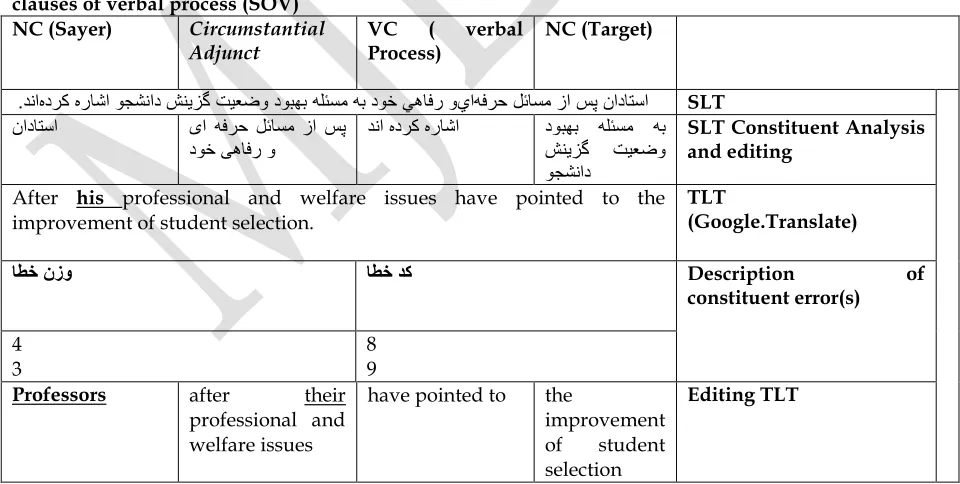
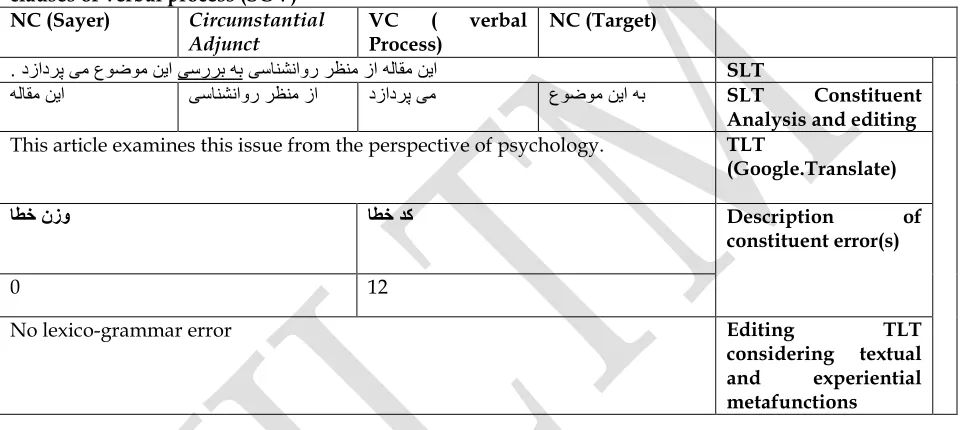
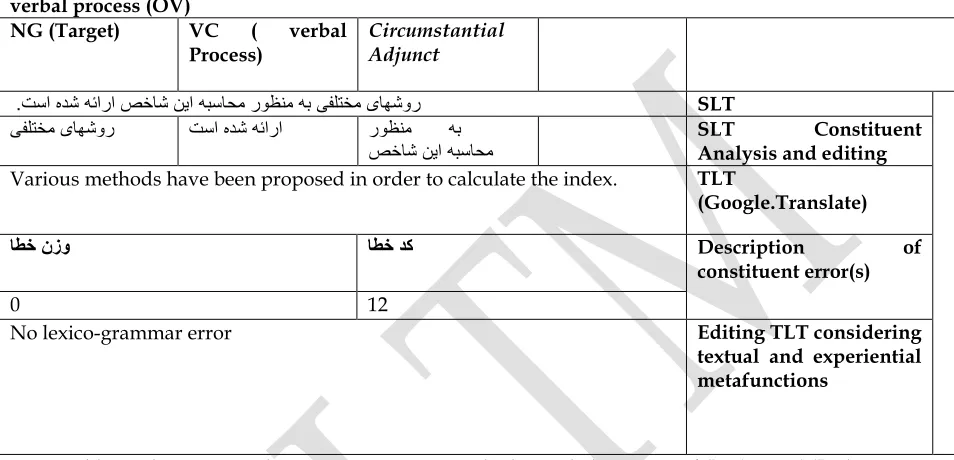
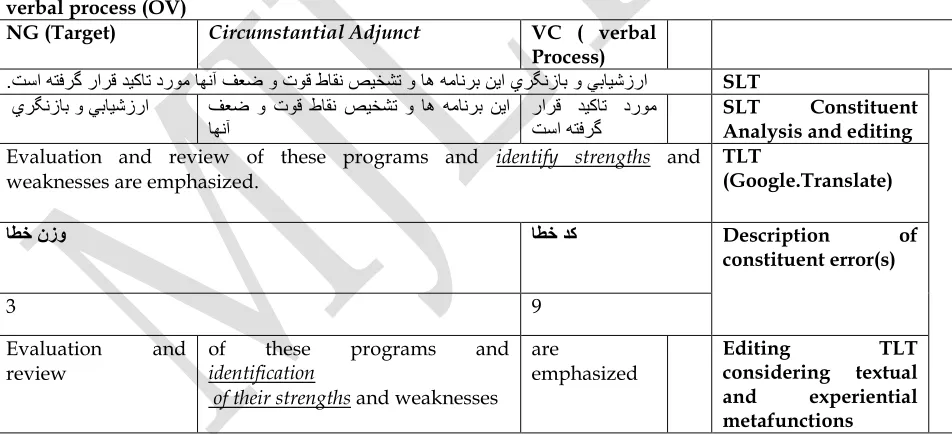
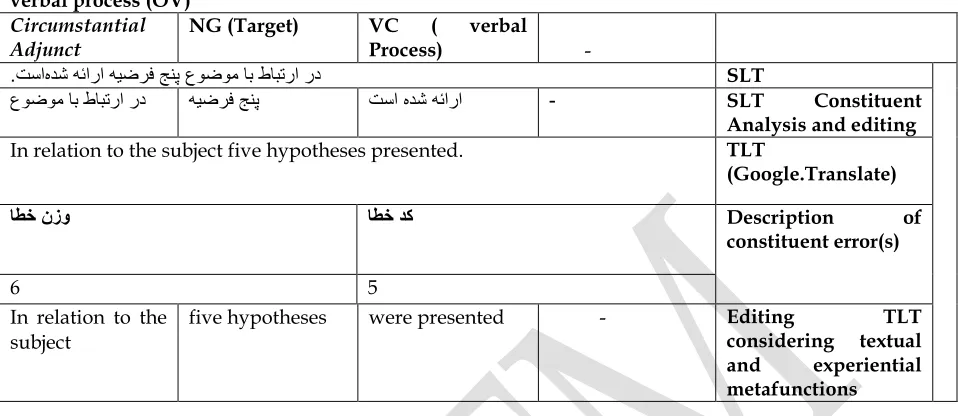
DUE TO THE FACT THAT WWW.TRANSLATE.GOOGLE.COM IS AN ACTIVE TRANSLATION SITE, AND THERE MAY BE PROBABLE ERRORS IN THE TARGET TEXT, AND DUE TO THE LACK OF AN APPROPRIATE FRAMEWORK FOR ASSESSING THE PROCESS OF PERSIAN INTO ENGLISH TEXTS, IT SEEMS HALLIDAY'S SYSTEMATIC FUNCTIONAL GRAMMAR (SFG) PROVIDES A SUITABLE FRAMEWORK TO ASSESS AND PREDICT KINDS OF ERRORS TO BE EDITED. BECAUSE THE TWO LANGUAGES HAVE DIFFERENT CONSTITUENCY ORDERS AND MORPHOLOGICAL TYPOLOGY, SIGNIFICANT LEXICO-GEAMMAR ERRORS CAN BE EXPECTED; OUT OF 350 CLAUSES REGARDING PHD THESIS WHICH WERE TRANSLATED BY GOOGLE TRANSLATE, 26 BELONGED TO THE VERBAL PROCESS OF THE EXPERIENTIAL METAFUNCTIONS OUT OF WHICH 16 CLAUSES BELONGED TO TRANSITIVE (9 UNMARKED AND 7 MARKED) AND 10 TO INTRANSITIVE PERSIAN CLAUSES; HERE 3 UNMARKED TRANSITIVE PERSIAN CLAUSES (SOV), 3
MARKED TRANSITIVE PERSIAN CLAUSES (SVO), ONE PRO-DROP-MARKED TRANSITIVE PERSIAN CLAUSE (SOV), AND 4 INTRANSITIVE PERSIAN CLAUSES HAVE BEEN CHOSEN TO BE STUDIED AND EDITED. THESE CLAUSES WERE CLASSIFIED AND EDITED INCONSTITUTION CLASSIFICATION AND EDITION BOX, THEN THEIR ERRORS WERE EVALUATED BY HAR TRANSLATION EVALUATION BOX DESIGNED BY THE AUTHORS IN WHICH ALL THE TERMS WERE DERIVED FROM SFG. GOOGLE TRANSLATE HAD FEWER AND LIGHTER ERRORS WHEN IT TRANSLATED PERSIAN MARKED TRANSITIVE CLAUSES OF VERBAL PROCESS WITH THE CONSTITUENCY ORDER OF SVO, THE SAME AS ENGLISH UNMARKED CONSTITUENCY ORDER SVO, AS WELL AS WHEN IT TRANSLATED INTRANSITIVE PERSIAN CLAUSES OF VERBAL PROCESS OV, THE SAME AS ENGLISH INTRANSITIVE CLAUSE CONSTITUENCY ORDER OF OV; BUT IT HAD MORE AND HEAVIER ERRORS WHEN IT TRANSLATED PERSIAN UNMARKED
TRANSITIVE CLAUSES WITH THE CONSTITUENCY ORDER OF SOV, OPPOSITE TO ENGLISH SVO.
KEY WORD: HAR TRANSLATION EVALUATION BOX, VERBAL PROCESS, PARTICIPANTS, TRANSITIVITY SYSTEM.
Introduction and Review of Literature
Due to lack of an appropriate framework for assessing the process of Persian into English translation, it seems Halliday's systematic functional grammar provides a suitable framework to assess developments occurring in the process of translation of Google Translate. Hence, in this article, through the same perspective, we want to evaluate the translation quality of Google translate for transitive and intransitive verbal clauses based on HAR1 translation evaluation model derived from SFG by the authors.
Traditionally, in translation studies, the focus has been mainly on experiential meaning, while the textual meaning has been neglected . However, an increasing number of studies in this field are still found in the literature, which has infused new thoughts to the translation studies of textual choices. With the help of SFG, we see translation as centrally involving the recreation of meaning through choices made by the translator in the interpretation of the source text and through choices in the generation of the translated text, translation involves recreating ideational meanings of the logical kind, ideational meanings of the experiential kind, interpersonal meanings and