Vaginal birth after caesarean section with less than two years delivery
interval
Received: 4/6/2014 Accepted: 19/11/2014
Abstract
* Department of Gynecology, College of Medicine, Hawler Medical University, Erbil, Iraq. ** Directorate of Health, Erbil, Iraq.
Introduction
The World Health Organization estimates the rate of caesarean sections between 10%-15% of all births in developed countries. There’s no doubt that the rate of caesarean section is high in the United States compared to elsewhere in the world. In 2009, caesareans accounted for 32.9% of all deliveries, up from 20.7% in 1996.1
According to WHO, the least developed countries have caesarean section rates averaging around 2%, while the most developed regions average just above 20%.2 In the United States the caesarean
rate has risen 48% since 1996, reaching a level of 31.8% in 2007.3 In Iraq the
incidence of caesarean section is 20.6%.4
VBAC refers to the practice in the absence
of a contraindication, a woman with
one previous low-transverse caesarean delivery be counseled to attempt labor in a subsequent pregnancy.5 A successful
vaginal birth with previous one caesarean section includes several factors. Out of these, favorable bishop’s score, BMI <20, prior vaginal delivery, weight of baby <3.5 kg and non-recurrent indication for previous caesarean section are the most common. Maternal age also plays an important role and age less than 40 years is considered to be a favorable factor.6
The aim of this study was to evaluate the outcome of delivery in women with previous single lower segment caesarean section with less than two year delivery interval and applying the results to decrease the rate of repeated caesarean section in Maternity Teaching Hospital.
Background and objective: A dramatic rise in caesarean deliveries has been occurring over the past three decades. The old myth of “once a caesarean always a caesarean” is no longer acceptable as this increases maternal morbidity. The aim of this study was to evaluate the safety and success of vaginal birth after caesarean section performed before less than two years.
Methods: A cross-sectional study was conducted in the Maternity Teaching Hospital in Erbil, Iraq from May to October 2012. Ninety two patients meeting the inclusion criteria were included in this study and followed up during their labour. Patients monitored for vaginal bleeding, scar tenderness and tachycardia.
Results: Of 92 patients with single lower segment caesarean section that underwent trial of labour; 52 (56.5%) patients had successful trial of labour and 40 (43.5%) had a repeated caesarean section. Factors found to be significantly affecting trial of labour were parity (P = 0.01), inter-delivery interval (P <0.001) and cervical dilatation (P = 0.015).
Conclusion: Vaginal birth after caesarean section is a reasonable choice for women with single lower segment caesarean section with good monitoring of mother and baby during labour. Short inter-delivery period does not preclude vaginal delivery in a woman with single lower segment caesarean section providing that there is no contraindication for vaginal delivery.
Keywords: caesarean section, vaginal labour, maternal morbidity.
776
It was also aimed to identify factors that predict successful vaginal birth after
caesarean section.
Methods
Results
single lower segment caesarean section of less than 2 years interval due to non recurrent cause and cephalic presentation. The exclusion criteria included clinically inadequate or contracted
pelvis, history of uterine rupture, hysterotomy, myomectomy, classical or
inverted T caesarean section, medical or obstetrical complications, and Ladies refused to undergo trial of labor. Statistical package of the social sciences (version 18) was used to analyze the data, using Chi-square test and Fisher's exact test.
P value of <0.05 was considered statistically significant.
A descriptive study was conducted on 92 term pregnant ladies who attended the labor ward of Maternity Teaching Hospital in Erbil, Kurdistan region, Iraq. Complete clinical work up was done for all mothers including cardiotocography (CTG) to asses
fetal well being. They were counseled for having trial of labor and their consent
was obtained. An intravenous line was maintained and cross matched blood was prepared. During trial of labor, they were closely monitored by checking vital signs
and fetal cardiac activity to exclude fetal distress. Lower abdominal pain, scar tenderness and vaginal bleeding were checked. Facilities for emergency
caesarean section were available. Following delivery all babies were evaluated by pediatrician. Inclusion criteria
included pregnant ladies at 37-42 weeks of gestation, a history of previous
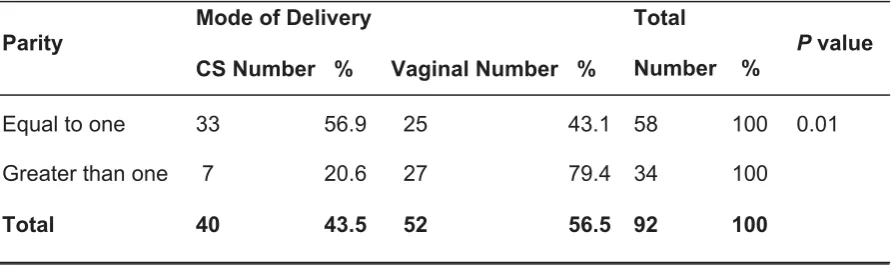
Fifty two (56.5%) patients had successful vaginal birth after previous caesarean section and 40 (43.5%) patients had repeated caesarean section as shown in Table 1. There was a statistically significant association between mode of
delivery and the parity groups (P = 0.01) as shown in Table 2.
Table 1: Distribution of sample by mode of delivery.
Mode Frequency (%)
Vaginal 52 (56.5)
CS 40 (43.5)
Total 92 (100.0)
Table 2: Distribution of cases according the association between the mode of delivery and parity
Parity
Mode of Delivery Total
Number %
P value
CSNumber % VaginalNumber %
Equal to one 33 56.9 25 43.1 58 100 0.01
Greater than one 7 20.6 27 79.4 34 100
The association between age groups and mode of delivery was statically non-significant (P = 0.5) as shown in Table 3. Of those women with no history of vaginal delivery (61 women), 29 women (47.5%) delivered vaginally and among those who had one or more previous vaginal deliveries, 23 women (74.2%) delivered vaginally. The gestational age has no effect on mode of delivery in the
Table 3: Association between age groups and the Mode of delivery.
Age Group/years Mode of delivery Total
Number %
P value
VaginalNumber % CSNumber %
< 25 11 57.9 8 42.1 19 100.0 0.5 25-34 33 58.9 23 47.1 56 100.0 35+ 8 47.1 9 52.9 17 100.0 Total 52 56.5 40 43.5 92 100.0
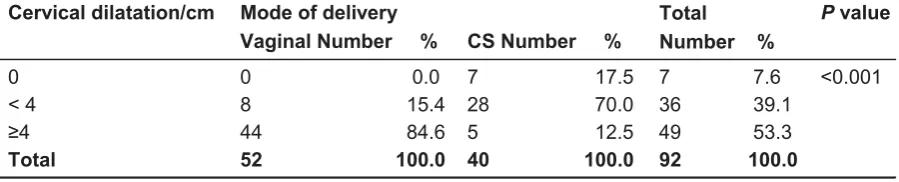
current study (P = 0.4) as seen in Table 4. The statistical association between the mode of delivery and the interval between previous and current caesarean section was statistically significant (P = 0.001) as shown in Table 5. The statistical associa-tion between the mode of delivery and cervical dilation at time of admission to the labour room was statistically significant (P <0.001) as shown in Table 6.
Table 4: Association between the mode of delivery and gestational age.
gestational age groups/weeks
Mode of Delivery
Total
Number % P value
CS
Number % VaginalNumber %
37-39 32 58.2 23 41.8 55 100.0 0.4 40-42 20 54.1 17 45.9 37 100.0
Total 52 56.5 40 43.5 92 100.0
Table 5: Association between the interval between the last caesarean section and the current mode of delivery
Interval /month Mode of DeliveryCSNumber % VaginalNumber % Total Number % P value
10-14 14 73.7 5 26.3 19 100 0.001 15-18 15 53.6 13 46.4 28 100
19-23 11 24.4 34 75.6 45 100 Total 40 43.5 52 56.5 92 100
Table 6: Association between the mode of delivery and the cervical dilatation/cm.
Cervical dilatation/cm Mode of delivery Total
Number %
P value
VaginalNumber % CSNumber %
0 0 0.0 7 17.5 7 7.6 <0.001 < 4 8 15.4 28 70.0 36 39.1
778
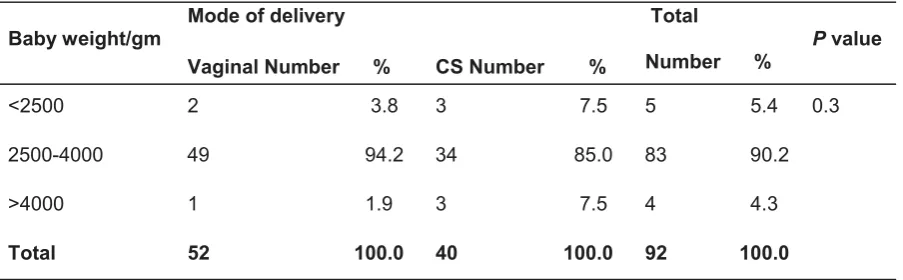
In the current study the association between the mode of delivery and baby weight was statistically non significant (P = 0.3) as seen in Table 7. There was no statistical difference in the complications
whether the delivery was by caesarean section or vaginally as shown in Table 8. The neonatal APGAR score at 5th minutes
was better after vaginal delivery as seen in Table 9.
Table 7: Association between mode of delivery and baby weight in gm.
Table 8: Association between the mode of delivery and the maternalcomplications.
Table 9: Association between the mode of delivery and the neonatal APGAR score at 5th minutes.
Baby weight/gm Mode of delivery Total
Number % P value
VaginalNumber % CSNumber %
<2500 2 3.8 3 7.5 5 5.4 0.3 2500-4000 49 94.2 34 85.0 83 90.2 >4000 1 1.9 3 7.5 4 4.3 Total 52 100.0 40 100.0 92 100.0
Complications
Mode of delivery Total
Number %
P value
Vaginal delivery caesarean section
No complication 51 35 86 0.1
Impending rupture 0 3 3
Incomplete rupture 0 1 1
PPH 1 1 2
Total 52 40 92
APGAR score
Group Mode of Delivery Total
Number %
P value
CSNumber % VaginalNumber %
<8 3 27.3 8 72.7 11 100.0 0.035
≥8 49 60.5 32 39.5 81 100.0
Discussion
The success rate of trial of labour in this study was in agreement with the review of literature done by Martel et al who reviewed MEDLINE database published from January 1995 to February 2004 and found that the success rate of a trial of labor after caesarean ranges between 50% and 85%.7 The success rate of vaginal birth
after caesarean section in this study is in agreement with a study done by Salih and Aldabbagh in Erbil Maternity Teaching Hospital in 2009 in which 82 patients attempted a trial of labour and 47 patients (54.7%) delivered vaginally.8 Regarding
maternal age, the rate of successful vaginal birth after caesarean section was higher among women younger than 35 years compared with those older than 35 years and this is in agreement with the study done by Srinivas et al published in 2007.9 In this study the association between the mode of delivery and maternal age was statistically non significant because of the small sample size and the fact that the majority of patients included in this study were younger than 35 years. In this study the statistical association between the mode of delivery and the parity was significant. This is compatible with the study done by Alwazzan and Yamani Zamzami.10,11 Regarding history of previous vaginal delivery, our result was compatible with the study done by Alwazzan, Landon et al and Gymfi et al, who also concluded that a successful trial of labor has been found to be influenced by previous vaginal delivery.10,12,13 Regarding cervical dilatation
on admission, we found that those women with cervical dilation of more than four cm on admission gave more successful vaginal birth after caesarean section. This was in agreement with Alwazzan and Kashif et al10,14 Regarding inter delivery interval, our
study revealed more successful trial of labor among the group with longer inter delivery interval (19-23 months). This is in agreement with studies of Huang et al, Alwazzan and Salih and Aldabbagh.10,8,15
Regarding gestational age, our results
were in agreement with Alwazzan and Coassolo et al.10,15 Fetal body weight also
has influence on mode of delivery and this was compatible with Alwazzan.10
Regarding complications, there was no maternal mortality in the current study. One patient had incomplete uterine rupture in the caesarean section group and was repaired. Bujold et al found the incidence of rupture increases with less inter delivery interval.11 Our patient who developed
incomplete uterine rupture was 35 years old which by itself is a risk factor for development of uterine rupture after trial of labor.11,12
Conclusion
Women with single lower segment caesarean section of less than two years
inter-delivery period can deliver vaginally safely providing that both the mother and the baby are adequately monitored during labour and that there is no contraindication for vaginal delivery. Factors associated with increased rate of successful vaginal delivery were parity, cervical dilatation
more than four cm on admission, history of vaginal delivery and non recurrent cause of the previous caesarean
section.
Conflicts of interest
The authors report no conflicts of interest.
References
1. Mehta SH, Bujold E, Blackwell SC, Sorokin Y, Sokol RJ. Is abnormal labor associated with shoulder dystocia in nulliparous women? Am J Obstet Gynecol 2004; 190(6):1604-9.
2. World Health Organization.
st
may 2014).
3. Betran AP, Merialdi M, Lauer JA, Bing-Shun W, T (2):98-113.
4. Monitoring the situation of children and women findings from Iraq. Multiple indicator cluster survey 2006. Final report 2007 October, 1. 2010
780 6. Guleria K, Dhall GI, Dhall K. Pattern of cervical
dilatation in previous lower segment Caesarean section patients. J Indian Med Assoc 1997; 95: 131-4.
7. Marie-Jocelyne M, Saskatoon SK , MacKinnon C J, Brantford ON. Guidelines for Vaginal Birth after Previous Caesarean Birth; JOGC No 155 (Replaces guideline No 147), February 2005. 8. Salih R A, Aldabbagh SR. Modes of delivery
among women with previous single lower transverse caesarean section of birth interval less than 2 year and their fetal outcome in Erbil Maternity Teaching hospital; 2009
10. Al-Wazzan RM; Factors affecting success of trial of labour after previous one lower segment Caesarean section; Ann Coll Med Mosul 2010; 36 (1&2):121-9.
11. Yamani TY. Vaginal birth after caesarean section in grand multiparous wom 2004; 270(1):21-4.
12. Landon MB, Leindecker S, Spong CY, Hauth JC, Bloom S, Varner MW, et al. National Institute of Child Health and Human Development Maternal Fetal Medicine Units Network; The Maternal Fetal Medicine Units Caesarean Registry: factors affecting the success of trial of labor after previous caesarean delivery. 193(3 Pt2):1016-23.
13.Gyamfi C, Juhasz G, Gyamfi P, Stone JL. Increased success of trial of labor after previous vaginal birth after caesarean. Obstet Gynecol 2004; 104(4):715
14. Kashif S, Mansoor M, Tariq R, Tahira T. Vaginal birth after caesarean section to evaluate factors for successful outcome. Professional Med J 2010; 17(4):665-9.