ISSN (E): 2305-9249 ISSN (P): 2305-9494
Publisher: Centre of Excellence for Scientific & Research Journalism, COES&RJ LLC Online Publication Date: 1st April 2015
Online Issue: Volume 4, Number 2, April 2015
http://www.centreofexcellence.net/J/JSS/JSS Mainpage.htm
© Author(s) 2015. Licensed under the Creative Commons License - Attribution 4.0
LEARNING AT A DISTANCE WITH MOBILE PHONE Khoo Yin Yin
Department of Economics, Sultan Idris Education University
Tel:+601548117457, email:[email protected]
Noor Al-Huda Abdul Karim
Department of Economics, Sultan Idris Education University Tel: +601548117516, email:[email protected]
&
Norasibah Abdul Jalil
Department of Economics, Sultan Idris Education University
Tel:+01648117475, email:[email protected]
The research is financed by RAGS, Ministry of Education Malaysia.
Abstract
This purpose of the study is to examine the effects of mobile learning with Quick Response Code (QR code) to promote distance learners’ motivation towards the Principles of Economics. This mobile learning with QR code allowed the distance learners to learn and communicate anytime and anywhere with their peers and lecturers. A survey method was employed in this study. A set of 25 items questionnaire constructed by the researcher was used as an instrument for the study. A total of 152 distance learners from one public university in Northern Malaysia were participated in this study. The findings showed that the majority of the respondents had positive results in the questionnaire. This research can be revised to implement in secondary school or different courses of further study.
Keywords
mobile learning, distance learners, motivation, Principles of Economics
Citation
Yin, Khoo Yin; Karim, Noor al-Huda Abdul; Jalil, Norasibah Abdul, (2015); Learning at a distance with mobile phone; Journal of Social Sciences (COES&RJ-JSS), Vol. 4, No. 2, pp:755-769.
1.Introduction
The boom in smart phones in this 21st century has inspired many learning tools. This technology has allowed learner to have all the elements such as audio, video, text and data files with internet connection in one place and students can learn everywhere they go especially like the adult learners engage in distance learning.
Since most of the distance learners engage themselves as part-time students, they have to work besides learning. For this reason, a modern technology such as smart phone can benefit them by saving their time and the learning process can happen informally as part of their daily life. They can read the text while waiting for the bus, lunch break or during their leisure time.
Some researchers may argue that adult learners have their notebook and computer. However, which is more convenient to carry, a notebook or a smartphone? Many adults will use the smart phone if they have choices. With implementation of smart phones, they can assist adult learners to cultivate the self-directed learning.
Many researchers have proposed strategies to maintain students’ motivation to learn which comprise reminding students about learning activities, praise, reward, assistance and encouragement (Printrich & Schunk, 1996; Liu & Hong, 2006; Iniguez & Canton, 2010; ChanLin & Chan, 2007; Hewitt 2005; Yen & Chen, 2007; Ogata, et al., 2008; Liu & Tsai 2008, Karakostas & Demetriadis, 2011; Lema & Agrusa, 2009; Lai, 2011). However, as instructors of distance learners, they can continue to maintain students’ learning interest by providing assistance over smart phone such as downloaded notes with their phones. In addition, an immediate interaction between lecturer and students may occur whenever the students are.
Distance learner should be highly autonomous but according to the researcher’s early investigation, in reality, they were not able to implement independent learning due to the time constraint. Although institutions and systems assert that lifelong learning is an important outcome, however, little effort is done to provide adult learners chances for self-directed in learning. (Aragon, 2003; Weight & Steward, 2005; Hiemstra, 2006; Song & Hill, 2007; Lema & Agrusa, 2009; Laxman, 2009; Lai, 2011). In addition, some students may be reluctant to be self-directed learners because it takes more effort and time to take control of learning. Students may arrive with expectations that tutors will provide expertise and be the source of knowledge. (Stevenson et al., 1996, 1997; Stevenson & Sander, 1998; Fung & Carr, 2000; Stevenson, MacKeogh & Sander, 2006; Clouston, Westcott, Whitcombe, Riley & Matheson, 2010). As a result, the students may lose the motivation of the study if they could not cope with their study.
According to the prior research, half of the 40 students had the miss-communication with the instructor indicated that their motivation had negatively affected. As a result of this occurrence, they had felt less inclined to get in touch with the instructor on subsequent occasions, felt insecure, and experienced a loss of motivation.(Cao, 2005; United States Distance Learning Association, 2005; Occhipinti, 2009).
757
members, particularly times that accommodated part-time students with work commitments, was a big challenge. (Burdet, 2003; Hockings, 2010; Lu, 2012). Based on research conducted at the Open University of the Philippines students in distance education, group work may not be practical when students were far from the institutions they were attached without the help of technology.(Neate, 2003; Fry, Ketteridge & Marshall, 2009). When the student is alone and could not complete their task, it will influence the student’s learning emotion. Stavredes (2011) stated that poor emotions students would indirectly affect students' motivation to learn more effectively.
About the present topic, there were fewer literature reviews done on mobile learning in Malaysia. On the other hand, there is very little research has been done on learner motivation in the use of mobile devices (Chaiprasurt & Esichaikul, 2013) Therefore, this research gap has to be filled. At university lever, the distance learners could not understand the assignment questions while answering the work. As a result, their overall academic performance is not good. For this reason, Principles of Economics course is made to be compulsory at university.
The problems faced by the distance learners could be overcome by the utilization of the developments in technology gadgets. Developments in technology can indirectly solve communication problems as well as motivate students to learn with the assistance of technology, such as mobile learning.
1.1 Objectives of the study
The main objective of this study is to examine the effect of the mobile learning in the teaching of Principles of Economics. This study is undertaken to find out the mobile learning method with Quick Response Code (QR code) to promote distance learners’ motivation.
2. Methodology
This study employed the descriptive quantitative method to seek the effect of mobile learning on distance learners’ motivation towards the course of Principles of Economics. 2.1 Samples
The study uses random sampling technique methods as it involves a big group of students. The study employs about 152 distance learners in one of the universities in Penang, Malaysia. Approximately 250 students engaged in the note viewing. However, about 60.8% of respondents’ rate of the students answered the online questionnaire. Selected students were majoring in Economy and were in their first year of the programme. Gender ratio of the sample is estimated at 2:1. It means that two male to 1 female. It represented the actual situation of the population.
2.2Instrument
A set of 25 item questionnaires was used as an instrument for the study. The questionnaire was constructed by the researcher. The questionnaire consisted of three parts: 5 questions on demographic information, 20 questions of motivation.
item was constructed on a 5- point Likert scale ranging from 1 (strongly disagree) to 5 (strongly agree).
2.3 Pilot test
A pilot test was carried out to examine the validity and reliability of the instrument before employing the actual research. Prior to the pilot study, the same syllabus was taught to the group of 47 students in a public university who were not going to participate in the formal group study.
Content validity of the questionnaire was established by a team of lecturers in education. This was done by appointing two distinguished examiners to score the pilot tests according to the marking scheme and then the researcher correlates between the two examiners. Meanwhile, the reliability of the questionnaire was estimated by calculating the Cronbach alpha coefficient value .953. These results are in line with the benchmark that an instrument with the coefficient of 0.70 or above has a high-reliability standard (Sekeran and Bougie, 2010). Therefore, all the items are reliable and usable.
2.4Research Procedure
Lecturers and students preparation for mobile learning should begin well before the implementation of the mobile learning. Preparation includes managing distance learners’ relevant skills and orienting students to the new learning environment.
The mobile software’s framework was created by Jaquery and Jaquery mobile. Mysq1 built the database and the script was written in PhP. The overview of the mobile learning with the icon ML shown in Figure 1 shown the log in page.
Figure 1 Log In page
759
the smart phone with the QR code to get the immediate access in the learning web by scanning the code. First of all, distance learners could log in QR code by downloading the QR reader. QR reader enables users to scan the QR code. Users also had the alternative to scan online or by using WeChat. This software is free of charge, user friendly and can be logged in easily with the QR code. This software only can be read in mobile phones, not accessible through laptops. Specifically, it would encourage gadget-maniac students to read in mobile phones anywhere and anytime. At the same time, students could also communicate with their lecturers and friends all the time. With the QR code students could scan learning materials and share their lessons in ‘WeChat’ or online.
Figure 2: QR code
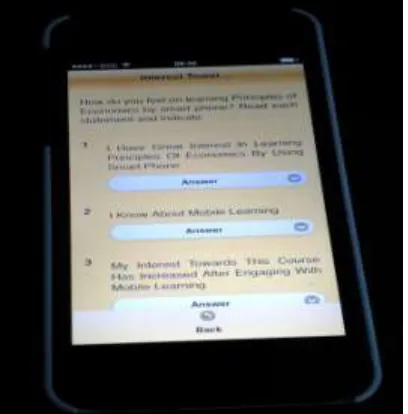
Students will get the immediate notes upload for the three selected chapters (Figure 3). The quiz was prepared for the students to encourage active learning. The intervention takes eight weeks to complete. The students participated self-reported the questionnaire was administered after the intervention (Figure 4). Students were also needed to answer online (in the phone) after the intervention. Besides, the students needed to sit for principles of economics assessment during the end of the intervention.
Figure 4 Layout of questionnaire in mobile phone
3.0 Results
3.1 Analysis of Students’ Motivation
Table 1 Analysis of the Students’ Motivation in The Questionnaire
No. Item
Frequency & Percentage (%) Total
Stro n g ly d is ag ree d is ag ree Neu tr al ag ree Stro n g ly ag ree
1. I am motivated to learn by mobile phone. 0 (0) 4 (2.6 ) 24 (15. 8) 81 (53. 3) 43 (28. 3) 152 (100.0)
2. I want to score in this course. 0 (0) 0 (0) 7 (4.6 ) 64 (42. 1) 81 (53. 3) 152 (100.0)
3. I try to solve the question that I cannot answer. 1 (.7) 2 (1.3 ) 15 (9.9 ) 85 (55. 9) 49 (32. 2) 152 (100.0)
4. I will try to understand all the concepts without lecturer/friends assistance. 1 (.7) 23 (15. 1) 24 (15. 8) 73 (48. 0) 31 (20. 4) 152 (100.0)
761 6. I want to get a better grade than
others. 1 (.7) 1 (.7) 10 (6.6 ) 68 (44. 7) 72 (47. 4) 152 (100.0)
7. I am confident I can score a good grade when I can understand the content. 0 (0) 0 (0) 12 (7.9 ) 77 (50. 7) 63 (41. 4) 152 (100.0)
8. I read the material before the lesson. 0 (0) 1 (.7) 32 (21. 1) 90 (59. 2) 29 (19. 1) 152 (100.0)
9. My motivation to learn this course is greater than other courses.
0 (0) 4 (2.6 ) 31 (20. 4) 81 (53. 3) 36 (23. 7) 152 (100.0)
10. I feel most fulfilled and confident when I can understand the content in the mobile.
0 (0) 2 (1.3 ) 23 (15. 1) 94 (61. 8) 33 (21. 7) 152 (100.0)
11. I like to read Principles of Economics by using mobile because the content is easy to understand. 0 (0) 5 (3.3 ) 36 (23. 7) 82 (53. 9) 29 (19. 1) 152 (100.0)
12. I like to read by using mobile because it is challenging.
0 (0) 4 (2.6 ) 46 (30. 3) 79 (52. 0) 23 (15. 1) 152 (100.0)
13. I feel important to understand all the content in the mobile.
0 (0) 4 (2.6 ) 30 (19. 7) 100 (65. 8) 18 (11. 8) 152 (100.0)
14. My thoughts have been organized while reading with mobile phone.
0 (0) 5 (3.3 ) 45 (29. 6) 86 (56. 6) 16 (10. 5) 152 (100.0)
15. I try to explain the economics concepts to my friends if they could not understand.
0 (0) 2 (1.3 ) 38 (25. 0) 90 (59. 2) 22 (14. 5) 152 (100.0)
16. I try to relate ideas in this course to other courses.
2 (1. 3) 4 (2.6 ) 40 (26. 3) 81 (53. 3) 25 (16. 4) 152 (100.0)
17. I take note all the important concepts and memorize them.
0 (0) 1 (.7) 17 (11. 2) 105 (69. 1) 29 (19. 1) 152 (100.0)
18. I feel motivated when more contents are delivered in mobile device. 0 (0) 1 (.7) 28 (18. 4) 98 (64. 5) 25 (16. 4) 152 100.0
19. I ask myself questions to make sure I can understand the content.
0 (0) 0 (0) 18 (11. 8) 110 (72. 4) 24 (15. 8) 152 (100.0)
20. I try to engage myself in mobile learning to fit this new era.
Average of Frequency & Percentage (%)
0.4 (0.
2) 4.9 (3.4 )
26.4 (17.
4) 85 (55. 9)
35.5 (23. 3)
152 (100)
In response to item 1: “I am motivated to learn by mobile phone.” More than half of the respondents 53.3% (n= 81) selected ‘agree’ followed by 28.3% (n = 43) responded ‘strongly agree,’ 15.8 % (n =24) responded with ‘neutral’ and none of the respondents selected “strongly disagree.”
For item 2: “I want to score in this course”. The score reported the highest majority in the “agree” (n=64 or 42.1%) and “strongly agree” (n=81 or 53.3%) categories. The remaining of 7 respondents (4.6%) choose to be neutral.
For item 3: “I try to solve the question that I cannot answer”. The results show, majority of the respondents (55.9% (n=85)) choose “agree” as their response, followed by “strongly agree’ ( n = 49 (32.2%) and the remaining 9.9%, 1.3% and 0.7% rest on “neutral”, “disagree” and “strongly disagree” as their choice of answer.
Under item 4: “I will try to understand all the concepts without lecturer/friends assistance”. A majority of 73 respondents (48%) choose “agree” as their answer, 31 people (20.4%) answer “strongly agree”, the other 24 (15.8%) and 23(15.1%) people choose to be “neutral” and “disagree”, and finally one person chooses to answer “strongly disagree”.
In response to item 5: “I can learn the material without assistance”. The results indicate that, 57 (37.5%) respondents choose to “agree” with it, 36 (23.7%) others choose “neutral”, 33 people choose “disagree”, the other 24 (15.8%) choose “strongly disagree” and the last 2 people (1.3%) choose “strongly disagree” as their answer.
The score for item 6: “I want to get better grade than others”, has reported a majority of 47.4 and 44.7%, equivalent to 72 and 68 respondents, in the “strongly agree” and “agree” sections, while the other 6.6% (n=10)choose “neutral” as their answer. Each of the remaining two respondents chooses “disagree” and “strongly disagree” on their answers.
For item 7: “I am confident I can score good grade when I can understand the content”, more than half (50.7%, n=77) submitted “agree” as their answers, 41.4% (n=63) choose “strongly agree”, and the other 12 people (7.9%) remains neutral.
The findings for item 8: “I read the material before the lesson”, recorded the highest score of 59.2% (n=90) in the “agree” category, 21.1% (n=32) of them held “neutral”, 29 people (19.1%) “strongly agree” and the last 1 person (0.7%) choose to “disagree”.
763
people (equivalent to 23.7% and 20.4% ) choose “strongly disagree” and “neutral” as their answers, and the last 4 people (2.6%) “Disagree”.
The score for item 10: “I feel most fulfilled and confident when I can understand the content in the mobile”, reported the highest percent of 61.8% (n=94) in the “agree” section, followed by 21.7% (n=33) of the “strongly agree” section, 15.1% (n=23) of the “neutral” section, and the last 5 (3.3%) in the “disagree” section.
The score for item 11: “I like to read Principles of Economics by using mobile because the content is easy to understand”, provide indication that “agree” scores the highest percent ( 53.9% , n=82), followed by “neutral” of 23.7% (n=36) and “strongly agree” to 19.1% (n=29). Those who “disagree” score the lowest of 3.3%(n=5).
The response score for item 12: “I like to read by using mobile because it is challenging”, reported the highest score of 52% (n=79) for those who “agree”, the other 30.3% (n=46) of those who held “neutral” , and the rest 23 and 4 people ( equivalent to 15.1% and 2.6%) are among those who “strongly agree”, and “disagree” with it.
Relating to item 13: “I feel important to understand all the content in the mobile”, the highest percent (65.8%, n=100) decide to “agree”, the other 19.7% (n=30) choose to be “neutral” and the remaining 18 (11.8%) and 4 (2.6%) people choose to “strongly agree” and to “disagree” with it.
For item 14: “My thoughts have been organized while reading with mobile phone”, 86 respondents (56.6%) tend to “agree”, 45 others (29.6%) are “neutral” and the rest of 16 and 4 people, equivalent to 10.5% and 3.3%, appear to “strongly agree” and to “disagree” with it.
The results for item 12: “I try to explain the economics concepts to my friends if they could not understand”, show the highest percent (59.2%, n=90) are derived from those who collectively “agree”, while the next highest of 25% are obtained from those who choose the be held “neutral”, followed by 14.5% (n=22) of those who “strongly agree”, and the last two people who choose to “disagree” with it.
The scores for item 16: “I try to relate ideas in this course to other courses”, reported 81 respondents (53.5%) “strongly agree” with it, 40 others (26.3%) “agree”, and the rest of 4 (2.6%) and 2 (1.3%) people choose to be “neutral” and to “disagree” with it.
The results for item 17: “I take note all the important concepts and memorize them”, demonstrate 105 respondents (69.1%) “agree” with it, while 29 others (19.1%) “strongly agree” with it, the following 17 people (11.2%) proclaim to be “neutral” and the last one person “disagree” with it.
Referring to item 19: “I ask myself questions to make sure I can understand the content”, a total of 110 (72.4%) and 24 (15.8%) respondents choose to “agree” and “strongly agree” with it, and the remaining 18 people (11.8%) proclaim to be “neutral”.
For item 20: “I try to engage myself in mobile learning to fit this new era”, the findings show 98 respondents (64.5%) select “agree” on their answer, the following 37 people (24.3) choose “strongly agree” , the next 16 people (10.5%) decide to be “neutral” and remaining one person decide to “disagree” with it.
The overall score provides indication a majority of 55.8% ( n=85) falls in the “agree” category, the next highest percent of 23.2% (n=35.5) is in the “strongly agree” category, the following 26.4% (n=17.3), 4.7% (n=3.4) and 0.3%(n=0.4) are all in the “neutral”, “disagree” and “strongly disagree” categories. An illustration of overall result has shown in Figure 6.
4. Conclusion and Discussion
The findings of this study indicate that the mobile learning is an effective learning method in enhancing distance learners’ motivation. The results revealed that mobile learning has a significant effect during the intervention period. In fact, most of the universities in Malaysia have implemented online learning many years ago. By this learning method, those distance learners can communicate with the lecturers and peers anytime and anywhere. The learning process may happen anywhere.
In addition, mobile is more portable than a laptop and computer, mobile learning can encourage independent learning (Saedah Siraj, 2005; Eschenbrenner & Nah, 2007; Dimakopoulos & Magoulas, 2009; Beetham & Sharpe, 2013). It also provides the learners to read the materials with their different learning styles (Stead, 2006; Wei, Zhuo, & Zhang, 2008; Helou, Gillet, Salzmann & Rekik, 2008; Wang & Ryu, 2009; Lundin, Lymer, Holmquist, Brown & Rost, 2010; Clark & Mayer, 2011). Learners also can help their peers to understand the topic deeply from the notes provided. On the other hand, it also provided a platform for the learners to meet peers with the similar interest (Ryu & Parsons, 2008; Callum & Kinshuk, 2008; Wang, Shen, Novak & Pan, 2009; Macdonald &Creanor, 2010; Hung, Hwang & Lee, 2011) discussed the topics when they needed. Mobile learning also encourages learners to share their thoughts and ideas with peers through online discussion. This study proved that mobile learning enhances the social interaction among learners. The ability of gathering text information is impressive; with mobile device technology learners become more efficacious to access information and reach other learners.
The device is benefiting the distance learners that the requirement of their mobile devices is dismissed. In other words, all the users may download the notes instantly without any payment. Besides, they do not need to spend much time in training because it is user friendly and they will get a quick revision only with the finger- flip.
As a conclusion, the findings from this study provide an important insight for the future research. It could be interesting about this method are revised to implement in secondary school or different courses.
765 References
Aragon, S.R. (2003). Facilitating Learning in Online Environments. Wiley Subscription Services, Inc. Francisco: California.
Beetham, H. & Sharpe, R. (2013). Rethinking Pedagogy for a Digital Age Designing for 21st Century Learning (2nd Ed). Routledge.
Burdett, J. (2003). Making Groups Work: University Students' Perceptions. International Education Journal: Flinders University, School of Education, 4(3), 177(191).
Callum. K.M., & Kishuk. (2008). Mobile technology in collaboration: evaluation of a web-based discussion board. International Journal of Mobile Learning and Organisation, 2(4), 318-328. Doi: 10.1504/IJMLO.2008.020685
Cao, K.X.Q. (2005). Three Levels of Motivation in Institution. Building Interpersonal Relations
With Learners. Distance Learning---A Magazine for Leaders, Vol.2, No. 4, 1-29.
Chaiprasurt, C. & Esichaikul, V. (2013). Enhancing Motivation in Online Courses With Mobile Communication Tool Support: A Comparative Study. The International Review in Open and Distance Learning,14 (3), 378-400.
ChanLin, L-J, & Chan, C. (2007). Integrating inter-disciplinary experts for supporting problem-based learning. Innovations in Education and Teaching International, 44(2), 211-224. DOI: 10.1080/14703290701241026.
Clark, R. C. & Mayer, R. E. (2011). E-learning and the Science of Instruction (3rd Ed). USA: Pfeiffer.
Clouston, T., Westcott, L., Whitcombe, S., Riley, J. & Matheson, R. (2010). Problem- Based
Learning: In Health and Social Care. Blackwell Publishing. Ltd. United Kingdom: USA.
Dimakopoulos, D.N., & Magoulas, G.D. (2009). Interface design and evaluation of a personal information space for mobile learners. International Journal of Mobile Learning and Organisation, 3(4), 440-463. Doi: 10.1504/IJMLO.2009.027458
Eschenbrenner, B., & Nah, F.F-H. (2007). Mobile technology in education: uses and benefits. International Journal of Mobile Learning and Organisation, 1(2), 159-183. Doi: 10.1504/IJMLO.2007.012676
Fry, H., Ketteridge, S. & Marshall, S. (2009). Handbook of Teaching and Learning in Higher Education: Enhancing Academic Practice (3th Edi.) UK: Routledge.
Gay, L.R. and Arasian, P. (2003). Educational Research: Competencies for Analysis and Applications. 7th ed. New Jersey: Merrill Prentice – Hall, 367-469.
Gay, L.R., Millis, G.E., Arasian, P. (2011). Educational Research: Competencies for Analysis and Applications. 10th ed. Addison Wesley.
Helou, S.E., Gillet, D., Salzmann, C., & Rekik, Y. (2008). Feed-oriented awareness services for e-logbook mobile users. International Journal of Mobile Learning and Organisation, 2(4), 305-317. Doi: 10.1504/IJMLO.2008.020684
Hewitt, J. (2005). Toward an understanding of how threads die in asynchronous computer conferences. The Journal of the Learning Sciences, 7, 567–589.
Hiemstra, R. (2006). Is the internet changing self-directed learning? Rural users provide some answers. International Journal of Self-directed Learning, 3(2), 45-60.
Hockings, C. (2010). Inclusive Learning a Teaching in Higher Education: A Synthesis of Research. Higher Education Resource: EvidenceNet, 1-67.
Hung,P.H., Hwang, G.J., Lee, Y.H.& Wu,T.H. (2011). The Problem-refining Progress of 5th Graders’ Ubiquitous Inquiring. International Journal of Mobile Learning and Organisation, Vol. 5, (3/4), 255-267.
Iniguez,R.R., Canton,U. (2010). Understanding Motivation Large Groups of Engineering And Computing Students. UK: Glasgow Caledonian University.
Karakostas, A., & Demetriadis, S. (2011). Enhancing collaborative learning through dynamic forms of support: the impact of an adaptive domain-specific support strategy.
Journal of Computer Assisted Learning, 27, 243–258.
Knowles, M.S., Holton III, E.F., & Swanson, R.A. (1998). The Adult Learner. Texas: Gulf Publishing Company.
Lai, Horng-Ji. (2011). The Influence of Adult Learners’ Self-Directed Learning Readiness and Network Literacy on Online Learning Effectiveness: A Study of Civil Servants in Taiwan. Educational Technology & Society,14(2), 98-106.
Laxman, K. (2009). Facilitating adult mobile technology-based learning through problem solving. International Journal of Mobile Learning and Organisation, 3(1), 15-24. Doi: 10.1504/IJMLO.2009.023050
Lema, J., & Agrusa, J. (2009). Relationship of WWW usage and employee learning in the casino industry. International Journal of Hospitality Management, 28(1), 18-25.
767
Liu, C.C. & Tsai, C.C. (2008). An Analysis of peer interaction patters as discoursed by on-line small group problem-solving activity. Computers & Education, 5, 627-639
Lu, Z. (2012). Learning with Mobile Technologies, Handheld Devices, and Smart Phones: Innovative Methods.UK:University of Huddersfield.
Lundin, J., Lymer, G., Holmquist, L.E., Brown, B., & Rost, M. (2010). Integrating students' mobile technology in higher education. International Journal of Mobile Learning and Organisation, 4(1), (1-14). Doi: 10.1504/IJMLO.2010.029951
Macdonald, J. & Creanor, L. (2010). Learning with Online and Mobile Technologies. UK: MPG Book Group.
Mcconatha, D., Praul, M. & Lynch, M.J. (2008).Mobile Learning in Higher Education: An Empirical Assessment of A New Educational Tool. The Turkish Online Journal of Educational Technology , 7(3), 15-21
Neate, P. (2003). IPGRI Thematic Report 2000-2001. International Plant Genetic Resources Institute. Bioversity International.
Song, L., & Hill, J. R. (2007). A conceptual model for understanding self-directed learning in online environment. Journal of Interactive Online Learning, 6(1), 27-42.
Occhipinti,A. (2009). Foreign Language Anxiety in in-Class Spending Activities. [Thesis]. The University of Oslo.
Ogata, H., Hui., G.L., Yin, C., Ueda, T., Oishi, Y., & Yano, Y. (2008). LOCH: supporting mobile language learning outside classrooms. International Journal of Mobile Learning and Organisation, 2(3), 271-282. Doi: 10.1504/IJMLO.2008.020319
Oladokun, O. (2014). The Information Environment of Distance Learners: A Literature Review. Creative Education, 303-317.
Printrich,P.R. & Schunk,D.H. (1996). Motivation in Education: Theory, Research and Application. Englewood Cliffs, N.J. : Merrill.
Ryu, H., & Parsons, D. (2008). A learner-centred design of a location-aware learning reminder. International Journal of Mobile Learning and Organisation, 2(2), 187-200. Doi: 10.1504/IJMLO.2008.019768
Saedah Siraj (2005). M Learning dalam Pembangunan Sekolah Berteknologi Di Malaysia: Prospek Pelaksanaan (mlearning in the Development for School with Technology in Malaysia: Implementation prospects). Proceeding (in CD), Seminar of ICT in Education 2005, Sultan Idris Education University and Ministry of Education Malaysia, Prince Hotel and Residence, K. Lumpur. Nov 17-19, 2005.
Sharples, M., Taylor, J. & Vavoula, G. (2010). A Theory of Learning for The Mobile Age Learning Through Conversation and Exploration Across Contexts. Springer: Medienbiding in Neuen Kulturraumen,87-99.
Stavredes, T. (2011). Effective Online Teaching: Foundations and Strategies for Student Success. An Imprint of Wiley.
Stead, G. (2006). Mobile Technologies: transforming the future learning. In Emerging Technologies for Learning, British Educational Communication and Technology Agency, ICT Research, Coventry. Coventry,UK:BECTA, 6-15.
Stevenson, K., MacKeogh, K., & Sander, P. (2006). Working with student expectations of tutor support in distance education: testing an expectations-led quality assurance model.
Open Learning, 21(2), 139-152. DOI: 10.1080/02680510600713169
Stevenson, K., Sander, P., & Naylor, P. (1996). Student perceptions of the tutor’ s role in distance learning. Open Learning, 11(1), 22-30.
Stevenson, K., Sander, P., & Naylor, P. (1997) ELPOÐ a model that uses student feedback to develop effective open tutoring. Open Learning, 12(2), 54-59.
Stevenson, K., & Sander, P. (1998) How do Open University students expect to be taught at tutorials. Open Learning, 13(2), 42- 46.
United States Distance Learning Association. (2005). Distance Learning: A Magazine for Leaders: Volume 2 Number 4 2005. Information Age Publishing, INC. Greenwich: US.
Valk, J-H, Rashid, A.T. & Elder, L. (2010). Using Mobile Phone to Improve Educational Outcomes: An Analysis of Eviromdence from Asia. The International Review of Research
In Open and Distance Learning, Vol. 11, No.1, 117-140.
Vygotsky, Les.S. (1997). The Collected Works of L.S. Vygotsky.In R.W. Riceber & A.S. Carton (Ed.), Translated by N. Minick. New York: Plenum.
Wang, P., & Ryu, H. (2009). Not SMS, but mobile quizzes: Designing a mobile learning application for university students. International Journal of Mobile Learning and Organisation, 3(4), 351-365. Doi: 10.1504/IJMLO.2009.027453
769
Wei, J., Zhuo, J., & Zhang, H. (2008). Development of a mobile learning model with usability features for online education. International Journal of Mobile Learning and Organisation, 2(1), 18-35. Doi: 10.1504/IJMLO.2008.018715.
Weight, C.L. & Stewart,B.L. (2005).Valuing the Adult Learners in e-Learning Part Two-Insights From Four Companies. The Journal of Workplace Learning, Vol.17, No.56, 318-414.
Yen, J-C., & Chen, M-P. (2007). The effects of web-based learning experience, perceived-initiative, and perceived-performance on learners' attitudes toward mobile learning.
International Journal of Mobile Learning and Organisation, 1(30), 257-274. Doi: 10.1504/IJMLO.2007.015430