Journal of Computing and Security
Effective Intrusion Detection with a Neural Network Ensemble
Using Fuzzy Clustering and Stacking Combination Method
Mohammad Amini
a,∗
Jalal Rezaeenoor
aEsmaeil Hadavandi
baDepartment of Information Technology, University of Qom, Qom, Iran.
bDepartment of Industrial Engineering, AmirKabir University of Technology, Tehran, Iran.
A R T I C L E I N F O.
Article history:
Received:29 March 2014
Revised:28 September 2014
Accepted:20 November 2014
Published Online:27 February 2015
Keywords:
Intrusion Detection, Ensemble Classifiers, Stacking, Fuzzy Clustering, Artificial Neural Networks
A B S T R A C T
Data mining techniques are widely used for intrusion detection since they have the capability of automation and improving the performance. However, using a single classification technique for intrusion detection might involve some difficulties and limitations such as high complexity, instability, and low detection precision for less frequent attacks. Ensemble classifiers can address these issues as they combine different classifiers and obtain better results for predictions. In this paper, a novel ensemble method with neural networks is proposed for intrusion detection based on fuzzy clustering and stacking combination method. We use fuzzy clustering in order to divide the dataset into more homogeneous portions. The stacking combination method is used to aggregate the predictions of the base models and reduce their errors in order to enhance detection accuracy. The experimental results on NSL-KDD dataset demonstrate that the performance of our proposed ensemble method is higher compared to other well-known classification techniques, particularly when the classes of attacks are small.
c
2014 JComSec. All rights reserved.
1
Introduction
The use of Internet has been expanded in many areas of daily life as well as business activities. Organiza-tions usually employ complex information networks and open them in order to share information with their partners and customers. Therefore, information security and networks protection need to be carefully taken care of. However, as technology is progressing, the security attacks and intrusions are also developing. Nowadays, it is obvious that the basic security
mea-∗ Corresponding author.
Email addresses:[email protected](M.Amini),
[email protected](J. Rezaeenoor),
[email protected](E. Hadavandi)
ISSN: 2322-4460 c2014 JComSec. All rights reserved.
sures and tools such as firewalls or anti-viruses are not robust enough to provide the adequate level of security for corporate networks and prevent malicious users from breaking into the systems. A more sophisticated and intelligent solution for preventing intrusion and malicious activities is provided by Network Intrusion Detection Systems (NIDS). A NIDS is a tool which monitors and analyses data traffic on the network to detect possible attacks or intrusive activities.
types or intrusion scenarios. The network events are compared against this model to find matches with known attacks patterns. Usually the network events are either recognized as Normal or assigned to one of the four attack types DoS, Probe,U2R, and R2L.This method can be really effective in detecting known at-tacks. However, it has many limitations for detecting novel or unknown threats. In anomaly detection, a profile of the normal network traffic is generated first. The idea is to analyze the network events against this normal profile. If any deviation from the normal be-havior is detected, it can be identified as intrusive. The major advantage of this method is the ability to recognize unseen attacks. However, this method can create a considerably high rate of false alarms.
Recently, machine learning and data mining tech-niques have attracted high attention for intrusion de-tection in both mentioned categories [1,3]. The major advantage offered by these methods is their general-ization ability that enables them to detect not only known threats but also their variations. The goal in intrusion detection methods is to maximize detection accuracy and reduce false positive rate as much as possible. Mostly, researchers have developed classifica-tion models for intrusion detecclassifica-tion using single classi-fiers such as decision tree [4], support vector machine (SVM) [5,6], artificial neural networks (ANNs) [7,8], and K-nearest neighbor (KNN) [9,10]. Although these methods have been successful in detection to some degree, they suffer from a number of limitations. Espe-cially, in misuse detection, they have a low detection precision for low frequent attacks since they lack a sufficient number of samples to learn the rare attacks patterns. Another problem is that training the classi-fiers can be time consuming and create very complex models because the dataset is very large. The other issue is the lack of stability. For example the ANN is unstable and may converge to the local minimum [11].We need to have stable models which detect the known and unknown attacks accurately with a high degree of certainty.
The ensemble classifiers aim to improve the perfor-mance of classification by combining the output of multiple relatively-weak classifiers [12]. These weak classifiers are trained by different samples and develop different models. Then a combination strategy, such as majority vote, mixes their individual predictions so that they will generate better results. This way, the performance of the whole system is improved. These methods are very flexible and able to produce more accurate and stable results. In this article, we propose an ensemble classifier for intrusion detection which divides the problem space by fuzzy clustering method, and then utilizes the generated subspaces to train similar ANNs. To aggregate the predictions of all in-dividual classifiers we apply stacked generalization in
which another ANN is used to aggregate the outputs and reduce the errors of individual classifiers. We use a hybrid combination strategy in order to improve the classification accuracy. By using this ensemble sys-tem, the major drawbacks of the current single classi-fiers are removed. We also used radial basis function (RBF) neural networks which are more precise than multi-layer perceptron (MLP) networks in terms of generalization error. The results of our experiments are compared against other well-known classifiers such as decision tree, KNN and Na¨ıve Bayes, as well as two types of popular ensemble methods named Boosting and Bagging. The experimental results on NSL-KDD, which is a modified version of the popular KDD99 dataset, demonstrate better performance on low fre-quent attacks as well as the whole classification task compared to the aforementioned methods.
The remainder of this paper is organized as follows: In the next section, the fundamentals of ensemble classification techniques and the related works for in-trusion detection are described. In Section3, we de-scribe the framework of our proposed ensemble system and explain its working modules. Section4presents the experimental procedures, evaluation criteria, and discussion. Finally, Section5draws conclusion and describes future work.
2
Ensemble Methods for Intrusion
De-tection
Ensemble learning has been one of the most popular approaches in complex classification tasks in recent years. This classification method focuses on the idea that by combining several individual classifiers, it is possible to acquire a classifier which has a higher per-formance than that of all the individual classifiers [12]. The predictions of individual classifiers (or ensemble members) are combined using a proper method, e.g. voting or averaging, to produce a final prediction. The benefits given by the combination of redundant and complementary classifiers are increasing accuracy, ro-bustness and overall generalization capability in most applications [13].
Building an ensemble system consists of three phases: 1) Data sampling and selection, which creates diversity among ensemble members; 2) Training mem-ber classifiers which is performed using numerous com-peting algorithms such as bagging, boosting, stacked generalization, etc. 3) combining member predictions using different rules e.g. majority voting, simple or weighted average [14]. Many previous research works have shown that an ensemble classifier is often more precise and robust than all its member classifiers if the individual members perform well to some degree and have independent predictions [15–19].
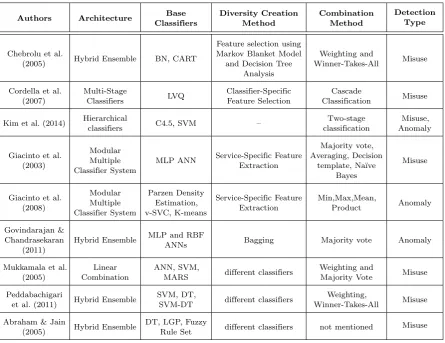
bring to the world of pattern recognition and classi-fication, some researchers began to use these meth-ods in intrusion detection context. Chauhan et al. compared the performance of ten best selected clas-sifiers including C4.5, BayesNet, Logistic Regression, Stochastic Gradient Descent (SGD), Instance Based Knowledge(IBK) , JRip, PART, Random Forest, Ran-dom Tree and REPTree [20]. The authors’ experiments showed that Random Forest, which is an ensemble of decision tree classifiers, outperformed other methods with respect to accuracy, specificity and sensitivity. Several ensemble methods have been proposed for mis-use and anomaly detection. Table1summarizes the most important research works on this area and the elements of creating their ensemble classifiers.
Mukkamala et al. demonstrated the advantage of us-ing ensemble approaches for intrusion detection. They created an ensemble of SVM, MARS and ANN classi-fiers and their results showed the obvious superiority of the ensemble system against the base classifiers in each of the 5 classes [21]. Giacinto et al. trained the in-dividual classifiers with different feature subsets and obtained better performance in misuse detection after combining them [22]. For anomaly detection, Giac-into established an ensemble approach with a modular multiple classifier system using the base unsupervised classifiers. Each classifier was trained on a group of similar network protocols or services [23].
Some authors tried to use slightly different methods for creating ensembles. In [24] classifiers for misuse de-tection were combined serially and the network traffic was inspected in sequential stages. A hybrid intrusion detection method was proposed by Kim et al. which hierarchically integrated a misuse detection model and an anomaly detection model [25].The authors used C4.5 decision tree (DT) to create the misuse detec-tion model and applied that model to decompose the normal training data into smaller subsets. Then, the one-class support vector machine (1-class SVM) was used to create an anomaly detection model in each decomposed region. Their experiments demonstrated that the proposed hybrid intrusion detection method could improve the IDS in terms of detection perfor-mance for unknown attacks and detection speed. Some methods make use of hybrid approaches in ensem-ble classifiers. Chebrolu et al. developed an ensemensem-ble system by combining Bayesian Networks (BN) and Classification and Regression Trees (CART) which performed the classification task after feature reduc-tion [26]. Then they created a hybrid architecture with the ensemble and the base classifiers themselves to build a lightweight IDS. Their results were significant, especially for smaller classes i.e. U2R and R2L . In [27] the authors combined the hybrid systems with the ensembles. They made a hybrid system using two classification techniques DT and SVM and then
de-veloped an ensemble classifier through combining the hybrid system and the base classifiers. They were able to produce the best accuracy in detection for all 5 classes. Particularly, the detection rate for Probe at-tacks was 100%. Abraham and Jain applied DT, LGP and fuzzy rule sets to create an ensemble model [28]. They demonstrated that different models offer com-plementary information about examples’ class labels. The authors selected the best model for each class as the classifier responsible for that class and then combined them with an efficient method.
One of the best methods which can provide good accuracy and flexibility in pattern recognition and data classification is using artificial neural networks (ANNs). They are good candidates as base classifiers in ensemble models. Hansen and Salamon demon-strated that the generalization ability for an ensemble of neural networks can be significantly high [29]. ANN ensembles have been used in many applications by various authors [30–34]. However, few studies have been done about the ensemble of ANNs and their per-formance for intrusion detection. Ghadiri and Ghadiri proposed a two-layer hybrid architecture for intrusion detection using fuzzy clustering and artificial neural networks [35]. The first layer used FCM and GK fuzzy clustering to extract the features and the second layer used a set of neural networks to perform the classi-fication. Their result showed high detection and low false positive rates. However, the authors mostly con-centrated on the clustering stage and didn’t focus on the concept of ensemble learning. Thus, there was no clear method for combining the individual classifiers.
In this article, we propose an ensemble model using Radial Basis Function (RBF) and Multi-Layer Percep-tron (MLP) neural networks. By using RBF networks as the base classifiers we are much less likely to deal with the problem of getting stuck in the local minima. Moreover, we aggregate the predictions of all ensemble members using a MLP network and obtain a predic-tion which is stable. RBF networks are trained based on different subsets of the whole network traffic.
Table 1. Ensemble methods proposed for Intrusion Detection
Authors Architecture Base
Classifiers
Diversity Creation Method
Combination Method
Detection Type
Chebrolu et al.
(2005) Hybrid Ensemble BN, CART
Feature selection using Markov Blanket Model
and Decision Tree Analysis
Weighting and
Winner-Takes-All Misuse
Cordella et al. (2007)
Multi-Stage
Classifiers LVQ
Classifier-Specific Feature Selection
Cascade
Classification Misuse
Kim et al. (2014) Hierarchical
classifiers C4.5, SVM –
Two-stage classification
Misuse, Anomaly
Giacinto et al. (2003)
Modular Multiple Classifier System
MLP ANN Service-Specific Feature Extraction
Majority vote, Averaging, Decision
template, Na¨ıve Bayes
Misuse
Giacinto et al. (2008)
Modular Multiple Classifier System
Parzen Density Estimation, v-SVC, K-means
Service-Specific Feature Extraction
Min,Max,Mean,
Product Anomaly
Govindarajan & Chandrasekaran
(2011)
Hybrid Ensemble MLP and RBF
ANNs Bagging Majority vote Anomaly
Mukkamala et al. (2005)
Linear Combination
ANN, SVM,
MARS different classifiers
Weighting and
Majority Vote Misuse
Peddabachigari
et al. (2011) Hybrid Ensemble
SVM, DT,
SVM-DT different classifiers
Weighting,
Winner-Takes-All Misuse
Abraham & Jain
(2005) Hybrid Ensemble
DT, LGP, Fuzzy
Rule Set different classifiers not mentioned Misuse
3
Ensemble Framework
In this section we describe our ensemble method in detail. First we explain the stacked generalization method for combining base classifiers. Then the ensem-ble framework is presented. After that we elaborate on its different modules.
3.1 Stacked Generalization
The idea behind stacked generalization (also called stacking) is to create a mapped example for each example in the original dataset [17, 36]. It uses the predicted labels of base classifiers as new features for the newly created examples. The target labels remain the same as the original dataset. The original examples of a dataset are first classified by each of the base classifiers. Then, the outputs of the base classifiers are used to make features in another space. The new features and the actual labels of the examples from the original dataset are put together to form a new dataset. Next, ameta-learner is trained by the new dataset. This meta-learner, which can be any kind of classifier, is able to reduce the errors made by each of the base classifiers through its training process. Therefore, the generalization ability of the system is improved.
3.2 The Proposed Ensemble System
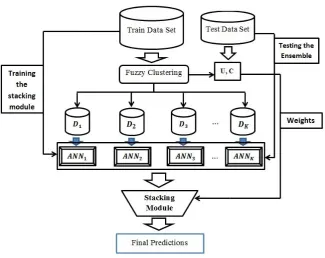
Our ensemble system consists of three major modules: Fuzzy clustering, base classifiers using RBF networks, and stacking module. To make the ensemble, we first divide the original training dataset into several sub-sets using fuzzy clustering technique. Then we train the equal number of RBF networks using the created subsets. Themembership gradesproduced by fuzzy clustering technique are used as special weights for the individual classifiers. Using these weights the pre-dictions of all individual RBF classifiers are combined and aggregated by a MLP network which acts as a stacking combiner. We use a MLP network for the com-bination module because the size of the dataset given to the meta-learner is very large (the whole dataset). With such a large dataset the RBF networks use a tremendous amount of system resources to build the model. MLP networks use less memory and CPU than RBF networks in experimental environment when the number of examples is very high. The final classifica-tion is determined by the MLP network output. The ensemble framework is depicted in Figure1.
Figure 1. Framework of the ensemble classifier for IDS
the training phase the following tasks are performed: • Task 1: From the training datasetD, K different subsets are created using fuzzy clustering tech-nique.
• Task 2: For each training subset Dj, j ∈
{1,2, . . . , K},AN Nj is trained using the subset
so that it offers the best generalization error . This way,K different ANN base classifiers are created.
• Task 3: In order to reduce the error for every AN Nj, all base ANNs are simulated by the whole
training datasetDand results are obtained. (The whole datasetDis given to all of ANNs as input and their predictions for the input examples are obtained as output.) To perform the stacking com-bination method the membership grades which are produced by the fuzzy clustering module are used to combine the results. Subsequently, we train a MLP network using the combined results. In the testing phase, first, the membership grades of each test example are calculated based on the outputs matrices of fuzzy clustering module. Then, we simply give the testing examples to each ofKRBF network base classifiers. After the classes of the examples are predicted by the base classifiers, the final results are computed using the stacking module.
In the next sections we explain how we deal with the problems in each module of the ensemble. We first describe subdividing the dataset using fuzzy cluster-ing and then explain the traincluster-ing method for RBF network base classifiers. Finally, we describe how to
combine the base models using the stacking combina-tion method.
3.3 Fuzzy Clustering Module
This module aims to partition the training dataset into smaller subsets. We create diversity in the en-semble members through clustering the training data. Each subset includes the examples with similar char-acteristics and this way a group of similar examples are provided to an ANN for training. Since the size and complexity of the training subsets are reduced, the training of the base classifiers will be efficient, quick, and less complex.
We chose the popular Fuzzy C-means algorithm [37,
38] for fuzzy clustering module. In this method, each data point can belong to multiple clusters at the same time. But the degree of membership is determined by membership grades which are assigned to each data point. For eachxi in dataset D the fuzzy C-means
algorithm assigns membership gradeuij which shows
the degree ofxi membership in clusterj (0≤uij ≤
1). The membership grades are calculated for each example based on the minimization of an objective function which measures the distance between each data point and the cluster centers. Ifmis the size of the input dataset and K is the number of clusters, this objective function is calculated as follows:
J=
K
X
j=1
m
X
i=1
In the above equationqis the fuzziness exponent and can be any real value greater than 1 depending on the kind of problem. cj is the center of j-th cluster
and its dimensions are equal to that of input vector xi.Creating the clusters is done through an iterative
optimization process for objective function in which membership gradesuij and cluster centerscj are
up-dated as below: uij =
1
PK
d=1
kxi−c
jk kxi−cdk
q−21
(2)
cj =
Pm
i=1uijxi
Pm
i=1uij
(3) Iteration is stopped when
max
i,j {|u
(t+1)
ij −u t
ij|}< ,(0< <1) (4)
where t shows the iteration step.
When Fuzzy C-means algorithm receives the un-labeled dataset with size m as input, it perform the above procedure and produces two matrices as output: MatrixU which has the membership grades of each data example in each of theKclusters and matrixC which includes the cluster centers forKclusters.
U = [uij], i= 1,2, . . . , m;j = 1,2, . . . , K (5)
C= [cj], j= 1,2, . . . , K (6)
Now we create K disjoint subsets from the dataset using matrix U. To do this, we determine one subset for each individual example in the training dataset based on its maximum membership grade:
f or each xi:if uiw= max{uij}then xi∈Dw, (7)
wherei= 1,2, . . . , m;j= 1,2, . . . , K.
After calculating the subset for all examples, the training dataset is divided toKdisjoint subsetsD1,
D2,. . . ,DK. The next step is to trainKRBF neural
networks using theseKsubsets.
3.4 RBF Neural Network Base Classifiers We use RBF neural networks to learn the pattern of the subsets which we created in the last section. Each subsetDj is assigned to an RBF neural network and
will be used to train the network. After training the networks,Kbase classifiers have been generated. We explain these classifiers in more details.
Two important types of artificial neural networks are multi-layer perceptron (MLP) and radial basis function (RBF) networks [11,39]. MLP networks have one input layer, one output layer, and one or more hidden layers [40]. All nodes in the hidden and out-put layers have their own activation function. MLP networks usually are trained with back propagation (BP) algorithm. The BP algorithm is used to compute
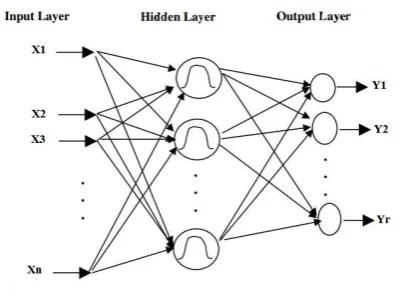
Figure 2. RBF network structure
the weights between the input layer and the first hid-den layer, between hidhid-den layers and between hidhid-den and output layers. This algorithm usually uses the gradient decent technique to adjust the weights.
The RBF neural networks consist of three constant layers. The input layer, one hidden layer, and the out-put layer [41].The neurons are completely connected but the difference here is that just the weights be-tween the hidden layer and output layer are adjusted by training. Figure2shows the structure of a RBF network. The activations of hidden layer neurons are computed using radial basis function. The most widely used form of radial basis function is the Gaussian Ker-nel function which is calculated as follows:
gi(x) = exp
−kx−vik2
2σi2
(8) wherexis the input vector andviis the vector denoting
the center of the receptive field unit (hidden layer neuron)giwithσias its width parameter. This way, if
we havesneurons in the hidden layer andrneurons in the output layer, the typical output of a RBF network will be calculated by:
yj(x) = s
X
i=1
wijgi(x), j= 1,2, . . . , r (9)
wherewij is the connection weight between thei-th
receptive field unit and thej-th output, andgi is the i-threceptive field unit.
The method of training RBF networks is a hybrid approach with two phases: unsupervised learning and supervised learning. First an unsupervised clustering algorithm is utilized to obtain the parameters of radial basis functions i.e. widths and the centers. Next, a supervised algorithm using least mean square error is performed to compute the weights of the connections between hidden nodes and the output nodes.
and slow convergence. Moreover, before training the model we have to determine the number of hidden layers and hidden nodes, possibly based on the input dataset, which causes inflexible training. On the other hand, RBF network is capable of universal approx-imation using a single hidden layer, which removes the need for specifying the number of hidden layers and nodes. Furthermore, the simple linear transforma-tion in the output layer can be optimized so that the learning algorithm becomes very fast and less likely to converge in the local minima [42]. The RBF learning is faster because it needs less computation.
We train K RBF networks with the K subsets from the train dataset to build the base models. These base models are different from each other because they have been trained on different subsets with no intersections. This makes a great diversity among ensemble members which is necessary for an ensemble system to work with high performance. After training the networks, K base models for the ensemble are ready to be combined using staking method.
3.5 Stacking Module
The proposed stacking module combines the predic-tions of the base classifiers using an efficient method and uses the result as a new set of features for an-other classifier. The new classifier will learn from the predictions of the base classifiers and gives final pre-dictions. So the stacking module has two components: The combination unit and the MLP classifier. 3.5.1 Combination Unit
Each RBF network gives a prediction for the exam-ples from the dataset. Then, these predictions will be combined to form the input of the meta-learner. The matrix U, which was produced by the fuzzy C-means technique, has the membership grades of the exam-ples. These grades are used for assigning weights to the base classifiers. We follow the procedure bellow to combine the results:
(1) The whole training dataset D is given to all AN Nj base models and the predictions are
ob-tained. The prediction for the examplexi is as
follows:
Pi= [pi1, pi2, . . . , piK], i= 1,2, . . . , m (10) wheremis the size of the training set.pi
j is the
prediction vector for thei-thexample byAN Nj.
(2) Multiply the membership grades of each exam-ple related to each subset to the corresponding predictions of the ANNs for the example. The new weighted prediction for example i will be:
Oi= [pi1ui1, p2iui2, . . . , piKuiK] (11)
whereuij is the membership grade ofi-th
exam-ple in thej-thcluster.
(3) We use a hybrid method to reduce the effect of majority models with small value predictions against the minority models with large value predictions. Also we do not want to ignore the prediction vectors of the majority models with acceptable large values even if their values are smaller than the maximum value provided by one model. Our hybrid method is inspired by the combination method used in Tian’s paper [43]. In this method we use a threshold value (δ) which is a real number between 0 and 1. For an exam-ple in the dataset, considerpj = (y1j, y2j, . . . , yjc)
as the weighted prediction vector ofj-th base classifier for the example (j= 1,2, . . . , K),cis the number of classes in the dataset. We prepro-cess the weighted outputs as follows:
(a) If∀t∈ {1,2, . . . , c}and∀j ∈ {1,2, . . . , K} , yt
j < δ thenpj is held intact. Then the
weighted prediction vectors of all base mod-els are aggregated linearly and the result is obtained.
(b) If the condition in (a) is not satisfied, the vectorspj are processed as follows: Ifytj<
δthenyt
j = 0. Next, the linear aggregation
of thepjvectors is calculated and the result
is obtained.
Using this combination method along with setting a threshold, we avoid ignoring the predictions of mi-nority base models which have large prediction values for a class (probability of an example being in a partic-ular class) against majority ones with smaller values for other classes. Therefore, we signify the effect of weighting the classifiers and receive higher accuracy in classification.
3.5.2 MLP Classifier
The results of the final aggregation in the combination unit are used as a new input for the MLP network. The aggregated predictions for the samples arecby 1 vectors which are used to indicate new features for the samples in another feature space. The new dataset using all these vectors and their corresponding labels in the original dataset is given to the MLP network for training. This MLP network learns the errors made by different base classifiers and increases the accuracy of the total classification. After training the MLP with the new dataset the classification model is built.
The procedure described above is used for training the ensemble when we use the training datasetD. For testing the ensemble model or applying it to any new traffic we do the following:
(1) For any example in test dataset T, we first calcu-late its membership grade in each cluster which was created by the fuzzy clustering module. We use the matrix of cluster centers C for calculat-ing the membership grades. For a new xT
membership gradeuT
ij is calculated with the
fol-lowing formula: uTij =
1
PK
d=1
kxT
i−cjk kxT
i−cdk
q−21
(12)
(2) Give the test dataset T to all base classifiers. Their prediction vectors and the membership grades are given to the stacking module which combines their outputs using the methods de-scribed in combination unit. Then the combined vectors are given to MLP classifier and the fi-nal results are obtained which are the predicted classes for the test data.
4
Experiments and Results
We carried out some experiments to evaluate the per-formance of the ensemble system. For the experiments, we used NSL-KDD dataset which has some benefits over the original KDD99 dataset. The system was im-plemented in Matlab R2012a environment on a PC with Core i5 CPU and 4 GB of RAM and a 64 bit windows operating system. In the next sections we describe the experiments in more detail.
4.1 Data preprocessing
Traditionally, most of the research works conducted on the field of intrusion detection utilized the popular KDD99 dataset which has a large size and includes many duplicate and redundant records. The large size of the dataset causes the classification task to be long and exhausting. The very high number of redundant records makes the classification task to be biased toward the frequent samples. The detection for smaller classes i.e. U2R and R2L which are more harmful attacks will not be efficient enough. Furthermore, the existence of these redundant records in the test set will also cause the evaluation results to be biased by the algorithms which have better detection rates on frequent samples [44].
In this study, we used the NSL-KDD dataset [45] which is derived from original KDD-99 and has elim-inated some of its drawbacks. It has the following characteristics [44]:
• There is no redundant record in the training set, so the bias toward more frequent record will not happen during learning process.
• There is no duplicate record in the new test set, so the evaluation of the learners will not be biased by the methods which have higher detection accuracy for the frequent records.
The NSL-KDD dataset consists of train and test sets. Each data sample is related to a network connection and consists of 41 features related to the connection characteristics of the network traffics. The labels of the samples indicate the class of attack type or the
Table 2. Number and percentage of records in each class in training and testing datasets
Class Training Set Test Set
Normal 6000 31.5% 9711 42.9%
DoS 6000 31.5% 7458 33.0%
PRB 6000 31.5% 2421 10.7%
U2R 52 0.3% 7533 2.3%
R2L 995 5.2% 2471 10.9%
normal state of the connection. The attacks in the dataset are categorized into four main classes: DoS, Probe, U2R, and R2L.The train data and the test data include 125973 and 22544 records respectively.
Revathi and Malathi performed a detailed analysis on NSL-KDD using different classification methods [46]. Their analysis showed that NSL-KDD dataset is ideal for comparing different intrusion detection mod-els. They used two feature sets (one with all 41features and one with a reduced 15 features). In their experi-ments which were carried out by WEKA data mining Tool, Random Forest showed the highest accuracy compared to other methods in both cases. Chauhan et al. also used NSL-KDD dataset to perform a compar-ative analysis of classification techniques for intrusion detection. Kim et al. used NSL-KDD for evaluating their proposed hybrid model [25]. However, few stud-ies have used this dataset in their experiments.
In order to reduce the size of the training set in our experiment, we selected 19047 records from the train set, in which all records in classes U2R and R2L were selected, and 6000 records were selected randomly from each of the Normal, DoS and PRB attacks. Table2shows the detailed information about the two datasets and the number of records in each class. In order to use the dataset for classification we need to normalize the data features. Therefore, using a linear normalization method, we convert the values of all features to the range (0, 1) except for features 5 and 6 which have very large values. These features are logarithmically scaled and converted to the values (0, 9).
4.2 Performance Measures
In order to evaluate the results of the experiments, some performance evaluation criteria are used [47]:
• True Positive (TP): number of examples correctly classified as being a particular type of attack. • False Positive (FP): number of examples
incor-rectly classified as being a particular type of at-tack
incor-rectly classified as not being a particular type of attack.
A popular measure which is usually used for assessing the performance of classification tasks is Accuracy which is calculated based on the above criteria as follows:
Accuracy= T P+T N
T P +T N+F P +F N (13) However, in intrusion detection the size of the classes are very different from each other. The number of sam-ples in U2R, R2L, and PRB is very low compared to the other two classes. Therefore, evaluating the perfor-mance of the system on the test data would be biased considering the above criteria. So the above measures are not satisfactory to evaluate the performance in a standard way [48]. This is why we use three different performance measures which are precision, recall and F-value. These criteria are not dependent on the size of the training and testing samples and can be really helpful in assessing the performance of the ensemble model. They are determined as follows:
P recision, P = T P
(T P +F P) (14) Recall, R= T P
(T P+F N) (15) F−V alue=(1 +t
2)P R
t2(P+R) (16)
where t indicates the relative importance of precision versus recall and normally is set to 1.
4.3 Implementation
A common problem in clustering methods is how to determine the right number of clusters. One possi-ble solution is to perform experiments with different number of clusters and find the number which gives us the best performance in the ensemble. However, this method is complicated and time-consuming. In addition, we need to choose the number of clusters before training the base classifiers. In this study,we used the idea of clustering quality evaluation [37,49] in order to identify the optimum number of clusters automatically. In [35] the authors used this method to avoid subjectivity when choosing the initial num-ber of clusters. We followed the same procedure, used four evaluation methods and integrated the results to make better decisions about the initial number of clus-ters. After this step, the obtained optimum number of clusters was 8.
Data samples with 41 features were given to the RBF networks as input vectors. RBF networks were implemented with limited number of hidden neurons which is set before the implementation. The important parameters for the RBF networks are Goal, Spread,
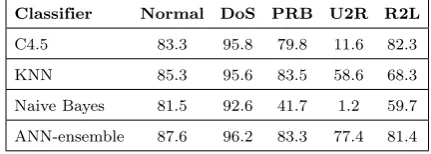
Table 3. Precision (%) of single classifiers compared to ANN ensemble on 5 classes
Classifier Normal DoS PRB U2R R2L
C4.5 83.3 95.8 79.8 11.6 82.3
KNN 85.3 95.6 83.5 58.6 68.3
Naive Bayes 81.5 92.6 41.7 1.2 59.7
ANN-ensemble 87.6 96.2 83.3 77.4 81.4
and MN. Goal indicates the desired mean squared error for the network learning process. Spread shows the width of radial basis function and MN is the maximum number of hidden neurons. The optimal set of parameters for the RBF networks was obtained based on the best generalization error of the networks. In our experiment Goal = 0.002, Spread = 0.8, and MN = 50. The input layer of the RBF networks has 41 nodes and the output layer has 5 nodes. The output of a RBF network for each example is a vector with 5 values indicating the support degrees for the example belonging to each of the 5 classes (probability of being a member in each of the 5 classes). The input vector for the MLP network is also 5 by 1 which shows the aggregated predictions of the base models. The output vector has the same dimension as the input vector. Since this experiment is rather complex, the number of hidden neurons in the MLP network is determined as 10.
4.4 Results and Discussion
We performed experiments 10 times by randomly se-lecting the samples with the sampling rules described in Section4.1and obtained the average results. The accuracy with the best number of clusters (8 clusters) is 89.1%. We compared the results with the other well-known classification methods, Decision Tree (C4.5), Na¨ıve Bayes and K nearest neighbor (KNN). The com-parative results for the classifiers are depicted in Ta-bles3to5. We performed the comparison based on the three measures introduced in Section4.2separated by each class.
As can be seen from the tables, the ensemble method has the highest precision compared to all classifiers except for KNN in PRB attack. The recall of ensemble method is higher than all methods in Normal class and has a close value to the best recall in other classes. The overall performance of the ensemble method is demonstrated by the F-value, where it has significant superiority over other classifiers in the low frequent attack classes U2R and PRB.
Table 4. Recall (%) of single classifiers compared to ANN ensemble on 5 classes
Classifier Normal DoS PRB U2R R2L
C4.5 86.7 74.2 66.4 95.5 96.8
KNN 94.0 79.1 72.2 91.5 92.8
Naive Bayes 88.4 32.3 88.7 6.5 77.9
ANN-ensemble 94.9 81.5 86.6 91.0 93.0
Table 5. F-value (%) of single classifiers compared to ANN ensemble on 5 classes
Classifier Normal DoS PRB U2R R2L
C4.5 84.9 83.7 72.5 20.7 89
KNN 89.4 86.6 77.4 71.5 78.7
Naive Bayes 84.9 47.9 56.7 2.0 67.6
ANN-ensemble 91.1 88.2 84.9 83.6 86.8
Table 6. Precision (%) of two popular ensemble methods compared to ANN ensemble on 5 classes
Classifier Normal DoS PRB U2R R2L
Bagging 82.9 96.0 74.7 45.1 85.7
Boosting 86.1 94.4 64.6 57.2 78.3
ANN-ensemble 87.6 96.2 83.3 77.4 81.4
of classifiers built on bootstrap replicates of the train-ing set. The classifier outputs are combined by the plurality vote. In Boosting, classifier ensemble is built incrementally, adding one classifier at a time. The clas-sifier that joins the ensemble at each step is trained on a dataset selected from the original dataset and has the examples which are more difficult to classify than the examples in the last step. In our experiments, we used the popular algorithmAdaBoost [51] as a Boost-ing method. The comparative results are depicted on tables6to8.
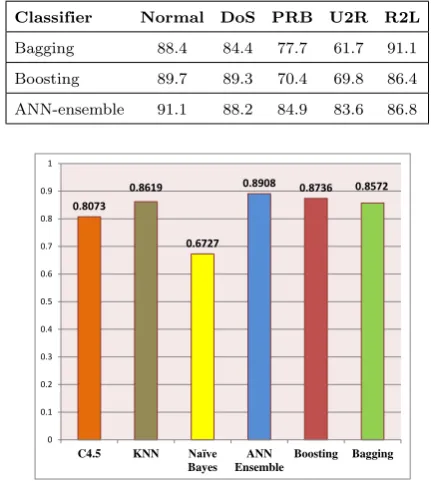
Bagging in R2L attack has better precision than our ensemble method (by 4.3%), however the ANN ensemble shows much better precision than bagging in classes U2R and PRB ( differences are 32.3% and 8.6% respectively).The two ensemble classifiers have slightly better F-values only in classes DoS (Boosting with 89.3%) and R2L (Bagging with 91.1%) than the ensemble system. The F-value for our ANN ensemble is significantly higher in the two classes PRB and U2R.
If we consider the overall accuracy on all 5 classes, our ensemble system’s accuracy has a better perfor-mance with 89.08% over all other classifiers. Figure3
shows the overall accuracy of the classifiers. 4.4.1 The Effect of Clustering
The clustering module divides the large and heteroge-neous training set into several smaller subsets which
Table 7. Recall (%) of two popular ensemble methods com-pared to ANN ensemble on 5 classes
Classifier Normal DoS PRB U2R R2L
Bagging 94.6 75.3 74.7 97.5 97.3
Boosting 93.7 84.7 64.6 89.5 96.3
ANN-ensemble 94.9 81.5 86.6 91.0 93.0
Table 8. F-value(%) of two popular ensemble methods com-pared to ANN ensemble on 5 classes
Classifier Normal DoS PRB U2R R2L
Bagging 88.4 84.4 77.7 61.7 91.1
Boosting 89.7 89.3 70.4 69.8 86.4
ANN-ensemble 91.1 88.2 84.9 83.6 86.8
0.8073 0.8619
0.6727
0.8908 0.8736 0.8572
0 0.1 0.2 0.3 0.4 0.5 0.6 0.7 0.8 0.9 1
C4.5 KNN Naïve Bayes
ANN Ensemble
Boosting Bagging
Figure 3. The overall accuracy of the classifiers
2 4 6 8 10 60
65 70 75 80 85 90 95 100
Number of Clusters
Precesion(%)
Normal DoS Probe U2R R2L
Figure 4. Precision in 5 classes with different number of clusters
2 4 6 8 10
70 75 80 85 90 95 100
Number of Clusters
Recall(%)
Normal DoS Probe U2R R2L
Figure 5. Recall in 5 classes with different number of clusters
2 4 6 8 10
74 76 78 80 82 84 86 88 90 92 94
Number of Clusters
F−Value(%)
Normal DoS Probe U2R R2L
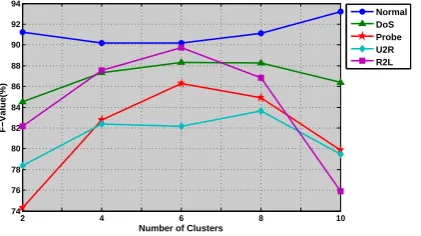
Figure 6. F-value in 5 classes with different number of clusters
issue which should be investigated further.
It is important to note that the values of the mea-sures we provided here is not very high considering the values in other studies. However, this difference is justifiable considering the fact that we used NSL-KDD dataset and not the usual NSL-KDD99 dataset for the experiments. The KDD 99 dataset has many re-dundant records which makes bias in the predictions and raise the accuracy rate on some classes, especially the large classes. Therefore, the whole accuracy rate will increase. Furthermore, the accuracies of the other classification methods used in this study are also in the same range with our proposed system. This can prove that the system has comparable performance and the lower accuracy is due to the inherent charac-teristics of NSL-KDD dataset.
5
Conclusion and Future Work
In this article we proposed an ensemble classifier for in-trusion detection based on fuzzy clustering and stack-ing combination method. Fuzzy clusterstack-ing module divides the whole dataset into several homogeneous subsets. Therefore, the complexity of training subsets is reduced and the models can have more accurate classifications. The RBF neural networks are able to learn faster and easier than MLP networks and avoid stopping in the local minima. Using a hybrid combina-tion method and a stacking procedure, the deteccombina-tion performance of the ensemble model is increased. The experiment with NSL-KDD dataset demonstrated the efficiency of our model particularly on smaller classes i.e. U2R, R2L and PRB which are difficult for classifi-cation. The stacking combination for ensemble learn-ing has many areas for further exploration.
For future research, finding good strategies to com-bine the predictions with weights and aggregating the base models can be pursued. Another important area to work on is establishing a good method to weight base classifiers based on the intrinsic characteristics of each cluster. This way the accuracy of the ensemble model can further be improved.
References
[1] Carlos A Catania and Carlos Garc´ıa Garino. Automatic network intrusion detection: Current techniques and open issues. Computers &
Elec-trical Engineering, 38(5):1062–1072, 2012.
[2] Aleksandar Lazarevic, Vipin Kumar, and Jaideep Srivastava. Intrusion detection: A survey. In
Managing Cyber Threats, pages 19–78. Springer,
2005.
[3] Chih-Fong Tsai, Yu-Feng Hsu, Chia-Ying Lin, and Wei-Yang Lin. Intrusion detection by ma-chine learning: A review. Expert Systems with
Applications, 36(10):11994–12000, 2009.
[4] Nong Ye, Xiangyang Li, and Syed Masum Emran. Decision tree for signature recognition and state classification. InProceedings of IEEE Systems, Man and Cybernetics Information Assurance &
Security Workshop, 2000.
[5] Zonghua Zhang and Hong Shen. Application of online-training svms for real-time intrusion de-tection with different considerations. Computer
Communications, 28(12):1428–1442, 2005.
[6] Latifur Khan, Mamoun Awad, and Bhavani Thu-raisingham. A new intrusion detection system using support vector machines and hierarchical clustering. The VLDB Journal—The
Interna-tional Journal on Very Large Data Bases, 16(4):
507–521, 2007.
sys-tems security conference, pages 368–81, 1998. [8] Guisong Liu, Zhang Yi, and Shangming Yang. A
hierarchical intrusion detection model based on the pca neural networks. Neurocomputing, 70(7): 1561–1568, 2007.
[9] Yang Li and Li Guo. An active learning based tcm-knn algorithm for supervised network intrusion detection. computers & security, 26(7):459–467, 2007.
[10] Ke Wang and Salvatore J Stolfo. Anomalous payload-based network intrusion detection. In
Recent Advances in Intrusion Detection, pages
203–222. Springer, 2004.
[11] Simon Haykin. Neural Networks: A
Comprehen-sive Foundation. Prentice Hall, 2nd edition, 1999.
ISBN 9780780334946.
[12] Josef Kittler, Mohamad Hatef, Robert PW Duin, and Jiri Matas. On combining classifiers. Pat-tern Analysis and Machine Intelligence, IEEE
Transactions on, 20(3):226–239, 1998.
[13] Nikunj C Oza and Kagan Tumer. Classifier en-sembles: Select real-world applications.
Informa-tion Fusion, 9(1):4–20, 2008.
[14] Robi Polikar. Ensemble learning. InEnsemble
Machine Learning, pages 1–34. Springer, 2012.
[15] Tin Kam Ho, Jonathan J. Hull, and Sargur N. Sri-hari. Decision combination in multiple classifier systems. Pattern Analysis and Machine
Intelli-gence, IEEE Transactions on, 16(1):66–75, 1994.
[16] Nikunj C Oza and Kagan Tumer. Input decima-tion ensembles: Decorreladecima-tion through dimension-ality reduction. InMultiple Classifier Systems, pages 238–247. Springer, 2001.
[17] David H Wolpert. Stacked generalization.Neural
networks, 5(2):241–259, 1992.
[18] Kagan Tumer and Nikunj C Oza. Input deci-mated ensembles. Pattern Analysis &
Applica-tions, 6(1):65–77, 2003.
[19] Anders Krogh, Jesper Vedelsby, et al. Neural network ensembles, cross validation, and active learning.Advances in neural information
process-ing systems, pages 231–238, 1995.
[20] Himadri Chauhan, Vipin Kumar, Sumit Pundir, and Emmanuel S Pilli. A comparative study of classification techniques for intrusion detection.
InComputational and Business Intelligence
(IS-CBI), 2013 International Symposium on, pages
40–43. IEEE, 2013.
[21] Srinivas Mukkamala, Andrew H Sung, and Ajith Abraham. Intrusion detection using an ensemble of intelligent paradigms. Journal of network and
computer applications, 28(2):167–182, 2005.
[22] Giorgio Giacinto, Fabio Roli, and Luca Didaci. A modular multiple classifier system for the detec-tion of intrusions in computer networks. In
Mul-tiple Classifier Systems, pages 346–355. Springer,
2003.
[23] Giorgio Giacinto, Roberto Perdisci, Mauro Del Rio, and Fabio Roli. Intrusion detection in computer networks by a modular ensemble of one-class classifiers. Information Fusion, 9(1): 69–82, 2008.
[24] Luigi Pietro Cordella, Alessandro Limongiello, and Carlo Sansone. Network intrusion detection by a multi-stage classification system. InMultiple
Classifier Systems, pages 324–333. Springer, 2004.
[25] Gisung Kim, Seungmin Lee, and Sehun Kim. A novel hybrid intrusion detection method integrat-ing anomaly detection with misuse detection.
Ex-pert Systems with Applications, 41(4):1690–1700,
2014.
[26] Srilatha Chebrolu, Ajith Abraham, and John-son P Thomas. Feature deduction and ensemble design of intrusion detection systems. Computers & Security, 24(4):295–307, 2005.
[27] Sandhya Peddabachigari, Ajith Abraham, Crina Grosan, and Johnson Thomas. Modeling intru-sion detection system using hybrid intelligent sys-tems. Journal of network and computer
applica-tions, 30(1):114–132, 2007.
[28] Ajith Abraham and Ravi Jain. Soft computing models for network intrusion detection systems.
In Classification and clustering for knowledge
discovery, pages 191–207. Springer, 2005.
[29] Lars Kai Hansen and Peter Salamon. Neural network ensembles.IEEE transactions on pattern
analysis and machine intelligence, 12(10):993–
1001, 1990.
[30] Giorgio Giacinto and Fabio Roli. Design of effec-tive neural network ensembles for image classifi-cation purposes. Image and Vision Computing, 19(9):699–707, 2001.
[31] Zhi-Hua Zhou, Yuan Jiang, Yu-Bin Yang, and Shi-Fu Chen. Lung cancer cell identification based on artificial neural network ensembles. Artificial
Intelligence in Medicine, 24(1):25–36, 2002.
[32] David West, Scott Dellana, and Jingxia Qian. Neural network ensemble strategies for financial decision applications. Computers & operations
research, 32(10):2543–2559, 2005.
[33] Jianbo Yu. Online tool wear prediction in drilling operations using selective artificial neural net-work ensemble model. Neural Computing and
Applications, 20(4):473–485, 2011.
[34] Srinivas Gutta, Ibrahim F Imam, and Harry Wechsler. Hand gesture recognition using ensem-bles of radial basis function (rbf) networks and decision trees. International Journal of Pattern
Recognition and Artificial Intelligence, 11(06):
845–872, 1997.
on fuzzy clustering and rbf neural networks. In
Communication Networks and Services Research
Conference (CNSR), 2011 Ninth Annual, pages
123–129. IEEE, 2011.
[36] Saso Dˇzeroski and Bernard ˇZenko. Is combining classifiers with stacking better than selecting the best one? Machine learning, 54(3):255–273, 2004. [37] James C Bezdek. Pattern recognition with fuzzy
objective function algorithms. Kluwer Academic
Publishers, 1981.
[38] Nikhil R Pal and James C Bezdek. On cluster validity for the fuzzy c-means model. Fuzzy
Sys-tems, IEEE Transactions on, 3(3):370–379, 1995.
[39] G´erard Dreyfus. Neural networks: methodology
and applications. Springer, 2005.
[40] Lefteri H Tsoukalas and Robert E Uhrig. Fuzzy
and neural approaches in engineering. John Wiley
& Sons, Inc., 1996.
[41] Joydeep Ghosh and Arindam Nag. An overview of radial basis function networks. InRadial basis
function networks 2, pages 1–36. Springer, 2001.
[42] Chunlin Zhang, Ju Jiang, and Mohamed Kamel. Intrusion detection using hierarchical neural net-works. Pattern Recognition Letters, 26(6):779– 791, 2005.
[43] Jin Tian, Minqiang Li, Fuzan Chen, and Jisong Kou. Coevolutionary learning of neural network ensemble for complex classification tasks.Pattern
Recognition, 45(4):1373–1385, 2012.
[44] Mahbod Tavallaee, Ebrahim Bagheri, Wei Lu, and Ali-A Ghorbani. A detailed analysis of the KDD CUP 99 data set. In Proceedings of the Second IEEE Symposium on Computational In-telligence for Security and Defence Applications 2009, 2009.
[45] Nsl-kdd dataset, 2009. URL http://nsl.cs.
unb.ca/NSL-KDD/.
[46] S Revathi and A Malathi. A Detailed Analysis on NSL-KDD Dataset Using Various Machine Learning Techniques for Intrusion Detection. In-ternational Journal of Engineering Research and
Technology, 2(12 (December-2013)), 2013.
[47] Stefan Axelsson. The base-rate fallacy and the difficulty of intrusion detection. ACM Transac-tions on Information and System Security (TIS-SEC), 3(3):186–205, 2000.
[48] Paul Dokas, Levent Ertoz, Vipin Kumar, Alek-sandar Lazarevic, Jaideep Srivastava, and Pang-Ning Tan. Data mining for network intrusion detection. InProc. NSF Workshop on Next
Gen-eration Data Mining, pages 21–30, 2002.
[49] Weijiao Zhang, Chunhuang Liu, and Fangyu Li. Method of quality evaluation for clustering [j].
Computer Engineering, 20:004, 2005.
[50] Ludmila I Kuncheva. Combining pattern
clas-sifiers: methods and algorithms. John Wiley &
Sons, 2004.
[51] Yoav Freund and Robert E Schapire. A desicion-theoretic generalization of on-line learning and an application to boosting. In Computational
learning theory, pages 23–37. Springer, 1995.
Mohammad Aminireceived his M.Sc. in Information Technology (E-commerce) from university of Qom in 2013. He is now a Ph.D. candidate studying E-commerce Engineering at Iran University of Science and Technology, Tehran, Iran. His main research interests in-clude e-commerce security and applications, Data Mining, Machine Learning, and Deci-sion Support Systems.
Jalal Rezaeenour received his M.Sc. and Ph.D. degrees in Industrial Engineering from Iran University of Science and Technology, Tehran in 2006 and 2011. His research inter-ests are in Performance Measurement, Knowl-edge Management, Data Mining, Research Methods, Decision Making and Multivariate Data Analysis. He has published 2 books and has more than 65 papers in different journals and conferences. Dr. Rezaeenour is now the head of Depart-ment of Industrial Engineering, and director of Information and Communication Technology Administration in University of Qom.