IJBCP
International Journal of Basic & Clinical Pharmacology
Review Article
Drug utilization research: a review
Dinesh Kumar Meena*, M. Jayanthi
INTRODUCTION
Drug utilization research as defined by WHO (World
Health Organization) is “marketing, distribution,
prescription and use of drugs in a society, with special emphasis on the resulting medical, social and economic consequences”. Rational use of drug requires that patient receive medication appropriate to their clinical needs, in dose that meet their own individual requirements for the adequate period and the lowest cost to them and their community.1 Poor management and irrational use of drugs
leads to increased morbidity and mortality, wastage of resources, prolonged suffering, death and loss of confidence in the health care system.2 There are many
factors underlying irrational use of drugs. Major factors
can be patients, prescribers, workplace and supply system.3,4 Therefore, it is important to recognize negative
consequences of inappropriate drug use to promote rational use of drug.5 The development of drug utilization
as research area made it possible to study drug use in a scientific manner.6 Studies on drug utilization have
become a potential tool to be used in the evaluation of healthcare system.7 The main objectives of drug utilization
research are to identify drug use related problems and analyze their consequences. Drug utilization research encourages rational prescribing of drug, contributes to the knowledge of current use of drugs in the society and explore whether a particular intervention affects the drug use in the population by observing the drug use pattern.8
ABSTRACT
Data from drug utilization research is an invaluable resource for all stake holders involved in drug and health policies. Drug utilization is “marketing, distribution, prescription and use of drugs in a society, with special emphasis on the resulting medical, social and economic consequences”. Research on drug utilization includes factors related to prescribing, dispensing, administering and intake of medication and its associated events. The ultimate purpose of drug utilization research is to estimate the optimal quality of drug therapy by identifying, documenting, analysing problems in drug utilization and monitoring the consequences. It encourages the prescribers to prescribe correct drug at appropriate dose and affordable price. It contributes to the knowledge of rational use of drugs in the society; whether the drug is being prescribed appropriately, whether the drug is taken in correct dosage, whether the drug is available at affordable price or misused. It provides valuable feedback about the rationality of the prescription to the doctors. It also assesses whether an intervention affects the drug use in the population by examining the outcomes of different types of intervention given to improve rationality in drug use. Drug utilization research can be qualitative or quantitative and can be done by various methods. This review highlights the understanding of various aspects, different designs and WHO guidelines for conducting drug utilization research.
Keywords: ATC classification, Aspects of drug utilization research, Drug utilization research, Defined daily dose, Drug use indicators, Drug and therapeutic committee
DOI: http://dx.doi.org/10.18203/2319-2003.ijbcp20190161
Department of Pharmacology, Jawaharlal Institute of
Postgraduate Medical Education and Research (JIPMER), Puducherry, India
Received: 11 September 2018
Revised: 12 December 2018
Accepted: 28 December 2018
*Correspondence to:
Dr. Dinesh Kumar Meena, Email: dinesh.pharmd8989@ gmail.com
LITERATURE REVIEW
The principal aim of drug utilization research is to facilitate rational use of drug in population. The objectives of the drug utilization research are to ensure that the pharmaceutical therapy meets current standards of care, to promote optimal medication therapy, to prevent medication related problems, to identify specific medicine use problems that require further evaluation, to create guidelines for appropriate medicine use, to define threshold for quality of medicine use and to control pharmaceutical cost.
Aspects of drug utilization research
Review of reported studies on drug use indicates that drug utilization research can be carried out focusing on three aspects: medical aspects, social aspects and Economical aspects
Medical aspects
Medical aspects of drug utilization research focus on efficacy of drugs in preventing, relieving and curing the disease as well as short and long term adverse effects of drugs and their management.
It can be used to increase our understanding of how drugs are being used, to estimate what extent drugs are being properly used, overused or underused, to determine the pattern or profile of drug use and the extent to which alternative drugs are used to treat conditions, to compare the pattern of drug use for the treatment of a certain disease like malaria, hypertension, acute respiratory illness, acute diarrhoea in children and common infections like urinary tract infections, respiratory tract infection etc. with current recommendations or guidelines. Studies can also look at what happen to the patient after drug prescribed. This can be done by following up the patient to check if they are taking the drugs as advised, if there is improvement in the disease condition or if any adverse drug reactions developed after taking drugs.
Social aspects
Social aspects include patient attitude to drugs, drug abuse and dependence, improper use of drugs (non-compliance, use of drugs for purpose for which they were not prescribed), unavailability of important drugs to those who need them etc.
Economic aspects (Pharmacoeconomics)
Pharmacoeconomics is the sciences that evaluate the costs of drug therapy. The goal of pharmacoeconomics is to select least costly and most effective drug therapy for a given disease condition.5
Studies on pharmacoeconomics can be classified into 4 types.8
• Cost minimization analysis- When two drugs are
equal in terms of outcome, cost of each drug may be evaluated and compared. This method used for comparing two drugs from same therapeutic and chemical group.
• Cost-effectiveness analysis- Cost-effectiveness
analysis compares therapies with similar outcome in particular therapeutic area.
• Cost is measured in a monetary unit and outcome is
measured in a natural unit e.g. no. of successfully treated patients, no. of life years gained.
• Cost benefit analysis - This method involves direct calculation of the net expenditure to achieve healthy outcome.
• Cost utility analysis- This analysis is used to
determine the cost of utilities such as quantity and quality. It compares two drugs which have different outcomes i.e. differences in their benefits. This type integrates both, the increase in the survival time and the changes and the quality of life, either with or without the increase in the survival time.
Levels of drug utilization research6
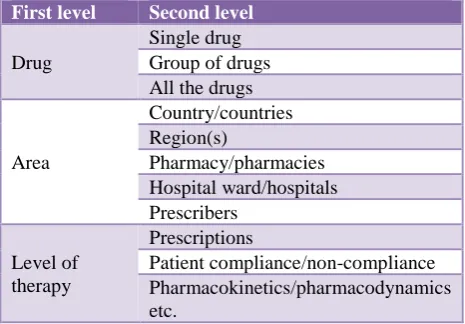
[image:2.595.312.545.456.618.2]Drug utilization research can be done at various levels of health care depending on the purpose of study as shown in Table 1. Studies can be conducted at a primary health centre level by analyzing prescriptions. At tertiary care level, studies can be done to compare cost effectiveness of medicines procured by pharmacy.
Table 1: Various levels of drug utilization research.
First level Second level
Drug
Single drug Group of drugs All the drugs
Area
Country/countries Region(s)
Pharmacy/pharmacies Hospital ward/hospitals Prescribers
Level of therapy
Prescriptions
Patient compliance/non-compliance Pharmacokinetics/pharmacodynamics etc.
Quantitative versus qualitative drug utilization research
Quantitative DUR
Qualitative DUR
Qualitative DUR include research on quality of health care and factors affecting the quality of health care. Qualitative DUR based on concept of “criteria”. Criteria are standards or reference (such as Standard Treatment Guideline, National Drug Formulary, and National Essential Drug List) against which quality of care to be evaluated.9
Study design in drug utilization research9,10
Observational research methods are most commonly used design in drug utilization research. It involves observing the prescribing practices for rationality as well as observing the availability of infrastructure and other facilities required for effective provision of medicine use like availability of qualified practitioners and dispensers, availability of essential medicines, availability of NEM list and standard treatment guidelines etc.
Cross-sectional study
Involve analyzing drug use at a single point.
Pre and post study design
Where drug use is examined before and after intervention to improve prescribing pattern.
Prospective studies
It involves evaluating drug utilization while follow up of patients or health facility over a period of time.
Retrospective studies
Involves review of drug therapy after the patient has received treatment. Retrospective studies are usually record based which includes review of prescriptions, checking stock out in the pharmacy for previous year.
How to investigate drug use in health facilities: WHO guidelines10
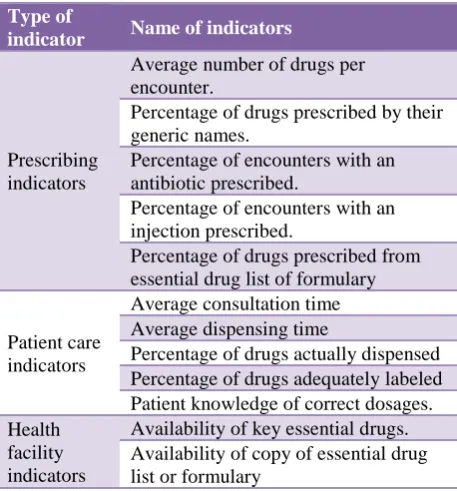
The WHO and INRUD (International Network of Rational Use of Drug) developed indicators to be used as measure of performance in the rational use of drug in primary care. These indicators are commonly known as core drug use indicators (Table 2) list of indicators to be used to study drug utilization in health facility and the rational and formula to calculate each indicator has been mentioned in Table 3.
How to investigate drug use in community: WHO guidelines11
Studies on drug use in community helps to identify the type of drug misuse such as non-compliance with health worker’s prescriptions, self-medication with prescription
[image:3.595.314.543.162.408.2]drugs, misuse of antibiotics, overuse of injections, overuse of relative safe drugs, use of irrational combinations of drugs or use of needlessly expensive drugs. It helps to gain insight into various channels through which people in community obtain drugs.
Table 2: Types of indicators.
Type of
indicator Name of indicators
Prescribing indicators
Average number of drugs per encounter.
Percentage of drugs prescribed by their generic names.
Percentage of encounters with an antibiotic prescribed.
Percentage of encounters with an injection prescribed.
Percentage of drugs prescribed from essential drug list of formulary
Patient care indicators
Average consultation time Average dispensing time
Percentage of drugs actually dispensed Percentage of drugs adequately labeled Patient knowledge of correct dosages. Health
facility indicators
Availability of key essential drugs. Availability of copy of essential drug list or formulary
People may be in habit of obtaining their drugs from other drug distribution channels than health centers that are distributing essential drugs. Such people receive drug related information which may or may not be appropriate. Community health workers are trained to distribute drugs in primary health centers.
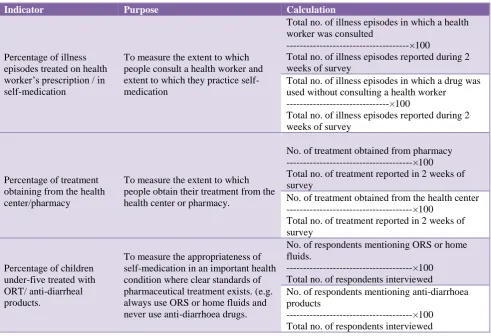
It is important to study the appropriateness of drug distribution by community health workers: How adequate is the supply of drug? What is the coverage of community health workers? How rational are their prescriptions practices? To what extent people rely on community health workers for their drug needs? It helps to gain knowledge about people’s ideas of drug safety and their self-medication practices. List of indicators to be used to study drug utilization in community has been mentioned in Table 4.
Stepwise approach to drug utilization research12
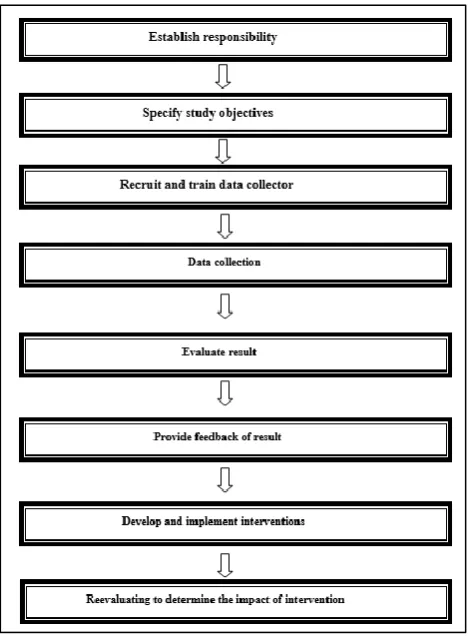
The following flow chart outlines the basic steps to conduct a drug utilization research (Figure 1).
Define study objectives
Table 3: Purpose and formula to calculate each indicator.
Indicator Purpose Calculation
Prescribing indicators
Average number of drugs per encounter.
To measure the degree of polypharmacy
Average:
Total number of different drug products prescribed
--- Total number of encounters surveyed.
Percentage of drugs prescribed by generic names
To measure the tendency to prescribe by the generic names
Percentage:
Number of drugs prescribed by generic names
---×100 Total number of drugs prescribed
Percentage of encounters with an antibiotic/injection prescribed
To measure the overall level of use of two important but commonly overused and costly forms (antibiotic and injection) of the drug therapy.
Percentage:
Number of encounters during which an antibiotic or an injection are prescribed ---×100 Total number of encounters surveyed.
Percentage of drugs prescribed from essential drug list or formulary
To measure the degree to which practices confirms to a national drug policy as indicated by
prescribing drugs from EML or formulary.
Percentage:
Number of products prescribed which are listed on the essential drugs list or local formulary
---×100 Total number of products prescribed, multiplied.
Patient care indicators
Average consultation time
To measure the time that medical personnel spend with patient in the process of consultation and prescribing
Average:
Total time for series of consultation ---Number of consultations.
Average dispensing time To measure the average time that personnel
dispensing drugs spend with patient.
Average:
Total time for dispensing drugs to a series of patients
--- Total number of encounters.
Percentage of drugs actually dispensed
To measure the degree to which health facilities are able to provide the drugs which are prescribed.
Percentage:
Number of drugs dispensed ---×100 Total number of drugs prescribed
Percentage of drugs adequately labeled.
To measure the degree to which dispenser’s record essential information on the dug package they dispense.
Percentage:
Number of drug packages containing at least patient name, drug name and when the drug should be taken ---×100 Total number of drug packages dispensed
Patient knowledge of correct dosage
To measure the effectiveness of the information given to patient on the dosage schedule of the drugs they received
Percentage:
Number of patients who can
adequately report the dosage schedule for all drugs
---×100 Total number of patients interviewed
Facility indicators
Availability of copy of essential drug list or formulary
To indicate the extent to which copies of the EML
or formulary are available at health facility. Yes/No
Availability of key drugs To measure the availability of key drugs at health facility
Percentage:
Number of specified products actually in stock
Table 4: Indicators to be used to investigate drug use in the community.
Indicator Purpose Calculation
Percentage of illness episodes treated on health worker’s prescription / in self-medication
To measure the extent to which people consult a health worker and extent to which they practice self-medication
Total no. of illness episodes in which a health worker was consulted
---×100
Total no. of illness episodes reported during 2 weeks of survey
Total no. of illness episodes in which a drug was used without consulting a health worker
---×100
Total no. of illness episodes reported during 2 weeks of survey
Percentage of treatment obtaining from the health center/pharmacy
To measure the extent to which people obtain their treatment from the health center or pharmacy.
No. of treatment obtained from pharmacy ---×100 Total no. of treatment reported in 2 weeks of survey
No. of treatment obtained from the health center ---×100
Total no. of treatment reported in 2 weeks of survey
Percentage of children under-five treated with ORT/ anti-diarrheal products.
To measure the appropriateness of self-medication in an important health condition where clear standards of pharmaceutical treatment exists. (e.g. always use ORS or home fluids and never use anti-diarrhoea drugs.
No. of respondents mentioning ORS or home fluids.
---×100 Total no. of respondents interviewed
No. of respondents mentioning anti-diarrhoea products
---×100 Total no. of respondents interviewed
Drug use studies should focus on the most important medicines, those with the highest potential problems such as high-volume medicine use, medicines with low therapeutic index, medicines with high incidence of ADR, expensive medicines, antimicrobial medicines, injections, medicines undergoing evaluation of addition to the formulary, medicines used for off-label indications or medicines used for high-risk patients
Recruit and train data collector
Data collection can be tedious work and requires dedication and attention. Data collector should be familiar with pharmaceuticals terms to record information in a standard way. Data collectors may include persons with clinical experience such as physicians, nurses, pharmacists and paramedical staff. Training should be provided to data collectors before visiting health facilities.
Data collection
It is important to limit data collection to only the most important and relevant aspects of drug use. The appropriateness of data collection form can be tested by performing a pilot study on a small number of patients.
Data can be collected prospectively or retrospectively based on design of study.
Evaluate result
Data should be summarized into major categories of results and checked where exactly the data shows deviations from the guidelines and usage criteria that are previously identified. Then the reason for this deviation should be evaluated.
Provide feedback of result
Success of any drug utilization research depends on feedback of the result to prescribers, other hospital staff and to administrative heads.
Develop and implement interventions
Intervention to improve drug use can be educational or
operational. Educational intervention consists of
Re-evaluating to determine the impact of intervention
[image:6.595.52.287.152.472.2]Drug use and prescribing pattern need to be monitored to determine the success of intervention. Re-evaluation should be done 3-12months after the introduction of intervention.
Figure 1: Stepwise approach to drug utilization research.
[image:6.595.51.283.574.763.2]Anatomical Therapeutic Chemical (ATC) classification system8,13
Table 5: Indicates 14 main subgroup of level 1.
Level 1 System on which drug acts
A Alimentary and metabolism
B Blood
C Cardiovascular system
D Dermatological
G Gastrointestinal system
H Hormonal preparation
J Anti-infective
L Antineoplastic and immunomodulators
M Musculo-skeleton system
N Nervous system
P Antiparasitic
R Respiratory system
S Sensory organs
V Various
ATC classification system is an international classification system of drugs that is commonly followed worldwide as tool for performing comparative drug utilization studies. ATC classification system can be used to compare the drug consumption both nationally and internationally.
In this system, the active substances are classified in a hierarchy with five different levels as shown in Table 5.
• Level 1: It indicates anatomical main group. It
consists of 14 main subgroups.
• Level 2: Therapeutic subgroup
• Level 3: Pharmacological subgroup
• Level 4: Chemical subgroups
• Level 5: Chemical substances
Table 6: Indicates ATC code of metformin.
Code Different ATC levels
A Alimentary tract and metabolism
A10 Drugs used in diabetes
A10B Blood glucose lowering drugs
A10BA Biguanides
A10BA02 Metformin
For example; ATC code of metformin is A10BA02, which has been explained in Table 6.
There are certain general principles while using ATC classification system for assigning ATC code for drug:
Only one ATC code should be given for each route of administration. A substance can be given more than one ATC code if it is available in two or more strength or route of administration with clearly different therapeutic uses. For example, finasteride tablets are available in two different strengths which are used in two different indications. Low strength tablet of finateride is used to treat male pattern baldness whereas a high strength finasteride tablet is used to treat benign prostate hypertrophy. Both low strength and high strength tablets have been given different ATC code i.e. D11AX for low strength tablet and G04C for high strength tablets.
Defined daily dose concept8,13
“Defined daily dose is the assumed average maintenance dose per day for a drug used for its main indication in adult”. DDD provides a rough estimate of the proportion of patients within a community that would receive a drug.
The WHO has given following general principles of defined daily dose
products, sera, vaccines, antineoplastic agents, allergen
extracts, general and local anesthetics and contrast media.
DDD for plan product
Plan products contain one single active ingredient. The average adult dose for the main indication will be assigned as DDD. The maintenance dose (long term therapeutic dose) is usually preferred as DDD. DDD will be same for various dosage forms of the same drug.
For combination products
Treatment with a combination product A containing two active ingredients i.e. 20mg of substance X and 15 mg of substance Y than DDD for a combination product will be 1 UD i.e. 1 tablet of product A.
As per WHO Defined Daily Dose can be calculated as following:
DDD for out-patients expressed as DDDs/1000 inhabitants/day and can be calculated as following:
(Utilization in DDDs)
--- × 1000
(Number of inhabitants) × (Number of days in the period of data collection)
Where utilization in DDD can be calculated as:
(Number of package used) × (Number of DDD in a package)
DDD for inpatients expressed as DDD/100 bed days and can be calculated as following:
(Utilization in DDDs)
---×100 (Number of occupied bed days)
Drug utilization research in India
Irrational use of medicines is a major problem worldwide.14 Data of drug utilization studies conducted in
India shows irrational use of medicines. Studies conducted in psychiatric OPD of various tertiary care teaching hospitals to assess the prescribing pattern of anti-psychotic
drugs reported poly pharmacy was common.15-17 A
prospective prescription monitoring study was carried out to investigate drug use pattern of anti-asthmatic drugs in Gujarat.18 Another similar study was conducted in three
famous hospitals of Shamli.19 Similar study conducted in
various hospitals of Gorakhpur.20 All these studies
reported that prescribing pattern of anti-asthmatic drugs was not according to standard treatment guidelines. Studies conducted in India in speciality clinics of psychiatry, orthopaedics, ENT, have found poly pharmacy of anti-epileptic drugs, anti-psychotic drugs and NSAIDs in addition to irrational use of medicines. One study
conducted to evaluate prescribing pattern in six speciality departments (surgery, orthopaedics, ENT, ophthalmology, medicine and pediatrics).21 Another study conducted to
analyse usage of antibiotics in outpatient facilities in 24 districts of west Bengal.22 Both these studies reported that
use of antibiotics was inappropriate and lack of adherence to standard treatment guidelines. Inappropriate or over prescribing is major driving force for the emergence of antibiotic resistance also. A report from WHO documented high rate of antibiotic resistance across a range of bacteria that cause common infections. Resistance to antibiotics is worldwide challenge to public health and directly related to the antibiotic use in community. Quality of antibiotic prescribing in developing countries is not satisfactory. There is considerable overuse of common antibiotics across countries particularly in primary health canters which lead to increase in resistance rate, morbidity, mortality and cost.23,24
DISCUSSION
Appropriate use of medicines plays a central role in achieving standard healthcare services. A large number of drug utilization studies have been conducted across the country. With few exceptions, studies show irrational use of medicines and suggest rational use of medicines at all levels of healthcare delivery system. The factors related to medicines misuse or overuse can be based on the various parties involved in the distribution of medicines like health care providers, pharmacists and patients. Primary causes of medicine misuse are poor script regulations, non-qualified practitioner, unregulated dispensing of medicines, non-availability of health care services especially in rural area and weak drug policies. Drug utilization research plays a key role in helping the health-care providers to understand, interpret and improve the prescribing, administration and use of medications. It involves a comprehensive review of a patient’s medication and health history before, during, and after dispensing in order to attempt to achieve appropriate therapeutic decision-making and positive patient outcomes. It can increase our understanding on how drugs are used.
Researcher can estimate to what extent drugs are properly used, misused or overused. Drug use research information also allows prescribers to compare their approach to
treating certain diseases with their peers. The
Funding: No funding sources Conflict of interest: None declared Ethical approval: Not required REFERENCES
1. WHO policy perspectives in medicines. Promoting
rational use of medicines: World Health Organization.
2002. Available at:
http://www/who.int/medicines/publications/policyper spectives/ppm05en.pdf. Accessed 19 July 2018. 2. Foster S. Supply and use of essential drugs in
sub-Saharan Africa: some issues and possible solutions. Social Sci Med. 1991 Jan 1;32(11):1201-18.
3. Bhatt AD. Drug promotion and doctor: a relationship
under change?. J Postgrad Med. 1993 Jul 1;39(3):120.
4. Choudhry NK, Stelfox HT, Detsky AS. Relationship
between authors of clinical practice guidelines and the pharmaceutical industry. JAMA. 2002; 287:612-7.
5. Drug Utilization Research: Methods and Applications,
First Edition. Elseviers M, Wettermark B,
Almarsdóttir AB, Andersen M, Benko R, Bennie M, et al, eds. John Wiley & Sons Ltd; 2016.
6. Truter I. A review of drug utilization studies and
methodologies. Jordan J Pharmaceut Sci.
2008;1(2):91-103.
7. Laporte JR, Porta M, Capella DO. Drug utilization studies: a tool for determining the effectiveness of drug use. Br J Clin Pharmacol. 1983 Sep;16(3):301-4.
8. WHO. Introduction to Drug Utilization Research.
2003. Available at:
http://apps.who.int/medicinedocs/pdf/s4876e/s4876e. pdf. Accessed 20 July 2018.
9. Sachdeva PD, Patel BG. Drug utilization studies-scope and future perspectives. Int J Pharmaceut Biol Res. 2010;1(1):11-7.
10. International Network for Rational Use of Drugs and
World Health Organization. How to Investigate Drug use in Health Facilities: Selected drug use indicators.
1993. Available at:
http://apps.who.int/medicinedocs/pdf/s2289e/s2289e. pdf. Accessed 23 July 2018.
11. WHO. How to investigate drug use in community: Guidelines for social science research. 1992.
Available at:
http://apps.who.int/iris/bitstream/handle/10665/61866 /WHO_DAP_92.3.pdf?sequence=1&isAllowed=y. Accessed 17 July 2018.
12. Drug Use Evaluation-Participant’s Guide. 2007.
Published by Management sciences for health and World Health Organization. 3-9. Available at: http://www.who.int/medicines/technical_briefing/tbs/ Participant-s-Guide-All-Sessions.pdf. Accessed 12 September 2018.
13. WHO Collaborating Centre for Drug Statistics
Methodology. Guidelines for ATC classification and DDD assignment 2018. Oslo, Norway, 2017.
Available at:
https://www.whocc.no/filearchive/publications/guidel ines.pdf. Accessed 12 September 2018.
14. WHO. Organization of Health Care in Developing
Countries, Report of the conference of experts, the rational use of drugs, 1985, WHO. Geneva 1987.1-6.
Available at:
http://apps.who.int/medicinedocs/documents/s17054e /s17054e.pdf. Accessed 2 April 2018.
15. Trivedi JK, Dhyani M, Yadav VS, Rai SB. Anti-psychotic drug prescription pattern for schizophrenia: Observation from a general hospital psychiatry unit. Indian J Psychiatry. 2010 Jul 1;52(3):279.
16. Ramadas S, Kuttichira P, Sumesh TP, Ummer SA. A
study of an antipsychotic prescription pattern of patients with schizophrenia in a developing country. Indian J Psychological Med. 2010 Jan;32(1):13-16.
17. Grover S, Kumar V, Avasthi A, Kulhara P. An audit
of first prescription of new patients attending a psychiatry walk-in-clinic in north India. Indian J Pharmacol. 2012 May;44(3):319-25.
18. Patel Pinal D, Patel RK, Patel NJ. Analysis of prescription pattern and drug utilization in asthma therapy. Int Res J Pharm. 2012;3(7):257-60.
19. Srivastava R, Sharma S, Keshri L, Wal P. Assessment
of prescription pattern in asthma therapy at Shamli hospitals. Rev Recent Clin Trials. 2012 May 1;7(2):158-66.
20. Pandey A, Tripathi P, Pandey RD. Prescription pattern in asthma therapy at Gorakhpur hospitals. Lung India. 2010;27:8-10.
21. Remesh A, Salim S, Gayathri AM, Nair U, Retnavally
KG. Antibiotics prescribing pattern in the in-patient departments of a tertiary care hospital. Arch Pharmacy Pract. 2013 Apr 1;4(2):71-6.
22. Hazra A, Tripathi SK, Alam MS. Prescribing and dispensing activities at the health facilities of a non-governmental organization. National Med J India. 2000;13(4):177-82.
23. Mashalla Y, Setlhare V, Massele A, Sepako E,
Tiroyakgosi C, Kgatlwane J, et al. Assessment of prescribing practices at the primary healthcare facilities in Botswana with an emphasis on antibiotics: Findings and implications. Int J Clin Pract. 2017 Dec;71(12):e13042.
24. Ab Rahman N, Teng CL, Sivasampu S. Antibiotic
prescribing in public and private practice: a cross-sectional study in primary care clinics in Malaysia. BMC Infectious Dis. 2016 Dec;16(1):208.