Module 2
Circles
What this module is about
This module will discuss in detail the characteristics of tangent and secants; the relationship between tangent and radius of the circle; and how secant and tangent in a circle create other properties particularly on angles that they form. This module will also show how the measures of the angles formed by tangents and secants can be determined and other aspects on how to compute for the measures of the angles.
What you are expected to learn
This module is written for you to
1. Define and illustrate tangents and secants.
2. Show the relationship between a tangent and a radius of a circle. 3. Identify the angles formed by tangents and secants.
4. Determine the measures of angles formed by tangents and secants.
How much do you know
If CB and CD are tangents to circle A, then 1. CB ___ CD
2. CB____AB
3. CB and CA are tangents to circle O. If mBOA160, then mC_____.
4. If mBCO22, what is mACO?
A B
C
D
C B
O
5. In the figure, if m PTA = 242, what is mPAL?
6. Two secants GD and BL intersect at A. If m BG = 83 and m LD = 39, find mGAB.
7. In the figure, if m MX = 54, and mAX = 120, what is mN?
8. AC and AT are tangents to the circle with C and T as the points of tangency. If ACT is an equilateral triangle, find m CT.
9. AC and AT are secants. If mA23 and m CT = 66, find m BM.
A T
B L
P
O
G
L
D A B
N
X
M A
N
A C
T M
A B
M C
10. DB is a diameter of circle O. If the ratio of DE:EB is 3:2, what is mX ?
What you will do
Lesson 1
Circles, Tangents, Secants and Angles They Form
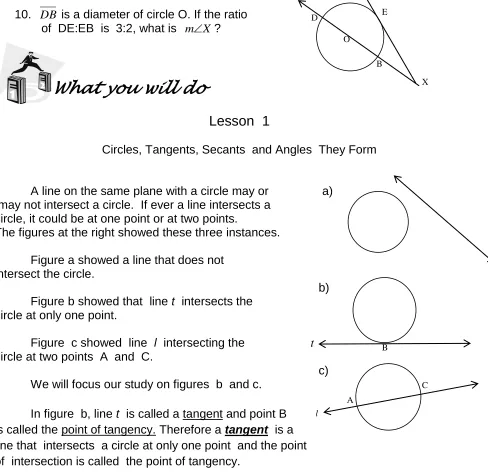
A line on the same plane with a circle may or a) may not intersect a circle. If ever a line intersects a
circle, it could be at one point or at two points.
[image:3.612.71.559.80.553.2]The figures at the right showed these three instances.
Figure a showed a line that does not intersect the circle.
b)
Figure b showed that line t intersects the circle at only one point.
Figure c showed line l intersecting the circle at two points A and C.
c) We will focus our study on figures b and c.
In figure b, line t is called a tangent and point B is called the point of tangency. Therefore a tangent is a line that intersects a circle at only one point and the point of intersection is called the point of tangency.
In figure c, line l intersects the circle at two points A and C. Hence, line l is called a secant. Thus a secant is a line that intersects a circle at two points.
Some properties exist between tangent and circle and they will be discussed here in detail. The first theorem is given below.
Theorem: Radius-Tangent Theorem. If a line is tangent to a circle, then it is perpendicular to the radius at the point of tangency.
t B
A
C
l
X E
D
O
Given: line t is tangent to circle O at A. OA is a radius of the circle.
Prove: t OA
Proof:
Statements Reasons
1. Let B be another point on line t. 2. B is on the exterior of circle O
3. OA < OB
4. OA t
1. The Line Postulate
2. Definition of a tangent line ( A tangent can intersect a circle at only one point . 3. The radius is the shortest segment from the center to the circle and B is on the exterior of the circle.
4. The shortest distance from a point to a line is the perpendicular segment.
Example:
In the figure, if AC is tangent to circle B, then
AC BD at D.
The converse of the theorem is also true.
Converse: The line drawn perpendicular to the radius of a circle at its end on the circle is tangent to the circle.
Illustration:
If AC BD at D, then
AC is tangent to circle B.
Examples:
GY is tangent to circle A.
1. What kind of triangle is ∆ AGY? Give reason. 2. If mA79, what is mY?
Solutions:
1. ∆AGY is a right triangle because GY is tangent to circle A and tangent line is perpendicular to the radius of the circle. Perpendicular lines make right angles between them thus AGY is a right angle making ∆AGY a right triangle.
O
A B t
B
D
C A
B
D
C A
A
2. Since ∆AGY is a right triangle, then
m A + mY = 90 79 + mY = 90 mY = 90 – 79
= 11
A circle is composed of infinite number of points, thus it can also have an infinite number of tangents. Tangents of the same circle can intersect each other only outside the circle.
At this point, we will discuss the relationship of tangents that intersect the same circle. As such, those tangents may or may not intersect each other. Our focus here are those tangents that intersect each other outside the circle.
Consider the given figure:
AM and AY are tangent segments from a common external point A. What relationship exists between AM and AY? The next theorem will tell us about this relationship and other properties related to
tangent segments from a common external point.
Theorem: If two tangent segments are drawn to a circle from an external point then a. the two tangent segments are congruent and
b. the angle between the segments and the line joining the external point and the center of the circle are congruent.
Given: Circle A. BC and BD are two tangent segments from a common external point B. C and D are the points of tangency.
Prove: a. BC BD b. CBADBA
Proof:
Statements Reasons
1. Draw AC, AD, AB
2. BC and BD are two tangent segments from a common external point B.
3. AC BC, AD BD
1. Line determination Postulate 2. Given
3. A line tangent to a circle is perpendicular to the radius at the point of tangency
O •
A M
Y
A C
D
5. ∆ACB and ∆ADB are right triangles 6. AC AD
7. BC BD
8. ∆ACB ∆ADB 9. BC BD
10. CBADBA
5. Definition of right triangles
6. Radii of the same circle are congruent 7. Reflexive property of Congruency 8. Hy L Congruency Postulate
9. Corresponding parts of congruent triangles 10. are congruent.
Examples:
a) In the figure, CB and CD are tangents to circle A at B and D.
1. If CB = 10 what is CD?
2. IfmBAC 49, what is mBCA? 3. mBCD73, what is mBCA?mDCA
Solution:
1. Since CB and CD are tangents to the same circle from the same external point, then CB CD , and therefore, CB = CD. Thus if CB = 10 then CD = 10
2. mBACmBCA90 49 + mBCA90
49 90 BCA m
= 41
3. 21( )
BCD m BCA
m
= 21(73) = 36.5
DCA BCA
5 . 36
BCA m DCA
m
b) PQ, QR and PR are tangents to circle A at S, M and T respectively. If PS = 7, QM = 9 and RT = 5, what is the perimeter of ∆PQR?
Solution:
Using the figure and the given information, It is therefore clear that PS = PT, QS = QM and RM = RT.
PQ = PS + SQ QR = QM + MR PR = PT + RT
Perimeter of ∆PQR = PQ + QR + PR
= (PS + SQ) + (QM + MR) + (PT + RT) = (PS + QM) + (QM + RT) + (PS + RT) = 2PS + 2QM + 2RT
= 2(PS + QM + RT) = 2( 7 + 9 + 5) = 2 (21)
= 42
Every time tangents and secants of circles are being studies, they always come with the study of angles formed between them. Coupled with recognizing the angles formed is the knowledge of how to get their measures. The next section will be devoted to studying angles formed by secants and tangents and how we can get their measures.
Angles formed by secants and tangents are classified into five categories. Each category is provided with illustration.
1. Angle formed by secant and tangent intersecting on the circle. In the figure, two angles of this type are formed, FED and FEB. Each of these angles intercepts an arc. FED intercepts EF and FEB
intercepts EGF.
2. Angle formed by two tangents. In the figure, E is formed by two tangents. The angle intercepts the whole circle divided into 2 arcs, minor arc FD , and major arc FGD.
3. Angle formed by a secant and a tangent that intersect at the exterior of the circle. C is an angle formed by a secant and a tangent that intersect outside the circle. C intercepts two arcs, DB and AD.
4. Angle formed by two secants that intersect in the interior of the circle. The figure shows four angles formed. MAN, NAR, PAR and PAM. Each of these angle intercepts an arc. MAN,intercepts MN, NAR, intercepts NR, PAR intercepts PR and MAP intercepts MP.
E F
B D
G
F
E
D G
C D
A
B
M N
A
5. Angle formed by two secants intersecting outside the circle. E is an angle formed by two secants intersecting outside the circle. E intercepts two arcs namely QR and PR
How do we get the measures of angles illustrated in the previous page? To understand the answers to this question, we will work on each theorem proving how to get the measures of each type of angle. It is therefore understood that the previous theorem can be used in the proof of the preceding theorem.
Theorem: The measure of an angle formed by a secant and a tangent that intersect on the circle is one-half its intercepted arc.
Given: Circle O. Secant m and tangent t intersect at E on circle O.
Prove: mCEB 21CE
Proof:
Statements Reasons
1. Draw diameter ED. Join DC. 2. DEt
3. DCE is a right angle 4. DEB is a right angle 5. ∆DCE is a right triangle 6. m1 + m290
7. m1mBEC mDEB
8. m1mBEC 90
9. m1m2 = m1mBEC
10. m1 = m1
11. m2 = mBEC
12. m2 = 21 mCE
13. mBEC = 21mCE
1. Line determination Postulate 2. Radius-tangent theorem
3. Angle inscribed in a semicircle is a right angle.
4. Perpendicular lines form right angles 5. Definition of right triangle
6. Acute angles of a right triangle are complementary
7. Angle addition Postulate
8. Definition of complementary angles 9. Transitive Property of Equality 10. Reflexive Property of Equality 11. Subtraction Property of Equality 12. Inscribed angle Theorem
13. Substitution
Illustration:
In the given figure, if mCE = 104, what is the mBEC? What is mCEF? Q
P
S
R
E
B E
C D
F
O
Solution:
BEC
m = 21mCE BEC
m = 21(104)
= 52
mCEF = ½ (mCDE)
mCEF = ½ (360 – 104)
= ½ (256) = 128
Let’s go to the next theorem.
Theorem: The measure of an angle formed by two tangents from a common external point is equal to one-half the difference of the major arc minus the minor arc.
Given: Circle O. AB and AC are tangents
Prove: mA 21(BXCBC)
Proof:
Statements Reasons
1. Draw chord BC
2. In ∆ABC, 1 is an exterior angle 3. m1 = m2+ mA
4. mA = m1 - m2 5. m1 = ½ mBXC m2 = ½ mBC
6. mA = ½ mBXC - ½ mBC 7. mA = ½( mBXC – m BC)
1. Line determination Postulate 2. Definition of exterior angle 3. Exterior angle theorem
4. Subtraction Property of Equality
5. Measure of angle formed by secant and tangent intersecting on the circle is one-half the intercepted arc.
6. Substitution
7. Algebraic solution (Common monomial Factor)
Illustration:
Find the mA if mBC = 162.
Solution:
Since mA = ½( mBXC –m BC) then we have to find first the measure of major arc BXC. To find it, use the whole circle which is 360o.
A B
C 1
2 X
mBXC = 360 – mBC = 360 – 162
= 198
Then we use the theorem to find the measure of A A
m = ½( mBXC –m BC) = ½ (198 – 162) = ½ (36)
A
m = 18
We are now into the third type of angle. Angle formed by secant and tangent intersecting on the exterior of the circle.
Theorem: The measure of an angle formed by a secant and tangent intersecting on the exterior of the circle is equal to one-half the difference of their intercepted arcs.
Given: BA is a tangent of circle O BD is a secant of circle O
BA and BD intersect at B
Prove: 21( )
AC AD B
m
Proof:
Statements Reasons
1. BA is a tangent of circle O,BD is a secant of circle O
2. Draw AD
3. 1 is an exterior angle of ∆ DAB 4. m1mBmADB
5. mBm1mADB
6. m1 ½m AD
7. mADB= ½ mAC
8. mB = ½ mAD – ½ mAC 9. mB = ½ (mAD– mAC)
1. Given
2. Line determination Postulate 3. Definition of exterior angle 4. Exterior angle Theorem
5. Subtraction Property of Equality
6. The measure of an angle formed by secant and tangent intersecting on the circle equals one-half its intercepted arc.
7. Inscribed angle Theorem 8. Substitution
9. Simplifying expression
Illustration:
In the figure if mAD = 150, and mAC = 73, what is the measure of B?
A B
C O
D
Solution:
B
m = ½ (mAD– mAC) = ½ (150 – 73) = ½ (77) mB = 38.5
The next theorem will tell us how angles whose vertex is in the interior of a circle can be derived. Furthermore, this will employ the previous knowledge of vertical angles whether on a circle or just on a plane.
Theorem: The measure of an angle formed by secants intersecting inside the circle equals one-half the sum of the measures of the arc intercepted by the angle and its vertical angle pair.
Given: AC and BD are secants intersecting inside circle O forming 1 with vertical angle pair CED. (We will just work on one pair of vertical angles.)
Prove: m1(mAEB) = ½ (AB + DC)
Proof:
Statements Reasons
1.AC and BD are secants intersecting inside circle O.
2. Draw AD
3. 1 is an exterior angle of ∆AED 4. m1 = mDAC + mADE
5. mDAC = ½ mDC mADE = ½ mAB
6. m1 = ½ mDC + ½ mAB m1 = ½ (mDC + mAB)
1. Given
2. Line determination Postulate 3. Definition of exterior angle 4. Exterior angle Theorem 5. Inscribed Angle Theorem
6. Substitution
Illustration:
Using the figure, find the measure of 1 if mAB = 73 and mCD = 90.
Solution:
Using the formula in the theorem, 1
m = ½ (mDC + mAB) = ½ ( 90 + 73) = ½ (163) = 81.5
E A
B
C O
D 1
Let us discuss how to find the measure of the angle formed by two secants intersecting outside the circle.
Theorem: The measure of the angle formed by two secants intersecting outside the circle is equal to one-half the difference of the two intercepted arcs.
Given: AB and CD are two secants intersecting outside of circle O forming BEC outside the circle.
Prove: mBEC = ½ (AD – BC)
Proof:
Statements Reasons
1. AB and CD are secants of circle O forming BEC outside the circle. 2. Draw DB
3. 1 is an exterior angle of ∆ DBE 4. m1= m2+ mBEC
5. mBEC = m1 - m2 6. m1 = ½ mAD
m2 = ½ mBC
7. mBEC = ½ mAD – ½ mBC mBEC = ½ (mAD – mBC)
1. Given
2. Line determination Postulate
3. Definition of exterior angle of a triangle 4. Exterior angle Theorem
5. Subtraction Property of Equality 6. Inscribed Angle Theorem
7. Substitution
Illustration:
Find the measure of E if mAD = 150 and mBC = 80.
Solution:
Again we apply the theorem using the formula:
BEC
m = ½ (mAD – mBC) = ½ (150 – 80
= ½ ( 70) = 35
B
E
D
C A
1
Example 1.
In each of the given figure, find the measure of the unknown angle (x).
1. 2.
3. 4.
5.
Solutions:
1. Given: AB = 1500 Find: mx
x
is an angle formed by a secant and a tangent whose vertex is on the circle. x
intercepts AB.
x
m = ½ AB
x
m = ½ (150) x
m = 75 A
B
x
1500
M P N
O 1570
x
O
x A
M Y
P ●
780
x F
D
E
G H 670
400
R P
Q
T S
1060
2. Given: m MP = 157 Find: mx
x
is an angle formed by two tangents from a common external point. x intercepts minor arc MP and major arc MNP
x
m = ½ ( MNP – MP)
m MNP + mMP = 360
mMNP = 360 – m MP = 360 – 157
mMNP = 203
x
m = ½ (203 – 157)
= ½ (46) = 23
3. Given: m AP = 78
AY is a diameter Find: mx
Since AY is a diameter, then AY is a semicircle and m AY = 180. Therefore
a. m AP + m PY = 180
m PY = 180 – m AP m PY = 180 – 78
m PY = 102
b. mx = ½ ( mPY – mAP) = ½ ( 102 – 78) = ½ (24) = 12
4. Given: mFD = 67, m GE = 40 Find: mx
x
is an angle formed by secants that intersect inside the circle, Hence
x
5. Given: mSR = 38, mPQ = 106 Find: mx
x
is an angle formed by two secants whose vertex is outside the circle. Thus
x
m = ½ (mPQ – mSR) = ½ (106 – 38) = ½ (68) = 34
Example 2:
Find the unknown marked angles or arcs (x and y) in each figure:
1. 2.
3. 4.
5. 6.
M D
B C
A
x y
●
Q P
R N
2450
y
y x
R S
U
T 580
320 y 220 x
P
Q
S
R 300
A B C
D E
x 350
E
F D
G
H 270 370
Solutions:
1. Given : mBMD = 210 Find: mx , my
mBMD + mBD = 360 (since the two arcs make the whole circle) mBD = 360 – mBMD
= 360 – 210 = 150
a. mx = ½ mBD = ½ (150)
= 75
b. my = ½ m BMD = ½ (210) = 105
2. Given: mPNR = 245 Find: mx, my
mPNR + mPR = 360 (since the two arcs make a whole circle)
mPR = 360 – mPNR = 360 – 245 = 115
But mx = mPR (Central angle equals numerically its intercepted arc) mx = 115
my = ½ (mPNR – mPR) = ½ (245 – 115) = ½ (130)
= 65
3. Given: mRU = 32, mST = 58 Find: mx, my
x
x
m + my = 180 Linear Pair Postulate y
m = 180 - mx
y
m = 180 – 45 = 135
4. Given: mQR = 30, m1 = 22 To check;
Find : mx, y m1 = ½ (mPS + mQR) First, find y by using m1 = ½ (14 + 30 )
1
m = ½ ( y + 30) = ½ ( 44) 22 = ½ (y + 30) = 22 2(22) = y + 30
44 = y + 30 y = 44 – 30 y = 14
5. Given: mA = 35, mCD = 110
Find: x To check:
A
m = ½ (110 – x) mA = ½ (110 – x) 35 =
2 110x
A
m = ½ (110 – 40)
2(35) = 110 – x mA = ½ (70) 70 = 110 – x mA = 35
x = 110 – 70
x = 40
6. Given: mE = 27, mDH = 37
Find: x To check:
E
m = ½ (x – 37) mE = ½ (x – 37)
27 = 2
37
x
E
m = ½ (91 – 37)
Try this out.
1. BC is tangent to circle O at A. mDE = 68
mAF = 91. Find a. mEA
b. mDF c. mBAE
d. mEAD
e. mDAF f. mFAC
2. ∆DEF is isosceles with DE DF. m1 = 82. Find
a. mD b. mDE c. mEF d. m2 e. m3
3. If x = 18 and y = 23, find m1.
4. If mDE = 108 and mDOC = 85, find: a. mEA
b. mEAF c. mDAC d. mCAB e. m1
5. Using the given figure, find x and y.
O
F H
E
G 2
3 D
1
B
C A
1
y x
D
D
E
O C
A
F B
1
x
1100
600 y
D A
E
F ●
B
C 680
910
6. EC is tangent to circle O. AB is a diameter. If mDB = 47, find mAD, mECD
7. A polygon is said to be circumscribed about a circle if its sides are tangent to the circle. ∆PRT is circumscribed about circle O. If PT = 10, PR = 13 and RT = 9, find AP, TC and RB.
8. PT is tangent to circle O at P. If mNP = 90, and mMXP = 186, find
a. m1 b. m2 c. m3 d. m4 e. m5 f. m6
9. O is the center of the given circle. If mBD = 122 find
a. m1 d. m4 b. m2 e. m5 c. m3 f. m6
A
D
C
B O
E
P
T A
B
C R
O 4
3 1 M
T P
N
X 2
5
6
3 E
D
F
O
A B C
5
1 4
Let’s Summarize
1. A tangent is a line that intersect a circle at only one point.
2. A. secant is a line that intersect a circle at two points.
3. If a line is tangent to a circle, it is perpendicular to a radius at the point of tangency.
4. If two tangents are drawn from an exterior point to a circle then
a) the two tangent segments are congruent
b) the angle between the segment and the line joining the external point and the center of the circle are congruent.
5. The measure of an angle formed by a secant and a tangent intersecting on the circle is equal to one half the measure of the intercepted arc.
6. The measure of an angle formed by two tangents from a common external point is equal to one-half the difference of the measures of the intercepted arcs.
7. The measure of an angle formed by secant and tangent intersecting outside the circle is equal to one-half the difference of the measures of the intercepted arcs.
8. The measure of an angle formed by two secants intersecting inside the circle is equal to one-half the sum of the measure of the intercepted arc of the angle and its vertical angle pair.
What have you learned
1. QP is tangent to circle O at P. If mPOQ = 73, what is mQ?
2. DE, EF and DF are tangents to circle M. If DB =- 5, EC = 7 and AF = 4, what is the perimeter of ∆DEF?
3. PS AND PQ are secant and tangent of circle A. If mRQ = 52, what is mP?
4. Given circle E with secants AB and CD. If mBD = 53 and mBC = 117, find
mBED.
5. XY is tangent to circle at A . If mAB = 105, and AB BP, find mBAP and
6. mPAY
O
Q P
E D
F
B
A
C
A S
Q
P R
E A
D
B
C
P
B
A
7. Given circle A with secants OQ and OP. If mRS = 32 and mQR = 2mRS, find mO?
8. AB║ DE. BE is tangent to the circle at B and intersects DE at E.
If mAB = 110 and mAD = 70, then mABF = ___________.
9. mBEC = __________.
10. Using the same figure, if mE = 42, mBC = 60, find mAB.
A S O
P
R Q
A
F
B
Answer Key
How much do you know
1. or congruent 2. or perpendicular 3. 40
4. 22 5. 59 6. 61 7. 33 8. 120 9. 20 10. 18
Try this out Lesson 1 1. a. 112
b. 89 c. 56 d. 34 e. 44.5 f. 45.5
2. a. 16 b. 164 c. 32 d. 82 e. 16
3. 41 4. a. 72
5. x = 70 y = 50
6. mAD = 133 mECD = 43
7. AP = 7 TC = 3 RB = 6
8. a. 45 b. 45 c. 42 d. 93 e. 57 f. 48
9. a. 122 b. 61 c. 29 d. 29 e. 29 f. 45
What have you learned
1. 17