Reference & User Services Quarterly, vol. 59, no. 1, pp. 44–65
© 2019 American Library Association. All rights reserved.
Permission granted to reproduce for nonprofit, educational use.
E-book platforms have multiplied among vendors and publishers, complicating not only acquisitions and collection develop-ment decisions, but also the user experi-ence. Using a methodology of task-based user testing, the researchers sought to measure and compare user performance of eight common tasks on nine e-book platforms: EBSCO eBooks, ProQuest Ebook Central, Gale Virtual Reference Library (GVRL), Oxford Reference, Safari Books Online, IGI Global, CRCnetBASE, Springer Link, and JSTOR. Success and failure rates per task, average time spent per task, and user comments were evalu-ated to gauge the usability of each plat-form. Findings indicate that platforms vary widely in terms of users’ ability and speed in completing known-item searches, navigation tasks, and identification of specialized tools, with implications for library acquisition and user instruction decisions. Results also suggest several key vendor design recommendations for an optimal user experience. The study did not aim to declare a “winning” platform, and all the platforms tested demonstrated both strengths and weaknesses in differ-ent aspects, but overall performance and user preference favored ProQuest’s Ebook Central platform.
E
-book platforms havemul-tiplied among vendors and publishers, complicating not only acquisitions and collec-tion development decisions, but also the user experience. Recurring anec-dotal discussions among Library fac-ulty at Sam Houston State University remained inconclusive regarding vari-ous platforms’ ease or intuitiveness of use. Researchers sought to measure and compare common tasks across nine different e-book platforms using task-based user testing. User behavior observation and direct quotes, along with quantitative data such as aver-age time per task and success/failure rates for task completion, informed researchers of the ease, intuitiveness, and duration for eight tasks for each of the platforms tested. The research-ers hope that the findings of this study will provide valuable information for other libraries making collection devel-opment and instruction recommen-dations or decisions regarding these various platforms, while also serving as a mode of feedback to the platforms’ vendors and publishers.
Kat Landry Mueller,
Zachary Valdes, Erin Owens,
and Cole Williamson
Kat Landry Mueller (klmueller@shsu .edu) is Associate Professor, Electronic Resources Librarian, Newton Gresham Library, Sam Houston State University, Zachary Valdes ([email protected]) is Associate Professor, E-Resources Metadata Management Librarian, Newton Gresham Library, Sam Houston State University, Erin Owens ([email protected]) is Associate Professor, Access Services Coordinator and Scholarly Communications Librarian, Newton Gresham Library, Sam Houston State University, and Cole Williamson(wcwilliamson@ualr .edu) is Assistant Professor, Research and Scholarly Communications Librarian, Ottenheimer Library, University of Arkansas at Little Rock.
LITERATURE REVIEW
Scope of the Literature Review
This literature review focuses on the past works of most rel-evance to the current study based on the goal pursued and/ or the methodology employed. The aim of this literature review will be to highlight key works that have focused on evaluating the usability of e-book platforms in the desktop computer environment, particularly those works that sought to compare competing platforms, and to demonstrate how the current study fits in with and builds further upon these past works.
Many studies have compared user preferences for e-books versus print books, user acceptance of e-books, and comparative user behavior in the two reading mediums. This literature review will not attempt to detail this sizable body of work, as it is outside the scope of the present study, which aims to assess actual student interaction with differ-ent platforms in occasions when a user must use an e-book, regardless of preferences. However, one example from that body of literature worth mentioning briefly is Berg, Hoffman, and Dawson (2010), where task-based usability testing, very similar to that of the current study, was employed to compare specific e-book titles on one platform with the same titles in print.1 This study and its literature review would provide a good starting point for librarians more specifically interested in usability-based comparisons of e-book versus print for-mats, as opposed to comparing different e-book platforms.
Similarly out of scope for this literature review are stud-ies focused specifically on the use of dedicated e-reading devices, the usability of e-books on mobile devices, and the use of e-textbooks (required course texts in electronic for-mat), as they emphasize specific aspects of the e-book expe-rience that are not pertinent to the current study.
Survey, Review, and Focus Group Methodologies
The host of studies discussing users’ thoughts and attitudes towards e-books may be separated into a few categories, depending on how they approach the subject. First, there are those studies seeking to look at the usability of e-books through a variety of lenses that are pertinent to the course of this current study. One such by Hobbs and Klare (2016) sought to look at the general efficacy of student interactions with e-books through a combination of interviews and sur-veys.2 Their findings showed that while the number of stu-dents using e-books increased, their overall proficiency with them remained flat. Reasons cited for this by the participants were difficulty in using the e-book interface, as well as dif-ficulty using study habits acquired with print materials, such as the marking of pages with tabs. The present study will be looking at both the ease of use for the interface, as well as the availability of tools, such as note-taking. A usability study by Abdullah and Gibb discussed the various reasons that drew users toward or away from e-books.3 One negative
aspect of e-books they found was the difficulty in learning new technology; the present study may help to inform fur-ther understanding of this difficulty by determining which platforms present greater or lesser barriers to intuitive use.
Comparative reviews of platforms, using e-books focused in one specific subject, comprise another category of studies pertinent to this paper. Shereff (2010) compares the various tools and features of NetLibrary and Thieme e-books with the aim of examining usability, search interfaces, and con-tent in biomedical information.4Comparison reviews such as these provide a stepping-stone for the current paper’s larger comparative usability scope. A similar review by Heyd (2010) of medical library aggregators compared Net Library, R2 Digital Library, and Stat!Ref, but again, did not extend in scope beyond this focused content topic.5
A study by Shrimplin, et al. (2011), bears consideration; the authors used a Q methodology to divide readers into four categories,6 from which they determined that individual attitudes towards e-books range between utilitarian and emotional.7 The two emotional categories were Book Lovers and Technophiles, while the utilitarian categories were Print-ers and Pragmatists. PrintPrint-ers were those usPrint-ers who would increase their use of e-books if the usability of the interface were to be improved, highlighting the importance of usabil-ity in repeat use of e-books.
The professional literature is replete with librarians’ reviews of individual e-book platforms, or detailed com-parisons of multiple platforms. These provide valuable assessments from the expert’s perspective concerning what functions and features a platform includes or omits, how well essential tools work in a given environment, and treat-ment of aspects such as ADA accessibility. One key example is a work by Tovstiadi and Wiersma (2016), who conducted a rubric-based evaluation of 20 publisher and aggregator platforms to gauge and compare usability.8 Their rubric used the CRL (Center for Research Libraries) Academic Database Assessment tool9 as a foundation and incorporated additional evaluation from the e-book Accessibility Project. Using the rubric, the researchers assessed each platform in regards to 34 elements important to usability and user experience, such as pagination, table of contents, native citation tool, search functionality, zoom, annotation, and more. A follow-up work by the same authors, published in 2017, elaborates on the use of rubrics to compare metadata and search results for the same e-book titles on different aggregator and publisher plat-forms.10 These two papers provide an excellent assessment of comparative platform usability, but these studies (and the entire genre of librarians’ expert reviews) stop short of study-ing actual user interaction with each platform.11
disadvantages, and likes and dislikes. The focus groups found that students:
z liked clear, uncluttered reading interfaces and quick loading times;
z disliked the difficulty of annotating;
z generally lacked interest in “added features” such as note-taking;
z preferred to download the whole e-book versus chap-ters; and
z desired content that could be downloaded in PDF and retained.
Although the study lists some of the main aggregator platforms that the library uses, “including VLe-books, daw-sonera, MyiLibrary, ebrary, EBL and EBSCO,” the author is not explicit about whether all platforms were examined; fur-thermore, the specific points of praise and criticism shared from the student focus groups are not tied to specific plat-forms in the article. Therefore the article describes general strengths, weaknesses, and preferences without evaluating individual platforms. Furthermore, the study’s scope did not include observation of how the students actually interacted with each platform.
Most recently, a study by Tracy (2018) sought to look deeper at user choices and preferences for print versus electronic by examining the variations in e-book platforms that may affect user choices.13 In the study, 62 participants completed online diary forms over an eight-week period, documenting instances of e-book use and deliberate e-book avoidance in academic use contexts. The forms collected details such as the e-book used, the tasks completed, and which e-book features users found “easy or challenging to use,” or for instances of avoidance, the reasons for avoidance and alternate formats or content used.14 Participants were also interviewed during the study to discuss the usage chal-lenges described in their diary forms. Examples of aspects where the study identified room for platform improvement included platform “clutter,” navigation, page numbering, search function, and downloadability and portability. The current study provides the opportunity to build upon and validate or refute these findings through user testing.
Task-Based Usability Testing Methodology
Finally, the current study’s use of task-based usability test-ing builds upon an existtest-ing history of studies involvtest-ing similar methodology. Hernon et al. (2007), conducted task-based usability testing where students were given a plausible research assignment from one of three disciplines and were asked to demonstrate their search strategies in approaching the assignment.15 The researchers observed what types of e-books students in each discipline used and how they used them; however, students were not limited to searching e-books only, and the researchers did not seek to compare how suc-cessful students were in interacting with different platforms.
The 2008 study by Abdullah and Gibb has rightly been treated as an important work on student experiences with e-books, and it does employ task-based testing methodol-ogy.16 Student participants were asked to perform a series of search and browse tasks in a single platform, NetLibrary; the researchers compared each student’s performance against that student’s self-reported past experience with e-books and also conducted a follow-up web survey of student preferences for e-books versus print books. Although quite informative regarding user preferences, this study tested the usability of only a single platform and focused mostly on student reac-tions to that platform; the current study seeks to expand on the knowledgebase of past research by widening the focus and comparing student, as well as faculty and staff, success in task completion on numerous platforms.
O’Neill’s 2009 thesis employed a research goal and meth-odology similar to the current study.17 Ten students (five undergraduate and five graduate) were recruited to test three platforms—ebrary, MyiLibrary, and Ebook Library (EBL)— by attempting four assigned tasks. Users were divided into three groups, and each group used the three platforms in a different order, to prevent the data for any given platform from being skewed by greater or lesser experience with other platforms. After completing the tasks, participants were asked a series of follow-up questions, such as which platform they believed was easiest to use. The data was coded for key concepts and patterns of user behavior, with an emphasis on user experience versus simple quantitative measures, such as length of time or number of steps or errors. The current study builds upon O’Neill’s work by expanding the comparison to a larger number of platforms, introduc-ing rubric-based evaluation of participant task completion, enlarging the user sample to include faculty and staff, and combining qualitative data on user behavior and experi-ence with quantitative measures such as time required to complete a task. A new study in this vein is reasonable due to significant platform upgrades in the years since O’Neill’s research, including the merger of ebrary and EBL into Pro-Quest Ebook Central, the greater availability of continuous scrolling—a feature identified as desirable by O’Neill’s test participants, but absent at that time in both ebrary and MyiLibrary—and other changes.
EBSCO conducted a study in 2011 to inform the pro-cess of transforming NetLibrary into EBSCO eBooks; they combined usability testing with NetLibrary log analysis, customer feedback, and formal surveys.18 The study’s find-ings highlighted four key areas of functionality that required the developers’ focus to improve user experience, namely, Discoverability, Online Viewing, Printing/Emailing, and Downloading. Unfortunately, little detail is provided about the nature or scope of the usability test performed in that study, which limits its reproducibility and presents obstacles to expanding on its place within the literature or comparing it to the current study in a more detailed fashion.
(based on a screening survey) to participate in task-based usability testing of library e-books.19 The test involved the ebrary, Ebook Library (EBL), EBSCO eBooks, Safari Books Online, and ACS Humanities e-book platforms. Searches for e-books on specific subjects were performed from the library homepage rather than in any specific e-book platform. Users were then asked to locate specific e-book titles on different platforms, find a specified piece of information inside the e-book (such as the definition of a term), and then, “if pos-sible, conduct the following four actions: copy the answer; highlight the answer; add a note next to the answer; and download the answer page(s).”20 Data analyzed also included time required to complete each task, number of errors, quan-tity of requests for help, and a tally of positive or negative comments during each task. The study’s findings included the fact that beginners tended to search inside books more often, whereas intermediate or expert users preferred using the index, table of contents, or lists of figures and tables in comparison to using “Search Within” tools. Also noteworthy was participants’ difficulty in understanding features, such as highlighting and note-taking, deviated from more com-monly understood interactions—for example, the use of less recognizable icons without explanatory tooltips, or the need to click an intermediary button before a familiar keyboard command like Ctrl + C will function. Most of the findings discussed center around the impact that a user’s experience level with e-books has on that user’s behavior when attempt-ing tasks in an e-book platform.
A presentation by Tovstiadi, Wiersma, and Tingle at the Electronic Resources and Libraries 2017 conference described a study that was coincidentally conducted around the same time as the present investigation and employed highly similar methodology.21 Seventeen users participated in task-based testing on three platforms each, and then were asked to rank their platform preferences after tasks were attempted; platform order was randomized during testing, just as in the current study. A total of six platforms were tested: Brill, Cambridge University Press, Ebook Central, EBSCO eBooks, ScienceDirect, and Wiley. Tasks and ques-tions presented to users included identification of biblio-graphic information, opening a book, navigation within a book, searching, annotation, citation, printing a page, and downloading a chapter. Some key findings included: most students (defined as more than 50%) “found citation tools easily”; most students “used a page number box to ‘jump’ to a specific page when available”; most students “blamed them-selves when the platform didn’t perform as expected”; most students “tried Ctl + F first” for finding information within a book; students showed a clear preference for aggregators over publisher platforms; and content providers should “use universally recognized icons/terminology.”22
Tovstiadi, Wiersma, and Tingle selected e-book titles available on multiple platforms (two aggregators and the publisher), which was advantageous in decreasing variables; the present study instead selected a unique title on each platform, which had different advantages. This permitted
the consideration of a broader selection of platforms and content areas while also providing a better opportunity for “fresh eyes”—in other words, with a greater diversity of subjects and platforms, each participant was more likely to encounter something unfamiliar, for which they could not simply rely on past experience. The current study set its sights on a different selection of platforms than those tested by Tovstiadi, Wiersma and Tingle; additionally it sought to measure task completion rather than just observing methods attempted, thereby offering additional insight on the topic. Furthermore, with such similar methodologies involved, direct comparisons between the findings are more relevant; therefore, the current study may also help to validate or ques-tion previous findings.
METHODOLOGY
The researchers developed a mixed-methods approach to observe user interaction with multiple e-book platforms, and to evaluate how easily, intuitively, or quickly users were able to complete tasks. The Institutional Review Board (IRB) at Sam Houston State University (SHSU) approved the study before recruitment and testing began. For context, SHSU is Carnegie-classified as “Doctoral Universities: Moderate Research Activity” (R3); total enrollment for the Fall 2016 semester, shortly before testing began, was 20,632 students. The central methodology employed was task-based test-ing, in which users were asked to complete a list of prescribed tasks (available at https://hdl.handle.net/20.500.11875/2615). Researchers observed the test neutrally, but did not inter-vene or provide direction; the exception was Task 1, which required that the e-book be opened in order for subsequent tasks to be possible. Tasks were drawn from real needs that the researchers had observed through course assignments or during reference consultations, as well as expected user interactions with e-books.
In selecting e-book platforms to test, the researchers took a variety of factors into consideration. These included (1) the quantity of books accessible via the library on that platform, whether by perpetual access or subscription; (2) the diversity of subject areas represented by content avail-able on the platform; (3) the uniqueness of the platform; and (4) the extent to which the platform had been absent from previous e-book usability studies. The researchers ultimately selected nine e-book platforms for testing: EBSCO eBooks, ProQuest Ebook Central, JSTOR, IGI Global, Springer Link, Safari, CRCnetBASE, Gale Virtual Reference Library (GVRL), and Oxford Reference.
content, JSTOR was the last addition to the list of selected platforms. It was added in the hopes that usability feed-back might inform the library’s decisions about increasing acquisition of content on that platform, since its desirable DRM-free content offerings had begun to attract the atten-tions of librarians conducting collection development. Mean-while, GVRL and Oxford Reference were selected to allow evaluation of platforms designed specifically for e-reference content, since these tend to differ in key ways from other platforms. One e-book title was selected on each platform, along with specific keywords in the book’s contents to be leveraged in searching and navigation tasks. Finally, the researchers conducted careful investigations to determine what capabilities and features each platform provided. At this stage, the researchers were unable to ascertain that Springer offered any form of citation tool; however, while analyzing video recordings after testing, the researchers did find a single instance demonstrating that the feature was actually available.
To recruit participants, study invitations were mass-emailed to all enrolled undergraduate and graduate students and all employed faculty and staff; a $10 Amazon gift card for each participant was offered as an incentive to volunteer. The researchers were concerned about being able to enlist the desired number of participants, given that participation required an average of 15–30 minutes on site in the library, and therefore cast a wide net by inviting all students rather than a selected sample. The researchers enlisted 30 testing participants, comprised of ten faculty/staff, four graduate students (two doctoral, two masters), and four students at each undergraduate level (senior, junior, sophomore, fresh-man). Testing appointments were made with respondents on a “first come, first served” basis until the quota was filled for a given user group; tests were conducted between January and March of 2017.
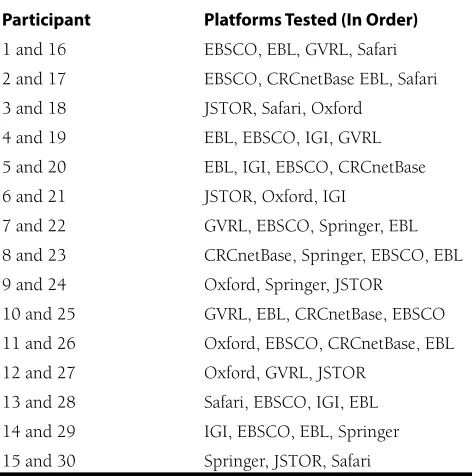
Each enrolled participant was randomly assigned a par-ticipant number, with two parpar-ticipants testing each defined slate of platforms (see table 1). Informed by the usability concept of randomized testing, the order in which platforms were tested was rotated to avoid any skewing of the data based on the presence or absence of experience with other platforms. For instance, a platform might rate lower if always tested first, or might rate higher if always tested last, so rear-ranging the order in which platforms were tested increased the likelihood of a fair evaluation.
Initially the researchers planned to test eight platforms, with every participant testing EBSCO eBooks, Ebook Cen-tral, and two additional platforms—four interfaces in total. Because JSTOR was a late addition after the number of par-ticipants was set, several parpar-ticipants instead tested only three platforms, reducing the number of tests for EBSCO eBooks and Ebook Central (see table 1).
Prior to each test, the study methods and goals were explained to the participant, who then signed an informed consent document agreeing to the methodology and record-ing. Researchers explained that the test was intended to
assess the platform, not the user, and therefore self-con-sciousness about right versus wrong answers was unwar-ranted. Participants were asked to use the “think aloud” protocol during testing to make their thought processes vis-ible to the researchers, and they were instructed to inform the test administrator when they reached a point where they would, under normal circumstances, give up or quit their attempt. The procedures followed for the user tests are avail-able at https://hdl.handle.net/20.500.11875/2615.
Screen-recording software was used to capture both audio and user activity in the interface, in order to allow the researchers to review tests in greater detail during data analysis. While the participant attempted each task and expressed their thoughts and reactions aloud, the test administrator watched and made notes of what methods the user attempted, along with any noteworthy user quotes. If a user quit attempting a specific task, the administrator noted this and moved onto the next task; the administrator instructed the user in completing the abandoned task only if necessary to progress past Task 1. After the participant had attempted all assigned tasks, the administrator asked follow-up questions regarding which platform they liked most and least, their past experience with the platforms tested, and their expectations regarding likely future use.
As part of assessing each platform’s usability, the researchers sought to evaluate how easily or intuitively a given task could be completed in the interface. To this end, a rubric was developed that would score a user’s attempt on a given task as an Efficient Success, Alternate Success, or Failure. Efficient Success was defined as using the method(s) that seemed to be most intended by the platform design-ers, as opposed to other alternate methods of successful completion (which were classified as Alternate Success). For Table 1. Participant Platform Testing Assignments
Participant Platforms Tested (In Order)
1 and 16 EBSCO, EBL, GVRL, Safari
2 and 17 EBSCO, CRCnetBase EBL, Safari
3 and 18 JSTOR, Safari, Oxford
4 and 19 EBL, EBSCO, IGI, GVRL
5 and 20 EBL, IGI, EBSCO, CRCnetBase
6 and 21 JSTOR, Oxford, IGI
7 and 22 GVRL, EBSCO, Springer, EBL
8 and 23 CRCnetBase, Springer, EBSCO, EBL
9 and 24 Oxford, Springer, JSTOR
10 and 25 GVRL, EBL, CRCnetBase, EBSCO
11 and 26 Oxford, EBSCO, CRCnetBase, EBL
12 and 27 Oxford, GVRL, JSTOR
13 and 28 Safari, EBSCO, IGI, EBL
14 and 29 IGI, EBSCO, EBL, Springer
example, Task 2 asked participants to navigate to page 50 in the e-book, thus on most platforms, typing 50 into a Go-to-Page function would be more efficient than clicking the Next Page navigation button 50 times. The researchers relied heavily on the Help files within each platform to inform their classification of Efficient Success, with the rationale that such product documentation would reflect the method by which developers intended users to accomplish a specific task. In cases where the Help documentation did not address a topic, distinctions between Efficient and Alternate Success were determined by discussion and consensus among the four co-authors.
Task attempts were classified as Failures when partici-pants voluntarily quit their attempts, erroneously believed a task had been completed when it had not been, or other-wise failed to achieve the goal of the assigned task. If a task required a feature not provided by a given platform—such as note-taking—the rubric provided an option to score the task with a Null value; this way the platform was not penal-ized for a user’s failure to interact with a non-existent tool. In instances when a user inadvertently skipped over a task, or there was a technological glitch, the researchers scored these as a Null value as well.
Initially, researchers attempted to design a single rubric to describe tasks across all platforms; in the end, however, the rubric template was customized for each platform, since the most efficient, or even the possible, methods of task completion varied so significantly between platforms. The rubrics underwent several iterative norming sessions to improve inter-rater reliability. All nine platform-specific rubrics developed by the researchers for this study are avail-able at https://hdl.handle.net/20.500.11875/2615.
After testing was complete, the researchers reviewed the recordings to (a) score task completion according to the rubric, (b) record additional quantitative data such as the length of time to complete each task, and (c) note qualita-tive data such as the participants’ verbal comments and researchers’ observations. After data was recorded for all testing sessions, averages were calculated per platform and per task to further inform data analysis. To conduct a more comprehensive comparison of completion time results, the researchers elected to collate and assess times in both their original state and an adjusted state in which all null value sessions were assigned times derived from the overall mean time across all platforms for a given corresponding task.
To conduct a more comprehensive comparison of com-pletion time results, the researchers elected to collate and assess times in both their original state and an adjusted state in which all null value sessions were assigned times derived from the overall mean time across all platforms for a given corresponding task. By introducing this Null Mean Substitution method into the assessment and reporting of completion time results, the researchers aimed to avoid any substantial skewing of data that would have resulted from comparing overall average time calculations across platforms possessing an inequivalent number of testable features.
While introducing mean time values into null task sessions does introduce potential for skewing of data and bias, the researchers believed this approach to be appropriate for the purpose of this research and the characteristics of the analysis. Additionally, because the overall number of com-pleted task sessions to null sessions was largely in favor of completed sessions, the researchers identified the Null Mean Substitution method as one being acceptable in this analysis for connecting missing data points while largely maintaining the integrity of the original data. To accomplish this, the time values for all completed sessions of each task were averaged, which generated a value that was then allocated to all null sessions for the corresponding task. For example, if Task 1 incurred 10 nulls overall, and 20 completed sessions overall, the completion times for the 20 completed sessions would be averaged, and this average would then be allocated to the 10 null sessions. When reporting on overall platform comple-tion times and their corresponding rankings, the researchers elected to incorporate both adjusted and non-adjusted times; and when reporting on individual task completion times and rankings, the researchers elected to only report adjusted times. The one exception implemented by the researchers when reporting on individual task completion times and rankings was to exclude any platform which did not offer the feature being tested for that task.
RESULTS
For the remainder of the paper, the following short-hand acronyms may be used: Efficient Success Rate (ESR), Alter-nate Success Rate (ASR), Overall Success Rate (OSR), and Failure Rate (FR). For additional tables of data regarding average task times and success or failure rates, refer to the Appendixes of Supplemental Tables at https://hdl.handle .net/20.500.11875/2615.
EBSCO eBooks
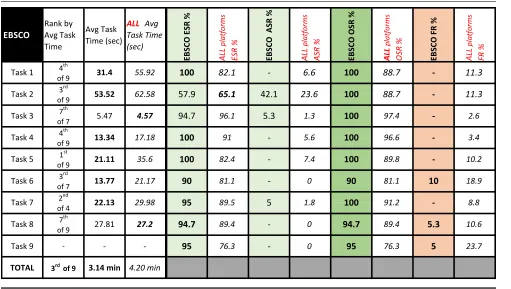
EBSCO eBooks achieved a 100% Overall Success Rate on Tasks 1–5 and 7; for complete data on EBSCO eBooks’ suc-cess and failure rates, see table 2.
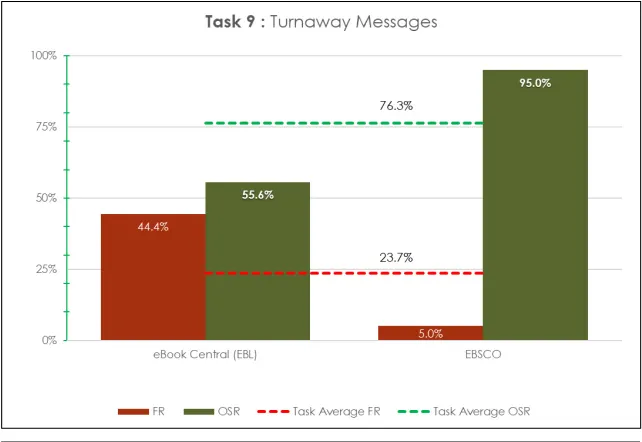
A review of average task durations placed EBSCO eBooks first place on Task 5 last at seventh of seven places on Task 3. Task 9 (turnaway message) was not timed, but saw an ESR of 95%.
EBook Central (formerly EBL)
EBook Central produced the highest (100%) OSR on Tasks 1, 3, 4, 5, 7, and 8. EBook Central saw its worst usability in Task 9 (turnaway message), with 55% ESR, and a high 44% FR.
Nonetheless, EBook Central generated 100% ESR in more than half of all tasks, and produced top-ranked completion times in three tasks. For complete data on EBook Central’s success and failure rates, see table 3.
Table 2. EBSCO eBooks Performance Compared to All-Platform Averages
EBSCO
Rank by Avg Task Time
Avg Task Time (sec)
ALL Avg Task Time (sec)
EBSCO ESR % ALL
platforms
ESR % EBSCO ASR % ALL
platforms
A
SR
%
EBSCO OSR % ALL
platforms
OSR % EBSC
O
F
R %
ALL
platforms
FR %
4th
of 9 3rd
of 9 7th
of 7 4th
of 9 1st
of 9 3rd of 7 2nd
of 4 7th of 9
Task 9 - - - 95 76.3 - 0 95 76.3 5 23.7
TOTAL 3rdof 9 3.14 min 4.20 min
8.8
Task 8 27.81 27.2 94.7 89.4 - 0 94.7 89.4 5.3 10.6
5 1.8 100 91.2
-Task 7 22.13 29.98 95 89.5
10.2
Task 6 13.77 21.17 90 81.1 - 0 90 81.1 10 18.9
- 7.4 100 89.8
-Task 5 21.11 35.6 100 82.4
11.3
11.3
2.6
3.4
- 5.6 100 96.6
-5.3 1.3 100 97.4
-42.1 23.6
Task 4 13.34 17.18 100 91
Task 3 5.47 4.57 94.7 96.1
100 88.7
-Task 2 53.52 62.58 57.9 65.1
- 6.6 100 88.7
-Task 1 31.4 55.92 100 82.1
Ebook Central
Rank by Avg Task Time
Avg Task Time (sec)
ALL Avg Task Time (sec)
Ebook Central ESR % ALL
platforms
ESR % Ebook Central ASR % ALL
platforms
ASR % Ebook Central OSR % ALL
platforms
OSR % Ebook Central FR % ALL
platforms
FR %
3rd
of 9 2nd
of 9 3rd
of 7 7th
of 9 4th
of 9 4th
of 7 1st
of 4 3rd
of 9
Task 9 - - - 56 76.3 - 0 56 76.3 44 23.7
2nd of 9
TOTAL 2.98 min 4.2 min
8.8
Task 8 21.15 27.2 100 89.4 - 0 100 89.4 0 10.6
- 1.8 100 91.2 0
Task 7 14.51 29.98 100 89.5
10.2
Task 6 24.45 21.17 83 81.1 - 0 83 81.1 17 18.9
- 7.4 100 89.8 0
Task 5 23.04 35.6 100 82.4
2.6
Task 4 21.35 17.18 93 91 7 5.6 100 96.6 0 3.4
- 1.3 100 97.4 0
Task 3 4.58 4.57 100 96.1
11.3
Task 2 42.71 62.58 78 65.1 17 23.6 95 88.7 5.6 11.3
- 6.6 100 88.7 0
Task 1 26.86 55.92 100 82.1
Among average task completion times, EBook Central ranked first of nine on Task 7. EBook Central was one of two platforms that contained all testable features. After adjust-ing to account for 25 null values, the average time spent on EBook Central’s platform increased by 20.90% from 2.46 to 2.98 minutes, ranking second of nine platforms.
Gale Virtual Reference Library (GVRL)
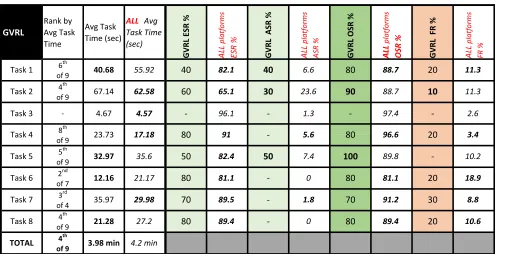
GVRL had its highest Overall Success Rate of 100% on Task 5, based on 50% ESR and 50% ASR. GVRL saw the most frequent Failures on Task 7, in which the platform produced a 30% FR versus a 70% ESR. For complete data on GVRL’s success and failure rates, see table 4.
GVRL achieved its best average time on Task 6, for which it ranked in second place with just 12.16 seconds compared to 21.17 seconds for all others. GVRL’s worst average time, earning eighth place on Task 4, was 23.73 seconds versus 17.17 seconds for all platforms.
GVRL did not have a next-page feature at the time of testing and incurred 15 null values in total. When adjusted to account for null values, GVRL’s overall average time increased by 5.89% from 3.76 to 3.98 minutes, ranking fourth of all nine platforms.
Oxford Reference
Oxford Reference achieved 100% OSR on Task 2 and Task 5. Oxford Reference’s worst performance occurred in Task 6, with a majority (55.6%) Failure Rate. For complete data on Oxford Reference’s success and failure rates, see table 5.
Oxford Reference did not manage any first place rankings
for average tasks times, but it did rank in the top half of plat-forms for Task 8 and Task 5. The platform earned last place on Task 4 and Task 7.
Oxford Reference did not have a next-page feature at the time of testing and incurred 15 null values in total. When adjusted to account for null values, Oxford Reference’s over-all average time increased by 4.60% from 5.26 to 5.50 min-utes, ranking eighth of all nine platforms.
Safari
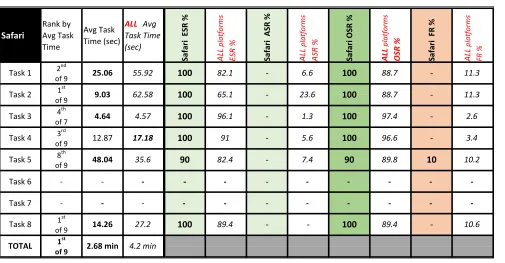
Safari achieved 100% OSR, as well as 100% ESR, on all tasks except Task 5. For complete data on Safari’s success and fail-ure rates, see table 6.
When comparing average completion times, Safari ranked in first place among all platforms on Task 2 and Task 8. Safari’s struggled most on Task 5, with the second-slowest average completion time.
Safari did not have a citation feature or a note feature at the time of testing and incurred 22 null values in total. When adjusted to account for null values, the overall average time increased by 46.75% from 1.83 to 2.68 minutes. This platform experienced the largest percentage change when accounting for null values, but ultimately maintained a top-place ranking overall.
IGI Global
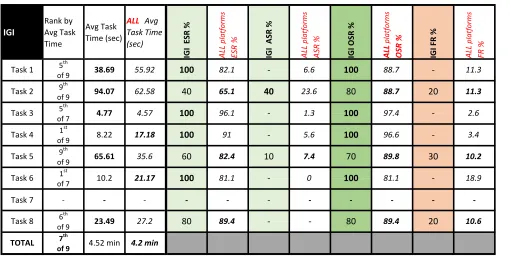
IGI Global achieved 100% OSR, as well as 100% ESR, on Tasks 1, 3, 4, and 6. IGI Global’s highest FR occurred in Task 5, with nearly a third (30%) of its users failing to com-plete the task. For comcom-plete data on IGI Global’s success and Table 4. GVRL Performance Compared to All-Platform Averages
GVRL
Rank by Avg Task Time
Avg Task Time (sec)
ALL Avg Task Time (sec)
GVRL ESR % ALL
platforms
ESR % GVRL ASR % ALL
platforms
ASR % GVRL OSR % ALL
platforms
OSR % GVRL FR % ALL
platforms
FR %
6th
of 9 4th
of 9
Task 3 - 4.67 4.57 - 96.1 - 1.3 - 97.4 - 2.6
8th
of 9 5th
of 9 2nd
of 7 3rd
of 4 4th
of 9
4th of 9
10.6
TOTAL 3.98 min 4.2 min
- 0 80 89.4 20
Task 8 21.28 27.2 80 89.4
18.9
Task 7 35.97 29.98 70 89.5 - 1.8 70 91.2 30 8.8
- 0 80 81.1 20
Task 6 12.16 21.17 80 81.1
3.4
Task 5 32.97 35.6 50 82.4 50 7.4 100 89.8 - 10.2
- 5.6 80 96.6 20
Task 4 23.73 17.18 80 91
11.3
Task 2 67.14 62.58 60 65.1 30 23.6 90 88.7 10 11.3
40 6.6 80 88.7 20
failure rates, see table 7.
IGI Global achieved first place completion times on Task 4 and Task 6, but produced last-place completion times on Task 2 and Task 5. Due to IGI Global not offering a note-taking feature at the time of testing, Task 7 was null.
Despite IGI Global tying for the most first-place comple-tion times (2), it also produced the slowest complecomple-tion times
for two tasks. The platform did not have a citation feature at the time of testing, and incurred 16 null values in total. When adjusted to account for null values, IGI Global’s overall average time increased by 13.10% from 4.00 to 4.52 min-utes, earning the platform a seventh place ranking among all nine platforms.
Table 5. Oxford Reference Performance Compared to All-Platform Averages
Oxford
Rank by Avg Task Time
Avg Task Time (sec)
ALL Avg Task T ime (sec)
Oxford ESR % ALL
platforms
ESR % Oxford ASR % ALL
platforms
A
SR
%
Oxford OSR % ALL
platforms
OSR % Oxford FR % ALL
platforms
FR %
8th
of 9 7th
of 9
Task 3 - - - - 96.1 - 1.3 - 97.4 - 2.6
9th
of 9 3rd of 9
7th
of 7 4th of 4
2nd
of 9
8th of 9
20
Task 1 106.48 55.92 70 82.1 11.3
Task 2 71.81 62.58 70 65.1 30 23.6 100 88.7 - 11.3
10 6.6 80 88.7
28.6
Task 4 25.89 17.18 71.4 91 3.4
Task 5 22.43 35.6 80 82.4 20 7.4 100 89.8 - 10.2
- 5.6 71.4 96.6
55.6
Task 6 36.33 21.17 44.4 81.1 18.9
Task 7 47.3 29.98 77.8 89.5 - 1.8 77.8 91.2 22.2 8.8
- 0 44.4 81.1
10
Task 8 15.07 27.2 90 89.4 10.6
TOTAL 5.5 min 4.2 min
- 0 90 89.4
Safari
Rank by Avg Task Time
Avg Task Time (sec)
ALL Avg Task Time (sec)
Safari ESR % ALL
platforms
ESR % Safari ASR % ALL
platforms
A
SR
%
Safari OSR % ALL
platforms
OSR % Safari FR % ALL
platforms
FR
%
2nd of 9
1st
of 9 4th of 7
3rd
of 9 8th of 9
Task 6 - - - - - - - - - -
-Task 7 - - - - - - - - - -
-1st
of 9
1st of 9
-Task 1 25.06 55.92 100 82.1 11.3
Task 2 9.03 62.58 100 65.1 - 23.6 100 88.7 - 11.3
- 6.6 100 88.7
-Task 3 4.64 4.57 100 96.1 2.6
Task 4 12.87 17.18 100 91 - 5.6 100 96.6 - 3.4
- 1.3 100 97.4
10
Task 5 48.04 35.6 90 82.4 10.2
Task 8 14.26 27.2 100 89.4 - - 100 89.4 - 10.6
- 7.4 90 89.8
TOTAL 2.68 min 4.2 min
CRCnetBASE
CRCnetBASE produced an OSR of 100% on Tasks 1, 3, and 4; for complete data on CRCnetBASE’s success and failure rates, see table 8.
On completion times, CRCnetBASE ranked among the lower performers on Task 1 and Task 2, while it scored as the worst performer on Task 8. Only Task 5 was scored in the top three platforms. Task 7 was null, as this feature was not offered on the platform at the time of testing.
Only on Task 5 did CRCnetBASE rank in the top half of platforms for average completion times. CRCnetBASE came in dead last at ninth place on Task 8 with 57.57 seconds— the average across all platforms was 27.2 seconds, and the platform that took first place on this task averaged just 14.26 seconds.
Although CRCnetBASE generated an OSR of 90% or better in all tasks, the platform fell into the bottom third in completion times for all but one task. After adjusting to account for the platform’s 13 null values, the overall average time decreased from 4.01 to 4.53 minutes, putting this plat-form in the lower middle (sixth) among all nine platplat-forms.
Springer Link
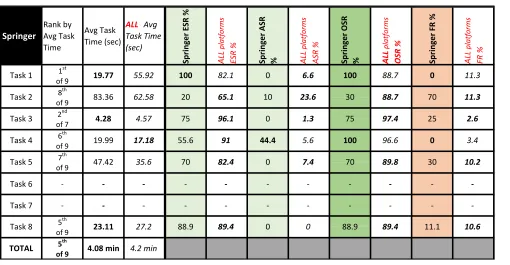
Springer Link produced its highest OSR on Tasks 1 and 4, and its worst usability in Task 2, with a substantial 70% FR. For complete data on Springer Link’s success and failure rates, see table 9.
With respect to the average task completion time, Springer Link was highly competitive on Task 1 and Task 3, but ranked in the bottom half of platforms on Task 4, Task
5, and Task 2. Because Springer Link did not offer note or citation tools at the time of testing, Tasks 6 and 7 were null.
Despite landing in the top quartile of completion times for two tasks, Springer Link fell into the low middle rank-ings for all others. For Task 2, Springer Link produced the second-worst FR percentage for any task among all plat-forms. The platform did not have a full book citation feature or a note feature at the time of testing and incurred 21 null values in total. When adjusted to account for null values, the overall average time increased by 27.06% from 3.21 to 4.08 minutes, thereby moving the platform down from fourth to fifth place among all nine platforms.
JSTOR
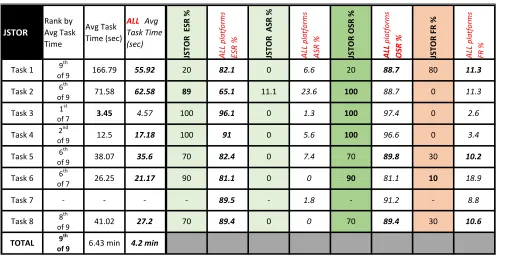
JSTOR achieved 100% OSR on Tasks 2, 3 and 4. JSTOR’s highest FR occurred in Task 1 (80%). For complete data on JSTOR’s success and failure rates, see table 10.
When comparing average task completion times, JSTOR produced a first-place ranking amongst all platforms on Task 3 and a second-place ranking for Task 4, although both tasks produced relatively small completion times overall. Con-versely, JSTOR also produced the second-slowest completion time on Task 8 and the slowest for Task 1, which is almost 3 times the overall average. Due to JSTOR not offering a note-taking feature at the time of testing, Task 7 was null.
In addition to generating the most Failure Rates of ≥30% (three tasks), JSTOR’s Task 1 FR of 80% came in as the worst FR for any task among all platforms. Furthermore, outside of placing first (Task 3) and second (Task 4), the platform did not manage to place higher than sixth for average comple-tion time rankings on any other task. The platform did not
IGI
Rank by Avg Task Time
Avg Task Time (sec)
ALL Avg Task Time (sec)
IG
I E
SR
%
ALL
platforms
ES
R %
IGI ASR % ALL
platforms
A
SR
%
IGI OSR % ALL
platforms
OSR % IGI F
R %
ALL
platforms
FR %
5th
of 9 9th
of 9 5th
of 7 1st
of 9 9th
of 9 1st
of 7
Task 7 - - - - - - - - - -
-6th of 9
7th of 9
-Task 1 38.69 55.92 100 82.1 11.3
Task 2 94.07 62.58 40 65.1 40 23.6 80 88.7 20 11.3
- 6.6 100 88.7
-Task 3 4.77 4.57 100 96.1 2.6
Task 4 8.22 17.18 100 91 - 5.6 100 96.6 - 3.4
- 1.3 100 97.4
30
Task 5 65.61 35.6 60 82.4 10.2
Task 6 10.2 21.17 100 81.1 - 0 100 81.1 - 18.9
10 7.4 70 89.8
20
Task 8 23.49 27.2 80 89.4 10.6
TOTAL 4.52 min 4.2 min
have a note feature at the time of testing and incurred 11 null values in total. When adjusted to account for null values, the overall average time increased by 9.07% from 5.89 to 6.43 minutes, ranking last.
Follow-Up Questions
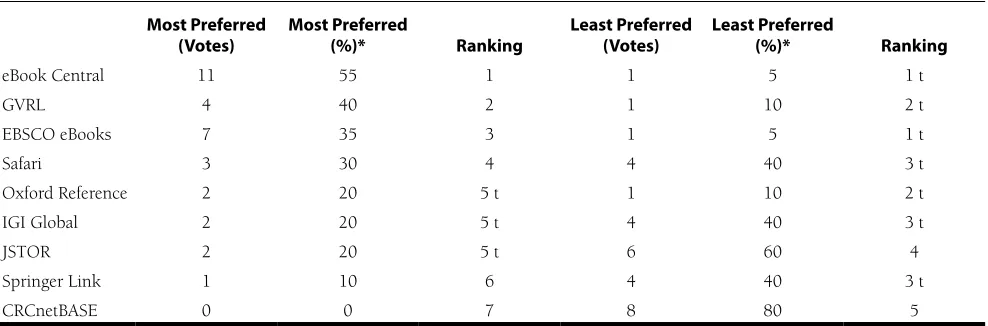
Following each test, the participant responded to follow-up questions regarding which platform they liked most and least, their past experience with the platforms tested, and their expectations regarding likely future use. Table 11 sum-marizes the key quantitative results; the Discussion section
CRC
Rank by Avg Task Time
Avg Task Time (sec)
ALL Avg Task Time (sec)
CRC ESR % ALL
platforms
ESR % CRC ASR % ALL
platforms
A
SR
%
CRC OSR % ALL
platforms
OSR % CRC FR % ALL
platforms
FR %
7th
of 9 5th
of 9 6th
of 7 5th
of 9 2nd
of 9 5th
of 7
Task 7 - - -
-9th
of 9
6th of 9
0
Task 1 47.54 55.92 80 82.1 11.3
Task 2 70.01 62.58 70 65.1 20 23.6 90 88.7 10 11.3
20 6.6 100 88.7
0
Task 3 4.77 4.57 100 96.1 2.6
Task 4 16.7 17.18 100 91 - 5.6 100 96.6 0 3.4
- 1.3 100 97.4
10
Task 5 21.7 35.6 90 82.4 10.2
Task 6 25.03 21.17 90 81.1 - 0 90 81.1 10 18.9
- 7.4 90 89.8
10
Task 8 57.57 27.2 90 89.4 10.6
TOTAL 4.49 min 4.2 min
- 0 90 89.4
Springer
Rank by Avg Task Time
Avg Task Time (sec)
ALL Avg Task Time (sec)
Springer ESR % ALL
platforms
ESR % Springer ASR % ALL
platforms
A
SR
%
Springer OSR % ALL
platforms
OSR % Springer FR % ALL
platforms
FR %
1st
of 9 8th
of 9 2nd
of 7 6th
of 9 7th
of 9
Task 6 - - - - - - - - - -
-Task 7 - - - - - - - - - -
-5th
of 9
5th of 9
10 23.6 30 88.7
44.4 5.6 100 96.6
0 6.6 100 88.7 0 11.3
83.36 62.58 20 65.1
Task 1 19.77 55.92 100 82.1
55.6 91
70 11.3
Task 3 4.28 4.57 75 96.1 0 1.3 75 97.4 25 2.6
Task 2
0 3.4
Task 5 47.42 35.6 70 82.4 0 7.4 70 89.8 30 10.2
Task 4 19.99 17.18
11.1
Task 8 23.11 27.2 88.9 89.4 10.6
TOTAL 4.08 min 4.2 min
0 0 88.9 89.4 Table 8. CRCnetBASE Performance Compared to All-Platform Averages
more fully addresses qualitative data from participant com-ments.
DISCUSSION
Table 12 lists the shorthand phrases that will be used in this section to refer to testing tasks.
EBSCO eBooks
Despite being unable to generate a top completion time in any task, EBSCO eBooks produced 100% ESR for three tasks (Next Page, Next Chapter/Entry, and Search Term), and only on one task did it produce an ESR below 90% (Task 2, Go To Page 50). When asked to navigate to page 50 of a selected e-book, more than 40% of participants elected to scroll through the e-book’s pages instead of taking advantage of the platform’s direct page navigation feature. Although this result did generate a higher ASR than any other platform on this task, the difference between the average completion times for Efficient Success and Alternate Success methods was only four seconds. This demonstrated to the research-ers that while EBSCO eBooks’ direct page navigation tool may have not been easily noticed, the platform was able to compensate for this by providing a layout that participants were able to navigate relatively easily. Additionally, on Task 7 (Notes Tool), EBSCO eBooks generated a 100% Over-all Success Rate, and of the 20 participants tested for this task, only one was unable to produce an Efficient Success. The researchers found EBSCO eBooks’ resounding success in this area particularly surprising when compared to the
study by Tovstiadi, Wiersma, and Tingle, in which less than 25% of testers were able to locate the notes tool within the platform.23
This ease of navigation did not always translate into top-ranking completion times, however, as EBSCO eBooks produced times for Next Page and Find Another E-Book tasks which ranked in the bottom-third among all platforms. Additionally, despite high success rates overall, some par-ticipants occasionally had difficulty completing certain other tasks on the platform. For example, when attempting to perform a search within the book (Task 5), one partici-pant commented, “I don’t immediately see a search button,” and another commented, “That was a little hard to find.” EBSCO eBooks excelled at conveying when an e-book was in use (95% ESR; see figure 1). The researchers believe this capabil-ity is increasingly important as platforms and acquisitions methods proliferate, forcing patrons to interpret limited concurrent access to some electronic resources.
In post-testing follow up questions, all participants were asked to select the platform they preferred most and least from the sample of platforms included in their particular testing session. Since not all platforms were tested an equal number of times (e.g., aggregator platforms were tested 20 times each, with all other platforms being tested 10 times each), the discussion of post-testing results for all platforms henceforth use percentages calculated from the number of participants who actually tested the platform. For exam-ple, if a participant did not test a particular platform and consequently did not select that platform as their favorite platform, it would not count against the platform as a non-selection, nor would it be reflected in the reported percent-age of selections that platform earned within the category
JSTOR
Rank by Avg Task Time
Avg Task Time (sec)
ALL Avg Task Time (sec)
JSTOR ESR % ALL
platforms
ESR % JSTOR ASR % ALL
platforms
A
SR
%
JSTOR OSR % ALL
platforms
OSR % JSTOR FR % ALL
platforms
FR
%
9th
of 9 6th of 9 1st
of 7 2nd of 9 6th
of 9 6th of 7
Task 7 - - - - 89.5 - 1.8 - 91.2 - 8.8
8th
of 9
9th of 9
10.6
TOTAL 6.43 min 4.2 min
0 0 70 89.4 30
Task 8 41.02 27.2 70 89.4
10.2
Task 6 26.25 21.17 90 81.1 0 0 90 81.1 10 18.9
0 7.4 70 89.8 30
Task 5 38.07 35.6 70 82.4
2.6
Task 4 12.5 17.18 100 91 0 5.6 100 96.6 0 3.4
0 1.3 100 97.4 0
Task 3 3.45 4.57 100 96.1
11.3
Task 2 71.58 62.58 89 65.1 11.1 23.6 100 88.7 0 11.3
0 6.6 20 88.7 80
of favorite platform. Participants selected EBSCO eBooks as their favorite platform seven times (35%, third place). Comments in favor of the platform included, “Simple! Had everything I was looking for right there,” and, “It had easy and very specific navigation. [Using] words, instead of symbols, made it superior to [EBook Central].” Participants chose the platform as their least preferred e-book platform only once (5%, tied for first place); however, when this participant was asked to elaborate on what they did not like about the platform, one of the details mentioned was the lack of a citation tool. This led the researchers to believe that this tester may have confused EBSCO eBooks with another platform that did not offer this particular feature.
EBook Central
While Task 9 was only tested by the two aggregator platforms and was not timed, EBook Central’s Failure Rate of 44.4% for this task was almost 9 times higher than the compet-ing platform (5%). Nonetheless, EBook Central generated 100% ESR in more than half of all tasks, and produced a top-ranked completion time on one task (Task 7; Note Tool).
EBook Central tied for the most ESR scores, with 100% rates on Task 1 (Find E-Book), Task 3 (Next Page), Task 5 (Search Term), Task 7, and Task 8 (Find Another E-Book). Additionally, EBook Central was one of only two platforms to generate a 100% OSR on Task 7.
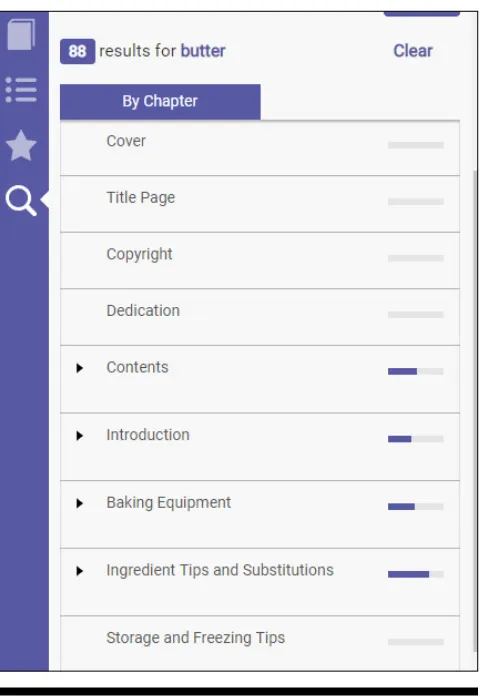
On average, EBook Central participants successfully searched terms within the specified e-book 31.3% faster than the average produced across all other platforms. However, on at least seven occasions, participants expressed difficulty navigating the results of those searches; the results, which were displayed via bars demonstrating the count of the searched term in each chapter, obscured the actual matched text until clicked upon (see figure 1). One tester asked, “Is it supposed to highlight it when I search?,” and another stated, “This doesn’t make any sense. What I’m used to is it popping up the specific [results], not all this extra information.” The majority of the patrons who experienced uncertainty with the search term results did eventually decipher the structure, but sev-eral ultimately moved on without indicating understanding of the arrangement.
Additionally, EBook Central participants were able to search and locate specified e-books 52% faster than the Table 11. Most and Least Preferred Platforms
Most Preferred
(Votes) Most Preferred (%)* Ranking Least Preferred (Votes) Least Preferred (%)* Ranking
eBook Central 11 55 1 1 5 1 t
GVRL 4 40 2 1 10 2 t
EBSCO eBooks 7 35 3 1 5 1 t
Safari 3 30 4 4 40 3 t
Oxford Reference 2 20 5 t 1 10 2 t
IGI Global 2 20 5 t 4 40 3 t
JSTOR 2 20 5 t 6 60 4
Springer Link 1 10 6 4 40 3 t
CRCnetBASE 0 0 7 8 80 5
* Due to the variance in total number of tests conducted for each platform, the researchers elected to rank platform preference by percentage of vote type, and not by total number of votes received for each category
Table 12. Shorthand Phrases to Represent Testing Tasks
Task Shorthand
Task 1, Find specified e-book title Find E-Book
Task 2, Navigate to Page 50 Go To Page 50
Task 3, Go to the Next Page Next Page
Task 4, Go to the Next Chapter Next Chapter/Entry
Task 5, Search for provided term within the e-book Search Term
Task 6, Find a citation for the e-book Citation Tool
Task 7, Save a Note in this e-book Note Tool
Task 8, Find another e-book title Find Another E-Book
average time across all other platforms, and were able to locate the note tool 34.43% faster than the second highest ranked platform (EBSCO) on average. Participants praised the visibility of the note tool with comments such as, “This one gives you a highlighter, a notes box, and a bookmark. I like that,” and “It’s pretty easy to tell because it’s a little empty page, and it’s right next to the highlighter [icon].” This intuitiveness may in part have con-tributed to the platform’s top completion time.
EBook Central generated very few failed tasks overall, but the citation tool task (Task 6) produced the platform’s highest number of failures (3 total) and lowest OSR (83.3%), contributing to the average task time ranking of fourth out of 7. Most of the issues EBook Central experienced with this task appeared to relate to the use of a quotation mark icon,
which participants did not notice or locate intuitively. Icons for citation tools on other platforms were accompanied by explanatory text, such as “Get Citation” or similar, which did not require hovering over the icon; this may have proved advantageous, since participants rarely hovered over the Ebook Central icon long enough for pop-up text to appear.
EBook Central tied for the fewest number of least-preferred platform votes among all participants (1 vote, 5%), and took top ranking with 11 participants (55%) indicating it as their favorite platform. This mirrored its selection as the most preferred platform among those tested in the study by Tovstiadi, Wiersma, and Tingle.24 Participant comments pertaining to the platform were predominately positive; however, the platform did garner several comments imply-ing there may still exists room to improve certain areas. When expounding upon dislikes, one tester noted, “It has to do with it being too busy. It can almost [become] overwhelming with the amount of data that comes up on the screen.” Other par-ticipants conveyed contrary sentiments, however, with one tester stating, “Everything was just so clear, and everything was where I thought it should be. All of the notes and citations were above [the text], and the search bar was really clear on the side.” Among those testers who favored EBook Central, nearly all expressed being pleased with the platform’s ease of naviga-tion and intuitiveness.
Gale Virtual Reference Library (GVRL)
GVRL generated a completion time in the top quartile for only Task 6; most results were in the low middle of the aver-age task time rankings. GVRL was one of only three plat-forms that failed to achieve a 100% Overall Success Rate for Task 1 (Find E-Book), tying for the second worst OSR with Oxford Reference. Despite GVRL generating only a 40%
Efficient Success Rate to Oxford Reference’s 70% on Task 1, Gale users were able to complete this task nearly twice as quickly (40.68 seconds versus 106.48 seconds). GVRL’s generated the second highest failure rate (20%) on Task 4, making it one of only two platforms to produce a less than perfect score on this task. This may have been due to a high number of participants misunderstanding what “Next Entry” meant, as indicated by the five Null values generated for this task.
GVRL was only able to achieve a 100% OSR on one of six tasks (Task 5—Search Term). When compared to the other platforms that generated a 100% OSR on this task, GVRL produced completion times that were 48.58% slower on average. One tester correctly located the search tool; however, even after locating it, she remained uncertain as to whether it was the correct location to generate a search. The platform’s worst result may have been produced in Task 7 (Note Tool), where it produced a 30% Failure Rate (highest among all platforms), and a completion time that was nearly 20% slower than the average completion time (35.97 seconds versus 29.98). Several participants commented that the tool was unintuitive to use. One participant managed to find the notes tool, but was unable to figure out how to use it. Another participant was able to locate the tool, but was not certain whether her notes would be saved upon leaving the e-book.
Despite GVRL struggling on most tasks, four participants (40%) selected it as their favorite platform, making it the second most popular; only one participant (10%, tied for second) selected it as their least favorite. The researchers’ notes regarding these selections included participant com-ments favoring the platform’s presentation of search results, ease of navigation, and visibility of its tools.
Oxford Reference
Although Oxford Reference ranked in the bottom third for completion times on many tasks—bringing in the lowest ranking on two of seven tasks—it achieved second place on Task 8, demonstrating successful usability in open search-ing that was perhaps not seen in known-item searchsearch-ing (Tasks 1 and 5) or navigating within an e-book (Tasks 1, 2, 3, and 4).
The researchers believe Oxford Reference’s higher suc-cess rate in Task 8 (Find Another E-Book) had much to do with its engaging landing page, which made identifying new e-books a more intuitive process for participants. Con-versely, Oxford Reference’s poor performance on other tasks highlighted a disconnect between form and function. Several participants commented on Oxford Reference’s welcom-ing aesthetics the start of testwelcom-ing sessions; however, many participants experienced difficulty and confusion when completing tasks such as navigating to the next chapter of an e-book (Task 4) or locating the citation tool (Task 6). The researchers observed that the platform failed to translate its approachable design into a user-friendly experience. This was most apparent from the average task completion times for Task 4. While all other platforms averaged 17.18 seconds
to complete navigating to the Next Entry, Oxford Reference testers took over 44% longer (24.91 seconds).
Not only did Oxford Reference generate the slowest completion time for Task 4, but it also generated the low-est Overall Success Rate (71.4%), and highlow-est Failure Rate (28.6%). Similar issues were observed on Task 6 (Citation Tool) and Task 7 (Note Tool), where Oxford Reference comple-tion times were 71.6% and 57.8% slower than the average completion times. For both of these tasks, Oxford Reference produced the second highest Failure Rate, as well as the lowest OSR for Task 6 and the second lowest OSR for Task 7. Oxford Reference’s struggle with the citation tool con-trasted with the success of the citation tools on many other platforms, not only in the present study but also in the study by Tovstiadi, Wiersma, and Tingle, which found that most students (more than 50%) “found citation tools easily.”25 Oxford Reference produced better OSR on other tasks, such as Task 5 (100%), and Task 1 (80%), but struggled with a poor average completion time in the initial task of finding the specified E-Book (106.48 seconds vs. 49.87 for all plat-forms, or 90% longer), which could have given participants a frustrating first impression.
Despite Oxford Reference’s overall below-average perfor-mance, the platform generated only one vote for least favorite platform (10%, tied for second place). However, it also earned only two votes for most favorite platform (20%, tied for fifth place). Of those participants who favored the platform, one indicated preferring the platform due to “knowing how to do everything on it,” while another tester expressed oppo-site feelings, stating, “I would probably kick [Oxford Reference] to the curb, which is interesting because most of Oxford’s stuff I usually like.”
Safari
Safari took the top completion time in two tasks (Go To Page 50 and Find Another E-Book), earned second place on Task 1 (Find E-Book), and third place for Task 4 (Next Chapter/Entry), but only generated an eighth place finish on Task 5 (Search Term). At the time of testing, only six of the eight tasks could be tested on the Safari platform; thus, the results included a fairly high number of null values (22 total) due to the lack of testable features.
Safari tied for the most 100% Efficient Success Rates (Tasks 1–4, and 8), and produced 90% ESR ratings for the remaining task (Task 5). Impressive to the researchers, Safari was the only platform to have only one task (Task 5; 10%) generate any failures. In contrast, IGI Global, EBSCO eBooks, and EBook Central all had three tasks generate at least one failure.