Ames Laboratory Accepted Manuscripts
Ames Laboratory
5-1-2018
Using first-principles calculations to screen for
fragile magnetism: Case study of LaCrGe 3 and
LaCrSb 3
Manh Cuong Nguyen
Ames Laboratory, [email protected]
Valentin Taufour
University of California, Davis
Sergey L. Bud’ko
Iowa State University and Ames Laboratory, [email protected]
Paul C. Canfield
Iowa State University and Ames Laboratory, [email protected]
Vladimir P. Antropov
Ames Laboratory, [email protected]
See next page for additional authors
Follow this and additional works at:
https://lib.dr.iastate.edu/ameslab_manuscripts
Part of the
Condensed Matter Physics Commons
, and the
Materials Science and Engineering
Commons
This Article is brought to you for free and open access by the Ames Laboratory at Iowa State University Digital Repository. It has been accepted for inclusion in Ames Laboratory Accepted Manuscripts by an authorized administrator of Iowa State University Digital Repository. For more information, please [email protected].
Recommended Citation
Nguyen, Manh Cuong; Taufour, Valentin; Bud’ko, Sergey L.; Canfield, Paul C.; Antropov, Vladimir P.; Wang, Cai-Zhuang; and Ho, Kai-Ming, "Using first-principles calculations to screen for fragile magnetism: Case study of LaCrGe 3 and LaCrSb 3" (2018).Ames Laboratory Accepted Manuscripts. 167.
Using first-principles calculations to screen for fragile magnetism: Case
study of LaCrGe 3 and LaCrSb 3
Abstract
In this paper, we present a coupled experimental/theoretical investigation of pressure effect on the
ferromagnetism of LaCrGe3 and LaCrSb3 compounds. The magnetic, electronic, elastic, and mechanical
properties of LaCrGe3 and LaCrSb3 at ambient condition are studied by first-principles density-functional
theory calculations. The pressure dependences of the magnetic properties of LaCrGe3 and LaCrSb3 are also
investigated. The ferromagnetism in LaCrGe3 is rather fragile, with a ferro- to paramagnetic transition at a
relatively small pressure (around 7 GPa from our calculations, and 2 GPa in experiments). The key parameter
controlling the magnetic properties of LaCrGe3 is found to be the proximity of the peak of Cr density of
states to the Fermi level, a proximity that is strongly correlated with the distance between Cr atoms along the c
axis, suggesting that there would be a simple way to suppress magnetism in systems with one-dimensional
arrangement of magnetic atoms. By contrast, the ferromagnetism in LaCrSb3 is not fragile. Our theoretical
results are consistent with our experimental results and demonstrate the feasibility of using first-principles
calculations to aid experimental explorations in screening for materials with fragile magnetism.
Disciplines
Condensed Matter Physics | Materials Science and Engineering | Physics
Authors
Manh Cuong Nguyen, Valentin Taufour, Sergey L. Bud’ko, Paul C. Canfield, Vladimir P. Antropov,
Cai-Zhuang Wang, and Kai-Ming Ho
PHYSICAL REVIEW B
97
, 184401 (2018)
Using first-principles calculations to screen for fragile magnetism:
Case study of LaCrGe
3and LaCrSb
3Manh Cuong Nguyen,1,*Valentin Taufour,1,2Sergey L. Bud’ko,1,3Paul C. Canfield,1,3Vladimir P. Antropov,1
Cai-Zhuang Wang,1and Kai-Ming Ho1,3
1Ames Laboratory – U.S. Department of Energy, Iowa State University, Ames, Iowa 50011, USA 2Department of Physics, University of California Davis, Davis, California 95616, USA 3Department of Physics and Astronomy, Iowa State University, Ames, Iowa 50011, USA
(Received 19 November 2017; revised manuscript received 29 March 2018; published 2 May 2018)
In this paper, we present a coupled experimental/theoretical investigation of pressure effect on the ferromag-netism of LaCrGe3and LaCrSb3 compounds. The magnetic, electronic, elastic, and mechanical properties of
LaCrGe3and LaCrSb3at ambient condition are studied by first-principles density-functional theory calculations.
The pressure dependences of the magnetic properties of LaCrGe3 and LaCrSb3 are also investigated. The
ferromagnetism in LaCrGe3is rather fragile, with a ferro- to paramagnetic transition at a relatively small pressure
(around 7 GPa from our calculations, and 2 GPa in experiments). The key parameter controlling the magnetic properties of LaCrGe3is found to be the proximity of the peak of Cr density of states to the Fermi level, a proximity
that is strongly correlated with the distance between Cr atoms along thecaxis, suggesting that there would be a simple way to suppress magnetism in systems with one-dimensional arrangement of magnetic atoms. By contrast, the ferromagnetism in LaCrSb3is not fragile. Our theoretical results are consistent with our experimental results
and demonstrate the feasibility of using first-principles calculations to aid experimental explorations in screening for materials with fragile magnetism.
DOI:10.1103/PhysRevB.97.184401
I. INTRODUCTION
Suppression of a ferromagnetic magnetic transition to zero temperature is of great interest as it may lead to quantum criticality where exotic phenomena such as non-Fermi liquid or unconventional superconductivity may emerge [1–7]. The common methods used to suppress magnetism in ferromag-netic materials includes doping or substituting magferromag-netic ele-ment by other non- or very weak magnetic eleele-ment or applying external pressure [1–5]. Doping or substitution always involves defects or randomness in the distributions of dopants and substituents, making it very difficult to investigate the effects of doping/substitution on the physical properties of materials in both experimental and theoretical studies. In addition, the choices of non- or very weak magnetic dopants or substituents that do not change the crystallography of the material can be very limited or even inexistent. In contrast, external pressure is a thermodynamic parameter which is considered cleaner and can be applied to any material. Recent examples in the family of Fe-based superconductors showed that the effect of pressure on magnetism can be very similar to the effect of chemical substitutions [8–12]. This makes external pressure a very promising controlling parameter to tune physical properties of materials. For practical reasons, small or intermediate pressures are more favorable than high and ultrahigh pressure, since high and ultrahigh pressure is difficult to handle by experiment, often are not hydrostatic and hard to model, and also can induce structural transformation. A theoretical
screening tool to classify whether the magnetism in a material is fragile or not under pressure will be very helpful for efficient experiment explorations [4].
In this work, we demonstrate that first-principles calcu-lations can be used as a tool to identify compounds with fragile magnetism by comparing two compounds LaCrGe3and LaCrSb3with different crystal structures (Fig.1). LaCrGe3has a hexagonal crystal structure withP63/mmcsymmetry (space group No. 194) andZ =2 formula units (f.u.) in the unit cell. LaCrSb3has an orthorhombic structure withPbcmsymmetry (space group No. 57) andZ=4 f.u.in the unit cell. Cr in both structures is coordinated by 6 Ge or Sb. Whereas the 6 coordi-nating Ge of Cr in LaCrGe3form a regular octahedron, the octa-hedron formed by 6 coordinating Sb of Cr in LaCrSb3is heavily distorted. The Cr–Sb bond is almost the same for 6 coordinating Sb, with less than 0.01 ˚A differences, but the Sb–Cr–Sb bond-ing angles are spread out largely from 80 to 130◦ with bond angle varianceσ2=90.6. Another difference between these two systems is in the dimensionality of the arrangement of Cr atoms. In LaCrGe3, CrGe6octahedra form a one-dimensional line along lattice vectorc. The CrSb6 octahedra in LaCrSb3 form wiggling planes perpendicular to lattice vectora.
At ambient conditions, LaCrGe3 shows a ferromagnetic (FM) ground-state structure with magnetization aligned along the lattice vector c. LaCrSb3 was observed to have a non-collinear magnetic configuration at low temperature [13]. There are a high moment FM coupling along the lattice vector b and a small moment antiferromagnetic (AFM) coupling along the lattice vectorc. The magnetic moment of the FM sublattice is 1.65μB/f.u. and that of the AFM sublattice is 0.49μB/f.u.[13]. There have been several theoretical works
MANH CUONG NGUYENet al. PHYSICAL REVIEW B97, 184401 (2018)
FIG. 1. Atomic structure of (a) LaCrGe3and (b) LaCrSb3. Some atoms in both structures and unit cells of LaCrSb3are repeated to show
the one- and two-dimensional features of Cr in LaCrGe3and LaCrSb3, respectively.
on LaCrGe3and LaCrSb3based on density functional theory [14–18], where all of them focused on electronic and magnetic properties of materials at ambient pressure.
Our first-principles calculations show that at ambient pres-sure LaCrGe3 is a simple FM and LaCrSb3 exhibits a non-collinear magnetic configuration, consistent with the experi-mental reports. Both systems are mechanically stable and quite compressible (especially LaCrSb3) in comparison with typical metals. In the pressure dependence investigation, we first take only FM and nonmagnetic (NM) phases into consideration identifying the magnetism in LaCrGe3as fragile in comparison with that of LaCrSb3. The key controlling parameter to the magnetic properties of LaCrGe3under pressure is the distance between Cr atoms so the effects of hydrostatic and uniaxial pressures on magnetic moment are very similar.
II. COMPUTATIONAL AND EXPERIMENTAL METHODS
The first-principles spin-polarized density functional theory (DFT) [19] calculations are performed using the plane-wave basis Vienna Ab Initio Simulation Package (VASP) [20] with the projector-augmented wave pseudopotential method [21,22] within the local density approximation parameter by Perdew and Zunger [23,24]. The energy cutoff is 450 eV and the Monkhorst-Pack scheme [25] is used for Brillouin-zone sam-pling. A densek-point grid of 2π×0.025 ˚A−1 is used in all calculations, except for density of states (DOS) calculations where a 1.5 times denser k-point mesh is used for accurate DOS. All structures are fully relaxed until the forces acting on each atom are smaller than 0.01 eV/A and pressures are˚ smaller than 0.1 GPa. The energy convergence criterion is 10−5eV. The total enthalpy is calculated asH =E+P V, where E is the total energy,P is the external pressure, and
V is the system volume. The noncollinear spin-polarization and spin-orbit coupling (SOC) interaction [26] are included in some calculations for LaCrSb3 at ambient pressure where noted. All other calculations are collinear spin-polarized with-out spin-orbit coupling except where it is clearly indicated. In our experiment, single crystals of LaCrGe3 and LaCrSb3 were grown from solutions as reported in Refs. [2,3,5,27]. The magnetization measurements under pressure were performed using a moissanite anvil cell [28]. Daphne 7474 was used as a pressure medium [29], and the pressure was determined at 77 K by the ruby fluorescence technique [30].
III. RESULTS AND DISCUSSION
A. Physical properties of LaCrGe3and LaCrSb3
at ambient condition
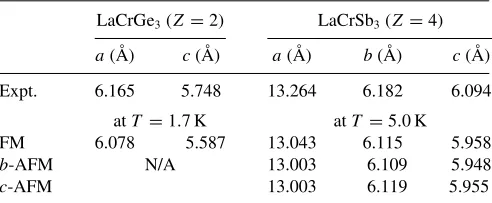
We first discuss the structural and magnetic properties of LaCrGe3and LaCrSb3at ambient conditions. In our calcula-tions, FM, NM, and different AFM structures are studied in order to verify the experimentally observed ground structures. Specifically, for LaCrGe3, we consider AFM structure along thecaxis. For LaCrSb3both AFM along thebaxis (b-AFM) and c axis (c-AFM) structures are considered. We list the lattice parameters of LaCrGe3 and LaCrSb3 in all magnetic structures as well as from experiment and previous calculations in TableI. Our calculations confirm that the FM structure is the most stable one for both LaCrGe3 and LaCrSb3. In the LaCrGe3system, the FM structure is−34.9 meV/f.u.lower in energy than the NM structure, which is consistent with previous calculation [18]. The AFM structure cannot be stabilized and it converged to a NM structure in our calculation. For LaCrSb3 within collinear magnetism without SOC interaction, the FM structure is−48.3,−46.4 and−101.2 meV/f.u.lower in en-ergy than theb-AFM,c-AFM, and NM structures, respectively, consistent with experiment and previous calculation [14]. We note that a previous calculation by Choiet al.[15] predicted that the FM phase is a metastable structure. Their calculations showed thatc-AFM is more stable than bothb-AFM and FM structures.
As one can see from Table I, the local-density approxi-mation (LDA) calculated lattice parameters of FM LaCrGe3 are slightly smaller than those from experiment at 1.7 K [31],
TABLE I. Lattice parameters from experiment and calculations (T =0 K) for different magnetic configurations of LaCrGe3 and
LaCrSb3.
LaCrGe3(Z=2) LaCrSb3(Z=4)
a( ˚A) c( ˚A) a( ˚A) b( ˚A) c( ˚A)
Expt. 6.165 5.748 13.264 6.182 6.094
atT =1.7 K atT =5.0 K FM 6.078 5.587 13.043 6.115 5.958
b-AFM N/A 13.003 6.109 5.948
c-AFM 13.003 6.119 5.955
[image:4.608.314.560.648.750.2]USING FIRST-PRINCIPLES CALCULATIONS TO SCREEN … PHYSICAL REVIEW B97, 184401 (2018)
TABLE II. Magnetic moment of Cr atom (μB) and total magnetic moment of LaCrGe3(μB/f.u.) and LaCrSb3from current (within LDA,
LDA with experimental lattice constant, and LDA+SOC) and previous calculations. The methods used in previous calculations are also shown.
LaCrGe3 LaCrSb3
MCr Mtot MCr Mtot
Expt. 1.22∼1.25 1.61∼1.72
This work LDA 1.17 1.09 1.65 1.55
LDA expt. latt. 1.28 1.16 1.91 1.80
LDA+SOC 1.20 1.12 1.70 1.55
Previous works 1.30 (TB–LMTO)a 2.81b,c 2.39c(LMTO)
(LMTO) 2.10d(FPLO)
aReference [18]. bReference [14]. cReference [15]. dReference [16].
1.4% and 2.8% smaller fora andcparameters, respectively. The results are similar for LaCrSb3 where LDA slightly un-derestimates the FM lattice parameters, within 2.2% difference from experiment at 5 K [32]. We note that DFT calculations are at 0 K but the thermal expansion effect on the lattice parameter comparison should be negligible as experimental data are collected at very low temperature as mentioned above. All previous theoretical work on LaCrSb3used experimental lattice parameters [15–17] so there are no other DFT relaxed lattice parameters to compare with our results. LaCrGe3 has been synthesized in experiment recently so, apart from our work [5], there is only one theoretical work on LaCrGe3[18], which also used experimental lattice parameters.
TableIIshows the magnetic moment of Cr atom in LaCrGe3 and LaCrSb3from experiment [2,3,13,31,33], our calculations, and previously available calculations. Previous calculations were performed by linear muffin-tin orbital (LMTO) band method [15], tight-binding LMTO [18], or full-potential local-orbital (FPLO) method [16]. In our calculations, the magnetic moment of Cr atom is 1.17μB in LaCrGe3 and 1.65μB in LaCrSb3. The magnetic moments of La and Ge/Sb are AFM coupled with those of Cr, so the total magnetic moment is slightly smaller than the magnetic moment of the Cr atom. From Table II we can see that magnetic moments are re-produced well in our LDA calculations for both LaCrGe3 and LaCrSb3. The total magnetic moments of LaCrGe3 and LaCrSb3are slightly underestimated in comparison with
ex-periment. Note that all previous calculations substantially overestimated the magnetic moment of LaCrSb3, especially for LMTO calculation. The large overestimation of Cr moment in LaCrSb3in LMTO calculations might be due to the choice of basis set and muffin-tin radii, as it is shown that different LMTO calculation settings [14,15] can give different relative stability between magnetic phases. For a better and direct comparison with previous studies, we also perform calculations with experimental lattice parameters. In this case the magnetic moment appears to be slightly larger in comparison with those of relaxed structures by LDA but still agrees well with the experiment. This enlargement of magnetic moment is directly related to the underestimation of lattice parameter of LDA. The difference between our calculations and previous ones, especially for LaCrSb3, could be due to implementations of LDA as mentioned above.
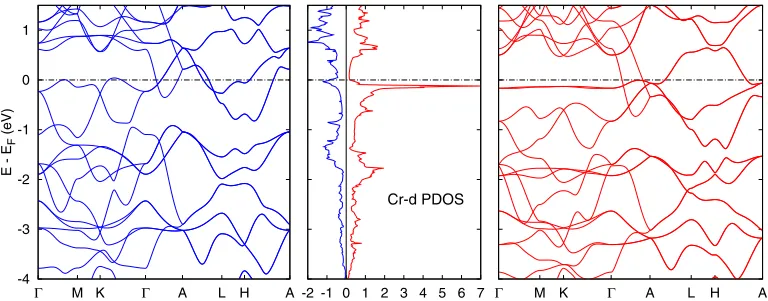
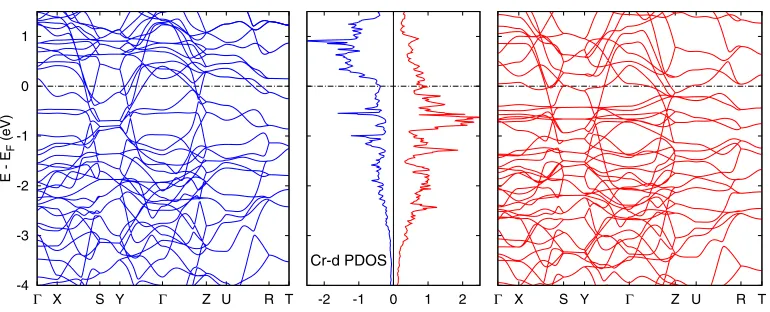
Figures 2 and 3 show band structures for majority and minority spin and projected density of states (PDOS) on Cr
dorbitals of FM LaCrGe3and FM LaCrSb3, respectively. The positive and negative DOS values are corresponding majority-and minority-spin PDOS. We find that the main contributions to the DOS near Fermi level are from Crdorbital in both systems. There are very strong Crdorbitals PDOS peaks just below the Fermi level in the majority-spin channel of LaCrGe3. The flat bands running through the-M-K-segment of majority-spin band structure are responsible for this strong peak. As will be seen later, the first occupied peak, count from Fermi level, of
-4 -3 -2 -1 0 1
Γ M K Γ A L H A
E - E
F
(eV)
-2 -1 0 1 2 3 4 5 6 7 Cr-d PDOS
Γ M K Γ A L H A
FIG. 2. Band structures of (left) minority- and (right) majority spin and (middle) DOS of Crdorbitals of LaCrGe3.
[image:5.608.113.497.584.735.2]MANH CUONG NGUYENet al. PHYSICAL REVIEW B97, 184401 (2018)
-4 -3 -2 -1 0 1
Γ X S Y Γ Z U R T
E - E
F
(eV)
-2 -1 0 1 2
Cr-d PDOS
[image:6.608.113.498.66.222.2]Γ X S Y Γ Z U R T
FIG. 3. Band structures of (left) minority- and (right) majority spin and (middle) DOS of Crdorbitals of LaCrSb3.
LaCrGe3, is much closer to Fermi level than that of LaCrSb3, and its proximity to the Fermi level is responsible for the magnetic fragility of LaCrGe3. The unoccupied minority spin bands at∼0.8 eV are also quite flat and they correspond to a PDOS peak in minority spin channel at∼0.8 eV above Fermi level. There is also a small DOS peak of Cr d orbitals in minority spin channel very close to Fermi level.
For LaCrSb3, the contribution from Crd orbitals is dom-inating for the first main peak from −0.4 to −0.8 eV of majority-spin DOS. There are very flat bands running through the -X-S-Y--Z segment of majority-spin band structure. These bands induce the peaks in majority-spin DOS around −0.4 and −0.6 eV. There are also quite flat band going through the-X-Sand-Zsegments of majority-spin band structure and they are responsible for peaks near −0.8 eV. The unoccupied minority-spin bands of these orbitals at∼0.9, ∼0.6, and ∼0.3 eV are also quite flat and pure as well and they are corresponding to DOS peaks in minority spin at∼0.9, ∼0.6 and∼0.3 eV above Fermi level.
As mentioned above, the neutron scattering experiment observed a noncollinear magnetic structure for LaCrSb3[13]. To investigate the effects of noncollinearity, we perform self-consistent noncollinear magnetic calculations in LDA, i.e., allowing the magnitude of magnetic moment in all directions (i.e.,x,y, andz) to change freely, for LaCrSb3with the above relaxed lattice parameters. Several calculations are performed independently with different initial magnetic moments to make sure we obtained the global stable state but not a local minimum. All symmetries are turned off for these calculations. Since La is a relatively heavy element, the SOC interaction is included in the noncollinear calculation. The obtained magnetic configuration for LaCrSb3consists of a FM sublattice along thebaxis and an AFM sublattice along thecaxis with a magnitude of Cr magnetic moment of 1.66 and 0.38μB/Cr for each sublattice, respectively, which is in very good agreement with experiment. Our analysis revealed that such a magnetic configuration is formed by the interplay between nearest- and next-nearest-neighbor Cr-Cr exchange interactions: a positive (FM) next-nearest-neighbor interaction in the (a,b) plane and a negative (AFM) nearest-neighbor interaction along thecaxis. This is somewhat similar to the spin reorientational transition mechanism in Invar systems proposed by Antropovet al.[34]. Thus, this frustration is a leading mechanism of magnetic struc-ture formation in this system. These results again show that
LDA as implemented inVASPcan describe the LaCrSb3system reasonably well. We also perform the noncollinear including SOC interaction calculation for LaCrGe3 to investigate the effect of SOC interaction on the magnetic moment of Cr. We find that magnetic moments of Cr are collinear and slightly enhanced from their value of 1.17μB in calculation without SOC interaction to 1.20μB. The obtained orbital moments of all atoms in LaCrGe3and LaCrSb3are practically zero.
There have been no investigations on elastic and mechanical properties of LaCrGe3and LaCrSb3. All previous work are on electronic and magnetic properties [14–18]. In this work, we also investigate elastic and mechanical properties of LaCrGe3 and LaCrSb3 in the thermodynamic ground states of FM. The elastic constants are calculated based on the stress-strain relationship approach [35]. The Voigt (subscript V) and Reuss (subscript R) bounds of bulk (B) and shear (G) moduli are calculated by the following formulas [36]:
BV=(1/9)[2(C11+C12)+4C13+C33],
GV=(1/30)(M+12C44+12C66),
BR =C2/M,
GR =(5/2)(C2C44C66)/[3BvC44C66+C2(C44+C66)],
where M=C11+C12+2C33−4C13 and C2=[(C 11+
C12)C33−2C2
13] for hexagonal LaCrGe3.
BV=(1/9)[C11+C22+C33+2(C12+C13+C23)],
GV=(1/15)[C11+C22+C33+3(C44+C55
+C66)−(C12+C13+C23)],
BR=/[C11(C22+C33−2C23)+C22(C33−2C13)
−2C33C12+C12(2C23−C12)+C13(2C12−C13) +C23(2C13−C23)],
GR=15/{4[C11(C22+C33+C23)+C22(C33+C13)
+C33C12−C12(C23+C12)−C13(C12+C13)
−C23(C13+C23)]/+3[(1/C44+1/C55+1/C66)]},
where =C13(C12C23−C13C22)+C23(C12C13−C23C11)+
C33(C11C22−C122) for orthorhombic LaCrSb3.
The arithmetic averaged values of bulk or shear moduli from Voigt and Reuss bounds are the corresponding Voigt-Reuss-Hill approximation of bulk or shear moduli, respectively.
USING FIRST-PRINCIPLES CALCULATIONS TO SCREEN … PHYSICAL REVIEW B97, 184401 (2018)
TABLE III. Elastic constants of LaCrGe3and LaCrSb3.
LaCrGe3(GPa) LaCrSb3(GPa)
C11 243.8 133.6
C12 64.9 41.5
C13 58.7 41.7
C22 243.8 163.9
C23 58.7 34.6
C33 204.9 170.0
C44 80.3 56.0
C55 80.3 55.6
C66 89.5 47.6
BV/BR 117.5/116.5 78.1/77.6
GV/GR 84.0/83.7 55.2/54.4
EH 203.1 113.1
Within Voigt-Reuss-Hill approximation, Young’s modulus (E) is calculated as
EH =9BHGH/(3BH +GH).
The results from our calculations for elastic constants and moduli of LaCrGe3 and LaCrSb3 are shown in TableIII. All moduli of LaCrSb3 are quite smaller than those of LaCrGe3. Comparing with other typical metals, moduli of LaCrSb3are comparable to those of Zn. The shear and Young’s moduli of LaCrGe3 are comparable to those of Co and Ni but its bulk modulus is only about two-thirds of those of Co and Ni. From elastic constants in Table III we can verify easily that both LaCrGr3and LaCrSb3are mechanically stables as their elastic constants obey the corresponding Born mechanical stability criteria [36,37]:
C44 >0, C11>|C12|, and (C11+2C12)C33>2C132
for hexagonal LaCrGe3or
Cii >0(i=1,6), [C11+C22+C33+2(C12+C13+C23)]
>0, (C11+ C22−2C12)>0, (C11+C32−2C13)>0
and (C22+C33−2C23)>0 for orthorhombic LaCrSb3.
B. Pressure dependence of magnetic moments
of LaCrGe3and LaCrSb3
We have also performed calculations to investigate the stability of FM phases of LaCrGe3and LaCrSb3under external pressure. The formation enthalpy differences between FM and NM phases of LaCrGe3 and LaCrSb3are shown as functions of external pressure in Fig. 4. We also show in this figure the pressure dependence of magnetic moments of Cr atom in LaCrGe3 and LaCrSb3. The FM phases of LaCrGe3 and LaCrSb3 are seen to be fully suppressed by pressures of about 7 and 30 GPa, respectively. The magnetic moment of Cr in LaCrGe3 is decreasing slightly with external pressure, within 10% from 1.17μB at ambient condition to 1.08μB at 6 GPa, before the NM phase becoming stable at 7 GPa. For LaCrSb3, when the external pressure is increasing, the magnetic moment of Cr is decreasing more rapidly, but the FM phase will transform to another lower-moment FM phase
−100 −80 −60 −40 −20 0
0 4 8 12 16 20 24 28
Δ
H (meV/f.u.)
P (GPa) 0.0
0.4 0.8 1.2 1.6
0 4 8 12 16 20 24 28
MCr
(
μB
)
LaCrGe3
LaCrSb3
0 40 80 120
0 1 2 3 4 5 6 Experiment Tc
(K)
P (GPa)
FIG. 4. Formation enthalpy differences between FM and NM phases and magnetic moment of Cr atom as functions of pressure for LaCrGe3and LaCrSb3. The inset shows the experimental results
for the dependence of LaCrGe3and LaCrSb3Tcon pressure [3,5].
before finally transforming to NM phase. The first transition pressure, from high- to low-moment FM, is 18 GPa and the second transition pressure, from low-moment FM to NM, is 30 GPa. The magnetic moment of the Cr atom in high-moment FM phase is decreasing with pressure and it is decreasing almost linearly. For low-moment FM phase of LaCrSb3, there is a very small bump in the formation enthalpy difference. It increases slightly first, then decreases with pressure. The formation enthalpy difference of LaCrSb3 at 19 GPa is −2 meV/f.u. and it has a dip of−4 meV/f.u.at 20 GPa (Fig.4). It should be noted that these small enthalpy differences are within the accuracy of DFT calculations. The magnetic moment of Cr atom in LaCrSb3 low-moment FM phase decreases slightly with external pressure between 19 and 29 GPa.
In the inset of Fig.4we also show the experiment results for the dependence of Curie temperature (Tc) of LaCrGe3 and LaCrSb3 on external pressure up to 6 GPa [3,5]. The experimental results show that the FM phase of LaCrGe3 becomes unstable at 2.2 GPa and there is no sign of magnetic transition in LaCrSb3up to 6.0 GPa, the high-pressure limit in our experiment. Our present theoretical calculation results are consistent with experiment that LaCrGe3is a fragile magnet where its ferromagnetism can be suppressed with small exter-nal pressure, whereas LaCrSb3is not fragile magnetically and requires a very high pressure to suppress its ferromagnetism. These results indicate that first-principles DFT calculation is able to predict the magnetic fragility of FM materials and it can be used to screen potential fragile FM compounds under external pressure to guide experiment explorations. However, we can see clearly an overestimation of the transition pressure from our calculation for LaCrGe3. We would like to note that phase-transition pressure from DFT calculation sometimes can be systematically off from the experimental value, but the trend of pressure-dependent phase transition usually can be well described. For example, the predicted structural transition pressure of Si from carbon diamond (Si-I) toβ-Sn (Si-II) phase is several GPa different from the experimental value, depend-ing on the exchange-correlation functional used [38,39]. But
[image:7.608.49.295.83.242.2]MANH CUONG NGUYENet al. PHYSICAL REVIEW B97, 184401 (2018)
the sequence of phase transitions, i.e., Si-I to Si-II to Si-V to Si-VI to Si-VII, from DFT calculations is consistent with experiment [38]. The DFT calculation, therefore, is expected to be able to predict well the magnetic phase transition sequence. The second possible source of the overestimation of transition pressure from our calculations is the appearance of various AFM phases, so the magnetic phase transition could be from FM phase to AFM [5] or even some noncollinear phase [34] instead of NM phase. This is due to possible importance of metallic spin fluctuations in such metals [40] especially near magnetic phase transition. However, in the current section, only FM and NM phases are taken into account. While the analysis of the DOS can be profitable for the discussion of FM-state stability, the possible presence of other magnetic states requires the knowledge of magnetic susceptibility at all wave vectors. In general, such analysis of magnetic susceptibility and the account of spin fluctuations can be important but it goes beyond the DFT treatment we employed in this paper. We plan to address this issue in our future publications. We also show later that for LaCrGe3, the appearance of AFM phases can lower the transition pressure. From Fig.4 we also observe that for LaCrGe3there is a correlation between magnetic moment and
Tcas both are decreasing with pressure. However, there seems to be no clear correlation between the magnetic moment and
Tc of LaCrSb3 under pressure. TheTc of LaCrSb3 is almost constant with pressure up to 6 GPa in experiment.
The Cr in LaCrGe3 forms a pseudo-1D structure along the c axis since the distance between Cr atoms along the
c axis is 2.79 ˚A, which is much smaller than the distance between Cr atoms in the basal plane (6.078 ˚A). This implies that the magnetic interaction between Cr atoms is mainly between Cr atoms along thecaxis, meaning that the magnetic properties of the LaCrGe3under hydrostatic pressure and that of hypothetically uniaxially strained LaCrGe3should be very similar as long as they have the same Cr-Cr distance along thecaxis. In other words, we would see very similar ordered Cr magnetic moments for these two systems. In order to verify this, we change the length of lattice vectorcmanually and fully relax the lattice vectorsaandband internal atomic coordinates of LaCrGe3 to calculate the magnetic moment of Cr. This simulation is equivalent to directional compression or uniaxial pressure experiment where the LaCrGe3system is compressed along the c axis. Thus, an experiment can be performed to verify our calculation prediction. The results of Cr magnetic moment of uniaxial pressure-compressed LaCrGe3 together with the results for LaCrGe3under hydrostatic pressure from the above calculations as functions of the distance between Cr atoms along the c axis are shown in Fig.5. In this figure, we also show the magnetic moment of Cr in LaCrGe3 under negative pressure to compare with that of Cr in LaCrGe3under directional elongation. It is interesting that the magnetic mo-ments of Cr in LaCrGe3under hydrostatic pressure fall almost perfectly on the magnetic moments curve of Cr in LaCrGe3 under directional compression/elongation, reconfirming that Cr in LaCrGe3is indeed essentially one dimensional in terms of the magnetic interaction.
These results show that for systems with one-dimensional magnetic moment bearing atoms the effects of hydrostatic and uniaxial pressures on magnetic properties could be very close.
0.0 0.4 0.8 1.2
2.65 2.70 2.75 2.80 2.85 2.90
MCr
(
μB
)
dCr−Cr (Å)
[image:8.608.313.559.56.155.2]Pressing c Pressure
FIG. 5. Magnetic moment of Cr as function of distance between Cr atom along thecaxis of LaCrGe3under hydrostatic pressure and
pressing along thecaxis. Diamond-marked point is for systems at ambient condition.
Therefore, uniaxial pressure can be used as another method to suppress magnetism in the systems with magnetic atoms arranged in one-dimensional fashion, although experimentally the range of accessible uniaxial pressures is significantly smaller than that of hydrostatic or quasihydrostatic pressures. The different exotic phenomena could be emerging from mag-netic materials with one-dimensional magmag-netic atoms when hydrostatic pressure or uniaxial pressure is applied.
In order to understand more physics of the transition from FM to NM phase of LaCrGe3under pressure, PDOS of Cr in LaCrGe3under different hydrostatic and uniaxial pressures are calculated. Figure6shows the Cr PDOS at ambient condition and under hydrostatic pressure of 6 and 7 GPa. The figure’s inset shows the Cr PDOS of LaCrGe3under uniaxial pressure along lattice vectorc. The Cr-Cr distances in LaCrGe3structure withc/c0=0.98 and 0.97 are very close to that of LaCrGe3 under hydrostatic pressure of 6 and 7 GPa, respectively, where
c0and c are the lengths of lattice vectorcat ambient condition and under uniaxial pressure. We can see clearly from Fig.6 that when LaCrGr3is more and more compressed under either hydrostatic or uniaxial pressure, the very high Cr PDOS peak, which is just below (about −0.15 eV) the Fermi level at ambient condition, is pushed closer and closer to the Fermi level. When this peak crosses the Fermi level, somewhere between 6 and 7 GPa or between c/c0=0.98 and 0.97, it introduces a peculiar instability to the FM phase due to very high DOS of one spin channel at Fermi level. This instability
FIG. 6. PDOS of Cr in LaCrGe3under hydrostatic pressure and
(in the inset) uniaxial pressure. PDOS of NM LaCrGe3at 7 GPa and
c/c0=0.97 are plotted as half positive and half negative for better
comparison.
[image:8.608.313.558.557.691.2]USING FIRST-PRINCIPLES CALCULATIONS TO SCREEN … PHYSICAL REVIEW B97, 184401 (2018)
0.0 0.4 0.8 1.2 1.6
3.70 3.75 3.80 3.85
(b)
MCr
(
μB
)
dNNNCr−Cr (Å)
Pressure 0.0
0.4 0.8 1.2 1.6
2.70 2.75 2.80 2.85 2.90 2.95 3.00
(a)
MCr
(
μB
)
dNNCr−Cr (Å)
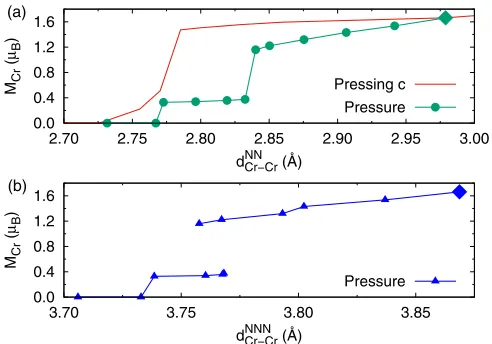
[image:9.608.50.296.70.242.2]Pressing c Pressure
FIG. 7. Magnetic moment of Cr as functions (a) NN and (b) NNN distance of Cr-Cr NN in LaCrSb3 under hydrostatic pressure and
pressing along thec axis. Diamond-marked points are for system at ambient condition.
will induce a magnetic or structural transition. We do not observe any structural transition as the symmetries are the same at 6 and 7 GPa and atc/c0=0.98 and 0.97. The magnetic phase transition could be from FM phase to a noncollinear magnetic, an AFM, or a NM phase. Since we do not consider noncollinear and AFM phases in this work, what kind of magnetic phase transition cannot be resolved precisely. However, the important observation here is that the FM phase is destabilized by the high Cr PDOS peak at Fermi level. Comparing Cr PDOS of LaCrGe3 at 6 and 7 GPa or between c/c0=0.98 and 0.97 in Fig.6, we can see a splitting of the strong Cr majority-spin PDOS peak into an unoccupied peak at about 0.20 eV and other two occupied peaks at about−0.50 and around−1.90 eV. We obtain a similar FM to NM transition picture in LaCrSb3for the first majority-spin PDOS center at∼−0.75 eV. Thus, the proximity of a strong DOS peak to Fermi level in LaCrGe3 makes the FM phase fragile and it may be used as an indicator for screening of ferromagnetic fragile materials.
At this point, one may ask whether LaCrSb3shows the same magnetic behavior under uniaxial and hydrostatic pressure as we observed in the LaCrGe3 system above. As can be seen from Fig.7(a), the magnetic moment of Cr in LaCrSb3 under hydrostatic pressure and that of LaCrSb3under uniaxial pressure are resolvedly different in terms of dependence on Cr-Cr distance along the c axis. This result is expected as we mentioned above that Cr in LaCrSb3 forms a pseudo-2D structure instead of 1D as that in LaCrGe3. For LaCrSb3 at ambient condition, the distance between Cr atoms along thec
axis [which is the Cr-Cr nearest neighbor (NN)] is 2.98 ˚A, while the nearest distance between Cr atoms in the (a, b) plane [which is the Cr-Cr next-NN (NNN)] is 3.93 ˚A, which is not much larger than the NN distance. Therefore, there is interplay between the NN and NNN Cr-Cr interactions. Under the hydrostatic pressure, both the Cr-Cr NN and NNN distances of FM LaCrSb3 would decrease with pressure, whereas the latter one is increasing as we apply uniaxial pressure along thecaxis on FM LaCrSb3in order to release stresses induced by compression of thecaxis. These differences in the Cr-Cr
NNN distances induce different behavior of the NNN Cr-Cr interactions and thus the magnetic moment of Cr. As can be seen in Fig. 7(a), the magnetic moments of Cr atom in hydrostatic and uniaxial pressure cases diverge from the starting point of ambient condition. A closer look at the change of Cr-Cr NN and NNN distances of LaCrSb3under hydrostatic pressure, shows there is an abrupt bump of the NNN distance at the transition from high-spin to low-spin state [Fig.7(b)], while the NN distance is decreasing monotonically with pressure. We do not observe any sudden opposite direction change of the Cr-Cr NNN distance in the uniaxial pressure case. These results imply that the bump of the Cr-Cr NNN distance could be responsible for stabilizing the low-spin state and a steplike behavior of magnetic moment of LaCrSb3 under hydrostatic pressure. Figure 7(b) also shows the coexistence of low (0.4μB) and high (1.2μB) spin ferromagnetic configurations near NNN distance∼3.77 ˚A and hysteretic type of behavior for magnetization. In this area more complex magnetic states may exist. A comparison of DOS of LaCrSb3at 20 GPa to that at 18 GPa shows that, apart from some minor differences in DOS profiles, the up- (down-) spin DOS is shifted to the right (left) of Fermi level, changing the occupation of each spin channel. This explains the calculated magnetic moment is lower in the higher-pressure FM phase.
Recently, further detailed investigations of resistivity and muons spin spectroscopy [5] on the pressure-phase diagram of LaCrGe3 found evidence for the appearance of modu-lated AFM phases. The appearance of the modumodu-lated AFM phases would lower the pressure with the FM phase being depressed since AFM phases could become more stable than the FM phase at lower pressure before the NM phase becomes stable. Indeed, as was shown in Ref. [5], AFM orders with small q vectors can become more stable than the FM phase and hence reduce the pressure at which the FM disappears. This demonstrates the possibility of an ideal integration between first-principles calculations and experi-ments: the calculations can identify which material is likely to show fragile magnetism; the experiments can discover unexpected phases which can then be considered in the calculations.
IV. CONCLUSIONS
In summary, we have investigated elastic, mechanic, elec-tronic, and magnetic properties of LaCrGe3 and LaCrSb3by first-principles density functional theory calculations. Overall the DFT results are consistent with experiments. LaCrGe3 has a ferromagnetic ground state, while the LaCrSb3 ground state consists of a ferromagnetic sublattice with moment parallel to lattice vectorband an antiferromagnetic sublattice with a quite smaller moment parallel to lattice vector c. First-principles calculations can be used for screening for fragile FM phases by considering FM and NM phases. When various AFM phases are considered, first principles can predict accurately the transition pressure of the FM phase of LaCrGe3 at ∼2 GPa [5]. The key parameter for a magnetic system with one-dimensional magnetic atoms is the distance between them, so the effects of hydrostatic and uniaxial pressures on magnetic moment are very similar. The proximity of
MANH CUONG NGUYENet al. PHYSICAL REVIEW B97, 184401 (2018)
the LaCrGe3 high DOS peak to Fermi level makes the FM phase fragile.
ACKNOWLEDGMENTS
This work was supported by the U.S. Department of Energy (DOE), Office of Science, Basic Energy Sciences, Materi-als Science and Engineering Division, including computing
time at the National Energy Research Scientific Computing Center (NERSC). The research was performed at the Ames Laboratory, which is operated for the U.S. DOE by Iowa State University under Contract No. DE-AC02-07CH11358. Magnetization measurements under pressure (V.T.) were sup-ported by Ames Laboratory’s laboratory-directed research and development funding.
[1] V. Taufour, D. Aoki, G. Knebel, and J. Flouquet,Phys. Rev. Lett.
105,217201(2010).
[2] X. Lin, V. Taufour, S. L. Bud’ko, and P. C. Canfield,Phys. Rev. B88,094405(2013).
[3] X. Lin, V. Taufour, S. L. Bud’ko, and P. C. Canfield,Philos. Mag.
94,1277(2014).
[4] P. C. Canfield and S. L. Bud’ko,Rep. Prog. Phys.79,084506 (2016).
[5] V. Taufour, U. S. Kaluarachchi, R. Khasanov, M. C. Nguyen, Z. Guguchia, P. K. Biswas, P. Bonfà, R. De Renzi, X. Lin, S. K. Kim, E. D. Mun, H. Kim, Y. Furukawa, C.-Z. Wang, K.-M. Ho, S. L. Bud’ko, and P. C. Canfield,Phys. Rev. Lett.117,037207 (2016).
[6] G. G. Lonzarich, S. S. Saxena, P. Agarwal, K. Ahilan, F. M. Grosche, R. K. W. Haselwimmer, M. J. Steiner, E. Pugh, I. R. Walker, S. R. Julian, P. Monthoux, A. Huxley, I. Sheikin, D. Braithwaite, and J. Flouquet,Nature (London)406,587(2000). [7] H. v. Löhneysen, A. Rosch, M. Vojta, and P. Wölfle,Rev. Mod.
Phys.79,1015(2007).
[8] E. Colombier, S. L. Bud’ko, N. Ni, and P. C. Canfield,Phys. Rev. B79,224518(2009).
[9] S. K. Kim, M. S. Torikachvili, E. Colombier, A. Thaler, S. L. Bud’ko, and P. C. Canfield,Phys. Rev. B84,134525(2011). [10] J. J. Wu, J.-F. Lin, X. C. Wang, Q. Q. Liu, J. L. Zhu, Y. M. Xiao,
P. Chow, and C. Jin,Proc. Natl. Acad. Sci. U.S.A.110,17263 (2013).
[11] U. S. Kaluarachchi, V. Taufour, A. Sapkota, V. Borisov, T. Kong, W. R. Meier, K. Kothapalli, B. G. Ueland, A. Kreyssig, R. Valentí, R. J. McQueeney, A. I. Goldman, S. L. Bud’ko, and P. C. Canfield,Phys. Rev. B96,140501(2017).
[12] J. Paglione and R. L. Greene,Nat. Phys.6,645(2010). [13] E. Granado, H. Martinho, M. S. Sercheli, P. G. Pagliuso, D. D.
Jackson, M. Torelli, J. W. Lynn, C. Rettori, Z. Fisk, and S. B. Oseroff,Phys. Rev. Lett.89,107204(2002).
[14] J. H. Shim and B. I. Min,J. Magn. Magn. Mater.272-276,E241 (2004).
[15] H. C. Choi, J. H. Shim, S. K. Kwon, and B. I. Min,J. Appl. Phys.
101,09G513(2007).
[16] M. Richter, J. Rusz, H. Rosner, K. Koepernik, I. Opahle, U. Nitzsche, and H. Eschrig,J. Magn. Magn. Mater.272-276,E251 (2004).
[17] M. P. Ghimire, Sandeep, T. P. Sinha, and R. K. Thapa,Solid State Commun.151,1224(2011).
[18] H. Bie, O. Y. Zelinska, A. V. Tkachuk, and A. Mar,Chem. Mater.
19,4613(2007).
[19] W. Kohn and L. J. Sham,Phys. Rev.140,A1133(1965). [20] G. Kresse and J. Furthmüller,Phys. Rev. B54,11169(1996). [21] P. E. Blöchl,Phys. Rev. B50,17953(1994).
[22] G. Kresse and D. Joubert,Phys. Rev. B59,1758(1999). [23] J. P. Perdew and A. Zunger,Phys. Rev. B23,5048(1981). [24] D. M. Ceperley and B. J. Alder, Phys. Rev. Lett. 45, 566
(1980).
[25] H. J. Monkhorst and J. D. Pack,Phys. Rev. B13,5188(1976). [26] S. Steiner, S. Khmelevskyi, M. Marsmann, and G. Kresse,Phys.
Rev. B93,224425(2016).
[27] U. S. Kaluarachchi, S. L. Bud’ko, P. C. Canfield, and V. Taufour, Nat. Commun.8,546(2017).
[28] P. Lebre Alireza, S. Barakat, A.-M. Cumberlidge, G. Lonzarich, F. Nakamura, and Y. Maeno,J. Phys. Soc. Jpn.76,216(2007). [29] K. Murata, K. Yokogawa, H. Yoshino, S. Klotz, P. Munsch,
A. Irizawa, M. Nishiyama, K. Iizuka, T. Nanba, T. Okada, Y. Shiraga, and S. Aoyama,Rev. Sci. Instrum.79,085101(2008). [30] G. J. Piermarini, S. Block, J. D. Barnett, and R. A. Forman,J.
Appl. Phys.46,2774(1975).
[31] J. M. Cadogan, P. Lemoine, B. R. Slater, A. Mar, and M. Avdeev, Solid State Phenom.194,71(2013).
[32] N. P. Raju, J. E. Greedan, M. J. Ferguson, and A. Mar,Chem. Mater.10,3630(1998).
[33] D. D. Jackson, M. Torelli, and Z. Fisk,Phys. Rev. B65,014421 (2001).
[34] V. P. Antropov, M. I. Katsnelson, B. N. Harmon, M. van Schilfgaarde, and D. Kusnezov,Phys. Rev. B54,1019(1996). [35] Y. Le Page and P. Saxe,Phys. Rev. B65,104104(2002). [36] Z. Wu, E. Zhao, H. Xiang, X. Hao, X. Liu, and J. Meng,Phys.
Rev. B76,054115(2007).
[37] F. Mouhat and F. X. Coudert,Phys. Rev. B90,224104(2014). [38] A. Mujica, A. Rubio, A. Muñoz, and R. J. Needs,Rev. Mod.
Phys.75,863(2003).
[39] R. G. Hennig, A. Wadehra, K. P. Driver, W. D. Parker, C. J. Umrigar, and J. W. Wilkins,Phys. Rev. B82,014101(2010). [40] A. L. Wysocki, A. Kutepov, and V. P. Antropov,Phys. Rev. B
94,140405(R)(2016).