Copyright © 2016 (Ke Jiang, George A. Barnett, & Laramie D. Taylor). Licensed under the Creative Commons Attribution Non-commercial No Derivatives (by-nc-nd). Available at http://ijoc.org.
Dynamics of Culture Frames in International News Coverage:
A Semantic Network Analysis
KE JIANG
GEORGE A. BARNETT
LARAMIE D. TAYLOR
University of California, Davis, USAA semantic network analysis was conducted to investigate how national political culture shapes news frames for international political coverage. Specifically, the Associated Press framed the Arab Spring as a process of pursuing democracy, a core value of American political culture, whereas Xinhua News Agency framed it as a crisis that challenged authority and the related stability, the central concerns of Chinese political culture. The results of the analysis of coevolution of cultural symbols indicate that competition between the two different cultural frames happened with the purpose of negotiating the meaning of the Arab Spring on the global stage.
Keywords: news frames, culture, semantic network analysis, dynamic evolution
An international event such as the Arab Spring is often represented differently and placed in different systems of interpretation. One way to demonstrate such differences is to show that news texts portraying the Arab Spring produced by media outlets situated in different cultural and media systems embodied different keywords and keyword constellations. Demonstrating such difference calls on framing formulations of news texts, especially the one that focuses on the cultural dimensions of framing, as its theoretical background. At the same time, connecting semantic constellations of keywords to news or media framing also helps address the bottleneck issue in framing research: how to conceptualize and empirically analyze news texts to identify frames and their meaning-making functions that Gamson and his colleagues have envisioned (Gamson & Lasch, 1983; Gamson & Modigliani, 1989). Moreover, at the macro level, in the era of globalization, world media provide a series of arenas in which symbolic competitions are being carried out among various cultural groups. The longitudinal cross-cultural comparison of news texts in different nations provides not only a deeper understanding of the dynamics of cultural frames embedded in news but also how different national cultural groups negotiate the meaning of the social reality and world culture on the global stage.
Semantic network analysis (SMA) describes a wide variety of “computer supported solutions” that enable scholars to “extract network of concepts” (Diesner & Carley, 2005, p. 83) from texts and discern the meaning represented. The key underlying assumption of such methods is that the text is first represented as a network of words and the relations between them, and then “the position of concepts within a text network provides insight into the meaning or prominent themes of the text as a whole” (Hunter, 2014, p. 350). This article presents the results of a computer-assisted SMA examining patterns of concept associations in the coverage of the Arab Spring in the United States and in China from 2011 to 2013 to examine the cultural characteristics reflected in news frames, and how such news frames coevolved as the Arab Spring unfolded over time.
Culture and News Framing in an International Context
News reporting can be conceived of as a set of structured interpretive packages giving meaning to news events (Gamson & Modigliani, 1989). Each package is composed of various associated symbols, but not all symbolic packages are equally potent. Certain packages have a natural advantage given that their ideas and languages resonate with larger cultural themes and narratives that are part of the majority of a group’s cultural heritage (Gamson & Modigliani, 1989; Snow & Benford, 1988). Inasmuch as media professionals and audiences’ cognitive schema are all enmeshed in certain cultural presumptions, media professionals can use cultural symbols in news packages to reduce the discrepancy between the communicators’ framing intention and the target audiences’ thinking and conclusion. The potency of frames to influence the receivers lies in the fact that they are closely tied with the public’s cultural assumptions (Van Gorp, 2007). Therefore, culture, which refers to the collective pattern of thoughts “distinguishing the member of one group or category of people from another” (Hofstede, 1984, p. 260), might be manifested as the stock of “common frames exhibited in the discourse and think of most people in a social grouping” (Entman, 1993, p. 53). At the national level, despite the similarities (and dissimilarities) of mass media institutions across societies, media production is a reflection of national interests (McQuail, 1994), and the media have to maintain a culturally specific orientation in their coverage to reach the local audience (Gurevitch, Levy, & Roeh, 1991).
Culture, Framing Dynamics, and Discursive Struggles
Cultural systems have logics and dynamics of their own (Gamson & Modigliani, 1989). The media systems in different nations are embedded in different national cultural contexts. Whereas Western media reveal a common commitment to democratic values, the Chinese media reflect emotions of authorizing and respecting Communist leadership (Lee, Chan, Pan, & So, 2000). The domestication of international news (Cohen, 1996; Gans, 1979) has created a site of discursive struggle in the expression of preferred values and orders at the global level (Lee et al., 2000), in which different elements of cultural systems ebb and flow in prominence to accommodate different situations and topics at different times. From this perspective, the dynamics of the framing process lie in a series of arenas in which symbolic competitions are being carried out among social actors who compete in sponsoring their preferred frames. At the macro level, various national cultural groups and ideologies negotiate the definition of social reality and the world culture in the arena provided by the worldwide media.
However, examinations of media frames extant in the research literature have mainly been studied from a static viewpoint (Li, 2007). Few studies have touched on frame dynamics in media coverage, and most have taken a micro-level approach. Macro-societal effects on the dynamics of media frames have been neglected. For example, Li (2007) suggested that the media are likely to follow the rapid change of a crisis to present varying frames. Chyi and McCombs (2004) argued that for the purpose of keeping the story fresh, the media emphasize different angles of an event over time. However, these studies ignore the ways in which frames construct particular meanings and culture’s connection with frames.
Semantic Network Analysis of News Frames and Framing Dynamics
News frames are manifest in media content in many ways, such as word choice, metaphors, exemplars, descriptions, arguments, visual effects, accompanying headlines, tone of presentation, placement, and amount of exposure of certain words (Gamson & Lasch, 1983; Pan & Kosicki, 1993). However, many scholars have reduced media frames to story topics or themes (Powers & Andsager, 1999; Rhee, 1997), and have drawn conclusions about the dominant meanings of the media content by summing all messages they judge as positive or negative (Entman, 1993). Scholars have suggested that the study of social reproduction is best undertaken at the level of language given that language plays a crucial role in the conceptualization of everyday life (Giddens, 1976).
analysis that identifies the network of associations between concepts expressed in a text (Carley & Palmquist, 1992; Doerfel, 1998).
SMA first focuses on analyzing the salience of the concepts. Entman (1993) stated that frames are “manifested by the presence or absence of certain key words” (p. 52). From this perspective, frames draw attention to some aspects of reality while omitting others. On the one hand, the media text can make a piece of information more salient through repetition or putting it in a salient position in the semantic structure of the media content; on the other hand, “it also can make bits of information more salient by associating them with culturally familiar symbols” (Entman, 1993, p. 53). This means that even a single appearance of a notion in an obscure part of the text can be very important if it is consistent with the existing schemata in a receiver’s belief system. The salience of the concept can be measured through the analysis of concept centrality, which reflects the location and the importance of a concept in relation with other concepts in the network (Freeman, 1979; Kwon, Barnett, & Chen, 2009). Given that the meaning of a concept depends on its surrounding context, SMA also focuses on examining concept associations by looking at the frequency with which concepts co-occur or appear in close proximity. In addition, through the analysis of semantic networks at different times, the dynamic evolution and coevolution of media’s reporting on a topic can be tracked.
By conducting an SMA, we examined the differences in the news frames of international coverage between the United States and China, and assumed that political culture would be an important factor contributing to these differences. This study also investigated the dynamics of the framing process at the macro level by analyzing how the U.S. and Chinese news agencies compete in sponsoring their preferred cultural frames.
Political Culture and Media System in the United States and China
Compared with Americans’ focus on egalitarian individual participation and rights, the Chinese civilization’s basic themes of social and political life emphasize the importance of collectivity and individuals’ responsibilities to the collective. One of the most important responsibilities can be described as obeying authority, which is supposed to be absolute and even ruthless, and is argued to be the source of wisdom and morality (Pye, 1992). Respecting authority represents the central concern of Chinese political culture. Furthermore, if harmony is the goal of China’s rule, achieving harmony requires that individuals respect authority (Ogden, 2002). Looking back thousands of years, although the Chinese people have rebelled when their rulers’ policies led to misery, they felt great anxiety over the lack of a central authority and feared power struggles through which their society had been torn apart. For example, after the Qing-Han dynastic transition, the Sui-Tang dynastic transition, and the Ming-Qing dynastic transition, the emergence of strong central authorities in the Rule of Wen and Jiang (Early Han, 180 BC–141 BC), in the Zhenguan Period (Early Tang, 627–649), and in the Rule of Kangxi and Qianlong (Early Qing, 1684–1799) brought about three golden ages in the Chinese history when people were living in a relatively stable and prosperous society. This traditional political culture of submission to authority indicates that the Chinese believe that power lies external to the self (Hua & Nathan, 2001). Since the founding of the People’s Republic of China in 1949, the media and communications industry in Mainland China has been under the supervision of various government agencies. The cultural value of submission to authority has brought about the “nationalism” of Chinese media outlets, which comply with the requests of the Communist Party and demonstrate “patriotic emotions” supporting the idea that “a Chinese dream could not have been realized without strong Communist leadership” (Lee et al., 2000, p. 303).
The Arab Spring as a Case Study
Arab Spring is a term coined by the media representing a revolutionary wave of nonviolent and violent demonstrations, protests, riots, and civil wars in the Middle East and North Africa. It is widely believed that the Arab Spring was instigated by people’s dissatisfaction with the rule of national governments (Sadian, 2012). Specifically, factors leading to the protests included issues such as dictatorship, human rights violations, political corruption, economic decline, unemployment, and extreme poverty (Korotayev & Zinkina, 2011). The Arab Spring began at the end of 2010 and spread rapidly across Tunisia, Egypt, Libya, Yemen, Bahrain, Syria, Algeria, Iraq, Jordan, Kuwait, Morocco, Sudan, Mauritania, Oman, Saudi Arabia, Djibouti, and Western Sahara. The regional unrest was not limited to the Arab world. Demonstrators in South Caucasus, Europe, Asia, and the United States, claiming inspiration from the Arab Spring, have staged their own popular protests, such as the Occupy Wall Street movement in the United States and the Jasmine Revolution in China. As a result, the Arab Spring has attracted widespread attention from the global community and international news agencies. As a global media event, the Arab Spring provided an opportunity for opposing national media communities to express and reinforce their enduring political and cultural values. News coverage about the Arab Spring from different international news agencies presents a good comparative case study.
(A. D. Miller, 2011), it is likely that the coverage of the Arab Spring in the United States demonstrates a positive and supportive attitude toward the democratic values of the Arab Spring. On the contrary, from the Chinese perspective, the Arab Spring represents a widespread challenge to authority. Although the corruption of Arab autocracies has resulted in serious violations of human rights, the media reports of the Arab Spring in authoritarian Chinese media system may be framed as a crisis, given that the new democratic governments were thought to be challenges of authoritarian governments in Arab countries and weak institutions with the absence of strong leaders (A. D. Miller, 2011). Comparing news coverage of the Arab Spring from the United States and China provides an opportunity to explore the influences of these two different political cultures on news frames and the symbolic discourses that are being carried out between the American and Chinese cultures.
Method and Research Questions
A computer-assisted SMA was conducted to analyze the coverage of the Arab Spring from the Associated Press (AP) and Xinhua News Agency (XH) from 2011 to 2013. Whereas XH is controlled by the Chinese Communist Party and is regarded as a mouthpiece of the Chinese government in disseminating the policies of central government (Ma, 2005), AP operates more like an independent news corporation in a liberal media system. However, both AP and XH are the leading news sources in the United States and China, respectively (Wu, 2006), and media outlets in the two nations rely on AP and XH feeds for content. AP distributes news to 1,500 U.S. newspapers (“AP’s History,” n.d.). Most of the newspapers in China rely on XH feeds to fill their pages because they cannot afford to station correspondents abroad or even in every Chinese province (“Xinhua News Agency,” 2013). Thus, it was reasonable to choose them as the sources for comparison. Furthermore, one could expect news coverage from these two agencies to reflect different national political culture. English-language news stories were selected from the LexisNexis database using the phrases Arab Spring, Arab Revolution, Arab Uprising, and Arab Awakening as key phrases; January 2011 to December 2013 as the time line; and the individual news agencies (AP and XH) as sources. AP yielded 5,078 articles, and XH yielded 2,700 articles. In total, 7,031 articles were selected and divided into six annual subsets. These six subsets are AP2011 (n = 1,991), AP2012 (n = 1,583), AP2013 (n = 992), XH2011 (n = 1,057), XH2012 (n = 1,048), and XH2013 (n = 360). Six semantic networks were generated based on the analysis of word co-occurrences in each of the subsets. This study first focused on determining the salience of the concepts in each semantic network:
RQ1: What were the most central concepts in each semantic network?
We predicted that when reporting on the Arab Spring, concepts related to “democracy” would be more salient in AP than in XH and concepts related to “crisis” would be more salient in XH than in AP. The hypotheses about this framing difference follow:
H1a: The centralities of the concepts related to “democracy” in semantic networks of coverage of the Arab Spring from AP were greater than those from XH.
We also focused on analyzing how the most central concepts differing between two political cultures (American and Chinese) were associated with other concepts, suggesting the following research questions:
RQ2a: What concepts were more closely associated with the concepts with greater centralities in each semantic network?
RQ2b: What concepts were more closely associated with the concepts related to “pursuit of democracy” in each semantic network?
RQ2c: What concepts were more closely associated with the concepts related to “maintenance of authority” in each semantic network?
At the macro level, we examined the evolution of the news frames of the coverage of the Arab Spring through investigating the correlations between the overall structures of the six semantic networks, and asked the following research question:
RQ3: What were the correlations between the overall structures of the six semantic networks?
Furthermore, we looked into the coevolution of cultural symbols in semantic networks of coverage of the Arab Spring from AP and XH, suggesting the following research questions:
RQ4a: What concepts in semantic networks of coverage of the Arab Spring from XH coevolved with the concepts related to “pursuit of democracy” in semantic networks of coverage of the Arab Spring from AP?
RQ4b: What concepts in semantic networks of coverage of the Arab Spring from AP coevolved with the concepts related to “maintenance of authority” in semantic networks of coverage of the Arab Spring from XH?
Research Procedure
The second step was to create concept co-occurrence matrices among the 239 concepts. The principle of producing concept links of semantic network was based on the measurement of concept co-occurrence, which indicates the chance of reading about one concept given that one reads about other concepts. Based on G. A. Miller’s (1956) argument that people’s working memory can process seven meaningful units at a time, concept pairs among the 239 most frequent concepts that co-occurred within a window of seven concepts were found, and a concept pair was considered connected regardless of distance within the window. Six concept co-occurrence matrices were created for statistical analysis. They are AP2011, AP2012, AP2013, XH2011, XH2012, and XH2013.
The first two steps were conducted using the ConText software (Diesner, Aleyasen, Kim, Mishra, & Soltani, 2013). The six concept co-occurrence matrices were then run through Visone (Brandes & Wagner, 2004) and UCINET (Borgatti, Everett, & Freeman, 2002). Visone creates dynamic animations of visual maps of semantic networks and UCINET calculates the centralities of each word. This study used eigenvector centrality as the criterion measure because it indicates a word’s overall network centrality (Bonacich, 1972).
The third step was to use QAP correlation analysis to explore the correlation between the six semantic networks. QAP correlation is similar to traditional correlation analysis. The only difference is that QAP is a nonparametric technique that does not rely on assumptions of independence. The algorithm proceeds in two steps (Borgatti et al., 2002). First, it computes the Pearson’s correlation between the corresponding cells of the two networks. Second, it randomly permutes the rows and columns of the matrix and recomputes the correlation hundreds of times to determine the proportions that are larger than or equal to the measure calculated in Step 1. A low proportion (<.05) suggests a strong relationship between networks that is unlikely to have occurred by chance.
The fourth step was to study the coevolution of concepts in semantic networks of coverage of the Arab Spring from AP and XH. The 7,031 news articles of the Arab Spring from AP and XH were aggregated to the biweekly level, 78 time points for both AP and XH, one semantic network for both sources. Two centrality matrices (239 78) were created using R, describing the weighted centralities of 239 concepts in AP and XH at 78 time points. The corresponding cells in the centrality matrix of AP at time t was correlated with the centrality matrix of XH at t + 1 for the entire series, creating a 77 vector of correlations. Then, 77 vectors were spectrally analyzed, producing a coherency network composed of squared coherences, which are analogous to the squared correlation coefficient (Barnett, Jiang, & Hammond, 2015), describing the extent of coevolution of the weighted centralities of the 239 concepts used in semantic networks of coverage of the Arab Spring in AP and XH from 2011 to 2013. The time lags were analyzed to determine the direction of coevolution. The coherency network was visualized using Visone.
Results
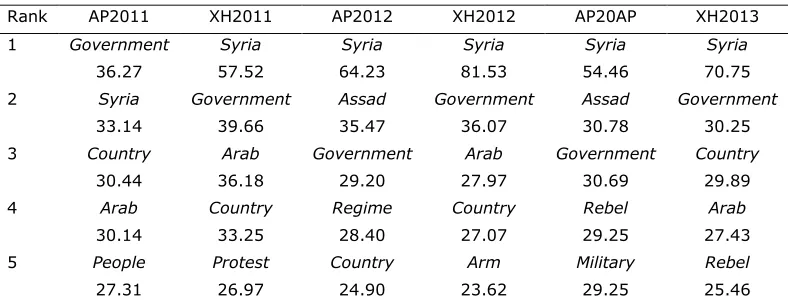
associated with Syria. People and regime were the central concepts in AP2011 and AP2012, respectively; protest and arm were the central concepts in XH2011 and XH2012, respectively. In 2013, rebel was the central concept for AP and XH; military was the central concept only in AP.
Table 1. Top-Five Concepts With Greatest Normalized Eigenvector Centralities.
Rank AP2011 XH2011 AP2012 XH2012 AP20AP XH2013
1 Government Syria Syria Syria Syria Syria
36.27 57.52 64.23 81.53 54.46 70.75
2 Syria Government Assad Government Assad Government
33.14 39.66 35.47 36.07 30.78 30.25
3 Country Arab Government Arab Government Country
30.44 36.18 29.20 27.97 30.69 29.89
4 Arab Country Regime Country Rebel Arab
30.14 33.25 28.40 27.07 29.25 27.43
5 People Protest Country Arm Military Rebel
27.31 26.97 24.90 23.62 29.25 25.46
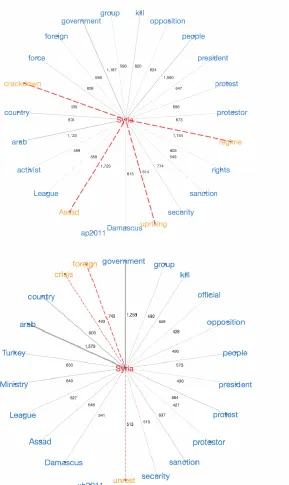
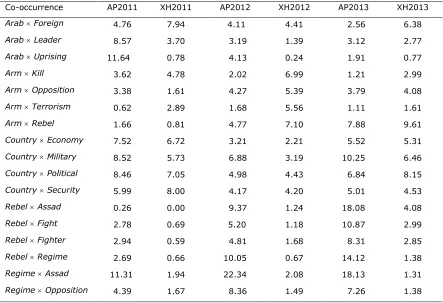
To answer RQ2a, Figure 1 illustrates the evolution of the concepts with which Syria was most closely associated. The thicker lines in the graphs represent a stronger relationship between two concepts. The link strength that illustrates the number of co-occurrences between concepts is noted next to the lines. Table 2 illustrates the normalized number of co-occurrences between Syria and the concepts with which Syria was closely associated. Whereas Syria always had a close association with regime in AP, it was always closely associated with crisis and foreign in XH. Moreover, Syria had close associations with crackdown and unrest in AP and XH, respectively, in 2011, and these associations decreased gradually in the following two years. The associations between Syria and rebel and between Syria and fight increased gradually in AP and peaked in AP in 2013. The associations between Syria and political increased gradually in XH and peaked in XH in 2013.
Table 2. Normalized Number of Co-occurrences Between Concepts: Syria.
Co-occurrence AP2011 XH2011 AP2012 XH2012 AP2013 XH2013
Syria Crackdown 9.16 5.13 5.58 1.75 1.01 0.15
Syria Crisis 1.63 14.72 6.58 33.74 4.93 31.53
Syria Fight 1.37 0.68 8.50 5.11 15.72 5.85
Syria Foreign 8.42 22.18 15.47 26.09 10.32 18.22
Syria Political 3.95 6.00 8.87 17.70 7.41 20.30
Syria Rebel 0.80 0.50 25.84 15.80 43.07 36.00
Syria Regime 16.54 8.51 31.14 6.47 21.82 6.15
[image:9.612.86.529.509.644.2]Table 3. Normalized Number of
Co-occurrences Between Concepts: Other Central Concepts.
Co-occurrence AP2011 XH2011 AP2012 XH2012 AP2013 XH2013
Arab Foreign 4.76 7.94 4.11 4.41 2.56 6.38
Arab Leader 8.57 3.70 3.19 1.39 3.12 2.77
Arab Uprising 11.64 0.78 4.13 0.24 1.91 0.77
Arm Kill 3.62 4.78 2.02 6.99 1.21 2.99
Arm Opposition 3.38 1.61 4.27 5.39 3.79 4.08
Arm Terrorism 0.62 2.89 1.68 5.56 1.11 1.61
Arm Rebel 1.66 0.81 4.77 7.10 7.88 9.61
Country Economy 7.52 6.72 3.21 2.21 5.52 5.31
Country Military 8.52 5.73 6.88 3.19 10.25 6.46
Country Political 8.46 7.05 4.98 4.43 6.84 8.15
Country Security 5.99 8.00 4.17 4.20 5.01 4.53
Rebel Assad 0.26 0.00 9.37 1.24 18.08 4.08
Rebel Fight 2.78 0.69 5.20 1.18 10.87 2.99
Rebel Fighter 2.94 0.59 4.81 1.68 8.31 2.85
Rebel Regime 2.69 0.66 10.05 0.67 14.12 1.38
Regime Assad 11.31 1.94 22.34 2.08 18.13 1.31
Regime Opposition 4.39 1.67 8.36 1.49 7.26 1.38
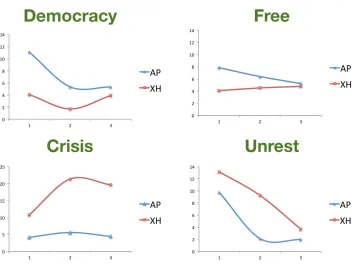
Figure 3. Normalized eigenvector centralities of the concepts related to democracy and
crisis. AP (blue) = Associated Press; XH (red) = Xinhua News Agency.
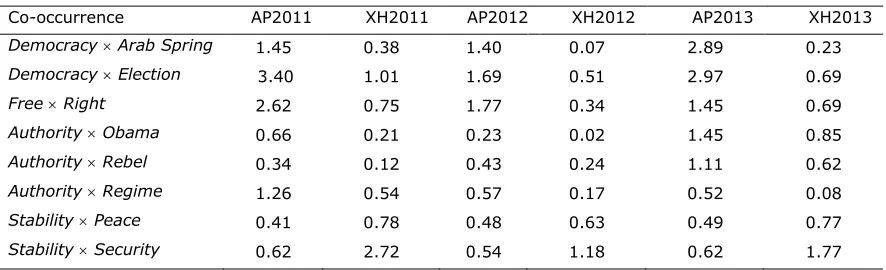
Table 4. Normalized Number of Co-occurrences Between Cultural Concepts.
Co-occurrence AP2011 XH2011 AP2012 XH2012 AP2013 XH2013
Democracy Arab Spring 1.45 0.38 1.40 0.07 2.89 0.23
Democracy Election 3.40 1.01 1.69 0.51 2.97 0.69
Free Right 2.62 0.75 1.77 0.34 1.45 0.69
Authority Obama 0.66 0.21 0.23 0.02 1.45 0.85
Authority Rebel 0.34 0.12 0.43 0.24 1.11 0.62
Authority Regime 1.26 0.54 0.57 0.17 0.52 0.08
Stability Peace 0.41 0.78 0.48 0.63 0.49 0.77
Stability Security 0.62 2.72 0.54 1.18 0.62 1.77
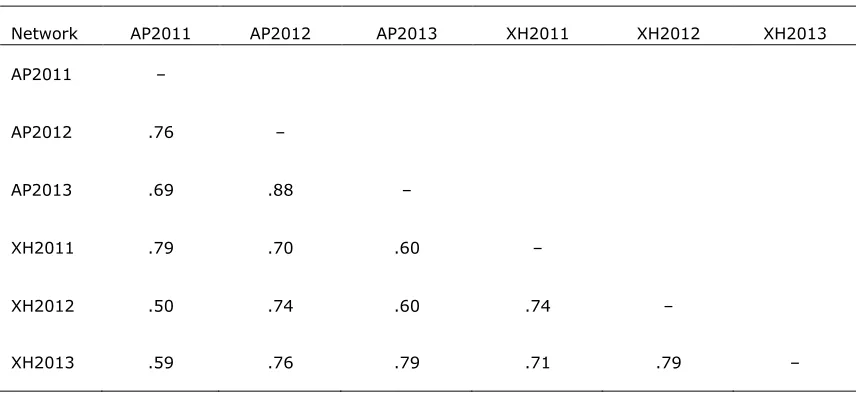
To answer RQ3, we employed QAP correlation. The results of QAP correlations (see Table 5) revealed significant correlations among the six semantic networks (p < .001). The mean QAP correlation, within the set of AP (.78) and the set of XH (.75) were greater than those between the two news sources (.67), suggesting greater differences between the sources than within (over time) the same sources. However, from 2011 to 2013, the correlation coefficient between the two sources within the same year ranged from .74 to .79, not only illustrating the similarity between the semantic structures of news coverage of the Arab Spring in AP and XH, but also making it reasonable to attribute framing differences between news coverage of the Arab Spring in AP and XH to concept centralities and association differences found above that are reflections of different political cultures in the United States and China. When reporting on the same international event, journalists in different nations are likely to follow the rapid change of an event to emphasize its different angles simultaneously, but cultural characters that are in line with the existing schemata of journalists’ belief system can transcend the mobility and become persistent parts of news frames.
XH were likely to lead the changes of the centralities of free in AP in the same direction about one month later.
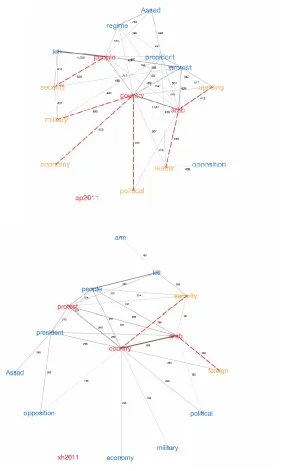
Figure 4. Evolution of concept associations of the cultural symbols related to democracy and
[image:17.612.178.436.123.603.2]
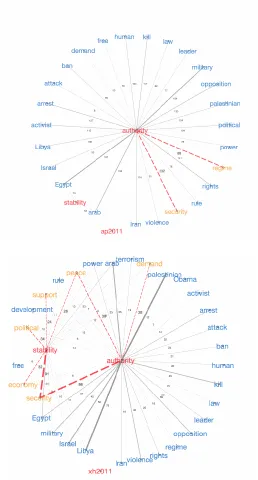
Figure 5. Evolution of concept associations of the cultural symbols related to authority and
Table 5. QAP Correlation of Six Semantic Networks.
Network AP2011 AP2012 AP2013 XH2011 XH2012 XH2013
AP2011 –
AP2012 .76 –
AP2013 .69 .88 –
XH2011 .79 .70 .60 –
XH2012 .50 .74 .60 .74 –
Discussion
Different Cultural Frames
This research analyzed the salience of the concepts in the reporting of the Arab Spring not only by identifying the five most central concepts, but also which were more closely associated. Based on the network analysis, this study found that both AP and XH focused on reporting about Syria. However, AP associated Syria with the concepts regime and rebel, whereas XH linked Syria with crisis and unrest. This indicates that different political culture frames were embedded in the reporting of the Arab Spring. In AP, the American political culture frame of pursuit of democracy led to the journalists’ emphasis on the opposition to the authoritarian regime and the rebellion against Syria’s President Assad. However, in XH, the Chinese political culture frame of respecting authority presented a portrait of Syria’s protest and civil war as crises and social unrest in a foreign country. For example, AP reported, “Syria has one of the Middle East’s most tightly controlled and repressive regimes”; “The Arab Spring demonstrates that the universal aspiration for open societies, political freedoms and transparent and accountable government cannot be suppressed”; “President Assad and his regime are deluding themselves if they believe they can halt this tide”; and “Syria’s uprising, which is targeting one of the Middle East’s most repressive regimes.” However, XH reported, “The year of 2011 was one of the toughest years that Syria has ever gone through in its modern history, and the crisis that has plagued the country . . . is still dragging on with no looming solution” and “Fears are now high that the country is on the verge of a military intervention and an internationalization of the Syrian crisis . . . solving the crisis should be within the Syrian home without any foreign intervention.”
Although the preference of cultural frames in AP and XH were relatively stable over time, the differences in centralities of concepts between AP and XH diminished a great deal in 2013 (see Figure 3). This may be explained from the perspective of global homogenization of international news. In the process of globalization and media commercialization, the diffusion of cultural and social practices from one country to another occurs (Camaj, 2010). However, from the maps (see Figures 4 and 5), we can see that although the differences in centralities of the cultural concepts between AP and XH became smaller over time, democracy and free in AP had closer associations with election and right than in XH, and stability in XH had a stable association with authority via connecting to security. This indicates that whereas journalists in AP used the cultural frame that believing the pursuit of democracy and free elections represents fundamental human rights, journalists in XH made use of the culture frame that supporting the idea that respecting official authority can maintain the security and stability of a society and the absence of a strong authority will lead to a crisis.
Competition of Different Cultural Frames
relatively high correlations across semantic networks in each year indicate the substantial relatedness and similarities of news coverage of the Arab Spring in AP and XH; on the other hand, the significant co-evolution of the concept pairs found above (see Figure 6) illustrate that when reporting on the Arab Spring, AP and XH employed different cultural frames that reflect different cultural ideologies that the American and Chinese media system embedded in almost synchronously. Driven by international trade and rapid development of information technology, globalization has intensified, which enables long-distance interconnectedness and entails a compression of time and space (Hannerz, 1996; Harvey, 1989; Mittelman, 1996). Under such circumstance, the intercultural communication has resulted in various modalities of local cultural hybridizations that challenge the stability and persistence of national cultures. Although the convergence model of communication posits that the world’s culture is converged toward a common set of cultural traits and practices if communication is allowed to continue indefinitely (Barnett & Kincaid, 1983; Kincaid, 1982; Rogers & Kincaid, 1981), there are many obstacles for cross-cultural communication, and language difference, which generates the different ways people see the world, is one of the largest obstacles. The stable differences of the preference of cultural frames in AP and XH indicate that when the integration of local cultural hybridizations are not significant enough to have huge impacts on people’s national cultures, the dialogue of different cultural frames at the macro level may reflect symbolic competition rather than the symbolic convergence in a short period of time.
Conclusion
Through conducting the above study, a theory of framing from a cultural perspective and operationalization of the construct of “frame,” which employs the newly developed tool of social and communication networks, have been presented. Based on the qualitative studies of the existing literatures, an inventory of frames referring to political culture in the United States and China (i.e., democracy culture and authority culture) was first created. Then, SMA methods were used to determine to what extent the two different political cultural frames were present in the data. Specifically, this study identified the salience of the concepts in news coverage of the Arab Spring based on the measurement of concept centralities and associations among semantic networks. Finally, the analysis of the co-evolution of semantic networks of the Arab Spring from the United States and China has provided a way to understand framing dynamics at the macro level as manifested in different national cultural groups, which compete in sponsoring their preferred cultural frames and negotiate the construction of dominant social realities on the global stage.
Future research should determine whether the results of this study could be generalized to other news sources including broadcast and online organizations that may frame events differently. For example, scholars can analyze news frames of the Arab Spring from The Wall Street Journal, Fox News, and Huffington Post in the United States, and Southern Weekly, CCTV News, and SINA News in China. Also, future studies can investigate whether this study’s conclusions can be applied to other international events, such as Occupy Central With Love and Peace in Hong Kong.
as a reflection on the ideas resulting from the production of mass media. In the future, the analysis of co-evolution of semantic networks of human discourse on the Web-based public spaces and the content of mass media can provide one way to understand the individual-level outcomes of framing and feedback loop from the receivers to news sources.
In addition, the computer storage and processing power of computational linguistics have increased in recent decades, leading to the development of many advanced computer-assisted linguistic tools and techniques. Future research is planned to study the semantic networks of news coverage where the relations among the concepts are directional. Through examining the source and target of the semantic links, scholars can move beyond the analysis of concept association by identifying the causal relations among different concepts to have a deeper understanding of the framing strategies embedded in news coverage.
Finally, future scholars can place SMA within a larger social context to address the connections and co-evolution of semantic networks with other networks, such as the global telecommunication network (Barnett, 2001; Barnett, Ruiz, Hammond, & Xin, 2013), trade networks (Garlaschelli & Loffredo, 2005), and social media networks (Smith, Rainie, Shneiderman, & Himelboim, 2014) to provide a deeper and more comprehensive examination of the content of international news coverage.
References
AP’s history. (n.d.). Retrieved from http://ap.org/company/history/ap-history
Barnett, G. A. (2001). A longitudinal analysis of the international telecommunication network, 1978–1996. American Behavioral Scientist, 44(10), 1638–1655. doi:10.1177/0002764201044010007
Barnett, G. A., Jiang, K., & Hammond, J. (2015). Using coherencies to examine network evolution and co-evolution. Social Network Analysis and Mining, 5(1), 1–11. doi:10.1007/s13278-015-0297-6
Barnett, G. A., & Kincaid, D. L. (1983). Cultural convergence: A mathematical theory. In W. B. Gudykunst (Ed.), Intercultural communication theory: Current perspectives (pp. 171–194). Beverly Hills, CA: SAGE Publications.
Barnett, G. A., Ruiz, J. B., Hammond, J. R., & Xin, Z. (2013). An examination of the relationship between international telecommunication networks, terrorism and global news coverage. Social Network Analysis and Mining, 3(3), 721–747. doi:10.1007/s13278-013-0117-9
Benson, R., & Saguy, A. (2005). Constructing social problems in an age of globalization: A French– American comparison. American Sociological Review, 70(2), 233–259.
doi:10.1177/000312240507000203
Bonacich, P. (1972). Factoring and weighting approaches to status scores and clique identification. Journal of Mathematical Sociology, 2(1), 113–120. doi:10.1080/0022250X.1972.9989806
Borgatti, S., Everett, M., & Freeman, L. C. (2002). UCINET: Network analysis software [Computer software]. Columbia, SC: Analytic Technologies.
Brandes, U., & Wagner, D. (2004). Analysis and visualization of social networks. In Graph drawing software (pp. 321–340). Heidelberg, Germany: Springer.
Camaj, L. (2010). Media framing through stages of a political discourse: International news agencies’ coverage of Kosovo’s status negotiations. International Communication Gazette, 72(7), 635–653. doi:10.1177/1748048510378147
Carley, K. M., & Palmquist, M. (1992). Extracting, representing, and analyzing mental models. Social Forces, 70(3), 601–636. doi:10.1093/sf/70.3.601
Chyi, H. I., & McCombs, M. E. (2004). Media salience and the process of framing: Coverage of the Columbine school shootings. Journalism and Mass Communication Quarterly, 81(1), 22–35. doi:10.1177/107769900408100103
Cohen, A. A. (1996). Global newsrooms, local audiences: A study of the Eurovision news exchange (Vol. 12). London, UK: John Libbey.
Collins, A. M., & Quillian, M. R. (1972). Experiments on semantic memory and language comprehension. In L. W. Gregg (Ed.), Cognition in learning and memory (pp. 117–138). New York, NY: Wiley.
D’Angelo, P. (2002). News framing as a multi-paradigmatic research program: A response to Entman. Journal of Communication, 52(4), 870–888. doi:10.1111/j.1460-2466.2002.tb02578.x
Danowski, J. A. (1993). Network analysis of message content. In W. D. Richard & G. A. Barnett (Eds.), Progress in communication sciences (Vol. 12, pp. 198–221). Norwood, NJ: Ablex.
Diesner, J., & Carley, K. M. (2005). Revealing social structure from texts: Meta-matrix text analysis as a novel method for network text analysis. In V. K. Narayanan & D. J. Armstrong (Eds.), Causal mapping for research in information technology (pp. 81–108). Harrisburg, PA: Idea Group Publishing.
Doerfel, M. L. (1998). What constitutes semantic network analysis? A comparison of research and methodologies. Connections, 21(2), 16–26.
Doerfel, M. L., & Barnett, G. A. (1999). A semantic network analysis of the International Communication Association. Human Communication Research, 25(4), 589–603.
doi:10.1111/j.1468-2958.1999.tb00463.x
Entman, R. M. (1993). Framing: Toward clarification of a fractured paradigm. Journal of Communication, 43(4), 51–68. doi:10.1111/j.1460-2466.1993.tb01304.x
Fillmore, C. J. (1982). Frame semantics. In Linguistic Society of Korea (Ed.), Linguistics in the morning calm: Selected papers from SICO 1981 (pp. 111–138). Seoul, South Korea: Hanship.
Floss, D., & Marcinkowski, F. (2008). Do media news frames reflect a nation’s political culture? Retrieved from http://www.nccr-democracy.uzh.ch/publications/workingpaper/do-media-news-frames-reflect-a-nation2019s-political-culture
Freeman, L. C. (1979). Centrality in social networks conceptual clarification. Social Networks, 1(3), 215– 239. doi:10.1016/0378-8733(78)90021-7
Gamson, W. A., & Lasch, K. E. (1983). The political culture of social welfare policy. In S. E. Spiro & E. Yuchtman-Yaar (Eds.), Evaluating the welfare state: Social and political perspectives (pp. 397– 415). Cambridge, MA: Academic Press.
Gamson, W. A., & Modigliani, A. (1989). Media discourse and public opinion on nuclear power: A constructionist approach. American Journal of Sociology, 95(1), 1–37. doi:10.1086/229213
Gans, H. J. (1979). Deciding what’s news: A study of CBS Evening News, NBC Nightly News, Newsweek, and Time. Evanston, IL: Northwestern University Press. doi:10.1080/08821127.2005.10677988
Garlaschelli, D., & Loffredo, M. I. (2005). Structure and evolution of the world trade network. Physica A: Statistical Mechanics and Its Applications, 355(1), 138–144.
Gurevitch, M., Levy, M. R., & Roeh, I. (1991). The global newsroom: Convergences and diversities in the globalization of television news. In P. Dahlgren & C. Sparks (Eds.), Communication and
citizenship: Journalism and the public sphere in the new media age (pp. 195–216). London, UK: Routledge.
Hannerz, U. (1996). Transnational connections: Cultures, people, places. London, UK: Routledge.
Harvey, D. (1989). The condition of postmodernity. Cambridge, MA: Blackwell.
Hofstede, G. (1984). Culture’s consequences: International differences in work-related values (Vol. 5). London, UK: SAGE Publications.
Hua, S., & Nathan, A. J. (2001). Chinese political culture, 1989–2000. New York, NY: M. E. Sharp.
Hunter, S. (2014). A novel method of network text analysis. Open Journal of Modern Linguistics, 4(2), 350–366. doi:10.4236/ojml.2014.42028
Jiang, K., Barnett, G. A., & Taylor, L. D. (2014, December). Culture frames in international news
coverages: A semantic network analysis. Paper presented at the Daegu Gyeongbuk International Social Network Conference, Daegu, South Korea.
Kincaid, D. L. (1982, July). Communication and cultural convergence. Paper presented at the Second Symposium on Communication Theory From Eastern and Western Perspectives, Yokohama, Japan.
Korotayev, A. V., & Zinkina, J. V. (2011, April 4). Egyptian revolution: A demographic structure analysis. Retrieved from http://cliodynamics.ru/index.php?option=com_content
&task=view&id=276&Itemid=70
Kwon, K., Barnett, G. A., & Chen, H. (2009). Assessing cultural differences in translations: A semantic network analysis of the Universal Declaration of Human Rights. Journal of International and Intercultural Communication, 2(2), 107–138. doi:10.1080/17513050902759488
Lee, C. C., Chan, J. M., Pan, Z., & So, C. Y. (2000). National prisms of a global media event. In J. Curran & M. Gurevitch (Eds.), Mass media and society (pp. 295–309). London, UK: Arnold.
Li, X. (2007). Stages of a crisis and media frames and functions: U.S. television coverage of the 9/11 incident during the first 24 hours. Journal of Broadcasting & Electronic Media, 51(4), 670–687. doi:10.1080/08838150701626578
McQuail, D. (1994). Mass communication theory: An introduction (3rd ed.). London, UK: SAGE Publications.
Miller, A. D. (2011). For America, an Arab winter. Wilson Quarterly, 35(3), 36–42. Retrieved from http://www.wilsonquarterly.com/article.cfm?AID=1967
Miller, G. A. (1956). The magical number seven, plus or minus two: Some limits on our capacity for processing information. Psychological Review, 63(2), 81–97. doi:10.1037/h0043158
Miroff, B., Seidelman, R., Swanstrom, T., & Luca, T. D. (2009). The democratic debate: American politics in an age of change. San Francisco, CA: Cengage Learning.
Mittelman, J. H. (1996). The dynamics of globalization. In J. H. Mittelman (Ed.), Globalization: Critical reflections (pp. 1–19). Boulder, CO: Lynne Rienner.
Ogden, S. (2002). Inklings of democracy in China. Cambridge, MA: Harvard University Asia Center.
Pan, Z. P., & Kosicki, G. M. (1993). Framing analysis: An approach to news discourse. Political Communication, 10(1), 55–75. doi:10.1080/10584609.1993.9962963
Powers, A., & Andsager, J. L. (1999). How newspapers framed breast implants in the 1990s. Journalism & Mass Communication Quarterly, 76(3), 551–564. doi:10.1177/107769909907600310
Pye, L. (1992). The spirit of Chinese politics. Cambridge, MA: Harvard University Press.
Reese, S. D. (2001). Understanding the global journalist: A hierarchy-of-influences approach. Journalism Studies, 2(2), 173–187. doi:10.1080/14616700118394
Rhee, J. W. (1997). Strategy and issue frames in election campaign coverage: A social cognitive account of framing effects. Journal of Communication, 47(3), 26–48.
doi:10.1111/j.1460-2466.1997.tb02715.x
Rogers, E. M., & Kincaid, D. L. (1981). Communication networks: Toward a new paradigm for research. New York, NY: Free Press.
Ruigrok, N., & van Atteveldt, W. (2007). Global angling with a local angle: How U.S., British, and Dutch newspapers frame global and local terrorist attacks. The International Journal of Press/Politics, 12(1), 68–90. doi:10.1177/1081180X06297436
Sadian, J. C. G. M. (2012). The Arab Spring one year later: Last year’s clamor for democratic reform meets this year’s need to sustain its momentum. The CenSEI Report, 2(6), 24–32.
Schultz, F., Kleinnijenhuis, J., Oegema, D., Utz, S., & van Atteveldt, W. (2012). Strategic framing in the BP crisis: A semantic network analysis of associative frames. Public Relations Review, 38(1), 97– 107. doi:10.1016/j.pubrev.2011.08.003
Semetko, H. A., & Valkenburg, P. M. (2000). Framing European politics: A content analysis of press and television news. Journal of Communication, 50(2), 93–109.
doi:10.1111/j.1460-2466.2000.tb02843.x
Smith, M. A., Rainie, L., Shneiderman, B., & Himelboim, I. (2014, February 20). Mapping Twitter topic networks: From polarized crowds to community clusters. Retrieved from
http://www.pewinternet.org/2014/02/20/mapping-twitter-topic-networks-from-polarized-crowds-to-community-clusters
Snow, D. A., & Benford, R. D. (1988). Ideology, frame resonance, and participant mobilization. International Social Movement Research, 1(1), 197–217.
Sussman, G., & Galizio, L. (2003). The global reproduction of American politics. Political Communication, 20(3), 309–328. doi:10.1080/10584600390218931
Swanson, D. (2004). Transnational trends in political communication. In F. Esser & B. Pfetsch (Eds.), Comparing political communication: Theories, cases, and challenges (pp. 45–63). New York, NY: Cambridge University Press. doi:10.1017/CBO9780511606991.004
Van Gorp, B. (2007). The constructionist approach to framing: Bringing the culture back. Journal of Communication 57(1), 60–78. doi:10.1111/j.0021-9916.2007.00329.x
Wu, M. (2006). Framing AIDS in China: A comparative analysis of U.S. and Chinese wire news coverage of HIV/AIDS in China. Asian Journal of Communication, 16(3), 251–272.
doi:10.1080/01292980600857781