Choroszewicz Paweł, Brzezinski Łukasz, Dybowski Maksymilian, Różański Gracjan, Dobosiewicz Anna, Zukow Xawery. Nutrition practice during ultramarathon running in theory and reality. Journal of Education, Health and Sport. 2018;8(11):833-843. eISSN 2391-8306. DOI http://dx.doi.org/10.5281/zenodo.3405400
http://ojs.ukw.edu.pl/index.php/johs/article/view/7428
The journal has had 7 points in Ministry of Science and Higher Education parametric evaluation. Part B item 1223 (26/01/2017). 1223 Journal of Education, Health and Sport eISSN 2391-8306 7
© The Authors 2018;
This article is published with open access at Licensee Open Journal Systems of Kazimierz Wielki University in Bydgoszcz, Poland
Open Access. This article is distributed under the terms of the Creative Commons Attribution Noncommercial License which permits any noncommercial use, distribution, and reproduction in any medium, provided the original author (s) and source are credited. This is an open access article licensed under the terms of the Creative Commons Attribution Non commercial license Share alike.
(http://creativecommons.org/licenses/by-nc-sa/4.0/) which permits unrestricted, non commercial use, distribution and reproduction in any medium, provided the work is properly cited. The authors declare that there is no conflict of interests regarding the publication of this paper.
Received: 01.11.2018. Revised: 25.11.2018. Accepted: 30.11.2018.
Nutrition practice during ultramarathon running in theory and reality
Paweł Choroszewicz1, Łukasz Brzezinski1, Maksymilian Dybowski1, Gracjan Różański1,
Anna Dobosiewicz1, Xawery Zukow2
1. Scientific Circle of Exercise Physiology at Department of Hygiene, Epidemiology and Ergonomics. Division of Ergonomics and Exercise Physiology, Nicolaus Copernicus University in Toruń, Collegium Medicum in Bydgoszcz, Poland
2. Intercollegiate Faculty of Biotechnology, University of Gdansk and Medical University of Gdansk, Poland
Corresponding author: Anna Maria Dobosiewicz, [email protected]
Abstract
Finally it compares the theory with reality, showing nutrition plans used by elite athletes during competitions.
Key words: nutrition, ultramathon, running, athletes
Introduction
Ultramarathons are runs over a distance longer than the marathon one, i.e. 42.195 km. The most popular distances in this competition are 50 km, 100 km, 100 miles (160 km), and time-trials: 6, 12, 24 and 48 hours. Often the participants have to face unfavourable weather conditions, as well as topographical obstacles, because the organizers of ultramarathon runs are particularly fond of mountainous areas. This forces the competitors to prepare an appropriate strategy of using limited energy resources (and supplementing it) in such a way as to cover the assumed distance as soon as possible. The so-called "pacing strategy" is determined on the basis of the athlete's subjective feelings about the distance remaining to be covered and the energy reserves preserved [1].
It is worth mentioning that ultramarathons attract more and more athletes, both professionals and amateurs. Taking into account the fact that people participating in such events for recreation usually do not show sufficient knowledge about proper nutrition and fluid replenishment, which is absolutely necessary for this type of physical activity. Proper hydration of the body is also extremely important. Although athletes strive to prevent dehydration, recent research has been conducted on hyponatraemia due to excessive hydration of the body. It is worth noting that the most exposed persons to the occurrence of the above phenomenon are the slowest competitors participating in ultramarathons because of the longer duration of exercise [2].
strategy to achieve the best possible result can be determined almost to the nearest kcal and minute of effort [1]. However, the participants struggle with many problems, both psychological [3], logistic (access to food) and gastric [4,5,6]. Often the theory, under the influence of extreme fatigue, is difficult to transform into practice. During the run a very important role, apart from physical preparation and strategy, is played by experience and the so-called "strong head", i.e. mental resistance to fatigue and stress [3]. These features allow the competitor to complete the race according to a pre-determined plan and avoid unwanted reactions of the body. Every person reacts to such a high level of effort in a different way and despite the available knowledge, not everything can be predicted and planned. The aim of the article is to compare the recommendations of professionals and potential obstacles in their implementation and the real strategies used by ultramarathon runners on the competition routes.
Nutrition on the ultramarathon route in theory
The optimal nutrition strategy (amount of carbohydrates, proteins and fats) for the ultramarathon route is not known [1,7]. Fats are a very important source of energy, especially when the effort is as long as during the ultramarathon, but their supplementation during the effort is not as important as carbohydrates. This is due to the fact that nearly 90% of the energy stored in the human body is stored in fats. The relatively low amount of stored carbohydrates combined with the fact that the body prefers the energy from carbohydrates during a higher level of exercise, typical for competitions, causes these reserves to be depleted much faster than fat reserves, and therefore they need to be replenished in order to prevent hypoglycaemia [1].
and nutrition knowledge had an impact on nutritional label use. Health promoters should aim to increase the use of nutritional labels [8].
According to the conducted research, carbohydrate intake allows to improve sports performance during medium intensity efforts with a duration of more than 2 hours, as well as more than 1 hour during higher intensity efforts (>75% VO2max). A study by JB Mitchell
shows that taking 16 grams of glucose in water solution per hour has contributed to a 14% improvement in endurance compared to water alone. Smaller doses did not show any significant improvement. Most studies show that the optimal amount of carbohydrates to consume during long exercise is between 40 and 75 grams per hour. Above this value, no positive effects were found, which is most likely due to the digestive capacity of the body. However, it is believed that humans are able to process from food about 1.0-1.1 g/min of carbohydrates, or in the case of optimal mixtures (e.g. a mixture of glucose and fructose) up to 1.7 g/min. This is all the more important because, knowing this dependence, it is possible to prepare drinks containing an appropriate mixture of carbohydrates, which will be processed by the body at a faster rate. This in turn will reduce the amount of undigested food in the gastrointestinal tract and thus reduce the risk of stomach problems. Scientists also believe that reduced blood flow through the gastrointestinal tract does not affect the rate at which the food is processed into muscle fuel. The limiting factor in this matter is the rate of absorption in the small intestine, which was estimated at 1.2-1.7 g/min carbohydrates [9].
Kristopher A. Pruitt and Justim M. Hill have developed a model that, based on the results of performance and physiological examination, as well as route length and topography, is able to assess the best time an individual can achieve, including the pace strategy for each section of the route and the minimum amount of carbohydrates needed to complete the race. It is worth noting that this model assumes total depletion of muscle glycogen stores and glycogen stored in the liver at the exact moment of crossing the finish line [1].
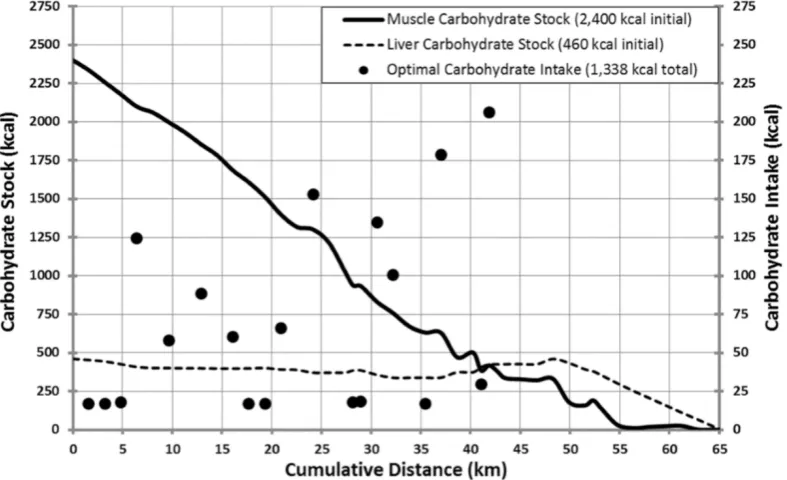
supply is not the optimal method. According to this model, the most beneficial way to drive the body is to consume more carbohydrates in the early stages of the race. The graph below shows the estimated dietary strategy for the athlete described, along with muscle and liver glycogen levels during the race. It can be seen that liver glycogen is not consumed unless it is necessary (carbohydrate consumption during exercise almost completely blocks its breakdown, but only reduces the rate of muscle glycogen wear). [1,9]. Theoretically, such a model should solve all the problems related to the choice of nutritional strategy. However, it does not take into account the competitor's psyche and possible gastric problems, which play a very important role in such long runs and may contribute to the inability to implement the adopted plan [1,3].
Fig. 1. Optimal nutrition strategy for a 70 kg runner with 69 ml/kg/min VO2max. Carbohydrate supplementation on the right axis, on the left - muscle and liver glycogen stores resulting from the strategy [1].
Health problems on the route of the ultramarathon competition
[image:5.595.81.475.288.528.2]The race was held in high ambient temperature, ranging from 21 to 38 degrees Celsius. Urine and blood were collected in the evening on the day before the race, at 88 km of the race and at the finish line, urine was also collected after the race [10]. Thirteen of the 26 people completed 160 km in an average time of 26.2 hours, while those who did not finish the race covered at least 45 km. No significant weight loss was recorded at the end of the race, the difference was only 0.6% of the initial value, which is equivalent to 0.5 kg. A slight weight loss after crossing the finish line is an important discovery, as it suggests that too much fluid was delivered to the body. Overloading the body with fluid caused hyponatremia directly responsible for mood fluctuations during the race [10,11]. It is estimated that ultra-marathoners must lose about 4% of their body weight in order to maintain an adequate concentration of sodium in the serum while simultaneously hydrating the body with an adequate amount of fluids [12]. This study proved, among other things, that through extreme environmental conditions combined with long-term physical effort, the estimated race duration was prolonged, which resulted in an increased supply of fluids to the body. This fact is directly responsible for lowering the sodium level in the blood. The result of the study was also influenced by the fact that the athletes delivered about half as much sodium per hour as they should. The subjects delivered about 0.5 g of sodium per hour, whereas 1 g per hour is recommended for this type of exercise lasting many hours [10,12].
The correlation between too much water consumption and indigestion was also observed. Moreover, when the competitors did not provide enough protein between the stages of a longer race, they also encountered such problems more often, which may be related to incomplete regeneration due to the lack of protein building material [5]. It is worth mentioning that the athletes without gastric problems achieved a slight increase in body weight, while the athletes with nausea remained approximately at the same level [6].
According to the observations of 42 amateur runners on the route of a mountain marathon held in Switzerland, the vast majority, i.e. 90%, of the calorie intake of meals was significantly lower than the suggested nutrition [4]. One of the reasons for this state of things are the logistical problems faced by the competitors. In addition, we should mention the issue of dietary education of athletes, possible gastric problems or appetite fluctuations, which seem to be the key factor [5]. Approximately 43% of athletes confirm that flatulence, nausea or vomiting significantly affect their performance [6].
complain about problems usually in the running part [6]. Research shows that 93% of triathlon athletes in the ultramarathon distance faced gastric problems. The problems mentioned by the competitors are mainly: rebounding, heartburn, vomiting. In the 161 km race with 89% of the competitors reporting problems, as much as 63% of them were related to the upper part of the digestive tract. This seems to be a key factor influencing the withdrawal of competitors from the race [5]. The reasons for this state of affairs include a large outflow of blood from the intestines (up to 80% in favour of skeletal muscles, shocks or mechanical injuries during the run [5,6]. This should also be associated with disturbances in food transit, which causes bacteria to move, leading to gastrointestinal problems [6]. Researchers also mention the mental state of the competitor as an equally important factor [3], which is confirmed by the thesis of Kristin Jean Stuempfle & Martin Dean Hoffman that there is a strong correlation between individual predispositions of the competitor and the occurrence of nausea affecting the course of the race. According to their research, 57% of racers do not mention these problems as the key to their result. Studies say that nausea can be a normal consequence of swallowing more air [6]. There is a confirmed correlation between gastric problems in everyday life and during races [4]. Gels seem to be a safe way to administer carbohydrates, where no problems were observed at the supply of 1.4 g/min [4]. This is extremely important, since adequate rest between the individual stages allowed the body to get rid of inflammatory cytokines, to intensify the work of the immune system, as well as general rest and restoring the body to homeostasis [5].
According to a study on a multi-stage marathon and a 24-hour run, conducted in Spain on a group of 54 people for the first and 22 for the second race, 89% of the contestants had clear problems. The results did not show any correlation with gender [5]. However, in the study conducted on the route of 161 km in the Western States, women more often reported flatulence [6]. The race time was important, the longer the competitors ran, the higher the probability of gastric problems such as vomiting [5]. This was the case in a multistage marathon. In the 24-hour race, competitors covering a longer distance recorded more episodes of bad digestion (166 ± 28 km; 6.9 ± 1.2 km/h) compared to non-reported competitors (139 ± 15 km; 5.8 ± 0.6 km/h) [4]. In the study by Kristin Jean Stuempfle & Martin Dean Hoffman, they obtained information that the competitors felt nauseous mainly at stages of 48 and 90 kilometres of the 161-kilometre long run [6].
biggest problem for both those who finished and those who did not finish the race [6]. It is worth mentioning, however, that it was the hottest of all the races in this place in history.
Nutritional strategies used by athletes in practice
Trent Stellingwerff has studied the nutritional strategies of three elite ultramarathon veterans. Over the course of 2014, the participants were able to compete in 16 ultramarathons with a distance of 100 km or 100 km, of which 8 won. Each competitor had limited professional knowledge of how to supply the body with nutrients. Everyone used their own nutritional plan, which was based on little scientific research and above all on experience. They also pointed out that the plan must be adjusted to the conditions on the route (weather conditions, altitude, tactics or gastric problems). Those surveyed on the race route over a distance of 100 miles took 5.530 ± 1.673 kcal in the form of carbohydrates (1.162 ± 250 grams), which translated into 71 ± 20 CHO/h (g) [14]. They all fit into the values recommended by scientists today (40-110 CHO/h (g)) [9]. None of the competitors encountered gastric problems on the route. Two of them added ginger to their dietary plan (12.5g and 4.2g), in order to prevent these problems. However, there is not enough data to objectively determine whether this has resulted in a lack of gastric problems. Everyone also took caffeine at 912 ± 322 mg, i.e. 55 ± 22 mg/h or 0.9 ± 0.27 mg/kg/h during the run. Data on weight at start and finish were also collected for two of the subjects. It dropped from 61.5 kg to 58.2 (5.1%) and from 61.6 kg to 58.2 (5.8%), respectively.
weight was only 0.5 kg less than at the start. He also did not encounter any serious health problems during the race, struggling only with constipation, which, however, did not cause a reduction in his sports capabilities, and the aforementioned frequent urine. Each day, most likely due to increasing tiredness, he covered less and less kilometers - from 270 km on the first day to 135 km on the fifth day [7]. However, it is not possible to determine whether the change in the way of nutrition (especially the increased supply of proteins and fats) would result in a slower fatigue rate increase.
Conclusion
The current level of knowledge, available physiological research and experience in the field of nutrition and physical activity enables a very precise definition of the running and nutrition strategy for any competitor, leading to the best possible result from a scientific point of view. An example model created by Pruitt and Hill allows to estimate the runner's potential over a given distance, taking into account the topography of the route, with a very small margin of error and create an accurate running plan and calorific demand for him [1]. It is no secret that in such long distance runs, in addition to adequate efficiency and endurance, it is also important to know one's own body and the participant's experience, especially in the selection of the aforementioned strategies. Theoretically, such a model should allow, even for newcomers, to optimize the distribution of energy and smoothly cover the route, neutralizing the role of the previously mentioned experience during the competition. However, the implementation of such a complex plan, especially in the field of nutrition, requires a very high level of self-discipline. It can also be hindered by problems with the digestive and genitourinary system (the risk of which can be minimized by an appropriate feeding plan), mental fatigue, or other random events on the route of the competition. Especially in the latter case, the runner's experience is invaluable, allowing him or her to adjust the plan on an ongoing basis - a skill that the beginner will not have.
then, no significant progress has been made in the field of nutrition of athletes during such long efforts.
References
1. Kristopher A. Pruitt, Justin M. Hill. Optimal pacing and carbohydrate intake strategies for ultramarathons. European Journal of Applied Physiology, December 2017, Volume 117, Issue 12 (p. 2527-2545).
2. Martinez S., Aguilo A., Rodas L., Lozano L., Moreno C., Tauler P. Energy, macronutrient and water intake during a mountain ultramarathon event: The influence of distance. Journal of Sports Sciences, 2018, Volume 36, Issue 3 (p. 333 – 339).
3. Holt N.L.,Lee H., Kim Y., Klein K. Exploring Experiences of Running an Ultramarathon. The Sport Psychologist, 2014, 28, (p. 22 – 35).
4. Williamson E. Nutritional implications for ultra-endurance walking and running events. Extreme Physiology & Medicine, 2016, volume 5, Article number: 13.
5. Ricardo J. S. Costa, Rhiannon Snipe1, Vera Camões-Costa, Volker Scheer and Andrew Murray. The Impact of Gastrointestinal Symptoms and Dermatological Injuries on Nutritional Intake and Hydration Status During Ultramarathon Events. Sports Medicine – Open, 2016, volume 2, Article number: 16.
6. Stuempfel K.J., Hoffman M.D. Gastrointestinal distress is common during a 161-km ultramarathon. Journal of Sports Sciences, 2015, Volume 33, Issue 17 (p. 1814 – 1821). 7. Rontoyannis G.P., Skoulis T., Pavlou K.N. Energy balance in ultramathonrunning.
American Journal of Clinical Nutrition, 1989, June, (p. 976 – 979).
8. Cannoosamy, K., Pugo-Gunsam, P., & Jeewon, R. Consumer knowledge and attitudes toward nutritional labels. Journal of nutrition education and behavior, 2014, 46(5), 334-340.
9. Jeukendrup A.E. Carbohydrate Intake During Exercise and Performance. Nutrition 2004;20 (p. 669-677).
10. Glace B.W., Murphy C.A., McHugh M.P. Food Intake and Electrolyte Status of Ultramarathoners Competing in Extreme Heat. Journal of the American College of Nutrition, 2002, Volume 21, Issue 6 (p. 553 – 559).
12. Speedy D.B., Rogers I.R,. Noakes T.D., Wright S., Thompson J.M., Campbell R,. Hellemans I., Kimber N.E., Boswell D.R., Kuttner J.A., Safih S. Exercise-induced hyponatremia in ultradistance triathletes is caused by inappropriate fluid retention. Clinical Journal of Sport Medicine, October 2000, Volume 10, Issue 4 (p. 272 – 278). 13. Goldberger E. A Primer of Water, Electrolyte and Acid-Base Syndromes. Ann Intern
Med., 1970;73(6) (p. 1053 – 1054).