OPEN A
CCE
SS
JZ
AR R
esearch article
OPEN A
CCE
SS
captive African wild dogs (
Lycaon pictus)
Dian G.M. Zijlmans* and Marie José H.M. DuchateauAnimal Ecology, Utrecht University, Utrecht, the Netherlands
*Correspondence: D Zijlmans MSc, [email protected]
Keywords: African wild dog, captive management, social relationships, behaviour, welfare
Article history:
Received: 06 Dec 2017 Accepted: 09 Oct 2018 Published online: 31 Jan 2019
Abstract
African wild dogs (Lycaon pictus) are endangered carnivores with a population size that is currently
estimated at 6,600 adults in the wild. The European Endangered Species Program (EEP) for African wild dogs aims to maintain a healthy zoo population that is sustainable in the long term and thereby prevent extinction of the species. Safaripark Beekse Bergen is one of the zoos that participate in the African wild dog EEP and they faced some challenges in the captive management of their breeding pack because of the death of the alpha male. Nine male littermates were transferred to GaiaZOO in an attempt to restore the complex social structure and decrease the risk of inbreeding in the pack. This study evaluates this captive management decision by comparing the social relationships and behaviour in both zoos before and after pack separation. The heterogeneous social network, rank reversals and increased rates of aggression, affiliation and dominant behaviour imply that the remaining pack members in Safaripark Beekse Bergen formed a socially unstable pack during the first month following pack separation. Although there were rank reversals in the newly formed GaiaZOO pack as well, the homogenous social network and low rates of aggressive behaviour imply that the nine male littermates formed a socially stable pack in GaiaZOO by the second month after pack separation. Based on the results, recommendations are provided for further improving zoo animal management and the welfare of captive African wild dogs.
Introduction
The African wild dog (Lycaon pictus) is an endangered carnivore species (IUCN 2017). African wild dogs are cooperative breeders that live in packs consisting of close relatives with strong social relationships and a clear dominance hierarchy, separate for males and females (Girman et al. 1997; de Villiers et al. 2003; Frame et al. 1979). Although the species was common throughout sub-Saharan Africa, African wild dogs have disappeared from much of their original range today (IUCN 2017). Their population size is currently estimated at 6,600 adult individuals in 39 subpopulations in the wild (IUCN 2017). The decline in population size is caused by habitat fragmentation, human-wildlife conflicts, e.g. road kills, and infectious disease, e.g. rabies and canine distemper virus (Creel and Creel 1998;
IUCN 2017). Captive breeding programmes in zoos contribute to conservation by maintaining a captive stock of endangered species in secure ex-situ locations and may provide animals for reintroduction programmes (Hosey et al. 2013). For African wild dogs, a European Endangered Species Programme (EEP) was established in 1990 (EAZA 2017). The African wild dog EEP aims to maintain a healthy and sustainable zoo population that is both genetically diverse and demographically stable.
same-sex groups to emigrate (Creel and Creel 2002). Thus, the death of an alpha leads to dispersal in the wild by which inbreeding is prevented (Frame et al. 1979). However, the African wild dogs in Safaripark Beekse Bergen were not able to disperse without human intervention. The death of the alpha male therefore led to social instability, which was characterised by uncertainty about social (dominance) relationships and increased aggression with the associated risk of injuries (Sapolsky 1983). Besides, pack composition became unnatural with a high risk of inbreeding as all remaining pack members were related to each other (either mother-child or full siblings, r=0.5). To mimic the wild situation, zoo animal management of Safaripark Beekse Bergen decided to transfer nine male littermates, i.e. individuals from the same age-sex cohort, to another zoo. The aim of this study was to evaluate the changes in social relationships and behaviour resulting from pack separation in both zoos and to provide recommendations for further improving zoo animal management and welfare of captive African wild dogs.
Material and methods
Subjects of this study were 16 related African wild dogs that lived in Safaripark Beekse Bergen, Hilvarenbeek, the Netherlands. The pack consisted of an alpha female, born in 2009, and her offspring from two successive litters: three males born in 2012 and nine males and three females born in 2013 (supplementary Table 1). Individuals from the same sex and same litter belong to the same sex cohort, so the pack contained four different age-sex cohorts. The alpha female was unrelated to the former alpha male, who died on 2 November 2015. The African wild dogs at Safaripark Beekse Bergen lived in a semi-natural environment with an inside enclosure of 66 m2 and an outside enclosure of more than 5,000 m2. The outside enclosure contained a small water basin, two small wooden shelters, some sand dunes and a den that was dug by the animals themselves. The animals were fed 0.5 kg skeletal meat per animal per day six days a week on an irregular time schedule. Once in a while the African wild dogs were fed whole carcasses depending on availability. Water was available ad libitum from the small water basin. The transfer of nine male littermates, aged 27 months, to GaiaZOO, Kerkrade, the Netherlands, took place on 16th March 2016. This went in accordance with the procedures described in the husbandry guidelines for African wild dogs (Verberkmoes and Verberkmoes 2009). Housing and husbandry in GaiaZOO were comparable to the situation in Safaripark Beekse Bergen with an enclosure size of 36 m2 inside and 2,500 m2 outside.
In Safaripark Beekse Bergen, behavioural data were collected three months before pack separation and one month after. In GaiaZOO, data were collected during the second month after pack separation. All observations were carried out by the same observer to assure consistency in behavioural scoring. During observations, the dogs were locked outside and observations took place between 0900 and 1700h. Pack members were individually identified by their unique coat markings.
The strength of social relationships was determined by proximity scoring during the resting period of the dogs (de Villiers et al. 2003). Proximity was scored by scan sampling with 15-minute intervals (McCreery 2000). Individuals were scored as being together when two or more dogs were in close proximity with a maximum distance of two adult dog lengths, which roughly corresponds to two metres; an individual was scored as being alone when it was more than two metres away from any other dog (McCreery 2000). Only scans in which all individuals were visible were included in the analyses. Every dyad was given a proximity score, which was calculated as the number of times two individuals were scored as being together divided by the total
number of scans during the resting period. Proximity scores were used to perform social network analyses using the Kamada-Kawai algorithm in R version 3.2.3.
Social and stress-related behaviour were recorded by all occurrence sampling for a variable amount of time per day with an ethogram that was based on previous African wild dog and wolf studies (Derix et al. 1993; van Hooff and Wensing 1987; McCreery 2000; supplementary Table 2). Social behaviour included aggression, affiliation, dominant behaviour and submission, which are all part of the normal behavioural repertoire of African wild dogs. The all occurrence observations only started when all individuals were visible, not resting, there was no competition over food or enrichment and there were no outside disturbances, such as the presence of animal caretakers. For the statistical analyses only data were used in which there was one actor and one recipient. The frequency of the behaviour per individual was calculated per hour. The data were corrected for the smaller number of recipients after pack separation. Data were analysed separately for the pack that remained at Safaripark Beekse Bergen and the newly formed GaiaZOO pack as the observation periods differed from each other. Behavioural rates before and after pack separation were compared per individual using paired data.
Dominance hierarchies were constructed using MatMan 1.1 (Noldus technology, Wageningen, the Netherlands) with submissive behaviour that was scored ad libitum. Matrices with different combinations of submissive behaviour were constructed and reordered to find an order that resembles a linear hierarchy with the I&SI method, which minimises the number and strength of inconsistencies (de Vries 1998). The matrix that combined active submission with low body postures during interactions was most reliable as it yielded the highest linearity and consistency (de Vries 1995; van Hooff and Wensing 1987). Dominance hierarchies were calculated separately for both packs for the periods before and after pack separation (supplementary Table 1). All dominance hierarchies were significantly linear and highly consistent (Beekse Bergen before: h’=0.94, P=0.0001, DCI=0.94; Beekse Bergen after: h’=0.946, P=0.0038, DCI=0.919; GaiaZOO: h’=0.75, P=0.0045, DCI=0.938). Behavioural and dominance data were analysed using IBM SPSS Statistics version 22 and the significance level used in this study was α=0.05.
Results
Social relationships
The social network based on proximity scores shows that the pack at Safaripark Beekse Bergen before pack separation was clearly divided in two subgroups (Figure 1). The individuals born in 2013 formed the largest subgroup together with the alpha female, while the three older brothers were the outsiders of the pack. These three males were the lowest-ranking males in the dominance hierarchy (supplementary Table 1). High-ranking males were significantly more often in close proximity of the alpha female, i.e. their mother, than were lower-ranking males (Spearman correlation, r=-0.846, n=12, P=0.001). Individuals of the same age-sex cohort formed clusters within the social network, because dyadic proximity scores were significantly higher between individuals of the same age-sex cohort compared to individuals of different age-sex cohorts (rowwise matrix correlation, τ=0.62, n=105, P=0.0005). Furthermore, individuals of the same age-sex cohort had significantly smaller rank differences compared to individuals of different age-sex cohorts (rowwise matrix correlation, τ=-0.51, n=105, P=0.0005). However, dyadic proximity scores were not related to rank difference when controlling for age-sex cohorts (partial rowwise matrix correlation, τ=0.07, n=120, P=0.1275).
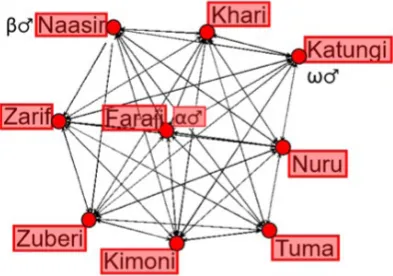
The social network of the pack at Safaripark Beekse Bergen during the first month after pack separation showed that the three males born in 2012 stayed separate from the other pack members (Figure 2). The dyadic proximity scores between pack members in Safaripark Beekse Bergen significantly increased after pack separation (Wilcoxon signed ranks test, Z=-2.833, n=21, P=0.005). The social network of the nine males in GaiaZOO showed that the relationships between dyads were homogenous by the second month after pack separation (Figure 3). The proximity scores also significantly increased for the nine males that were transferred to GaiaZOO (paired samples t-test, t=-12.462, n=36, P<0.0005). The increase in proximity scores applied to all males in GaiaZOO except for Katungi, which may be associated with his rank reversal from highest-ranking male in Safaripark Beekse Bergen to lowest-ranking male in GaiaZOO. Several other rank reversals took place after pack separation in both packs (supplementary table 1).
Behaviour
Individual changes in social and stress-related behaviour before and after pack separation for pack members in Safaripark Beekse Bergen and GaiaZOO are shown in Figure 4. After pack separation, the remaining pack at Safaripark Beekse Bergen showed a significant increase in aggression (paired samples t-test, t=-3.373, n=7, P=0.015; Figure 4a), affiliation (paired samples t-test, t=-5.649, n=7, P=0.001; Figure 4c) and dominant behaviour (Wilcoxon signed ranks test, Z=-2.197, n=7, P=0.028; Figure 4e), while the rate of submissive behaviour did not change (Wilcoxon signed ranks test, Z=-1.521, n=7, P=0.128; Figure 4g). Data from the nine males transferred to GaiaZOO showed completely opposite results. The rates of aggression (Wilcoxon signed-rank test, Z=-0.297, n=9, P=0.766; Figure 4b), affiliation (paired samples t-test, t=-0.996, n=9, P=0.349; Figure 4d) and dominant behaviour (Wilcoxon signed-rank test, Z=-0.770, n=9, P=0.441; Figure 4f) had not changed by the second month after pack separation, while submissive behaviour significantly increased (paired samples t-test, t=-3.515, n=9, P=0.008; Figure 4h). Next to changes in social behaviour, individuals in both packs showed a significant increase in stress-related behaviour after pack separation (Beekse Bergen: paired samples t-test, t=-7.289, n=7, P<0.0005; GaiaZOO: paired samples t-test, t=-6.698, n=9, P<0.0005; Figure 4i,j).
Discussion
The aim of this study was to determine whether pack separation of a socially unstable pack resulted in the formation of two stable packs and to provide recommendations for the captive management of African wild dogs. After the death of the alpha male in Safaripark Beekse Bergen, it was desirable to restore the complex social structure and limit the chance of inbreeding in the pack, so nine male littermates were transferred to GaiaZOO. Behavioural observations on the social relationships and behaviour of the packs before and after pack separation were performed to evaluate this management decision.
This study found that individuals from the same age-sex cohort had smaller rank differences and stronger social bonds, indicated Figure 2. Social network based on proximity scores for the individuals
that remained in the natal pack at Safaripark Beekse Bergen during the first month after pack separation. Different age-sex cohorts are depicted in different colours. Alpha (α) and beta (β) symbols indicate the highest-ranking males and females in the pack during the first month after pack separation.
by resting together more often, compared to individuals from different age-sex cohorts. This suggests that African wild dogs from the same age-sex cohort form coalitions, which means that they support each other during dominance interactions (de Villiers et al. 1997). In the wild, individuals from the same age-sex cohort usually emigrate together to start their own pack when they are between two and three years of age (McNutt 1996). Age-sex cohorts should thus be considered as reproductive units in the captive management of African wild dogs. This led to the recommendation that captive African wild dogs from the same age-sex cohort should remain together during transfers.
The dominance hierarchy of the original pack at Safaripark Beekse Bergen showed that the age-sex cohort of the younger males was higher-ranked compared to the age-sex cohort of the older males. Younger individuals forming coalitions against older siblings has previously been found in captive African wild dogs and spotted hyenas (de Villiers et al. 2003; Holekamp and Smale 1993). As the nine males born in 2013 outnumbered the three males born in 2012, the size of the cohort seems to be important and likely enabled the younger males to overrule their older brothers in the dominance hierarchy. This implies that large litter sizes in captivity may increase the chance of social instability with the associated rank reversals and increased aggression in the natal pack. However, how litter size relates to social instability and aggression after separation from the natal pack remains unclear.
In Safaripark Beekse Bergen, the first few days after pack separation were characterised by some minor aggressive encounters, searching behaviour, restlessness and ‘hoo’ calls (personal observation). Hoo calls are often heard when individual pack members become separated from the pack during hunting, so it is suggested that hoo calls indicate distress (Robbins 2000). Restlessness and vocalisations are proposed as behavioural indictors of stress in domestic dogs as well (Pastore et al. 2011). As scratching, yawning and body shaking are part of the natural behaviour of African wild dogs, the occurrence of stress-related behaviour does not directly imply high stress levels. However, the increase in stress-related behaviour after pack separation suggests that it may lead to short-term stress in captive African wild dogs. Furthermore, pack separation resulted in rank reversals, which have been observed in other African wild dog packs both in captivity and in the wild, especially during times when pack members disperse (Frame et al. 1979; de Villiers et al. 2003). All social behaviour in Safaripark Beekse Bergen increased during the first month after pack separation except for submission. Moreover, the social network shows a heterogeneous distribution with males and females forming separate subgroups. The social network, rank reversals, increased aggression and other changes in social behaviour imply that the remaining pack at Safaripark Beekse Bergen was socially unstable during the first month after pack separation. The zoo should try to arrange a transfer for the three remaining males to another zoo to gain social stability in the pack, but also to prevent inbreeding.
In GaiaZOO, behavioural observations showed that the order of the dominance hierarchy between the nine male littermates changed by the second month after pack separation. After arriving in GaiaZOO animal caretakers reported that two males obtained some injuries, which implies that the re-establishment of the dominance hierarchy in a new environment was accompanied by some aggression. Although aggression was not significantly increased during behavioural observations, submission and stress-related behaviour were still increased by the second month after pack separation. Furthermore, the social network of the nine males in GaiaZOO shows a homogenous distribution of social relationships between the pack members. Proximity scores increased, which indicates that males were more often together after pack separation than before. Being together
more often may be used as a coping style to reduce stress that was associated with pack separation. This may be comparable to grooming in macaques, which has been shown to lower the heart rate and decrease stress hormone levels (Boccia et al. 1989; Shutt et al. 2007). The increased proximity scores, homogenous social network and low rates of aggressive behaviour imply that the nine males formed a socially stable pack by their second month in GaiaZOO. Therefore, moving the nine male littermates was an appropriate captive management decision.
Recommendations for African wild dog zoo management
Zoos should transfer individuals as soon as offspring of the alpha pair reach sexual maturity or when social instability and increased aggression are observed in a pack. Animal caretakers can use proximity during resting as a quick and reliable indicator of pack stability. As noted before, age-sex cohorts should always be kept together when packs are separated. One factor that complicates the captive management of African wild dogs is the fact that social learning is extremely important for a cooperative breeding species. African wild dogs with experience in helping to rear pups make better parents themselves (Verberkmoes and Verberkmoes 2009), so offspring should stay in the natal pack until at least one litter is born. Zoos should thus find a balance between preventing social instability on one side and providing their African wild dogs with enough time to gain social skills in their natal pack on the other side.
Acknowledgements
The authors would like to thank Safaripark Beekse Bergen and GaiaZOO, with special acknowledgement to Kris Jansen, Emile Prins and the animal caretakers of the African wild dogs for their contributions. The authors also want to acknowledge dr. Han de Vries for his contributions with the statistics.
References
Boccia M. L., Reite M., Laudenslager M. (1989) On the physiology of grooming in a pigtail macaque. Physiology & Behavior 45(3): 667–670. Creel S., Creel N.M. (1998) Six ecological factors that may limit African wild
dogs, Lycaon pictus. Animal Conservation 1(01): 1–9.
Creel S., Creel N.M. (2002) The African wild dog: behavior, ecology, and conservation. Princeton University Press.
de Villiers M.S., van Jaarsveld A.S., Meltzer D.G., Richardson P.R. (1997) Social dynamics and the cortisol response to immobilization stress of the African wild dog, Lycaon pictus. Hormones and behavior 31(1): 3–14.
de Villiers M.S., Richardson P.R., van Jaarsveld A.S. (2003) Patterns of coalition formation and spatial association in a social carnivore, the African wild dog (Lycaon pictus). Journal of Zoology 260(4): 377–389. de Vries H. (1995) An improved test of linearity in dominance hierarchies
containing unknown or tied relationships. Animal Behaviour 50(5): 1375–1389.
de Vries H. (1998) Finding a dominance order most consistent with a linear hierarchy: a new procedure and review. Animal Behaviour 55(4): 827– 843.
Derix R., de Vries H., van Hooff J.A. (1993) Relationships in wolves (Canis lupus) and African wild dogs (Lycaon pictus) in captivity. In: Derix, R. The Social Organization of Wolves and African Wild Dogs: an empirical and model-theoretical approach. PhD Thesis, Utrecht University. Frame L.H., Malcolm J.R., Frame G.W., van Lawick H. (1979) Social
organization of African wild dogs (Lycaon pictus) on the Serengeti plains, Tanzania 1967–1978. Zeitschrift für Tierpsychologie 50(3): 255–249.
Girman D.J., Mills M.G.L., Geffen E., Wayne R.K. (1997) A molecular genetic analysis of social structure, dispersal, and interpack relationships of the African wild dog (Lycaon pictus). Behavioral Ecology and Sociobiology 40(3): 187–198.
management, and welfare. Oxford University Press.
IUCN red list of threatened species, ‘Lycaon pictus’ (IUCN, 2017) <http:// www.iucnredlist.org/details/12436/0> accessed 26 January 2017. McCreery E.K. (2000) Spatial relationships as an indicator of successful
pack formation in free-ranging African wild dogs. Behaviour 137(5): 579–590.
McNutt J.W. (1996) Sex-biased dispersal in African wild dogs, Lycaon pictus. Animal behaviour 52(6): 1067–1077.
Pastore C., Pirrone F., Balzarotti F., Faustini M., Pierantoni L., Albertini M. (2011) Evaluation of physiological and behavioral stress-dependent parameters in agility dogs. Journal of Veterinary Behavior: Clinical Applications and Research 6(3): 188–194.
(Lycaon pictus). Behaviour 137(10): 1271–1298.
Sapolsky R.M. (1983) Endocrine aspects of social instability in the olive baboon (Papio anubis). American Journal of Primatology 5(4): 365– 379.
Shutt K., MacLarnon A., Heistermann M., Semple S. (2007) Grooming in Barbary macaques: better to give than to receive? Biology Letters 3(3): 231–233.
van Hooff J.A., Wensing J.A. (1987) Dominance and its behavioral measures in a captive wolf pack. In: Frank, H. (editor). Man and wolf: advances, issues, and problems in captive wolf research. Dordrecht: Dr W. Junk Publishers. 219–252.