ISSN (Online): 2348 – 3539
CORRELATION BETWEEN THE RANDOM GRID AND DETERMINISTIC VISUAL
CRYPTOGRAPHY
Dr.B.L.Velammal
Assistant Professor, Computer Science and Engineering, Anna University, CEG Campus, Chennai
Abstract: Visual Cryptography method is an encryption technique that converts the text into binary image. To encode an image, it splits into‘n’ shadow image. For decoding image, it needs to select some subset of these shadow image and make transparencies and stacking on top of each other. Secret image encode into shadow image in the form of transparencies called shares where each participant receive one share.ie each participant holds a transparency. Two methods of visual cryptography are used in this paper.1.Random Grid Method introduced by Kafri and Karen.2. Deterministic Method introduced by Naor and Shamir. This paper shows that to develop a novel and efficient construction for both methods and to show the comparision between these two methods. The experimental results demonstrate feasibility, applicability and feasibility of our construction. The parameters are pixel expansion and contrast of image.
Index Terms—Cryptography, Visual Secret sharing, Random Grid Method.
Reference to this paper should be made as follows: B.L.Velammal(2014) ‘Correlation Between the Random Grid and Deterministic Visual Cryptography’, International Journal of Inventions in Computer Science and Engineering , Volume 1 Issue 4 2014.
I INTRODUCTION
In the fast growing world, the whole communication network are Hi-Tech. These are like Internet broadband, Wi-Fi and others made it easy to access multimedia within chunk of seconds. In the growing need of technology, three important things are needed ie database[1], network and security. Because huge bulk of data are transmitted from source to destination over to the public on daily basis. It is quite difficult to send and receive at other end in the same form, quality and quantity. It may cause various attacks. Encryption is a process of locking up the information whereas decryption is process of unlocking. But the cost of encryption and decryption is high.
Cryptography is a process to protect & conceal critical information from the reach of unauthorized users. Cryptography is a study of transmitting confidential data without the knowledge of unauthorized users available over the communication medium.
Through this process, a plaintext is converted into cipher text by using an encryption key and a decryption key is used at the receiver end to get the original plain text. In the modern digital network world, people transmit huge digital and multimedia information through public network. While
transmitting sensitive data in such networks, the most important thing is to secure data and a kind of cryptography should be used like Visual Cryptography Scheme (VCS). In VCS, the visual information is encrypted and decrypted using a mechanical operation. The image is divided into n shares and each share is printed on separate transparency content. Decryption was performed by overlying shares. To get the original shares, these n shares need to get overlaid. Sharing a secret with number of people is like only two of them are required to decode the secret and the shares appear random to others, containing no decipherable (cipher to plain) information about the secret image. Any two shares are stacked on top of one another the secret image becomes decipherable by human eye. So, they preferred Visual Secret Sharing scheme using Random Grid Technology and Deterministic visual cryptography. Random Grid was proposed by Kafri and Karen where Deterministic visual cryptography was proposed by Noar and Shamir[3].
to implement Visual secret scheme without pixel expansion. The (2,2) can be divided into (2,n) and (n,n).In (2,n),the recovered image quality is improved where in (n,n),the meaningful shares are constructed so that management of shadows becomes efficient and chance of secret image encryption is reduced.Image encryption schemes of pictures and shapes with random grid to encrypt secret image into two random grids.The 2D array of image pixel is generated randomly such that fully transparent denotes’0’ and opaque as ‘1’.When two random grids are stacked, information of secret image is visualized by human eye.
In this study, Random Grid for General Access Structure is presented. The information to be encrypted is encoded into number of grids, by which only the qualified sets can decipher the secret information and forbidden sets cannot. The secret pixel corresponds to one pixel in reconstructed images.They use complementary matrices to share a black pixel and identical matrices to share a white pixel. By overlapping two shares, the resultant pixel will be while when two white pixels overlap and black pixel when the pixel is alternate. This implies that the superimposition of the shares will help to reconstruct the original information.
Traditional Deterministic Visual Cryptography process is done with pixel expansion m: each share is m times the size of the secret image, that is, each pixel of the secret image is expanded into m pixels. The deterministic model requires m ≥ 2 so it need large image to set the secret pixel.
II RELATED WORK
Probabilistic Model
The probabilistic model of the visual cryptographic scheme was first introduced by Ito etal. This model is based on the basis matrices, but only one column of the matrices is taken to encode a binary secret pixel, whereas in the traditional visual cryptography scheme the whole basis matrices is used. The size of the generated transparencies is identical to the secret image. Yang also proposed a probabilistic model of visual cryptography scheme, [6]and the two cases and are explicitly constructed to achieve the optimal contrast. Yang proposed a generalized visual cryptography scheme, in which the pixel expansion is between the probabilistic model of VC scheme and the traditional VC scheme.
In particular, the random grid schemes can be transformed into probabilistic schemes with no pixel expansion. Moreover it is observed that γRG≤ γPR,
where γRG is the contrast used in the random grid
model and γPR is the contrast used in the probabilistic
model. To prove the results getting from both the random grid model and deterministic model must be
is equalto one of the contrast measures proposed for the deterministic model.
Image Contrast
The contrast of image denotes the separation between the darkest and brightest areas of image.When the contrast of image is low,number of reversing based cisual cryptographic scheme have been proposed for binary secret image allowing participants to perform reversing operation on shares.In application of gray scale VCS,contrast is lower than of binary cases.When the contrast increses with increases of separation making shadows darker and highlights brighter.
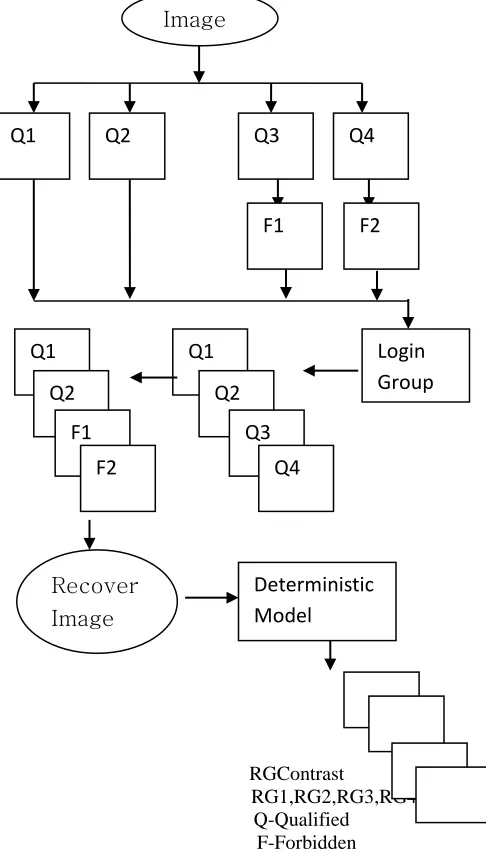
III ARCHITECTURE DIAGRAM
RGContrast
RG1,RG2,RG3,RG4 Q-Qualified F-Forbidden
Fig No 1.Block Diagram
Image
Q2
Q3
Q1
Q4
F1
F2
Login
Group
l
lo
lo
Login
‘g
Q1
Q2
Q3
Q4
Q1
Q2
F1
F2
Recover
Image
image
IV. MODULES
1.Random Grid
2.General Access Structures 3.Recover image
4.Deterministic Model
Random Grid
In visual cryptography we can handle only the Binary images. So we convert the color images in to binary image. After that split the image based on the OR operation first we split the two share from the original image.[13] In the existing random grids based (n, n) visual secret sharing (VSS) schemes, decryption is done with the help of human visual system by overlapping the cipher grids[8]. This operation is computationally modelled as Boolean OR operation, which suffers from two drawbacks.
Firstly, the contrast of the reconstructed image decreases exponentially by increasing n (≥2) and secondly, it requires perfect alignment of stacking the cipher grids.[9] So, in Boolean XOR operation as decryption operation for the existing random grids based (n, n) VSS schemes is used.The proposed operation removes both the drawbacks and does lossless secret reconstruction[10].
Average Light Transmission:
λ◦ and λ• are the average light transmission parameters of the scheme. Average Light Transmission can be calculated as ratio of number of white pixel in both the shares to the total number of pixel in both the share
.
Two Properties:
The first property is the contrast condition, in which the secret image will be visible by superposing the shares of a qualified set of participants. The second property is the security property from which a single share or from the superposition of the shares of a forbidden set of participants is finished,[5] .Black and white pixels are uniformly distributed and thus the condition λ◦(R) = λ•(R) is to say that the white area of the secret image is indistinguishable from the black area of the secret image.
Contrast. The reconstruction of image depends on the difference of the average light transmission between the white and the black areas of the secret image. [4]Papers that have considered random grid schemes have used the following definition of contrast. Given a random grid scheme S, with average light transmission parameters λ◦ and λ•, the contrast of S is:
γRG(S) = λ◦ − λ•
1 + λ• .
SCHEMES
We consider the random grid schemes of Kafri and Keren which provides (2, 2)-threshold schemes. These four schemes are called RG1, RG2,RG3 and RG4.
Scheme RG1
RG1 constructs first share as uniform random grid and second share by assigning to pixel the same color as white an opposite color as black. The representation with distribution matrices of RG1, that is, the equivalent scheme in the probabilistic model, is described by
This denotes shares and the superposition of the two shares that reveals the secret image. All shares are uniform random grids.
Average Light Transmission = 1/2 λ•(RG1)=0 λ◦(RG1)=1/2
γRG = λ◦- λ• = 0.5-0/1 = 0.5 1+ λ•
Scheme RG2
Scheme RG2 generates again the first share as a uniform random grid. The second share is equal to the first when the secret pixel is white but if the secret pixel is black then also the second share is chosen at random. Scheme RG2 is described by the following collections:
Average Light Transmission = 1/2 λ•(RG2) = 0.5
λ◦(RG2) = 0.25
γRG = λ◦- λ• = 0.5-0.25 = 0.25 1+ λ• 1.25
Scheme RG3
In this scheme the first share is again generated at random while the second one is also generated at random if the secret pixel is white, and is the “opposite” of the first share if the secret pixel is black. Using distribution matrices, scheme RG3 is:
Average Light Transmission = 1/2 λ◦(RG3)=0.25 λ•(RG3)=0 γRG = λ◦- λ• = 0.25
uniform grids where each share has more white pixels than black. Scheme RG4 is described by the following collections
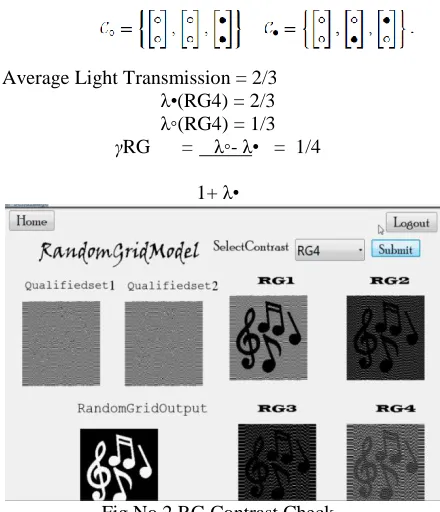
Average Light Transmission = 2/3 λ•(RG4) = 2/3 λ◦(RG4) = 1/3 γRG = λ◦- λ• = 1/4
1+ λ•
Fig No 2.RG Contrast Check
General Access Structure
The shares will decode the secret image where there will be less security level.So in order to overcome these problems,it is extended to an access structure (Q,F).It is a specification of the qualified subsets of participants and of the forbidden subsets of participants. Qualified sets of participants have to be able to visually recover the secret image by superposing their shares. [2]Forbidden sets of participants must not have any information about the secret image from the shares. Sent to the participants with key.Qualified can decrypt the secret image by no knowledge by stacking of shares.Stacking the disqualified shares are done.Thus construction of these schemes helps to increase the size and decode the quality of image even the values of gray levels reaches 256.
Recover Image
Each participant login with the group name and enter those participants user id and key.Open the shared image in the form of encryption change the forbidden images into qualified format now merge the four qualified images and get the original image.
Deterministic Model
Existing System is Deterministic Visual Cryptography. Visual cryptography was originally invented by Moni Naor and Adi Shamir in 1994
qualified sets and merge get the original image.Check the contrast of Random Grid Model RG1, RG2, RG3, RG4.
The (k, n) Visual Cryptography Scheme can decode the images without any cryptographic computations. It consists of black and white pixel for sharing single secret. The secret image is divided into exactly two random shares i.e. Share1 and Share2. To get the original image, both shares are to be stacked together.[11] When two shares are superimposed, if two white pixels overlap, the resultant pixel will be white and if a black pixel in one share overlaps with either a white or black pixel in another share, the resultant pixel will be black. thus superimposition of the shares are done[12].
Two shares are generated for each image encryption.While decryption requires these two shares to be superposed. In Visual Cryptography Scheme, all n shares have equal importance. It may compromise the security of system. [5]In this model,pixel expansion ‘m’ is done ie each share is m times the size of the secret image, that is, each pixel of the secret image is expanded into m pixels. The deterministic model requires m ≥ 2 so it need large image to set the secret pixel.
To achieve a deterministic reconstruction we must expand the secret image: each pixel of the secret image will be represented as a collection of m pixels, m ≥ 2. Parameter m is called the pixel expansion of the scheme. Deterministic schemes consist of two multi sets of n × m distribution matrices, one for black secret pixels and other for white secret pixels.
Each single element of the distribution matrices represents a pixel in a share. Each row in a distribution matrix represents a particular share, i.e., the m subpixels of the share. Each matrix represents a
set of n shares, one per participant.The row i represents the shares for participant.
Contrast: In deterministic model, the contrast of a image is defined as scheme S with contrast threshold parameters l and h with pixel expansion m is defined by Noar and Shamir as follows,
γNS(S) = h −l
m.
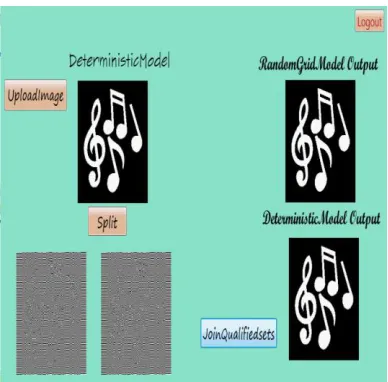
Comparing both models: In this paper,to prove that the contrast of image used in both the models such as random grid and deterministic model must be equal to one another.ie γRG, the contrast measure used
in random grid model and contrast measure γNS ued in
deterministic must be equal.The result will be γRG=
γES,The output getting from both the models must be
Fig No 3 Comparision work on both models
In random grid model, splitting of image into shares as qualified set of participants and forbidden set of participants in which qualified set of participants knows the secret from the original image where the forbidden set of participant does not reveal the secret from the original image. Random grid is done without pixel expansion. The deterministic model splits the shares into two shares as qualified set of participants and it is done with pixel expansion. In order to provide perfect secrecy and maximum clarity of recovered secret image[7],most researchers use the concept of pixel expansion.ie each pixel of binary secret image is encoded into m sub pixels on each share ‘m’ denotes the pixel expansion. By analysing any blocks of m sub pixels of forbidden set of shares, one cannot distinguish which colour was used in secret pixel. Qualified set are stacked up, black secret pixel to get the black sub pixel.
Thus proved that there is a strong connection between the random grid model and the deterministic model. Each random grid scheme has a corresponding deterministic scheme with similar characteristics and vice versa. This allows using results known in a model in the other model.
Conclusion:
Thus by creating group, register the details of the participant and login to the group. After registering the details of the participant, sender has to upload the image. If the uploaded image is colour then convert into binary image because in visual cryptography, it handles only binary image. Then splitting of shares are done where it can be split into four as qualified and forbidden set of shares in
order to avoid from hackers. By selecting the group, sender can send the image to other group members along with their user name and password .The user generate the random key along with their name and send to the receiver.
The receiver receives two set of qualified and two set of forbidden shares. They merge and convert these two forbidden to get the qualified one. Therefore by applying deterministic model that is done with pixel expansion, merging is done to recover the original image. Then after recovering the orinal image from the sender, the Random Grid contrast check is measured using the above four schemes mentioned earlier. Thus the relation among the random grid model and deterministic visual cryptography is proved to be same by using various performance analysis.
REFERENCES
[1] A. Adhikari and S. Sikdar, “A new (2,n)-visual threshold scheme for color images,” in Proc. 4th Int. Conf. Cryptol., Dec. 2005, pp. 148–161.
[2] G. Ateniese, C. Blundo, A. De Santis, and D. R. Stinson, “Visual cryptography for general access structures,” Inf. Comput., vol. 129, no. 2,pp. 86–106, Sep. 1996.
[3] G. Ateniese, C. Blundo, A. De Santis, and D. R. Stinson, “Extended schemes for visual cryptography,” Theoretical Comput. Sci., vol. 250, pp. 143–161, Aug. 2001.
[4] C. Blundo, S. Cimato, and A. De Santis, “Visual cryptography schemes with optimal pixel expansion,” Theoretical Comput. Sci., vol. 369, nos. 1–3, pp. 169–182, Dec. 2006.
[5] C. Blundo, A. De Bonis, and A. De Santis, “Improved schemes for visual cryptography,” Des., Codes Cryptogr., vol. 24, no. 3, pp. 255–278, Dec. 2001.
[6] C. Blundo, P. D’Arco, A. De Santis, and D. R. Stinson, “Contrast optimal threshold visual cryptography schemes,” SIAM J. Discrete Math., vol. 16, no. 2, pp. 224–261, 2003.
[7] C. Blundo and A. De Santis, “Visual cryptography schemes with perfect reconstruction of black pixels,” J. Comput. Graph., vol. 22, pp. 449– 455, Jan. 1998.
(2,∞) visual secret sharing by generalized random grids,” J. Vis. Commun. Image Represent., vol. 23, no. 4, pp. 677–684, May 2012.
[11] T.-H. Chen and K.-H. Tsao, “Visual secret sharing revisited,” Pattern Recognit., vol. 42, no. 9, pp. 2203–2217, Sep. 2009.
[12] T.-H. Chen and K.-H. Tsao, “Threshold visual secret sharing by random grids,” J. Syst. Softw., vol. 84, no. 7, pp. 1197–1208, Jul. 2011.