
ISSN: 2151-7452
Cook County Green Corps
African American Trainee Experience in a
Green Job Training Program
Lena Hatchett
Loyola University Chicago
Susan Ask
Animalia Project; formerly University of Illinois Extension, Cook County
Nancy Pollard
University of Illinois Extension
Loretta Brown
Maywood Environmental Beautification Commission
Abstract. This case study describes the Cook County Green Corps program, a green job
training program serving African American young adults from a low-income neighborhood. The program was implemented by an interdisciplinary organizing team to build knowledge, skills, and participation in sustainable jobs and urban agriculture among young adults. The trainees’ experience was documented by a program evaluation survey, environmental knowledge survey, and 1 year reflection interview. We summarize the experiential design, implementation and evaluation of the program. We discuss the limitations and the benefits of the program for trainees and the neighborhood. We share recommendations for future green job training programs that can best serve urban neighborhoods.
Journal of Sustainability Education http://www.susted.org/
Cook County Green Corps Trainees and authors Lena Hatchett, Loretta Brown, Nancy Pollard photo by Susan Ask
Introduction
Cook County Green Corps (CCGC) was a five-month green job training program designed to meet the needs of low-income young adults eligible for the Workforce Investment Act (1998). CCGC was developed in partnership with an organizing team of faculty, staff and trainees from Maywood Environmental Beautification Commission, Loyola University Stritch School of Medicine, University of Illinois Extension Cook County Horticultural program and Cook County Presidents Office of Employment and Training. The goal of the program was to prepare trainees for green jobs (Pinderhughes, 2006) through experiential education in environmental
coursework, garden work, farm work, community outreach and field trips. The purpose of this paper is to describe the program implementation, and impact and lessons learned from the experiential education components. We offer recommendations for future green job training programs serving urban African American communities.
September 2014 ISSN: 2151-7452
effectively meet the needs of young adults who may have dropped out of high school and have limited work experience (Bloom, 2010). The neighborhoods with high rates of high school drop outs are the same neighborhoods with high job losses, environmental pollution, and food
insecurity. Effective green job training programs can help bridge the gap in low income communities by preparing young adults to enter green collar jobs (Pinderhughes, 2006), build awareness of social justice issues and support positive community development efforts
throughout the process. To date there is little documented work on trainee experience in green job training and follow-up experience. There is a need for more policies and systems that prepare workers for green jobs (Cleary & Kopicki, 2009). To date the green job training experience and impact for the individuals and the communities needs to be documented.
Training program overview
CCGC training incorporated hands-on, experiential learning and classroom-based instruction on sustainability and life skills. There was a heavy emphasis on creating learning experiences that would resonate with trainees who had mixed experience and success in traditional classroom instructional settings. The program included 3 days of outdoor, experiential learning each week and only one day of classroom instruction. One day per week was devoted to developing life schools, which included interactive instruction, writing, demonstrations and other skill-building activities. The hands-on elements of the program are described in more detail in the
Implementation section.
Neighborhood Description
CCGC was established in Maywood, IL which is located in the west suburbs outside Chicago. Maywood has a population of approximately 25,506 residents of which 28% are youth (18 and under); 82.7% of the population is African American, 5.5% of the population is Caucasian, and 10.5% is of Hispanic origin. 53.2% are women. 36.5% of the population is below 200% the federal poverty level. Approximately 10,914 (43%) Maywood residents are enrolled in Medicaid. Unemployment rate for 2010 was 14.9%. Education Attainment is low; the high school
graduation rates are 51.9% for males and 68.8% for females (Illinois Public Health Institute, 2012). The food insecurity rate in Maywood is 23%, one of the lowest in west suburban Cook County (Greater Chicago Food Depository, 2011). Food security defined as “access by all people at all times to enough food for an active, healthy life” (USDA) is limited in African American communities. Low-income African American communities experience fewer full scale grocery stores, poorer quality produce, and higher prices for produce than white communities (Block & Kouba, 2006; Larson, Story, & Nelson, 2009; Zenk, Schulz et al, 2005; Zenk , Odoms-Young, et al 2011). To improve food security community organizations in partnership with government and universities across the country have created urban agriculture programs.
Trainee Description
Journal of Sustainability Education http://www.susted.org/
Staff generated daily reports which summarized the two groups of trainees’ behavior and progress on work tasks and hands-on assignment. Through these daily reports andregular
communication trainees shared some of the social and personal challenges affecting them during the program. Two trainees had unplanned pregnancies during the program. One trainee dropped out of the program early in the pregnancy and the other worked in the program until a few weeks before her due date. Two brothers became homeless and dropped out of the program in the last month as they struggled to find secure housing. One trainee missed work for several days while being investigated by police. Four other trainees were victims of violent crimes including robbery, guns, and a shooting of a family member during the 5 month program. Urban green space and initiatives have been related to local crime reduction in recent studies. (Kuo & Sullivan, 2001; Kuo, Sullivan, Coley, & Brunson, 1998).
Role of the Organizing Team
The organizing team was made of four colleagues from diverse disciplines and organizations; 1 public health faculty member (LH) from Loyola Stritch School of Medicine, 2 extension
educators (NP, SA) from University Illinois Extension and 1 Extension Master Gardener (LB) from Maywood Environmental Beautification Commission. Extension and short term partners provided additional education and training staff; 3 young adult supervisors, 5 guest lecturers and speakers. They covered session on life skills, job readiness and green career development. The organizing team trained together on the Roots of Success curriculum (Roots of Success, 2009). The team met in person and via teleconference for 6 weeksto design, plan and implement the
program. During the program the organizing team was responsible for teaching, supervising and managing the diverse training activities in the program. As a result each member of the
organizing team had the opportunity to work closely with trainees during experiential elements of the program.
Methods
Data Collection
The organizing team used three methods for collecting data: Trainee Program Evaluations, Trainee Environmental Knowledge Survey and follow-up interview. The data collection process was carried out between April 2010 and September 2011. The study was approved by the Institutional Review Board at Loyola University Chicago.
Trainee Program Evaluation Survey
Trainees were invited to give written responses to a 12 item open-ended survey at the end of the program. Questions asked trainees to describe which experiences in the program help to build their life and work skills and increase their environmental knowledge and awareness e.g.
questions “Describe which experiences in the program have helped to develop your work skills”.
Trainee Environmental Knowledge Survey
September 2014 ISSN: 2151-7452
environmental issues” and “how important is it for you to change your everyday habits to help the local environment”.
One Year Reflection Interview
One year after the program was completed two trainees were interviewed about their experience in the program. The questions were part of a larger study on African American leadership in urban agriculture. The current case focused on individual and community impact 1 year after the program was completed.
Planning and Timeline
After a 1-day intensive initial planning meeting, the organizing team met regularly from April 2010 to September 2010. Planning meetings covered learning objectives, garden design, in-service topics and teachers, scheduling, field trips, budget, supplies and supervision. The project had extremely limited planning time; we began planning in April and the program launched in June.
Implementation
Program Schedule
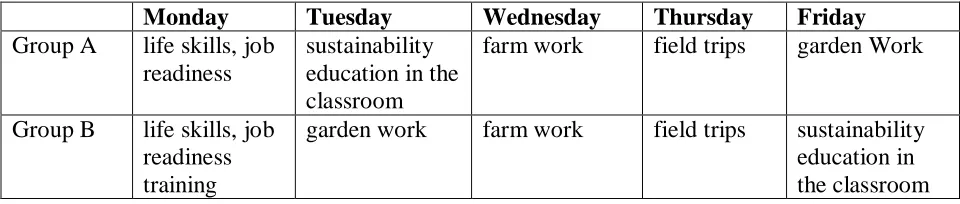
The Cook County Green Corps program integrated experiential learning with classroom instruction. The trainees were split into two groups with activities alternating by days of the week. Every week, the trainees engaged in experiential learning about sustainability that
included hands-on gardening, farm work and field trips. A typical week followed this schedule and experiential learning:
Table 1: CCGC Program Schedule
Monday Tuesday Wednesday Thursday Friday
Group A life skills, job readiness
sustainability education in the classroom
farm work field trips garden Work
Group B life skills, job readiness training
garden work farm work field trips sustainability
education in the classroom
Garden
Journal of Sustainability Education http://www.susted.org/
installed wood chipped paths, planted vegetable seedlings and planted seeds for flowers and vegetables. Throughout the summer, the trainees tended the garden. They harvested their locally grown, pesticide-free vegetables and flowers which were sold at a weekly farmers market in the community.
A 40’ x 40’ French style ornamental kitchen garden or potager was chosen for its form, function and beauty. Trainees staked out the beds and painted lines on the grass where the beds would be. A removable construction fence was rented and put in place to guard the garden. To raise the planting beds, 2” x 10” pine boards were staked and joined for the exterior walls. The free chips formed the interior walls of all the raised beds. For the 10” deep planting beds, a mixture of half and half compost and garden soil was purchased. It was laid over a weed barrier of several layers of damp newspaper. Garden paths, five or six foot wide, were created using a 10” layer of woodchips, also underplayed with newspaper as a weed barrier. Wood chips were donated. Large numbers of tools for installation day were also borrowed. Municipal Public Works departments often loan tools. We obtained rain barrels from the Metropolitan Water Reclamation District that the fire department agreed to refill on a weekly basis. (We have since learned that rain barrels should not be used for watering edible gardens, unless specific
conditions are met because of the potential for E. coli and other potentially serious pathogens.) A local greenhouse grew transplants for us and delivered them on planting day, so they did mature in a timely fashion.
Field trips
September 2014 ISSN: 2151-7452
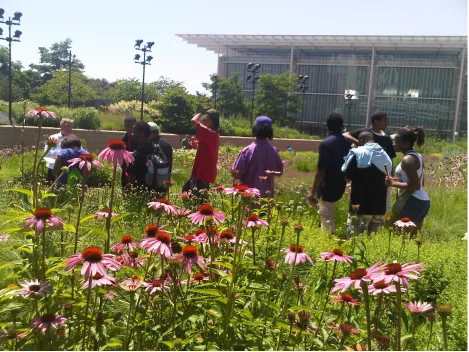
Trainees tour Lurie Gardens at Millenium Park in Chicago. Photo by Susan Ask.
Table 2: CCGC Topics and Field Trips
Topic Field Trip
Intro to Veggies
Smart Home/Museum of Science and Industry
Lurie Garden/Millennium Park Ginkgo Organic Gardens
Water Chicago Botanic Garden
Transportation and Waste
Angelic Organics Learning Center
Journal of Sustainability Education http://www.susted.org/
Food and Agriculture
International Food Market Maywood Library
Community Tour Project Uplift
Energy World’s Largest Laundromat
Chicago Center for Green Technology
IIT Smart Grid Center
Building & Conclusion
ILCA field day (IL Landscape Contractors Association)
Green building Christy Webber Landscapes
Garfield Park
Notebaert Nature Museum Calumet
Extended program Lincoln Marsh Natural Area
Exelon Solar City Rebuilding Exchange Rebuilding Exchange
Farms
The trainees spent one day each week working on small suburban farms to learn how food production scales up to larger production. The entire group of trainees worked together at a not-for-profit farm at the far western edge of the suburbs and at the farm of the Chicago High School for Agricultural Sciences on the south side of Chicago. Trainees travelled to the farms by bus and spent the day working on the farms; typical work included planting, harvesting and weeding vegetable crops. They were supervised by trainee leaders and farm staff.
Program Evaluation
Evaluation Survey
September 2014 ISSN: 2151-7452
“I liked learning about the garden and stuff because before that I wasn’t big on eating healthy or any of that. So, it kind of made me start paying attention to my health and eating healthier.”
“Actually, learning more about the product we were growing. I liked that a lot. That was nice and actually cooking it, too”.
Trainees also described the field trips. When asked about what they learned, many trainees talked about their visit to the ‘Smart Home’ a sustainable, demonstration home at the Museum of Science and Industry in Chicago. They learned that a ‘green home’ could be beautiful and technologically advanced. This site seemed to resonate with the trainees, who could happily imagine themselves living in a house like the one they visited.
“In the smart home [I learned] the importance of recycling”
Trainees were asked to describe which experiences increased their awareness of environmental issues. Responses suggest the field trips increased the environment awareness for some trainees
“There are houses such as green houses”
Environmental Knowledge
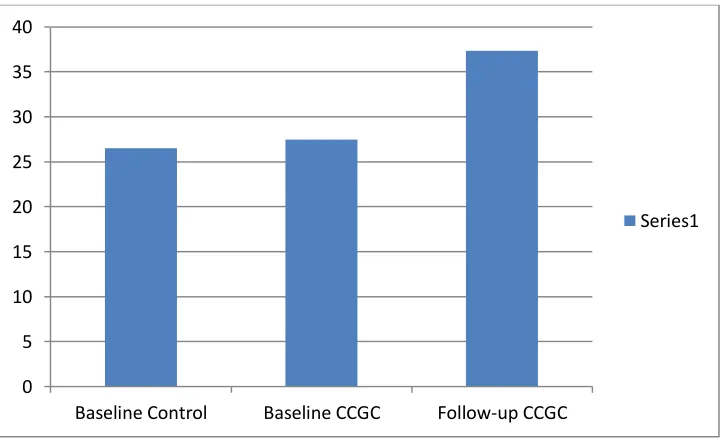
The environmental awareness and knowledge survey was taken at baseline and 4 month during the program to assess the change in environmental awareness and knowledge as a result of the program. The summarized data showed an increase in environmental awareness and knowledge. Figure 1 provides the average total score at baseline and follow-up for the trainee control group and the CCGC trainee group. 95% Confidence Interval for the Difference (-15.9059, -10.6241),-Value -10.3061, P--10.6241),-Value = < .00001
Table 3: Environmental Knowledge
0 5 10 15 20 25 30 35 40
Baseline Control Baseline CCGC Follow-up CCGC
Journal of Sustainability Education http://www.susted.org/ One year Reflection Interview
The follow-up survey captured trainees’ reflection of the program after one year. The
experiential element engaged trainees who weren’t otherwise interested in a green job training program Review of the transcript highlight four consistent themes about the impact of the program; 1) attitude change 2) community engagement, 3) heartfelt loss and 4) personal and environmental benefits.
Trainee Engagement
“I learned a lot of things I never thought would want to do. What I liked about it is it is much more to it than just garden work or agriculture work. I mean it’s a lot of other stuff that comes in like teamwork, responsibility, and meeting people.
“Damn. Boy, I never thought this much would come out of this program”
Trainees were asked what surprised them most about the program and many of them said they welcomed the program in urban agriculture as a new and different experience:
“It was different. I never would have planted no garden”
“Yeah, the Prairie Path looked bogus before but now it’s straight”
Community Engagement
Trainees discussed the positive affect the program had on the community and their engagement with their neighbors. They described the program as being an opportunity to inform and educate parents and children about sustainability and urban environmental issues.
“When we had the visitors come, we told them about things we built and ….we taught the younger kids, when they came in. We showed them the things that you showed us”.
“Once people found out what we were doing, it was a lot of random people that walked up. Then, we would explain to them, yeah, we’re working for such and such and we’re doing this. We built this garden and we do this. As we explained the program, a lot of people were asking about it and how could they get involved or how could their children get involved.”
“I can show my son, one day, like, ’We built that garden’.”
Not all trainees felt that they were contributing to the community and staff had to keep their expectations of program impact realistic. I really don’t feel like were benefiting the community, were not doing anything but putting in a few gardens and flower beds. Maybe I’ll feel
differently after Open House [a community open house where students provided garden tours for the community].
Feedback from the community was important to the trainees:
September 2014 ISSN: 2151-7452
“It gave a lot of people a different look on the youth of Maywood or Broadview because they probably think, “Oh, they just run the streets,” but when they seen a lot of kids they probably thought ran the streets doing something positive, it gave them a different look on us. Maybe he is trying to help better himself and do things. Then, they see you guys out trying to help us, that gave them, “Oh, we can help, too.”
Heartfelt Loss
Trainees expressed hope that the program would continue into the future to provide opportunities for more youth and enrich the community. There was much disappointment when trainees
realized the program could not be sustained in the next year. Trainees lament the loss of the program and the garden:
“It’s like we gave the people something and just when they started to reach out and grab it, we took it away from them. So, now, it’s like now they don’t care again. Once we had them. We had them on their heels.”
“You have kind of flashbacks. That was fun out there… I kind of miss it. Honestly I want to get back involved. I want the program back”.
Personal and Environmental Benefits
In addition to the community impact of the program, trainees described the impact the program had on them personally through health awareness, teamwork, and caring for the community. They discussed how the program helped them to become more responsible and proud of their abilities and work.
“I liked learning about the garden and stuff because before that I wasn’t big on eating healthy or any of that. So, it kind of made me start paying attention to my health and eating healthier”
“What I liked about it is it is much more to it than just garden work or agriculture work. I mean it’s a lot of other stuff that comes in like teamwork, responsibility, and meeting people.”
“We excited because we built it”
“We actually took our stuff and grew it. We had a goal and we made it.”
“we were just looking for a paycheck but as it went along, we started to learn and
memorize and when we go home, we see the things like, I remember, I just learned this in class. Or, I just seen this. Or, we see some food that we pick up in the grocery store and we remember, we grow this in our garden. This is more healthier than what this is here. It came out good because we learned more. So, my attitude changed more positive.
Journal of Sustainability Education http://www.susted.org/ Employment and Health
Three trainees obtained employment as a result of their participation. One in food service, two with a local park district. One participant lost significant weight and informs others about the importance of exercise, gardening, and healthy food.
Recommendations for Future Green Job Training Programs
Supervision
Each of the organizing team members had extensive experience in their respective fields working young adults. However, a major challenge to our program implementation was the increased enrollment size. We anticipated 15-20 trainees but when the program started we had 32 trainees with diverse educational backgrounds and needs. We had too few full time staff members to effectively supervise all activities comfortably. We recommend a 10 to 1 ratio between trainees and staff to supervise, guide, train and manage hands-on activities comfortably.
Youth Advisory Committee
As a program improvement, trainees recommend establishing a young adult advisory committee which represents the neighborhood being served. This committee will help bridge gaps between faculty staff from outside neighborhoods and trainees as unique local challenges occur. The steering committee should also be involved in the outreach, recruitment, and selection process for new trainees.
Logistics, scheduling and Work Site Investment
A repeated complaint from many trainees was the struggle of working daily in high
temperatures. The program supplied a few shade tents, but the tents were not enough to make a comfortable, let alone inviting, experience on many hot days during the summer. We recommend future projects limit garden and farm work to the first half of the day, to taken advantage of the cooler morning temperature. This would be less stressful for the trainees and for the garden plants. We had initially intended to schedule outdoor work for the mornings, but logistical limitations made this very difficult to accomplish. In the end, we feel the program would have been better served if we had maintained or initial intent despite the logistical hurdles. Many of the trainees were not used to working outside, so this was a significant negative issue for them. In addition, adequate shade tents and sun hats would give trainees more comfortable break areas while working in the outdoors.
Additionally, we encountered several challenges installing the garden. First, the ground was heavily compacted from vehicle and foot traffic. We had a limited budget for security fencing, soil and lumber so the gardens had to be square and fairly small to limit fencing costs. There was no water on site, except a fire hydrant, which only the fire department could access. The planning time was very limited. We first heard rumors of the potential project in March, was introduced to a new curriculum in April, and met to plan in May and June. The garden was to be planted July 1, which is very late for Illinois, and provided a limited window for growing
September 2014 ISSN: 2151-7452 Future activities
The program provided weekly field trips and community tours and an open house which were effective and memorable experiences for the trainees. Trainees recommend more community events and activities in future programs, for example bringing in a sports tournament to engage young people.
“The first thing they’re going to do is, “I don’t want to do it.” And, they’re going to wave it off. So, it’s like, we have to bring more things into it. We can bring a sport in with it that has to do with like you said extracurricular for them to get involved with it. Like maybe basketball, maybe a tournament or something like that, but it would still have to be a learning process”
Trainees recommend more opportunities for community presentation, education, and outreach. Relationships with local community partners need to be established during the program design phase for this to occur. Our trainees presented at the Department of Juvenile justice, Proviso Action Committee, and Park District organizations and programs in the west and south suburbs of Chicago.
Conclusions
Journal of Sustainability Education http://www.susted.org/ References
Austin, Algernon, “The crisis of African American Unemployment Requires Federal
Intervention” August 2012 Web. 31 Jan 2013 Retrieved from
<http://www.hhh.umn.edu/centers/rwc/conferences/fourth/pdf/AlgernonAustin-TheCrisisofAfricanAmericanUnemploymentRequiresFederalIntervention.pdf>
Block, D., & Kouba, J. (2006). A comparison of the availability and affordability of a market basket in two communities in the Chicago area. Public Health Nutrition, 9(07), 837-845.
Bloom, D. (2010). Programs and policies to assist high school dropouts in the transition to adulthood. The Future of Children, 20(1), 89-108.
Cleary, J., & Kopicki, A. (2009). Preparing the workforce for a “Green jobs” economy. Rutgers, NJ: John J.Heldrich Center for Workforce Development,
Greater Chicago Food Depository, 2011 Food Access in Suburban Cook County, March 2012, Chicago State University, Cook County Department of Public Health Retrieved from
Loyola University Health System Community Health Needs Assessment Report Retrieved
from <http://loyolahealth.org/sites/default/files/site_lm/chna-report.pdf>
Illinois Public Health Institute (June 2012) Loyola University Health System Community Health
Needs Assessment Report Retrieved from
<http://loyolahealth.org/sites/default/files/site_lm/chna-report.pdf>
Kuo, F.E., & Sullivan, W.C. (2001). “Environment and crime in the inner city: Does vegetation reduce crime?” Environment and Behavior, 33(3), 343-367
Kuo, F. E., Sullivan, W. C., Coley, R. L., & Brunson, L. (1998). Fertile ground for community: Inner-city neighborhood common spaces. American Journal of Community
Psychology, 26(6), 823-851.
Larson, N. I., Story, M. T., & Nelson, M. C. (2009). Neighborhood environments disparities in access to healthy foods in the US. American Journal of Preventive Medicine
Pinderhughes, R. (2006). Green collar jobs. Race, Poverty and the Environment: A Journal for Social and Environmental Justice.Urban Habitat Program.Summer,
USDA (n.d.) Food Security in the U.S. Retrieved November 16, 2012, from
http://www.ers.usda.gov/topics/food-nutrition-assistance/food-security-in-the-us.aspx
Zenk, S. N., Odoms-Young, A. M., Dallas, C., Hardy, E., Watkins, A., Hoskins-Wroten, J., & Holland, L. (2011). “You have to hunt for the fruits, the vegetables”: Environmental barriers and adaptive strategies to acquire food in a low-income african american
September 2014 ISSN: 2151-7452
![Australian industrial relations in a south east Asian context by Stanley Petzall, Nils Timo and Keith Abbott [Book review]](data:image/gif;base64,R0lGODlhAQABAIAAAP///wAAACH5BAEAAAAALAAAAAABAAEAAAICRAEAOw==)