,,
Frequency conversion
in nonlinear optical -waveguides:
from classical to quantum applications
A thesis submitted for the degree
of Doctor
of Philosophy
of
Australian National University
Alexander Solntsev
,,
Declaration
This thesis is an account of research undertaken in the Nonlinear Physics Centre within the Research School of Physics and Engineering at the Australian National University between May 2009 and April 2013 while I was enrolled for the Doctor of Philosophy degree.
The research has been conducted under the supervision of A/Prof. Andrey A. Sukhorukov, A/Prof. Dragomir N. Neshev, and Prof. Yuri S. Kivshar. However, unless specifically stated otherwise, the material presented within this thesis is my own.
None of the work presented here has ever been submitted for any degree at this or any other institution of learning.
d
,,
Publications
Journal
art
icles
1. A. S. Solntsev, F. Setzpfandt, A. S. Clark, C. W. Wu, M. J. Collins, C. Xiong, F. Eilenberger, A. Schreiber, F. Katzschmann, R. Schiek, W. Sahler, A. Mitchell, C. Silberhorn, B. J. Eggleton, T. Pertsch, A. A. Sukhorukov, D. N. Neshev, and Y. S. Kivshar, 11
Active Biphoton Quantum Walks,11
submitted for publication.
2. A. A. Sukhorukov, A. S. Solntsev, S. S. Kruk, D. N. Neshev, and Y. S. Kivshar, 11
Nonlinear coupled-mode theory for periodic wave-guides and metamaterials with loss and gain, 11
submitted for publication, http://arxiv.org/ abs/1309.2807
3. A. Sergeyev, R. Geiss, A. S. Solntsev, F. Schrempel, E.-B. Kley, T. Pertsch, and R. Grange, 11
Second-harmonic generation in lithium niobate nanowires for local fluorescence excitation,11
Optics Express, 21, 19012 (2013)
4.
t
o.
M. Markin, A. S. Solntsev and A. A. Sukhorukov, "Nonlinear waveguide arrays for discrete orbital-angular-momentum-entangled biphoton state generation," Physical Review A, 87, 063814 (2013)5. A. A. Sukhorukov, A. S. Solntsev, and J. Sipe, 11
Classical simulation of squeezed vacuum in optical waveguide arrays, 11
Physical Review A, 87, 053823 (2013)
6. A. S. Solntsev, A. A. Sukhorukov, D. N. Neshev, and Y. S. Kivshar, "Photon-pair generation in arrays of cubic nonlinear waveguides," Optics Express, 20, 27441 (2012)
7. M. Grafe, A. S. Solntsev, R. Keil, A. A. Sukhorukov, M. Heinrich, A. Tunnermann, S~ Nolte, A. Szameit and Yu S. Kivshar, "Bipho-ton generation in quadratic waveguide arrays: A classical optical simulation," Scientific Reports, 2, 562 (2012)
8. A. S. Solntsev and A. A. Sukhorukov, "Combined frequency con-version and pulse compression in nonlinear tapered waveguides," Optics Letters, 37, 446 (2012)
9. R . Schiek, A. S. Solntsev, and D. N. Neshev, "Temporal dynamics of all-optical switching in quadratic nonlinear directional couplers
Temporal dynamics of all-optical switching in quadratic nonlinear directional couplers," Applied Physics Letters, 100, 111117 (2012)
10. A. S. Solntsev, A. A. Sukhorukov, D. N. Neshev, and Y. S. Kivshar, "Spontaneous Parametric Down-Conversion and Quantum Walks in Arrays of Quadratic Nonlinear Waveguides," Physical Review
Let-ters, 108, 023601 (2012)
11. F. Setzpfandt, A. A. Sukhorukov, D. N. Neshev, R. Schiek, A. S. Solntsev, R. Ricken, Y. 1\/Iin, W. Sahler, Y. S. Kivshar, and T. Pertsch, "Spectral pulse transformations and phase transitions in quadratic nonlinear waveguid a r-rays," Optics Express, 19, 1942 (2011)
12. A. S. Solntsev, A. A. Sukhorukov, D. N. Neshev, R. Iliew, R. Geiss, T. Pertsch, and Y. S. Kivshar, "Cascaded third harmonic generation in lithium niobate nanowaveguides," Applied Physics Letters, 98, 231110 (2011)
13. A. S. Solntsev, G. K. Kitaeva, I. I. Naumova, and A. N. Penin, "Measur ment of the extraordinary refractive index dispersion in the MIR for Mg:Nd:LiNb03 crystals by the use of quasi-phase-rnatching in a random lD domain structure, 11 Applied Physics B, 99, 197 (2010)
14. Y. C. Huang, A. S. Solntsev, T. D. Wang, and W. W. Hsu, "Generation of fs laser pulses fro1n a ps pulse-pu1nped optical parametric amplifier with a beat-wave seed signal," Optics Communications, 282, 2250 (2009)
Fl1ll-t xt
i1
1ter11at
iona
l
conference
proceeding
1. A. A. Sukhorukov, A. S. Solntsev, S. S. Kruk, D. N. eshev and Y. S. Kiv. har, 11
ri-,,
als, 11
The 7th International Congress on Advanced Electromagnetic Niaterials in Microwaves and Optics, Bordeaux, France, September 16 - 21 (2013)
2. A. S. Solntsev, F. Setzpfandt, A. S. Clark, A. Schreiber, F. Katzsch1nann, R. Schiek, W. Sohler, C. Silberhorn, T. Pertsch, A. A. Sukhorukov, D. N. Neshev, and Y. S. Kivshar, "Nonlinear Quantum Walks at the Edge of Quadratic vVave-guide Arrays,'1 Nonlinear Optics Conference, Kohala Coast, Hawaii, USA, July 21 - 26 (2013)
3. A. A. Sukhorukov, A. S. Solntsev, D. A. Antonosyan, C. W. Wu, D. N. Ne-shev, and Y. S. Kivshar, "Quantum Walks of Photon Pairs in Coupled Nonlin-ear Waveguides, 11
International Conference on Coherent and Nonlinear Optics, Nioscow, Russia, June 18 - 22 (2013)
4. D. A. Antonosyan, A. S. Solntsev, A. A. Sukhorukov, and Y. S. Kivshar, "Ef-fects of losses and pump depletion on quantum walks in nonlinear waveguide arrays, 11
20th Central European Workshop on Quantum Optics, Stockholm, Sweden, June 16 - 20, (2013)
5. C. W. Wu, A. S. Solntsev, D. N. Neshev; A. l\ .. Sukhorukov, and Y. S. Kivshar, 11
Photon pair generation in nonlinear adiabatic waveguiding structures, 11
Con-ference on Lasers and Electro-Optics, San Jose, California, USA, June 9 - 14
(2013)
6. tA. S. Solntsev, F. Setzpfandt, A. S. Clark, NI. J. Collins, C. Xiong, C. W. Wu, F. Eilenberger, A. Schreiber, F. Katzschmann, R. Schiek, W. Sohler, A. Niitchell, C. Silberhorn, B. J. Eggleton, T. Pertsch, A. A. Sukhorukov, D. N. Neshev, and Y. S. Kivshar, 11
Controllable Photon-Pair Generation and Qua n-tum Walks in Nonlinear Waveguide Arrays, 11
Australian Institute of Physics Congress, Sydney, Australia, December 9 - 13 (2012)
7. A. A. Sukhorukov, A. S. Solntsev, S.S. Kruk, D. N. Neshev and Y. S. Kivshar, 11
Nonlinear coupled-mode theory for periodic waveguides and metamat eri-als with loss and gain, 11
The Fifth International Workshop on Theoretical and Computational Nano-Photonics, Bad Honnef, Germany, October 24 - 26 (2012)
8. A. S. Solntsev, A. S. Clark, F. Setzpfandt, M. J. Collins, C. Xiong, A. Wu, F. Eilenberger, A. Schreiber, F. Katzschmann, R. Schiek, W. Sahler, A. Mitchell, C. Silber horn, B. J. Eggleton, T. Pert sch,
A. A. Sukhorukov, D. N. Neshev, and Y. S. Kivshar,
"Simultane-ous Photon-Pair Generation and Quantum Walks in a Waveguide Array," Frontiers in Optics / Laser Science Conference, Rochester, NY, USA, October 14 - 18 (2012)
9. A. S. Solntsev, F. Setzpfandt, A. Wu, D. N. Neshev, A. A. Sukho-rukov, T. Pertsch, and Y. S. Kivshar, "Observation of spontaneous parametric down-conversion in quadratic nonlinear waveguide ar-rays," Nonlinear Photonics Conference, Colorado Springs, Colorado, USA, June 12 - 21 (2012)
10. NI. Grafe, A. S. Solntsev, R. Keil, A. Tlinnermann, S. Nolte, A. Szameit, A. A. Sukhorukov, and Yu. S. Kivshar, 11
Classical optical si1nulation of bi-photon generation in quadratic waveguide arrays, 11
Nonlinear Photonics Conference, Colorado Springs, Colorado, USA, June 12 - 21 (2012)
11. A. S. Solntsev, A. A. Sukhorukov, D. N. Neshev, and Y. S. Kivshar, 11
Gen-eration of Photon Pairs in Cubic Nonlinear Waveguide Arrays 11
, onlinear Photonics Conference, Colorado Springs, Colorado, USA, June 12 - 21 (2012)
12. A. S. Solntsev, F. Setzpfandt, A. Wu, D. N. Neshev, A. A. Sukhorukov, T. Pertsch, and Y. S. Kivshar, 11
0bservation of spontaneous parametric down-conversion in LiNb03 waveguide array, 11
Conference on Lasers and Elect ro-Optics / Quantu1n Electronics and Laser Science Conference, San Jose, Cali-fornia, USA, June 6 - 11 (2012)
13. NI. Grafe, A. S. Solntsev, R. Keil, A. Tiinnennann, S. Nolte, A. Szameit, A. A. Sukhorukov, and Yu. S. Kivshar, 11
Classical optical simulation of bi-photon generation in quadratic waveguide arrays, 11
Conference on Lasers and Electro-Optics / Quantum Electronics and Laser Science Conference, San Jose, Cali-fornia, USA, June 6 - 11 (2012)
14. A. S. Solntsev, A. A. Sukhorukov, D. N. Neshev, and Y. S. Kivshar, 11
Com-bined Photon Pair Generation and Quantum Walks in Quadratic Nonlinear vVaveguide Arrays, 11
Frontiers in Optics / Laser Science Conferenc , San Jose, California, USA, October 16 - 20 (2011)
15. A. S. Solntsev, A. A. Sukhorukov, D. . Neshev, and Y. S. Kiv har, 11
Photon Pair Generation and Quantum Walks in Quadratic -onlinear Waveguide Ar-ray . 11
,,
16. F. Setzpfandt, A. A. Sukhorukov, D. N. Neshev, R. Schiek, A. S. Solntsev R. Ricken, Y. l\!Iin, W. Sohler, Y. S. Kivshar, T. Pertsch., "Nonlinear evolution of laser pulses in lithium niobate ·waveguide arrays," International Quantum Electronics Conference / Conference on Lasers and Electro-Optics Pacific Rim, Sydney, Australia, August 28 - Septe1nber 1 (2011)
17. A. S. Solntsev, A. A. Sukhorukov, D. N. Neshev, and Y. S. Kivshar, "Photon Pair Generation and Quantum vValks in Quadratic Nonlinear Waveguide Ar-rays," The European Conference on Lasers and Electro-Optics and the XII th International Quantum Electronics Conference, l\!Iunich, Germany, July 21 -26 (2011)
18. A. S. Solntsev, A. A. Sukhorukov, and Y. S. Kivshar, "Modulated Nanowire Couplers for Ultrashort Pulses," The European
Con-ference on Lasers and Electro-Optics and the XIIth International
Quantum Electronics Conference, Munich, Germany, July 21 - 26 (2011)
19. A. S. Solntsev, D. N. Neshev, and R. Schiek, "Time-Resolved Ultrafast All-Optical Switching in Directional Couplers with Second-Order Nonlinearity," The European Conference on Lasers and Electro-Optics and the XIIth Int er-national Quantum Electronics Conference, Munich, Germany, July 21 - 26 (2011)
20. F. Setzpfandt, A. A. Sukhorukov, D. N. Neshev, R. Schiek, A. S. Solntsev, R. Ricken, Y. l\!Iin, W. Sohler, Y. S. Kivshar, T. Pertsch., "Nonlinear pulse transforn1ation and phase transitions in LiNb03 waveguide arrays," The Eu-ropean Conference on Lasers and Electro-Optics and the XIIth International Quantum Electronics Conference, Munich, Gennany, July 21 - 26 (2011) 21. A. S. Solntsev, A. A. Sukhorukov, D. N. Neshev, and Y. S. Kivshar,
"Pho-ton Pair Generation and Quantum vValks in Quadratic Nonlinear Waveguide Arrays," Nonlinear Optics Conference, Kohala Coast, Hawaii, United States, July 21 - 2 6 ( 2011)
22. F. Setzpfandt, A. A. Sukhorukov, D. N. Neshev, R. Schiek, A. S. Solntsev, F. Eilenberger, S. l\!Iinardi, R. Ricken, Y. l\!Iin, W. Sohler, Y. S. Kivshar, and T. Pertsch, "Nonlinear evolution of laser pulses in lithiun1 niobate waveguide arrays,11 Nonlinear Optics Conference, Kohala Coast, Hawaii, United States, July 21 - 26 (2011)
and Niicroelectronic Niaterials and Devices, Canberra, Australia, D c rnb r 12 - 15 (2010)
24. A. S. Solntsev, A. A. Sukhorukov, D. N. Neshev, R. Iliew, T. Pertsch, and Y. S. Kivshar, "High efficiency second and third harn1onic generation in LiNb0 3 membranes," Australian Institute of Physics Congress 2010, Nielbourne, Aus-tralia, Decen1ber 5-9 (2010)
25. A. S. Solntsev, A. A. Sukhorukov, "Combined frequency conversion and pul e compression in nonlinear tapered waveguides," Australian Institute of Physics Congress 2010, Nielbourne, Australia, December 5-9 (2010)
26. A. S. Solntsev, A. A. Sukhorukov, D. N. Neshev, R. Iliew, T. Pertsch, and Y. S. Kivshar, "High efficiency harmonic generation in LiNb03 n1en1branes," Nonlinear Photonics Conference, Karlsruhe, Germany, June 21 - 24 (2010)
27. A. S. Solntsev, A. A. Sukhorukov, "Combined frequency conversion and pulse compression in nonlinear tapered waveguides,'1 Nonlinear Photonics Confer-ence, Karlsruhe, Germany, June 21 - 24 (2010)
28. A. S. Solntsev, A. A. Sukhorukov, D. N. Neshev, R. Iliew, T. Pertsch, and Y. S. Kivshar, "High efficiency harmonic generation in LiNb03 membranes," Conference on Lasers and Electro-Optics / Quantum Electronics and Laser Science Conference, San Jose, California, USA, May 16 - 21 (2012)
29. A. S. Solntsev, A. A. Sukhorukov, D. N. Neshev, R. Iliew, T. Pertsch, and Y. S. Kivshar, "High efficiency hannonic generation in LiNb03 me111branes," Aus-tralian Conference on Optical Fibre Technology, Adelaide, Australia, ovem-ber 29 - December 3 (2009)
Acknowledgements
I would like to thank my exceptional supervisory panel A/Prof. Andrey A. Sukhorukov, A/Prof. Dragomir N. N eshev and Prof. Yuri S. Kivshar for their invaluable guidance at every critical juncture of my PhD project.
Many thanks to all Nonlinear Physics Centre staff members and students and to all co-authors for their support and useful discussions. I would like to give per-sonal thanks to my fellow PhD students Wei Liu, Sergey Kruk, Diana Antonosyan and Allen Wu and ( current and former) staff members Dr. Aliaksandr Minovich, Dr. Ivan Garanovich, Dr. Artur Davoyan, Dr. David Powell, Dr. Andrey Mirosh-nichenko, Dr. Ivan Niaksimov and Dr. Ilya Shadrivov for giving me great advice and making my PhD journey pleasant and entertain.ing. Also many thanks to Dr. Frank Setzpfandt, A/Prof. Alexander Szameit and Prof. !homas Pertsch from the University of Jena and Prof. Roland Schiek from the University of Regensburg for introducing me to German culture, scientific precision and beer.
I acknowledge support by the Australian Research Council (ARC), Australian National Computing Infrastructure (NCI), the Centre for Ultrahigh bandwidth De -vices for Optical Systems ( CU DOS) and the Optical Society of America ( OSA). I thank Australian National University for providing a PhD scholarship and multiple travel grants and prizes.
Abstract
This thesis encompasses a broad area of physics including linear and nonlinear optics, photonics and quantum physics. It combines the phenomena of nonlinear-optical frequency conversion with waveguiding and coupling, taking advantage of new opportunities presented by advances in fabrication technologies of micro- and nano-vvaveguides. In this dissertation an in-depth analysis of quantum and classical properties of light traveling in nonlinear optical waveguides, directional couplers and waveguide arrays is performed. The concepts of spatial and temporal dispersion, waveguiding in structures with subwavelength dimensions and nonlinear interactions between different frequencies of light are studied both theoretically and experimen-tally. Some sections of this thesis include development and imple1nentation of novel physical ideas, while other sections are focused on comprehensive experimental and nu1nerical analysis of advanced theoretical concepts.
The results presented in this dissertation demonstrate new physical phenon1-ena with potential applications in the areas of telecommunications and quantu1n information. The research performed in this thesis opens opportunities for fre-quency conversion with world-leading power efficiency, including operation with ultrashort pulses for a variety of wavelengths to suit a wide range of perspective application requirements. It also shows an approach for simple and energy effi-cient spatio-te1nporal optical signal control, which can find applications in n xt generation telecon11nunications networks. Furthennore, the results obtained in this dissertation demonstrate the possibility for flexible shaping of quantum statistics of photons generated in photonic waveguiding structures through spontaneous fr -quency conversion, contributing to the development of integrated quantu1n circuits.
Outline
The dissertation is organized as follows.
The Chapter 1 of this thesis is a brief introduction into the concepts of nonlinear optical frequency conversion and classical and quantum aspects of waveguiding and coupling. It contains both a compact literature review and some theoretical formulas that are later used in the other Chapters of this dissertation. Since the topic of this thesis is relatively broad, each following Chapter and Section contains a more focused introduction closely relating to the results presented there.
The Chapter 2 demonstrates a number of novel theoretical ideas in the area of high-confinement subwavelength-waveguides ( often also called nano-waveguides). In this Chapter it is shown that strong nonlinearity and broadband dispersion engi-neering enabled by the high-confinement nature of nano-waveguides allow for ultr a-efficient cascaded third hannonic generation [the Section 2.1], and simultaneous frequency conversion and strong pulse compression [the Section 2.2].
The Chapter 3 shows the results of theoretical and experimental investigation of all-optical temporal, spectral and spatial light dynamics in waveguiding structures. It presents world first measure1nents of pulse reshaping and phase dynamics in quadratic nonlinear couplers [the Section 3.1] and waveguide arrays [the Section 3.2]. The study focuses on cascaded quadratic nonlinearity that can potentially bring enhanced speed and energy savings to ultrafast optical telecom1nunications.
The Chapter 5 discusses the opportunities opened by higher dirnen ionality when dealing with spontaneous parametric down-conversion and quantum walk in vvave-guide arrays. In this Chapter it is shown that classical light in 2D linear waveguide arrays can be used to simulate nonlinearity and quantum statistics of photon-pair
generation and quantum walks in nonlinear lD waveguide arrays [the Section 5.1] and that 2D nonlinear waveguide arrays can be used for clean and efficient gener-ation of orbital-angular-momentum-entangled photon pairs [the Section 5.2]. The former has scalability implications for quantu1n information, while the later can be useful in quantum communications.
The Chapter 6 brings together the nano-waveguide concept studied in the
Chap-ter 2, nonlinear quantum walks developed in the Chapter 4 and nonlinear phase -modulation discussed in the Chapter 3. A numerical model describing the process of integrated photon-pair generation and quantum walks in arrays of cubic nonlinear high-confinement waveguides is developed in the Section 6 .1. This scheme in cor-porates nonlinear phase-modulation-based all-optical quantum state control. The Section 6.2 discusses experimental feasibility of this approach and demonstrates
novel ways of statio-temporal pulse control in nano-waveguide arrays. The
nu1neri-cal results show that the developed platform has significant potential for quantum
information and optical telecommunications.
In the Chapter 7 I draw the conclusions and discuss future opportunities that can be realized by co1nbining the ideas and concepts de1nonstrated in the Chapters 2 - 6
and developing integrated quantum nano-photopic spatio-temporal circuits, opening
Contents
1 Introduction 1
1.1 Frequency conversion . . . . 1
1.2
1.3
1.1.1 Optical nonlinearity 1
1.1.2 Second harmonic generation and phase-matching 2 1.1.3 Spontaneous parametric down-conversion . . . 4
1.1.4 Cascaded third harmonic generation and cascaded quadratic
nonlinear phase shift . . . 6
1.1.5 Cubic nonlinear phase shift, stimulated four-wave-mixing and spontaneous four-wave-mixing . .
Waveguides and classical applications . .
1. 2 .1 Dispersion engineering and pulses
1.2.2 Coupled waveguides and waveguide arrays
Waveguides and quantu1n applications 1.3.1 On-chip integration
1.3.2 Quantum walks ..
7
10
10
13 15 1516
2 Frequency conversion in nano-waveguides 19
19
25 2.1 Second and third harmonic generation in nano-membranes2.2 Pulsed four-wave-n1ixing in nano-tapers .. . . .. .
3 Pulse dynamics induced by cascaded second harmonic generation 31
3.1 Efficient all-optical switching in quadratic nonlinear directional couplers 31 3.2 Spatiotemporal pulse shaping in quadratic nonlinear waveguide arrays 40
4 Spontaneous parametric down-conversion in lD waveguide arrays 51
4.1 Nonlinear quantum walks . . . 51 4.2 Analytical model and biphoton spatial statistics 55
4.3 Experimental control of spontaneous parametric down-conversion
..
11 Contents
5 Photon-pair generation in waveguide arrays: higher dimensions 68 5 .1 Classical simulation: from one to two dimensions . . . 6 5.2 Generation of orbital-angular-momentum-entangled biphotons 1n
two-dimensional triangular waveguide arrays . . . . .
6 Spontaneous four-wave mixing in waveguide arrays 6.1 Nonlinear phase shift and photon-pair correlations .. 6.2 Pulse dynamics in 1nodulated nano-waveguide arrays
7 Conclusion and outlook
Bibliography
77
86
86
94101
Chapter 1
Introduction
1.1
Frequency
conversion
1.1.1
Optical nonlinearity
In this introduction I will give a general overview of the basic concepts as well
as brief analysis of the current state of physical science regarding key aspects of
waveguiding frequency conversion. I will provide a common background for the
other Chapters and outline how some of the important problems are resolved in
this thesis. Every following Chapter and Section will have its own more focused
introduction.
The field of nonlinear optics was founded in 1961 [1], shortly after experimental
demonstration of the ruby laser [2]. In this first frequency conversion experiment a
ruby laser was focused into a crystalline quartz sample, and output radiation was
spectrally resolved by a quartz prism. The second hannonic (SH) radiation with
frequency WsH
=
2wp, two times larger than the pump laser frequency wp, wasobserved and recorded on a photographic plate, see Fig. 1.1.
l
2 Introduction
Let us now discuss the theoretical description of the process of second harn1onic
generation (SHG) [3]. When light enters a material, it induces a polarization P. Radiation from a common light bulb induces a polarization that is linearly dep n-dent on light intensity. However for strong coherent laser beams nonlinear effects start to appear, and the polarization P can be represented as Taylor series with
respect to electric field E [ 4]:
P
(w)
=
Eo[X(i)E(w)
+
x(2)
E(w1)E(w2)
+
x(3)E(w1)E(w2)E(w
3 )+ ..
.
]
(1.1)" - - v - - "
f"',Jp(l) (w) f"',JP(2) (w,w1 ,w2) f"',Jp(3 ) (w,w1 ,w2 ,w3)
Here x(l,2,3) are nonlinear susceptibility tensors of the first, second and third
or-der respectively, and w, w1 , w2 , w3 are the frequencies, between which the energy exchange is possible.
The first term p (l)
=
x(l) E (w)
is responsible for the polarization-dependant index of refraction n: x(l)=
n2(w) -
1. The second term p (2) is non-zero only incrystals without a center of symmetry, such as LiNb03 [5]. It may be employed for a variety of frequency conversion processes including SHG, which will be discussed in detail in the next Section. The third term p (3) becomes significant when the laser intensity is high and a particular highly nonlinear material is used. Such materials include a range of chalcogenide glasses and semiconductors. If a laser
beam is focused into a narrow silicon waveguide, then the third-order nonlinearity p(3) becomes substantial even for laser powers in sub-watt range [6].
1.1.2
S
ec
ond harmonic
generat
ion
and
phase-matching
We will now look at the second order polarization p (2) and SHG 111 detail.
The SHG is a useful tool in a broad range of applications ranging fro1n signal
processing [7] to powerful and affordable laser sources at higher frequencies [8]. The coupled-mode equations describing si1nple collinear SHG can be written as follows [4]:
(1.2)
(1.3)
,.;,..;here
(1.4)
1.1 Frequency conversion
w,k
(a)
w,k
x2
2w,2k
1 (
b)
,._Q) ~ 0.5 0
Cl. I
Cl) 0
o
0.5 1propagation distance, a.u.
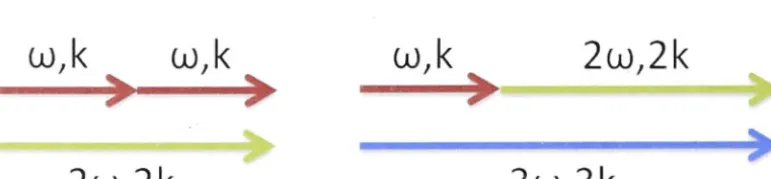
Figure 1.2: ( a) Scheme of Second Harmonic Generation. (b) Growth of seco nd-harmonic power along the propagation direction, assuming a constant pump intensity. Solid curve: phase-matched case, with the power growing in proportion to the square of the propagation distance. Dashed curve: non phase-matched case, with the second-harmonic power oscillating between zero and a small value.
3
(FW)] and second harmonic waves. Here A wp and A 2wp are the slowly varying electric field envelopes and nwp and n 2wp are the refractive indices for the pump wave with frequency wP and the second harmonic wave with frequency 2wP respectively, z is the beam propagation direction, and c is the speed of light.
For efficient SHG several conditions must be satisfied. The pump intensity n1ust be relatively high, the pump and the SH beams have to overlap well in space, and the energy and momentum have to be conserved in the process. Energy conservation ( or frequency 1natching) is fulfilled automatically as wsH
=
2wp. Spatial overlap is usually well satisfied for approxi1nately collinear nonlinear optical processes and weakly diffracting beams. Both these conditions can be achieved in bulk, with particularly high efficiency if the nonlinear medium is put in a cavity [9, 10] and in ·waveguides, where large overlap can be achieved together with tighter beam confinen1ent for higher intensity and higher conversion efficiency [11].1VI0n1entun1 conservation [ or phase-1natching (P1VI)] 6.k
=
0 usually has to be engineered due to refractive index dispersion nwp -/- n 2wp . If the phase-matching condition is not fulfilled [12, 13], then when the accu1nulated phase difference b e-tween the pu1np and SH ·waves reaches 11-/2, the newly generated SH field interferes destructively with SH generated previously and converts back to the pu1np beam [see Fig. 1.2]. There are several approaches to achieve P1VI. One of them is to use birefringent crystals, vvhere refractive index dispersion depends on polarization [4]. For a particular choice of pump and SH polarizations the refractive indices and therefore phases during SHG process can be n1atched [see Fig. 1.2].Another possible approach is to use periodically poled crystals with peri odi-cally inversely poled domains, which change the sing of quadratic nonlinear sus-ceptibility x (2) [14- 16]. For optimal poling period the phase of generated second harnionic flips every time the phase difference between the pump and second ha r-1nonic wa, es reaches 11 / 2 [see Fig. 1.3]. In this -v..ray the second harmonic generation
4 Introduction
~~ith ouit philse n1~tc hi nig with quasi- ph as n1atch ing
Figure 1.3: Addition of amplitude contributions from different parts of the crystal. With quasi-phase-matching, a high conversion efficiency can be achieved.
quasi-phase-1natching (QP1VI) method is that it often allows the use of larger 1n
ate-rial nonlinearity due to the particular choice of polarizations of pump and second harmonic waves
[
15
]
.
The n1ost recently developed approach to phase-matching is to use differ nt vvaveguiding 1nodes in a vvaveguide to 1natch phases of pu1np and s cond har-1nonic [17; 18]. This method will be discussed in detail in the Section 1.2.1.
1.1.3
Spontaneous
paran1etric down-conversion
Second order nonlinearity p (2) can be used not only for SHG, but al o for a range of other nonlinear processes, including for exa1nple sum-frequency generation and
difference frequency generation, when two waves with different fr quencies w1 and w2
are con1bined to generate a nevv wave vvith frequency w
=
w 1+
w 2 or w=
w 1 -w2 re-spectively. Overall. nonlinear frequency conversion enables the operation of tunableand broadband light source v1ith characteristic tailored for a range of classical ap
-plications. including spectroscopy; comn1unication networks etc. However one of the
nonlinear processe involving second order nonlinearity stands out due to its u e
ful-ness for non-classical applications uch a quantu1n cryptography
[
19
]
and quantumsin1ulations [20]. Thi process is called spontaneous parametric down-conv rsion
Dur-1.1 Frequency conversion 5
signal
pump
idler
Figure 1.4: Schernatic representation of degenerate type-I spontaneous parametric down-conversion.
ing SPDC a pump photon with frequency wP has a chance to split into two photons,
usually called a signal photon with frequency W8 and an idler photon with frequency
(1.5)
For efficient SPDC momentum conservation is also needed:
(1.6)
Signal and idler photons form a pair called a biphoton.
Due to these conditions degenerate
(wi
=
w8 ) spontaneous parametricdown-converted radiation typically leaves the nonlinear crystal as a cone consisting of pair of photons [ see Fig. 1.4] if signal and idler photons have identical polarizations ( type-I) or as two cones if signal and idler photons have different polarizations (Type-II).
Generation of photon pairs through SPDC was first experimentally confirmed in 1970 [21]. Later it was den1onstrated that the generated photons in a pair interfere non-classically [22].
The key concept explaining the non-classicality of SPDC is quantum
entangle-ment, which is related to correlations between the photons in a pair. According to
quantum mechanics, in many cases the outcome of a particular experiment involving
a photon pair cannot be determined with absolute certainty [23]. Quantum entan-glement is a form of quantum superposition. When a measurement is made and it
causes one photon to take on a definite value (for example a certain polarization or
path), then the other member of this entangled pair will at any subsequent time be
[image:19.770.110.580.144.356.2]6 Introduction
or frequency). Thus, there is a correlation between the results of rneasuren1ents perforn1ed on entangled pairs, and this correlation is observed even though the e
n-tangled pair may have been separated by arbitrarily large distanc s. However the transfer of information though quantum entangle1nent requires a classical channel
and cannot happen faster than the speed of light [24].
Quantum entanglement opens opportunities for 1nuch better security in qua
n-tu1n cryptography
[
19
] a
nd potentially higher computation speed in quantum logicdevices coin pared to classical computers [20]. Essential problems in this area
in-clude precise entanglement control and scalability to a larger number of entangled photons [25].
1.1.4
Cascaded third
harmonic
generation and cascad
ed quadrati
c
nonlinear phase shift
Cascaded quadratic nonlinear processes combine two or more nonlinear inte
r-actions in media with quadratic nonlinearity [26, 27]. The si1nplest exa1nple is cascaded third hannonic generation (THG), which co1nprises two steps: initially second hannonic is generated w
+
w=
2w and then it is recombined with the fun-damental wave to generate the third harmonic (TH) 2w+
w=
3w, see Fig. 1.5. A large magnitude of quadratic nonlinearity in noncentrosymmetric crystals typicallyleads to much stronger quadratic nonlinear effects in comparison to cubic nonlinear
effects, therefore cascaded THG can be far more efficient in comparison to THG based on cubic nonlinearity [28]. Third hannonic generation is useful for building short wavelength lasers [29] and in the future 1night beco1ne a useful tool in optical
telecon11nunications [30].
In order to make cascaded THG process efficient, both SHG PM and SFG Pl\lI have to be satisfied, otherwise the conversion efficiency tends to be limited by a few percents [28]. In other words refractive indexes for all three interacting frequencies should be equal, nw
=
n2w=
n3w. There are various ways to achieve such conditions using complex aperiodic poling, but they have the cost of lowering th effectivew,k
)
w,k
)w,k
2w,2k
)
2w,2k
3w,3k
[image:20.792.193.579.916.1005.2]1.1 Frequency conversion
~k
Figure 1.6: Typical dependance of pump nonlinear phase shift 6 ¢ on SHG phase mismatch 6.k during cascaded quadratic nonlinear phase modulation.
7
nonlinearity [28]. Therefore realizing efficient THG in a compact device is quite
challenging.
Another important example of cascaded quadratic nonlinear processes is
nonlin-ear phase modulation
[31].
This process can be employed for all-optical switching, which may become a cornerstone of optical signal processing and be useful in thenext generation telecommunication devices [26]. l\!Iost previous works considered
nonlinear phase-modulation based on cubic nonlinearity [32], while quadratic non-linear processes can be operated at lower pump powers
[33]
and bring substantial energy savings.The explanation of quadratic cascaded nonlinear phase shift is rather st raight-forward. During second hannonic generation energy conversion can go both ways, see Eqs. (1.2)- (1.3). Therefore when the power of the SH reaches values compara-ble to the pump, a conversion back from SH to pump starts to be noticeable. If during this process there is either positive of negative phase mismatch 6.k, then this
mismatch will be translated to phase detuning for both pump and SH waves, see
Fig. 1.6.
Comprehensive experimental investigation of this phenomenon in the pulsed
regi1ne would be essential to provide a detailed picture of the process.
1.1.5
Cubic nonlinear phase
shift, stimulated
four-wave-mixing
and
spontaneous
four-wave-mixing
In the Sections 1.1.2 - 1.1.4 we looked at second order nonlinear processes. Although second order nonlinearity x(2) in noncentrosym1netric crystals is typically far larger than third order nonlinearity x(3), designing nonlinear processes based on x(3) allows larger range of usable materials, including Si, for which advanced
8 Introduction
)
k.
I)
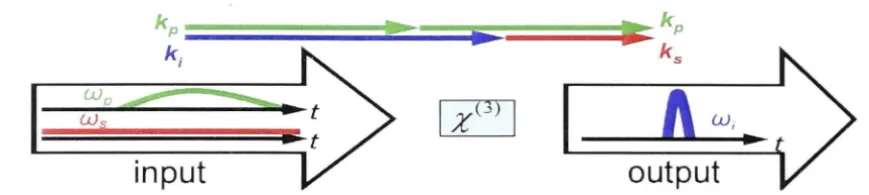
Figure 1. 7: Schematic illustration of the four-vvave-mixing energy and n1omentu1n
conservation: 2wp
=
Ws+
Wi and 2kp=
ks+ ki.Cubic nonlinearity leads to a large variety of nonlinear optical processes, how
-ever in this thesis I focus on four-vvave-1nixing (FvVNI) and the nonlinear phase
modulation that manifests itself as self-phase modulation (SPNI) and cross-phase
modulation (XPNI). Four-wave-mixing was experi1nentally observed in 1966 [34],
and cubic nonlinear phase 1nodulation vvas firstly demonstrated one year later in
1967 [32].
The effect of SPNI can be modeled by the follovving equation [35]:
(1. 7)
One vvay to look at nonlinear phase shift is that it effectively changes the refractive
index. In this equation, n2
=
3x(3) / (8n0 ) is the nonlinear addition to the index ofrefraction n
=
n0+
n2I
A
J
2vvhere n0 is the refractive index in linear optical regime.
The coupled-mode equations describing the amplification of a ignal amplitude
As through FvV:\I with strong un-depleted pump AP and idler wave Ai in the pr s
-ence of nonlinear phase shifts can be written as follovv [35]:
8As 8z 8Ai
8z
8AP 8z
(1.8)
(1.9)
(1.10)
Here JJ .in ~s.i) _4~r!. *.i exp[i6.kz]/ c are F\Y:\I term re ponsible for energy tran fer
fron1 pun1p (p) to ignal (s) and idler
(i)
.
wPn~p)IAPJ2 Ap/ c i a fa1niliar P:\I term.and 2JJ .in ~· .i)
I
-A
pj
2_
-t
.
i/
care XP:\I tern1 through ·which the pump affect ignal and idler pha e . 6.k=
2kp - k. - ki here i a F\V:\I pha e 1nismatch . . ee Fig. 1.7.Sin1ilar to quadratic nonlinearity. cubic nonlinearity can al o be u ed for build
-1.1 Frequency conversion 9
sential to develop efficient and compact broadband FW1VI systen1s, which are able to operate in the pulsed regime.
Another novel important area of cubic nonlinear applications is quantum s imu-lations [38]. Four-wave-mixing can be operated not only in the stimulated regime
with a seeded signal, but also in the spontaneous regime without seeded waves, when quantum-entangled photon pairs are generated [39]. This process is called sponta
-neous four-wave-mixing (SFvVM). Here the essential challenges include scaling to a
10 Introduction
1.2
\!Vaveguides
a
nd
c
l
ass
i
ca
l
app
li
cat
ion
s
1.2.1 Disp
e
rsion
eng
in
eer
ing
and
puls
es
~ onlinear optical waveguides offer unique advantages for frequency conversion and other nonlinear processes due to several reasons. Firstly optical waveguides can be integrated on chip and 111ake optical devices compact and stable [40]. Secondly
light guided in a ·waveguide can be strongly focused over a much longer distance
co1npared to diffraction in bulk ·which allows higher efficiency of nonlinear interac
-tions [41, 42]. Lastly, ·waveguides offer unique solution to the problem of PlVI both
for quadratic [17, 18, 43] and cubic nonlinear processes [44] .
The vvaveguiding PlVI method is based on a change in an effective refractive
index of a vvave propagating as a guided mode in comparison to propagation in
bulk, see Fig. 1.8. To describe vvaveguided modes it is common to use so-called
propagation constants ,8 in place of wave vectors to take into account guided mode
effective refractive index: k -+ (3. sing vvaveguides for frequency conversion is u e
-ful because it allovvs high vvaveguiding field confinement (which translates to higher
pump intensity) to be combined with modal PlVI for higher effective nonlinearity.
vVith ad\ ances in fabrication technologies using cubic nonlinear materials [46]
and lately also quadratic nonlinear material [47], it becomes possible to create
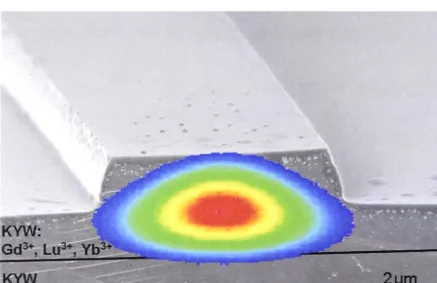
nano-scale optical ,vaveguides [see Fig. 1.9], where frequency conversion can occur in the
regin1es ,vhich are not feasible in conventional micro-scale waveguides, including
[image:24.792.160.598.713.996.2]higher nonlinear efficiency due to increased mode confinement and higher flexibility
1.2 Waveguides and classical applications 11
(b)
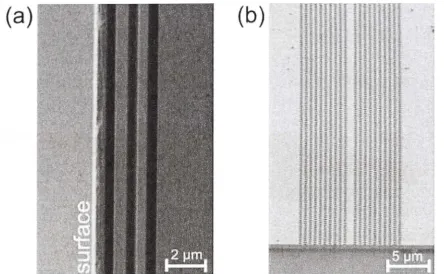
Figure 1.9: Scanning electron microscope (SEM) images of nano-waveguides made
of quadratic nonlinear material LiNb03 from Ref. [ 4 7]. (a) Stack of three 540 nm
thick slab waveguides separated by 450 nm wide air gaps and (b) nano-structured
photonic-crystal waveguide in a freestanding 450 nm thick me1nbrane.
of waveguiding dispersion engineering for modal phase-matching [44]. Additionally,
nano-waveguides allow precise control of higher orders of dispersion [48], which can be important for operation in a pulsed regime that is particularly useful for telecomn1unications applications.
When a short laser pulse with correspondingly broad spectrum propagates in dispersive media, its shape and phase changes. The n1echanis1n for this change is based on the differences between the velocities of its spectral components. The process can be modeled by the following equation [49]:
8A
8z
iD82A
(1.11)
Here D
=
82/3 /
8w2 is the second order dispersion called group velocity dispersion (GVD), and T is time. It is usually convenient to choose T=
0 to coincide withthe center of the pump pulse in the te1nporal domain. To understand how the dispersion affects frequency conversion, one 1night look at how pulses interact during a nonlinear process, for exa1nple during second harmonic generation [49]:
8A2w
8z
8Aw8z
. wxC2) A 2 (. ;\k ) iD2w 82 A2w c5 8A2w
'l w exp i u Z
-8
2 -8
2n2wC 2 T T
.wxC2) . iDw 82 Aw
i
2 A 2wAw exp(-i6kz) - - 8 2
nwC 2 T
(1.12)
(1.13)
[image:25.770.164.609.129.403.2]12 Introduction
Infra-red in
s
l
ow
li
ght
Figure 1.10: Schematic illustration of third harmonic generation in photonic-crystal
Si nanowire from Ref. [30].
disperse, which is defined by GVD coefficients D2w and Dw, but also the difference
between the pump and the SH group velocities, which is governed by group-velocity
mismatch ( G VNI) coefficient r5.
Niodern nano-waveguides allow precise control of phase-mismatch, CVNI and
GVD [48], thus greatly improving the flexibility of frequency conversion, including
access to new spectral regions, operation with ultra-short pulses, all whilst dramat
-ically improving the energy efficiency of nonlinear interactions. Additional mag
ni-fication of the effective nonlinearity can be realized by slo-wing the light in nano
-structured cavities, which can be realized in photonic-crystal structures [30, 50].
These nano-waveguiding advantages can be applied in almost every area of no
nlin-ear optics, from efficient tunable light sources to next-generation telecommunication networks.
A good exa1nple is the recently reported generation of third optical harmonic
in Si nano-structured photonic crystal waveguides [30], see Fig. 1.10. Such THG
·would be ahnost co1npletely absent in case of bulk 1naterial samples. However, in
this experiment the TH was emitted in the out-of-plane direction since Si is not
transparent at the visible hannonic ·wavelengths, and such limitation also applies
to structures using a range of other materials, such as chalcogenide glas [51]. In
the Section 2.1 of this thesis I show that n1uch n1ore efficient THC can be achieved
in LiNb0 3 nano-vvaveguides, due to their large quadratic nonlinearity and a the
transparency of this n1aterial .fron1 visible to infrared wavelengths. To achiev such
an effect I use cascaded THC (the Section 1.1.4] and pha e-match all nonlinear
interactions by en1ploying nano-waveguiding <lisper ion control.
Another i1nportant challenge in nonlinear optic is the development of efficient
approaches for broadband frequency conver ion. which can operate aero a large
n-1.2 Waveguides and classical applications 13
gineering in nano-waveguides [48], it may not be possible to completely suppress dispersion in a very broad spectral range. In the Section 2.2 I develop a novel con-cept for optimizing dispersion along the nano-waveguide instead of canceling it to perform broadband frequency conversion combined with pulse compression.
1.2.2
Coupled waveguides and waveguide arrays
A key advantage that can be achieved by side- coupling the waveguides is spatial light control. When two waveguides are placed close to each other, so that their individual waveguiding modes slightly overlap, then light can couple from one wave-guide to another and back, which can be modeled by coupled-mode equations [52]:
(1.14)
(1.15)
Here C is a coupling coefficient that determines the rate of energy transfer between waveguides 1 and 2.
1\/Iore waveguides can be put together to form a waveguide array (WGA) [53], see Fig. 1.11. Light propagation in an array of coupled waveguides can be described by a set of coupled-mode equations [53]:
(1.16)
By solving the Eq. (1.16) for Bloch waves it is possible to calculate the waveguide array spatial dispersion:
/3
=
2C cos(k1_), (1.17)where k1_ is a normalized transverse wave vector.
When considering waveguide arrays made of nonlinear material, the spatial wave dispersion in such structures is connected to the process of frequency conversion thought phase-matching. Therefore it becomes possible to achieve flexible control over the frequency conversion which can be tuned by shaping or inclining an input beam [54]. Moreover, the spatial degree of freedom, in which optical beams can travel in different waveguides, enables applications for spatial beam shaping, focus-ing, and optical switching between different output positions both in directional couplers [55] and in waveguide arrays [56]. Such switching can also be cornbined with nonlinear frequency mixing [57].
materi-14
::
0
Waveguide channels
[image:28.792.196.593.137.445.2]Introduction
Figure 1.11: Discrete diffraction of light in a waveguide array.
als such as LiNb0 3 can lead to extremely efficient nonlinear interactions; quadratic
nonlinear couplers and waveguide arrays might be a good solution for light
switch-ing and control in telecommunications systen1s [26]. evertheless until now there
have been no extensive experimental studies with direct measurements of spat
io-te1nporal pulse dyna1nics in quadratic nonlinear coupled waveguiding structures.
In the Chapter 3 I present the first comprehensive experimental characterization
of pulse and phase shaping in quadratic nonlinear couplers [the Section 3.1] and
vvaveguide arrays [the Section 3.2].
Furthennore in array of optical nano-waveguides the temporal dispersion and
spatial diffraction cannot be separated; a coupling between waveguides can modify
the dispersion [58]. In the Section 6.2 of this thesis I present a method to sepa
-rately control the dynamics of these phenomena in nano-waveguide arrays and tudy
the potential of these structure for quantum-optical applications di cus ed in the
1.3 Waveguides and quantum applications 15
1.3 Waveguides
and
quantum
applications
1.3.1 On-chip integration
In the Sections 1.1.3 and 1.1.5 we briefly looked at photon-pair generation and its usefulness for quantum telecommunication and up-coming computation. Nowadays the conventional use of bulk optics for generating correlated photons as well as building blocks of logic gates hinders the scalability of the quantum circuitry with increasing number of components. The successful and efficient operation of quantum optical circuits requires the preservation of entanglement after passing through all optical components. Integrated optical quantum circuits based on waveguides are seen as a solution for on-chip scalable quantum networks, since they are scalable, compact, stable and can lead in the near future to mass production of chips for quantum simulations [59, 60].
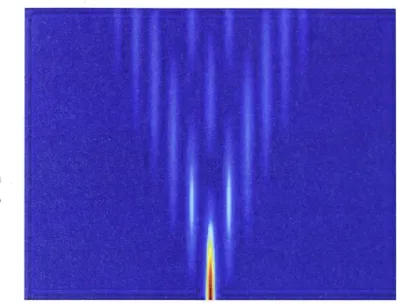
Some of the most desirable features for quantum integrated circuits are the integration of photon sources and the realization of dynamic manipulation of the photon states. Recently there has been strong progress in these directions. It was de1nonstrated that the spatial profiles of photon pairs generated during SPDC can be shaped by appropriate electric poling that modulates the sign of the quadratic nonlinear susceptibility
[61],
and such sche1ne can replace the need for several optical elements by integrating their functionalities in one crystal,- see Fig. 1.12. On the other hand, methods have been developed for dynamic 1nanipulation of photon states through tunable phase-shifting in integrated waveguide couplers [62].In 1ny thesis, I focus on developing this concept further by integrating a source of photon pairs (SPDC or SFWNI) with waveguide arrays for simultaneous efficient generation and flexible control of spatial quantum statistics. The results of my research involving biphoton generation in waveguide arrays are presented in the
...
11111 I I I I II I I I 11111 I I
14-1
'
++
I I 11111 I - \ •
l I I I I I
I
' I
' 11111 I I
I I I I I
II II 111 I
Engineered
crystal
I I I I I I I I
I l I I l ~ I I l I I
I I I I I I I I
I I I I I I I I
:4
I I I:
I I I I II I I I
0
1I I
:
I~
I \~
.
I II
Homogeneous Lens
crystal
Figure 1.12: Integrated photon-pair generator and a lens realized in Ref. [61]: Note
that in this scheme it is no longer necessary to carefully select the angles and positions of the measuring detectors as in Fig. 1.4, since the integrated lens can focus both
[image:29.770.121.595.807.971.2]16 Introduction
•
0--+ t-··
A A
t-··
0--+ 2 5 6 t-··
B B
t-··
Figure 1.13: A biphoton reconfigurable quantum circuit for generating, manipulating and detecting entanglement from Ref. [62].
Chapters 4 - 6; showing improved reconfigurability. In particular, the Section 5.2
shovvs the possibility to generate photon pairs with precisely controllable orbita
l-angular-mon1enta (OANI) in a single integrated device, which until now required
complex and non-scalable bulk setups [63]. The mechanism employed in this process
is briefly explained in the following Section.
1.3.2 Quantum
walks
One of the ways to look at photon pairs in waveguide arrays is by employing the
concept of quantun1 vvalks. The idea of a quantum walk becomes rather straightfo
r-vvard when quantum vvalks are compared with classical random walks. A classical
random vvalk is a path consisting of random steps. A molecule traveling in a liquid
or a gas, a fluctuating stock price or genetic drift are all examples of systems that
a
•
.
'
Timeb
•
•
•
1.3 Waveguides and quantum applications
Waveguide
I
Antisymmelnc
entanglement
Beam splitter
Borosll1cale -grass chip
Boson
behaviour
0
17
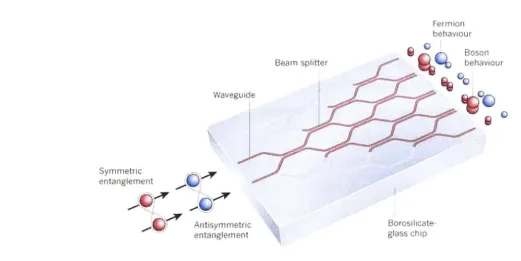
Figure 1.15: Schematic illustration of a photon-pair quantum walk simulating fermionic and bosonic statistics from Ref. [64].
are described well by random walks, and random walks implemented on con1puters
are routinely used to simulate these and many other systems [64].
A quantum walk is a random walk of a quantun1 particle such as an electron or
a photon. In comparison to a classical random walk that follows just one path, a
quantu1n walk follows a superposition of all possible paths, see Fig. 1.14. The idea
behind employing this process for simulations is that a number of entangled photons
traveling in specially fabricated waveguide arrays might simulate certain quantum
processes that otherwise would be hard to measure [65]. One of the implementations
of a quantum walk includes entangled photons being injected into a WGA, see
Fig. 1.15. At the output single photon detectors are used to measure how the
photons are correlated in space after traveling through the WGA structure [64].
It has been suggested that quantum walks can help better understand
molecules [66] , topological effects [67, 68] and even biological photosynthesis [69, 70].
Quantum walks might also be e1nployed for ultrafast database search [71-7 4].
Similar to 1nany other quantum optical systems, the key to unravel the quantum
walk potential is on-chip integration that enables better scalability in co1nparison to
bulk optical schemes. The first experimental demonstration of photon-pair quantum
walk in a linear ·waveguide array has attracted substantial interest [75], followed up
by a number of works further investigating quantum walks [76, 77]. However it
remains difficult to scale these systems to more photons and to control quantu1n
walk parameters, since on one hand photons can be lost on their way from the
source to the waveguide array, and on the other hand linear waveguide arrays are
diffic11lt to reconfigure.
In the Chapters 4 - 6 of my thesis I integrate quantum walks with frequenc
[image:31.770.78.599.124.385.2]18 Introduction
scalability and dernonstrates nevv ways of quantun1 walk control. In the Chapter 4 I
fon11ulate the theory and perform the world's first experiments on integrated
bipho-ton generation and quantum walks. In the Chapter 5 I den1onstrate how quantu1n
vvalks in tvvo-din1ensional waveguide arrays help to explore the relationship between
linear classical and nonlinear quantum processes [ the Section 5
.
1
]
and generate use-ful quantun1 states [the Section 5.2].
I co1nbine the developments on frequency conversion, nano-waveguides, phase shifts and quantum walks in the Chapter 6 and de1nonstrate how these concepts can be united to create an advanced platform for tunable nonlinear cla ·sical and
quantum optics.
Chapter 2
Frequency conversion in nano-waveguides
2.1
Second and third harmonic
generation
membranes
.
1n
nano-In this Chapter I demonstrate my theoretical numerical results on frequency conversion in nano-vvaveguides. As mentioned in the Section 1.2.1, bringing wave-guide cross-section to subwavelength dimensions while utilizing high refractive index contrast between the waveguide and the cladding allows for higher field confinement and dispersion engineering. This Chapter shows that employing these advantages opens novel pathways for higher frequency conversion efficiency and pulse shape control.
In this Section I predict highly efficient third harmonic generation through si1nul-taneous phase-matching of second-harmonic generation and sum-frequency genera-tion in lithium niobate nano-waveguides, enabled due to strong modal dispersion. I also reveal that coincidentally for this type of waveguide the cross-section size which corresponds to the phase-matching is also optimal for the highest mode confinement and therefore for strongly enhanced conversion efficiency.
As discussed in the Section 1.1.4, important advantages can be obtained by cas-cading several parametric processes [28]. In particular, the highest efficiency third hannonic generation (THG) can be achieved in media with quadratic nonlinearity through two cascaded parametric processes: (I) SHG and (II) SFG that incorpo-rates 1nixing of the pump and the SH to generate the TH. The conversion is most efficient when the Pl\lI conditions for both processes are satisfied.
Whereas material birefringence can be conveniently used to phase-match a single process, the simultaneous PM of cascaded processes requires engineering of linear or nonlinear material properties at micro- and nano-scale. In particular, quasi phase-matching [14] introduced in the Section 1.1.2 can also be applied for cascaded THG [78, 79].
possi-20 Frequency conversion in nano-waveguides
ble to fabricate high-index-contrast nano-waveguides which provide strong patial
confinement of the guided modes thus enhancing the nonlinear interactions. By us-ing such ,vaveguides one can achieve Pl\!I of quadratic nonlinear processes through
dispersion engineering of guided n1odes [18, 43, 80- 83]. This is a flexible approach that avoids the need for additional periodic poling of the waveguide and has been widely used for PiVI of four-wave mixing nonlinear interactions [84].
In this Section, it is shown that ultra-thin Lil b03 waveguides suspended in air can be used for efficient cascaded THG. Air suspended Lil b03 slab waveguides
·were shovvn to be feasible for fabrication at various thicknesses [47, 85] and with
higher quality in con1parison to epitaxially grown LiNb03 films [86]. The SHG
in Li b03 1naterial vvas studied theoretically in photonic crystals [83] and thin
films on a substrate [80]. Furthermore efficient SHG was also predicted for AlGaAs
slot waveguides [18], rods [81] and thin high-index-contrast AlGaAs/ oxidized AlAs
waveguides [82]. Hovvever the simultaneous Pl\!I of cascaded para1netric processes
in nano-waveguides has never been considered. It is de1nonstrated that complete Pl\!I of both cascaded quadratic processes can be realized simultaneously in a single
waveguide vvithout periodic poling. The high quadratic nonlinearity of LiNb03
and tight field confinement in a nano-waveguide can allow strong enhancement of the conversion efficiency in comparison to quasi-phase-matched cascaded THG
in periodically poled LiNb0 3 ,vaveguides [28, 79] and direct THG through cubic
nonlinearity in silica glass waveguides [87].
To get a better insight in the possibilities for Pl\!I of the cascaded THG I first
develop a se1ni-analytical model that describes PlVI in LiNb03 slab waveguide . I
then shovv that this n1odel can also be used as a starting point to design more prac
-tical nanovvire waveguides. For efficient frequency conversion; in addition to PlVI.
it is desirable to employ nonlinear interactions ba ed on the large t nonlinear us
-ceptibility tensor components. I therefore perform a systematic analysi of different slab orientations. and find that the most efficient ca caded THG is realized in a
z-cut Li:\'b03 slab vvaveguide with all interacting waves propagating in y direction.
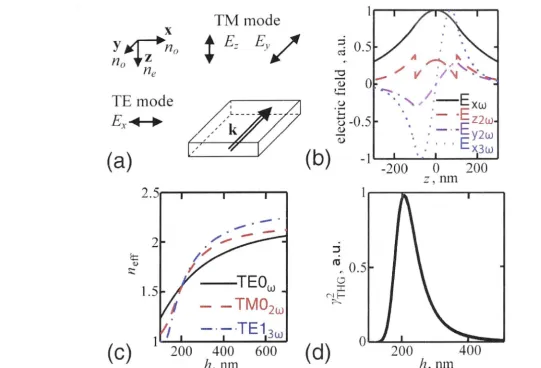
as illustrated in Fig. 2.l(a).
I detern1ine that the optimal THG proce s in the Li:\'b03 lab waveguide is the
conYersion of pun1p TE0 n1ode into SH T:\I0 mode. and then their mixing to the
TH TE1 n1ode in the proce of um-frequency generation [ e Fig. 2 .1 (b)]. The el ctric field profiles of the guided modes can be expre ed a E
=
exp[- iwt+
ikoneff( ··)y] x [Ex(z. w). Ey(z.w)
.
Ez(z. )]. Here neff is the effective mode index.:..v· i the funda1nental optical frequency. k0
=
w / c. and c i the pe d of light invacuun1. For TE n1ode . the electric field i polarized in the x direction
(
E
2 = Ey =0). and the electric field con1ponent Ex ati fie the \vave equation: 82
Ex/ 8z2
=
E.rk5[(n;{)22.1 Second and third harmonic generation in nano-membranes 21
TM mode l
X
i
Ez Ey/Y17n
0~
0.5
c,:;:s
.
no z A ---'.•f\ ·.
ne
-
'"O / V' :; ~ ' ~·.0 _.. I
Q.)
,-
-/ ·
TE n1ode '+-< u ·-: ' " ·-Exw
·-
·. :- ·Ez2w Ex ~...
t>-0.5 i-. . . EQ.)
·. · - ·~ Y2w
-
Q.)· : · · · Ex3w
(a)
(b)
-10 200 -200
z, nm
2.5 1
-
.-2 ::J .
~ .
Q)
'°
~
0.5s:::
TEOw c.J
1.5 "T"
0-!._~
- TM02w ..-..
I - ·- ·TE13w
0
(c)
l 200 400 600(d)
200 400h, nm h, nm
Figure 2.1: (a) LiNb03 slab waveguide orientation for third-harmonic generation. (b) Elec
-tric field profiles for slab waveguide thickness of 200 nm and pump wavelength of 1542 nm. ( c) Effective refractive index vs. slab waveguide thickness for pump, SH, and TH modes. ( d) Normalized square of THG nonlinear coefficient for slab waveguide.
congruent LiNb03 [88] for
!
z
!
<
h/2 (inside the slab waveguide), and nx,y,z=
l for Iz
l
>
h/ 2 ( outside the slab waveguide), where h is the waveguide thickness. For TJVI modes, the electric field is polarized in the y - z plane, and can be expressed through the single component of the magnetic field Hx, E2=
-Z0n;f1n; 2 Hx
and
Ey = -iZ0k
0
1n;28Hx/8z with the vacuum impedance Z0 = (µ0/c0 )1l2. The waveequation for the n1agnetic field is: n;8[n;28Hx/8z]/8z
=
H2k5[(n:'f) 2- n;].
I solve the wave equations using the transfer n1atrix method [89] and obtain the
effective indices and profiles of the guided modes. Then, the frequency conversion
can be modeled by coupled equations for the amplitudes of narrowband pump, SH
and TH n1odes [28], Ap, AsH and ArH respectively. In the case of undepleted pump
approximation, AP
>>
AsH>>
ArH, the coupled equations for SHG discussed in the Section 1.1.2 and the corresponding equations for sum-frequency generation reduce to the following form:8AsH 8y 8ArH
8y
rSHGA~ exp ( il:lksHGY) '
=
rsFcAsH AP exp ( il:lksFcY) .(2.
1
)
(2.2)
[image:35.772.69.611.127.495.2]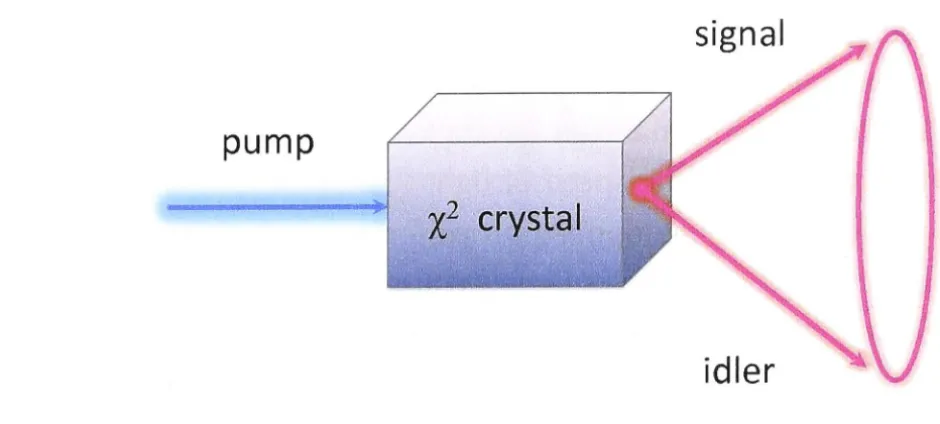
![Figure 1.12: Integrated photon-pair generator and a lens realized in Ref. [61]: Note that in this scheme it is no longer necessary to carefully select the angles and positions of the measuring detectors as in Fig](https://thumb-us.123doks.com/thumbv2/123dok_us/8208684.262657/29.770.121.595.807.971/integrated-generator-realized-necessary-carefully-positions-measuring-detectors.webp)