Activity-Based Gamified e-Learning for IoT and Energy
Efficiency: Academic Education, Workforce Development, and
Public Literacy
Yakov E. Cherner1, Gary Mullett2, James Uhomoibhi3, Osei Darkwa4, Tatyana A. Cherner1
1ATeL – Advanced Tools for e-Learning, Swampscott, MA, 2Springfield Technical Community College, MA, 3Ulster University, Belfast, UK, 4Teletech Institute of
Technology, Konongo, Ghana ycherner@atelearning, com
Abstract
This paper presents the activity-based reconfigurable learning and training environment build around a “Virtual Energy Efficient House” (v-EEHouse). It provides an interactive context for cross-disciplinary learning and teaching a wide spectrum of STEM topics related to solar energy, energy efficiency, and Internet of Things (IoT) technology. The target audience includes K-12 and higher education students and faculty, and general public. It can also be employed for the professional training of employees of utility industry and IoT service providers.
v-EEHouse enables users to explore energy consumption by major home systems and appliances, get familiar with the IoT technology and the domestic use of renewable energy sources, and adapt an energy-responsible behavior. The v-EEHouse and its individual components can be integrated with online courses including these delivered via the MOOC platforms including edX.
Application of the environment in different countries (USA, UK, Ghana, and Tanzania), at diverse educational levels and in various settings, as well as students and instructors’ feedback is discussed.
Introduction
Today, there is a global trend to transition to sustainable energy sources and to enhance the energy efficiency of households in response to a finite supply of fossil fuels and increased social awareness of pollution and climate change. These facts combined with the rapidly increasing availability of less expensive smart devices and a ubiquitous
Science
Volume 3, 2020, Pages 54–60
Internet has raised interest in the so called - smart home. This reality has created a necessity in public awareness and understanding of the next generation of Internet applications, commonly known as the Internet of Things (IoT), specifically those that are applied to energy efficiency and savings. Collaterally, this trend has also generated a rapidly growing demand for professionals skilled in designing smart dwellings, as well as installing and maintaining cyber-physical systems (CPS) which are the control systems that provide the desired increase in energy efficiency.
This paper will present an activity-based reconfigurable learning and training environment purposely designed for this area of technology. A Virtual Energy Efficient House (v-EEHouse) [1] has been devised to enable a wide range of users, including K-16 and the general public, to explore energy consumption by major home systems and appliances, to become familiar with typical IoT technology and the domestic use of renewable energy sources, and promote an energy-responsible behavior. It provides an interactive context for cross-disciplinary learning and is adaptable to teaching a wide spectrum of STEM topics and can also be employed for the professional training of employees of utility industry and IoT service providers. Reconfigurable guided online activities make it possible to individualize the learning experience and adapt it to different cognitive styles and ways of learning.
V-EEHouse is grounded on the constructivist theory and oriented toward learning-by-doing and contextual learning. It matches the learning and communication habits of what is known as the digital generation. Today’s students and young employees that learn differently from the previous generation and heavily depend on the Web for accessing information.
The project is partially funded by the NSF grants DUE-010375 and DUE-1801090.
Virtual Energy Efficient House Details
The v-EEHouse allows users to interactively explore underlying fundamental science principles related STEM subjects, technical concepts of IoT technology, and the economic aspects of energy efficiency. Additionally, virtual and blended activities enable users to get familiar with the application of IoT technologies at a smart house (especially for energy conservation) and to grasp hands-on skills in cyber-physical systems and the devices used to implement these systems. The distinctive feature of the v-EEHouse is the use of familiar everyday real-world objects and processes as the context for interdisciplinary learning and training activities.
creating new ones, Learning/Content Management System (LCMS), supplemental resources, and cyberinfrastructure.
The current version of the virtual house represents a typical US residential house with normal major domestic systems, home appliances, energy sources, etc. that may be customized.
One of our educational goals is to connect fundamental knowledge and practical experience to keep users engaged and help them acquire awareness of energy responsible behavior.
Blended (or Hybrid) Laboratories
A blended (or hybrid) laboratory (Fig. 1) synergizes learning effect of hands-on and online experimentation. This combination of hands-on laboratory practice coupled with realistic visualization and interactive online exploration helps connect the development of practical skills with a deeper understanding of underlying scientific and engineering concepts.
The v-EEHouse can be linked with fairly inexpensive physical sensors and computing platforms (i.e. Raspberry Pi and/or Arduino) to allow for real-time data acquisition. Calculated parameters may be synchronized with real-world measured data. Additionally, using a typical smartphone, students may control the virtual home appliances and residence HVAC systems and observe the results of these actions. This
type of virtual environment combined with real sensors, wireless communications links, and computing/control platforms provides a realistic example of the IoT technology. Since IoT technology can be utilized in almost any STEM area, this opens up a wealth of possible scenarios using the v-EEHouse.
Solar water heating and photovoltaic (PV) systems and Electrical system
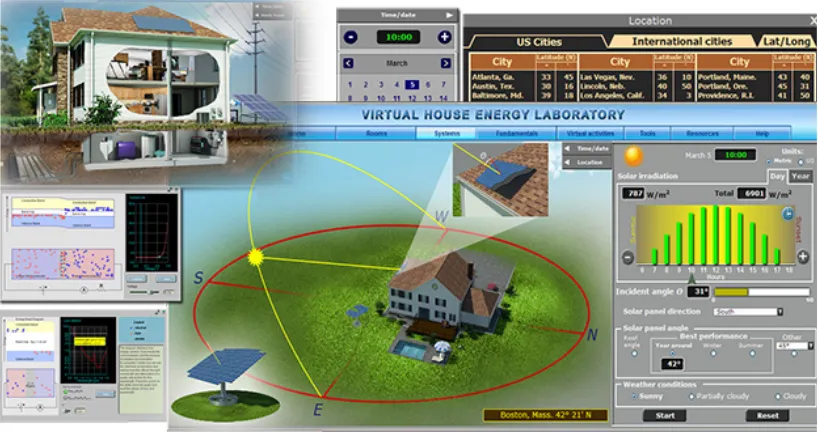
Virtual solar water heating and PV systems (Fig. 2) facilitate multidisciplinary learning of STEM subjects such as solar radiation and its transformation into thermal and electrical energy. Students are able to experientially study the factors affecting efficiency of solar systems. The ability exists to select a geographical location and explore how solar irradiation and system efficiency depends on seasons and daytime, house and panel orientations, weather conditions and other factors. Electricity produced by the solar PV system is contributed to a grid-tied house power system.
Auxiliary simulations (shown in the left of Fig. 2) allow the investigation of the basic semiconductor processes responsible for converting light energy into electricity and other factors affecting the efficiency of PV panels.
For the MIT undergraduate course “The Physics of Energy” its author, Professor R. Jaffe has developed interactive online exercises based on the learning content of his textbook of the same name. Students are required to experiment with the virtual solar PV system and compare different models for computing solar insolation, calculate PV panel configuration capable to power average households in different states. These problems demonstrate practical applications of fundamental concepts and facilitate students’ cognitive development derived from the possibility of experiencing on the basis of refuting or confirming a theory been incorporated into the simulation.
Gamified virtual kitchen
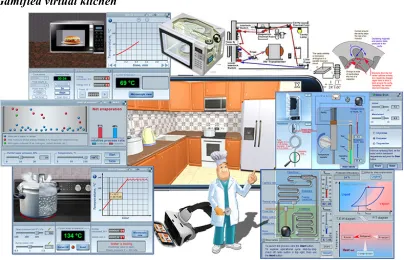
A Virtual Kitchen (v-Kitchen) module (Fig. 3) incorporates game dynamics and helps students study, in a highly interactive manner, various STEM principles and laws relevant to kitchen appliances, cooking, and cookware. A 3D version and VR version for smartphones installed on a VR headset provides learners with excitement and virtual reality learning experience.
Students may navigate through this environment learning about energy efficient cooking technologies leading to energy savings. An avatar provides the students with instant feedback, comments and asks questions.
Discussion
The v-EEHouse has been used at different educational levels (K-12 to undergraduate) including science/engineering students and liberal art majors. According to faculty feedback, v-Labs and relevant simulations allowed them to substantially broaden their instructional palette, create educational content of a greater quality and meaning, and enhance their teaching efficacy. Instructors appreciated the opportunity to adjust exercises and challenge students with real world practical problems. The authoring toolkit has been helpful in personalizing learning assignments and tailoring them to student backgrounds and specific educational goals and course content.
The v-EEHouse successfully facilitated expanded education by providing a learning environment where the student is learning as the protagonist, building his/her personal learning path and using self-guided virtual or hybrid activities when necessary. Considering that many of v-EEHouse users were engaged in flexible and independent learning, build in self-assessment, step-by-step instructions and other supporting resources are provided.
Students feedback and faculty observations reveal that online and hybrid activities combined with just-in-time conceptual learning were efficient in helping students build and deepen their understanding of how fundamental STEM principles governing the processes involved in domestic energy production, conversion, storage, and consumption worked. New knowledge and skills acquired by one’s active interaction with learning content better retains in the learner’s memory and are easily retrieved when needed.
The use of the renewable energy lab by both undergraduate and graduate students at Ulster University (Northern Ireland, UK) has been found quite useful by both students and industrial partners who have observed real world problems successfully tackled through the use of v-Labs.
However, some challenges have been observed and need to be considered and addressed robustly through the development and adoption of policies and the deployment of appropriate resources to meet the needs of the various communities of practice. For example, among outstanding challenges of the field is a large gap between emerged technology-enabled opportunities in education and conventional pedagogy. A deeper transformation is needed in teaching and learning practices to efficiently and successfully take advantage of new technologies rather than just acquiring advance educational materials and tools.
To address rapid changes in software/hardware, computer platforms, etc., as well as the growing trend of the majority of students move from PC to mobile, the v-EEHouse and all its components are designed with an open modular and easy adjustable architecture. They can run plugin-free on PC, Mac, iPad/iPhone and Android tablets and smartphones.
Work in Progress
Although v-EEHouse can be used and are being used with a pretty conventional teaching-leaning practice, we are currently working on a new pedagogical plan that is completely experiment-based and most energy related STEM subjects will be learned primarily in the context of a sequence of online or hybrid experiments. Such a strategy can be applied for face-to-face, online and/or blended learning models. We are doing research on what pedagogical principles are most efficient in providing different groups of students with the appropriate learning experience.
realities of including available renewable energy sources and clean cooking techniques. Interactive e-learning resources are also adjusted to specific requirements of African schools and universities. The revisions are aimed to help African students to acquire knowledge and skills demanded at local job markets. The goal is to contribute to sustainable socio-economic development through digital delivery strategies, as well as to promote efficient energy technologies and sources for African households, agriculture and food.