[Parthasarathy K* 4(5): May, 2017] ISSN 2349-4506
Impact Factor: 2.785
G
lobal
J
ournal of
E
ngineering
S
cience and
R
esearch
M
anagement
SKILLING SCHOOL STUDENTS THROUGH SUITS - AN EVALUATIVE STUDY
Parthasarathy K*, Aswini P M, Jayadurga R
*
(Chair - School of Skill Development and Entrepreneurship), Professor and Director, Institute for
Entrepreneurship and Career Development, Bharathidasan University, Khajamalai Campus,
Tiruchirappalli-620023
Managing Trustee, PASS Foundation, Madipakkam, Chennai-600091
Research Scholar, Department of Lifelong Learning, Bharathidasan University, Khajamalai Campus,
Tiruchirappalli-620023
DOI: 10.5281/zenodo.573522
KEYWORDS
:
Evaluating Skill Development, Graphics Designing.ABSTRACT
The salient feature of the present study is to throw light on skill development training provided by SUITS (School-University- Industry- Tieup- Scheme) by IECD (Institute for Entrepreneurship and Career Development) to school children of 14 years who are studying 8th standard in selected schools of TamilNadu and Puducherry. The SUITS maximizing the academic growth and future career development of the school children, especially in graphics designing programme which makes them more creative and knowledgeable in the field of multimedia sector. Children from 56 schools responded to the structured questionnaire. Descriptive research design with systematic sampling method was adopted for the present study. The major findings show that there are no significant association between age of the respondents and acquiring skills in graphics design through SUITS in the study area.
INTRODUCTION
Developing school children in their younger age will maximize their future career development. It is necessary to access the skill gap in school education to fulfill the demand of future skilled employees for the development of our country. Many countries were developed through skilled workforce through skill development and vocational training programmes. Among them India is one of the important nation which acquiring 54% of younger people in the age group of 25 to 35, which is greater than other developing and developed nations, MHRD (Ministry of Human Resource Development, 2015). It will manipulate a huge challenge and demand on employment in future decades.
According to OECD (Organization for Economic Co-operation and Development, 2013), vocational training and skill development programmes will develop rate of employment in our country. Enhancing their performance level especially in the field of Information Technology, Information Technology Embedded Services (ITES) etc., is used to develop the employment in the field of graphics, multimedia, advertisement, web designing, architecture, etc.,
IECD at Bharathidasan University has been conducting various skill development and vocational training programmes to school children, differently-abled person, school drop-outs, house wives, senior citizens and ex-service men. The important milestone of IECD is offering SUITS, which offered skill development training to the school children to the age group of 10-14 years. In the present study the feedback scheduled in the form of structured questionnaire were used to collect the primary data from school children in 56 schools in TamilNadu and Puducherry who were enrolled under SUITS.
LITERATURE REVIEW
[Parthasarathy K* 4(5): May, 2017] ISSN 2349-4506
Impact Factor: 2.785
G
lobal
J
ournal of
E
ngineering
S
cience and
R
esearch
M
anagement
by motivating their creativity and innovation in any skill development field through teaching and skilling. This will make them more committed in their studies and make them self-dependent in their future.Gawad Santosh Bhiwa, (2015), explained that skill development programmes should be launched and implemented in organizations, universities and schools. Future decades will be expected with increase in economic condition of our country. Vocational education is the backbone of country’s sustainable growth. Organizations should develop and modify their policies, skills and technologies by creating awareness to the employees. Educating the younger generation with advanced skills can foster better value to their personal life and career development.
According to Forfas, (2009), skilled manpower relies on processing generic skills like creativity, developing applications, expertise in in-depth creation, capable to design web products, innovative management and updated knowledge in creativity tools. Graphics and web development are essential for the special features of the frame working multimedia sector. Interactive setup of these creative industries are used to develop employee’s skills in designing animation, cartoons, advertisements, image modeling, laser show designing, virtual reality programmes, communication designing, product package designing, typography, visual arts, visual composition techniques, motion graphic designing and much more.
PROBLEMS AND OBJECTIVES
1) To study the evaluating aspects of the skill development training provided to the respondents on SUITS in the study area.
2) To find out the association between age and the evaluating aspects of the respondents on SUITS in the study area.
3) To find out the inter-relationship among the evaluating aspects of the respondents on SUITS in the study area.
METHODOLOGY
Research methodology is used to address the research design, sampling method, type of questionnaire, framing hypotheses and so on. The present study has adopted descriptive research design, which is used to frame hypotheses and to find related variables of the study. Through this method quantifiable information were gathered for analysis of observed data. The survey questionnaire which is used to evaluate student’s responses was closed ended dichotomous questions. Questions are very simple to understand and constructed with ‘yes’ or ‘no’ type. 56 schools were enrolled under the SUITS, offering graphic designing to students of 7th standard. Purposive sampling method was used to gather the responses from the children. This sampling method allows the researchers to select their samples from the population with their own judgment. The samples selected from each population will represent the whole population. Hence this method is also called as judgmental sampling. One respondent form each school was selected to response the questionnaire.
GENERAL FINDINGS OF THE STUDY
Table-1 Percentage analysis shows the Frequency distribution of evaluating aspects of the respondents on SUITS
S.No Evaluating Aspects of SUITS Agree Disagree Frequency Percentage
1 Constructive programmes for student’s future 56 - 56 100
2 Convenient learning materials 50 6 56 100
3 Students relished by SUITS 55 1 56 100
4 Instructor’s support to perform practical 50 6 56 100
5 Expeditious learning materials 50 6 56 100
6 Pragmatic tutoring 56 - 56 100
7 Instructor’s concerning student’s progress 53 3 56 100
8 Adequate tutoring materials 52 4 56 100
[Parthasarathy K* 4(5): May, 2017] ISSN 2349-4506
Impact Factor: 2.785
G
lobal
J
ournal of
E
ngineering
S
cience and
R
esearch
M
anagement
10 Instructors tutoring with SUITS books 55 1 56 10011 Easily perceivable syllabus 47 9 56 100
12 Relish to make entry in OMR sheets 53 3 56 100
13 Complex learning syllabus 22 34 56 100
14 Adequate practical timing 54 2 56 100
15 SUITS intellectualized students 55 1 56 100
Table-1 shows that all the students agreed about the variable constructive programmes for students’ future. This shows that SUITS programmes are better foundation for their future academic and career growth. 50 students agreed the variable convenient learning materials and only 6 of them disagree the same, which denotes most of the students feel that the computer programmes are convenient to learn with other academic subjects. Most of the students agree the variable students relished by SUITS, which specified that students are interested and like to learn SUITS programmes. Majority of the students agreed the variable instructor’s support to perform practical paper, which indicates that the in-charge staffs were handling the computer practicals more than theory, which sustaining the students interest to learn more in their course. Most of the students agreed the variable expeditious learning materials, which implied that the students received SUITS text books on required time.
All the students agreed the variable pragmatic tutoring which indicates that the in-charge staffs of the computer programmes were handling the courses effectively and make the students to understand quickly. Maximum number of students agreed the variable instructor’s concerning students’ progress, which express that the in-charge staffs were interested on student’s personal development. Majority of the students agreed the variable adequate tutoring materials which indicate that the text books provided for theory and practical papers are adequate to learn. Maximum of the students agreed the variables instructor conduct regular classes with SUITS text books, shows that the in-charge staffs were handling the classes for the courses regularly with text books provided for the computer programmes.
47 students were agreed the variable easily perceivable syllabus and only 9 of them dis agreed the variable, it implied that the syllabus structured for the SUITS programmes were easy to understand by them. Maximum of the students agreed the variable relish to make entry in OMR sheets denotes that the students like to mark their answers in form of shades in OMR sheets in their main examination. 22 students agreed complex learning syllabus and 34 students dis agreed the variable, which indicates that children in the age group of 14 may feel little difficulty in following the syllabus of graphics designing programme. Necessary modifications will be updated for the next year syllabus. Maximum of the students were agreed the variables adequate practical timing and SUITS intellectualized students. It express about the interest of students in practical papers and results in improving the students practical skills and knowledge in graphic designing programme.
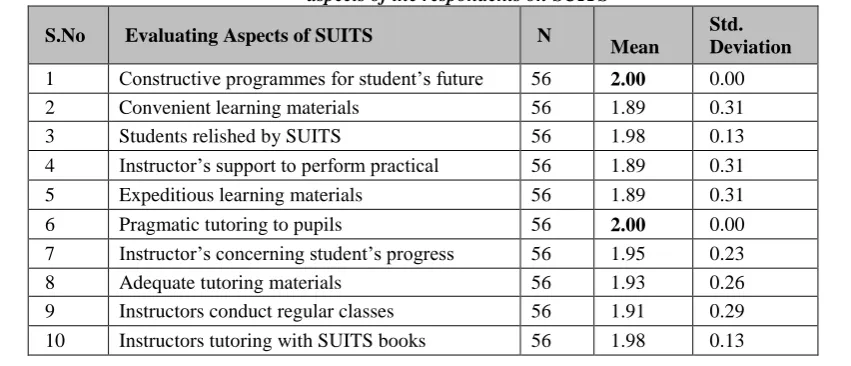
Table 2 Descriptive Statistics shows the mean and standard deviation of the evaluating aspects of the respondents on SUITS
S.No Evaluating Aspects of SUITS N
Mean
Std. Deviation
1 Constructive programmes for student’s future 56 2.00 0.00
2 Convenient learning materials 56 1.89 0.31 3 Students relished by SUITS 56 1.98 0.13
4 Instructor’s support to perform practical 56 1.89 0.31
5 Expeditious learning materials 56 1.89 0.31
6 Pragmatic tutoring to pupils 56 2.00 0.00
7 Instructor’s concerning student’s progress 56 1.95 0.23
8 Adequate tutoring materials 56 1.93 0.26 9 Instructors conduct regular classes 56 1.91 0.29
[Parthasarathy K* 4(5): May, 2017] ISSN 2349-4506
Impact Factor: 2.785
G
lobal
J
ournal of
E
ngineering
S
cience and
R
esearch
M
anagement
11 Easily perceivable syllabus 56 1.84 0.3712 Relish to make entry in OMR sheets 56 1.95 0.23
13 Complex learning syllabus 56 1.39 0.49 14 Adequate practical timing 56 1.96 0.19
15 SUITS intellectualized students 56 1.98 0.13
Mean is used to calculate the average of the sum of observed outcome of variables. This value is used for measuring central distribution value.
Here x denotes the observed value and n denotes the sample size N=56. Median used to find the middle score of the observed variables, which is used to find the typical value out of observed variables. The observed square values of mean values are called variance and the square root of variance divided by number of sample size is called standard deviation. x denotes the calculated Mean value, n denotes the total number of samples.
Table-2 shows that the highest mean score out of the evaluating aspects “constructive programmes for student’s future and pragmatic tutoring to pupils” are 2.00, it indicates that the SUITS programmes are constructively designed for the future growth of the students and the in-charge staffs for computer programmes were also handling the classes effectively. Here the lowest mean score value is 1.39 for the variable “complex learning syllabus” and the standard deviation for the same value is 0.49. It shows that students can easily grasp the syllabus provided for them.
HYPOTHESES RELATED FINDINGS
Hypothesis-1 There will be no significant association between the age of the respondents and their evaluating aspects of SUITS.
Table-3 Chi Square showing the association between the age and evaluating aspects of the respondents on SUITS
Evaluating Variables χ2 Value Sig. (2- Sided)
Convenient learning materials 1.950 0.377
Students relished by SUITS 0.882 0.643 Instructor’s support to perform practical 0.037 0.982 Expeditious learning materials 3.501 0.174 Instructor’s concerning student’s progress 7.272 0.026 Adequate tutoring materials 1.250 0.535 Instructors conduct regular classes 2.660 0.264 Instructors tutoring with SUITS books 2.336 0.311 Easily perceivable syllabus 0.203 0.903 Relish to make entry in OMR sheets 1.651 0.438 Syllabus was hard to learn 0.212 0.899 Adequate time for practicals 2.860 0.239
[Parthasarathy K* 4(5): May, 2017] ISSN 2349-4506
Impact Factor: 2.785
G
lobal
J
ournal of
E
ngineering
S
cience and
R
esearch
M
anagement
Table- 3 shows that the χ2 value of the evaluating aspects is greater than the significant level. Hence there is no significant association between the age and evaluating aspects of the SUITS. It is concluded that the hypothesis- 1 is acceptedHypothesis-2 There will be no significant correlation among the evaluating aspects of the SUITS
Table- 4 Inter-Correlation among the evaluating aspects of the respondents on SUITS
Evaluating
aspects of SUITS Q1 Q2 Q3 Q4 Q5 Q6 Q7 Q8 Q9 Q10 Q11 Q12 Q13 Q14 Q15
Q1(Const ructive program mes for student’s future) Pearso n Correl ation
.a .a .a .a .a .a .a .a .a .a .a .a .a .a .a
Sig. (2-tailed)
. . . .
N 56 56 56 56 56 56 56 56 56 56 56 56 56 56 56
Q2(Conv enient learning materials) Pearso n Correl ation
.a 1 -.047 -.120 -.120 .a -.082a -.096 .094 -.047 .477 .174a -.194a -.067 -.047
Sig. (2-tailed)
. .732 .378 .378 . .546 .481 .491 .732 .000 .200 .151 .625 .732
N 56 56 56 56 56 56 56 56 56 56 56 56 56 56 56
Q3(Stude nts relished by SUITS) Pearso n Correl ation
.a -.047 1 -.047 -.047 .a -.032a .486 -.042 -.018 .308 -.032a .108a -.026 -.018
Sig. (2-tailed)
. .732 .732 .732 . .814 .000 .757 .894 .021 .814 .426 .849 .894
N 56 56 56 56 56 56 56 56 56 56 56 56 56 56 56
Q4 (Instructo r’s support to perform practical) Pearso n Correl ation
.a -.120 -.047 1 .067 .a .174a .128 .296 -.047 .006 -.082a .160a .556 -.047
Sig. (2-tailed)
. .378 .732 .625 . .200 .347 .027 .732 .967 .546 .238 .000 .732
N 56 56 56 56 56 56 56 56 56 56 56 56 56 56 56
Q5 (Expediti ous learning materials) Pearso n Correl ation
.a -.120 -.047 .067 1 .a -.082a -.096 .296 -.047 -.152 -.082a .160a -.067 .389
Sig. (2-tailed)
. .378 .732 .625 . .546 .481 .027 .732 .265 .546 .238 .625 .003
N 56 56 56 56 56 56 56 56 56 56 56 56 56 56 56 Q6
(pragmati c tutoring to pupils)
Pearso n Correl ation
[Parthasarathy K* 4(5): May, 2017] ISSN 2349-4506
Impact Factor: 2.785
G
lobal
J
ournal of
E
ngineering
S
cience and
R
esearch
M
anagement
Sig.(2-tailed)
. . . .
N 56 56 56 56 56 56 56 56 56 56 56 56 56 56 56
Q7 (Instructo r’s concernin g student’s progress) Pearso n Correl ation
.a -.082 -.032 .174 -.082 .a 1a .550 .482 .567 -.104 -.057a .191a .382 -.032
Sig. (2-tailed)
. .546 .814 .200 .546 . .000 .000 .000 .445 .679 .158 .004 .814
N 56 56 56 56 56 56 56 56 56 56 56 56 56 56 56
Q8 (Adequat e tutoring materials)
Pearso n Correl ation
.a -.096 .486** .128 -.096 .a .550a 1 .399** .486 .067 -.066a .223a .320 -.037**
Sig. (2-tailed)
. .481 .000 .347 .481 . .000 .002 .000 .621 .629 .098 .016 .784
N 56 56 56 56 56 56 56 56 56 56 56 56 56 56 56
Q9 (Instructo rs conduct regular classes ( Pearso n Correl ation
.a .094 -.042 .296* .296* .a .482a .399 1 .431* .033* -.074a .124a .277 -.042
Sig. (2-tailed)
. .491 .757 .027 .027 . .000 .002 .001 .806 .585 .364 .039 .757
N 56 56 56 56 56 56 56 56 56 56 56 56 56 56 56
Q10 (Instructo rs tutoring with SUITS books) Pearso n Correl ation
.a -.047 -.018 -.047 -.047 .a .567a .486 .431 1 -.059 -.032a .108a -.026 -.018
Sig. (2-tailed)
. .732 .894 .732 .732 . .000 .000 .001 .666 .814 .426 .849 .894
N 56 56 56 56 56 56 56 56 56 56 56 56 56 56 56
Q11 (Easily perceivab le syllabus) Pearso n Correl ation
.a .477*
* .308* .006 -.152 .a -.104a .067*
* .033* -.059 1 .112a -.245a
-.084** -.059*
Sig. (2-tailed)
. .000 .021 .967 .265 . .445 .621 .806 .666 .412 .068 .537 .666
N 56 56 56 56 56 56 56 56 56 56 56 56 56 56 56
Q12 (Relish to make entry in OMR sheets) Pearso n Correl ation
.a .174a -.032a -.082a
-.082a .a -.057a -.066a -.074a -.032a .112a 1a -.296a -.046a -.032a
Sig. (2-tailed)
. .200 .814 .546 .546 . .679 .629 .585 .814 .412 .027 .738 .814
[Parthasarathy K* 4(5): May, 2017] ISSN 2349-4506
Impact Factor: 2.785
G
lobal
J
ournal of
E
ngineering
S
cience and
R
esearch
M
anagement
Q13 (Complex learning syllabus)
Pearso n Correl ation
.a -.194 .108 .160 .160 .a .191a .223 .124 .108 -.245 -.296a 1a .155 -.168
Sig. (2-tailed)
. .151 .426 .238 .238 . .158 .098 .364 .426 .068 .027 .255 .217
N 56 56 56 56 56 56 56 56 56 56 56 56 56 56 56
Q14 (Adequat e practical timing)
Pearso n Correl ation
.a -.067 -.026 .556 -.067 .a .382a .320 .277 -.026 -.084 -.046a .155a 1 -.026
Sig. (2-tailed)
. .625 .849 .000 .625 . .004 .016 .039 .849 .537 .738 .255 .849
N 56 56 56 56 56 56 56 56 56 56 56 56 56 56 56
Q15 (SUITS intellectu alized students)
Pearso n Correl ation
.a -.047 -.018 -.047 .389 .a -.032a -.037 -.042 -.018 -.059 -.032a -.168a -.026 1
Sig. (2-tailed)
. .732 .894 .732 .003 . .814 .784 .757 .894 .666 .814 .217 .849
N 56 56 56 56 56 56 56 56 56 56 56 56 56 56 56 **. Correlation is significant at the 0.01 level (2-tailed).
*. Correlation is significant at the 0.05 level (2-tailed).
a. Cannot be computed because at least one of the variables is constant.
In table-4, few values of the variables remains constant, which expressed that, those values can’t vary or change in any circumstances. In the present study the variables constructive programmes for student’s future and pragmatic tutoring to pupils are remains constant, due to 100% agreed responses from the students to those variables. It clearly implied that the SUITS provides a basic foundation of graphic designing programme to the students and their-charge staffs of them are handling the theory and practical papers of graphic designing more clearly to their school children. Here the correlation matrix shows that there is a negative correlation among the evaluating variables. It denotes the increases or decreases of one variable resulting in decreases or increases of another variable in the matrix, hence the variables moves in the opposite direction of the matrix. Hence there are no significant inter-relationship among the evaluating aspects of SUITS and the hypothesis- 2 is accepted.
CONCLUSION
[Parthasarathy K* 4(5): May, 2017] ISSN 2349-4506
Impact Factor: 2.785
G
lobal
J
ournal of
E
ngineering
S
cience and
R
esearch
M
anagement
BIBLIOGRAPHY
1. Aswini,P.M., Parthasarathy,K and Jayadurga,R. (2016), Skill Development: Influence of Demographic Characteristics of School Teachers in TamilNadu, International Journal of Engineering and Management Research, Vol.6, No.6, pp. 273- 276.
2. Forfas, (2009), Skills in creativity, design and innovation, Experts Group on Future Skill Needs (EGFSN), Ireland, pp.2-10.
3. Gawad Santosh Bhiwa, (2015), Skill Development - An Engine of Economic Growth, Tactful Management Research Journal, Vol.3, No.3, pp.98-92.
4. Parthasarathy, K., Aswini,P.M and Jayadurga,R. (2016), Exploring the Imperatives of Skill Development Training through School Teachers, Tamil Nadu, International Research Journal of Management Sciences & Technology, Vol.7, No.6, pp.49-66.
5. Parthasarathy, K., Shanmuga Priya, P.M., Sasiraja, S and Jayadurga, R. (2016), Impact of Skill Development Training among School Teachers, International Journal of Business and Management Invention, Vol.5, No.1, pp.65-74.
6. Parthasarathy,K, Shanmuga Priya,P.M, Monika,M. (2016), Effectiveness of Pre- Service Training Programme to School Teachers on Computer Science, International Journal of Research in IT and Management (IJRIM), Vol.6, No.11,pp. 120-131.