13
Available online at www.ijiere.com
International Journal of Innovative and Emerging
Research in Engineering
e-ISSN: 2394 – 3343 p-ISSN: 2394 – 5494
REMOVAL OF TOTAL DISSOLVED SOLIDS AND
SUSPENDED SOLIDS FROM VISHWAMITRI USING ANSYS
FLUENT
Monika Shah, Saloni Patel
Assistant Professor, Civil Engineering Department, Navrachana University, Vadodara Final Year, Civil Engineering Department, Navrachana University, Vadodara
ABSTRACT:
Rivers all round the world are pressurized due to growing industrialization and urbanization. Rivers of Gujarat are also bound to this pressure, this paper discusses about study conducted on Vishwamitri River flowing through Vadodara city. Significant difference has been observed in the water quality of the river before it enters the Vadodara city and after is leaves the city limits. This paper aims to find the amount of total dissolved solids (TDS) and suspended solids (SS) present in the Vishwamitri River through its course of flow in Vadodara and design a coagulation tank using Ansys workbench. In this project, the software is used to model a coagulation tank and study the flow of water, mixing of coagulant and formation of scum and sludge inside the tank.
Keywords: Total Dissolve Solids, Total Suspended Solids, Coagulation tank.
Introduction:
Water pollution in rivers is posing a major threat to flora and fauna residing in the rivers. It is estimated that nearly 80 percent of the world's population lives in areas where rivers are highly polluted. Rivers of Gujarat are no exception to this global scenario. Rivers like Sabarmati, Vishwamitri, Tapi and Aji are loaded with tons of industrial pollution, sewage and garbage every day.
Vishwamitri River flowing through Vadodara has turned into sewage and the river cannot support life as it used to 60 years back. Vishwamitri is a seasonal river which flows east to west between the Mahi and Narmada rivers in Gujarat. The Vishwamitri flows west through the city of Vadodara and joins with the Dhadhar and Khanpur River and empties into the Gulf of Khambat. As it flows through Vadodara, the Vishwamitri River is subjected to the drainage of the city's sewage and effluents from nearby industries. The river is a home to crocodiles. The water quality degradation has seriously affected the survival and habitat of crocodiles in various ways.
The total domestic sewage generation from Vadodara city is about 215 MLD out of which the treatment is being given to only 180 MLD of the sewage. The treated and untreated wastewater is let out into the river. The major water quality issues are high organic, nutrient and dissolved solid load. (Central Pollution Control Board) CPCB has categorized Vishwamitri River as one of the most polluted river in India.
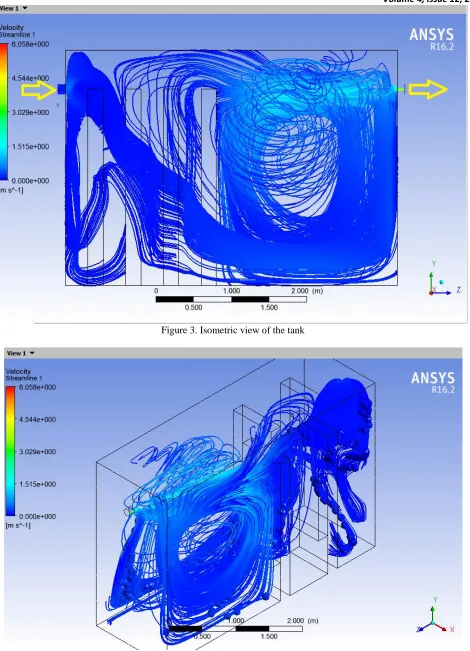
In this paper, samples of Vishwamitri River water were collected from three locations across Vadodara City and studied for Total dissolved solids (TDS) and suspended solids (SS) present in the samples. And a coagulation tank has been designed using ANSYS workbench. This model shows the movement of river water inside the tank when mixed with the coagulant and removal of TDS and SS by formation of sludge and scum respectively.
Experimental Work:
PRESENCE OF SS AND TDS IN VISHWAMITRI:
Samples of Vishwamitri river water are collected from three locations across Vadodara namely from
Location 1: Karelibaug
Location 2: Kirti Mandir, Sayajigunj
14 Two samples are collected from each location and amount of TDS and SS is found out in the laboratory.
A well-mixed 10ml sample is filtered through a standard glass fiber filter, and the filtrate is evaporated to dryness in a weighed dish on a water bath and dried to constant weight. The increase in dish weight represents the total dissolved solids. The residue which remains after filtration is also dried in an oven. The increase in weight of filter paper represents total suspended solids. W1: Weight of clear porcelain evaporating dish
W2: weight of the dish and residue
Total Dissolved Solids (per 10ml of sample) Set 1
Location W1(gm) W2(gm) W=W2-W1
Karelibaug 57.596 57.602 0.006
Kirti Mandir 66.079 66.083 0.004
Manjalpur 62.758 62.749 0.009
TABLE 1 Readings of TDS Set 2
Location W1(gm) W2(gm) W=W2-W1
Karelibaug 61.646 61.649 0.003
Kirti Mandir 67.417 67.424 0.006
Manjalpur 49.990 49.974 0.007
TABLE 2 Readings of TDS
Total Suspended Solids (per 10 ml of sample) Set 1
Location W1(gm) W2(gm) W=W2-W1
Karelibaug 1.1000 1.1007 0.0007
Kirti Mandir 1.1125 1.1129 0.0004
Manjalpur 1.0954 1.0960 0.0010
TABLE 3 Readings of SS
Set 2
Location W1(gm) W2(gm) W=W2-W1
Karelibaug 1.1111 1.1119 0.0008
Kirti Mandir 1.0792 1.0805 0.0013
Manjalpur 1.0715 1.0723 0.0008
TABLE 4 Readings of SS
Following are the readings obtained after taking an average of the above obtained results and converting to per liter of the sample:
Location Amount of TDS Amount of SS
Karelibaug 450 mg/L 75mg/L
Kirti Mandir 550 mg/L 84 mg/L
Manjalpur 750 mg/L 90 mg/L
TABLE 5 Amount of TDS and SS obtained
REMOVAL OF TDS AND TSS
Total dissolved solids and suspended solids obtained above can be removed from the Vishwamitri samples using the method of coagulation. Coagulation is the process in which chemicals are added to induce aggregation and settling of finely divided suspended matter, colloidal substances and large molecules. It is known is sedimentation with coagulation or simply clarification.
15 DESIGN OF TANK
Amount of water to be treated: 30MLD Dose of alum: 20mg/L Detention time: 30sec
Quantity of alum needed on daily basis = (20x30x106)/ 106
= 600Kg/day
Maximum discharge= 30x106x10-3x1.5
= 45000m3/day = (45000)/ (24x60x60) = 0.52m3/s
Volume of tank = discharge x detention time = 0.52x30
= 15.6 ~ 20m3
Depth of tank is taken as 3m. Design parameters for a sedimentation tank is from 3:1 to 5:1 hence taking 4.4m length and 1.5m breath.
Tank dimensions: 4.4mx1.5mx3m
Figure 1. Geometry of tank
16 Figure 3. Isometric view of the tank
17 CONCLUSION
The present study concludes that the water of Vishwamitri River showed good quality and low pollution before entering the Vadodara city. From the locations studied it is observed that TDS and SS amounts are minimal at Karelibaug from where the river enters the city and maximize as it reaches Manjalpur.
If coagulation is applied to the river water as proposed in the report, 40% of suspended solids can be removed, i.e. the efficiency of the tank is 40%
It is recommended that proper disposal of sewage through sewage lines should be done out of the city limits to improve the water quality of the river. Solid waste dumping along the river bank should be avoided through proper identification of dumping sites and better mechanism of door to door collection of garbage.
REFRENCES:
[1] Central Pollution Control Board, water quality in India status and trend (1990-2001), New Delhi.
[2] Central Pollution Control Board. Annual report of Ministry of Environment & Forests, Government of India (2009). [3] “Spatial difference in pollution levels across Vishwamitri River”, International Journal of Environmental Biology,
Received 07 August 2013; revised and accepted 01 January 2014
[4] “Purpose driven study on study of water quality fluctuation in River Vishwamitri”, Gujarat Engineering Research Institute(GERI), March 2014