Coupling equation based models and agent-based
models: example of a multi-strains and switch SIR
toy model
Nghi Quang Huynh
1, Tri Nguy en-Huu
2,3,5, Arna ud Grignard
5,
Hiep Xuan Huynh
1, Alexis Drog oul
2,41DREAM-CTU/IRD, CICT-CTU, Cantho, Vietnam
2IRD, Centre Ile-de-F rance, 32 avenue Henri Varagna t, 93140 Bondy, France 3Facul té des Sciences de Semlalia, Univ ersité Cadi Ayyad, Marr akech, Maroc 4Univ ersity of Science and Technol ogy of Hanoi, Hanoi, Vietnam
5IXXI, ENS Lyon, 46 allée d’Italie, 69364 Lyon Cedex 07
Abstract
Modeling in ecol ogy or epidemiol ogy gener all y opposes tw o classes of models, Equa tion Based Models and Agent Based Models. Mathema tical models all ow predicting the long-term dynamics of the studied systems. However, the variability betw een individ uals is difficul t to represen t, wha t makes these more suitable models for larg e and homog eneous popula tions. Multi-agent models all ow represen ting the attributes and beha vior of each individ ual and theref ore provide a grea ter lev el of detail. In return, these systems are more difficul t to anal yze. These approaches have often been compared, but rarel y used simultaneousl y. We propose a hybrid approach to couple equa tions models and agent-based models, as well as its implemen tation on the modeling pla tform Gama [8]. We focus on the represen tation of a classical theoretical epidemiol ogical model (SIR model) and we ill ustr ate the construction of a class of models based on it.
Receiv ed on 01 March 2016; accepted on 08 July 2016; published on 06 March 2017
Keywords: Equa tion-based model, agent-based model, coupling framew ork, simula tion pla tform, epidemiol ogy
Copyright © 2017 Nghi Quang Huynh etal., licensed to EAI. This is an open access article distributed under the terms of
the Crea tiv e Commons Attribution license (http://creativecommons.org/licenses/by/3.0/), which permits unlimited
use, distribution and reprod uction in any medium so long as the original work is proper ly cited. doi:10.4108/eai.6-3-2017.152334
1. Introduction
Agent Based Modeling and Equa tion Based Modeling are tw o common modeling approaches for dynamical systems. Equa tion Based Models (EBMs) usuall y describe the dynamical processes at the global scale (at the popula tion lev el in ecol ogy) while Agent Based Models (ABMs) describe the same processes at the local scale (at the individ ual lev el in ecol ogy). Each approach offers differen t adv antag es and drawbacks. The scale at which the processes are represen ted determines the way the model is constructed: global processes, a small number of par ameters and no individ ual variability for the EBMs; individ ual processes, high lev el of detail
HPlease ensure tha t you use the most up to date class file available from EAI at http://doc.eai.eu/publications/transactions/ latex/
∗Corresponding author.Email: [email protected]
for ABMs. EBMs do not take into accoun t individ ual variability , assuming tha t mean fie d approxima tions convenien tly describe the dynamics at the global lev el. ABMs are relev ant when this individ ual variability has strong effect on the dynamics emerging at the global lev el. Additionall y they all ow explicit represen tations of the interaction netw ork of individ uals when its topol ogy has consequences on the dynamics of the system and the emerg ence of properties at the global lev el. ABMs also offer the possibility of an easy integr ation of GIS and social netw ork informa tion.
Apart from conceptual aspects, the comm unity of the modeler has a strong inf uence on which approach will be chosen. A strong knowledg e in mathema tics is needed to understand and buil d equa tions for the EBM approach. As a coun terpart , mathema tics offer pow erful tools to anal yse EBMs, providing a lot of in-depth informa tion about the dynamics, such as equilibria and
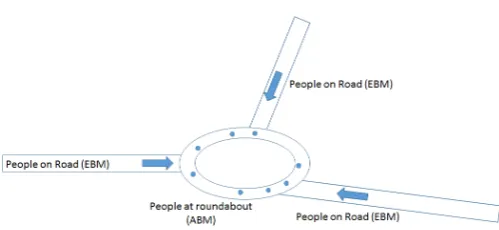
long term dynamics. ABM approach is more intuitiv e, and pla tforms such as Netl ogo or Gama propose modeling tools aiming at a wide audience. A few papers have been dev olved to the comparison or the coupling of both approaches. As an exam ple of a coupling of EBMs with ABMs, we refer to some particle transport models [10] based an oceanic curren t model based on physics and Partial Differen tial Equa tion, which output is used in a ABM tha t describes the dispersal of fis larv a. However, to our knowledg e, there are very few models of strong coupling of an ABM with an EBM, in the sense tha t both models use the outputs of the other . Such a model has been dev eloped by [1] for a model of pedestrian movemen ts. The model is based on an ABM describing the movemen ts of individ uals in the streets of a city. Each road segmen t betw een tw o crossroads can be replaced by a mathema tical transport model in order to red uce the amoun t of resources needed for the simula tions. At each intersection, the ABM feeds the EBM with the number of individ uals entering the road segmen t, then the EBM gener ates agents at its end.
In this article, we ill ustr ate the benefit of hybrid models embedding equa tions inside agents with a specifi class of models: epidemiol ogy models with multiple strains for the virus. Epidemiol ogy models describe the evolution with time of epidemics within a host popula tion. Usuall y, the host popula tion is divided in sev eral categ ories: susceptible individ uals (hosts without disease but which can get infected), infected individ uals, recov ered individ uals (hosts imm une to the disease). Many categ ories can be added depending on the disease and the model requiremen t, such as quar antined individ uals, infected but still not infectious, etc. Both classes of models are commonl y used: the firs and most famous, the SIR model by Kermack & McKendrick [9] being an EBM. Epidemiol ogy EBMs consider the popula tion at the global scale: they are compartmen t models, each compartmen t corresponding to a variable represen ting the popula tion size in a giv en categ ory, or the density at a giv en location. Evolution of the popula tion size (demogr aph y and transition from one compartmen t to another , such as newl y infected individ uals being transf erred from the susceptible compartmen t to the infected compartmen t) in a compartmen t is governed by differen tial equa tions. Such continuous models also have discrete equiv alen ts. ABMs represen t each host individ uall y. Hosts can chang e sta te (e.g. susceptible to infected) over time, giv en probabilistic and algorithmic rules.
In epidemiol ogy, EBMs often rela te to biol ogical or theoretical studies and have been used to model poten-tial public heal th outcomes bef ore testing strategies directl y on popula tions. As an exam ple, Shul gin et al. [17] discuss the benefit of a pulse vaccina tion using a classical SIR model. ABM focus more on studies with
sociol ogical aspects using graphs theory: they all ow examining the role of social netw orks, transporta tion systems, and responses to changing contexts on the evolution of epidemics [11]. As an exam ple, we refer to Auerbach et al. [2] study the propag ation of HIV in a sexual contact netw ork of 40 men. Usuall y, both approaches are used separ atel y. In this article, we focus on a particular class of epidemiol ogy models: mod-els with strain-pol ymorphic pathog ens. Multi-str ains models with evolutionary processes and interactions are a major concern in epidemiol ogy. EBM and ABM approaches have both been used: as an exam ple, Roche et al. [16] propose an ABM of inf uenza with strain-pol ymorphic pathog ens, based on an EBM model. Roche et al. decided to use an ABM beca use the original EBM fails to follow co-inf ections and consequen tly to incorpor ate re-assortmen t. One of the main challeng es is to defin proper ly the nature of strains space [20]. A common approach is to consider a linear space of par ameters. Evolution can be continuous, in which case the possible of strain is infinite or discrete. In the later case, models found in the liter ature use a finit number of strains. This approach is relev ant for pathog ens for which the differen t strains can be enumer ated. In EBMs, the number of strains is usuall y constr ained by the nature of systems of differen tial equa tions, which use a fi and finit number of equa tions. But evolution and pol ymorphism can giv e rise to unf oreseen types of strains, which can chang e the number of possible strains. In order to release this constr aint, we introd uce a simple epidemiol ogy model with dynamical chang e of the number of strains.
2. Related Work
In this part , we presen t the curren t sta te of the art of coupling the Agent-Based Modeling approach and Equa tion-Based Modeling approach. Although these tw o approaches aim at a common objectiv e, they are distinct by their modeling formalism. The necessity of coupling and comparing the tw o approaches has been raised in sev eral research studies. They use a common methodol ogy: expl oration is alw ays done by implemen ting an agent-base model beside an equa tion-based without the support of an agent-tion-based modeling framew ork neither an equa tion-based framew ork.
2.1. Equation-based model
The equa tion-based models [5] predict the long-term dynamics of the studied systems. they use mathema tical formalism based on Ordinary Differen tial Equa tions or Partial Differen tial Equa tions. The modelling approach is gener all y driv en by the principle of parsimon y
(or Occam’s razor), which means tha t the model
shoul d be kept as simple as possible, with as few par ameters as possible. Although, if a stochastic
approach is possible, a deterministic approach is pref erable when possible. In addition, processes are considered at a global scale (e.g. in ecol ogy: at the popula tion lev el instead of the individ ual lev el), assuming tha t the processes tha t govern the system at such a scale can be determined (often using mean fie d approxima tion). For exam ple, the demogr aphic dynamics of a popula tion can be described at the global lev el using a par ameter call population growth rate, which can be deriv ated from the mean of
offsprings per individ ual per time unit. Due to such approxima tions, the variability betw een individ uals is difficul t to represen t, making these models more suitable for larg e and homog eneous popula tions. Mathema tics often provide useful anal ytical tools to fin the properties of ODE models, such as equilibria and asym ptotic dynamics. The evolution of the system can be determined from mathema tical proofs, which are more robust than just simula tions. For those reasons, such models can be easil y anal ysed and are useful for making predictions. On the contrary, transla ting the studied processes into equa tions requires a good knowledg e of similar physics or mathema tical models. Processes also have to be sufficien tly smooth in order to fi their mathema tical description. As a summary , such models require a larg e amoun t of work upstreams, but they offer conceptuall y good possibilities of anal ysis downstreams (the technical issues tha t coul d be encoun tered in mathema tical proofs is not discussed here).
EBMs have been widel y used for epidemiol ogy modeling. A pragma tic reason is tha t mathema tical anal ysis methods were the only available methods, as computers and EBM were not available to Kermack and McKendrick in 1927. However, there are many conceptual reasons why EBM are a reasonable choice for modeling epidemics. Firstl y, epidemics arise in larg e popula tions, and the transmission and remission rates variability among individ uals can be easil y represen ted according to familiar distribution laws, making such processes easy to describe at the popula tion lev el using mean fie d approxima tions. Secondl y, the anal ysis of the equa tions provide useful prediction tools for epidemiol ogy: one can determine conditions on the par ameters for which the epidemics will arise or not. For exam ple, the basic reprod uction number R0 can
be computed with the par ameters of the model, based gener all y on transmission and remission rates. Values grea ter than one mean tha t an epidemics outbreak will occur, such an event can be then predicted without simula tions.
2.2. Agent-based model
Agent-based models [7] are used to represen t the attributes and beha vior at the individ ual lev el, and
theref ore to provide a grea ter lev el of detail. They can describe strong individ ual variability , not only for the attributes of the individ uals of a same popula tion, but also for their beha vior. They are often associa ted to small time scales, which correspond to the individ ual processes time scales. In return, these systems may be more difficul t to anal yze and prediction almost rel y on simula tions (apart from some ABMs which are actuall y probabilistic mathema tical models tha t can be anal ysed with mathema tical tools). Beca use of the larg e number of par ameters, it can be difficul t to test the model sensitivity to one of them. A larg e amoun t of anal ysis, dependen t on simula tions and on the assumed prior distribution of par ameters has to be perf ormed in order to provide syn thetic resul ts. ABM use a specifi languag e to describe in detail the aspects of agents: perception, action, belief , knowledg e, goals, motiv ation, intention, reflexion etc. Processes can be written as algorithms, offering more freedom to the modeler , as complex decision structures can be used (e.g. if the beha viour of individ uals depends on some condition, an
if-then-elseconstruct can be used). The ABM approach
also proposes a more intuitiv e way to buil d the model: processes can be represen ted as close to the perception of the modeler . As a summary , such approach proposes an easy and intuitiv e work upstreams, but requires a larg e amoun t of work downstream to provide relev ant resul ts. In addition, the larg e number of par ameters combined with the often larg e size of popula tion considered means tha t such a model may need a very importan t amoun t of resources to run simula tions.
Interest of epidemiol ogists in ABMs relies on the ability to giv e a detailed description of the netw ork of transmission, and such models have been dev eloped alongside graph theory . Such models are useful to represen t singular events (one infected individ ual entering a larg e susceptible popula tion) and the stochasticity associa ted to such events. Such models are used to represen t the worldwide propag ation of infection due to air travel. Depending on the disease, a detailed beha vior of the infection vector can be giv en.
2.3. Coupling EBM and ABM
Figure 1. Coupling approach example: people moving on the road are represented in the form of equation, and in form agents at the crossroads
Coupling and comparing agent-based and equa tion-based is also found in [15] where Rahmandad et al. examine in contrast the dynamic of well-know SEIR model which describe the common and importan t context of the spread of contagious disease. They compare and valida te an ABM and EBM for epidemiol ogical disease-spread models, as well as in [18] in which an ABM and an EBM of the 1918 Spanish f u are compared. In this publica tion, a model valida tion framew ork for choosing ABM or EBM i proposed.
In [13], it is proposed to use only one appropria te modeling formalism instead of tw o approaches, and infer an EBM from an ABM SIR model by expl oring the ded ucible par ameters like number of individ ual in popula tion, rates of interactions base on dimension of environmen t. They have done a study with the measure based on disk graph theories [12] to link ABM with EBM dynamical systems applied to theoretical popula tion ecol ogy.
Another coupling approach is proposed in [14], [1] or [4]. In the simula tion of emerg ency evacua tion of pedestrians in case of a tsunami in Nha trang City, Vietnam, people move along the road netw orks as agents. The agent based model of individ uals movemen ts are replaced by equa tion models for the roads with higher traffic. This transf orma tion giv e the model an addition of time and resource for such evacua tion model which usuall y take into accoun t hug e popula tions.
All these approaches provide mechanisms tha t all ow interaction betw een sev eral models but they still have the following disadv antag es:
- In gener al, these approaches are not generic and are difficul t to be re-im plemen ted in differen t domains and contexts.
- There are no consider ation of the differences in spa tial and tem poral scales.
- There are no framew ork tha t support coupling of heterog eneous models betw een equa tion-based modeling and agent-based modeling par adigm.
3. Description of the epidemiology model
In the presen t paper , we discuss the concept of integr ating EBM inside ABM. We buil d a model composed of sev eral sub-models. Each sub-model refers to an EBM or ABM. Instead of choosing betw een an ABM or EBM approach as in previous works for the global models, sub-models are integr ated in a framew ork tha t all ows using both par adigms at the same time.
As a demonstr ation, we introd uce a mathema tical epidemiol ogy model with dynamical chang e of the number of strains. The epidemiol ogy dynamics for a giv en strain is described by a classical EBM, while the strain evolution dynamics is described by an ABM.
The equa tions of the mathema tical model will be embedded into agents, each agent represen ting a differen t strain. Each strain is char acterized by differen t values of the par ameters. In order to ill ustr ate the benefit of the hybrid approach, the mono-str ain mathema tical epidemiol ogy model has to verify tw o conditions:
• the model must be as simple as possible, with very few par ameters. This condition all ows a good tractability of the model. Beca use each strain corresponds to particular values, it is easier to monitor the dynamics of evolution of strains with a low number of par ameters;
• epidemics outbreak does not fade away with time. This condition ensures tha t the evolution of strains can be monitored over an infinit period of time. Such a condition is not met with the classical SIR model [9] and thus a slightl y differen t class of compartmen t models must be chosen.
3.1. Mono-strain models
We base our study on a common mono-str ain SIS model, which is a compartmen t model with tw o compartmen ts
S, I which are respectiv ely the number of susceptible
and infected individ uals at a giv en time. The evolution of the S and I popula tions is governed by a system of
differen tial equa tions, which reads:
( dS
dt = −βIS+γI dI
dt = βIS−γI
(1)
where the total popula tion I+S is constan t over
time and normalized to 1. In presence of infected individ uals, the number of susceptible individ uals infected per unit of time is proportional to the to size of the infected popula tion and the proportion of susceptible individ uals in the total popula tion. The coefficien t of proportionality is written β and is
called the infection transmission rate. Finall y, constan t γ corresponds to the recov ery rate, the rate at which
infected individ uals recov er from the disease and become susceptible again. Such a model corresponds to diseases for which there is no long term imm unity , such as common cold and inf uenza. The SIS model has an explicit anal ytic solution and its dynamics is well known. Let us introd uce the basic reproduction
numberR0 =β/γ. A well know resul t is tha t if R0 <1,
the epidemic dies out, while if R0 >, the epidemics
spreads and the system tends tow ard an equilibrium with a infected popula tion of size 1−1/R0. Theref ore,
such a model verifie the tw o previous conditions: there are only tw o par ameters (β and γ), and the dynamics
tends tow ard a steady sta te with a persisten t infected popula tion.
A SIR model modify so as incorpor ate vital dynamics can be used. Such a model use a third compartmen t
Rwhich represen ts the recov ered individ uals, who are
free from the disease and who cannot be infected again. The model reads:
dS
dt = µ−µS−βIS dI
dt = βIS−(γ+µ)I dR
dt = γI −µR
(2)
Constan t µ is the popula tion renew al rate, which
means tha t popula tions S, I ad Rsuffer from a natur al
mortality rate ofµ, while new individ uals are prod uced
with the same fertility rate µ. The basic reprod uction
number is β/(µ+γ). If R0 >1, the dynamics tends
tow ard a steady sta te with a infected popula tion density of µ/β(R0−1). This model also verifie the tw o
conditions. The model has three par ameters, how ever par ameter µis not rela ted to the disease and won’t affect
the strains monitoring.
3.2. Multi-strains models, with a constant number of
strains
Usuall y, multi-str ains models are sta tic, meaning tha t N is constan t over time and there is no new strain tha t was not presen t at time t=0. Such approach is consisten t with the mathema tical approach of dynamical systems: the number of equa tions is the same once and for all. We propose a dynamics approach where strains can be crea ted or remov ed. The previous models are modifie in order to consider ndifferen t strains, the strainibeing
char acterized by a couple of par ameters (βi, γi),nbeing
constan t. The infected popula tion density is denoted Ii.
The modifie SIS models reads:
dS
dt = − n
P
i=1
βiIiS+γiIi
dI dt =
n
P
i=1
βiIiS−γiIi
(3)
A straightf orw ard anal ysis of the system shows tha t appart from the disease free equilibrium (DFE) (1,0, . . . ,0), there exist nequilibria
Ei = (1−γi/βi,0, . . . ,0, γi/βi,0, . . . ,0)
where the non-zero elemen t corresponds to the popula tion infected by strain i. If R0 >1, all those
equilibria are unstable but the one tha t maximizes
γi/βi. Let us denote i∗ the number of the strain
corresponding to the stable equilibrium. The systems tends tow ards this equilibrium, with a non-n ull infected popula tion density , with individ uals infected only by the strain i∗. Theref ore this model ill ustr ates the
competitiv e excl usion among the strains: only the strain with the highest fitnes surviv es.
Similar ly, the SIR model with vital dynamics and n
differen t strains reads:
dS
dt = µ−µS− n
P
i=1
βiIiS
dI dt =
n
P
i=1
βiIiS−(γi+µ)Ii
dR
dt = γiIi−µR
(4)
Similar resul ts can be obtained, with only one strain surviving in the long term. One shoul d notice tha t such a model introd uces simple competition betw een the strains as cross-imm unity is not considered. Theref ore there is only one global compartmen t for recov ered individ uals, which is common to all strains. In this model, we only take into accoun t virus strains muta tions. Host ecosystem, evolutionary processes and host variability impose selection on virulence [6]. Evolutionary ecol ogy epidemics models coul d benefi for such approach, mixing agents and equa tions.
3.3. Multi-strain models, with varying number of
strains
We now consider models in which the number of strains varies with time: strains are remov ed when the corresponding popula tion is too low, and a new strain is crea ted when a random muta tion occur in an existing strain. Formall y, the models can be described by the systems of equa tions 3and 4, except tha t tw o rules are added:
• when the popula tion of strain i drops bel ow a
threshol dσ, strainiis remov ed from the system.
• for each strain i, a muta tion can occur with
a probability p. When the muta tion occurs, a
density m of individ uals is remov ed from the
popula tion infected by strain i. A new strain n+
1 is crea ted, with an initial infected popula tion density In+1 =m. New par ameters βn+1 and γn+1
are randoml y chosen with reg ard to old values βi
In our study , we decide to chose the values βn+1
and γn+1 according to a unif orm distribution on the
respectiv e interv als [0.7βi,1.3βi] and [0.7γi,1.3γi].
4. Hybrid concept and implementation
Mathema tical models often do not consider systems of equa tions with a varying number of equa tions. Here we propose to use ABM with agents embedding equa tions in order to buil d a system of equa tions tha t can evolve with time. Strains are represen ted by agents which can comm unica te with each other . For each strain, there is one equa tion describing the evolution of infected individ uals corresponding to tha t strain. Such a system is an ABM and an EBM in the same time: each strain is considered as an individ ual, but the popula tion of susceptible and infected is considered at the global lev el. Each strain is an entity tha t embeds an equa tion. The interaction betw een individ uals form a larg e dynamics set of equa tions. It can be seen either as: - an ABM composed of strains, each individ ual embedding an equa tion. Interactions betw een the individ uals giv e rise to a non-sta tic system of equa tions, and so to an EBM tha t evolves with time.
- an EBM, in which each equa tion is represen ted by an agent corresponding to a strain which is dynamicall y linked to the others. The EBM is a non-classical one, in the sense tha t it can be dynamicall y be chang ed.
The model has been implemen ted on the Gama pla tform [8], which all ows embedding equa tions. In an equa tion associa ted to an agent, it is possible to refer to the variable and equa tions embedded in other agents, in order to buil d dynamicall y a set of equa tions.
The strains are susceptible to muta tions, and so to evolution through competition for resources (popula tion susceptible to the disease). From time to time, a strain is randoml y selected for muta tion, a new strain of one individ ual being crea ted, and the par ameters beta and gamma for the new strains being chosen randoml y with values close to the ones of the old one. The set of equa tions is upda ted dynamicall y, and the new strain joins competition for resources.
4.1. Dynamics of the model
The model we buil t ill ustr ates a phenomenon of genetic drifts. According to excl usiv e competition principle, the strains with the smaller fitnes final y get discarded from the pool. Depending on the frequency of the muta tion events and on random aspects, it happens tha t sev eral strains coexist for a short period (up to 20 in our simula tion with par ameters ...) According to expecta tion, the drift tends tow ards par ameter rang e where beta is larg e and gamma is small.
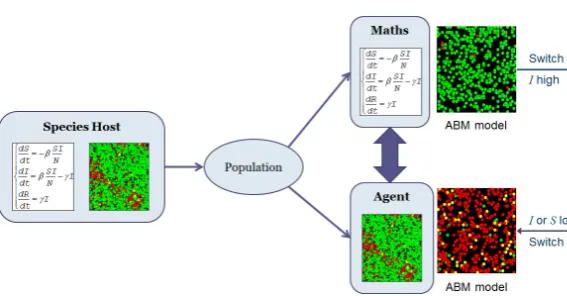
Figure 2. Representation the dynamic of "Switch" model
4.2. Model "Switch"
We ill ustr ate our coupling methodol ogy by implemen t-ing a hybrid model, called Switch, combint-ing equa tions and agents on the modeling pla tform Gama. We buil d a class of SIR model based in both ABM and EBM (figur
2), in which people are represqen ted by agents when the density is low, and by equa tions if the density is higher , a tilting mechanism for moving from an approach to another .
Both models are based on the same assum ptions. They involve tw o processes: contamina tion and recov -ery. The ABM model also adds spa tial interactions and dispersal. The mathema tical model is indeed a mean fie d approxima tion of the ABM and represen ts the dynamics at the global scale, while ABM shows the dynamics at local scale. The contamina tion and recov ery processes happen frequen tly with a "unif orm distribution " over time.
- Assum ption i) implies tha t processes can be represen ted at a continuous time;
- Assum ption ii) all ows to replace probabilities of processes occurrences by expectancies; final y assum ption iii) all ows to consider tha t all individ ual have the same number of neighbors.
- Assum ption iii) popula tions are considered to be at sufficien tly high density; popula tions are considered as homog eneous for spa tial distribution of individ uals, as well as for the distribution of each type of individ uals (S, I and R).
Considering tha t assum ption i) holds is rather natu-ral, as processes occur along constan t time steps. Epi-demiol ogical models usuall y assume tha t popula tion densities are high, thus condition for assum ption ii) seems to be natur all y fulfilled However, in a larg e popula tion, the density of infected (or even suscep-tible) individ uals may be very low. Indeed, a usual condition for such kind of model is the introd uction of a small group of infected inside a disease free popula tion. Mathema tical model are deterministic and ignore the variability due to stochasticity which alter
6 EAI Endorsed Transactions
on
the dynamics: if one infected individ ual is introd uced in the popula tion, if basic reprod uction rate R0>1, and epidemic outbreak will be predicted by the mathema t-ical model. However, in real cases or for ABM, there is a chance to avoid epidemic outbreak as contamina tion may not occur thanks to the stochasticity of infection process. Assum ption iii) may not be possible for spa-tiall y explicit ABM, as spa tial distribution does not remain constan t and spa tial patterns coul d appear , like contamina tion waves. Assum ption iii) makes tha t the EBM, as mean-fie d approxima tion of ABM, is also the the "limit " (in the mathema tical sense) of the EBM when spa tial process tends to spa tial homog eneity , which is achiev ed by letting the neighborhood of an individ ual tend to cover the whole environmen t, or by increasing the speed of movemen t of individ uals (well mixed popula tions).
Comparing both EBM and ABM is exhibiting the differences due to approxima tions done for the ABM model due to assum ptions ii) and iii). Assum ption ii) is at the heart of the model switch problema tic: EBM shoul d not be used when the conditions for this assum ption are not fulfilled Assum ption iii) also add a challeng e to model switching, as corrections have to be made in order to represen t into the ABM the effects of spa tial structures tha t have been hidden by the approxima tion made with this assum ption. Furthermore, switching from EBM to ABM introd uces an explicit spa tial distribution of individ uals, for which assum ption iii) doesn ’t have to be made. The spa tial distribution, hidden in the EBM, may have to be gener ated.
The tw o models are based on SIR models assum p-tions. Individ uals can be in three differen t sta tes: sus-ceptible individ uals (S): the individ ual is disease-free and can be contamina ted by contact with an infected individ ual (I). After some time, infected individ uals recov er from the disease (or die). They are assumed to be in a recov ered sta te (R): they are imm une to the disease and do not take part anymore in the infection dynamics. The models involve the following processes:
- infection: transmission of the disease from infected individ uals. This depends on the contact rate betw een susceptible individ uals and infected individ uals;
- recov ery: infected individ uals heal and recov er from infection;
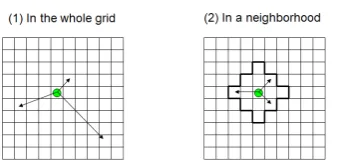
- movemen ts: individ uals are assumed to move within the considered environmen t. There are tw o type of movemen t, one is random walking and other is not random, (figur 3).
Hypothesis found in both models:
- Recov ery rate: the remission rate is very similar in the agent-based model and the equa tion-based model. In the ABM, par ameter gamma is the probability to recov er per time unit. In the EBM model, the par ameter gamma is a mean-fie d approxima tion, which means
Figure 3. Two type of deplacement of agent in an environment
tha t the number of recov ered individ uals giv en by the EBM model is exactl y the expectancy of the number of recov ered individ uals giv en by the ABM model (provided tha t there is no infection occurring at the same time). Stochasticity of recov ery rate appears at low I popula tions, otherwise both models fit
- Contact rate: in the presen t models, contact are define in a similar way for the mathema tical model and the agent-based model. In the agent-based model, tw o individ uals are considered to be "in contact " if they are in each other’ s vicinity for one time step. In mathema tical model, space is not explicitl y represen ted, but the average number of neighbours can be determined. Stochasticity of contact rate appear beca use of size of neighbourhood (strong variability in number of hosts neighbours) and speed of hosts (low speed means no mixing, neighbourhood proportion of R and I may grea tly vary).
We compare this model with existing models and presen t a method to determine the par ameters for transitions betw een models. In particular , we establish a link betw een the par ameters of the mathema tical model, and the represen tation of contacts and travel agents in a spa tial environmen t.
We are also interested in how to compensa te for the loss of informa tion on spa tial structures when we move an agent model to a mathema tical model. Curren tly, we save the attributes, especiall y the location and the sta tus, of all agents and re-assign to agents when they need. We are also interested in how to compensa te for the loss of informa tion on spa tial structures when we move an agent model to a mathema tical model. Curren tly we have implemen ted tw o following method of crea tion new distribution after the switch from EBM to ABM.
5. Experiments
5.1. Objective, Data and tools used
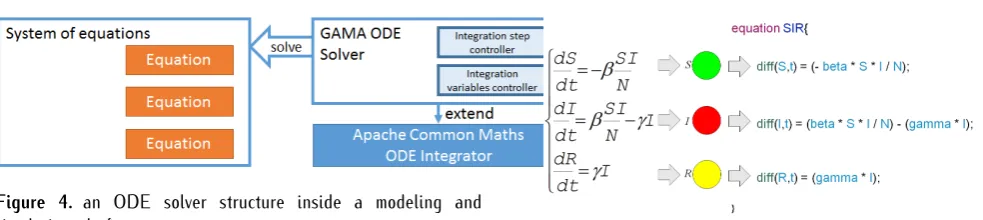
Figure 4. an ODE solver structure inside a modeling and simulation platform
5.2. Tools used: An ODE-integrated environment
We tackle the problems of differences modeling formalism with our proposition of coupling by integr ating these tw o approaches in a modeling and simula tion pla tform, GAMA [8], in which the equa tion-based model is declared as an attribute of the agent. It has tw o famous exam ples of equa tion-based modeling which are the Lotka and Volterr a [24] modeling of prey -preda tor dynamics or the Kermack and McKendrick [3] SIR model to represen t epidemic dynamics.
We have introd uced in GAMA the possibility to describe the dynamics of agents using a differen tial equa tion system and to integr ate this system at each simula tion step. With the enhancemen t of GAMA modeling languag e (GAML), modelers have possibility to write equa tions linking agentsâĂŹ attributes and to integr ate equa tion-based system with agent-based system. The GAML syn tax permit to write an system of equa tions of most EBM based on the implemen tation with Commons Mathema tics Libr ary.
To figur out the coupling problem of differen t tem-poral scale, we introd uce the controller of integr ation steps and simula tion steps beside the tw o curren t inte-gration method Rung e-Kutta 4 and Dormand-Prince 8(5,3). This controller is main tain in the solve sta temen t of GAML and would be call at each simula tion step. In the figur 4, an equa tion-based model in form of algebrics is represen ted into GAML syn tax tha t are called Equa tion. Set of equa tions make a System of equa tions. This type of entity will be integr ated by our GAMA ODE (Ordinary Differen tial Equa tion) Solver packag e.
5.3. Represent classical SIR model in EBM and
ABM formalism.
The firs experimen t show tha t we can easil y modeling the classical SIR in form of equa tion-based and also agent-based. As in the figur 5, an differen tial equa tion can be declare with tw o expression. The firs one on the left of “=“ is the keyw ord difffollowed by the name of integr ated variable and the time variable t:
d i f f ( < i n t e g r a t e d v a r i a b l e > , t ) = < c a l c u l a t i n g e x p r e s s i on > ;
Figure 5. Representation of an equation-based model in an simulation platform.
An EBM is then represen ted as a attributes of agent with a block of equa tions:
e q u a t i on < n a m e _i d e n t i f i e r > { d i f f ( . . . ) = . . . ;
d i f f ( . . . ) = . . . ; . . .
}
6. Results
6.1. Discussion on the methodology
The EBM submodel describes the dynamics of the epidemic at the global scale: host popula tion is considered at global popula tion through density measuremen ts. The ABM submodel describes the dynamics of strain evolution at the individ ual lev el: at each momen t, one can describe which strains are activ e and which have been remov ed. One shoul d notice tha t the global lev el for EBM is indeed embedded in the individ ual lev el for strains: to each individ ual strains corresponds a density of infected popula tion.
6.2. Adjust the parameters to calibrate EBM and
ABM
The ABM simula tion resul t is a stochastic resul t, instead of EBM’resul ts are deterministic. Our proposition all ow modeler to calibr ate the SIR model in ABM fi with EBM. We launch the simula tion with following par ameter: N = 500; I = 1.0; S = N - I; R = 0.0; beta = 1/2.0; gamma = 1/3.0. After 100 simula tions, the SIR model and agent model presen t significa t differences from (figur 6):
- popula tion initial (N) - effect of size grid (grid size)
- effect of topol ogies (neighborhood size)
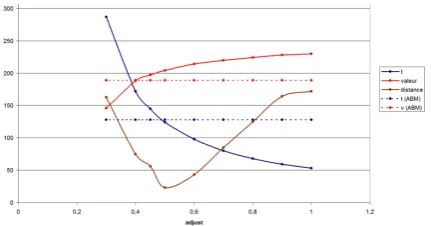
The transition beta from EBM to ABM is then adjust an amoun t alpha. We rela unch the simula tion 100 times to expl ore the value of alpha. We found the fixes alpha = 0,45 (figur 7). We have also found sev eral criterias tha t would be effect the fitnes betw een SIR EBM and ABM are: difference of synchronous/asynchronous
8 EAI Endorsed Transactions
on
Figure 6. Adjust the beta parameter of SIR model to calibrate EBM with ABM result.
Figure 7. Adjust the beta parameter of SIR model to calibrate EBM with ABM result.
(infect others vs is infected); random walk; effect of beta; dispersion; effect of movemen t speed.
6.3. Study of the dynamics of multi-strains
epidemiological model
with our proposed coupling methodol ogy, modeler can easil y study the multi strain epidemiol ogical model by the implemen tation like in the figur 8. agent strain can be crea ted an remov ed dynamicall y in time of simula tion.
As in the case of a constan t number of strains, competitiv e excl usion prev ails: the strains with lowest fitnes eventuall y disappear , while the one with the highest remains. As muta tions all ow the appear ance of new strains, strains with higher fitnes appear (higher
R0 =β/γ ratio), and it is possible to exhibit a genetic
drift. In figur 9, it is shown tha t evolution favours an increase of β (better contamina tion ability) and a
decrease ofγ(longer infection duration).
Figure 8. Multi-strain SIR model declared in Gama platform
Figure 9. The result of
6.4. Regenerate spatial information from EBM to
ABM
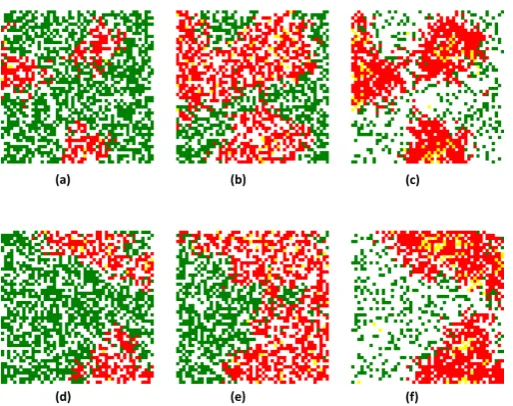
In this experimen t (figur 10), we save the attributes, especiall y the location and the contamina tion sta tus of all agents when we do a switch from ABM to EBM model. Then when re-assign to agents. The imag e represen t the regener ation algorithm in figur 10 is tw o exam ple resul ts. With the same manner , we have do 100 times of simula tion and compare the sta te of popula tion with and without a switch in the table 11 to see the efficien t of algorithm.
7. Conclusion
Figure 10. Regeneration of spatial information algorithm, the example result: (a),(d) population before the switch, (b)(e) population at threshold without a switch, (c)(f) population regenerated from (a)(d) after a switch
Figure 11. Average result by simulate 100 times the spatial regeneration algorithm.
is low, and equa tions with higher density , a tilt mech-anism for moving from an approach to the other . We compare this model with existing models and presen t a method to determine the par ameters during transitions betw een models. In particular , we seek to establish a link betw een the par ameters of the mathema tical model and represen tation of contacts and travel agents in a spa tial environmen t. We are also interested in how to compensa te the loss of informa tion on spa tial structures when moving an agent model to a mathema tical model.
8. Acknowledgments
This publica tion has been made possible through support provided by the IRD-DSF .
References
[1] N. T. N. Anh, Z. J. Daniel, N. H. Du, A. Drog oul, and V. D. An. A Hybrid Macro-Micro Pedestrians Evacua tion Model to Speed Up Simula tion in Road Netw orks. In D. Hutchison, T. Kanade, J. Kittler , J. M. Kleinberg, F. Mattern, J. C. Mitchell, M. Naor, O. Nierstr asz, C. Pand u Rang an, B. Steffen, M. Sudan, D. Terzopoul os, D. Tygar, M. Y. Vardi, G. Weikum, F. Dechesne,
H. Hattori, A. ter Mors, J. M. Such, D. Weyns, and F. Dign um, editors, Advanced Agent Technology, volume
7068, pag es 371–383. Spring er Berlin Heidelberg, Berlin, Heidelberg, 2012.
[2] D. M. Auerbach, W. W. Darrow , H. W. Jaffe, and J. W. Curran. Cluster of cases of the acquired imm une deficienc syndrome. The American Journal of Medicine,
76(3):487–492, Mar. 1984.
[3] N. BacaÃńr. McKendrick and Kermack on epidemic modelling (1926âĂŞ1927). InA Short History of Mathe-matical Population Dynamics, pag es 89–96. Spring er
Lon-don, LonLon-don, 2011.
[4] W. Bren t Daniel, N. W. Heng artner , M. K. Riv era, D. R. Powell, and T. N. McPherson. An epidemiol ogical model of spa tial coupling for trips longer than the infectious period. Mathematical Biosciences, 242(1):1–8, Mar. 2013.
[5] R. Y. Cavana. Modeling the environmen t: an introd uc-tion to system dynamics models of environmen tal sys-tems. Andrew Ford Island Press, Washington DC, 1999, viii + 401 pp. ISBN: 1-55963-601-7. System Dynamics Review, 19(2):171–173, 2003.
[6] A. P. Gal vani. Epidemiol ogy meets evolutionary ecol ogy.
Trends in Ecology & Evolution, 18(3):132–139, 2003.
[7] G. N. Gilbert. Agent-based models. Number no. 07-153
in Quan tita tiv e applic ations in the social sciences. Sag e Publica tions, Los Ang eles, 2008.
[8] A. Grignard, P. Taillandier , B. Gaudou, D. A. Vo, N. Q. Huynh, and A. Drog oul. GAMA 1.6: Advancing the Art of Complex Agent-Based Modeling and Simula tion. In G. Boella, E. Elkind, B. T. R. Savarim uthu, F. Dign um, and M. K. Purvis, editors, PRIMA 2013: Principles and Practice of Multi-Agent Systems, number 8291 in Lecture
Notes in Computer Science, pag es 117–131. Spring er Berlin Heidelberg, Jan. 2013.
[9] W. O. Kermack and A. G. McKendrick. A Contribution to the Mathema tical Theory of Epidemics. Proceedings of the Royal Society A: Mathematical, Physical and Engineering Sciences, 115(772):700–721, Aug. 1927.
[10] C. Lett , P. Verley, C. Mull on, C. Parada, T. Brochier , P. Penven, and B. Blanke. A Lagr angian tool for modelling ichth yoplankton dynamics. Environmental Modelling & Software, 23(9):1210–1214, Sept. 2008.
[11] D. A. Luke and K. A. Stama takis. Systems Science Methods in Public Heal th: Dynamics, Netw orks, and Agents. Annual Review of Public Health, 33(1):357–376,
Apr. 2012.
[12] N. D. Nguy en, T. H. D. Phan, T. N. A. Nguy en, A. Drog oul, and J.-D. Zucker . Disk Graph-Based Model: A Graph Theoretical Approach for Linking Agent-Based Models and Dynamical Systems. pag es 1–4. IEEE, Nov. 2010.
[13] N. D. Nguy en, P. Taillandier , A. Drog oul, and P. Auger. Inferring Equa tion-Based Models from Agent-Based Models: A Case Study in Competition Dynamics. In D. Hutchison, T. Kanade, J. Kittler , J. M. Kleinberg, F. Mattern, J. C. Mitchell, M. Naor, O. Nierstr asz, C. Pand u Rang an, B. Steffen, M. Sudan, D. Terzopoul os, D. Tygar, M. Y. Vardi, G. Weikum, N. Desai, A. Liu, and M. Winikoff, editors, Principles and Practice of Multi-Agent Systems, volume 7057, pag es 413–427. Spring er
Berlin Heidelberg, Berlin, Heidelberg, 2012.
10
EAI Endorsed Transactions on
[14] Nguy en Thi Ngoc Ann, Z. J. Daniel, Nguy en Manh Hung, D. Alexis, and Nguy en Hong Phuong. Simula tion of Emerg ency Evacua tion of Pedestrians along the Road Netw orks in Nha trang City. pag es 1–6. IEEE, Feb. 2012. [15] H. Rahmandad and J. Sterman. Heterogeneity and network
structure in the dynamics of diffusion: comparing agent-based and differential equation models, volume 54 of Management science : journal of the Institute for Operations Research and the Management Sciences. - Hanover, Md : INFORMS, ISSN 0025-1909, ZDB-ID 2063451. - Vol. 54.2008, 5, p. 998-1014. INFORMS, Hanov er, Md, 2008.
[16] B. Roche, J. M. Drake, and P. Rohani. An Agent-Based Model to study the epidemiol ogical and evolutionary dynamics of Inf uenza viruses. BMC Bioinformatics,
12(1):87, 2011.
[17] B. Shul gin. Pulse vaccina tion strategy in the SIR epidemic model. Bulletin of Mathematical Biology,
60(6):1123–1148, Nov. 1998.
[18] S. R. Sukumar and J. J. Nutaro. Agent-Based vs. Equa tion-Based Epidemiol ogical Models: A Model Selection Case Study. pag es 74–79. IEEE, Dec. 2012. [19] H. Van Dyke Parunak, R. Savit , and R. L. Riol o.
Agent-Based Modeling vs. Equa tion-Agent-Based Modeling: A Case Study and UsersâĂŹGuide. In G. Goos, J. Hartmanis, J. van Leeuw en, J. S. Sichman, R. Conte, and N. Gilbert , editors, Multi-Agent Systems and Agent-Based Simulation,
volume 1534, pag es 10–25. Spring er Berlin Heidelberg, Berlin, Heidelberg, 1998.
[20] P. S. Wikr amar atna, A. Kucharski, S. Gupta, V. Andreasen, A. R. McLean, and J. R. Gog. Five challeng es in modelling interacting strain dynamics.